


If you are finding more hair in your brush but no bald patch anywhere, you probably look for the reason in the here and now. With diffuse hair loss it almost always lies two to three months in the past, because the affected hairs first have to pass through the resting phase before they fall out (Malkud, J Clin Diagn Res 2015). Density decreases evenly across the whole scalp, the back of the head included, and that is exactly what sets it apart from the other types of hair loss. This article sorts out the different forms, explains how doctors make the diagnosis and shows how things typically progress from here.
The key points at a glance
- ✓Diffuse hair loss is a symptom with an underlying cause, not a condition in its own right, and the hair follicles remain intact
- ✓The trigger typically lies 8 to 12 weeks in the past, which is why you look for it in hindsight rather than in the present
- ✓The most common form is telogen effluvium, which in its acute version usually settles within 3 to 6 months
- ✓If the shedding lasts longer than six months or comes back in bouts, it needs a dermatological assessment
What matters now: have the form determined, find the trigger by looking back, and give the hair cycle the time it needs.
Summary
- What is diffuse hair loss?
- Diffuse, pattern or patchy? The three basic patterns compared
- Why diffuse hair loss only becomes visible 2 to 3 months after the trigger
- Telogen effluvium: the most common form of diffuse hair loss
- Anagen effluvium: the rare, rapid form
- Diffuse alopecia: the other forms
- Diffuse hair loss: causes in hindsight
- Diffuse hair loss in women: the most common triggers
- How diffuse hair loss is diagnosed: pull test, trichoscopy and blood values
- How long does diffuse hair loss last and when does the hair grow back?
- How to get through the waiting time with diffuse hair loss
- How to tell that diffuse hair loss is not going to stop on its own
- Diffuse hair loss: what can you do?
- Why a hair transplant is not the answer for diffuse hair loss
- Frequently asked questions about diffuse hair loss
- Sources
What is diffuse hair loss?
Diffuse hair loss, known medically as diffuse alopecia, is an even loss of hair across the entire scalp, with no circumscribed bald patches and no typical pattern (StatPearls, NCBI Bookshelf). The hair thins overall, the parting looks wider and the ponytail feels thinner. It is not a condition in its own right, but a symptom with a cause behind it.
- Even: the whole head is affected, not one circumscribed area
- Delayed: the trigger usually lies 2 to 3 months in the past
- Usually reversible: the follicles remain intact, they are only pausing
- Two main forms: the common telogen effluvium and the rare, rapid anagen effluvium
The most important reassurance comes first: diffuse hair loss does not lead to baldness. The hair roots are not destroyed, they simply enter the resting phase early. What counts is therefore not how much falls out, but whether the shedding stops of its own accord.
Diffuse hair loss in numbers
- 85 to 90% of scalp hairs are normally in the growth phase (anagen), StatPearls and the Malkud review
- 10 to 15% are in the resting phase (telogen) at the same time; in telogen effluvium this proportion rises markedly
- 2 to 3 months pass between the trigger and visible shedding, because that is how long the resting phase lasts (Malkud 2015)
- 3 to 6 months is how long the acute shedding phase usually lasts before it subsides (NHS Fife patient information)
- from 6 months onwards the course is described as chronic (Whiting, J Am Acad Dermatol 1996)
The five terms that appear in every report
- Effluvium: the process of increased hair shedding
- Alopecia: the result, in other words the visibly reduced hair density
- Anagen: the growth phase of the hair follicle
- Telogen: the resting phase of the hair follicle
- Diffuse: spread evenly across the entire scalp
Diffuse, pattern or patchy? The three basic patterns compared
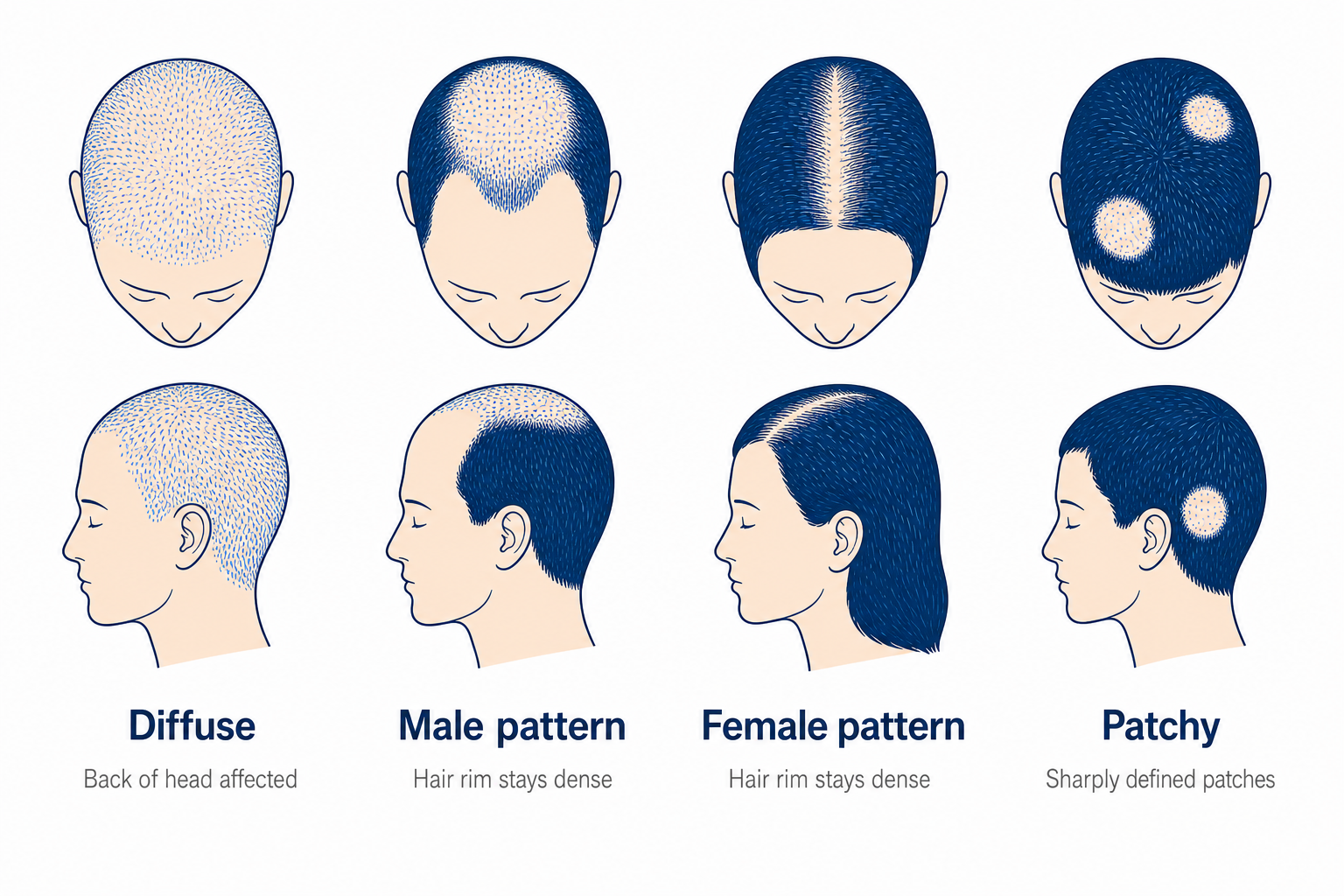
Hair loss is most reliably told apart by its distribution, not by the amount. Diffuse means evenly across the whole head. Androgenetic means regional: receding temples and a thinning crown in men, a widening central parting in women, while the back of the head stays dense. Patchy (alopecia areata) means sharply defined, smooth patches within otherwise dense hair.
The practical giveaway is the back of the head. In diffuse hair loss it is affected as well; in pattern hair loss the rim of hair stays stable. Under the dermatoscope this appears as a markedly altered ratio of hair density between the frontal and occipital regions, a criterion that Rudnicka and colleagues described for diagnosing female pattern hair loss. In telogen effluvium, by contrast, this ratio stays relatively balanced.
| Basic pattern | Where it shows | Back of the head affected? | Typical onset | Cause | Usually reversible? |
|---|---|---|---|---|---|
| Diffuse (diffuse alopecia) | evenly across the whole scalp, wider parting, thinner ponytail | yes, affected as well | 2 to 3 months after the trigger | acts on the whole body: infection, surgery, deficiency, hormones, medication | yes, once the cause is gone |
| Androgenetic in men | receding temples and thinning crown, the hairline moves back | no, the rim of hair stays dense | gradual, over years | genetically determined sensitivity of the follicles to DHT | no, progressive |
| Androgenetic in women | the central parting widens, the frontal hairline is usually preserved | no, the rim of hair at the nape is usually spared | gradual, often from the menopause onwards | genetic and hormonal | no, progressive |
| Patchy (alopecia areata) | sharply defined, smooth patches, often the size of a coin, within dense hair | possible, but in patches rather than across the whole area | within days to weeks | autoimmune process directed against the hair follicle | often, although the course is hard to predict |
Having both at once is common. A diffuse effluvium is often superimposed on an existing, until then unnoticed androgenetic alopecia and is what makes it visible in the first place. Once the diffuse component subsides, the pattern remains. That explains the widespread experience that the shedding stops but the hair stays thinner. How alopecia areata differs from this is set out in detail in its own article.
Three questions for a first assessment
Not a diagnosis, but a way of framing the conversation at your appointment.
1. Has the back of your head become thinner too?
Yes: this points to a diffuse process. No, the rim of hair is as dense as ever: this points to a pattern.
2. Was there an event 8 to 12 weeks ago?
An infection, surgery, childbirth, a diet, a new medication, a period of heavy strain. Yes: this points to telogen effluvium. No: a deficiency, the thyroid or a chronic course are more likely.
3. Are there sharply defined bald patches?
Yes: then it is not diffuse and needs a dermatological assessment. No: the picture stays a diffuse one.
Why diffuse hair loss only becomes visible 2 to 3 months after the trigger
Diffuse hair loss shows up two to three months after its trigger, not straight away. An acute event pushes many hairs out of the growth phase and into the resting phase prematurely and all at the same time. Those hairs can only fall out at the end of the resting phase, and according to the review by Malkud (J Clin Diagn Res 2015) that phase lasts about two to three months.
The shift is measurable. Normally 85 to 90% of scalp hairs are in the anagen phase and only 10 to 15% in the telogen phase (StatPearls, NCBI Bookshelf). After a strong trigger, the proportion of hairs moving prematurely into the resting phase can rise to around 70% in extreme cases, according to StatPearls. The hair cycle explains this mechanism in detail.
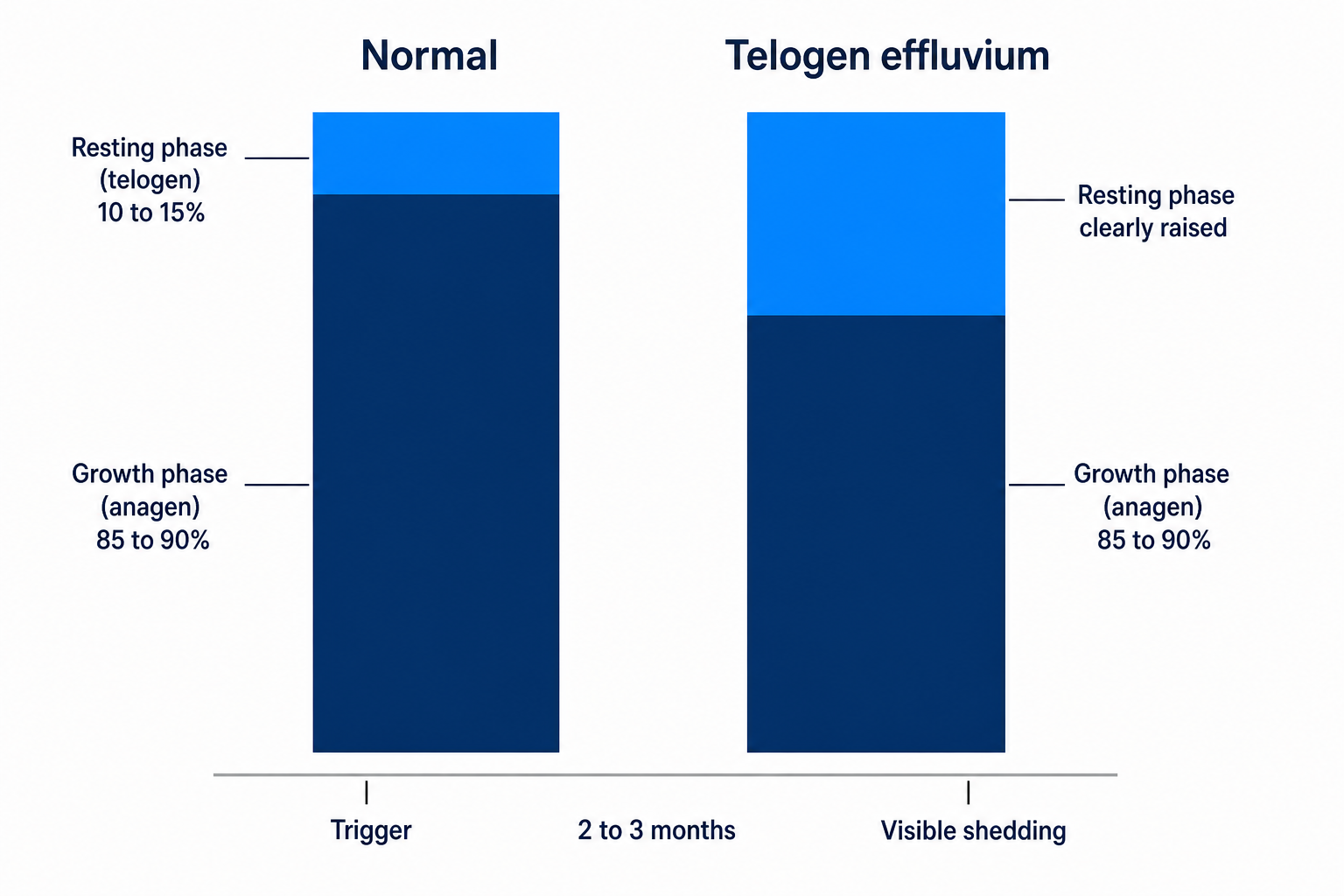
For you this means two things. First, the trigger is found by looking back: if you are shedding more hair today, check the window 8 to 12 weeks ago. Second, the recovery is delayed as well. If the cause is resolved today, the shedding does not stop today but over the following weeks. This is exactly where judging whether a treatment is working usually goes wrong.
Telogen effluvium: the most common form of diffuse hair loss
By far the most common form of diffuse hair loss is telogen effluvium . In it, an above-average number of hairs move into the resting phase at the same time and then fall out together after two to three months. The shedding affects the whole head, the follicles remain intact, and the acute form usually ends within 3 to 6 months once the trigger is gone.
Acute telogen effluvium
Acute telogen effluvium has a clear beginning, an identifiable trigger and a distinct shedding phase. By definition it lasts less than six months. The NHS Fife patient information puts the proportion of cases that resolve on their own without treatment at around 95%. It is the cause that is treated, not the hair.
Chronic telogen effluvium
If diffuse hair loss lasts longer than six months or keeps coming back in bouts, it is referred to as chronic telogen effluvium. Whiting described it in 1996 in the Journal of the American Academy of Dermatology as a pattern seen in middle-aged women, often without any single identifiable trigger and with a fluctuating course that can stretch over five to seven years.
A discrepancy is typical: the woman affected experiences a massive loss, yet she does not go bald. Density decreases, the distribution stays diffuse, and it is often also noticeable that the hair no longer reaches its former length. Whether a distinct condition really lies behind this is a matter of professional debate.
A systematic review in Am J Clin Dermatol 2023 (PMID 37052778) evaluated 18 studies with 1,628 cases and concluded that none of these studies ruled out all secondary causes. Many cases classified as chronic are probably early female androgenetic alopecia or a second, unrecognised effluvium. The six-month threshold remains valid as a warning sign, but the diagnosis behind it needs checking properly.
Trichoscopy can tell the two apart: in telogen effluvium the hair calibre is largely uniform, whereas in female pattern hair loss there are marked variations in calibre and miniaturised hairs, above all in the parting area (comparative study of dermoscopic findings, PMC9122275).
Anagen effluvium: the rare, rapid form
In anagen effluvium , the hairs are damaged in the middle of the growth phase. The shedding therefore sets in after just a few days to weeks and is far more dramatic: because most hairs are in the anagen phase, a large part of the scalp hair can be affected. The most common cause is chemotherapy.
Once chemotherapy has started, the shedding typically sets in after 7 to 10 days according to StatPearls, becomes clearly visible after 4 to 8 weeks and can affect almost all of the scalp hair within two to three months. Less common causes are radiotherapy to the head, severe poisoning with thallium or arsenic, for example, and a small number of highly potent medicines.
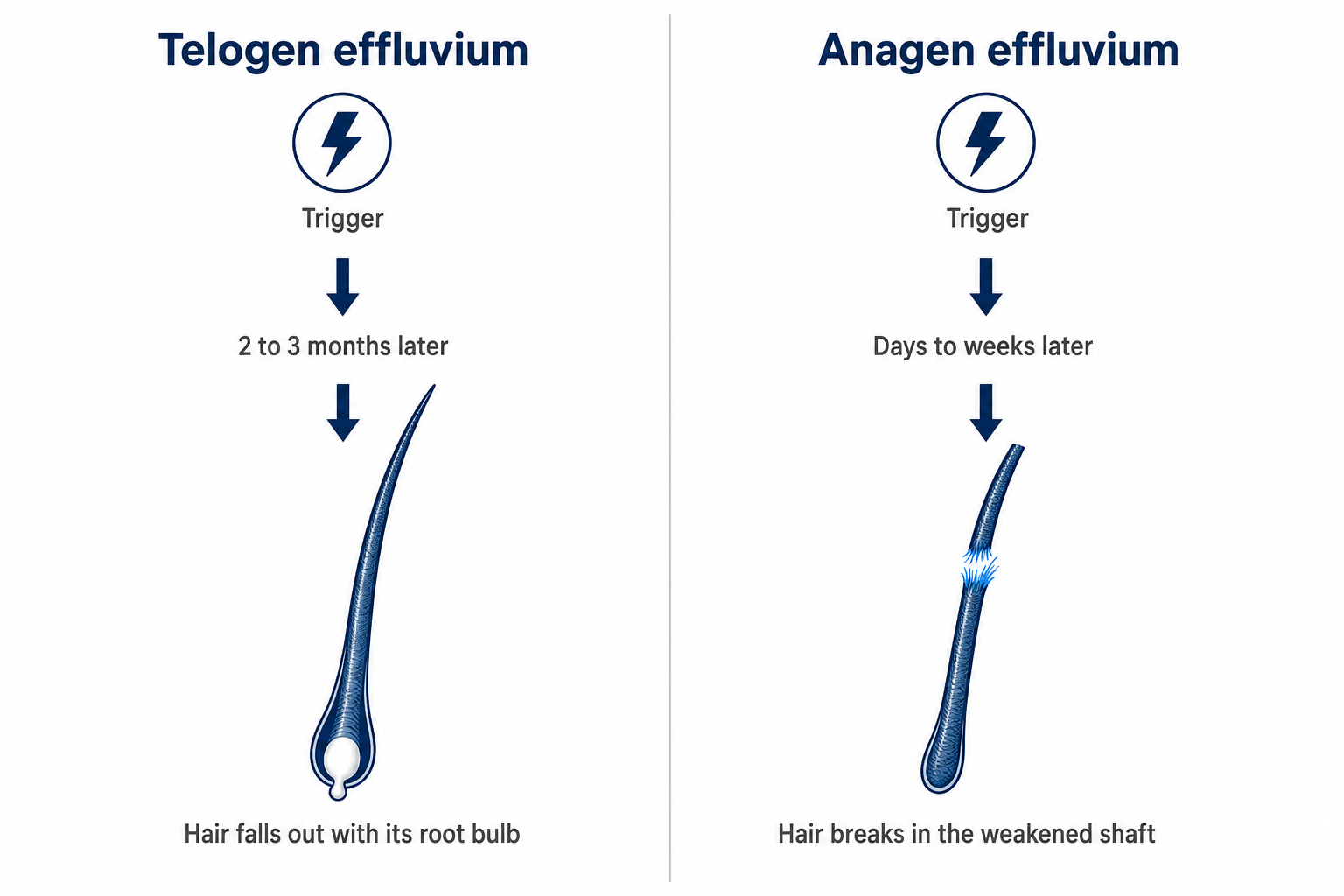
The distinguishing feature lies in the shed hair itself. In anagen effluvium the hair breaks off within the damaged shaft; in telogen effluvium it falls out complete with its small, club-shaped root. That is precisely why a doctor looks at the shed hairs instead of only asking how many there are.
The outlook is better than the picture suggests: the stem cells in what is known as the bulge region are usually spared, which is why the loss is largely reversible (StatPearls, NBK482293). Once the triggering therapy has finished, regrowth typically starts after a delay of three to six months, and texture and colour may change temporarily. Any questions about an ongoing course of treatment belong with the treating oncologist.
Diffuse alopecia: the other forms
Diffuse alopecia is the umbrella term for any hair loss spread evenly across the scalp. Alongside telogen and anagen effluvium, it covers three forms that are commonly mixed up in everyday life: the diffuse variant of alopecia areata, diffuse female androgenetic alopecia and, far more rarely, scarring alopecias at an early stage.
The terms separate cleanly: Effluvium describes the process of increased shedding, alopecia the result, in other words the visibly reduced hair density. An effluvium can lead to alopecia, but it does not have to.
| Form | What happens in the hair cycle | Delay before shedding | Typical duration | Typical triggers | Resolves on its own? |
|---|---|---|---|---|---|
| Acute telogen effluvium | many anagen hairs move prematurely into the resting phase at the same time | 2 to 3 months | by definition under 6 months | feverish infection, surgery, childbirth, crash diet, iron deficiency, medication | yes, usually once the trigger is gone |
| Chronic telogen effluvium | persistently raised telogen rate, often in bouts, the growth phase is shortened | often no single identifiable trigger | over 6 months, fluctuating over years | often unclear, described above all in middle-aged women | variable; disputed scientifically as a condition in its own right |
| Anagen effluvium | the hair matrix is damaged in the middle of the growth phase and the hair breaks off | days to weeks, with chemotherapy 7 to 10 days | for as long as the triggering therapy continues | chemotherapy, radiotherapy to the head, severe poisoning | usually yes, regrowth typically 3 to 6 months after the end of treatment |
| Diffuse alopecia areata | autoimmune interruption of the growth phase without the typical round patches | weeks | highly variable | autoimmune process, affects above all adult women | variable, needs dermatological treatment |
| Diffuse female androgenetic alopecia | the follicles miniaturise step by step, the hairs become finer and shorter | none, gradual onset | progressive over years | genetic and hormonal predisposition | no, progressive without treatment |
Perhaps the trickiest mix-up of all is diffuse alopecia areata, also known as alopecia areata incognita. It looks like an effluvium but is an autoimmune form. On trichoscopy, numerous uniform yellow dots and short regrowing hairs stand out; it can only be confirmed for certain on histology (review of alopecia areata incognita, PMC11908991). One more reason not to work out the form yourself.
Two special cases belong here as well. Scarring alopecias are rare, but they are the one situation with genuine time pressure, because destroyed follicles do not come back. And age-related thinning is not an effluvium at all: over the years, follicles drop out of the cycle for good and the remaining hairs become finer. This happens over years rather than weeks and feels different from acute shedding.
Diffuse hair loss: causes in hindsight
The causes of diffuse hair loss fall into five groups: acute physical strain, deficiencies, hormonal changes, medication and sustained psychological stress (StatPearls and the overview of causes from the Spanish dermatology society AEDV). The timing is decisive: the trigger almost always lies 8 to 12 weeks before the visible shedding.
Acute strain as a trigger of diffuse hair loss
Acute physical strain is the most clearly datable trigger of diffuse hair loss. A feverish infection, an operation under general anaesthetic, heavy blood loss or a serious illness are enough. Acute telogen effluvium after a COVID-19 infection is well documented (multicentre study, PMC7753386). If the shedding can be traced to a single, clearly datable event, the article on sudden hair loss will take you further.
Deficiency and diet: iron, crash diets, weight loss
Deficiencies are the most common treatable cause of diffuse hair loss. First on the list is iron deficiency, particularly in women; ferritin, the storage value, is more informative here than haemoglobin. Crash diets, rapid weight loss and a pronounced protein deficiency come on top of that.
With GLP-1 weight-loss medicines the picture is not yet settled. Rapid weight loss and a low nutrient intake are recognised triggers; whether the active substances themselves contribute as well is currently being investigated. A cohort study in the Journal of the American Academy of Dermatology (2025) and a systematic review by Gupta and colleagues (2026) find a weak independent signal, but they do not yet separate the factors cleanly.
Hormones and the thyroid
In diffuse hair loss, hormonal changes act across the whole hair cycle. Both an underactive and an overactive thyroid can trigger a diffuse effluvium, because thyroid hormones help regulate the cycle. The female triggers around childbirth, the contraceptive pill and the menopause are covered in the next section.
Medicines that can trigger an effluvium
Medicines usually trigger diffuse hair loss weeks to months after treatment starts. According to the Mayo Clinic, retinoids, beta blockers, ACE inhibitors, anticonvulsants, antidepressants, anticoagulants and hormonal contraceptives are among those that can trigger telogen effluvium. Never stop a prescribed medicine on your own initiative; speak to the doctor who prescribed it. Which drug groups are affected is set out in the article on hair loss caused by medication.
Psychological stress and diffuse hair loss
Sustained psychological stress can trigger diffuse hair loss; it acts through the control of the hair cycle and, again, with a delay. The reverse conclusion matters: a difficult phase may explain the shedding, but it does not rule out a physical cause. Even with obvious stress, the basic work-up still belongs. A complete overview is provided by the hub on the causes of hair loss.
| Trigger 8 to 12 weeks ago | Typical delay | Typical duration of shedding | How the suspicion can be checked |
|---|---|---|---|
| Feverish infection, including COVID-19 | 2 to 3 months | 3 to 6 months | medical history, matching the timing to the course of the illness |
| Surgery or general anaesthetic | 2 to 3 months | 3 to 6 months | medical history, date of the operation |
| Heavy blood loss | 2 to 3 months | 3 to 6 months | full blood count and ferritin |
| Childbirth | 2 to 4 months | 2 to 6 months | medical history, date of delivery |
| Crash diet or rapid weight loss | 2 to 3 months | for as long as intake stays low | dietary history, weight trend, ferritin |
| Starting a GLP-1 weight-loss medicine | 2 to 3 months after marked weight loss | variable | weight trend, discussion about the ongoing treatment |
| Contraceptive pill stopped or changed | several months | usually temporary | gynaecological assessment |
| New medication started | weeks to months after starting treatment | for as long as the medicine is taken | medication review with the prescribing doctor |
| Sustained period of strain | 2 to 3 months | for as long as the strain continues | medical history, basic work-up nonetheless |
| Iron deficiency | gradual | until the stores are replenished | ferritin, full blood count |
| Thyroid dysfunction | gradual | until thyroid function is stabilised | TSH, and if abnormal fT3 and fT4 |
| Pronounced protein deficiency | 2 to 3 months | until intake is adequate again | dietary history, laboratory check |
Diffuse hair loss in women: the most common triggers
Diffuse hair loss is considerably more common in women than in men, and the triggers are usually hormonal or iron-related: the time after childbirth, stopping or switching the contraceptive pill, the menopause, and low iron stores caused by menstruation, pregnancy, breastfeeding or a diet low in meat. It shows as hair that is thinner overall, a wider parting and a thinner ponytail, not as a bald patch.
After childbirth: postpartum effluvium
Postpartum hair loss starts on average around 2.9 months after the birth, peaks around the fourth month and resolves after around eight months on average, with a range of 6 to 12 months (summary of the available evidence; the Cleveland Clinic and Johns Hopkins Medicine give the same range).
The mechanism behind it is reassuring: during pregnancy the high oestrogen level keeps many hairs in the growth phase, and after the birth they move into the resting phase together. So it is not that too much is falling out; it is everything that was held back falling out at once.
One finding from the Journal of Clinical and Aesthetic Dermatology does qualify that reassurance: in the group studied, postpartum hair loss occurred on its own in only 9.5% of cases and alongside another form of hair loss in 90.5%, usually female pattern hair loss. Shedding after childbirth therefore often makes an already existing change visible.
The pill, the menopause and hormone replacement therapy
After stopping the pill , a similar pattern appears with a delay of a few months, usually temporary. If there was a previously undetected predisposition, pattern hair loss can become visible underneath it. During the menopause , oestrogen falls while androgen activity becomes relatively stronger, which is why diffuse effluvium and early female pattern hair loss frequently overlap. The details are in the article on hair loss during the menopause.
On hormone replacement therapy , the evidence is thin: large randomised trials on its effect on hair loss in the menopause are lacking (review of menopause and hair loss, 2025). It is not prescribed for the sake of the hair; the preparation, the progestogen component and the individual situation are what count here, and a change can itself temporarily trigger an effluvium. This weighing-up belongs in the gynaecology consultation.
Where there are cycle irregularities, increased body hair or acne, a hormonal assessment should be part of the work-up as well. And one sentence that should stick: women with diffuse hair loss do not, as a rule, go bald. The hair becomes thinner and usually recovers once the cause has been dealt with. Further forms and courses are described in the article on hair loss in women.
How diffuse hair loss is diagnosed: pull test, trichoscopy and blood values
The diagnosis of diffuse hair loss rests on four building blocks: the medical history with an eye on the past three to six months, the pull test, trichoscopy and targeted laboratory tests. A scalp biopsy is only necessary in unclear cases, above all when a scarring alopecia is suspected.
Pull test. The doctor takes hold of 40 to 60 hairs close to the scalp and draws them through with steady, gentle traction. If more than about one in ten of the hairs grasped comes away, the test counts as positive (Malkud review, and likewise the ISHRS patient information).
The pull test is only meaningful if the hair has not been washed for at least 24 hours, and it is carried out at several sites on the head. That is exactly what makes it valuable: if it is positive at the back of the head too, that points to a diffuse process.
Do not repeat the test yourself. Experience shows that non-professionals pull too hard and tear out healthy hairs in the growth phase, which distorts the result. If you want to gauge the amount at home, the article on extreme hair loss will help.
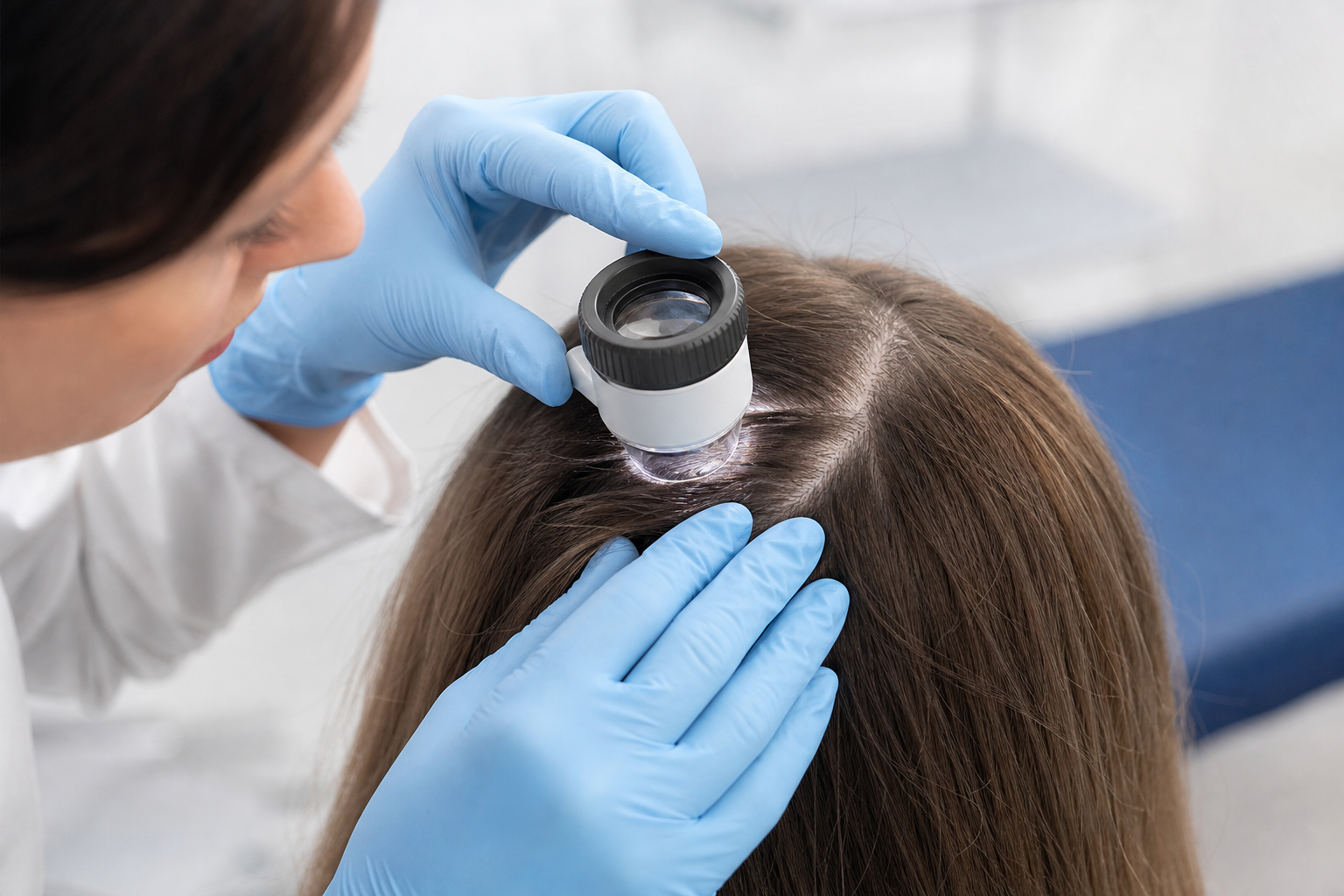
Trichoscopy. This surface microscopy of the scalp, given that name by Rudnicka and Olszewska in 2006, takes a few minutes and is non-invasive. It separates what looks identical to the naked eye: uniform hair thickness points to an effluvium, marked variation in calibre and miniaturisation to androgenetic alopecia, yellow dots and exclamation-mark hairs to alopecia areata, and absent follicular openings to a scarring alopecia (DermNet).
The trichogram and TrichoScan quantify the ratio of growing to resting hairs. A telogen proportion of more than 25% counts as an indication of telogen effluvium (Malkud review). Both methods are used less often today than trichoscopy, but they still turn up in reports.
Blood tests. The values your doctor may check in diffuse hair loss include ferritin as the iron store, the full blood count, TSH and, if that is abnormal, fT3 and fT4, vitamin D, zinc and vitamin B12, and, where there are cycle irregularities, a hormonal assessment as well. Which of these are medically justified is decided by the doctor on the basis of the findings. What lies behind them is explained in the article on blood tests for hair loss.
| Examination | What it shows | How it works | Who carries it out | When it makes sense |
|---|---|---|---|---|
| Medical history, looking back 3 to 6 months | assigns events to the window 8 to 12 weeks ago | conversation, list of medicines, timeline | GP or dermatologist | always, as the first step |
| Pull test | an increased shedding rate; positive at the back of the head as well points to a diffuse process | 40 to 60 hairs are drawn through gently close to the scalp | dermatologist | with any unexplained hair loss; do not wash the hair for 24 hours beforehand |
| Trichoscopy | distinguishes effluvium, pattern hair loss, alopecia areata and scarring forms | surface microscope on the scalp, painless, a few minutes | dermatologist | the key examination as soon as the form is unclear |
| Trichogram or TrichoScan | the proportion of telogen hairs; over 25% supports telogen effluvium | hair roots are removed or evaluated digitally | dermatologist | when the telogen rate needs to be quantified |
| Basic blood panel | iron stores, blood count, thyroid function, vitamin D, zinc, vitamin B12 | a single blood sample | GP, dermatologist or gynaecologist | with any diffuse hair loss that persists |
| Extended hormone testing | hormonal causes where there are cycle irregularities, acne or increased body hair | blood sample, in part depending on the cycle | gynaecologist or endocrinologist | when the corresponding accompanying signs are present |
| Scalp biopsy | the histological picture; over 25% telogen follicles supports an effluvium | a small tissue sample under local anaesthetic | dermatologist | only in unclear cases, above all when a scarring alopecia is suspected |
Appointment preparation sheet: my look back over six months
To photograph or print out. The appointment is far more productive if these points are prepared.
Values you can ask about
- ✓ferritin as the iron store and the full blood count
- ✓TSH, and if abnormal fT3 and fT4
- ✓vitamin D, zinc and vitamin B12
- ✓where there are cycle irregularities, a hormonal assessment as well
What to bring with you
- ✓a complete list of all medicines and supplements
- ✓the month in which the shedding began
- ✓events of the past six months: infection, surgery, childbirth, diet, period of strain
- ✓photos of your parting over time, ideally always in the same light
The point almost nobody mentions: do not wash your hair for at least 24 hours before the appointment. Only then is the pull test meaningful.
Diffuse hair loss despite normal blood results is more common than many expect. What usually lies behind it is a delayed effluvium whose trigger can no longer be detected, a ferritin level at the lower end of the range, a chronic course or an emerging pattern. The next step is then trichoscopy, not another blood count. The first port of call is the dermatologist; who is responsible for what is explained in the article hair loss: which doctor.
How long does diffuse hair loss last and when does the hair grow back?
With acute telogen effluvium the increased shedding usually ends within 3 to 6 months once the trigger is gone. The hair only becomes visibly denser after that: the follicles have to re-enter the growth phase, and hair grows about 1 centimetre a month. Realistically, recovery therefore becomes apparent after 6 to 12 months.
| Period | What happens in the follicle | What you see |
|---|---|---|
| Month 1 to 2 | the cause has been dealt with, no new hairs are being pushed prematurely into the resting phase | the shedding slowly eases, the amount in the brush and the plughole goes down |
| Month 3 to 4 | the follicles re-enter the growth phase | density has not yet visibly changed, but the shedding has settled |
| Month 5 to 6 | the new hairs grow back at about 1 centimetre a month | short stubbly hairs at the parting and along the hairline; this is regrowth, not new shedding |
| Month 7 to 9 | the proportion of hairs in the growth phase continues to normalise | density visibly increases, the parting looks narrower again |
| Month 10 to 12 | the regrown hairs reach the length of the rest | the overall picture evens out, usually back at the starting level once the effluvium has run its course |
Short stubbly hairs at the parting and along the hairline unsettle a lot of people and set off a second wave of worry. They are regrowth, not new shedding. Anyone who reads them as broken hairs often changes strategy at exactly the moment when the old one is beginning to work.
Will my hair be as thick as it was before? Once a telogen effluvium has run its course, density usually returns to the starting level, because no follicles are lost. Three qualifications belong here, in all honesty: a coexisting androgenetic alopecia, age-related thinning and a cause that is still active. If density stays behind, that points to one of these three and not to a burnt-out effluvium.
How to get through the waiting time with diffuse hair loss
The waiting time with diffuse hair loss is the hardest part, because treating the cause takes months before it shows. Three things help in this phase: making the hair look denser, treating it gently and having the right expectations of the calendar. None of that changes the number of hairs falling out, but it does change day-to-day life.
Make it look denser. Hair-building fibres and root powder in your hair colour make the parting look narrower, a shorter cut makes finer hair look fuller, and moving the parting to the side covers the widest spot. These are cosmetic measures: they do not change what is happening in the follicle, they only bridge the months until regrowth.
Treat it gently. You can carry on washing and combing as usual; neither makes an effluvium worse. It still makes sense to avoid unnecessary pulling: permanently tight ponytails, hard hair ties and frequent heat styling put extra strain on the hair structure without anything being gained where the shedding is concerned.
Set the right expectations. This is what takes the most pressure off. With acute telogen effluvium, around 95% of cases resolve on their own according to the NHS Fife patient information, because the follicles stay intact and are only pausing. Reckon on a shedding phase of 3 to 6 months and then a centimetre of regrowth a month, instead of assessing the hair in your brush every day.
Photos of your parting a month apart, always in the same light, show how things are developing far more reliably than how it feels on any given day. And if the hair loss is weighing heavily on your daily life, that is a good reason to raise it at your appointment. The distress is part of the picture, not a side issue.
How to tell that diffuse hair loss is not going to stop on its own
Diffuse hair loss counts as no longer self-limiting if it lasts longer than six months, keeps coming back in bouts or continues even though the cause has been dealt with. Three constellations usually lie behind this: a chronic course, a superimposed androgenetic alopecia or a persisting, so far unrecognised cause.
Points to it ending on its own
- •a clear trigger 8 to 12 weeks ago
- •the shedding phase has so far lasted less than six months
- •the amount is decreasing from week to week
Watch and document
- •the shedding has been going on for four to six months
- •the cause was only dealt with recently and the recovery still needs time
- •photos of your parting a month apart, always in the same light
Have it assessed by a dermatologist
- •longer than six months, or recurring bouts over years
- •the shedding stops but the density does not come back, above all at the central parting
- •the trigger has been dealt with and the shedding still continues
- •smooth, shiny areas with no visible follicular openings, redness, scaling, burning or pain
- •sharply defined bald patches appear as well
Two of these points deserve some context. If density does not return once the shedding has stopped, a superimposed androgenetic alopecia is the most common explanation. And smooth, shiny areas with no recognisable follicular openings belong in dermatological hands promptly, because scarred follicles do not come back. If sharply defined patches appear, the suspicion is alopecia areata , which is treated differently.
Diffuse hair loss: what can you do?
Diffuse hair loss is not treated at the hair but at the cause. The order is what counts: first have the form determined, then find the cause, then treat it in a targeted way, then allow the hair cycle its time. Anyone who reverses that and buys products on suspicion loses months.
Diffuse hair loss: the five steps in the right order
What demonstrably makes no difference: no shampoo ends an effluvium, because the shedding arises in the follicle and not on the surface of the scalp. Cutting your hair does not change the number of hairs falling out. Washing less often does not prevent the shedding, it only collects it until the next wash. Normal washing and combing does not make diffuse hair loss worse. If the daily amount feels threatening to you right now, the article on extreme hair loss puts it in perspective.
Important note: supplements can make the shedding worse
Supplements only help where a deficiency has been demonstrated. Without a deficiency there is no proven benefit, and in overdose individual nutrients can themselves trigger diffuse hair loss. So do not take high-dose preparations on suspicion, but only after a laboratory result and in consultation with your doctor.
- •Vitamin A: chronic hypervitaminosis is regarded as one of the most common supplement-related causes of a diffuse effluvium (review of vitamins and minerals in hair loss, Guo and Katta)
- •Selenium: a persistently high intake can lead to brittle hair and diffuse shedding; the figures given for the threshold vary considerably from source to source
- •Zinc without balancing copper: in high doses it can promote a copper deficiency, which can also be associated with hair loss; so far this is documented through case reports
This applies only to genuine overdoses, not to normal use as part of medically supervised supplementation. There is more on this in the articles on vitamins for hair loss and on capsules for hair loss.
Minoxidil is approved for androgenetic alopecia, not as a standard treatment for acute telogen effluvium. In a chronic course, or where pattern hair loss is superimposed, a dermatologist may consider it. The evidence for this is thin: the most frequently cited study, by Perera and Sinclair, included 36 women, ran without a control group and used oral minoxidil off-label, with facial hypertrichosis in 13 of the 36 participants.
Starting it therefore belongs in medical hands and not in your own. At the beginning there is typically a temporary increase in shedding. Anyone already shedding diffusely experiences this as a dramatic worsening and often stops at exactly that point. How it works is described in the article on minoxidil for hair loss, and the full comparison of treatments in the guide what to do about hair loss.
Why a hair transplant is not the answer for diffuse hair loss
Diffuse hair loss is not an indication for a hair transplant. The reason is medical: in a diffuse process the donor area at the back of the head is affected too. Hairs would then be taken from an unstable zone whose future behaviour nobody can predict. And as long as the cause is active, the loss continues anyway, including in the transplanted area.
The hair transplant literature describes the same logic under the term diffuse unpatterned alopecia (DUPA), coined by Norwood in 1975 and later taken up by Bernstein and Rassman: if the donor zone is affected as well, the basis for a transplant is missing and the procedure is considered contraindicated. A transplant requires a stable pattern and a stable donor zone. That is precisely what is not there with active diffuse hair loss, and reputable clinics turn such enquiries down.
Because diffuse and hereditary hair loss can overlap, the real question is not whether to have a transplant, but which form is present. That assessment is made by the dermatologist, and for a first impression the free hair analysis from Elithair looks at exactly that: diffuse thinning or a stable pattern. It is a visual assessment of the pattern and replaces neither trichoscopy nor a medical blood test.
If that shows a stable pattern with a dense rim of hair, the path leads on to the types of hair loss and to the hereditary form. If the picture is a diffuse one, it goes back to the beginning of this article: find the cause, treat the cause, give it time.
A view from clinical practice
When someone comes to a consultation with diffuse thinning, the first question is never how many grafts would be needed. The first question is whether the back of the head is affected too. If it is, the stable donor zone is missing and a transplant would be the wrong route. The case then belongs in a dermatological work-up of the cause, not in a surgical plan.
This screening is the reason why a considerable proportion of enquiries are turned down after the hair analysis. A good result depends on a stable starting position, and that cannot be created on the operating table.
Frequently asked questions about diffuse hair loss
How many hairs a day are normal with diffuse hair loss?
Around 100 shed hairs a day is considered normal, a figure cited among others in the review by Malkud (2015). With diffuse hair loss the amount is higher, but in practice it is not counted: it varies too much with the time since the last wash and with the hairstyle. The trend over weeks and the pull test at the dermatologist are more informative.
Can I wash and comb my hair as usual with diffuse hair loss?
Yes. Washing and combing do not cause hair loss and do not make an effluvium worse. If you wash less often, you only collect the telogen hairs until the next wash, which is why the amount then looks particularly alarming. Before a doctor’s appointment, though, the rule is: do not wash for 24 hours, otherwise the pull test is not meaningful.
Will diffuse hair loss make me bald?
As a rule, no. With an effluvium the follicles remain intact, they are only pausing, which is why no bald areas develop. Thinning usually stays visible only where hereditary hair loss is present as well, which the effluvium has simply brought to light.
Is diffuse hair loss contagious?
No. Diffuse hair loss arises within your own hair cycle, because follicles switch prematurely into the resting phase, and it cannot be passed on in any way. Even if an infection was the trigger, it is not the hair loss that is contagious but at most the infection itself. The shedding is the body’s delayed reaction to it.
Can diffuse hair loss come back after the hair has grown again?
Yes. Every new trigger can set off a new telogen effluvium, again with a delay of two to three months. If the shedding returns in bouts or lasts longer than six months, it counts as chronic (Whiting, 1996) and needs a dermatological review, because a second cause or an emerging pattern often lies behind it.
Does diffuse hair loss occur in men as well?
Yes, it is simply less common in men than in women. The triggers are the same: infection, surgery, blood loss, deficiency, medication, periods of strain. In men, a diffuse effluvium is more often mistaken for early hereditary hair loss. The back of the head makes the difference: if the rim of hair stays dense, that points to a pattern.
Which doctor treats diffuse hair loss?
The first port of call is the dermatologist, because that is the only place where trichoscopy and the pull test are carried out to a standard protocol. If a thyroid or hormone disorder is suspected, an endocrinologist or gynaecologist is brought in. Trichologist is not a protected professional title, so ask about the specialist qualification.
Sources
- Malkud S.: “Telogen Effluvium: A Review”, J Clin Diagn Res 2015;9(9):WE01-3, PMID 26500992. pmc.ncbi.nlm.nih.gov
- StatPearls, NCBI Bookshelf: “Telogen Effluvium” (NBK430848) and “Anagen Effluvium” (NBK482293). ncbi.nlm.nih.gov, NBK482293
- Whiting DA.: “Chronic telogen effluvium: Increased scalp hair shedding in middle-aged women”, J Am Acad Dermatol 1996;35(6):899-906. jaad.org
- “Chronic Telogen Effluvium: Is it a Distinct Condition? A Systematic Review”, Am J Clin Dermatol 2023, PMID 37052778. pubmed.ncbi.nlm.nih.gov
- ISHRS, patient information “Telogen Effluvium: A Guide to Temporary Hair Loss”. ishrs.org
- NHS Fife, patient information “Telogen Effluvium (a type of hair loss)”. nhsfife.org
- DermNet: “Trichoscopy of generalised noncicatricial hair loss”. dermnetnz.org
- “Comparison of Dermoscopic Findings in Female Androgenetic Alopecia and Telogen Effluvium”, PMC9122275. pmc.ncbi.nlm.nih.gov
- “Alopecia Areata Incognita: Current Evidence”, PMC11908991. pmc.ncbi.nlm.nih.gov
- “Postpartum Telogen Effluvium Unmasking Additional Latent Hair Loss Disorders”, J Clin Aesthet Dermatol. jcadonline.com; Cleveland Clinic on postpartum hair loss: my.clevelandclinic.org
- Perera E, Sinclair R.: “Treatment of chronic telogen effluvium with oral minoxidil: A retrospective study”, PMC5676194. pmc.ncbi.nlm.nih.gov
- Guo EL, Katta R.: review of vitamins and minerals in hair loss (vitamin A, selenium). link.springer.com
- Mayo Clinic News Network: “Stress may play a role in hair loss, but other triggers could be the cause” (list of medicines). newsnetwork.mayoclinic.org; AEDV / Fundación Piel Sana, “Efluvio telógeno”: aedv.fundacionpielsana.es
- “SARS-CoV-2-induced telogen effluvium: a multicentric study”, PMC7753386. pmc.ncbi.nlm.nih.gov
- Gupta AK et al.: “GLP-1 therapies and hair loss: A systematic review of current evidence”, 2026. journals.sagepub.com; cohort study JAAD 2025: jaad.org
- Bernstein Medical (specialist practice reference on the DUPA concept after Norwood 1975 and Bernstein/Rassman 1997, not an independent epidemiological source). bernsteinmedical.com
Medically reviewed, as of August 2026. This article is for information purposes and does not replace medical diagnosis or treatment. If hair loss lasts longer than six months, if there are bald patches, or if the scalp is red, scaly or painful, please contact a dermatology practice promptly. Never stop prescribed medicines on your own initiative.
Dr. Imad Moustafa
Hair transplant specialist