


What to do about hair loss? The short answer in four steps
- Check the extent. It becomes a concern when you consistently lose noticeably more hair than is normal for you (as a rough guide: persistently more than around 100 hairs a day over several weeks) or your hair visibly thins.
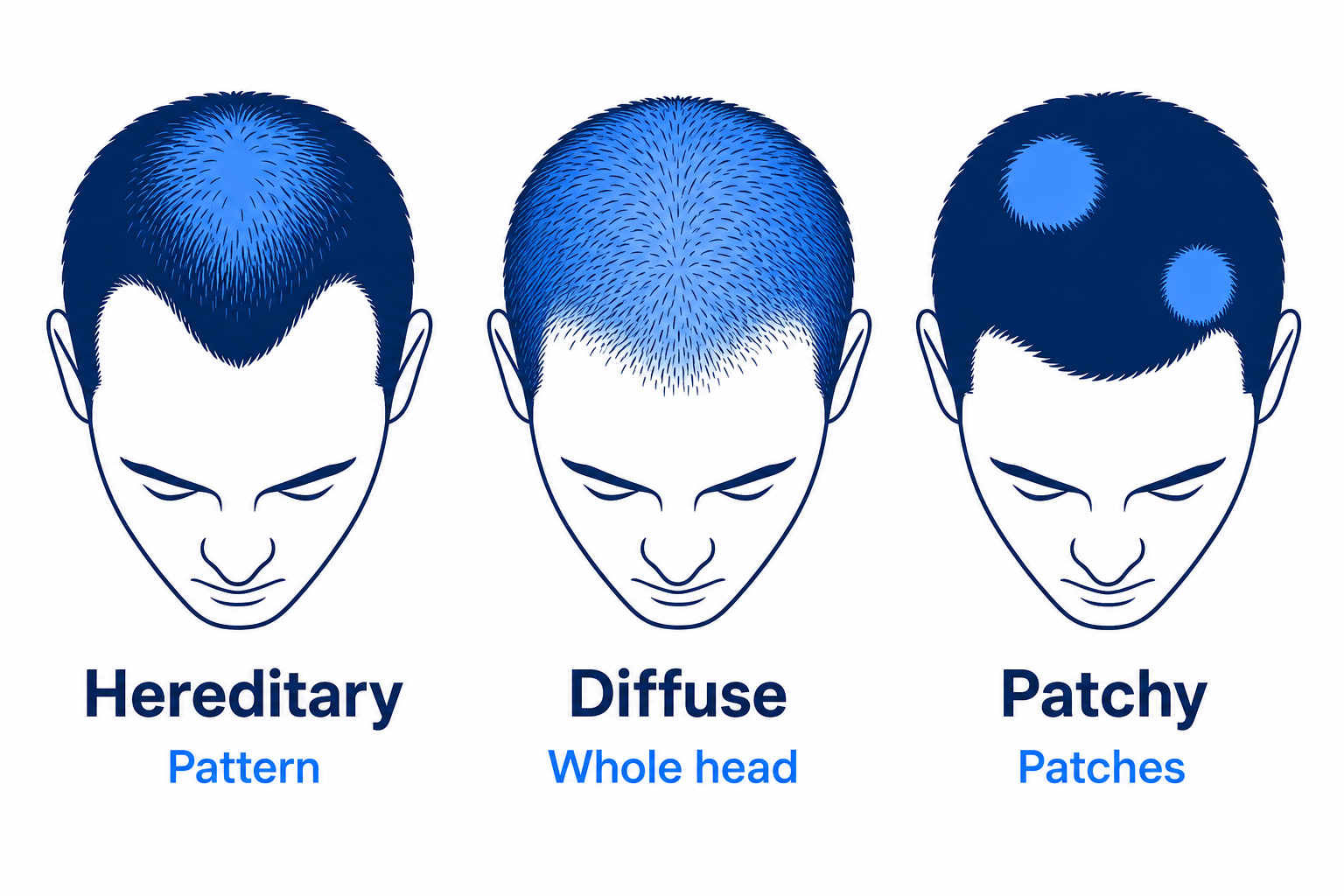
- Identify the type. Hereditary (a pattern at the temples and crown), diffuse (even thinning across the whole head) or patchy (sharply defined bald patches)?
- Pin down the cause. See a dermatologist and have targeted blood tests done.
- Treat according to the cause. The right help depends entirely on the type.
There is no single product that works for everyone. Correctable causes such as iron deficiency or a thyroid disorder can often be reversed, and the hair grows back. Hereditary hair loss, by contrast, needs ongoing treatment. You will find the self-check for this in the very next section.
More hair in your brush, a widening parting, bald patches on top: anyone who notices this mainly wants to know one thing: what to actually do now. This guide walks you honestly through the decision. It shows you how to recognise your type of hair loss, where to get help and which treatment is genuinely proven for which cause.
One thing up front: the most common form, hereditary hair loss, already affects 58% of men between 30 and 50, according to a population-based study of 1,005 men (Yeo et al., PMC2938575). It responds differently from diffuse, nutrition-related hair loss. It is precisely this distinction that determines the right help.
Summary
- When does hair loss need treatment?
- First step: which type of hair loss do I have?
- Which doctor helps with hair loss?
- Which blood values should I have checked?
- What really helps against hair loss? An overview of the treatment options
- What can I do myself about hair loss?
- What to do about sudden, stress-related or illness-related hair loss?
- Hereditary hair loss: what to do when medication is no longer enough?
- When does the hair grow back?
- Expert perspective
- Frequently asked questions: what to do about hair loss?
- Sources
When does hair loss need treatment?
Hair loss does not become a matter for treatment at a fixed number, but when your usual appearance changes: when you consistently lose noticeably more hair than usual, or your hair visibly thins over a period of weeks. As a rough guide, a daily loss of around 50 to 100 hairs is considered normal (a dermatological rule of thumb, including from NHS inform Scotland).
This rule of thumb is not a medical cut-off. How many hairs you lose each day depends heavily on hair density, hair length and how often you wash, and naturally more come out on wash days. More telling than counting is therefore the change over time, which you can best document with photos of your parting taken in the same light over several weeks.
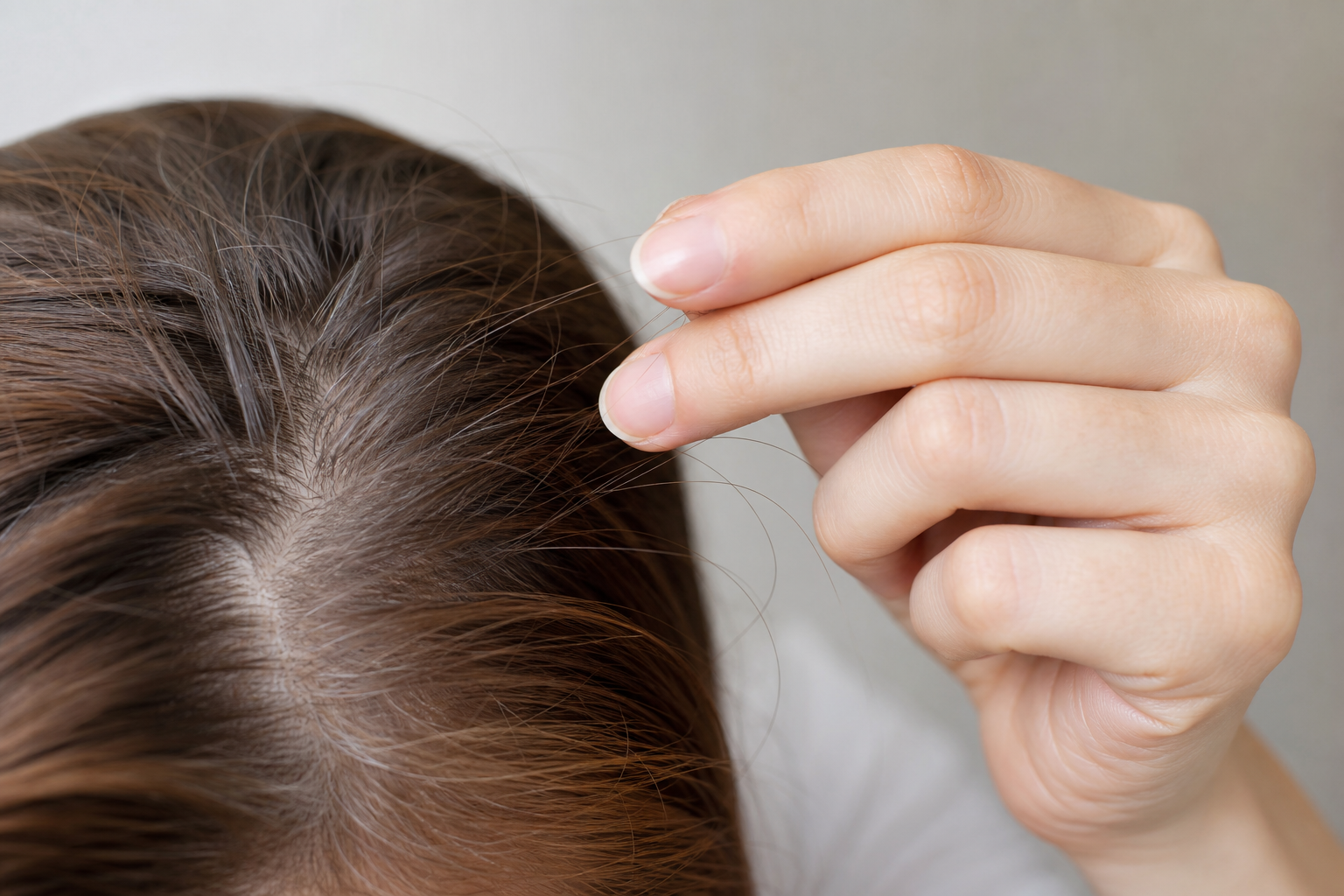
A simple self-check is the pull test: take about 50 to 60 hairs between your thumb, index and middle finger and pull gently from the root to the tip. As a classic rule of thumb, the result is considered notable if more than 10% come away (with 60 hairs, roughly 5 to 6). A more recent reference (McDonald et al. 2017) sets the threshold more strictly at around 2 hairs. The test only shows active hair loss, not a diagnosis.
| Observation | Assessment | Recommendation |
|---|---|---|
| A little more hair when washing, overall picture stable | Green | Usually normal. Keep monitoring and start taking photos of your parting. |
| More than 100 hairs a day for more than 6 weeks | Amber | Notable. Have the cause assessed by a doctor. |
| A visibly wider parting or a receding hairline at the temples | Amber | A sign of pattern hair loss. A dermatologist appointment is advisable. |
| Pull test: several hairs come away easily (more than 10%) | Amber | Active hair loss. Have it assessed by a doctor. |
| Sharply defined round bald patches | Red | See a dermatologist promptly, do not treat it yourself. |
| Sudden heavy shedding after illness, surgery or childbirth | Red | Have it assessed if it lasts more than 3 months. |
First step: which type of hair loss do I have?
The most important step with hair loss is to identify the type, because treatment, prognosis and the question of a possible hair transplant all depend on it. There are three main forms: hereditary (androgenetic), diffuse (telogen effluvium) and patchy (alopecia areata). The classification follows the American Academy of Dermatology (AAD).
Hereditary hair loss shows a typical pattern: in men, a receding hairline at the temples and a bald spot at the crown (Norwood scale); in women, a diffuse widening of the parting without a receding hairline (Ludwig scale). It is the most common cause worldwide and does not grow back on its own without treatment, because the affected follicles progressively shrink.
Diffuse hair loss thins the whole head evenly, without a sharp pattern. It is usually a response to a trigger such as iron deficiency, a thyroid disorder, stress or an illness, and in most cases it is reversible once the cause is addressed. Patchy hair loss shows sharply defined bald patches and is an autoimmune reaction.
| Type | How to recognise it | Typical cause | Grows back on its own? | First step |
|---|---|---|---|---|
| Hereditary (androgenetic) | Receding temples + crown balding (men); widening parting without a receding hairline (women) | Genetic sensitivity of the follicles to DHT | No, progressive | Dermatologist, then minoxidil/finasteride or, with a stable donor area, a hair transplant |
| Diffuse (telogen effluvium) | Even thinning across the whole head, no sharp pattern | Iron deficiency, thyroid, stress, illness, childbirth, crash diet | Usually yes, once the cause is addressed | Check blood values (ferritin, TSH, vitamin D, zinc, B12), treat the cause |
| Patchy (alopecia areata) | Sharply defined round or oval bald patches | Autoimmune reaction against the hair follicles | Unpredictable, remission possible | See a dermatologist straight away, no self-treatment |
| Scarring / traction | Redness, scaling; with traction, thinning along the line of tension (tight braids) | Inflammatory/autoimmune or chronic tension | No, once scarring has set in | See a specialist straight away; with traction, change the hairstyle immediately |
Sources: AAD “Types of Alopecia”; StatPearls “Traction Alopecia” (NBK470434); NHS inform Alopecia.
If you suspect a hereditary pattern, the established scales help you place it: the Norwood scale for men, the Ludwig scale for women. They describe how far pattern hair loss has progressed and give a first sense of which options make sense. The table below will help you place yourself roughly.
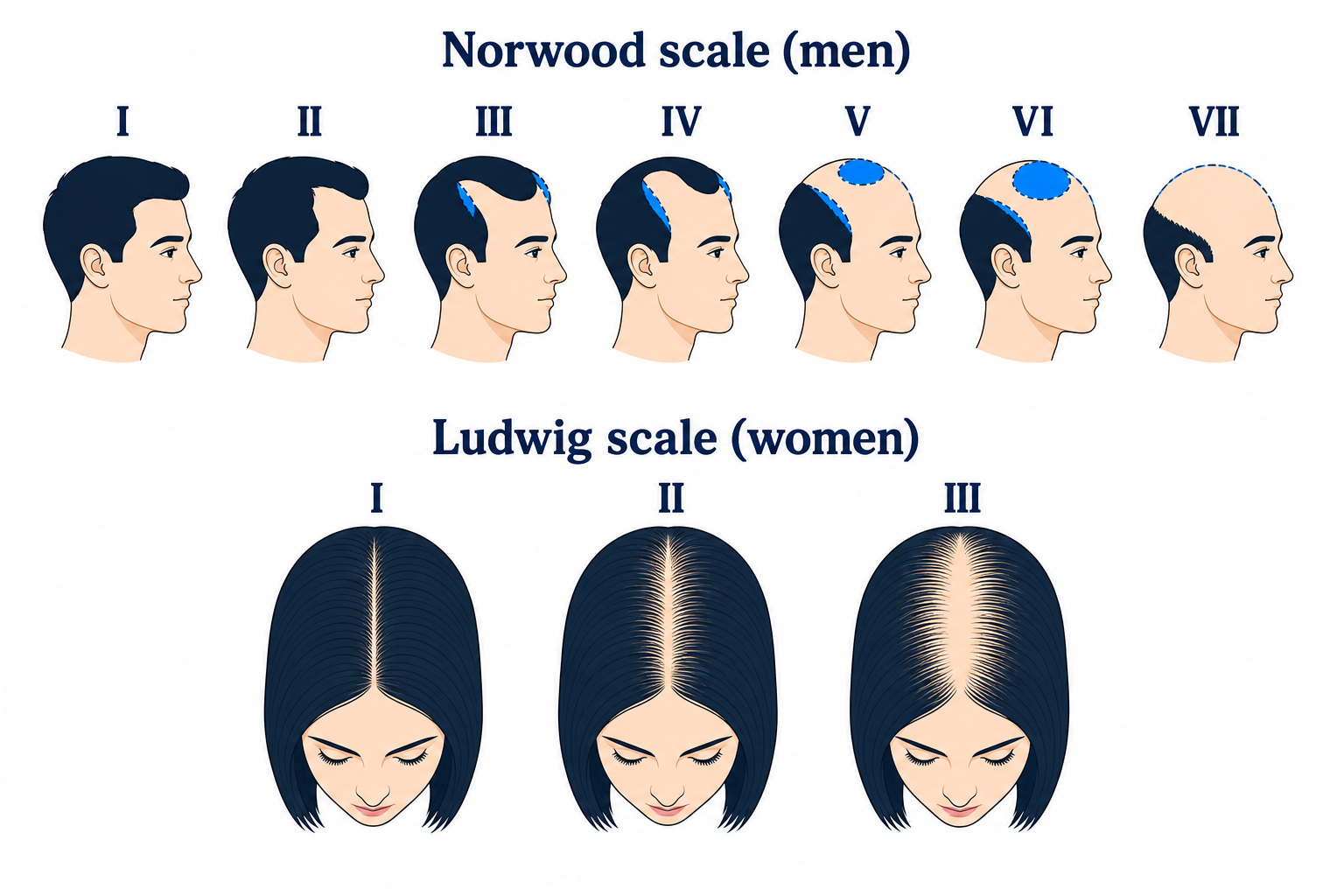
| Scale / stage | What is visible | Rough guidance |
|---|---|---|
| Norwood I to II (men) | Early recession at the temples, the hairline moves back slightly | Monitor, have it assessed by a doctor early |
| Norwood III to IV (men) | Marked recession at the temples, plus thinning at the crown | Consider medical treatment or a hair transplant |
| Norwood V to VII (men) | Large bald areas, only sparse hair left on top | Have your suitability and donor area assessed individually |
| Ludwig I to II (women) | The parting widens, the hairline stays intact | First rule out correctable causes, then treat |
| Ludwig III (women) | Pronounced diffuse thinning on top of the head | Specialist assessment, weigh up the options |
Classification after Norwood (1975) and Ludwig (1977). This is for rough self-orientation and does not replace a medical assessment.
This is the crucial fork in the road: only hereditary pattern hair loss responds to hair-growth products or a hair transplant. Diffuse hair loss needs treatment of the underlying cause. The two often occur at the same time. Both the causes of hair loss and androgenetic alopecia are broad topics worth understanding in more detail in our related articles.
Which doctor helps with hair loss?
The first port of call for help with hair loss is a dermatologist. They identify the type using trichoscopy, a non-invasive examination of the scalp with a dermatoscope, order the relevant blood tests and, if needed, carry out a scalp biopsy. In the specialist literature (PMC8719967), trichoscopy is regarded as a quick, painless standard tool for distinguishing between the forms of alopecia.
Additional specialist help can be useful: an endocrinologist if a hormonal or thyroid cause is suspected, and, for women with cycle- or hormone-related questions, a gynaecologist. In the UK, “trichologist” is not a protected medical title and does not replace medical diagnostics. For the actual work-up, the dermatologist remains responsible.
It pays to arrive well prepared for the appointment. It saves time and makes the diagnosis more accurate. Bring your photo record, a list of all your medicines and details about your family (does hereditary hair loss run in the family?). The checklist below sums up what to bring and which values to raise.
Checklist: preparing for your doctor’s appointment
What to bring
- A photo record of your parting and hairline over several weeks
- A list of all medicines and supplements
- Family history (hereditary hair loss in parents/grandparents)
- Timing and progression: since when, how fast?
Blood values to raise
- Ferritin (iron stores)
- TSH (thyroid)
- Vitamin D (25-OH vitamin D)
- Zinc and vitamin B12
- For women: hormone panel
This list does not replace a medical diagnosis. Your doctor decides which values make sense based on your symptoms.
Which blood values should I have checked?
For diffuse hair loss, a targeted blood test is worthwhile, because many triggers are correctable. The most important are ferritin (iron stores), TSH (thyroid), vitamin D, zinc and vitamin B12, plus a hormone panel in women. These values are part of standard dermatological diagnostics. You can read the details in our article on the blood test for hair loss.
For ferritin, a value below 30 ng/ml is regarded as manifest iron deficiency, which often goes hand in hand with hair loss. Some trichologists cite target values above 70 ng/ml for optimal hair growth. Important: this is a practical rule of thumb debated within trichology, not a general lab standard (the usual reference range is mostly 15 to 150 ng/ml). More on this in our article on iron deficiency and hair loss.
The TSH value reveals an over- or underactive thyroid, both of which can trigger diffuse hair loss (see our article on hair loss and the thyroid). For vitamin D, zinc and B12, intake is guided by the DGE reference values (vitamin D 20 µg/day, B12 4.0 µg/day, zinc 7 to 16 mg/day depending on phytate intake). Our article on vitamins against hair loss offers further background.
A word on safety: these values are diagnostic goals, not an invitation to self-supplement. Without a proven deficiency, overdosing can do harm; too much zinc, for example, triggers a copper deficiency, and too much vitamin D causes hypercalcaemia. Have your levels measured first, then correct them in a targeted way and under medical supervision.
What really helps against hair loss? An overview of the treatment options
What really helps against hair loss depends on the cause: correctable diffuse hair loss usually disappears once the trigger is addressed; hereditary hair loss needs ongoing treatment (minoxidil, and finasteride in men) or a hair transplant; and patchy hair loss is treated dermatologically. The recommendations for the hereditary type are backed by the European EDF S3 guideline (Kanti et al. 2018, JEADV).
Minoxidil (topical, for women and men) is well supported. A Cochrane review of female hair loss found twice as many women with at least moderate regrowth as on placebo (relative risk 1.86; 95% confidence interval 1.42 to 2.43). The effect only lasts, however, for as long as you use it. Once you stop, the hair loss returns. Details in our article on minoxidil for hair loss.
Finasteride (oral, prescription-only, men only) lowers DHT levels and is effective, but not without risks (see the safety note below). For women of childbearing age it is contraindicated because of the risk to unborn children. PRP (platelet-rich plasma therapy), along with low-level laser therapy and mesotherapy, can play a supporting role, but the evidence for them is limited and inconsistent (high study heterogeneity, risk of bias).
| Method | Works for type | Evidence | Permanent? | Cost (UK guide) | Daily effort |
|---|---|---|---|---|---|
| Treating the cause (iron, thyroid, nutrients) | Diffuse | Good, when the cause is clear | Yes, once addressed | Ongoing, low (often covered by the NHS) | Taking supplements, doctor check-ups |
| Minoxidil (topical) | Hereditary (women + men) | Good (Cochrane), moderate quality | No, only while used | Ongoing, around £25 to £50/month | Apply daily |
| Finasteride (oral) | Hereditary (men only) | Well supported, note the side effects | No, only while taken | Ongoing, around £27 to £50+/month | Taken daily |
| PRP (platelet-rich plasma) | Hereditary (supporting) | Limited, inconsistent | No, needs repeating | Private, per session | No daily routine, appointments |
| Laser/mesotherapy | Hereditary (supporting) | Weak, preliminary | No, needs maintenance | One-off device and/or sessions | Several times a week |
| Hair transplant | Hereditary only, stable donor area | Surgically established | Yes, transplanted follicles stay | One-off, roughly £1,500–£3,500 | No daily routine |
Cost figures are rough market observations from commercial sources and can vary widely by provider and region. They do not replace medical advice.
To put the last column in context: the practical difference often lies in the effort involved. Minoxidil and finasteride slow hereditary hair loss but demand daily, ongoing use and continuing costs. A hair transplant is a one-off procedure with a permanent result in the treated area. You should never adjust the dose of these medicines yourself; only use them as prescribed by a doctor.
Safety note on finasteride
Finasteride only after medical counselling
The BfArM (the German Medicines Agency) Direct Healthcare Professional Communication of 5 July 2018 warns of possible sexual dysfunction (erectile dysfunction, reduced libido), which in isolated cases can persist even after stopping, as well as mood changes ranging to depressed mood and suicidal thoughts. The BfArM recommends counselling before starting treatment.
The much-discussed post-finasteride syndrome (PFS) describes complaints said to persist for months after treatment ends. It is scientifically contested: the reports come mostly from case descriptions, and controlled studies have so far been unable to prove a clear causal link. Never start or stop finasteride on your own, but discuss the benefits and risks individually with your doctor.
On the common question of cost: in the UK, a dermatology work-up (history, trichoscopy, blood tests where medically indicated) is generally available on the NHS. A hair transplant for hereditary hair loss, by contrast, counts as a cosmetic procedure and is not covered as a rule. It is a privately funded treatment.
What can I do myself about hair loss?
There is plenty you can do yourself about hair loss, though you should be realistic about the effect: a balanced diet rich in protein and iron, less chronic stress, gentle hair care without tight braids (which encourage traction alopecia, StatPearls NBK470434) and giving up smoking all support hair health. With hereditary or disease-related hair loss, however, they do not replace treatment.
Let us be honest about home remedies and shampoos: caffeine shampoos and most cosmetic “miracle products” have no solid evidence for significant hair growth in hereditary hair loss. Excessive vitamin regimes do not help healthy people without a deficiency either, and can even do harm. You can read what nutrients can and cannot do in our article on capsules for hair loss.
What helps quickly to cover thinning, for example before an event?
If you want to bridge a thinning spot at short notice, say before a date, a celebration or an important meeting, there are purely cosmetic instant options. They do not treat the hair loss and do not replace a diagnosis, but they visibly conceal the thinning. Important: they are a stopgap, not a treatment, and change nothing about the cause.
Cover-up options at a glance
- Hair fibres: fine fibres (usually cotton or keratin) that cling electrostatically to your existing hair and make the parting look denser. Washable and lasting until your next wash, but only effective where some hair remains.
- Scalp micropigmentation (SMP): a tattoo-like application of fine dots of pigment that creates the impression of denser hair roots or a closely shaved cut. A purely visual, semi-permanent technique that does not make hair grow.
- A flattering hairstyle and cut: a shorter, even cut often makes thinning less noticeable than long, thin strands. A good hairdresser can achieve a lot here at short notice, with no procedure at all.
These options are cosmetic and do not address the cause. With progressive hair loss, a medical work-up remains the decisive step.
What to do about sudden, stress-related or illness-related hair loss?
Sudden, heavy hair loss is usually down to acute telogen effluvium, triggered by an event around 2 to 3 months earlier: a fever, an operation, a serious illness, a crash diet or severe stress. This form is often reversible and, according to the specialist literature (PMC8719967), usually settles within 6 months. If it lasts longer, you should have it assessed by a doctor.
With stress-related hair loss, the body pushes follicles into the resting phase prematurely. Once the trigger falls away, the cycle recovers on its own over a few months, and a specific medicine is usually not needed. After childbirth, hormone-driven shedding affects an estimated 40 to 50% of women. It often starts 2 to 4 months after delivery and usually normalises within 6 to 12 months.
Between women and men, the pattern differs: men usually show a receding hairline and a bald crown, women a widening parting with an intact hairline. In women, correctable causes such as iron deficiency or thyroid problems more often play a part as well, which is why blood values are especially important here. For more depth, see our articles on hair loss in women and hair loss due to hypothyroidism.
With patchy hair loss and sharply defined bald spots, you always belong in dermatological hands, as this is an autoimmune condition with its own treatment (AWMF S3 guideline 013-104). For severe cases, JAK inhibitors such as baricitinib have also been approved since 2022/2023. Do not treat this type yourself.
Hereditary hair loss: what to do when medication is no longer enough?
Hereditary (androgenetic) hair loss is progressive and does not grow back on its own. Medicines such as minoxidil and finasteride can slow it and partly thicken the hair, but they cannot bring back areas that are already bald with fully lost follicles. Where the pattern is stable and there is a sufficient donor area, a hair transplant is the only permanent solution.
On the common question “Do I still have time for minoxidil?” there is a rough guide: as long as fine, short fuzz is still visible on the thinning area, there are usually shrunken but living follicles there that might respond to medical treatment. If the skin looks completely smooth and shiny with no fuzz at all, the follicles there are probably exhausted, and medicines can generally no longer reactivate them. This is only a rough guide and does not replace a specialist’s view through the dermatoscope.
The honest distinction is decisive: only hereditary pattern hair loss is suitable for a hair transplant. Diffuse hair loss across the whole head is a contraindication; here the cause must be treated first. With active patchy hair loss, a transplant is even expressly contraindicated, because the immune system can attack newly transplanted follicles too. Often a hereditary and a diffuse component are present at the same time.
Because the right decision depends on the type, diagnostics always come first, not buying a product. For the medical work-up of the cause and blood values, the dermatologist is and remains the right person. If you already suspect a hereditary pattern and want to know whether it could be treated surgically, Elithair’s free hair analysis is a good second check, focused purely on the aesthetic-surgical side. It is a visual pattern analysis (Norwood/Ludwig) and assesses whether there is a stable donor area and transplantable hair loss. It replaces neither a visit to the dermatologist nor a medical blood test, but complements them.
When does the hair grow back?
With correctable causes such as iron deficiency, a well-managed thyroid or resolved stress, the hair grows back in most cases, realistically around 3 to 6 months after the cause is addressed. The reason lies in the hair cycle: the follicles first have to pass through the resting phase (telogen) before they re-enter the growth phase (anagen). More on this in our article on the hair cycle.
| Time frame | What happens in the follicle |
|---|---|
| Month 1 to 2 | The cause normalises, and the increased shedding slowly eases off. |
| Month 3 to 4 | The follicles move out of the resting phase and back into the growth phase (anagen). |
| Month 5 to 6 | The first short new hairs (baby hairs) become visible. |
| Month 9 to 12 | Density continues to recover, often back to its usual fullness. |
A physiological guide value. Hereditary hair loss does not grow back without treatment.
Expert perspective
From the perspective of the Elithair Medical Board
The most common mistake with hair loss is to reach hastily for an advertised product before the type has been established. Knowing first whether your hair loss is diffuse (correctable) or hereditary (progressive) saves months and money in practice and avoids false expectations. Diffuse hair loss calls for treating the cause, hereditary hair loss for a targeted, long-term strategy. That is why diagnostics always come before treatment.
Frequently asked questions: what to do about hair loss?
What helps fastest against hair loss?
The fastest thing you can do is establish the cause rather than buying a product blindly. With correctable causes such as iron deficiency or a thyroid disorder, the hair grows back in about 3 to 6 months after they are corrected. There is no instantly acting product; the hair cycle needs time.
At how many hairs a day does hair loss become a concern?
Losing around 50 to 100 hairs a day is a normal guide, not a fixed cut-off. What matters more is the change: consistently far more than is normal for you, a widening parting or bald patches over several weeks.
Which doctor is the right one for hair loss?
The first port of call is a dermatologist. They identify the type using trichoscopy and order blood tests. If a hormonal or thyroid cause is suspected, an endocrinologist is brought in, and for women a gynaecologist where appropriate.
Is hair loss reversible and does the hair grow back?
That depends on the type. Diffuse hair loss from correctable causes is usually reversible, and the hair grows back. Hereditary hair loss does not grow back on its own without treatment. Patchy hair loss runs an unpredictable course, and remission is possible.
What to do about sudden, heavy hair loss?
Sudden, heavy hair loss is usually acute telogen effluvium, with a trigger around 2 to 3 months earlier (illness, surgery, dieting, stress). It often settles within 6 months. If it lasts longer, have it assessed by a doctor.
What to do about stress-related hair loss?
Stress pushes follicles into the resting phase prematurely. Once the trigger falls away, the cycle usually recovers on its own over a few months. A specific medicine is generally not needed; reducing stress and eating a balanced diet help.
Do home remedies or special shampoos help against hair loss?
For caffeine shampoos and most cosmetic products, there is no solid evidence of significant hair growth in hereditary hair loss. A healthy diet and gentle care are supportive but do not replace treatment when there is a medical cause.
What can I do about hereditary hair loss?
Hereditary hair loss can be slowed with medication (minoxidil, and finasteride in men on prescription). Areas that are already bald, given a stable donor area, can be permanently restored with your own hair through a hair transplant. The type should first be confirmed by a doctor.
What to do about hair loss in women?
In women, correctable causes such as iron deficiency, thyroid problems or hormones often play a part. That is why blood values matter first, before the hair loss is classed as purely hereditary. The pattern usually shows as a widening parting with an intact hairline.
Which shampoo or product really helps against hair loss?
The one with proven effect in hereditary hair loss is topical minoxidil, though it must be used continuously. Most specialised shampoos lack solid proof of effect. Which product makes sense for you depends on the type and should be agreed with a doctor.
Does the NHS cover hair loss treatment?
In the UK, the medical work-up (history, trichoscopy, blood tests where medically indicated) is generally available on the NHS. A hair transplant for hereditary hair loss counts as a cosmetic procedure and is privately funded. Exceptions for disease-related hair loss are assessed case by case.
Sources
- European Dermatology Forum / Kanti V. et al.: “Evidence-based (S3) guideline for the treatment of androgenetic alopecia”, J Eur Acad Dermatol Venereol 2018. DOI 10.1111/jdv.14624
- AWMF Register No. 013-104 (S3): “Diagnostik und Therapie der Alopecia areata”. register.awmf.org
- BfArM, Direct Healthcare Professional Communication on finasteride (5 July 2018). bfarm.de
- Cochrane: “Treatments for female pattern hair loss”. cochrane.org
- “Practical Approach to Hair Loss Diagnosis”, PMC8719967. pmc.ncbi.nlm.nih.gov
- “Male Androgenetic Alopecia: Population-Based Study in 1,005 Subjects”, PMC2938575. ncbi.nlm.nih.gov
- American Academy of Dermatology (AAD): “Types of Alopecia”. aad.org
- German Nutrition Society (DGE): reference values for vitamin D, zinc, vitamin B12. dge.de
Note: this article is for general information and does not replace medical advice, diagnosis or treatment. If your hair loss is persistent or heavy, please see a dermatologist. Medicines such as minoxidil and finasteride may only be used after medical counselling and on prescription. Last updated: 2026.
Dr. Imad Moustafa
Hair transplant specialist