

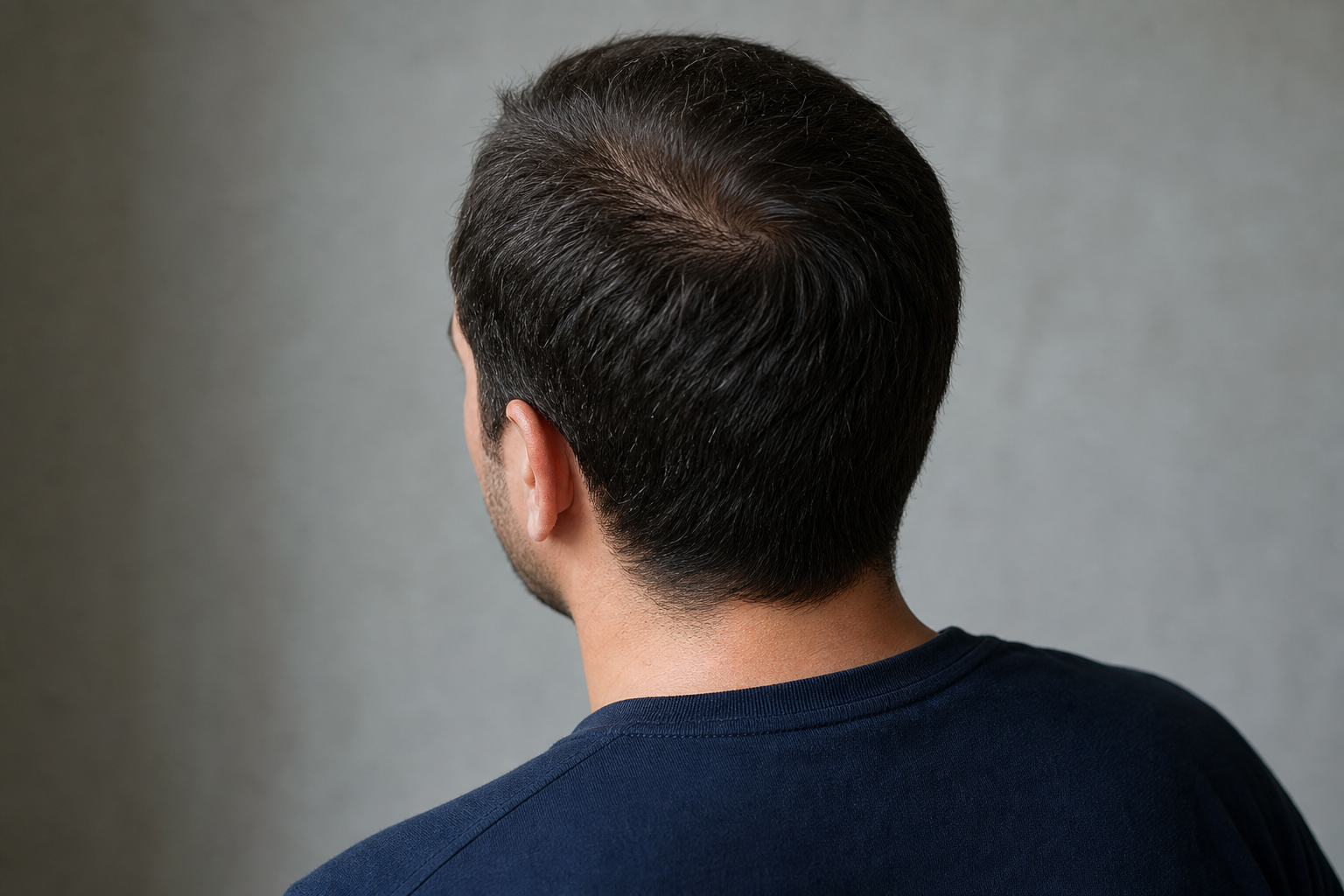
Hair loss at the back of the head is the last thing you notice yourself, usually in a holiday photo or because someone else says something. What tells you the cause is exactly where the hair is thinning: around the whorl, the cause is usually androgenetic alopecia, meaning hereditary hair loss. A thinning patch develops, the scalp starts to show through, and over the years the area grows into a tonsure. On the lower back of the head and at the nape, this particular type of hair loss is atypical, because that zone is resistant to the hormone DHT. Many men are affected: according to the NHS, up to 80% of men show some degree of hair loss by the age of 70. This article sorts out what you are seeing zone by zone, from the Norwood stages to the question of what actually helps at the whorl.
Key takeaways
- ✓The vertex, meaning the upper back of the head around the whorl, is a core zone of hereditary hair loss and is classified using the Norwood stages
- ✓On the lower back of the head and at the nape, hereditary hair loss is atypical; alopecia areata, tension and pressure are the more common explanations there
- ✓A whorl itself never goes bald; it only looks more open. What counts is the hair density at the edge and the trend over three to six months
- ✓In women, the back of the head is usually spared by hereditary hair loss; there it is the centre parting that thins (Ludwig pattern)
The table of contents shows what you will find where. After that we go into detail zone by zone, with a self-check, the Norwood stages and a sober look at the treatments.
Summary
- What is hair loss at the back of the head?
- Where exactly at the back of the head? The zone points to the cause
- Whorl or already a thinning patch? The self-check at the back of the head
- Causes of hair loss at the back of the head
- How far along is it? The Norwood stages at the back of the head
- Hair loss at the back of the head in women
- What effects can baldness at the back of the head have on those affected?
- Diagnosis and treatment options
- Which treatment fits which cause at the back of the head?
- Hair transplant at the back of the head: when it is the permanent solution
- Tailoring the treatment of hair loss at the back of the head to the individual
- Frequently asked questions about hair loss at the back of the head
- Sources
What is hair loss at the back of the head?
Hair loss at the back of the head is often a classic sign of androgenetic alopecia, meaning hereditary hair loss. It is by far the most common form of hair loss in men: in the United States, 53% of men aged 40 to 49 show a moderate to severe form, and after the age of 80 nearly all men do (review “Male Androgenetic Alopecia”, Endotext/NCBI).[2] At the start, the loss usually shows up around the forehead and temples, which is how a receding hairline at the temples develops.
As things progress, hair loss can increasingly shift to the back of the head. A small thinning patch appears there first, gets larger over time and can turn into what is known as a tonsure or monk’s bald spot. The term comes from the shaved patch on the top of the head worn by medieval monks. Characteristically, a ring-shaped rim of hair remains.
Bald patches at the back of the head can have other causes as well. In alopecia areata (patchy hair loss) hair is lost too, but not limited to one particular region; it can appear at various spots on the head. The lifetime risk of this is around 2% (Lintzeri et al., JDDG 2022).[6]
Because the causes differ and the course varies, having it clarified by a doctor early on makes sense. Above all, androgenetic hair loss keeps progressing if left untreated and will not stop on its own.
Where exactly at the back of the head? The zone points to the cause
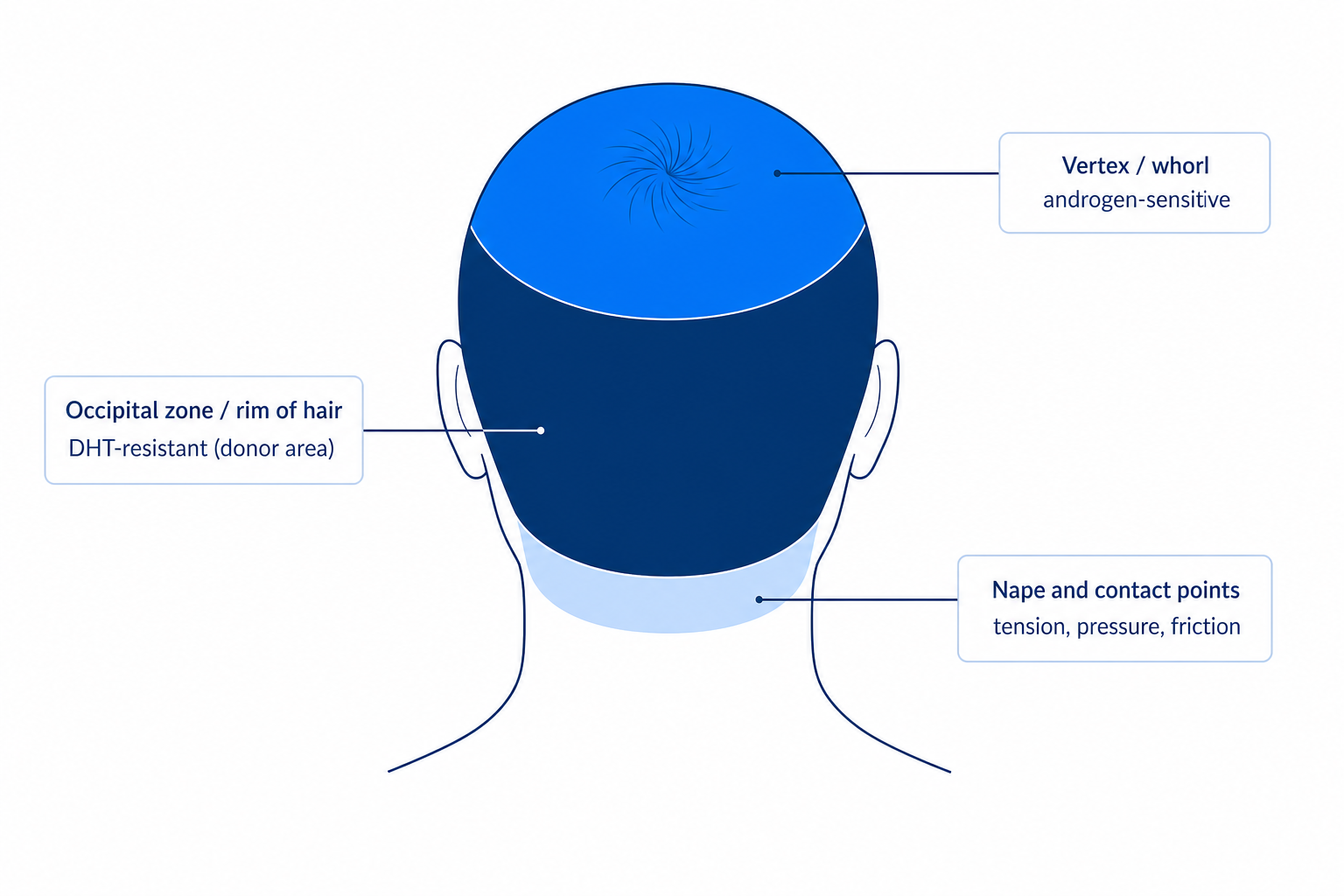
With hair loss at the back of the head, the zone points to the cause: the vertex, meaning the upper back of the head around the whorl, is androgen-sensitive and therefore the classic zone of hereditary hair loss. The lower back of the head and the nape, technically the occipital zone, are considered DHT-resistant. That is precisely why this area serves in a hair transplant as the donor area at the back of the head.
The mechanism behind this is called donor dominance. In 1959, Norman Orentreich described how a transplanted hair follicle keeps its genetic properties wherever it is moved. Sensitivity to dihydrotestosterone (DHT) therefore sits in the follicle itself, not in the scalp. Modern review articles on calculating the donor area confirm this principle as the basis of hair transplantation.[4]
Two things follow from that. First, the rim of hair stays in place while the vertex thins, and an occipital follicle keeps growing at the whorl. Second, hair loss at the nape is a reason to look more closely, and not a reason to assume it is “hereditary”: there, alopecia areata, tension, pressure and inflammatory forms are the more realistic explanations.
| Zone at the back of the head | What you see | Most common explanation | Next step |
|---|---|---|---|
| Vertex and whorl area (upper back of the head) | Scalp shows through around the whorl, the area slowly grows over months, short fine hairs in between | Androgenetic alopecia, vertex type (Norwood II to V) | Determine the Norwood stage, document the course photographically, consider conservative therapy |
| Transition from vertex to the top of the head | A thinning strip connecting the whorl and the parting region | Progressing androgenetic alopecia | Medical work-up, stabilisation before any further planning |
| Occipital zone and rim of hair (mid back of the head) | Circumscribed, sharply defined round bald patch with smooth skin | Alopecia areata; hereditary hair loss is atypical here (DHT-resistant zone) | See a dermatologist promptly |
| Lower hairline, band-shaped from ear to ear | Strip-shaped loss along the lower hairline across the nape | Ophiasis type of alopecia areata | See a dermatologist promptly, prognosis less favourable |
| Nape and contact points (pillow, headrest, helmet, collar) | Diffuse thinning or broken hairs at a friction point | Friction or pressure alopecia | Remove the trigger and observe for three months |
| Tension lines (ponytail, bun, extensions, turban) | Thinning along the tension line, often symmetrical | Traction alopecia | Stop the tension; reversible early on, scarring later |
| Any zone with redness, scaling, pustules, pain or shiny smooth skin | Signs of inflammation or missing follicular openings | Inflammatory or scarring alopecia | Do not wait, have a doctor look at it |
What we see in consultations
When people send us photos of the lower back of the head or of the nape, in most cases the explanation is not hereditary hair loss but a sharply defined patch, a tension line or a friction point. The reverse is true as well: photos of the whorl very often show an early vertex stage that the person still takes for a “strong whorl”. That is why the first question is always about the zone, and not about the treatment.
Whorl or already a thinning patch? The self-check at the back of the head
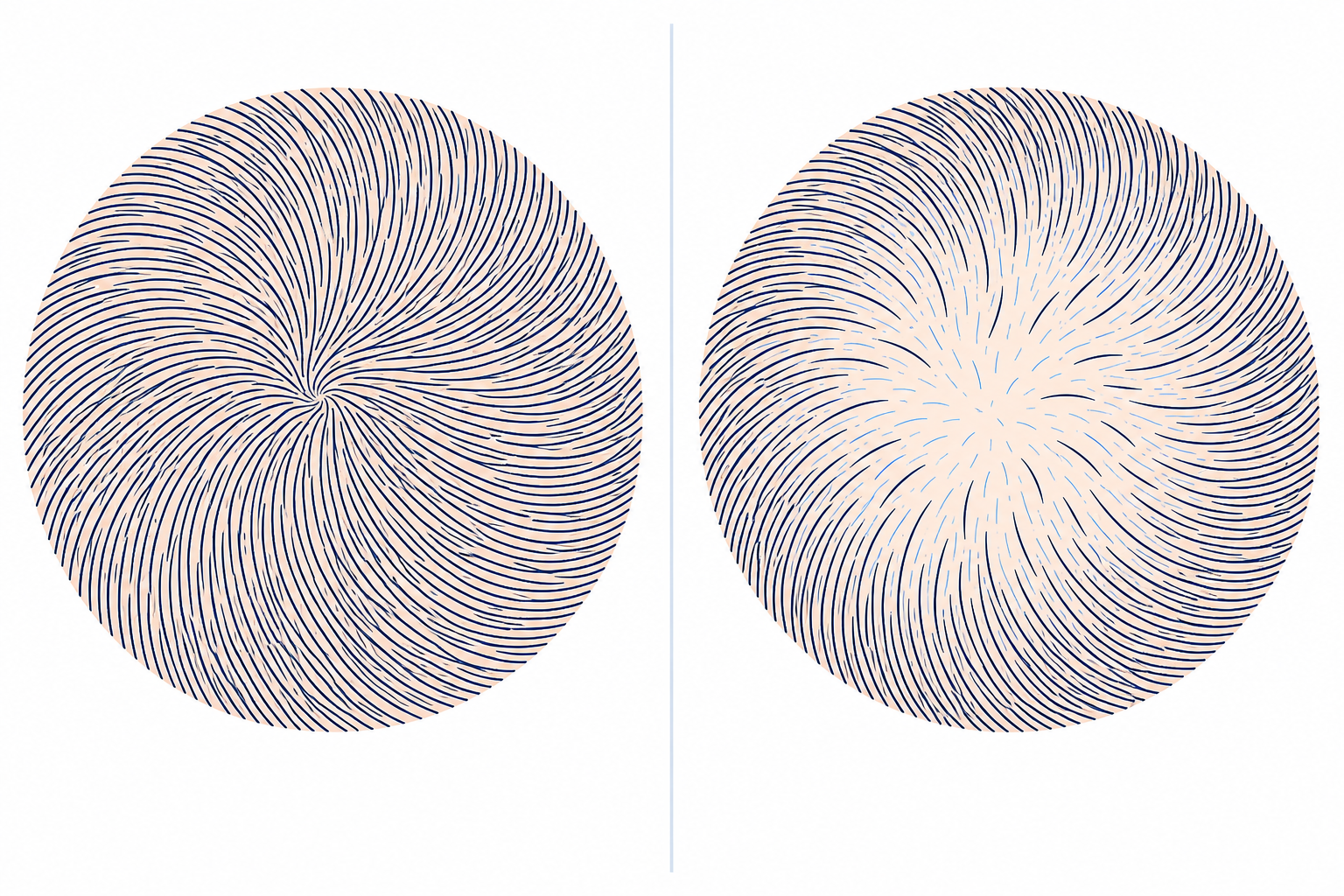
A whorl at the back of the head is a natural growth pattern and never goes bald; an early tonsure, by contrast, spreads outwards from the whorl. The difference is not the size of the open area but the hair density at its edge, the hair calibre and the trend over months. The key trichoscopic criterion of hereditary hair loss is anisotrichosis, meaning a hair shaft diameter variability of at least 20% in men and 10% in women.[5]
How do I tell a whorl from hair loss?
A normal whorl keeps a consistently high density right up to the swirl; an early tonsure thins towards the edge and shows miniaturisation, meaning short fine hairs among the strong ones. Four features separate the two reliably:
- Edge: At a whorl, density stays high right up to the swirl; with a tonsure it decreases towards the edge.
- Hair calibre: At a whorl, all hairs are similarly strong; with a tonsure, short fine hairs stand among the thick ones (miniaturisation).
- Shape: The whorl is a swirl with a clear growth direction, the tonsure a roundish area that grows outwards.
- Trend: The whorl looks the same after three to six months, the tonsure measurably larger.
These four features are exactly what dermatological trichoscopy measures: in the systematic review “Trichoscopy of Androgenetic Alopecia”, hair diameter variability was detectable in 94% of patients with androgenetic alopecia, and vellus hairs in 66%.[5] The self-check does not replace trichoscopy. It only tells you whether you can calmly keep watching or should make an appointment.
| Feature | Normal whorl | Early tonsure |
|---|---|---|
| Density at the edge of the open area | Stays high right up to the swirl | Decreases towards the edge, soft transition |
| Hair thickness within the area | Evenly strong | Thick and thin hairs mixed, many short fine hairs |
| Shape | Swirl with a recognisable growth direction | Roundish area, grows outwards |
| Trend over 3 to 6 months | Unchanged | Area measurably larger, scalp more clearly visible |
| Behaviour with wet hair | Looks more open when wet, normal again when dry | Visible even when dry and unstyled |
| Other areas of the head | Hairline and temples unchanged | Often a receding hairline at the temples as well |
| What to do now | Start a photo diary and compare in 3 months | Appointment with a dermatologist, determine the stage |
Photo diary for the back of the head
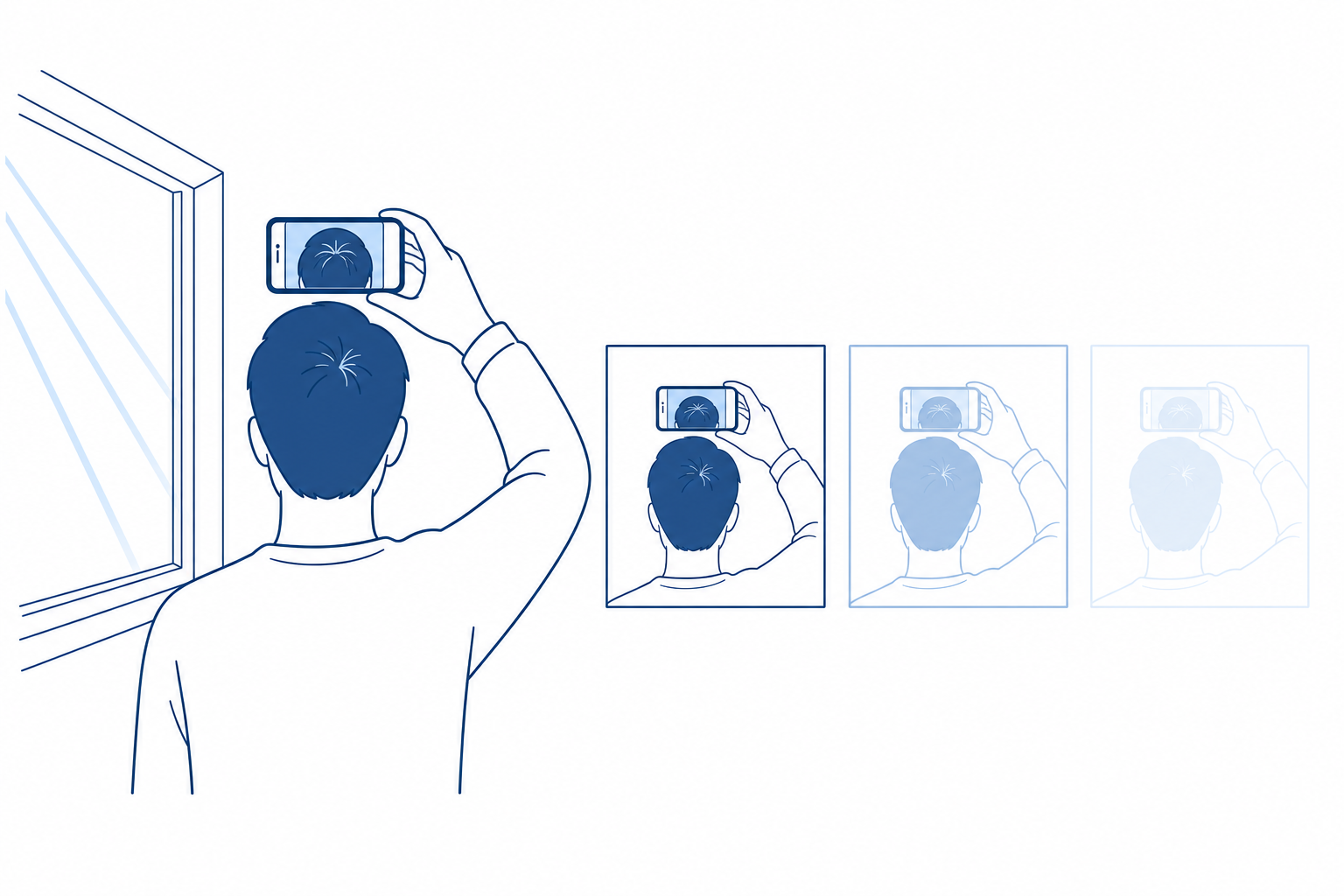
- Daylight by a window, no overhead light from above
- Hair dry, unstyled, parted as always
- Camera from above and behind, always the same distance and angle
- Always the same time of day and the same lighting
- Photos now, in 3 and in 6 months, file name with the date
- For the comparison, put both images side by side; do not judge from memory
The diary is a guide for the conversation with your doctor and does not replace a medical diagnosis.
The three most common false alarms at the whorl
Most false alarms at the back of the head come from lighting, styling and growth patterns. There are no studies on these three points; they are everyday experience from consultations, but they explain a large share of the worries. First, wet hair, gel and wax clump the hairs at the whorl together, and then every scalp shows through. Second, overhead light casts shadows into the swirl. Third, a double crown is a growth pattern and not hair loss, it just looks more unruly.
Two more points belong here, because they often get mixed up. A sunburn at the whorl is the opposite, a sign worth taking seriously: where there is less hair, UV protection is missing, and that points to genuinely reduced density. And sleeping on your back does not cause hair loss. Genuine pressure alopecia is described in the literature after hours of immobility, for instance after lengthy operations, not after a normal night.
How quickly does a tonsure develop at the back of the head?
A tonsure at the back of the head develops individually and usually over years, not weeks. There is no fixed speed; only the direction is well documented: in an Australian cohort, the proportion of men with a vertex or full baldness type rose from 31% among 40- to 55-year-olds to 53% among 65- to 69-year-olds.[2] Hereditary hair loss therefore progresses in waves over decades.
For your decision, your own speed matters more than any average. If the area visibly grows between two photos taken six months apart, the course counts as active, and then a medical assessment makes sense before you start thinking about a transplant. If the picture stays the same over a year, that points to a slow or stabilised course. That is exactly why the photo diary is more than a reassurance exercise: it gives you the only record of the progression that you can put together yourself.
Causes of hair loss at the back of the head
The most common cause of hair loss at the back of the head is androgenetic alopecia at the vertex, meaning the genetic predisposition around the whorl. Beyond that, hormonal, metabolic and mechanical triggers come into question, and they differ in pattern and course. The most common causes include:
- Genetic predisposition: With hereditary hair loss (androgenetic alopecia), the hair roots at the temples, in the forehead area and at the vertex, the upper back of the head around the whorl, react especially sensitively to the hormone DHT. The lower back of the head and the nape are usually spared; they are DHT-resistant.[4]
- Hormonal changes: A hormonal imbalance or an increased sensitivity to DHT can disrupt the hair cycle and speed up the loss in the typical areas.
- Stress: Sustained physical or psychological stress can shift the hair cycle. The resulting hair loss appears with a delay, typically two to three months after the trigger.
- Nutrient deficiency: If the body lacks iron, vitamin D, zinc or protein, the supply to the hair roots can suffer. This hair loss, though, is diffuse across the whole head and not limited to the back.
- Illnesses: Thyroid disorders, autoimmune diseases and skin conditions can change the hair growth cycle and encourage hair loss.
- Medications: Certain drugs can cause hair loss as a side effect, and it shows up at the back of the head among other places.
To pin down the exact cause, a medical examination of the scalp and hair roots and, where appropriate, blood tests are useful. Treating the cause specifically is what counts, even when the loss in this area is already advanced.
Causes that typically show up on the lower back of the head and at the nape
On the lower back of the head and at the nape, different causes lead the field than at the vertex, because this zone is resistant to DHT. Here is the group you should know if the patch is not at the whorl:
- Alopecia areata (patchy hair loss): sharply defined, smooth round patches with exclamation mark hairs at the edge. The band-shaped ophiasis type at the lower hairline has a prevalence of around 0.02% and is considered prognostically less favourable (Lintzeri et al., JDDG 2022).[6]
- Traction alopecia: tension from a ponytail, bun, cornrows or extensions, fully reversible early on, scarring after years.[8]
- Friction and pressure alopecia: rubbing against a pillow, headrest, helmet or collar.
- Inflammatory and scarring causes: at the nape, the leading one is acne keloidalis nuchae (StatPearls),[9] plus folliculitis decalvans, ordinary folliculitis and tinea capitis in children.
- Trichotillomania: mechanical pulling of the hair, with uneven hair lengths within the patch.
- Diffuse forms: a telogen effluvium after an infection, an operation, dieting, iron deficiency or a thyroid disorder affects the whole head, but is noticed at the whorl first (overview of all causes).
Redness, scaling, pustules, itching or pain are the warning signs in all inflammatory forms, because once scarring has happened the follicle is lost, and active scarring alopecias are a clear contraindication for a hair transplant.[9] What helps against which form and how long it takes is collected in the table Cause, treatment and time frame.
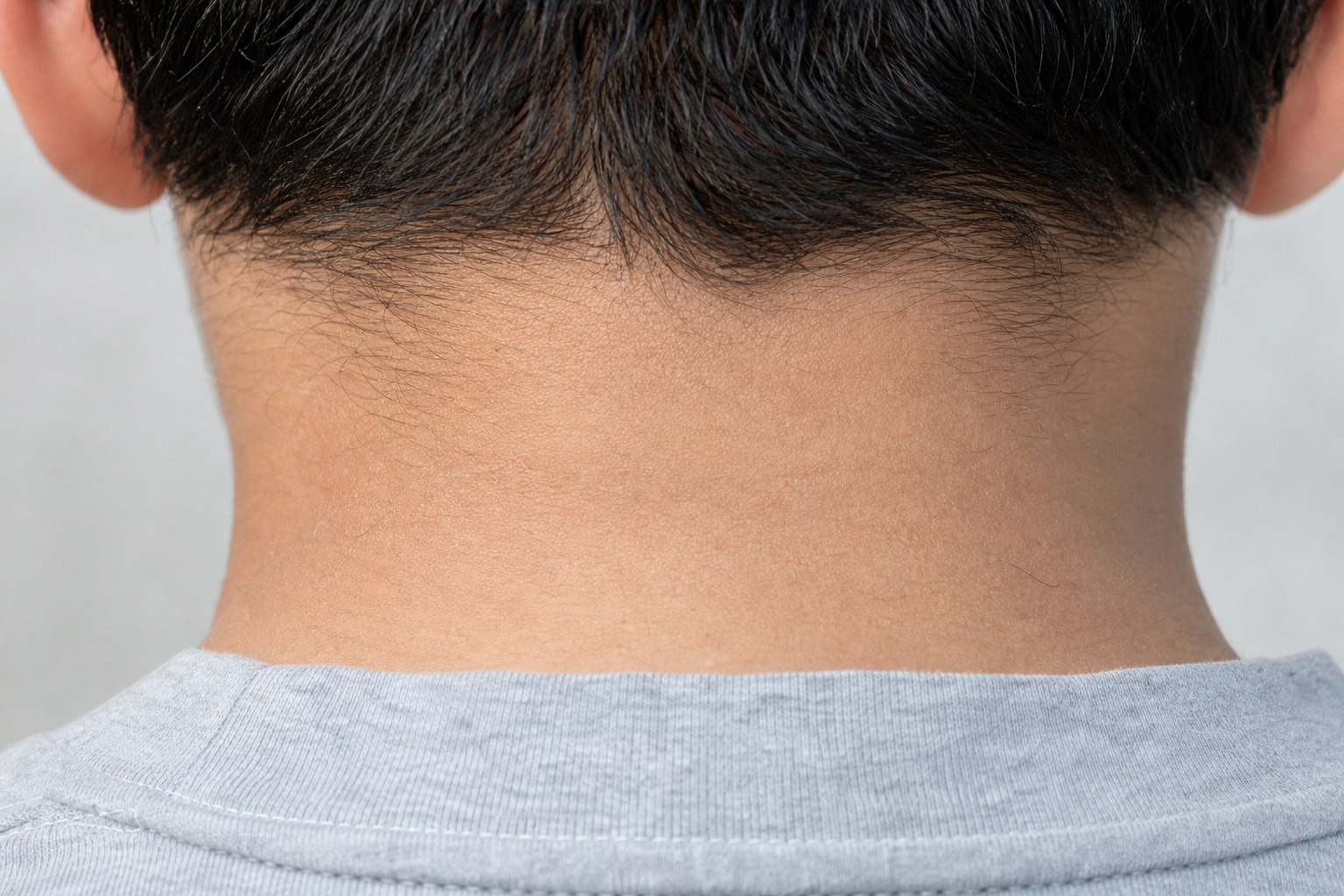
Hereditary hair loss at the nape? Why that is unlikely
Hereditary hair loss at the nape is atypical, because the occipital zone is resistant to dihydrotestosterone and is therefore considered the “safe zone” in hair transplantation.[4] If it does thin there anyway, three constellations speak for it: alopecia areata of the ophiasis type, a mechanical cause from tension or friction, or diffuse hair loss that affects the whole head and is simply noticed at the nape first.
In practice that means: a bald patch below the whorl is not an argument for “I am going bald”; it is a reason for a dermatological work-up. It also changes the therapy, because minoxidil and finasteride address androgenetic hair loss and not these forms.
Symptoms of hair loss at the back of the head
Losing 50 to 100 hairs a day is considered normal, and some guides put the range at 70 to 100 (NHS, American Academy of Dermatology).[10][1] There is no sharp threshold. It becomes notable when it is consistently and clearly more over several weeks. Hair loss at the back of the head usually makes itself felt gradually at first: the hair looks thinner overall, the scalp shows through more and more and is harder to cover up.
The real early sign, though, is not counting, it is miniaturisation: short, fine hairs among the strong ones, technically anisotrichosis. At a diameter variability of 20% or more in men and 10% or more in women, it counts as a diagnostic criterion of androgenetic alopecia.[5] These are exactly the hairs that are hard to style and stick out unevenly.
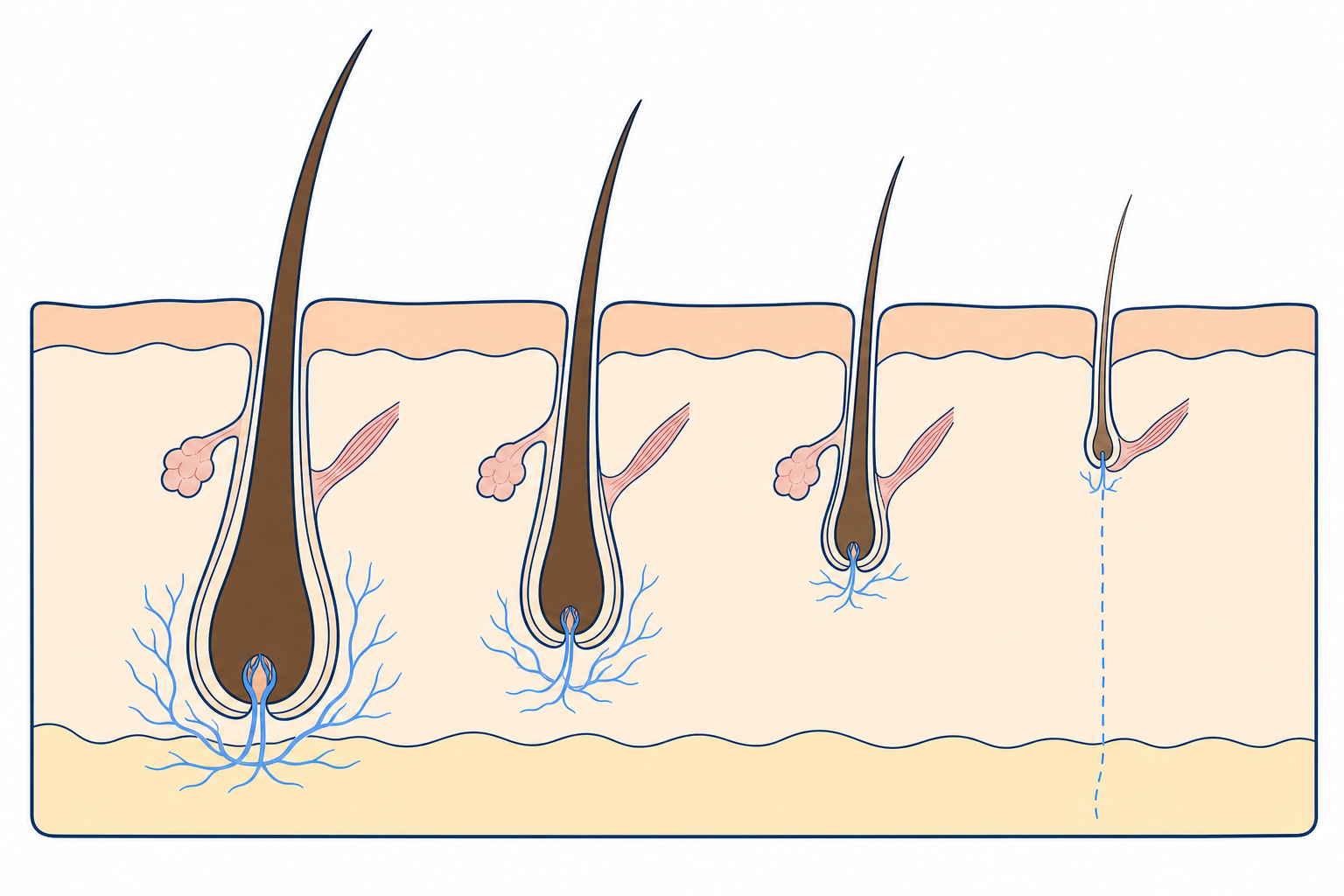
If the cause goes untreated, the initially small thinning patch at the back of the head can gradually get larger. At an advanced stage a clearly visible bald zone forms, while often only a rim of hair remains around the nape and the ears.
This course is typical of hereditary hair loss and can extend across the entire top of the head as it goes on. Clarifying it early is therefore important, so that the loss is recognised in time and treated in a targeted way.
How far along is it? The Norwood stages at the back of the head
Hair loss at the back of the head is classified using the Hamilton-Norwood scale as follows: the vertex type begins with an open patch at the whorl and grows until the vertex and the receding hairline merge into one bald area. The scale covers stages 1 to 7 and is reproducible, which makes it usable for tracking the course as well.[2] How often the vertex is affected depends heavily on age: in an Australian cohort, 31% of men aged 40 to 55 and 53% of those aged 65 to 69 showed a vertex or full baldness type.[2]
For you, the stage matters for a practical reason: it decides whether conservative therapy can still meaningfully preserve the hair that is there and whether a transplant would deliver a stable result. The full scale with all stages and images is in our article on the Norwood-Hamilton scale.
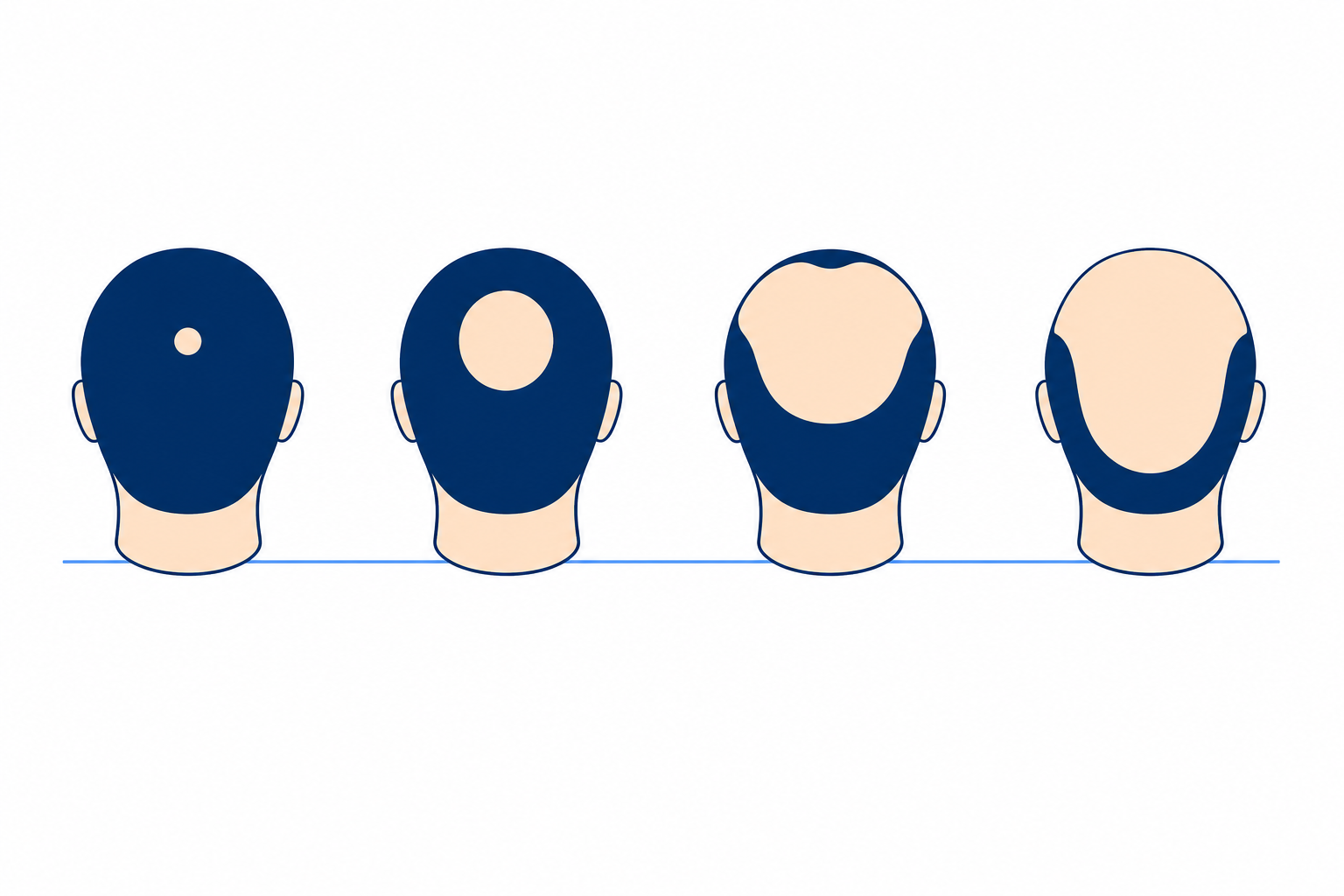
| Stage | What is visible at the back of the head | What makes medical sense | What that means for a transplant |
|---|---|---|---|
| Norwood II to III (vertex type) | Small open patch at the whorl, scalp shows through when the hair is wet, fine hairs in between | Confirm the diagnosis, document the course, consider conservative therapy | Usually too early: stabilise first and watch the course |
| Norwood IV | Clear tonsure at the vertex, with a band of hair still running to the forehead region | Conservative stabilisation, medical assessment of the speed | Plannable if the course has been stable for at least a year or has been stabilised with medication |
| Norwood V | The band of hair between vertex and forehead gets narrow, vertex and the top of the head move closer together | Stabilisation plus realistic planning of the priorities | Possible, the donor area now becomes the limiting factor |
| Norwood VI and VII | Vertex and forehead region are connected, the rim of hair remains | Medical assessment of the donor density, clarifying expectations for the area | Area and donor reserve are the deciding factors; an even full density is not achievable |
Hair loss at the back of the head in women
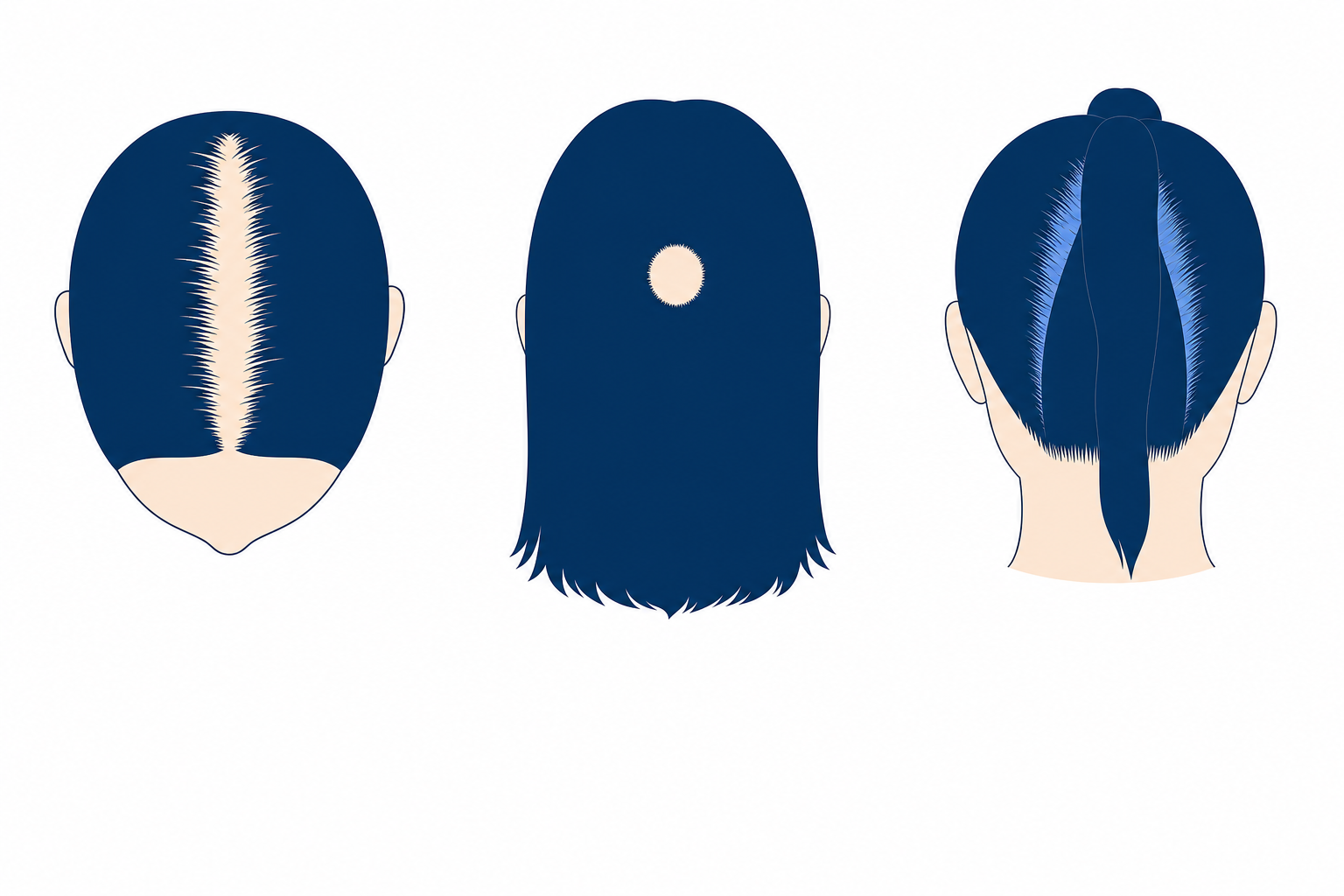
In women, the back of the head is usually not affected by hereditary hair loss: the female pattern according to Ludwig I to III thins the centre parting and the top of the head, while the frontal hairline and the back of the head stay intact. In the review “Female Pattern Hair Loss”, precisely this preservation of the hairline is the key feature, and the work-up compares central parting density against occipital density, because the occipital region stays stable.[11] According to the Spanish AEDV consensus document, just under 10% of women are affected.[3]
A circumscribed bald patch at the back of the head is therefore a different signal in a woman than in a man. In order of likelihood: alopecia areata, traction from a ponytail, bun or extensions, friction at contact points, a diffuse telogen effluvium after childbirth, after stopping the pill, with iron deficiency or a thyroid disorder, and inflammatory scarring forms. More on the female course is in the article on hair loss in women and on diffuse hair loss.
You should not wait if the patch is round and sharply defined, if the scalp reddens, scales, itches or hurts, if it looks shiny and smooth without visible follicular openings, if the loss starts suddenly within weeks, or if there are additional menstrual irregularities, acne, increased body hair or fatigue. In women, a hair transplant is only an option with a stable, clearly delimited cause and a sufficient donor area; with diffuse loss it is not indicated.
| Pattern | Typical location | What can be behind it | Urgency |
|---|---|---|---|
| Centre parting gets wider | Top of the head and parting, back of the head and hairline intact | Female pattern hair loss (Ludwig I to III) | Have it clarified without rush, document the course over months |
| Round, sharply defined patch | Anywhere at the back of the head, also band-shaped at the nape | Alopecia areata, at the nape the ophiasis type | Have a dermatologist look at it promptly |
| Thinning along the tension line | At the base of the ponytail, bun or extensions, often symmetrical | Traction alopecia, reversible early on, scarring later | Stop the tension immediately, have it checked by a doctor |
| Evenly less hair everywhere | Whole head, first noticeable at the whorl and parting | Telogen effluvium after childbirth, dieting, an infection, with iron deficiency or a thyroid disorder | Have blood tests done, observe the course for 3 to 6 months |
| Redness, scaling, pustules or shiny smooth skin | Any zone, often centrally on the top of the head or at the nape | Inflammatory or scarring alopecia | Do not wait, follicles are time-critical |
What effects can baldness at the back of the head have on those affected?
Hair loss at the back of the head is a measurable burden for many of those affected, but according to the evidence it is not a trigger of clinical depression. The back of the head has one peculiarity here: you never see it yourself, while other people see it constantly. That is exactly where the sense of having handed over control of your own appearance comes from.
What many people feel day to day can also be shown in numbers. A meta-analysis in JAMA Dermatology covering 41 studies with 7,995 patients found a significant impairment of quality of life in androgenetic alopecia and a moderately burdened emotional dimension (DLQI 8.16; Hair-Specific Skindex-29: 29.22 points).[12] The same analysis, however, found no significant association with clinical depression.
That is the more important message behind the figures: the burden is real and there is no reason to play it down, but it is not a diagnosis either. Younger men in particular experience the change as a turning point, feel older than they are, or avoid photos and group situations. In the few studies available on this, women reported lower self-esteem than men.[12]
How strongly the burden is felt varies a great deal from person to person. What is clear, though: for many people hair loss is more than a cosmetic issue. Looking at the causes and the possible treatment options early helps to put the situation in perspective and to regain confidence in dealing with your own appearance.
Diagnosis and treatment options
Diagnosing hair loss at the back of the head runs through trichoscopy, a pull test, blood tests and, in exceptional cases, a biopsy; the treatment then follows the cause that has been found. Targeted therapy is only possible once that cause is known. That is how reversible triggers are recognised, and progressive hair loss can in some cases be slowed down.
One exception is hereditary hair loss. With this form, the loss cannot be halted completely by medical means, only limited or slowed. That makes a realistic view of the possible therapies all the more important.
A dermatologist is the right person for the diagnostic work-up. Examining the scalp and hair roots and, where appropriate, running blood tests can reveal hormonal, metabolic or other causes. On that basis it can be judged which treatment options make sense in an individual case.
What actually happens at your appointment
The work-up for hair loss at the back of the head consists of four steps, each of which answers a question of its own. Trichoscopy, meaning dermoscopy of the scalp, is the centrepiece: it shows the anisotrichosis of androgenetic hair loss (threshold 20% in men, 10% in women), the exclamation mark hairs of alopecia areata and the loss of follicular openings as a sign of scarring alopecia.[5][6]
- Trichoscopy: Is there miniaturisation, are the follicular openings preserved, are there signs of inflammation? That separates androgenetic, patchy and scarring forms.
- Pull test and trichogram: How active is the shedding right now, and which cycle phase are the hairs in? That separates acute diffuse shedding from slow pattern hair loss.
- Blood tests: Ferritin, TSH, vitamin D and zinc, plus androgen status in women. This finds reversible contributing causes, which an overview of the causes of hair loss describes in detail.
- Biopsy: only if a scarring alopecia is suspected, when follicular openings are missing or the skin looks shiny and smooth.

Do not wait if …
- the patch is round and sharply defined, with smooth skin
- the scalp reddens, scales, weeps, shows pustules or hurts
- the skin looks shiny and smooth without visible follicular openings (a sign of scarring)
- the shedding started suddenly within a few weeks
- patches appear on a child
- there are general symptoms as well, such as fatigue, weight changes or menstrual irregularities
The reason for the hurry: with inflammatory and scarring forms, time decides whether the follicle survives. With a purely androgenetic course you can plan calmly.

Preventing hair loss at the back of the head
Hair loss at the back of the head can only be prevented where a mechanical or a reversible cause is behind it; no care routine prevents the hereditary course at the vertex. Preventive measures therefore make sense above all with an early or mild finding and after a medical work-up. In some cases, adjusting your lifestyle helps on its own, for instance reducing stress or eating a balanced diet.
Gentle hair and scalp care plays a role as well. Mild shampoos, lukewarm water and going easy on the heat when blow-drying or styling put less strain on the scalp. When combing, too, unnecessary pulling should be avoided.
For healthy hair growth the body needs various vitamins, minerals and trace elements such as zinc, biotin or magnesium. A balanced diet helps to supply the hair roots. If food alone does not cover it, supplements can help, but only in a targeted way and after professional advice.
Specifically at the back of the head, there is also mechanical relief : change hairstyles that pull constantly, reduce friction from helmets and pillows, and use satin or silk instead of cotton to reduce night-time friction. For mechanically caused forms this addresses the cause, since traction alopecia is fully reversible early on.[8] With hereditary hair loss you have to stay honest: there is no evidence that care or lifestyle prevents it.
Topical treatment option
The standard topical treatment for hair loss at the back of the head is minoxidil, and, of all places, its effect is best documented at the vertex. Alongside it, further drug-based approaches are available that can slow the loss or stabilise the existing hair. Frequently used are minoxidil or finasteride, which can have a densifying effect in certain forms of hair loss.
For the whorl, the data are particularly good. The licensing studies on topical minoxidil defined their target area at the vertex and counted the number of non-vellus hairs there: in the randomised study by Olsen et al. (2002), 5% minoxidil produced about 45% more regrowth after 48 weeks than 2%.[13] First terminal hairs appear after roughly four months, a reliable assessment needs at least 24 weeks, and in the first 2 to 8 weeks a temporary increase in shedding is possible.[13][14][2]
An important limit in the same breath: This effect applies to androgenetic alopecia. It does not apply to alopecia areata, not to traction or pressure alopecia and not to inflammatory or scarring forms. Dabbing minoxidil on an alopecia areata patch at the nape wastes time that really matters there.

A realistic view also matters: these therapies work only for as long as they are used. Once the treatment stops, the hair loss usually starts again. They are therefore not a permanent solution. In women of childbearing age, finasteride is not indicated.[3]
The add-on procedures, soberly classified: for PRP a 2023 meta-analysis of randomised studies shows significantly higher hair density after 3 and 6 months compared with placebo, but no significant difference in hair count or hair diameter.[15] In combination with minoxidil, density was better than under minoxidil alone.[16] Microneedling counts as a supplementary procedure with limited evidence, best studied in combination with light or drug therapy.[14] Finally, low-level laser therapy is listed by professional bodies as an option for androgenetic hair loss, and its evidence is weaker than that of minoxidil and finasteride.[17]
Which treatment makes sense depends on the cause and the stage. An early medical work-up is therefore decisive for choosing a suitable therapy and avoiding the wrong one. Applying something improperly or without a clear target can in some cases even make the loss worse.
Which treatment fits which cause at the back of the head?
Treating hair loss at the back of the head follows the cause and not the spot: reversible causes are fixed, hereditary hair loss is slowed, and follicles that have been lost can only be replaced by a transplant. The fourth column of the table is the part most people underestimate, because every effect follows the hair cycle and not the calendar of the person waiting for it.
| Cause | Typical zone at the back of the head | What the treatment addresses | When you can see a result | Realistic expectation |
|---|---|---|---|---|
| Androgenetic alopecia (vertex type) | Whorl and upper back of the head | Topical minoxidil, finasteride after medical consideration, PRP as an add-on; transplant with a stable course | First terminal hairs after about 4 months, assessment from 24 weeks, maximum around week 48 | Stabilisation and densification, no restoration of youthful density; effect only while it is being used |
| Alopecia areata (including the ophiasis type) | Circumscribed patches, band-shaped at the nape | Dermatological therapy according to current guidelines, no self-treatment | After the first episode, around 50% recover spontaneously within a year | Course in flare-ups, relapses are common; transplanting into active patches is contraindicated |
| Traction alopecia (tension) | Tension lines, base of a ponytail, bun, extensions | Stop the tension, change the hairstyle, medical check-up | 3 to 6 months after the tension is gone, if there is no scarring yet | Fully reversible early on; after years of tension it scars and is then permanent |
| Friction or pressure alopecia | Contact points: pillow, headrest, helmet, collar | Remove the trigger, reduce friction | 3 to 6 months of observation after the strain is gone | Usually reversible as long as no scarring has set in |
| Inflammatory or scarring alopecia (including acne keloidalis nuchae) | Lower hairline and nape | Prompt dermatological treatment of the inflammation | The goal is to stop the inflammation, not regrowth; if treated early, the prognosis is good | Scarred areas do not grow back, active forms are a contraindication for a transplant |
| Diffuse hair loss (telogen effluvium, deficiency, thyroid) | Whole head, first noticeable at the whorl | Treat the cause: iron, thyroid, medication, trigger | First new hairs after about 3 to 6 months, density assessable after 9 to 12 months | Usually reversible; a transplant is not indicated here |
Why the time frames look the way they do is explained by the hair cycle: the growth phase (anagen) lasts 2 to 5 years, the resting phase (telogen) around 3 months, and about 15% of follicles are normally in telogen. A follicle that is pushed into the resting phase today can only produce a visible hair again months later. The following table shows the typical course after a reversible cause has been fixed.
| Period | What happens in the follicle | What you see |
|---|---|---|
| Month 1 to 2 | The trigger is gone, the telogen rate slowly normalises | The increased shedding subsides; the brush stays emptier |
| Month 3 to 4 | Resting follicles re-enter the growth phase (anagen) | No densification yet, but the shedding has calmed down |
| Month 5 to 6 | New hairs grow out, short and fine at first | Short new hairs at the roots, often visible at the parting as “baby hair” |
| Month 9 to 12 | The new hairs reach length and calibre | Density can be assessed, now the photo comparison pays off |
One option is missing from the table, because it changes nothing medically and yet carries many people through this time: camouflage. At the whorl, what works above all is a shorter cut, because it reduces the contrast between hair and scalp, plus matte instead of shiny products, no gel that clumps strands together, and hair fibres or scalp micropigmentation if needed. It is a deliberate interim step, as long as the diagnosis is still open or you decide against treatment. The only thing that matters is that camouflage does not replace the work-up: an inflammatory or scarring cause does not get better underneath it, it just becomes invisible.

Hair systems and hairpieces at Norwood VI and VII
A modern hair system, meaning a human-hair piece fitted to the scalp, is the most honest non-surgical alternative at Norwood VI and VII, because at these stages the rim of hair as a donor area is rarely enough for an even full density across the whole surface. It does not change the hair loss; it covers it, and it does so immediately instead of after months.
Anyone considering this should know three things. The system is glued on or woven in and needs regular maintenance, usually every few weeks. At the transition to your own hair, the craftsmanship of the fitting determines the result, not the price of the material. And the scalp underneath has to be healthy: with inflammatory or scarring forms at the back of the head, the condition needs to be treated first, otherwise the system covers up a finding that costs time.
It also makes sense as an interim solution while the course is still active. For many people, a hair system or scalp micropigmentation is the way to bridge the years until the finding is stable, without deciding on a procedure under pressure. Others get along just as well with a consistently short cut. Both are legitimate decisions and not a last resort.
Dermatologist or hair clinic: who should you see?
With inflammatory, patchy, sudden or unclear findings at the back of the head, your GP or a dermatology clinic is the right first port of call; with a hereditary vertex course, a hair clinic answers the question of donor area and feasibility. The two paths do not compete; they answer different questions.
In practice that means: redness, scaling, pustules, pain, shiny smooth skin without follicular openings, round patches or an onset within a few weeks belong in a dermatological work-up, including blood tests and, if needed, a biopsy. A slowly growing thinning area around the whorl without signs of inflammation, on the other hand, is the classic case for an assessment of whether and when anything can be planned at the vertex at all.
That is exactly where our free hair analysis comes in. It is a visual pattern analysis of your photos: it places the zone, estimates the Norwood stage and the donor area and, above all, answers whether a transplant is the right therapy at this point at all. For a substantial share of enquiries it is not, and then we say so. It does not replace a medical blood test or a dermatological diagnosis.
Hair transplant at the back of the head: when it is the permanent solution
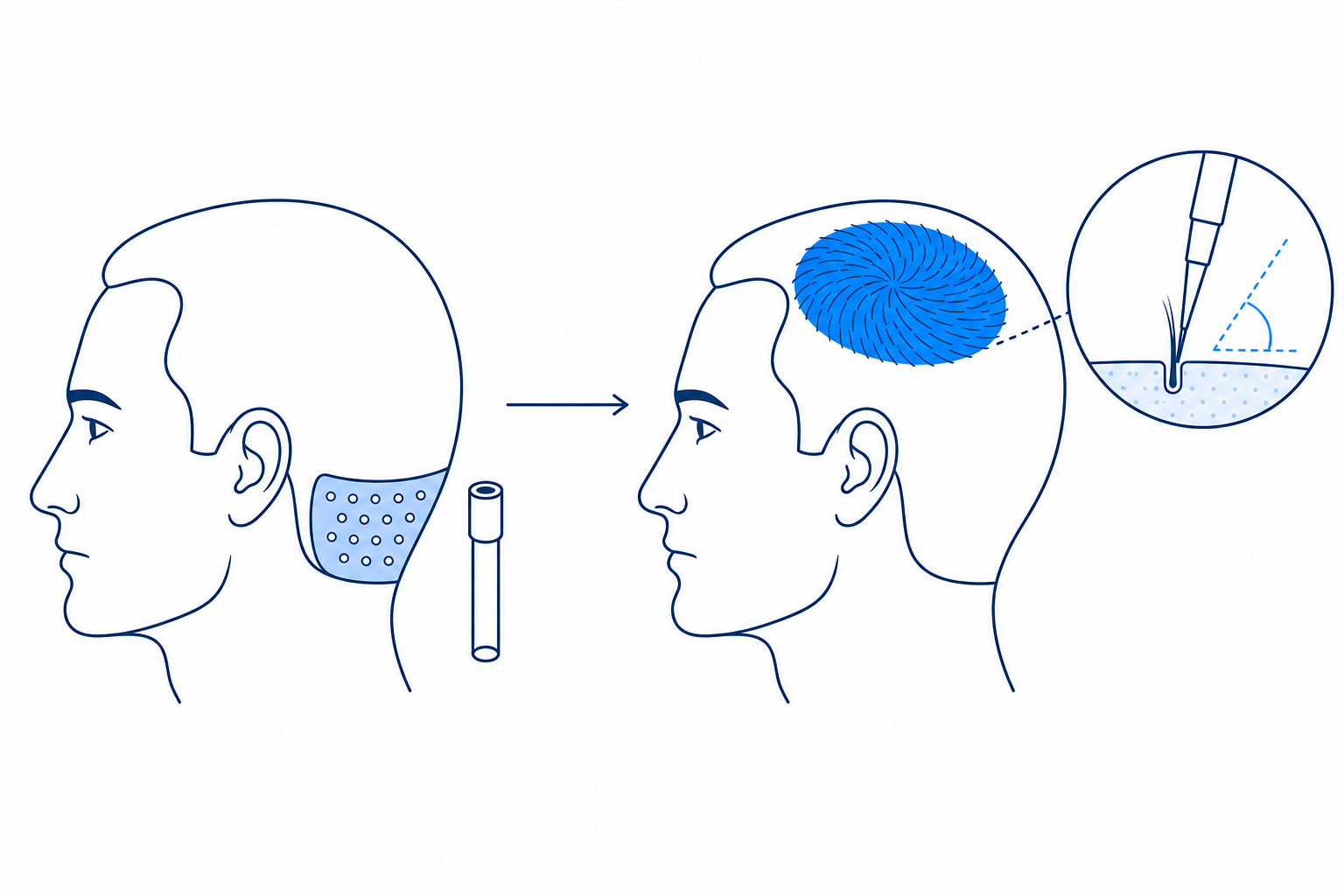
A hair transplant at the back of the head works permanently when the hair loss is androgenetic and stable in its course and the donor area is sufficient. With hair loss at the back of the head caused by androgenetic alopecia, non-surgical treatments often reach their limits. The hair roots in the affected area are then heavily miniaturised and, at the final stage, replaced by connective tissue; they no longer produce visible hair.[18] In this case, a transplant using your own hair is considered the only medically established way to replace lost hair permanently.
The advantage is that genetically stable hair follicles are usually still present at the sides and the back of the head. These do not react sensitively to dihydrotestosterone (DHT) and are therefore suitable as donor hair. How much may be harvested from this zone is part of the medical planning, and the article on the donor area explains it.
The extraction is usually done with the FUE method (Follicular Unit Extraction), in which individual follicular units are removed gently and with minimal scarring. For placing the hair follicles precisely, the DHI technique (Direct Hair Implantation) is used, which at Elithair is standard and included in the price. It allows precise control of growth direction and density, and that is exactly what counts at the whorl.
After an initial resting phase, new hair growth begins and develops over several months. The result can usually be assessed after 9 to 12 months. What you get is permanently growing hair of your own with a natural appearance. The design of the area and the growth direction are determined by the doctor, and every step is signed off by a doctor.
When a transplant at the whorl makes sense
Speaks in favour
- The androgenetic cause has been medically confirmed
- The course has been stable for at least a year or has been stabilised with medication
- The donor area at the back of the head is dense and large enough
- Expectations for the density achievable at the whorl are realistic
Speaks against it, or for waiting
- Active or unstable alopecia areata: transplanting into an active patch is contraindicated, because the autoimmune process can attack transplanted follicles as well
- Untreated inflammatory or scarring alopecia
- Very young patient with rapidly progressing loss
- Diffuse hair loss across the whole head
- Weakened or thinned-out donor area
This list is a guide. Suitability is always decided by the doctor in the individual case.
One point about the surface that helps with the decision: the vertex is an area with a whorl structure, not a line. For the same visible effect it takes more grafts than at the hairline, and if the hair loss is still progressing, donor hair has to be kept in reserve for later. That is why young patients with active vertex loss are often stabilised first and transplanted later. The procedure and the details of a transplant in the whorl area are covered in a separate article.
Tailoring the treatment of hair loss at the back of the head to the individual
Hair loss at the back of the head is not a condition in its own right; it is a symptom, which is why every sensible treatment starts at the cause and not at the bald patch. If a genetic predisposition is behind it, lost follicles can only be replaced long term by a hair transplant . With all other causes the order is reversed: treat the cause first, then think about cosmetics or surgery.
The next concrete step is a small one. Take the first photo of the back of your head today, following the photo diary, and mark a date three months from now in your calendar. If the comparison shows a growing area, or if you see one of the warning signs from the box above, then the finding belongs in a doctor’s hands, not in a forum.

Frequently asked questions about hair loss at the back of the head
Is a visible whorl at the back of the head already hair loss?
No. At the whorl, the hairs fan out in a spiral, which is why some scalp always shows through there. Only three signs point to hair loss: density that decreases towards the edge, short fine hairs among the strong ones (anisotrichosis of 20% or more in men) and an area that grows over three to six months.
How do I tell whether the bald patch at the back of my head is growing?
Only by comparing photos under identical conditions. Daylight by a window, dry unstyled hair, the same distance and angle, photos now and after 3 and 6 months. Shorter intervals mainly show differences in light and styling, because the hair cycle takes several months.
Can hereditary hair loss occur only at the back of the head?
Yes. That is the vertex type of androgenetic alopecia: the thinning patch starts at the whorl, and the hairline stays put at first. The Norwood scale lists it as stage III vertex. The lower back of the head and the nape are spared, because this occipital zone is DHT-resistant.
What does a round bald patch at the back of the head mean?
Usually alopecia areata. A round, sharply defined patch with smooth skin points to it; the lifetime risk is around 2%. Band-shaped at the lower hairline it is called the ophiasis type, prevalence around 0.02%, with a less favourable prognosis. Both should be seen by a dermatologist promptly.
Can hair loss at the back of the head be caused by a pillow, a helmet or a headrest?
Yes. As friction or pressure alopecia, exactly at the contact point, often with broken hairs. It usually resolves within 3 to 6 months once the strain is gone. Genuine pressure alopecia, by contrast, is described after hours of immobility, for instance after lengthy operations.
Hair loss at the back of the head in women: when is it critical?
In women, any circumscribed patch at the back of the head needs an explanation. The female Ludwig pattern thins the parting and spares the back of the head. You should have it clarified promptly if there is a round, sharply defined patch, a reddened, scaling or painful scalp, shiny smooth skin without follicular openings, or a sudden onset.
Does hair loss at the back of the head grow back on its own?
That depends on the cause. With alopecia areata, around 50% recover spontaneously within a year after the first episode; diffuse forms usually 3 to 6 months after the trigger is gone. Hereditary hair loss at the vertex does not reverse on its own, it progresses if left untreated.
Does minoxidil work better at the whorl than at the hairline?
At the vertex the effect is best documented. That is where the licensing studies measured their target area. In Olsen et al. (2002), 5% minoxidil produced about 45% more regrowth after 48 weeks than 2%, with first terminal hairs after about 4 months. This applies only to androgenetic hair loss.
How many hairs a day are normal?
50 to 100 hairs a day. That is the range named by the NHS and the American Academy of Dermatology; some guides say 70 to 100. There is no sharp cut-off, because the number varies with washing routine and season. It is notable when it stays consistently and clearly higher for weeks.
Am I too young in my early twenties for a transplant at the whorl?
It is not age that decides, it is the stability of the course. With rapidly progressing vertex loss, the usual approach is to stabilise conservatively first; otherwise more hair is lost around the transplanted area and donor hair is missing later. Suitability is assessed by the doctor in each individual case.
Do gel and wax make the whorl look balder than it is?
Yes, that is the most common false alarm. Wet hair or hair clumped with gel lies in strands, so scalp shows through at every whorl, and overhead light casts shadows into the swirl. There are no studies on this: judge only dry, unstyled hair in daylight.
Do I have hair loss or a double crown?
A double crown is a growth pattern, not hair loss. Two swirls simply make the back of the head look more unruly. What counts is still density and trend: if the hair stays strong right up to both swirls and the picture is unchanged over months, it is a pattern. There are no reliable studies on this.
Is a sunburn at the whorl a warning sign?
A plausible hint, not proof. Where hair is missing, UV protection is missing, and a sunburn exactly at the whorl points to reduced density at that spot. There is no study on this. Both make sense: wear a head covering and track the course photographically.
How can the progression of hair loss at the back of the head be slowed?
Only partly, and only with medication. Minoxidil and finasteride can slow hereditary hair loss, but not stop it completely. At the vertex, first effects are to be expected after about 4 months, assessable from 24 weeks, and the effect lasts only while the treatment is being used. Professional advice is recommended.
What non-surgical solutions are there for hair loss at the back of the head?
Camouflaging options, not causal ones. Hair thickening products, modern hair systems, wigs or hairpieces are temporary solutions, plus hair fibres, scalp micropigmentation and a shorter cut that reduces the contrast between hair and scalp. These options do not change the course.
How long does the result of a hair transplant at the back of the head last?
As a rule, permanently. The transplanted hairs come from the DHT-resistant occipital zone and keep that property (donor dominance). The result can be assessed after 9 to 12 months. Your own hair loss next to it can continue, which is why stabilisation stays a topic.
How do you care for transplanted hair after the procedure?
Gently and without pressure on the recipient area. The products recommended by your doctor support the grafts taking hold. In the first weeks the rule is: no friction on the transplanted area, so no lying on the whorl either, no head covering unless your doctor has cleared it, and no picking at the scabs.

Sources
- NHS, “Hair loss”: nhs.uk
- “Male Androgenetic Alopecia”, Endotext, NCBI Bookshelf: ncbi.nlm.nih.gov
- AEDV, Grupo Español de Tricología: consensus document on androgenetic alopecia, Actas Dermo-Sifiliográficas: actasdermo.org
- “Patient-Based Ratio Method for Permanent Zone Donor Area Calculation in Hair Transplant”, PMC (donor dominance, Orentreich 1959): pmc.ncbi.nlm.nih.gov
- “Trichoscopy of Androgenetic Alopecia: A Systematic Review”, PMC: ncbi.nlm.nih.gov
- Lintzeri et al. (2022): “Alopecia areata”, JDDG: onlinelibrary.wiley.com
- AWMF, S3 guideline on alopecia areata, reg. no. 013-104 (February 2026): register.awmf.org
- “Traction Alopecia: Clinical and Cultural Patterns”, PMC: pmc.ncbi.nlm.nih.gov
- “Acne Keloidalis Nuchae”, StatPearls, NCBI Bookshelf: ncbi.nlm.nih.gov
- American Academy of Dermatology, “Do you have hair loss or hair shedding?”: aad.org
- “Female Pattern Hair Loss”, PMC (Ludwig pattern): ncbi.nlm.nih.gov
- JAMA Dermatology: quality of life, depression and self-esteem in androgenetic alopecia (meta-analysis): jamanetwork.com
- Olsen et al. (2002): 5% vs. 2% topical minoxidil, PubMed 12196747: pubmed.ncbi.nlm.nih.gov
- “Expanding the therapeutic landscape of minoxidil”, Frontiers in Pharmacology 2025: frontiersin.org
- PRP in androgenetic alopecia, meta-analysis of randomised studies, PubMed 37533146: pubmed.ncbi.nlm.nih.gov
- PRP in addition to topical minoxidil, meta-analysis, PMC: ncbi.nlm.nih.gov
- Türk Dermatoloji Derneği: patient information on androgenetic hair loss (low-level laser therapy): turkdermatoloji.org.tr
- “Male androgenetic alopecia” (miniaturisation, fibrosis), PMC; additionally PubMed 33539849: pmc.ncbi.nlm.nih.gov
Medically reviewed, as of August 2026. This article is for information and does not replace a medical diagnosis or treatment. If you have round bald patches, a reddened, scaling, weeping or painful scalp, shiny smooth skin without visible follicular openings, or a sudden onset within a few weeks, please see a dermatologist promptly. Never stop prescribed medication on your own.

Dr. Imad Moustafa
Hair transplant specialist