

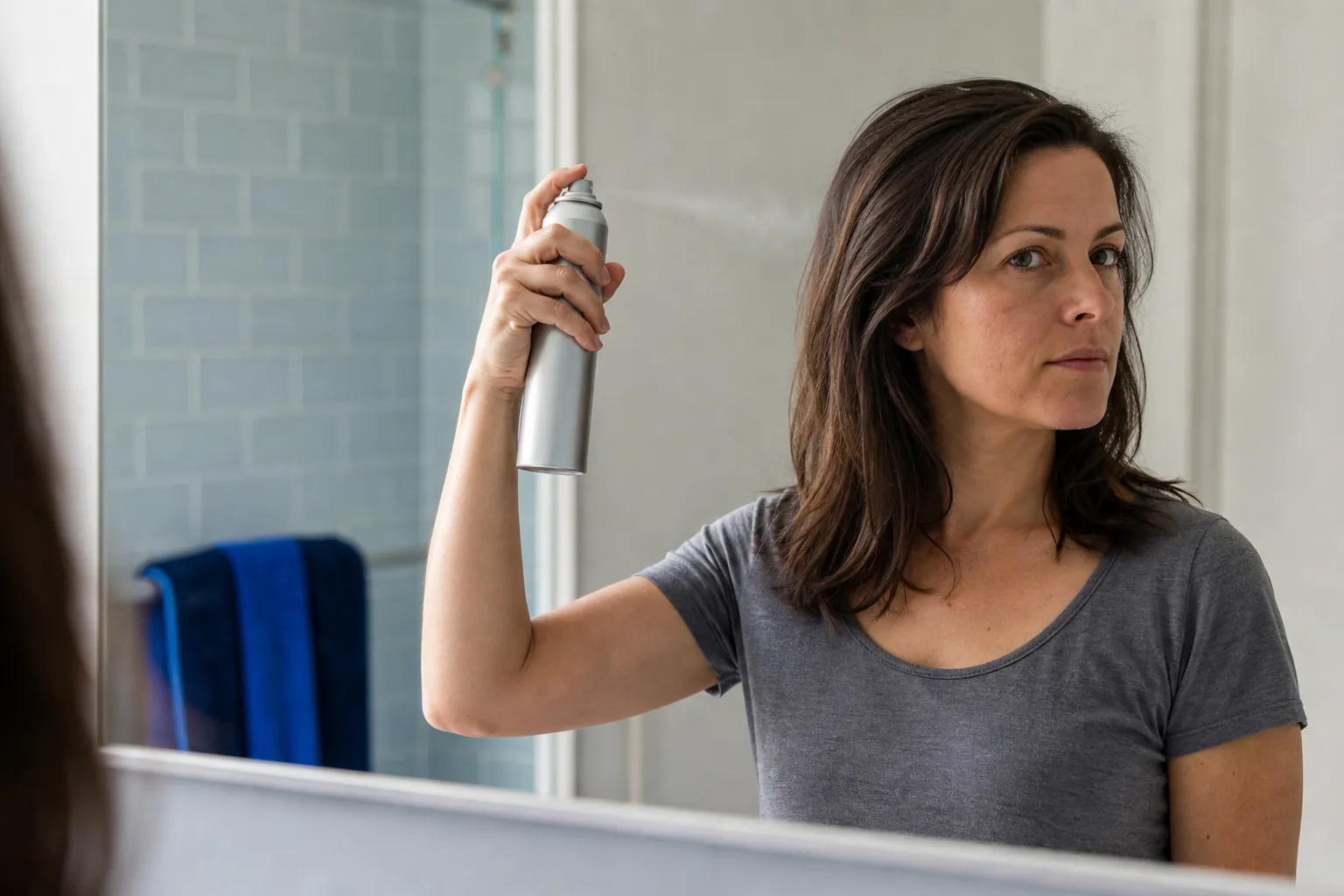
You spray in the morning, and by evening there are hairs in the basin: it is easy to suspect that hairspray is causing hair loss. Hair that is set stiffly can snap when you comb it. Ingredients can also irritate the scalp or trigger a contact allergy. That is something different from hereditary thinning and the other causes of hair loss. Looking closely at your hair ends, your scalp and the timeline helps you sort it out; it does not amount to a diagnosis.
Key takeaways
- ✓Stiffly set hair can break when you comb it; if your scalp itches, burns or turns red, pause the product that caused it
- ✓Gently release stiffened hair from the product film before detangling instead of dragging a brush through it
- ✓The explanation “hairspray clogs the pores, so oxygen and nutrients can’t get through” does not hold up anatomically
- ✓Visibly increasing thinning, new bald patches or lasting scalp symptoms should be assessed by a doctor
The sections below will help you tell breakage from hair loss and adjust your styling routine.
Summary
- Does hairspray cause hair loss? The short answer
- Is hairspray bad for your hair? What is in it and what it does
- Does hairspray ruin your hair? The damage happens when you comb it out
- Can hairspray irritate the scalp and cost you hair?
- Does hairspray clog the pores of the scalp? The most stubborn myth
- Hair loss from root spray: what pigment and volume sprays really do
- Dry shampoo and hair loss: same principle, different risk
- How to use hairspray properly: the routine that prevents breakage
- When hairspray is not the reason for your hair loss
- Conclusion: prevent breakage and take scalp reactions seriously
- Frequently asked questions about hair loss from hairspray
Does hairspray cause hair loss? The short answer
There is no evidence in the sources reviewed here that ordinary hairspray use directly destroys the follicle. The film sits mainly on the hair shaft. The living cells inside the follicle receive oxygen and nutrients through the blood, as StatPearls describes in its account of follicle anatomy. That does not mean, however, that ingredients can never reach the skin or trigger a reaction there.
The problems that matter in practice are breakage and possible scalp reactions. Lasting inflammation can also come with increased hair loss. How often these problems are caused specifically by hairspray cannot be quantified from the available sources. So judge your symptoms and the specific product instead of blaming every hair you lose on the spray or ruling out any connection.
The American Academy of Dermatology puts the usual range at roughly 50 to 100 hairs shed per day. What collects on a wash day also depends on how often you wash and comb. A higher number on its own does not prove telogen effluvium. If your shedding changes noticeably or your density drops, a medical assessment helps, as the article on extreme hair loss explains.
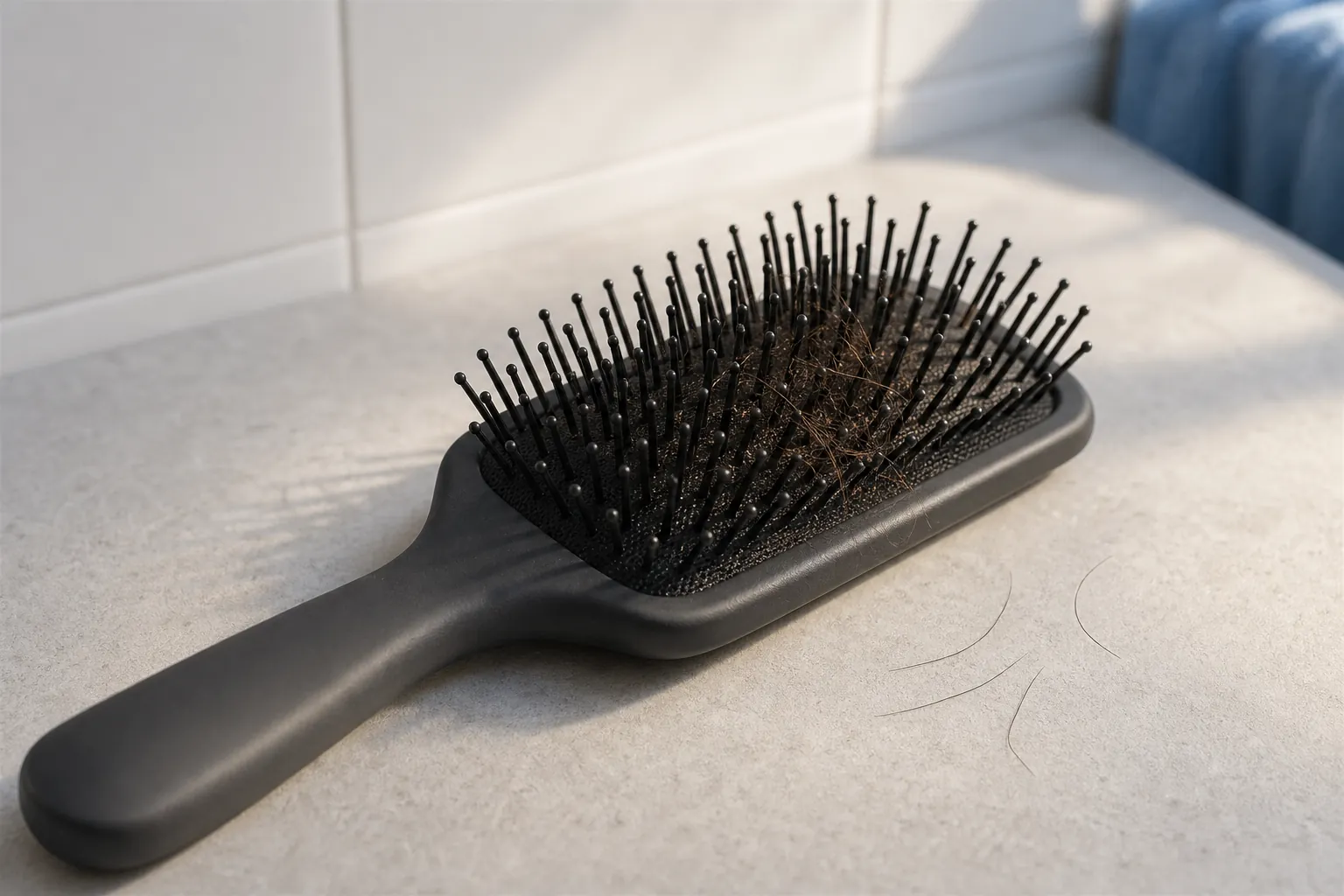
Breakage, scalp irritation and true hair loss are three different things
With breakage, the hair snaps somewhere along its length. The rest stays anchored in the scalp and keeps growing; the follicle is not involved. The typical signs are short hairs standing up on the surface, frayed ends and clearly different lengths within the same section.
With scalp irritation, the problem is in the skin, not in the hair. It itches, flakes, feels tight or burns after you spray, and you can see it: redness, flaking, sometimes small crusts. The hair itself looks unchanged at first.
When a telogen hair is shed, the hair shaft leaves the follicle with a pale club-shaped end; the follicle itself stays in the skin. This is part of the normal hair cycle, but it can also happen more often than usual. A parting that keeps getting wider or a visible loss of density are reasons to have things checked. Short hairs can be either breakage or regrowth, and both problems can exist at the same time.
| What you notice | Points to breakage | Points to an irritated scalp | Points to true hair loss |
|---|---|---|---|
| The end of the shed hair | no thickening, broken off cleanly or frayed; a white speck that you can rub off is product residue | mixed, usually unremarkable | a pale, club-shaped bulb end, firmly attached to the hair and impossible to rub off |
| Length of the hairs in your brush and plughole | highly variable, many short pieces | unremarkable | mostly full length |
| What you see on your head | short hairs standing up on the surface, frayed ends | redness, flaking, crusts, shiny or tight-looking skin | the scalp shows through, the parting gets wider |
| How it feels | the hair feels rough and straw-like, full of static | itches, feels tight or burns after you spray | can happen with no symptoms at all; itching or pain does not rule hair loss out |
| Timing pattern | gradual, in step with how often you style | linked in time to one particular product | in flare-ups, or increasing over months |
| What makes sense now | adjust your routine, see the section on how to use it | pause the product; see a dermatologist if symptoms persist | have the cause assessed, see the final section |
The full single-hair self-check, including a magnified image of the broken end, is in the article on hair loss from hair dye. Here we stick to what is specific to hairspray.
Is hairspray bad for your hair? What is in it and what it does
Whether a hairspray causes problems depends on the formula, how you use it and the condition of your hair and scalp. A hard polymer film can increase the mechanical strain when you detangle. Solvents can irritate sensitive skin; fragrances and preservatives are possible contact allergens. So no single ingredient decides on its own how well a product is tolerated.
The can usually lists the same groups: film formers such as VP/VA copolymer, PVP or polyvinyl acetate, alcohol as alcohol denat. or ethanol, propellants such as butane, propane and dimethyl ether in aerosols, plus plasticisers, a neutraliser such as aminomethyl propanol, and fragrances and preservatives.
The mechanism itself is simple: the alcohol carries the polymers onto the hair shaft and evaporates within seconds. What stays behind is a thin film that glues neighbouring hairs together where they touch. Those hair-to-hair bridges are exactly what gives you hold, and they are exactly the weak point.
| Ingredient | Why it is in there | What it does to the hair or scalp | What you can watch for |
|---|---|---|---|
| Film formers (VP/VA copolymer, PVP, polyvinyl acetate) | create the hold by laying a film around the hair shaft | glue hairs together at individual points, stiffen them and increase friction when you comb | do not apply layer on layer; wash the film out in the evening |
| Alcohol (alcohol denat., ethanol) | dissolves the polymers and evaporates after you spray | draws moisture out of the hair shaft; the cuticle can roughen | choose a lower-alcohol formula for very dry or colour-treated hair |
| Propellants (butane, propane, dimethyl ether) | push the product out of the aerosol can as a mist | no documented effect on the hair or the hair root; they only distribute the product | spray in a ventilated room, or use a pump spray instead of an aerosol |
| Plasticisers | keep the film flexible so it does not flake off right away | make the film less brittle and therefore tend to lower the risk of breakage | nothing you need to do |
| Fragrances and preservatives | scent and microbiological shelf life | among the common triggers of cosmetic contact allergies, according to the British Association of Dermatologists | if itching or redness keeps coming back, switch products and keep the packaging |
| Silicones | shine and combability | settle as a smoothing layer and can build up if you wash infrequently | wash regularly with a normal shampoo; use a clarifying wash only occasionally |
The sources reviewed here offer no comparison that would rank hairspray, gel, wax and mousse against each other. The products differ in their film formers, waxes and solvents, among other things. What matters is how stiff they make the hair and how you get them out again.
And is hairspray bad for your hair if you use it every day? Frequency alone does not decide it. What matters is what happens to the stiffened hair afterwards and whether the film comes off again in the evening.
Does hairspray ruin your hair? The damage happens when you comb it out
One damage pathway is easy to explain: combing out heavily set hair. The brush pulls on fibres that are glued to each other, and they can break in the process. Existing damage and the specific formula also influence how sensitively the hair reacts. Less firm hold and gentle detangling can reduce the strain.
Dry, alcohol-stressed hair has higher friction and breaks under less pulling force. In his review article “Hair Weathering”, hair researcher Ralph Trüeb notes that friction between comb or brush and hair is the main cause of this wear, and that oils and conditioners measurably reduce it.
In the process the cuticle roughens, the keratin cortex underneath is exposed, and the hair loses shine, elasticity and tensile strength. In pronounced cases you get the paintbrush-like frayed fracture points of trichorrhexis nodosa, which a 2025 clinical review calls the most common form of hair breakage of all. A case series in the PMC archive describes exactly this picture, brought on by a particular comb and a particular combing habit.
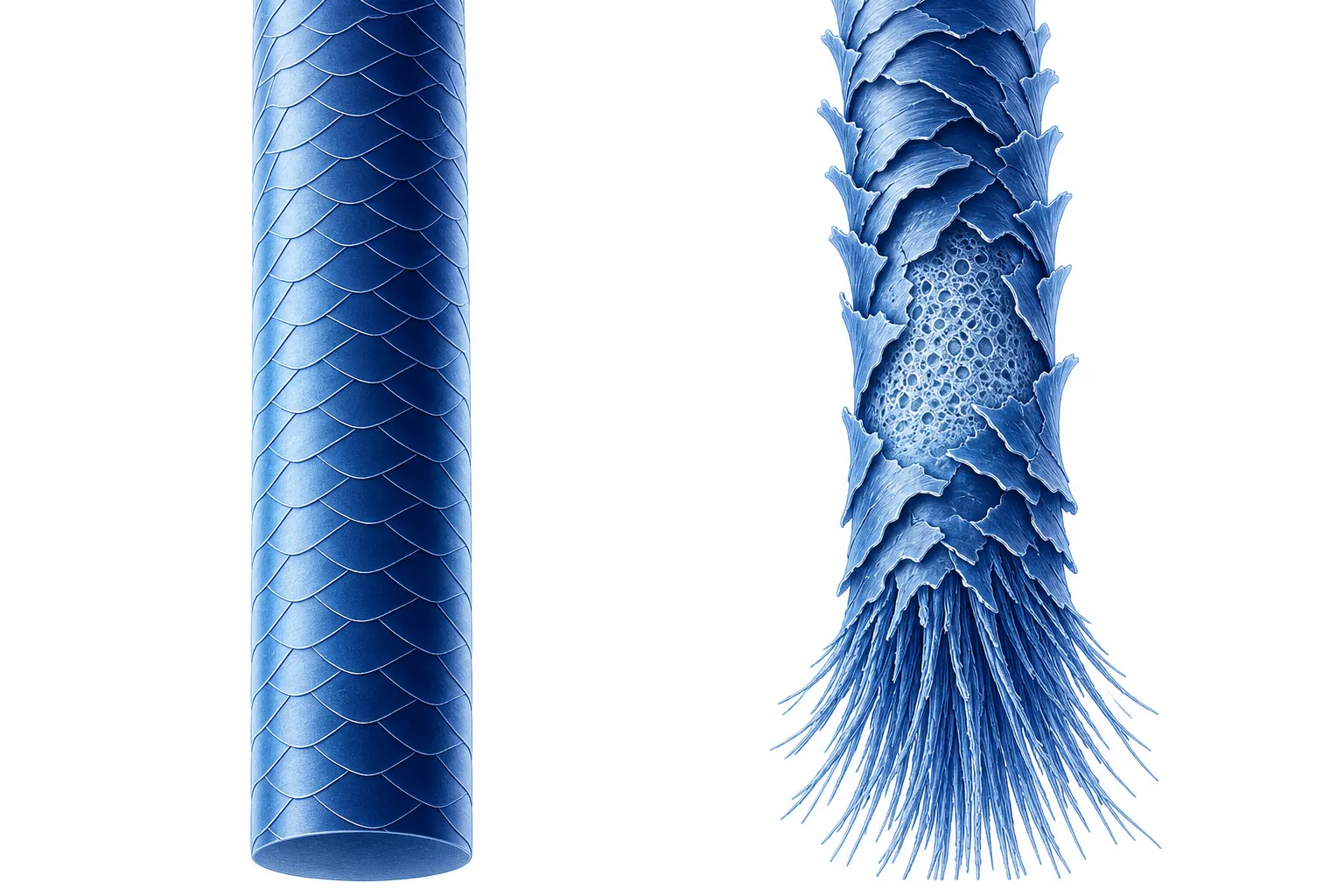
Breakage can happen at different points along the shaft and can also reduce visible fullness. Different hair lengths and frayed ends are signs of it. A clearly thin patch should still be examined, because breakage and other forms of hair loss can occur side by side.
Is the white dot on a shed hair the hair root?
A white end does not mean the whole follicle was torn out. Crumbs you can rub off may be product residue or sebum. A firm, pale club end, on the other hand, fits a telogen hair at the end of its resting phase. With the naked eye this distinction is not always reliable.
And here is the genuinely reassuring part. A firm, pale, slightly club-shaped end is a club hair. According to the StatPearls chapter on telogen effluvium, every hair carries exactly this white club at the end of its resting phase, without a gelatinous root sheath. The follicle stays in the skin, and telogen effluvium is explicitly a non-scarring form of hair loss.
According to the same source, the resting phase lasts around four months and follows about four years of growth. So a club hair in your brush is a completely normal event to begin with. How the growth, transition and resting phases take turns is explained in the article on the hair growth cycle.
Short hairs of differing lengths with torn or frayed ends point to breakage. They do not rule out additional hair loss. If the picture stays unclear or your density decreases, a dermatologist can examine your hair and scalp specifically.
Can hairspray irritate the scalp and cost you hair?
Ingredients can trigger an irritant reaction or a contact allergy. Lasting inflammation can come with increased hair loss; reliable frequency figures specifically for hairspray do not exist. Irritation and allergy have to be told apart, because the triggers and the treatment are not the same.
Irritant contact dermatitis depends on how much the skin is exposed to a substance and can appear quickly or after repeated contact. Allergic contact dermatitis is a delayed immune reaction and often shows up only one to three days after contact. The timing alone is not enough to tell them apart; that takes an examination and, if indicated, patch testing.
Fragrances and preservatives are among the common triggers of cosmetic contact allergies. The British Association of Dermatologists lists preservatives and fragrances in personal care products among the common causes of allergic contact dermatitis, and the British Society for Cutaneous Allergy sets the baseline patch-test series used to investigate exactly these reactions in the UK. There is no reliable sensitisation rate specifically for hairspray, which is why no percentage appears here.
If residue stays on an already sensitive scalp for longer, it can make symptoms worse. Seborrhoeic dermatitis, however, has several contributing factors, among them the response to Malassezia yeasts. Product residue alone tells you neither that diagnosis nor the cause of a flare.
Marked scalp inflammation can disturb the hair cycle and come with increased shedding. Occasional itching does not prove that connection; conversely, a condition is not always visible in a photo. More on other triggers is in the article on diffuse hair loss.
And one piece of context that belongs here: a contact reaction that is recognised and treated early usually clears up without consequences. That is not a guarantee, and that is exactly why lasting symptoms belong with a doctor rather than being waited out. How irritation and allergy can be told apart in detail, and how patch testing works, is covered at length in the article on hair loss from hair dye.
Where self-treatment ends
When to have your scalp looked at by a doctor
- ●redness or flaking that persists or gets worse after you stop the product
- ●weeping spots, blisters or crusts on the scalp
- ●swelling of the face or the eyelids after you spray
- ●painful pustules around individual hairs
- ●itching that disrupts your sleep
- ●visibly increasing thinning even though you changed your routine long ago
These symptoms need a medical assessment. If your lips or tongue swell, or if you have trouble breathing or circulatory problems, call 999 immediately. Mild itching that fades quickly after contact with a product can first be observed by pausing the product; lasting or worsening symptoms should be assessed.
Does hairspray clog the pores of the scalp? The most stubborn myth
No. Hairspray does not clog any pores through which the hair draws nutrients. The follicle is supplied from the inside, through a capillary network at the dermal papilla. Hair does not take up oxygen from the air.
According to the StatPearls chapter on follicle anatomy, the dermal papilla at the base of the follicle is rich in capillaries that supply the follicle with blood and deliver oxygen and nutrients to the rapidly dividing cells of the hair bulb. During the growth phase, the formation of new capillaries is even actively ramped up, because the metabolic demand rises.
What we colloquially call a pore is, on the haired scalp, the follicular ostium, the opening of the hair canal. According to the same source, this upper section begins at the skin surface, that is where the hair shaft emerges, and that is where the sebaceous gland opens as well. What matters, though, is not what goes in or out through that opening, but where the follicle gets its supply from: from the blood, deep in the skin.
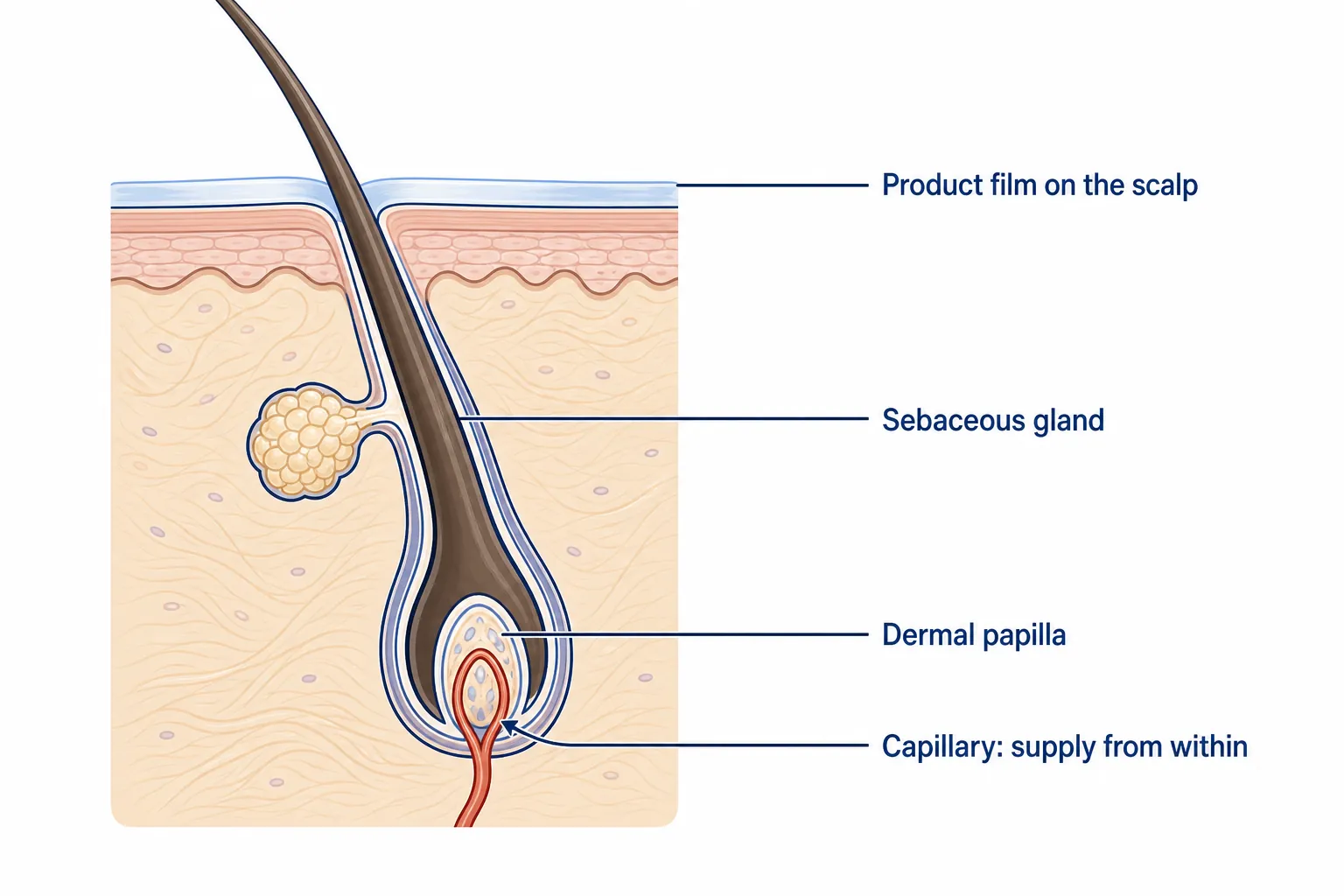
Residue can irritate the scalp. Washing removes the product film, but it does not treat inflammation or folliculitis that is already there. If redness, pain or pustules persist, have the cause assessed. So the myth that hairspray suffocates the hair is disproved; possible skin reactions are not.
This clogged-pores explanation appears in many guides, and until this revision it appeared in the earlier version of this article as well. It does not hold up anatomically, which is why we are correcting it openly here instead of quietly deleting it.
Hair loss from root spray: what pigment and volume sprays really do
Depending on the product, root sprays are used to cover grey roots, to visually mask thin areas or to add volume. A link in time between using them and losing hair does not prove a cause. But it does not rule out a product reaction either, especially if itching, burning or redness come with it.
Pigment or colour root sprays cover grey roots or a scalp showing through with colour pigments and resins. Volume or root-lift sprays add body at the roots with powder or polymer. One works visually, the other mechanically.
These products can involve more contact with the scalp than setting the lengths of your hair. Follow the instructions for use: a root spray, too, is not automatically meant to go straight onto the skin. Whether residue, irritation or breakage becomes the problem depends on the specific product and how it is used.
Some people only start using cover-up products because their hair is already getting thinner. For others, grey roots or the volume they want are the main reason. So the reason for buying does not explain newly appearing hair loss. Possible causes are described in the articles on hair loss in women and on diffuse hair loss.
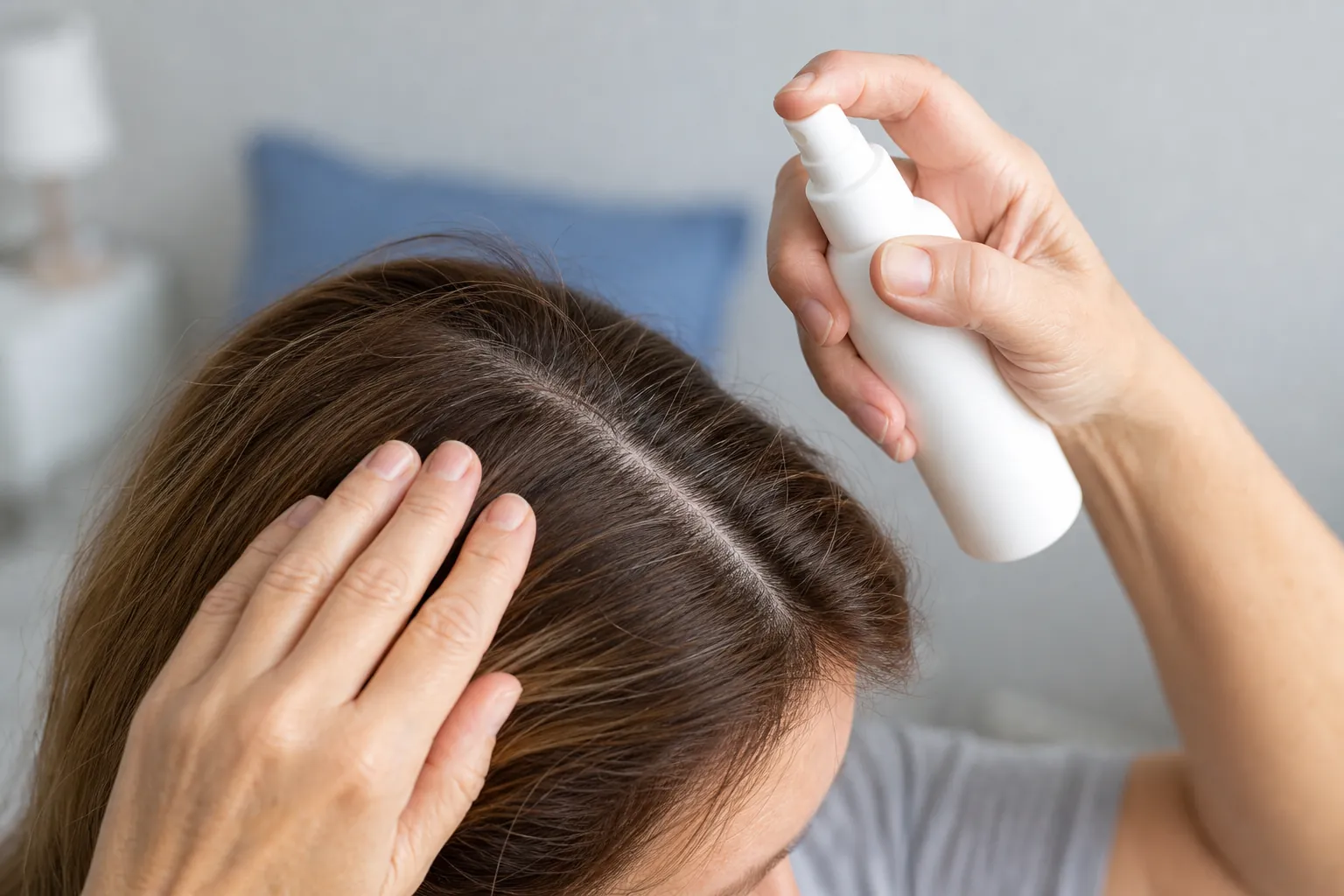
In practice that means: wash it out thoroughly instead of applying layer on layer, do not spray anything onto inflamed or broken scalp skin, and do not top up several days in a row without washing in between.
Do not confuse them: hairspray, root spray and sprays against hair loss
A spray against hair loss is not a styling product. A minoxidil solution, for example, is a medicine with its own purpose, its own application and its own side effect profile; in the European guideline on androgenetic alopecia, minoxidil is the topical option with the highest level of evidence. It has nothing in common with hairspray or root spray except the spray bottle. What it can and cannot do is set out in the article on minoxidil for hair loss.
Dry shampoo and hair loss: same principle, different risk
Dry shampoo absorbs oil, but it does not replace washing your hair. If residue stays on your hair and scalp, it can encourage symptoms and breakage. The American Academy of Dermatology mentions increased hair loss in this context as well. So dismissing the idea out of hand would be wrong.
It contains starch from rice or maize, clay, plus propellants and fragrances. The powder binds the oil and then sits on the scalp and at the roots until it is washed out.
If you keep topping up, powder, sebum and product residue stay on the scalp. That mixture can irritate and change how the hair feels. If itching, burning or pain appear, pause the product. A lasting reaction needs to be assessed.
The American Academy of Dermatology gives a concrete recommendation here: after one or two applications of dry shampoo, you should wash with water again. If the residue stays on your hair and scalp, the AAD says that can encourage breakage and increased hair loss. That is expert practical advice, not the result of a controlled study.
That leaves the recalls: in October 2022, one manufacturer recalled several dry shampoos in the United States after elevated benzene levels were found in batches produced before October 2021; according to the FDA notice, the cause was contamination of the propellants, not an added ingredient. That was a batch-related contamination rather than a property of the product category, and it has nothing to do with hair loss.
How to use hairspray properly: the routine that prevents breakage
If you tolerate your spray well, the places to start are hold, amount and detangling. If your scalp reacts with itching, burning or redness, pause the product. The application tips below follow the mechanics of hair and the recommendations of dermatological professional bodies.
Keep your distance when you spray, about an arm’s length, and work with short bursts onto the hair rather than into the roots. From close range you get a locally hard, brittle film, and a large part of the product lands on the scalp, where it has no business being.
Use a finishing spray the way the packaging says, usually last on dry hair. A hairspray is not a substitute for a heat protectant. Avoid unnecessarily high heat and rough pulling on the hair.
The most important point: do not brush through stiffened hair. Loosen the film with your fingers first or wash it straight out, and then work with a wide-tooth comb from the ends upward. Without that intermediate step, the brush tears open the glue points between the hairs; with it, they come apart.
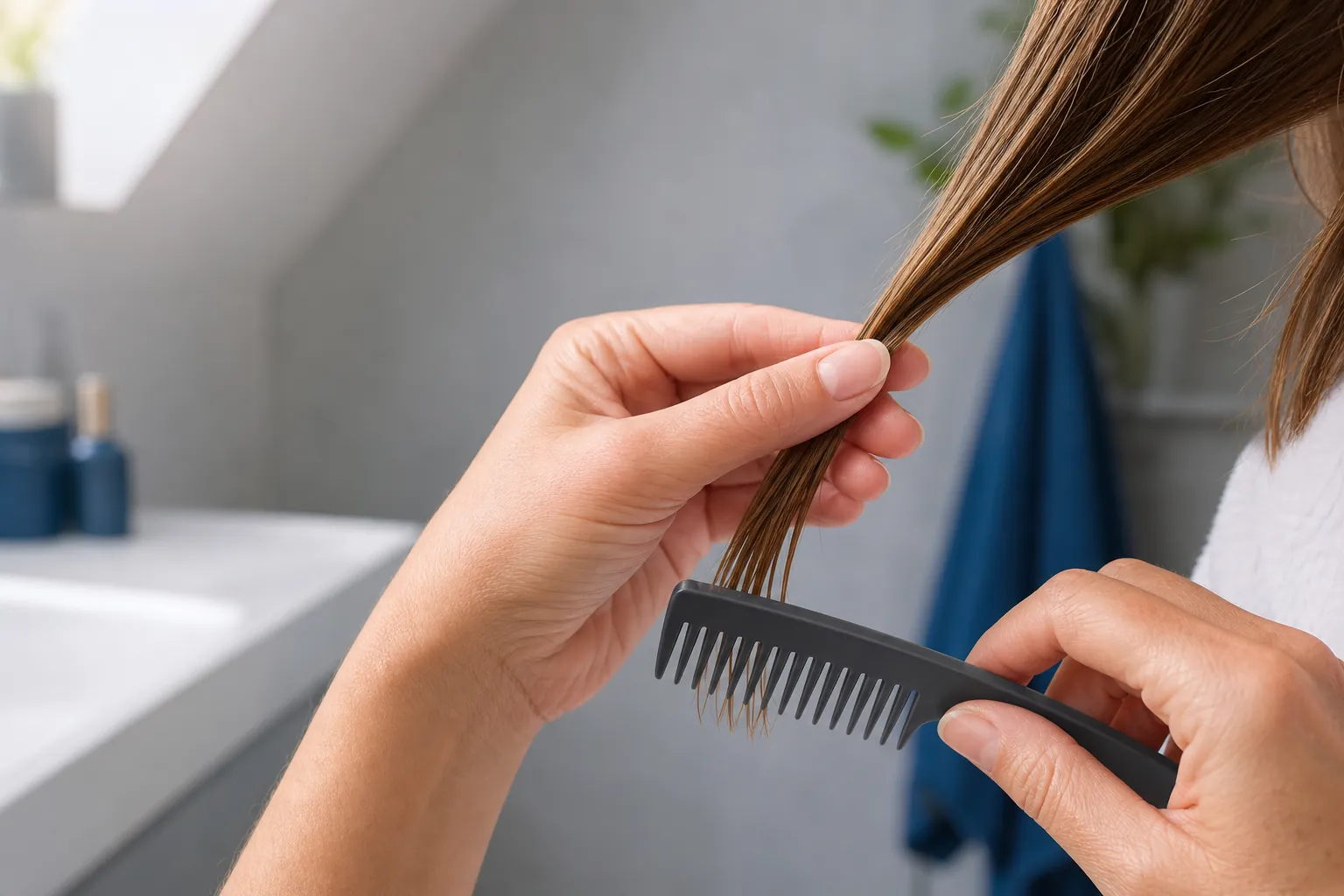
Wash it out in the evening instead of spraying more the next day. Layer on layer is the number one cause of residue. A normal shampoo is usually enough for that; use a clarifying wash only occasionally, because it dries the hair out on top of everything else.
For very dry, stressed or colour-treated hair, a lower-alcohol formula or a pump spray instead of an aerosol can is worth it. How much chemical treatments pre-stress the fibre is shown in the article on hair loss from hair dye. Which other everyday habits tug at your hair is covered in the overview of habits that ruin your hair.
The ingredient list can help you choose a product, but it does not reveal exact concentrations. Under the cosmetics regulation that applies in the UK (Regulation (EC) No 1223/2009 as retained in UK law, Article 19), ingredients are listed in descending order of weight; anything present at less than one per cent may follow in any order.
If alcohol denat. appears near the top, that is a hint that ethanol may make up a larger part of the formula. You cannot read a percentage or how well you will tolerate it off that. If symptoms keep coming back, watch how you react to the product as a whole and have a contact allergy checked if necessary.
Fine, straight, curly hair: the polymer film does not work the same way on everyone
Your hair type has a say in how quickly hold turns into breakage. The differences below are derived from the mechanics; there is no comparative study by hair type. They still work as orientation for your own routine.
Fine, straight hair carries little substance per fibre. Even a thin layer feels stiff here, the hold collapses sooner, and many people top up during the day. Every top-up and every comb-through afterwards is another round of friction in the same place.
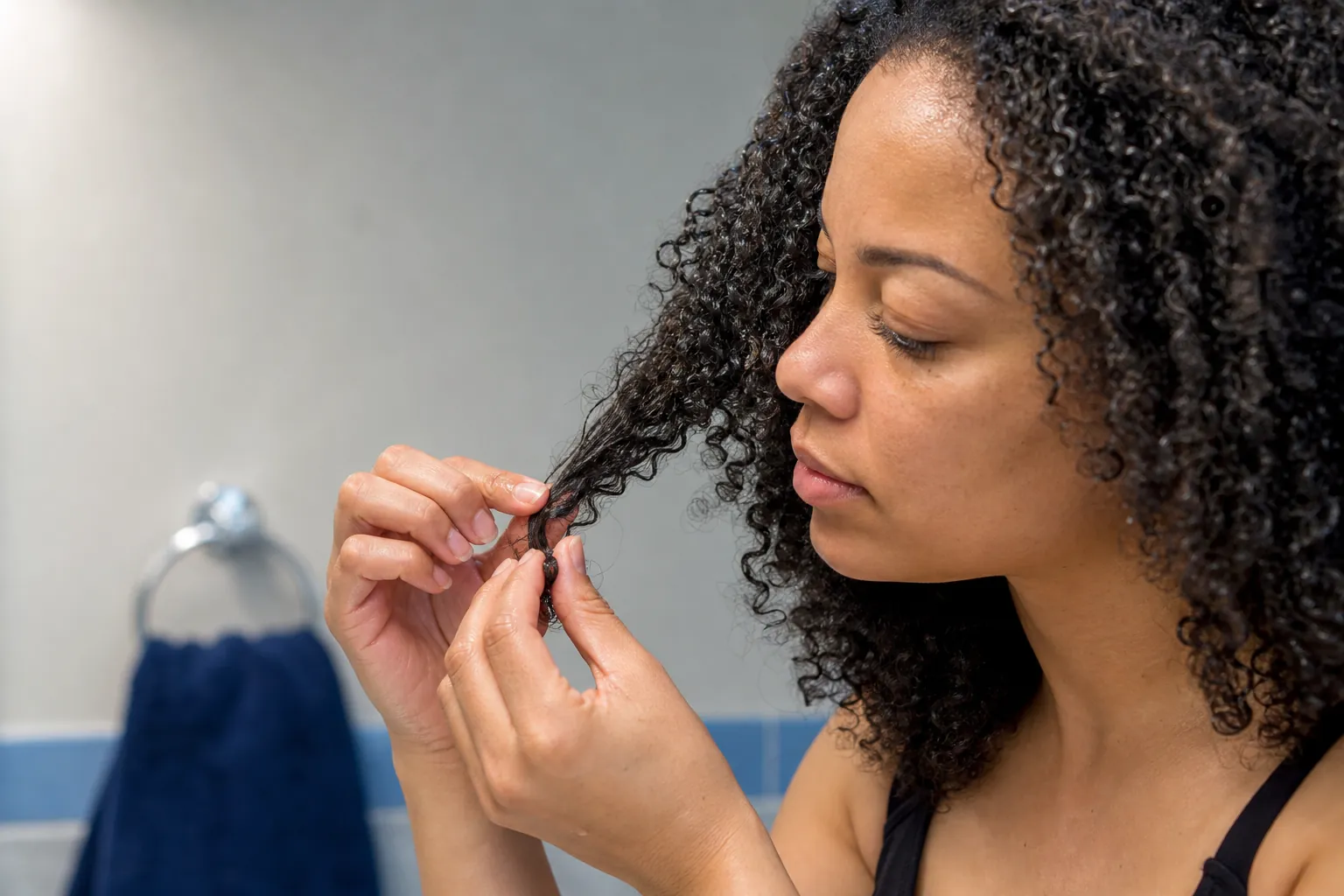
Curly and afro-textured hair is drier, because sebum travels down a curved fibre less easily, and it is harder to detangle. Dry hair has more friction and breaks under less pulling force, and it is exactly this friction that oils and conditioners measurably reduce, according to the review article “Hair Weathering”.
In practice, for curls that means: soft, flexible products instead of firm hold, and loosening the film under water and with conditioner instead of combing it out dry. If you deliberately wash less often, do not spray more every day; otherwise long gaps between washes and layer upon layer add up.
There is one point that concerns very curly and afro-textured hair and has nothing to do with the spray itself: tight hairstyles. According to the American Academy of Dermatology and the British Association of Dermatologists, traction alopecia is particularly common in this group. The cause is the pull, not the product that holds the style.
| Common mistake | What happens | What to do instead |
|---|---|---|
| Brushing through stiffened hair | the brush tears open the glue points between the hairs, and the hair breaks along its length | loosen it with your fingers first or wash it straight out, then use a wide-tooth comb from the ends upward |
| Spraying damp hair and blow-drying it | wet hair is mechanically the most vulnerable, and heat is added on top of the fresh polymer film | let it dry or blow-dry it, and set it only afterwards |
| Spraying spot by spot from close range | a locally hard, brittle film, and a lot of product lands on the scalp | keep your distance, use short bursts, aim at the hair rather than the roots |
| Topping up the next day instead of washing | residue, trapped sebum, itching and flaking | wash it out in the evening; a normal shampoo is usually enough |
| Scrubbing sprayed hair while washing and rubbing it dry with a towel afterwards | wet hair stretches the most and breaks the most easily, and the roughened cuticle snags on top of that | massage the shampoo into your scalp and let it rinse through the lengths, then squeeze the water out with the towel instead of rubbing |
| Wearing a tight, spray-set hairstyle permanently and overnight | constant pull at the hairline can cause traction alopecia; the mechanical tension is the decisive factor | reduce the tension, change the position and height, take the style down in the evening |
When hairspray is not the reason for your hair loss
If your density is decreasing, looking only at your styling is not enough. The course over time, the pattern of distribution and any scalp symptoms help a dermatologist work out the cause. No single observation reliably rules other causes out.
Diffuse across the whole head, often showing up with a delay after a trigger such as an infection, a diet, surgery or a period of heavy strain: that points to telogen effluvium. According to StatPearls, the latency is typically around three months, with a range of one to six months. More on this in the article on diffuse hair loss and in the overview of the causes of hair loss.
This delay is why the spray so often falls under suspicion: the actual trigger lies months back and is long forgotten, while the can sits in the bathroom every morning. So take a calendar and look at the weeks around three months ago.
Look back instead of hunting for a product
What was going on for you about three months ago?
- ●a feverish infection or another illness with a high temperature
- ●surgery, even a minor procedure, or an anaesthetic
- ●a strict diet or noticeable weight loss in a short time
- ●a prolonged period of psychological strain, at work or privately
- ●childbirth; here the shedding typically starts only weeks to months later
Such a trigger can fit as an explanation for telogen effluvium, but it does not prove it. In this non-scarring form the follicles remain intact. Lasting thinning or additional scalp symptoms should be examined regardless of a possible trigger.
A receding hairline at the temples and a thinning crown with preserved density at the back point to androgenetic alopecia, the most common form of all. It follows a fixed pattern and has nothing to do with styling. The details are in the article on androgenetic alopecia.
Round, sharply defined bald patches point to alopecia areata. For the UK, the British Association of Dermatologists has published a living guideline on managing the condition, updated in 2025. It belongs in a doctor’s hands rather than under cosmetic cover-up. What lies behind it is explained in the article on alopecia areata.
A hairline receding at the temples can point to traction alopecia if you wear permanently tight hairstyles. The cause here is the pull. The American Academy of Dermatology advises not wearing tight braids or ponytails for longer than six to eight weeks and loosening them immediately if there is pain, crusting or signs of tension. Caught early, the picture can improve; according to the British Association of Dermatologists, lasting strain can cause permanent hair loss.
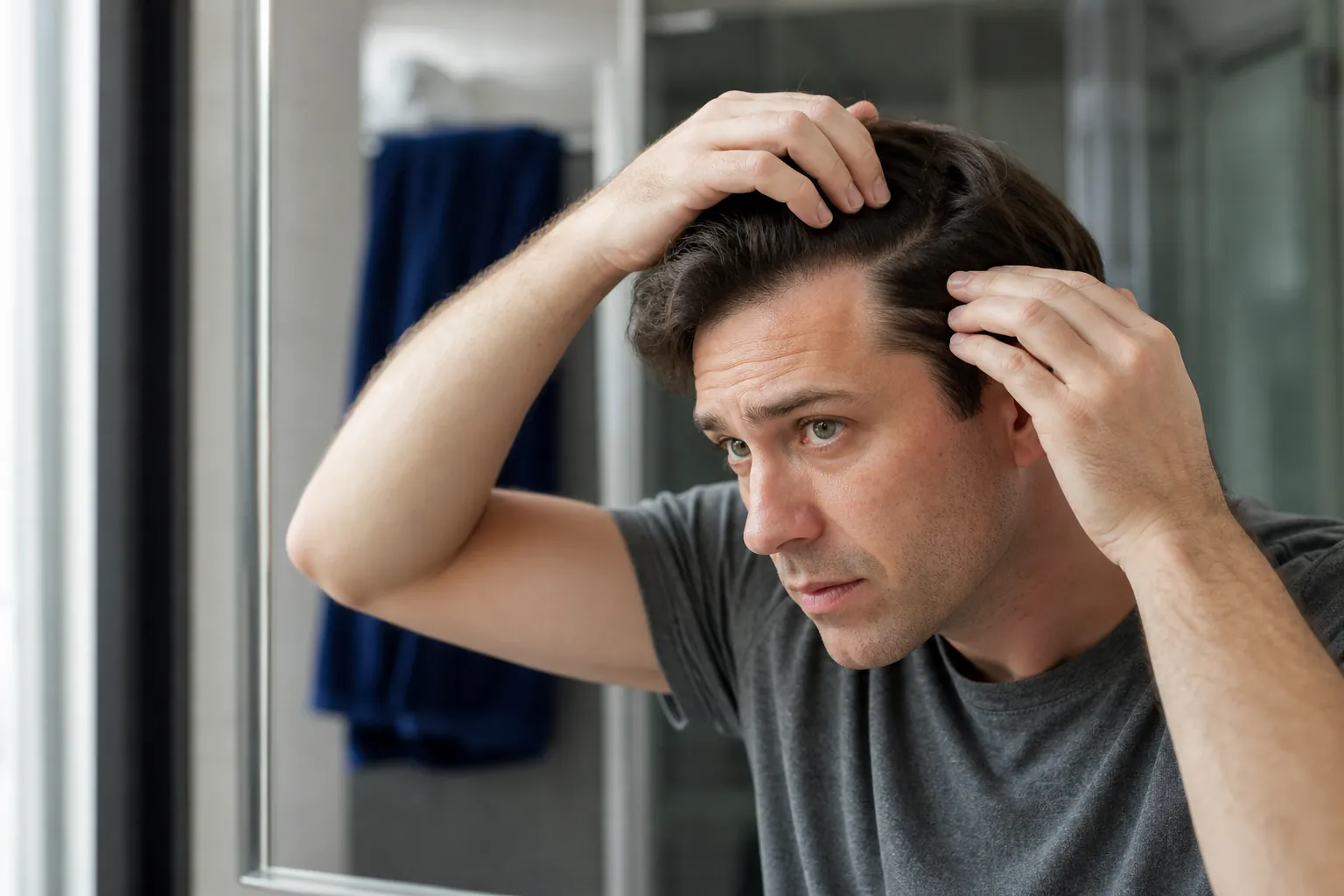
If what stands out is mainly broken ends and stressed lengths, gentler hair care comes first. If there is additional thinning, there are symptoms or the picture is unclear, a dermatological examination makes sense.
Elithair offers you a free hair analysis based on photos. It can give you an idea of the visible state of your hair and of possible next steps for a consultation. Whether a styling product triggered a reaction or another condition is present cannot be diagnosed by this visual first assessment; that requires a medical examination.
One limit belongs here explicitly: styling damage is not treated with a transplant. Broken hair keeps growing back on its own from the intact follicle; no procedure is needed for that. Anyone who is advised to have a hair transplant because of breakage is getting an answer to the wrong question.
Which steps make sense in which order for real hair loss, from diagnosis through to the treatment options, is what the article what to do about hair loss summarises.
Conclusion: prevent breakage and take scalp reactions seriously
Hairspray can stiffen the hair so much that it breaks when you comb it. On top of that, irritation and contact allergies are possible. The myth that clogged pores cut the hair root off from oxygen and nutrients does not explain these problems: the supply comes through the blood. A possible link between contact with a product and your symptoms should still be taken seriously.
Breakage, normal hair turnover and pathological hair loss can look similar and occur at the same time. Watch the course over time, the broken ends and the state of your scalp. Observing yourself can support a medical assessment, but it cannot replace it.
Remove product residue gently, dial back firm hold and avoid pulling when you detangle. If you have a reaction, pause the product you suspect. If your density decreases or symptoms persist, have the cause clarified before you try more products or treatments.
Frequently asked questions about hair loss from hairspray
Is the white dot on a shed hair the hair root?
A pale, firm club end fits a telogen hair at the end of its resting phase. The hair shaft is shed while the follicle stays in the skin. White crumbs you can rub off, by contrast, may be sebum or product residue. With the naked eye this cannot always be told apart reliably; increased shedding or loss of density should be assessed regardless.
Does hairspray really cause hair loss?
There is no evidence in the sources reviewed here of direct follicle damage from ordinary hairspray use. Hair that is set stiffly can, however, break when you comb it. Ingredients can also irritate the scalp or trigger a contact allergy. Lasting inflammation and increasing hair loss belong in a doctor’s hands rather than being dismissed out of hand.
Is hairspray bad for your hair if I use it every day?
That depends on the product, the amount, how well you tolerate it and your routine. Do not pull a brush through heavily stiffened hair and do not keep piling on more product. If itching, burning or redness appear, pause the spray. Even careful use is no guarantee that every product suits your scalp.
Does hairspray clog the pores of the scalp?
The hair follicle draws oxygen and nutrients from the blood, not through the opening at the skin surface. So a film of product does not suffocate the hair. Residue can still irritate the scalp. Washing removes it but does not treat existing inflammation; persistent redness, pustules or pain need to be examined.
Do I have to wash hairspray out every evening?
It is not strictly necessary, but it is easier. It only becomes critical when you top up over several days without washing in between, because then layer builds on layer. A normal shampoo is enough for that. Products that go directly onto the scalp, meaning root and pigment sprays, should be washed out more consistently.
Is alcohol-free hairspray better for your hair?
A formula lower in ethanol can be worth a try if you have a sensitive scalp or dry hair. How well you tolerate it depends on the whole formula, though. The order of the ingredient list does not reveal an exact concentration, especially not for ingredients below one per cent. A product without ethanol can still contain fragrances or other possible irritants.
Does root spray cause hair loss?
You cannot conclude that from the order of events alone. A root spray can leave residue on the scalp or trigger a reaction; at the same time, an unrelated cause of hair loss may be present. If itching, burning or redness appear, pause the product. Lasting symptoms or decreasing hair density should be assessed by a doctor.
How often can I use dry shampoo?
The American Academy of Dermatology recommends washing with water and shampoo again after one or two applications. That means applications, not a fixed number of days. Dry shampoo binds oil but does not remove the residue. If it irritates, pause it; the recommendation does not replace an individual assessment of lasting symptoms.
Will my hair grow back if I stop using hairspray?
With pure breakage and an intact follicle the hair keeps growing; the missing length simply takes time. If a product irritated your scalp, pausing it makes sense, but it does not fully clarify the cause. If your density is decreasing, what happens next depends on the diagnosis. Lasting or increasing hair loss should be examined.
Is it harmful to breathe in hairspray?
Used as directed, the toxicity is low, according to Poison Control, the US poison control service. Breathing in the spray mist can still irritate the airways. So do not spray directly towards your face, ventilate the room and follow the instructions on the packaging. Anyone with asthma or another respiratory condition should be especially careful.
Sources and last update
- Anatomy, Hair Follicle. StatPearls, NCBI Bookshelf, on the dermal papilla, the capillary supply and the follicular ostium (ncbi.nlm.nih.gov)
- Telogen Effluvium. StatPearls, NCBI Bookshelf, on the club hair, the telogen phase and the latency after a trigger (ncbi.nlm.nih.gov)
- Physiology, Hair. StatPearls, NCBI Bookshelf, on angiogenesis during the growth phase (ncbi.nlm.nih.gov)
- American Academy of Dermatology: “Do you have hair loss or hair shedding?”, the benchmark of 50 to 100 hairs per day (aad.org)
- American Academy of Dermatology: “Hairstyles that pull can lead to hair loss”, traction alopecia, 6 to 8 weeks, warning signs (aad.org)
- British Association of Dermatologists: patient information leaflet “Traction alopecia” (bad.org.uk)
- Hair Weathering, Part 2: Clinical Features, Diagnosis. Cutis, on cuticle roughening and Trüeb on friction as the main cause (mdedge.com)
- A Clinical Review of Trichorrhexis Nodosa, 2025, on the most common form of hair breakage and on weathering as its cause (sciencedirect.com) as well as the case series on comb-induced trichorrhexis nodosa (pmc.ncbi.nlm.nih.gov)
- Differential Diagnosis of Irritant Versus Allergic Contact Dermatitis. Dermatology Practical & Conceptual, on the latency of 24 hours versus 24 to 72 hours (pmc.ncbi.nlm.nih.gov)
- British Association of Dermatologists: patient information leaflet “Contact dermatitis” (reviewed June 2025), on fragrances and preservatives in personal care products as common causes of allergic contact dermatitis (bad.org.uk); in addition the British Society for Cutaneous Allergy, which sets the baseline and specialist patch-test series used in the UK (cutaneousallergy.org)
- Seborrheic Dermatitis Revisited: Pathophysiology, Diagnosis, and Emerging Therapies, 2025, on Malassezia and sebum as causes (ncbi.nlm.nih.gov)
- British Association of Dermatologists living guideline for managing people with alopecia areata 2025, Br J Dermatol 2026;194(2):e56–e73 (bad.org.uk)
- Regulation (EC) No 1223/2009 on cosmetic products as retained in UK law, Article 19(1)(g): the list of ingredients in descending order of weight, with ingredients present at less than 1 per cent in any order after those above 1 per cent (legislation.gov.uk)
- U.S. Food and Drug Administration: voluntary recall of selected dry shampoos in the United States over possible benzene residues, October 2022 (fda.gov)
- American Academy of Dermatology: Hair styling without damage and recommendations on dry shampoo.
- Poison Control: The safety of hairspray, on possible airway irritation from spray mist.
Last updated: September 2026. This article is for information and does not replace a medical diagnosis or treatment. If you have persistent hair loss, scalp symptoms or suspect an allergy, please see a dermatologist.

Dr. Imad Moustafa
Hair transplant specialist