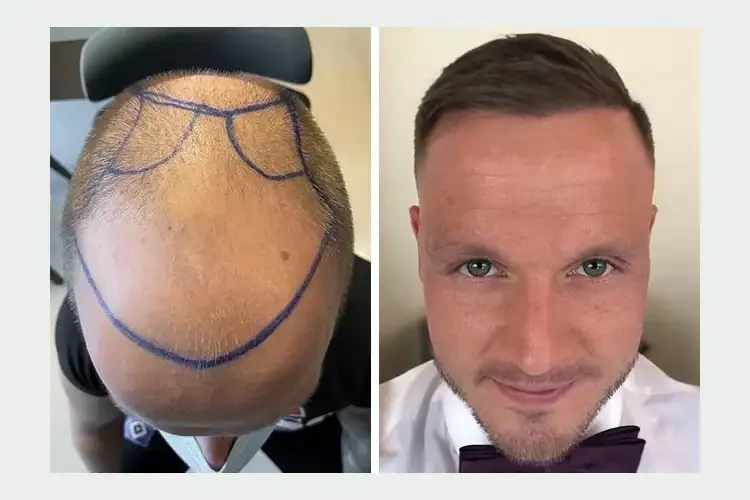
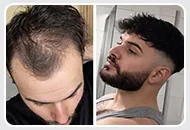
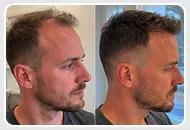
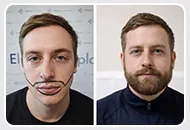
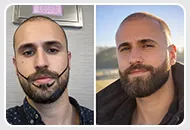
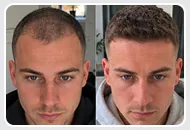
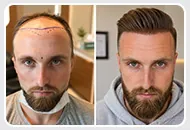
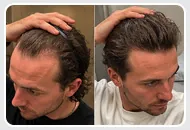
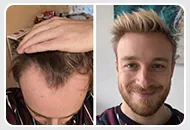
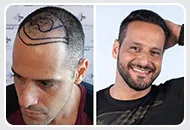
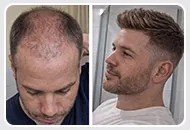
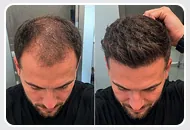
Before
After
Dominik K. – 5,200 grafts

4.9 - 11,000+ Reviews on Google

150,000+ Happy Patients Worldwide
free & without obligation
 4.9 out of 5 stars on Google
More than 150,000 treatments
at our specialist clinic, certified to ISO 9001:2015
by TÜV Thüringen.

 Honest from the start
Baldness often changes your appearance in the mirror more than any other form of hair loss, so wanting a fuller head of hair again is completely understandable.
Whether a hair transplant can restore that fullness depends less on how bald you are today and more on how much healthy donor hair remains at the back of your head (Balwi et al. 2026).
The amount of suitable donor hair available helps determine:
Below, we explain what a hair transplant can achieve at Norwood stages 5 to 7 and where its limits lie, including graft planning, preserving donor hair, cost and recovery.
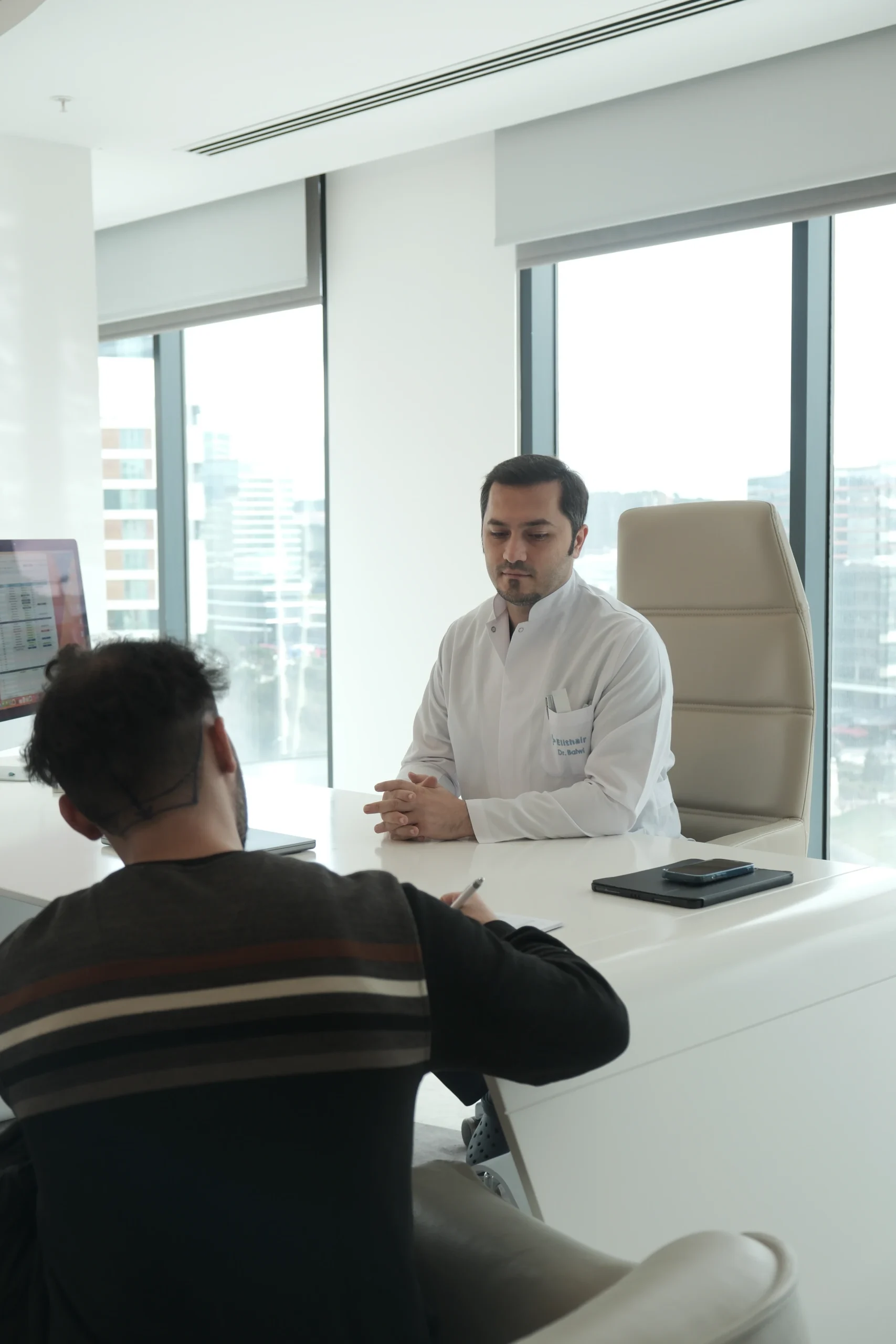
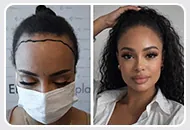
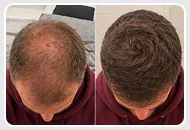
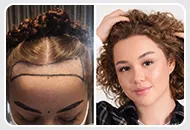
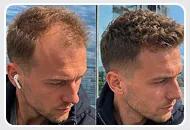
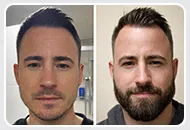
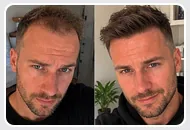
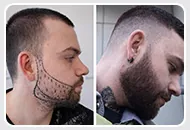
Documented cases give you the clearest picture of what a hair transplant can achieve for advanced hair loss, including complete baldness. Here, you can see real patients before treatment and about twelve months afterwards.
Dominik K. – 5,200 grafts
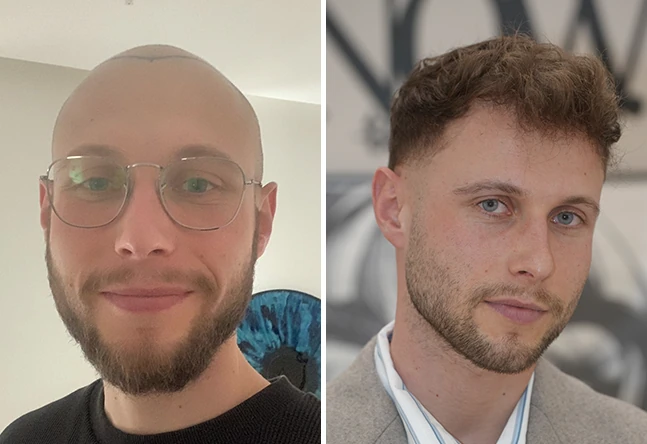
Niklas N. – 4,000 grafts
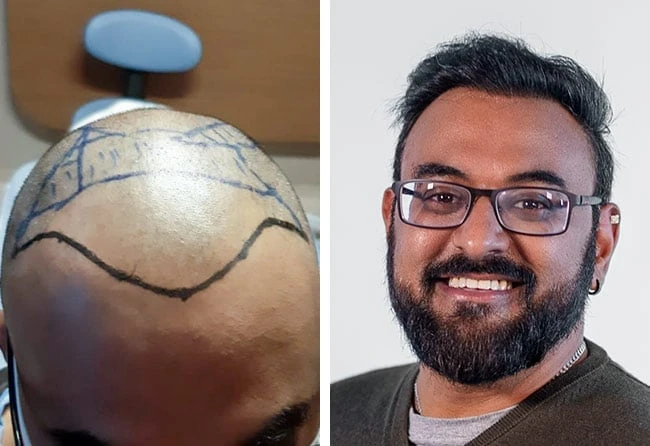
Shahid A. – 4,000 grafts
The new hairline and how full your hair looks in everyday life play a particularly important role. For someone with advanced baldness, this visual improvement is a realistic yet impressive result.
All-inclusive pricing can be especially valuable when you need a large number of grafts. Many providers charge per graft, and at 6,000 grafts, the cost adds up quickly. At Elithair, treatments with 5,000 grafts and above have an all-inclusive price of £3,449, whether you need 5,000 or 6,000 grafts. There are no hidden charges.
The package includes DHI implantation with the CHOI Implanter Pen, the patented NEO FUE® Serum set with a dermaroller (provided at the clinic for use on days 14 and 28 after your procedure), Sleep-Deep sedation while the local anaesthetic is administered, the six-step Pre-Test System for your individual treatment plan, three nights at a 4-star hotel near the clinic, VIP local transfers, one PRP treatment, the care and medication package and twelve months of aftercare through the Elithair App.
The included PRP treatment takes place at the clinic on the day of your procedure. Only your flight is extra: you book it separately, and it typically costs around £90 to £220. Zero Shave FUE and Manual FUE are available as optional extraction methods at an additional cost.
Is one large session more cost-effective than several smaller ones? Usually, yes. Two separate smaller procedures mean two trips, two rounds of preparation and two recovery periods. One carefully planned, larger session is usually the more affordable option.
| Criterion | Elithair | UK clinic |
|---|---|---|
| Price for 5,000 to 6,000 grafts | £3,449, all-inclusive package | £12,700 |
| Billing | All-inclusive prices by graft tier | – |
| Included services | Hotel, transfers, Pre-Test System for your treatment plan, PRP, aftercare | – |
| Your saving | About 73% based on the comparison figures shown | Comparison figure |
FeasibilityThe short answer: it depends on your donor area, not on the bald area.
For advanced hair loss, including complete baldness, the key question is how many healthy hair follicles remain in the band of hair at the back and sides of your head.
That area is your only source of new hair, and it is limited. That is why the same degree of baldness can lead to completely different recommendations for two different men.
Here is a quick overview of what to expect:
Process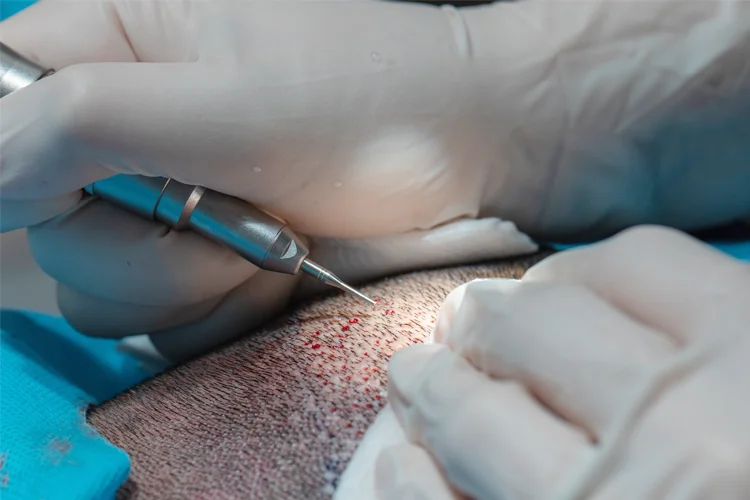
The procedure is carried out under local anaesthetic on one treatment day during your four-day, three-night stay in Istanbul. It takes around five to eight hours, depending on the number of grafts being transplanted.
Brief twilight sedation, called Sleep-Deep, lets you sleep while the local anaesthetic is administered, with 0% pain throughout the procedure. Results develop over several months, so patience is worthwhile, especially when large areas are treated. The timeline below shows what happens at each stage.
Crusting, mild redness and swelling can occur; light desk work is usually possible from day 2 or 3, depending on your role and recovery
On days 10 and 11, the crusts are gently loosened with the aftercare lotion, and from day 12 you can wash your hair with your usual shampoo
Transplanted hair shafts may shed temporarily while the roots remain intact. Not every patient experiences this shedding.*
New growth begins by this stage at the latest, with roughly a further 10% of the result becoming visible each month
Around 40% of the result is visible
Most of the final result is visible; the final result at the front of the scalp is reached after 10 to 12 months
Full density; the final result at the crown is visible after 15 to 18 months
In the first weeks after treatment, transplanted hair shafts may shed temporarily while the roots remain intact. Not every patient experiences this shedding.










 Norwood scale
The Norwood-Hamilton scale is commonly used to describe the pattern and extent of male-pattern hair loss, from stage 1 to stage 7.
On this page, advanced baldness refers mainly to Norwood stages 5 to 7.
This classification has practical implications: it determines the size of the area that needs coverage and how much donor hair is available to cover it.
The key point is that the band of hair at the sides of your head is genetically resistant to DHT, the hormone that triggers hair loss. This hair usually lasts a lifetime and is also your only donor source.
Norwood 5 is considered the last stage at which an experienced doctor can achieve a truly full result with scalp hair alone.
From stage 6 onwards, planning often focuses on improving coverage in key areas and preserving donor hair rather than trying to recreate the original density across the entire scalp.
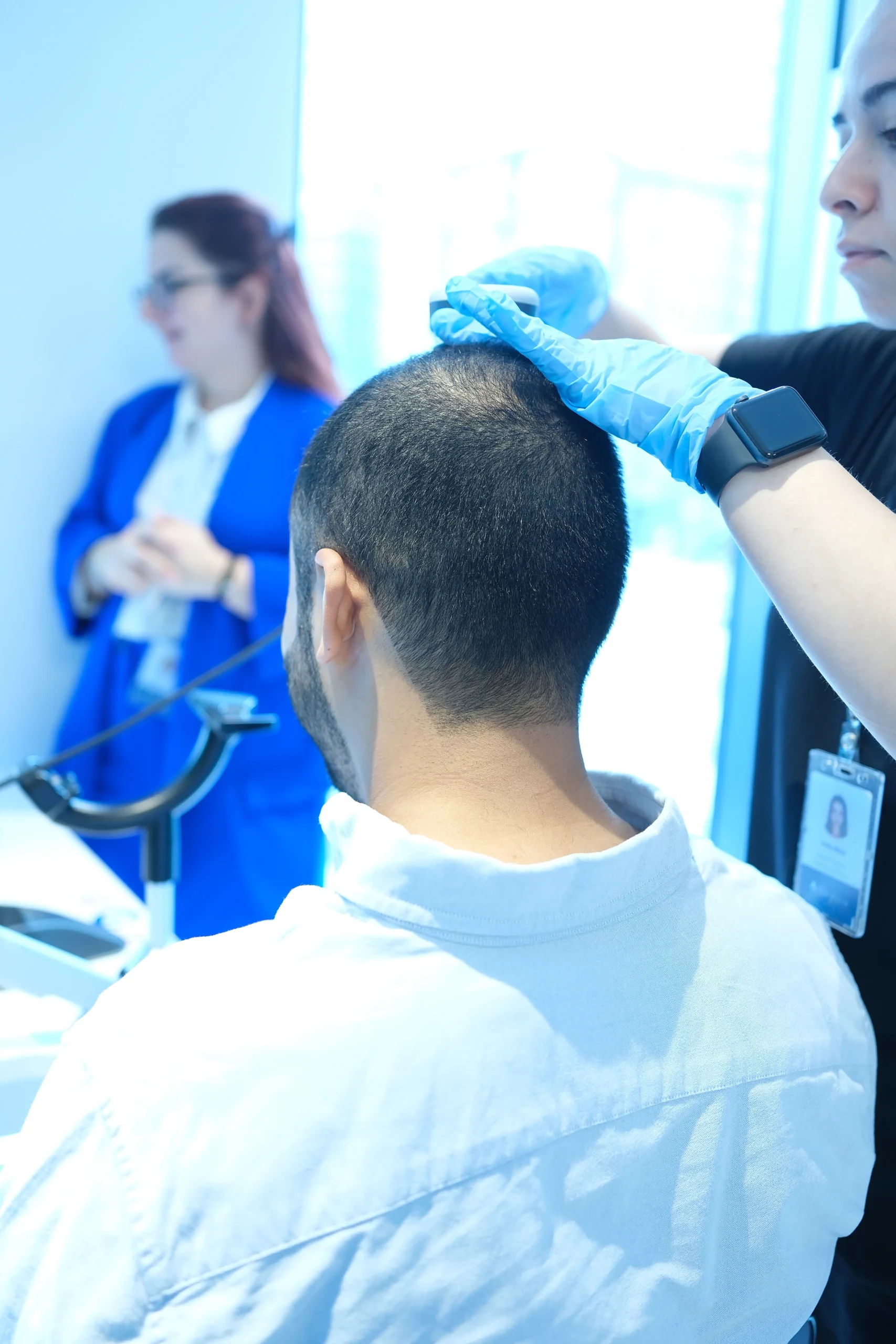
A hair transplant for baldness does not "grow" new hair. It redistributes the hair you already have. The roots come from the safe donor area: the band of hair at the back of your head and above your ears. Because this hair is DHT-resistant, it does not fall out after transplantation either. But the supply is finite: the donor area contains an average of 65 to 85 hair follicles per square centimetre (Chouhan et al. 2019).
Only some of those follicles can be removed safely, because the donor area itself needs to stay dense and free of gaps. With average donor density, the entire safe donor area of about 80 to 100 square centimetres can provide roughly 5,000 to 6,000 grafts over your lifetime, potentially across several sessions.
That number does not change, no matter how large the bald area is. A Norwood 3 patient and a Norwood 7 patient have the same supply. One simply has far less to cover.
 Preserving Donor Hair
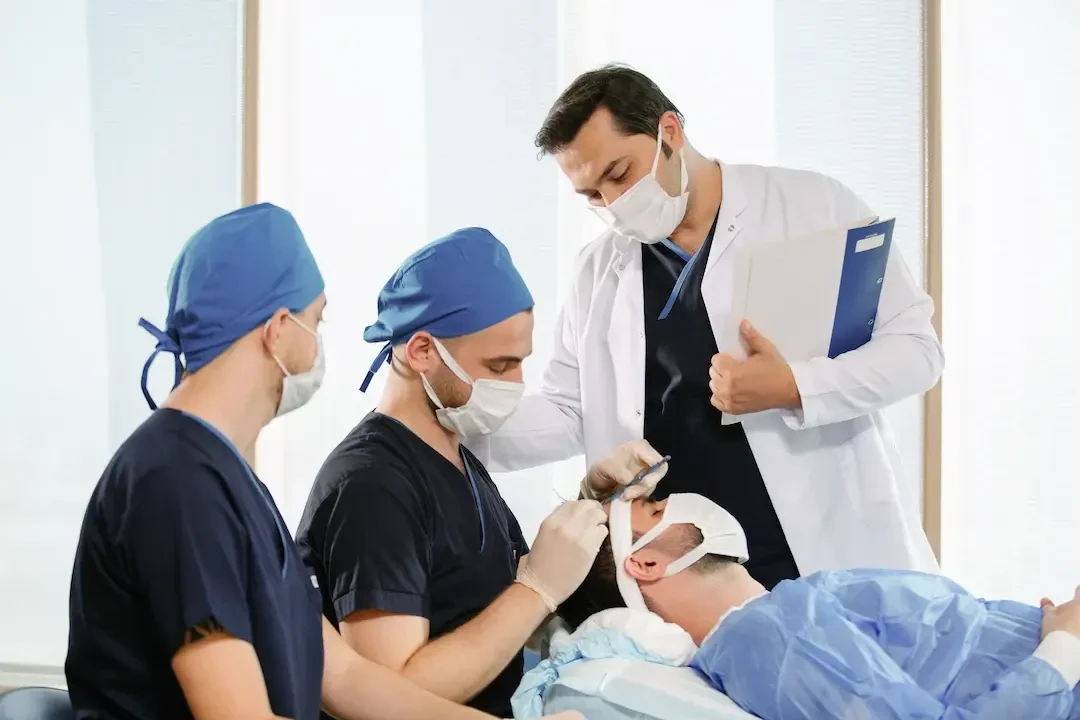
You might wonder whether removing more hair from the donor area would provide more grafts. This is called "overharvesting". The safety guideline is to remove at most one in four follicular units, preserving roughly 50 to 60 per cent of the original donor density.
Removing more leaves the donor area visibly thin or patchy, which often looks worse than the original baldness. The removed hair does not grow back, so the damage is irreversible.
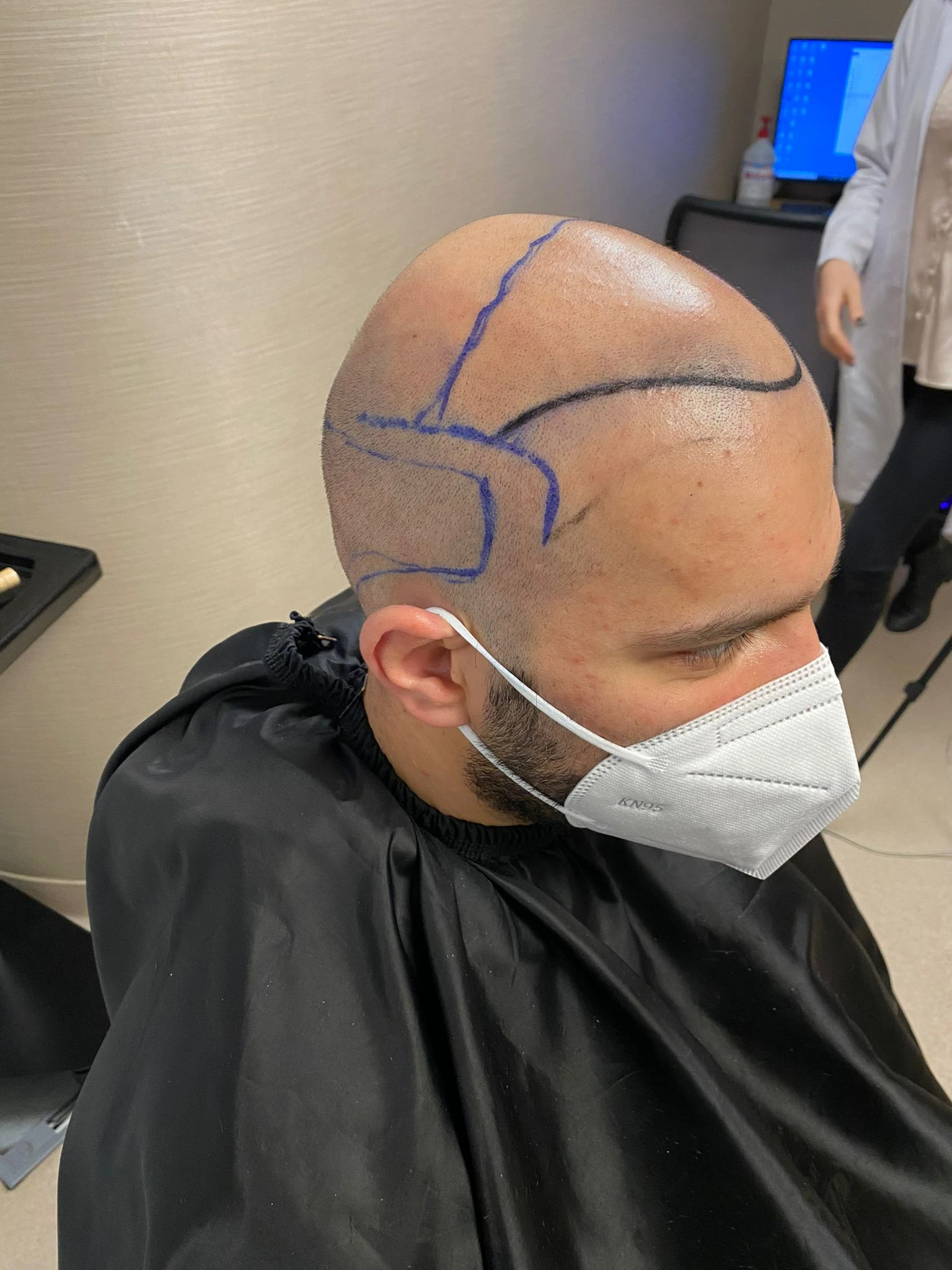
That is why Elithair examines the donor area closely before every procedure. The results of the 6-step Pre-Test System are used to create your individual treatment plan, which also specifies how many grafts can reasonably and safely be removed. The limit is set before the first follicle is removed.
Graft countsTwo numbers need to be compared: how many grafts you need and how many your donor area can provide. At lower Norwood stages, the supply comfortably meets the need. From Norwood 6 onwards, the gap widens noticeably.
The idea that a transplant is always impossible at Norwood 7 is a myth. Some clinics turn down all patients with Norwood 7 hair loss.
If the donor area is strong enough, some patients at Norwood 7 may see a meaningful improvement in appearance, especially at the front and middle of the scalp (Chouhan et al. 2019). Recreating the full density of a scalp unaffected by hair loss across the entire scalp is usually not realistic.
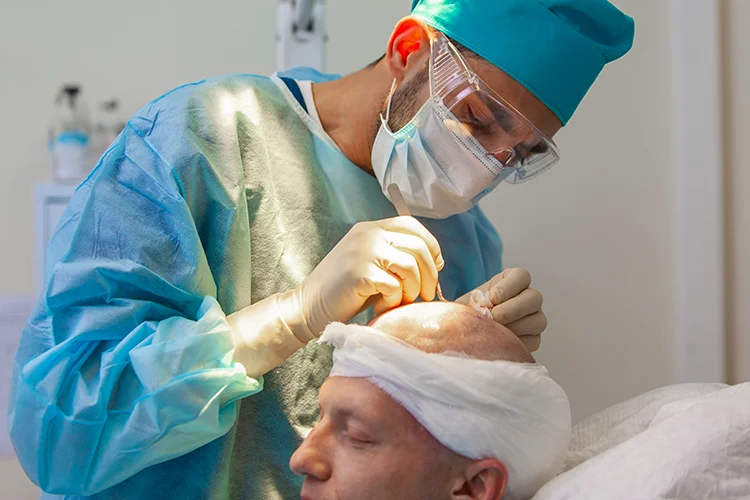
Treating a completely bald head usually involves 5,000 to 6,000 grafts, which typically uses the entire available donor reserve. Even if half of your donor hair could theoretically be removed, distributing it across the bald area would restore about 35 to 50 per cent of your original hair density, rather than 100 per cent.
Coverage can look better than the number of grafts alone might suggest for several reasons:
Keep in mind: thick, dark, wavy hair provides much better visual coverage than fine, light, straight hair with the same number of grafts.
As a rough rule of thumb, doubling the hair diameter roughly quadruples the visual density per graft. Two men with the same Norwood stage and the same number of grafts can therefore get very different results. For a natural-looking result, we aim for about 30 to 50 grafts per square centimetre, depending on how much hair your donor area can provide and how thick your hair is.
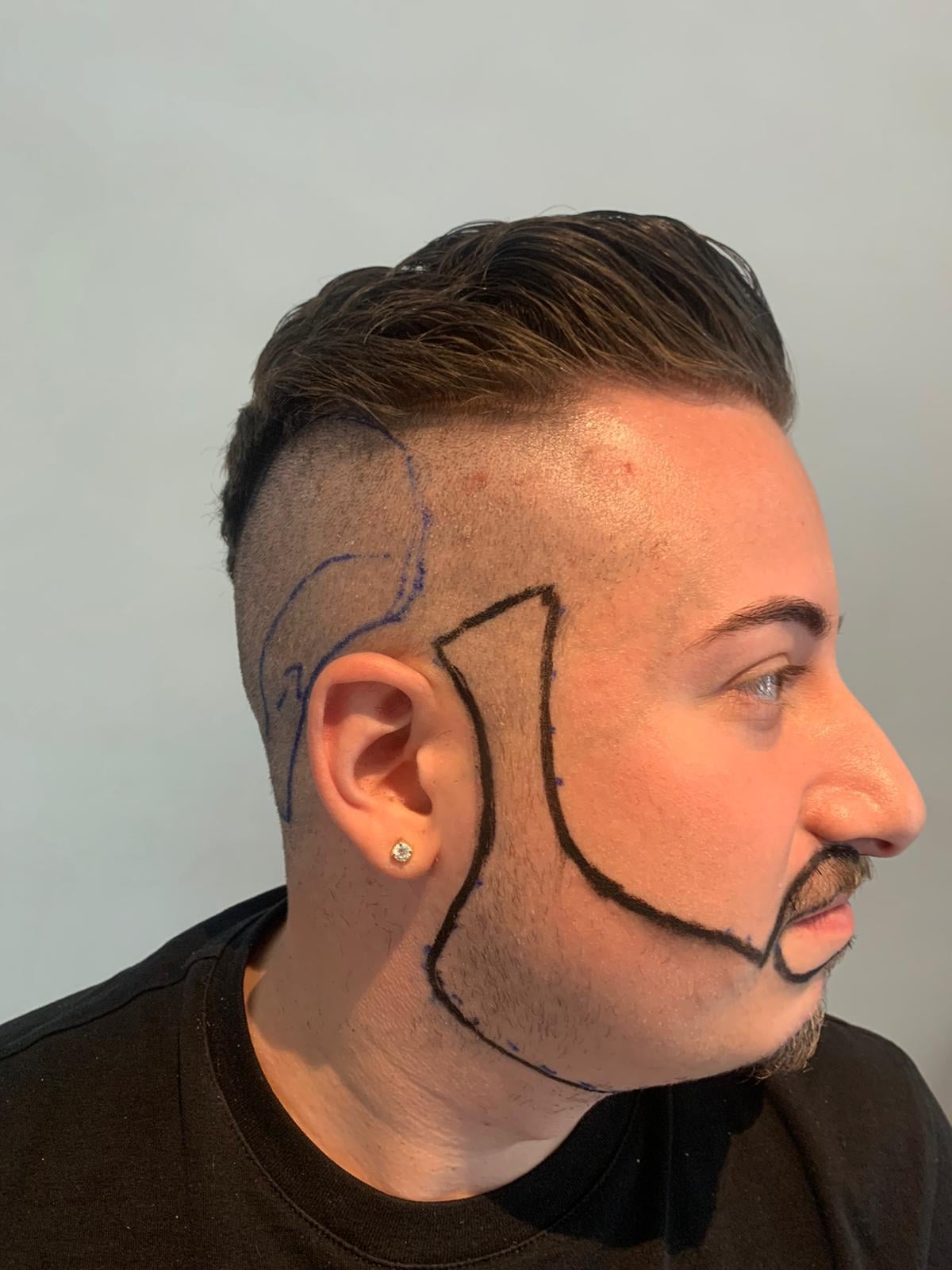
For some patients with advanced hair loss, beard or body hair may be considered as an additional donor source when the supply of donor hair from the scalp is limited.
This noticeably increases the supply of donor hair and can make the difference between sparse coverage and a fuller-looking result. Beard hair is the most valuable supplementary source. It is strong and thick, making it well suited to adding volume to the top of the head and the crown, where volume matters more than a fine hairline. Hair from the chest or back can provide additional grafts when a very large number is needed.
Many providers fail to make an important limitation clear: beard and body hair can only supplement scalp hair; they cannot serve as the sole donor source. Their growth cycles and structure differ from those of scalp hair, which is why a transplant using body hair alone does not produce a natural, even result.
| Donor source | Graft Survival Rate | Role in treating baldness |
|---|---|---|
| Scalp fringe | approx. 98% | Primary source for fine hair at the hairline and coverage on top of the head |
| Beard hair | about 85 to 90% | Supplementary source for greater volume on top of the head and at the crown |
| Body hair (chest, back) | about 85 to 90% | Supplementary option for selected patients who need a large number of grafts |
Priorities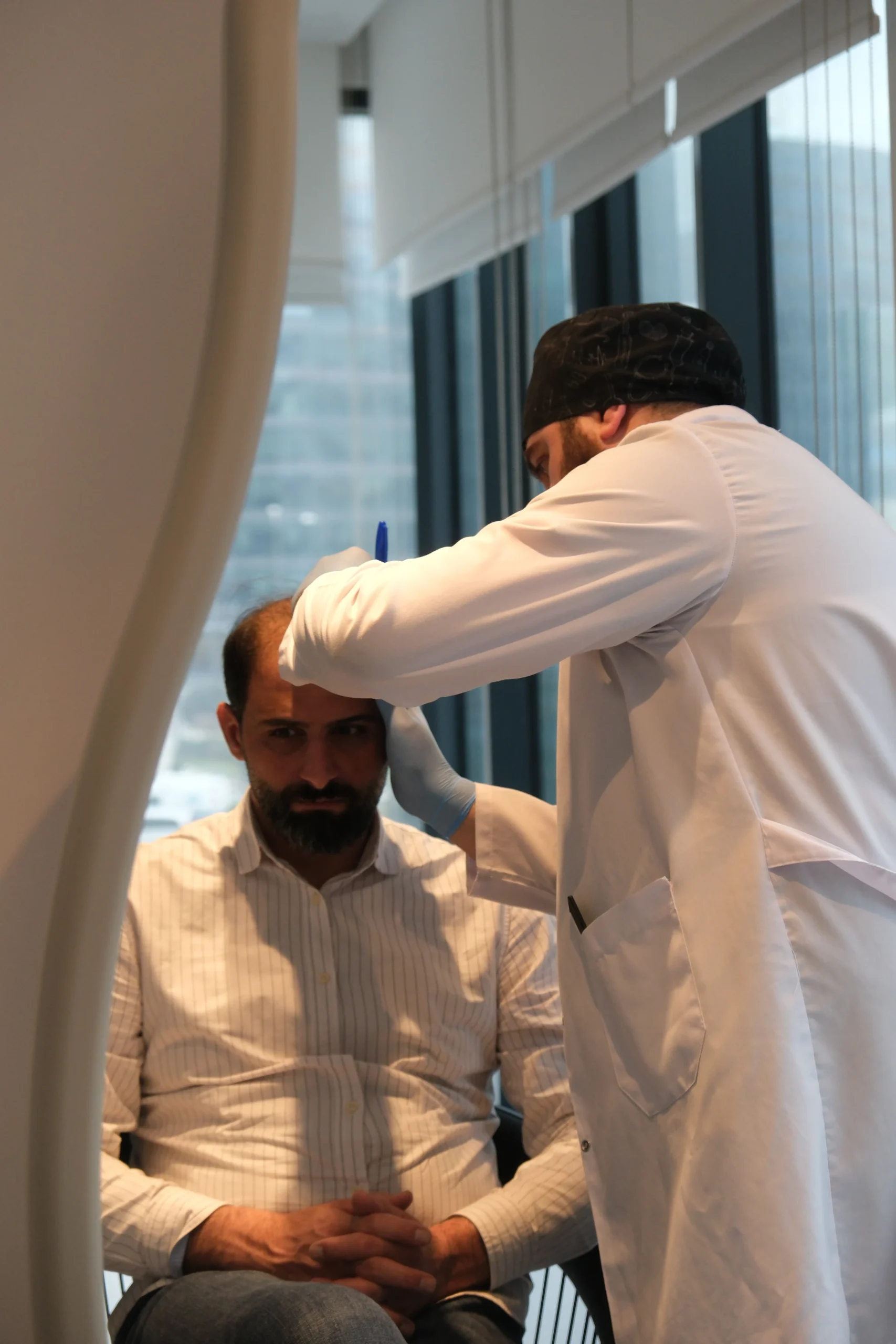
When donor supply is limited, the treatment plan has to prioritise where grafts will create the greatest visual benefit.
The hairline and middle of the scalp often take priority because they frame your face and are most visible from the front. With very advanced hair loss, a lower density may be planned for the crown to preserve donor hair for areas with higher priority.
The goal is the appearance of fullness rather than full density. Your hair can look full and natural without the same number of hairs you had at 20, as long as they are distributed strategically.
A typical hair transplant for a receding hairline involves 2,000 to 3,500 grafts. Baldness calls for a much more extensive treatment, with several thousand grafts extracted and implanted in one day.
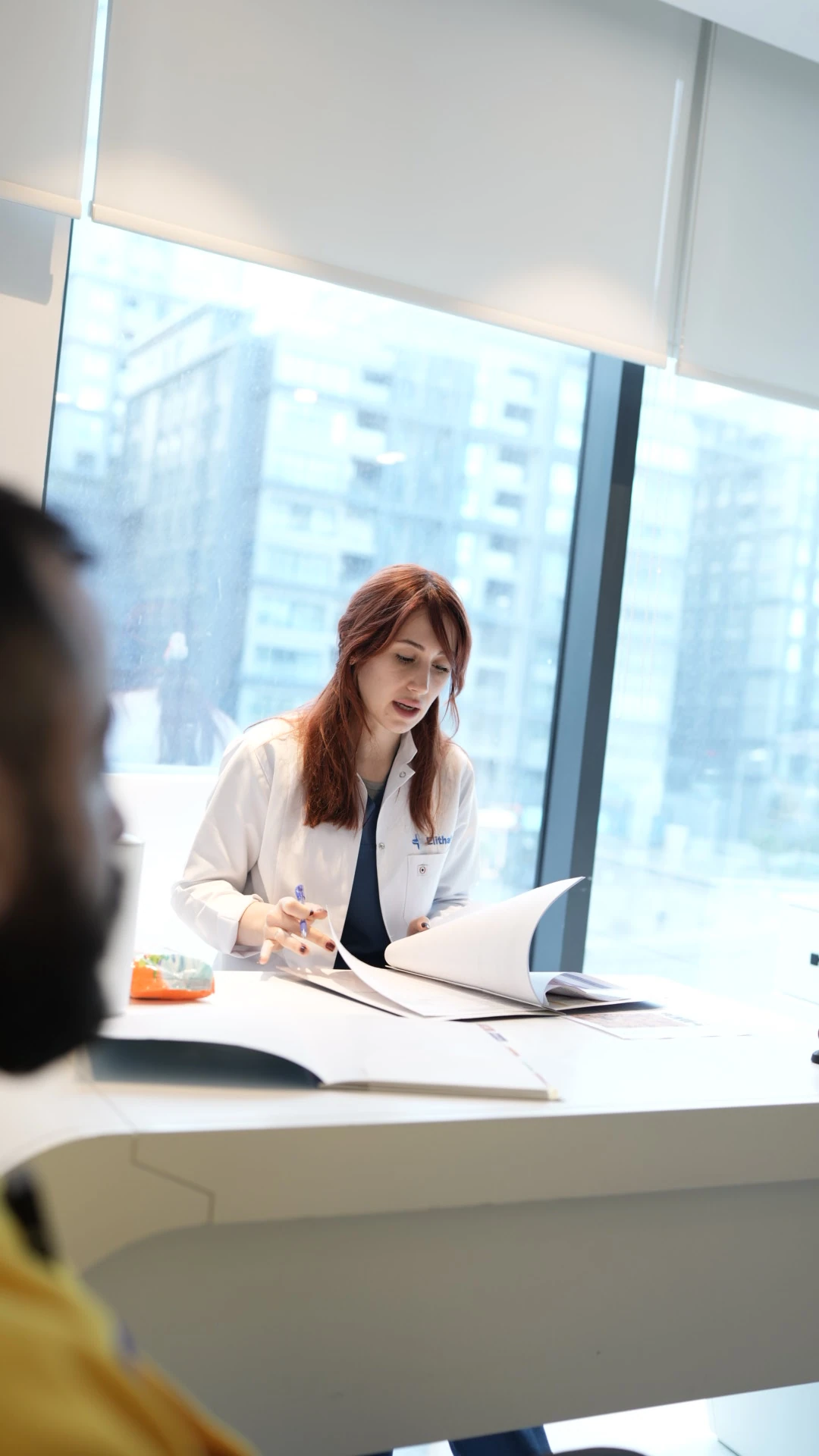
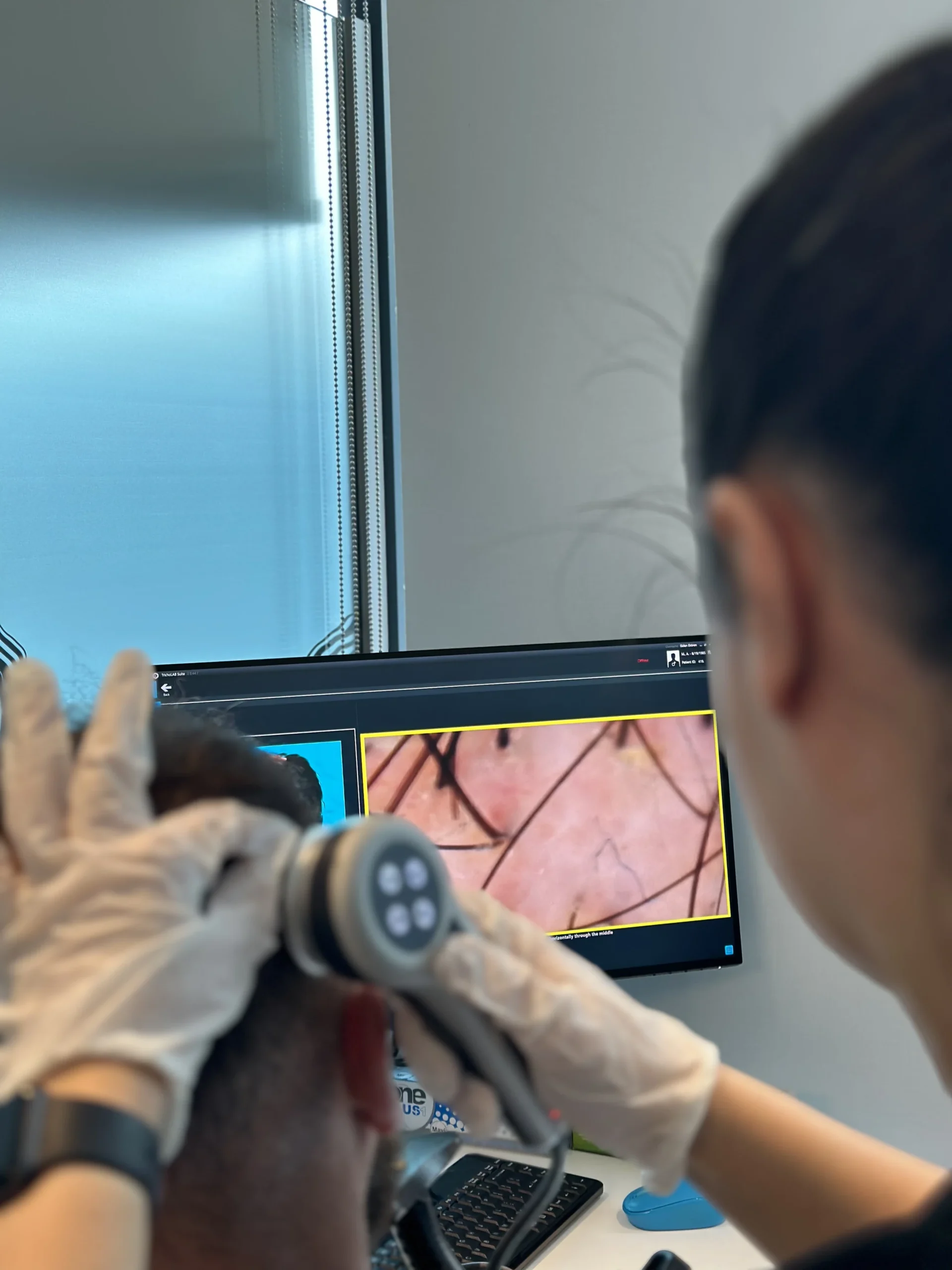
Procedures involving a large number of grafts require careful management of the donor area, graft handling, hydration, temperature control and team coordination, because thousands of follicles are extracted and implanted one by one. The insertion depth is determined beforehand in the Pre-Test System from your skin thickness and blood flow and built into your individual treatment plan, which makes a graft survival rate of approximately 98% possible.
At Norwood 6 and 7, a second session is often part of the plan. At Elithair, we explain this openly before surgery so it does not come as a surprise afterwards. A second session can take place no earlier than six months after the first, whether it treats a new area or adds density to areas that have already been treated. During that time, the donor area recovers and the treated area heals, allowing the results of the first session to be assessed before the second is planned.

Our commitment to honest advice means we decline to treat around 40% of applicants. In these cases, we advise against surgery because a transplant would be ineffective or could cause harm, rather than simply as a routine precaution.
If any of these points applies to you, an honest recommendation against surgery is more valuable than a procedure that cannot deliver a natural, good-looking result.
Declining or postponing treatment when the donor area or diagnosis is unsuitable is part of responsible surgical planning.
If surgery is not appropriate, non-surgical or cosmetic options may still help depending on the diagnosis and the result you want.
Your own donor hair is redistributed; donor follicles are generally more resistant to androgen-related miniaturisation. Suitable when the donor area is sufficiently dense.
Fine pigment deposits recreate the appearance of a closely shaved hairline. Suitable when the donor area is too small, for a closely shaved look, or to complement a transplant.
Finasteride and minoxidil may help manage androgenetic hair loss in suitable patients. Suitable in the early stages and for stabilisation before a transplant.
A hair system or hairpiece is worn or attached to the scalp. Suitable when surgery is not wanted or not possible.
In most cases, yes, as long as the band of hair at the back and sides of your head is still dense enough. This is the source of donor hair for the transplant. If the donor area is too thin or is itself affected by hair loss, a transplant is not appropriate. A free hair analysis determines this before treatment.
Yes, if the donor area provides enough hair. The result is natural-looking, denser coverage focused on the hairline and the top of the head, rather than the full density of your youth across the entire scalp. About 35 to 50 per cent of the original density is usually realistic. With strategic graft placement, this can look like a full head of hair in everyday life.
Norwood 7 does not automatically rule out a transplant, even if some clinics treat it that way. What matters is the density of your remaining donor hair. If it is sufficient, a noticeable improvement is possible, usually with one large session and often a second. Full restoration is not realistic at Norwood 7.
Treating a completely bald head usually involves 5,000 to 6,000 grafts. The donor area typically cannot provide more, because its lifetime capacity is capped at roughly 5,000 to 6,000 grafts. At Norwood 7, that is often not enough for full coverage, but it is enough for a clear visual improvement at the hairline and on top.
At Elithair, the all-inclusive package prices are currently £3,249 for 4,000 grafts and £3,449 for 5,000+ grafts. The UK comparison figures used on Elithair's cost page for these packages are £10,100 and £12,700, representing savings of 68% and 73% respectively.
Yes, a 5,000-graft transplant is a large procedure, well above a typical session of 3,000 to 4,000 grafts. It uses a substantial proportion of the available donor hair and is typical for Norwood 6 and above. At Elithair, treatment with 5,000 grafts or more costs a flat £3,449.
Yes, as a supplement. If your scalp does not provide enough donor hair, beard hair can add substantial volume to the top of your head, and hair from the chest or back can provide additional grafts. These grafts have survival rates of around 85 to 90 per cent. Keep in mind: beard and body hair can only supplement scalp hair, rather than serve as the sole donor source, because their growth cycles differ.
At lower stages, one session with the required number of grafts is enough. At Norwood 6 and 7, a second session is often part of the plan, and Elithair explains this openly before surgery. A second session, whether it treats a new area or adds density to treated areas, can take place no earlier than six months after the first procedure. This gives the donor area time to recover and allows the results of the first session to be assessed.
In the first weeks after the procedure, the transplanted hairs may fall out temporarily (shock loss). Not every patient experiences shock loss. New growth begins by the fourth month at the latest, with about 10% more growth each month after that. Initial results become visible after six months, and the final result at the front is visible after 10 to 12 months. In the crown area, the final density becomes visible after 15 to 18 months.
Yes, if the grafts are placed strategically and at a natural angle. Single-hair grafts create a fine, natural-looking hairline, while thicker grafts add volume to the top of your head. The hairs overlap like roof tiles and cast shadows on the scalp, making your hair look full in everyday life even if its measured density is lower than when you were younger.
Yes, although this is often misunderstood. Transplanted donor hair remains permanently because it is DHT-resistant. Your remaining, non-transplanted hair can continue to fall out. At Norwood 6 and 7, hair loss is usually already advanced, so the risk of further loss is lower than in younger patients. Good planning accounts for that possibility.
The transplanted hair does not fall out again. If hereditary hair loss continues to thin your remaining non-transplanted hair, bald areas can reappear around the transplanted hair. This is known as the halo effect. If you still have enough non-transplanted hair, finasteride can help prevent this. With very advanced hair loss, the risk is low because little non-transplanted hair remains.
Transplanted hair is permanent because it is genetically resistant to hereditary hair loss. It continues to grow in its new location throughout your life. Elithair provides a 20-year written guarantee on transplanted hair, provided you follow the aftercare instructions. Your surrounding, non-transplanted hair can change over time, while the transplanted hair remains.


