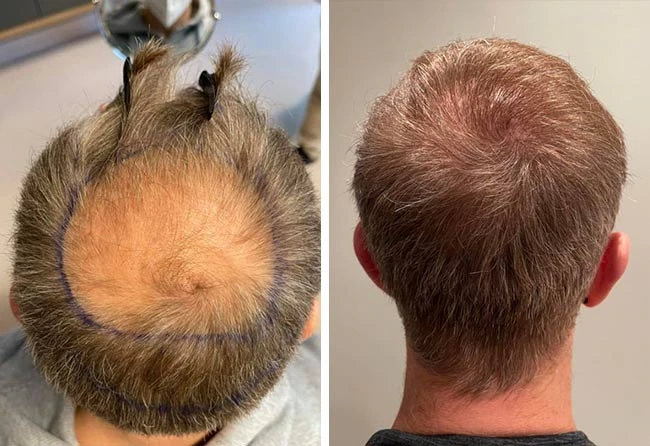
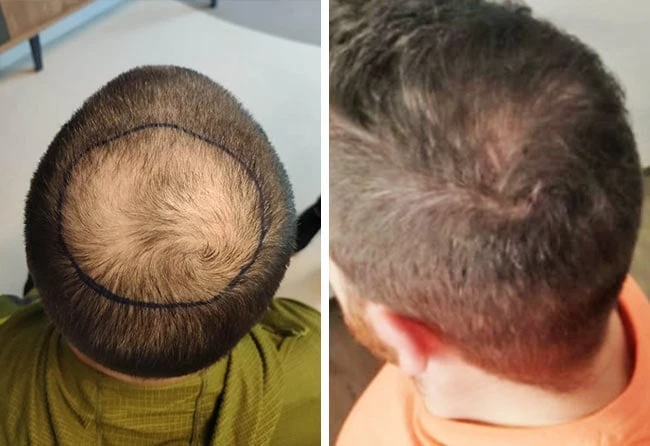
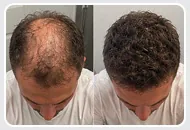
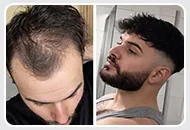
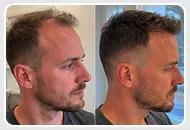
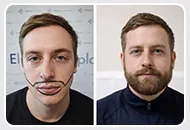
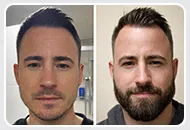
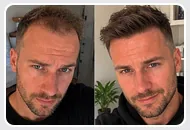
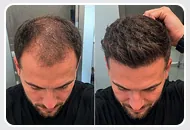
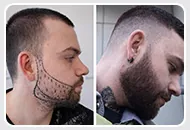
Before
After
Raffaele L. – 4,750 grafts

4.9 - 11,000+ Reviews on Google

150,000+ Happy Patients Worldwide
free & without obligation
 4.9 out of 5 stars on Google
More than 150,000 treatments
at our specialist clinic, certified to ISO 9001:2015
by TÜV Thüringen.

The crown, also called the vertex, is the area at the upper back of your head. It can be treated with a hair transplant, but it is the most challenging area of the scalp to treat. The experience of your treatment team plays a key role in achieving a natural-looking result (Devroye 2013).
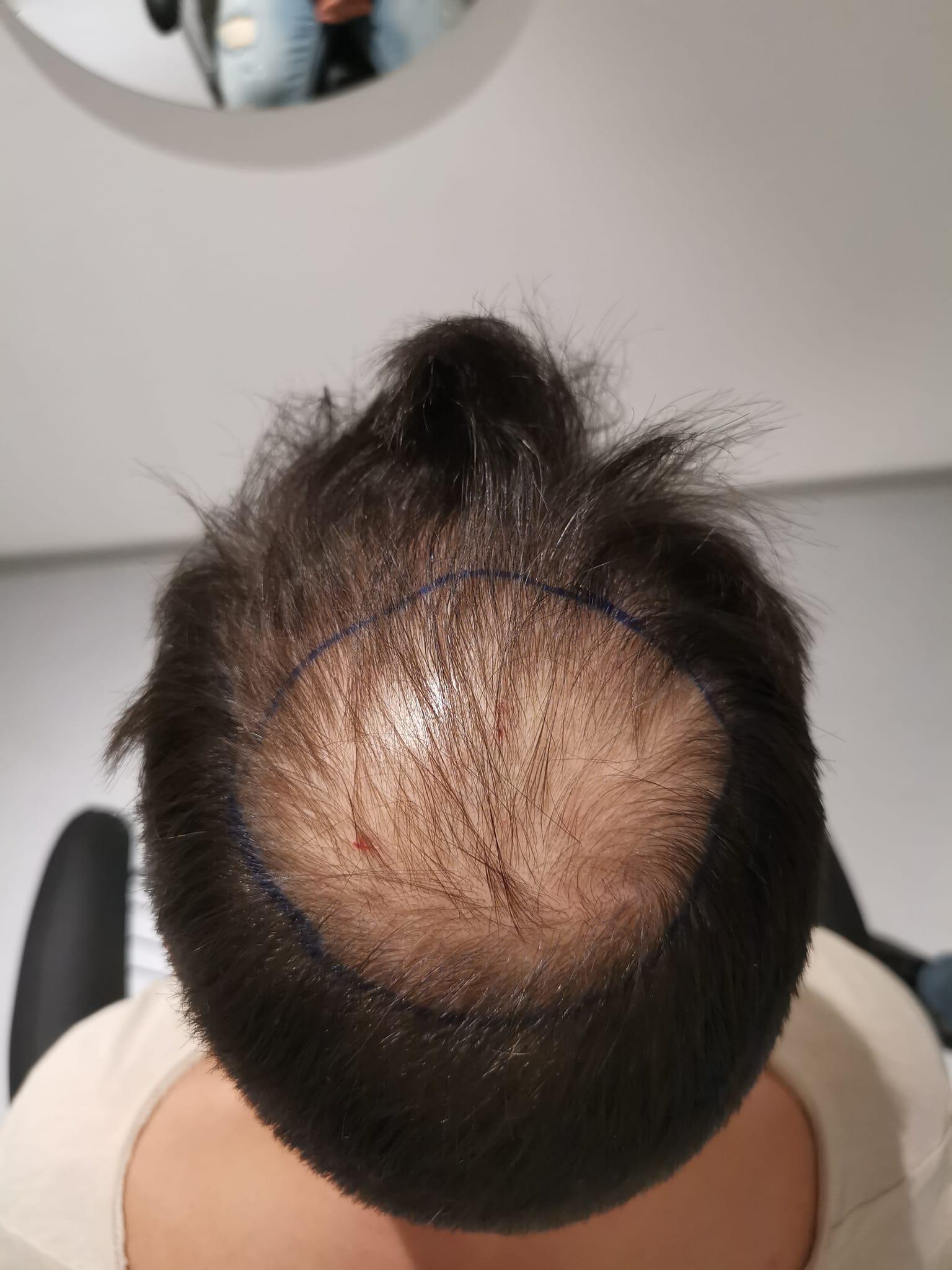
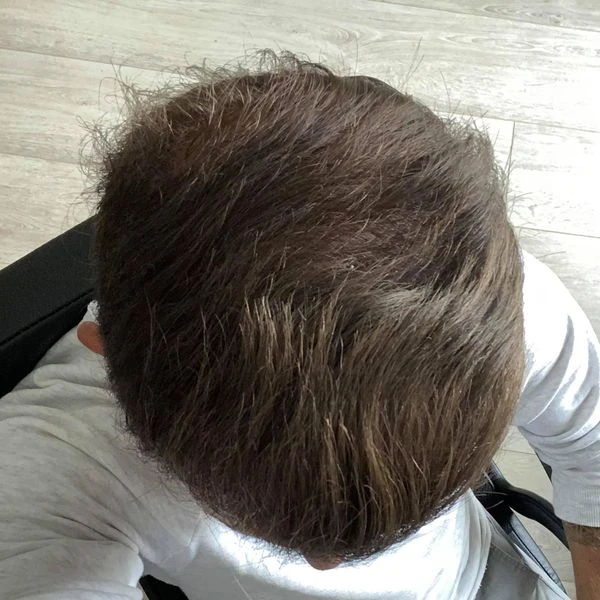
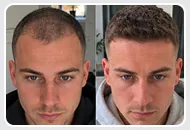
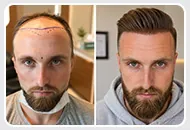
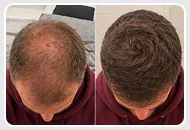
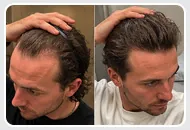
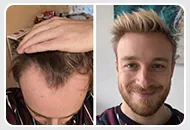
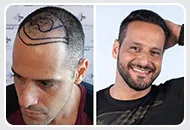
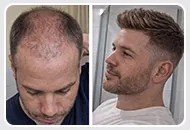
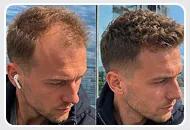
When it comes to the crown, real results matter more than promises. Our crown hair transplant before-and-after photos show that most cases involving the crown and mid-scalp use around 2,500 to 5,000 grafts.
Raffaele L. – 4,750 grafts
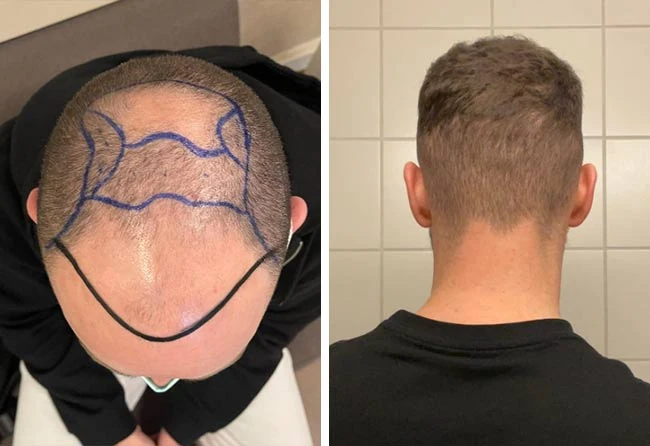
Kriss Kross - 4,700 grafts
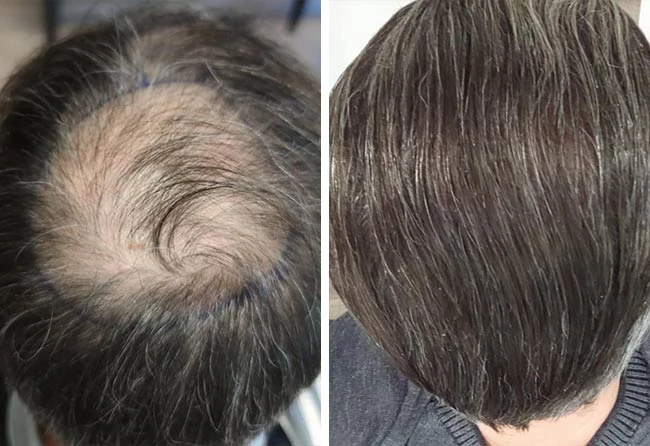
Dani E. – 3,100 grafts
Tho M. – 4,000 grafts
 Process
The procedure takes place on one day during your four-day, three-night stay in Istanbul. The main stages are:
At the clinic, you receive the serum set, which includes a dermaroller and two ampoules. You apply the serum to your scalp exactly twice, on day 14 and day 28 after the procedure.
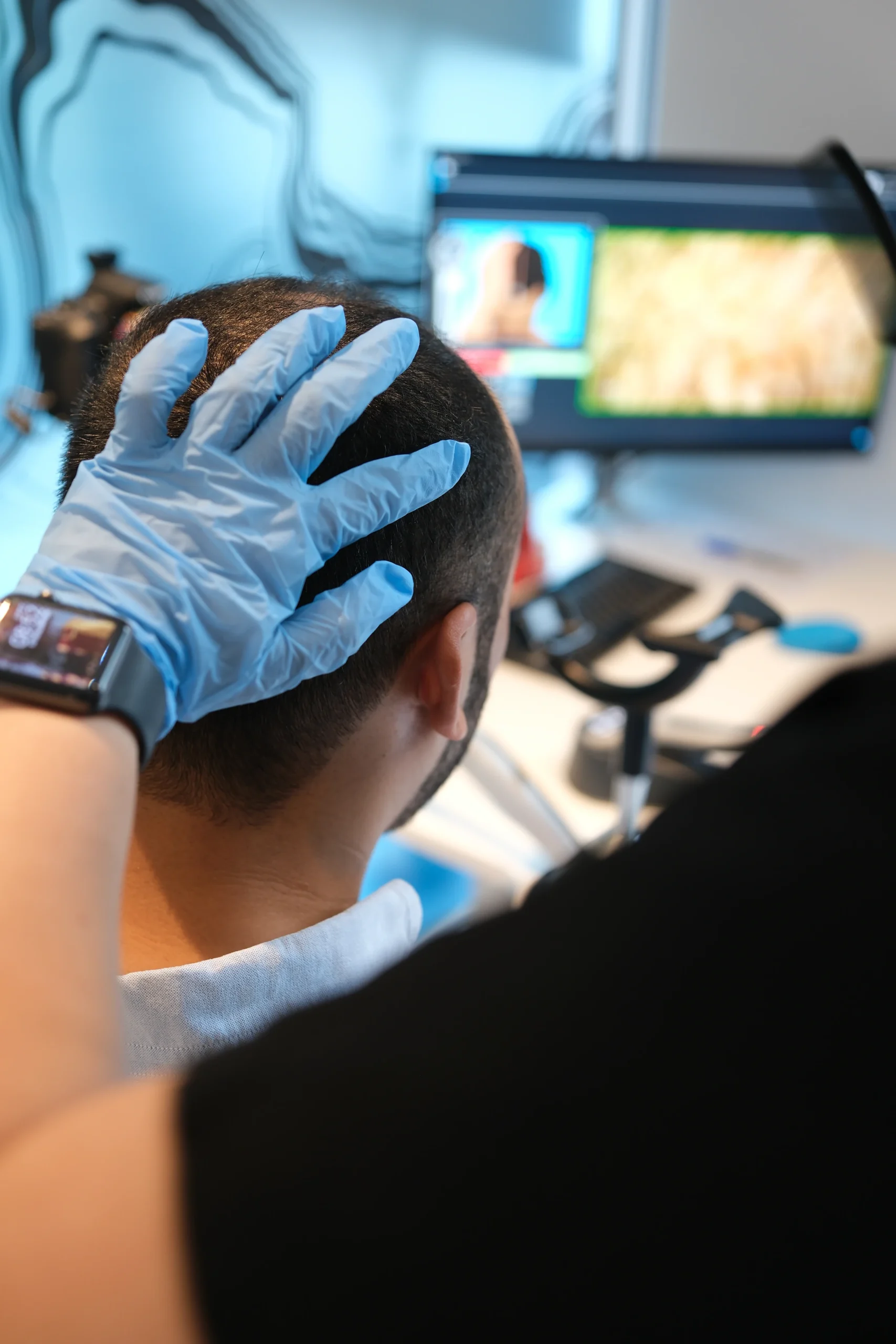
There you undergo six checks. Our doctors use the results to draw up your individual treatment plan.
We extract grafts one at a time from the donor area on the lower part of the back of your head
CHOI Implanter Pens create an opening as each graft is inserted (Choi et al. 1992).
Four-step process timeline (Pre-Test, extraction, DHI implantation, then NEO FUE serum on day 14 and day 28 after the procedure)
Patented NEO FUE® Serum: This serum is specific to Elithair and is included in your care. At the clinic, you receive the serum set, which includes a dermaroller and two ampoules. You apply the serum to your scalp exactly twice, on day 14 and day 28 after the procedure, to support healing.
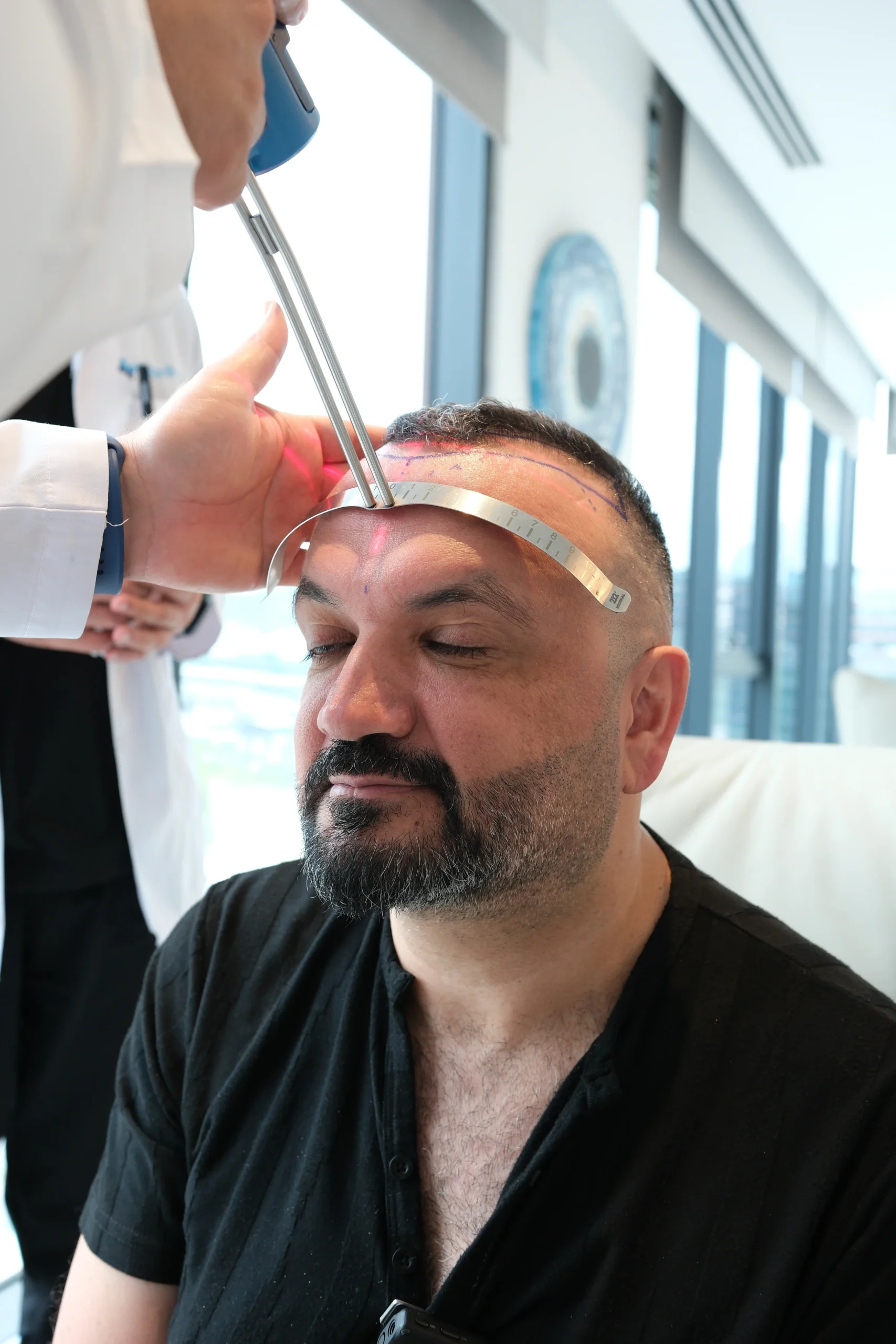
Pre-Test System: On the day you arrive, we collect you from the airport and take you straight to the clinic for six checks: an ECG, a blood test for your general health, a blood test relating to hair loss, TrichoLAB analysis of hair density and structure, an ultrasound scan to measure scalp thickness and a Doppler scan to assess blood flow. Together, scalp thickness and blood flow determine the depth at which the grafts are placed. Our doctors use the results to draw up your individual treatment plan. We then take you to your hotel.
If you arrive late in the evening, we still bring you to the clinic for the blood tests, and the remaining Pre-Test steps follow on day 2.
This matters especially at the crown, where a large number of grafts is needed and we want to rule out overharvesting. Your treatment plan is always tailored to you and explained clearly.
FUE extraction: We extract grafts one at a time from the donor area on the lower part of the back of your head. These hairs are genetically resistant to hereditary hair loss and remain permanently. The donor area lies below the crown. Extraction leaves no scars, and with careful planning, your donor area retains an even density.
DHI implantation: The grafts are placed using CHOI Implanter Pens, which create an opening as each graft is inserted. This allows the team to follow the natural direction of the whorl at your crown and adjust the angle, depth and spacing of each graft.
We use grafts with different numbers of hairs at the crown. Fine grafts with 1 to 2 hairs go in the centre for a soft transition, grafts with 2 to 3 hairs in the middle, and grafts with 3 to 4 hairs along the outer edge for maximum coverage. The goal is dense coverage across the crown, rather than the soft hairline we create at the front.
The crown is usually shaved to give the team clear access for planning and implantation. In selected cases, our Zero Shave FUE extraction method may be possible at an additional cost, depending on the area being treated, your existing hair and the number of grafts needed.

















 Cost
Elithair offers all-inclusive packages priced by graft count rather than charging for each graft. Current prices range from £2,849 to £3,449.
Your flight is booked separately. Zero Shave FUE and Manual FUE are available as optional extraction methods at an additional cost.
A 4,000-graft crown transplant costs £3,249 at Elithair.
Differences in staffing, premises and running costs help explain why treatment can cost less in Turkey.
Unlike the frontal hairline, the crown usually follows a spiral or whorl pattern, and some people have more than one whorl.
Each graft must be placed at the correct angle: flat in the centre and steeper towards the edge. Even a deviation of 5 to 10 degrees can make the hair stick out. At Elithair, our medical specialists use the results of the Pre-Test System to map your hair growth direction and whorl pattern before the procedure. Both are reviewed and approved before we place the first graft.
The crown lacks the frame provided by the hairline at the front, so the same number of grafts looks sparser here. Its rounded surface must be filled from the inside out and requires roughly 20 to 30 per cent more grafts per square centimetre — about 45 to 50 for good coverage. Because the area is viewed from an angle above, visible scalp is particularly noticeable here.
Blood circulation at the top of the head is also poorer, so the roots receive nutrients more slowly and results take longer to appear. This makes the technique especially important. With DHI implantation using the CHOI Implanter Pen, we create the channel and implant the graft in one step, allowing the precise control over placement angles that the crown requires.
 Graft count
The number of grafts you need depends on the size of the bald area. Because the crown has no defined edge and needs coverage across its entire surface, it requires more grafts per square centimetre than similarly sized areas at the front. Use these estimates as a guide:
2,000 to 4,500 graftstypical range for a transplant to the crown alone
A transplant to the crown alone typically requires around 2,000 to 4,500 grafts. Treating the middle or front of the scalp at the same time increases the total number needed.
A graft count of 4,500 is not unusual for crown treatment. It marks the upper end of the range for a large bald area at the crown and is often needed to cover the rounded area adequately. An assessment of your bald area and donor area is the only way to determine how many grafts you need.
Important: More grafts are not automatically better. The donor supply is finite, and overharvesting can leave visible thinning or reduce options for future treatment. For large areas, a staged plan may be safer than trying to maximise the graft count in one session.
TimingTiming is crucial for a crown transplant, but its importance is often underestimated. For most men, hair loss at the crown continues to progress. Having a transplant while hair loss is still active can lead to a poor result.
This is because of the halo or doughnut effect. If transplanted hair grows at the crown while the surrounding hair continues to fall out, you can eventually develop an island of transplanted hair surrounded by an expanding bald area. This can look worse than the original hair loss.
The course of hair loss can be harder to predict in younger patients, and pattern hair loss becomes more common with age.
After the transplantnew hair at the crown
Over the yearsan island of transplanted hair surrounded by an expanding bald area
If your hair loss is still active, we usually advise against a crown-only procedure until it stabilises. Such a procedure is appropriate only in exceptional cases.
Use medication to stabilise the remaining hair that has not been transplanted. Finasteride (for men) and minoxidil help protect against the doughnut effect.
These medications are more effective at the crown than in other areas. In one study (Kaufman et al., 1998), hair count at the vertex increased by 12.8% with finasteride, compared with only 6.4% at the front. According to Olsen et al. (2002), 5% minoxidil has its strongest effect at the crown.
Important: The benefits of finasteride and minoxidil generally depend on continued treatment and can diminish if you stop. If you do not take medication, keeping enough donor hair in reserve for possible future hair loss becomes especially important.
If you have extensive hair loss at the crown, the team may discuss treatment in stages from the outset (Chouhan et al. 2019). A second procedure is possible after six months at the earliest, once there has been enough time to assess the first result and the donor area. If crown loss is only beginning, monitoring or medical stabilisation may be more appropriate than immediate surgery.
The crown does not frame the face in the way the hairline does, so the same number of grafts can look less dense there. This does not indicate a surgical error; it reflects how we see a rounded surface.
Good visual coverage is a realistic, successful result. Your scalp no longer shows through, you no longer need a comb-over, and your crown no longer draws attention in everyday life. A crown transplant usually cannot restore the full density you had before losing your hair.
Your hair type plays a big part. If you have thicker or slightly wavy hair, the same number of grafts can give you better coverage at the crown than someone with fine, straight hair would achieve.
Colour contrast matters, too. The scalp is more visible when dark hair contrasts with light skin than when hair and skin tones are similar. We assess this in advance through the Pre-Test System so your expectations match a realistic result.
 Timeline
Multi-hair grafts along the outer edge (3 to 4 hairs) maximise the appearance of density without overharvesting the donor area.
If you also have receding hair at the temples, we use single-hair grafts to create greater density along the hairline because it frames your face and has the greatest visual impact (Shapiro et al. 2013). We distribute multi-hair grafts across the crown behind it.
crusts come away by day 11; shedding (shock loss) may occur, but not everyone experiences it
shedding (shock loss) may occur, sometimes later, but not everyone experiences it
initial results visible
approx. 20–30% visible
final result at the front (10 to 12 months)
approx. 60–70% visible
full result (reached after 10 to 12 months)
usually mature
IMPORTANT: If the crown still looks thin at six months, it may simply be too early to judge. Crown growth often continues to mature well beyond this point, so allow roughly 15 to 18 months before assessing the final result.




Healing follows the same broad course as any hair transplant, with two crown-specific points: sleeping position and sun protection.
| Day and month | What happens |
|---|---|
| Days 1 to 3 | Crusts, mild redness and swelling. |
| Days 10 and 11 | The crusts are gently loosened with lotion. From day 12, you can wash your hair with your usual shampoo. |
| In the first weeks after treatment | The transplanted hair shafts may fall out temporarily (shock loss), but the roots remain intact. Not every patient experiences shock loss. |
| By month 4 at the latest | Early new growth begins to appear. |
| Month 6 | Only 20 to 30 per cent visible at the crown. |
| Months 15 to 18 | The result at the crown is usually fully developed. |
You may be able to return to light desk work from day 2 or 3, depending on your role and recovery. Light exercise is usually possible after two weeks, moderate exercise after four weeks and weight training after six weeks.
Sleeping: At the crown, the grafts sit exactly where your head normally rests. Sleep on your back with a neck pillow so that there is no pressure on the crown or the fresh grafts. For the first five days, the recipient area must not touch the pillow. You can sleep without the neck pillow and on your side from day 5, and on your front from day 10.
Sun protection: The crown is the part of the scalp most exposed to the sun, so wear a head covering in direct sunlight and dusty conditions. For the first 14 days, wear only the hat provided by the clinic. How long you need a head covering depends on the temperature: up to 23°C, none is needed; at 24 to 39°C, wear it for 14 days; at 40°C or above, wear it for one month.
Your donor area at the back of the head is dense enough to supply the grafts you need, your hair-loss pattern is stable enough to plan for the long term, with medical treatment considered where appropriate, and you accept good coverage as the goal, not the full density you once had.
your donor area is too thin to provide enough grafts for the large crown area, or your hair loss is progressing quickly. In that case, stabilisation comes before surgery.
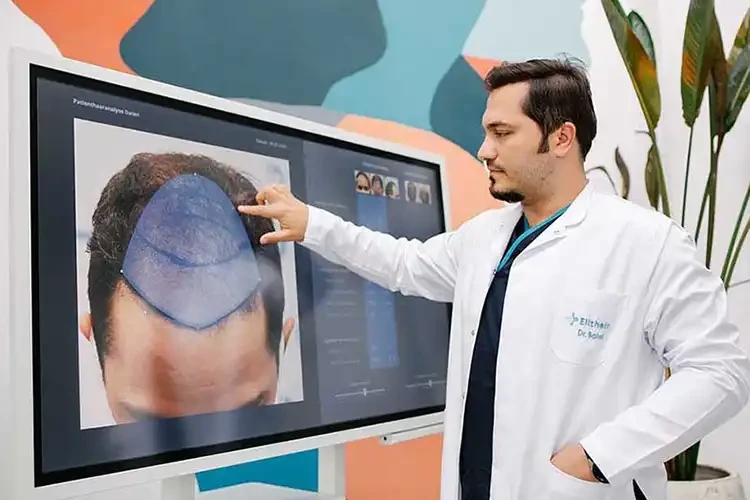
Our free hair analysis establishes what is suitable for you. Rather than sending a standard response, our doctors review your photos and assess your donor area individually to give you a personalised answer.
At Elithair, the graft survival rate is approximately 98%, supported by the implantation depth determined individually through the Pre-Test System and the NEO FUE protocol. There is an important distinction: transplanted roots reliably take hold, but how dense your results look depends on the size of the treatment area and your donor area. At the crown, good visual coverage is the realistic goal.
For the crown alone, a typical estimate is around 2,000 to 4,500 grafts: around 2,000 to 2,500 for light thinning, 2,500 to 3,500 for a bald area at the crown and 3,500 to 4,500 for a large treatment area at the crown. Restoring full coverage at the crown may require around 2,500 to 5,000. The final number depends on the size of the area, your existing hair and the available donor hair, and is confirmed after a clinical assessment.
At Elithair, current package prices range from £2,849 to £3,449, depending on graft count. The UK comparison prices listed on Elithair's cost page range from £5,100 to £12,700, although prices vary by clinic, surgeon, number of grafts needed and region.
In the first weeks after the procedure, the transplanted hairs may fall out temporarily (shock loss). Not every patient experiences shock loss. The first fine hairs appear by month 4 at the latest. At the crown, only 20 to 30 per cent of the final result is visible after 6 months, with full results appearing after 15 to 18 months. Growth at the crown takes longer than at the front because blood circulation is poorer.
The scalp at the crown is thicker and has poorer blood circulation than at the front. The larger blood vessels lie at the sides, and capillary pressure is lower at the crown. The transplanted roots therefore take longer to receive nutrients and produce hair. Allow 15 to 18 months to see the final result at the crown.
No. This graft count marks the upper end of the range for a large bald area at the crown — an advanced but normal case. At the crown, a high graft count is often needed to cover the rounded area.
Not in the first few days. Sleep on your back with a neck pillow so that the recipient area does not touch the pillow for the first five days. You can sleep without the neck pillow and on your side from day 5, and on your front from day 10.
Smaller crown areas may be treatable in one session, while extensive areas may need a staged approach. A second procedure, including one to add density, is possible after six months at the earliest, once the first result and the donor area can be assessed. Elithair also provides a 20-year written guarantee on the transplanted grafts, subject to the guarantee terms and aftercare requirements.
Yes, if your hair loss is progressing. Both medications stabilise the hair you still have around the transplanted area and help protect against the doughnut effect. They are more effective at the crown than at the front. During your hair analysis, you can discuss whether medication is appropriate for you and which option makes sense.
Elithair has performed over 150,000 treatments and has ratings of 4.7 on Trustpilot (3,700+ reviews) and 4.9 on Google with over 11,000 reviews. Our crown before-and-after page shows individual patient results with the graft count for each case.


