Hand typing on a computer keyboard with illustrated question marks above it

Hair Transplant FAQ: Answers to the Most Common Questions

  • 50 questions from consultations
  • From suitability to guarantee
  • Clear timelines to help you plan
  • Clear references to research

free & without obligation

4.9 out of 5 stars on Google

Experience and Certification

More than 150,000 treatments
at our specialist clinic, certified to ISO 9001:2015
by TÜV Thüringen.

ISO 9001:2015, TÜV Thüringen and health certification seals for the Elithair clinic
50 questions from consultations

The most common questions about hair transplants

Before a hair transplant, almost everyone has similar questions: am I suitable, will it hurt, how long will the results last and when can I go out in public again? Here we answer the 50 questions we hear most often during consultations, in the order you're likely to ask them.

All preparation and recovery timelines are based directly on the personalised treatment schedule you receive before travelling. Whenever we discuss scientific findings, we clearly reference the relevant research.

This gives you a clear overview for planning. All medical details are also documented so that you can refer to them whenever you need to.

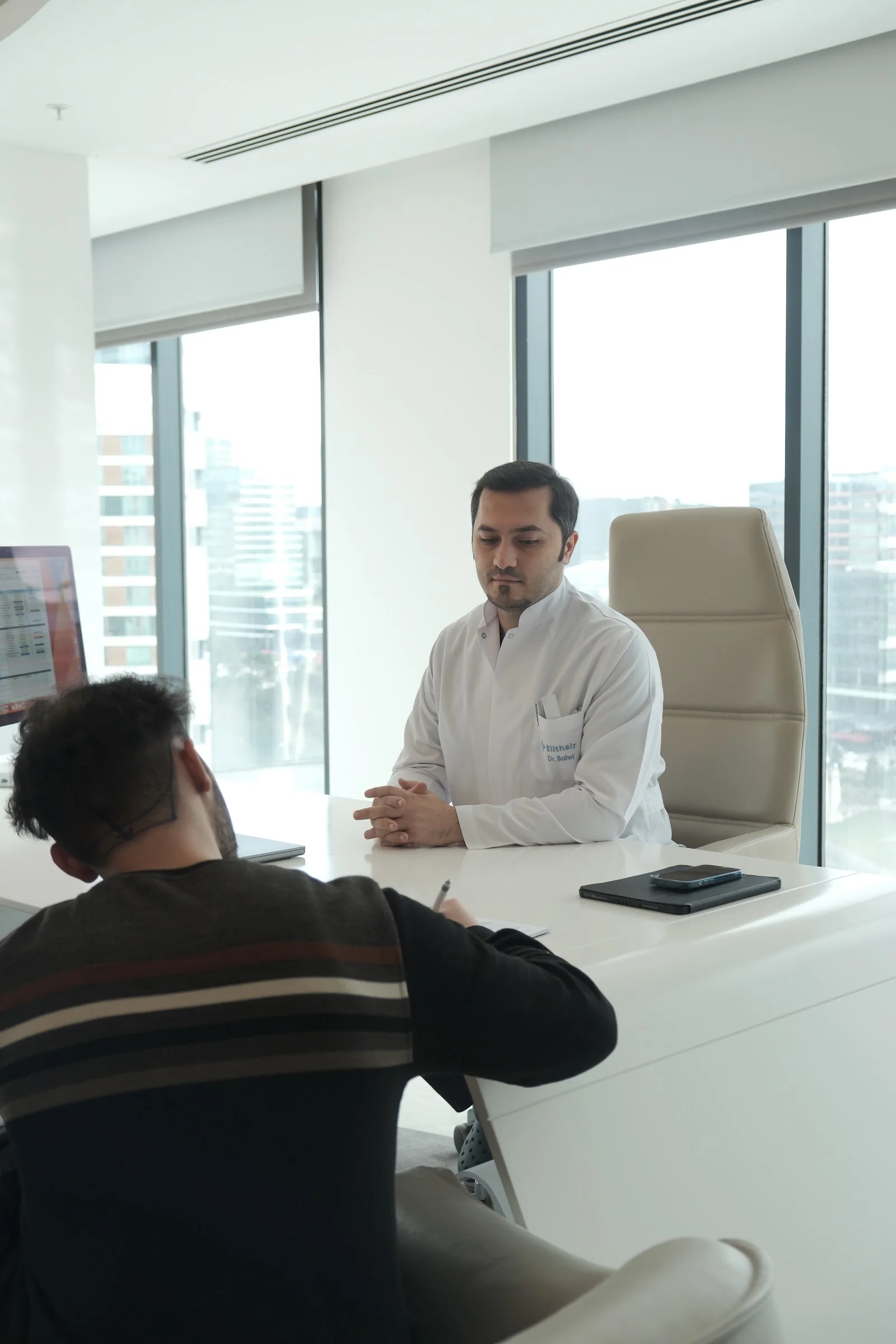
Doctor with hands clasped consulting with a patient at a desk.

The categories at a glance

The eight FAQ categories with their topics and question numbers
Category What it covers Questions
Candidacy and timing Who is suitable, age considerations and when surgery is not advised 1 to 8
Grafts and planning What a graft is, how many you need and whether you can have further treatment 9 to 13
Methods FUE, DHI, sapphire, Zero Shave, NEO FUE® serum and beard transplants 14 to 20
Procedure and pain Anaesthesia, four days in Istanbul, Pre-Test System, what the package includes 21 to 27
Healing and what to do afterwards Work, scabs, sleeping, exercise, sun, haircuts 28 to 36
Results and longevity Timeline, shedding after a few weeks, longevity and graft survival rate 37 to 43
Risks and safety Side effects, scars, corrections, reputable clinics 44 to 47
Cost, treatment location and guarantee Price, NHS and private insurance, where treatment takes place, guarantee 48 to 50
Questions 1 to 8

Candidacy and timing

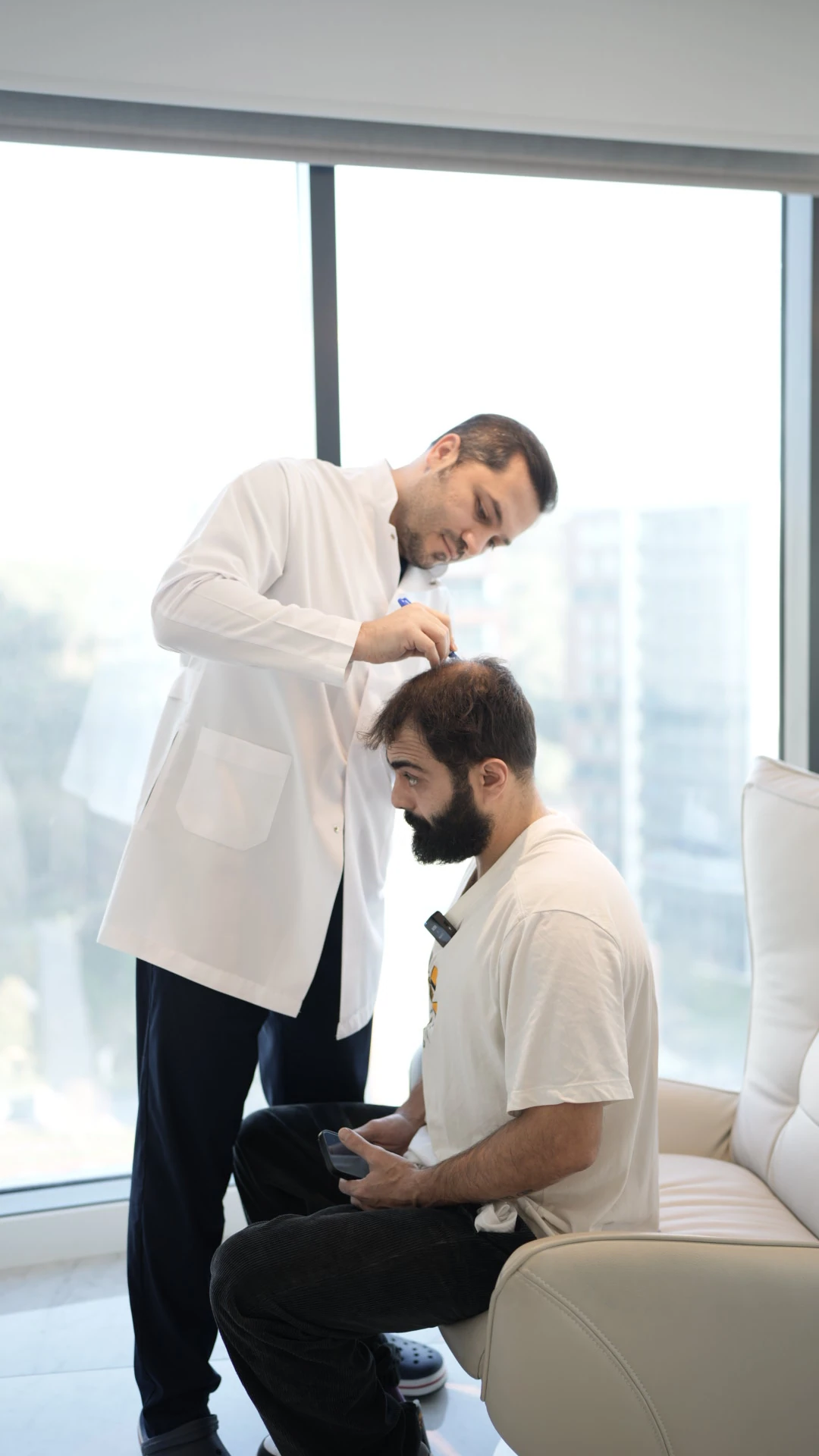
Doctor checking the hair density of a bearded patient in a treatment chair by the window

1. Am I a candidate for a hair transplant?

You are suitable if your donor area can supply enough grafts for the area you want treated and your hair loss is sufficiently stable. We assess this through the Free Hair Analysis using your photos, before you plan any travel.

We decline around 40% of enquiries after this analysis because we would not be able to achieve a result those patients would be happy with.

The European professional societies' guideline on hereditary hair loss also recommends transplantation only under these conditions: stable hair loss and an adequate donor area.

2. What is the right age for a hair transplant?

What matters is not your age itself, but how stable your hair loss is. For very young patients whose hair loss is still progressing rapidly, we often recommend waiting or stabilising the hair loss first, because its future pattern is not yet clear.

Most first-time patients worldwide are between 20 and 35 years old, according to the annual survey by ISHRS, the international professional society.

In this age range, the pattern of hair loss is usually recognisable and the donor area is still fully intact.

3. Is 20 too young for a hair transplant?

Often, yes, but not always. In their early twenties, many men can't yet tell how far their hair loss will go. A hairline set too early and too low can look unnatural later if more hair is lost behind it. If we do recommend treatment at that age, we design a conservative hairline that will still suit you as you get older, and preserve donor hair for possible future treatment.

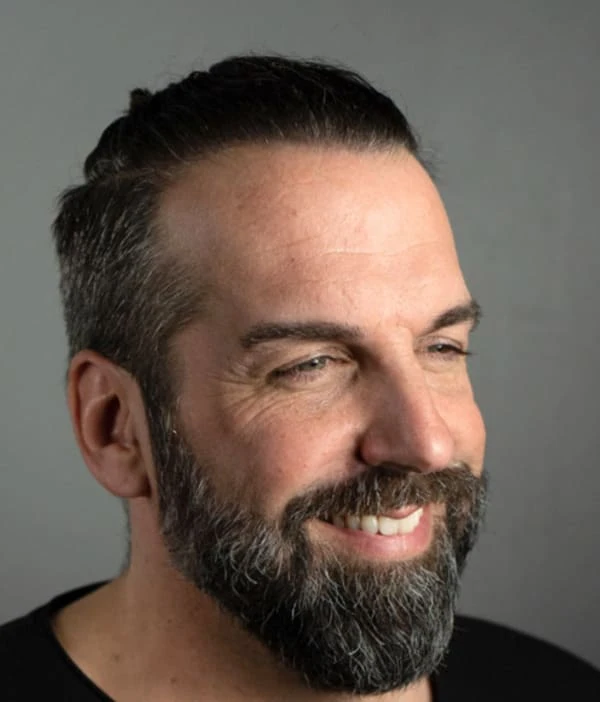
Side view of a smiling older man with salt-and-pepper hair and a beard

4. Is a hair transplant worth it at 50 or 60?

Yes, provided you have enough donor hair. At this age, hair loss has usually largely stabilised, which makes planning more reliable. What matters is your donor hair density and general health. Our six-step Pre-Test System examines your scalp and donor area, and we use the findings to create your individual surgical plan.

5. Can women get a hair transplant?

A hair transplant is also an established treatment for women; the individual pattern of hair loss is what matters (Unger 2013). If hair loss is concentrated in particular areas, such as a high forehead, receding temples or clearly defined patches caused by scarring, transplantation can usually achieve a dense, natural-looking result.

If your hair is thinning across the entire top of your head, we carefully assess whether your donor area has enough strong hair follicles before recommending a hair transplant for women.

The global trend also shows that more women are choosing this route to fuller hair: women now account for around 15% of treatments worldwide.

6. Can a hair transplant help with advanced baldness?

To some extent. With extensive hair loss, the donor area rarely provides enough grafts for complete coverage (Chouhan et al. 2019). However, a noticeable improvement is usually possible where it makes the greatest difference: at the hairline and front of the scalp. The Free Hair Analysis shows what is realistic in your case.

7. When is a hair transplant not possible?

A hair transplant is not possible or advisable

  • if the donor area is too weak,
  • if your hair loss is still progressing rapidly
  • or if an underlying condition or blood test result makes it inadvisable.

For some forms of hair loss, such as alopecia areata, a transplant is usually not the right treatment either. In these cases, we explain this openly and, where appropriate, recommend stabilising your hair loss first. You'll find the alternatives under Treatments.

8. Is it worth waiting before I decide?

Waiting usually does not improve your starting position. Hair removed from your donor area does not grow back, and while hair loss remains active, the area requiring coverage gets larger. You also need to allow time for the result to develop. The final result in the frontal area is visible at around twelve months. Every month you postpone treatment also pushes that point back. The Free Hair Analysis is entirely without obligation and shows you where you stand today.

Grafts and planning

9. What is a graft?

A graft is a naturally occurring group of hair follicles in the scalp, usually containing one to four hairs. During a hair transplant, each group is harvested and implanted as a single unit. That's why the number of hairs is always higher than the number of grafts.

10. How many grafts do I need? That depends on the treatment area and the density of your donor hair. There is no universal average that tells you what you personally need. The Free Hair Analysis provides an initial estimate based on your photos. In Istanbul, the graft count is confirmed through hair analysis with the TrichoLAB scanner as part of the Pre-Test System and used to create your individual treatment plan.

11. How many grafts are possible in one session? This depends on your donor area rather than a fixed upper limit (Chouhan et al. 2019). What matters is how many grafts can be harvested without visibly thinning the donor area. With Zero Shave FUE without shaving, treatment is possible with fewer than 3,500 grafts.

12. Is my donor area sufficient? This can only be assessed through an examination. Your donor area is your only reserve for harvesting grafts, and extracted follicles do not grow back there. We therefore plan for your current needs while preserving enough donor hair for possible future treatment. Dr Abdulaziz Balwi published this principle in the journal Cosmetics in 2026.

13. Can you have more than one transplant? Yes, if your donor area allows it. A second treatment is possible after six months at the earliest, whether it covers a new area or adds density to an already treated area. According to the ISHRS, an average of 1.5 procedures worldwide is needed to achieve the desired result.

Questions 14 to 20

Methods

14. Which method is right for me?

Hair transplant methods refer to different steps in the same treatment rather than competing alternatives.

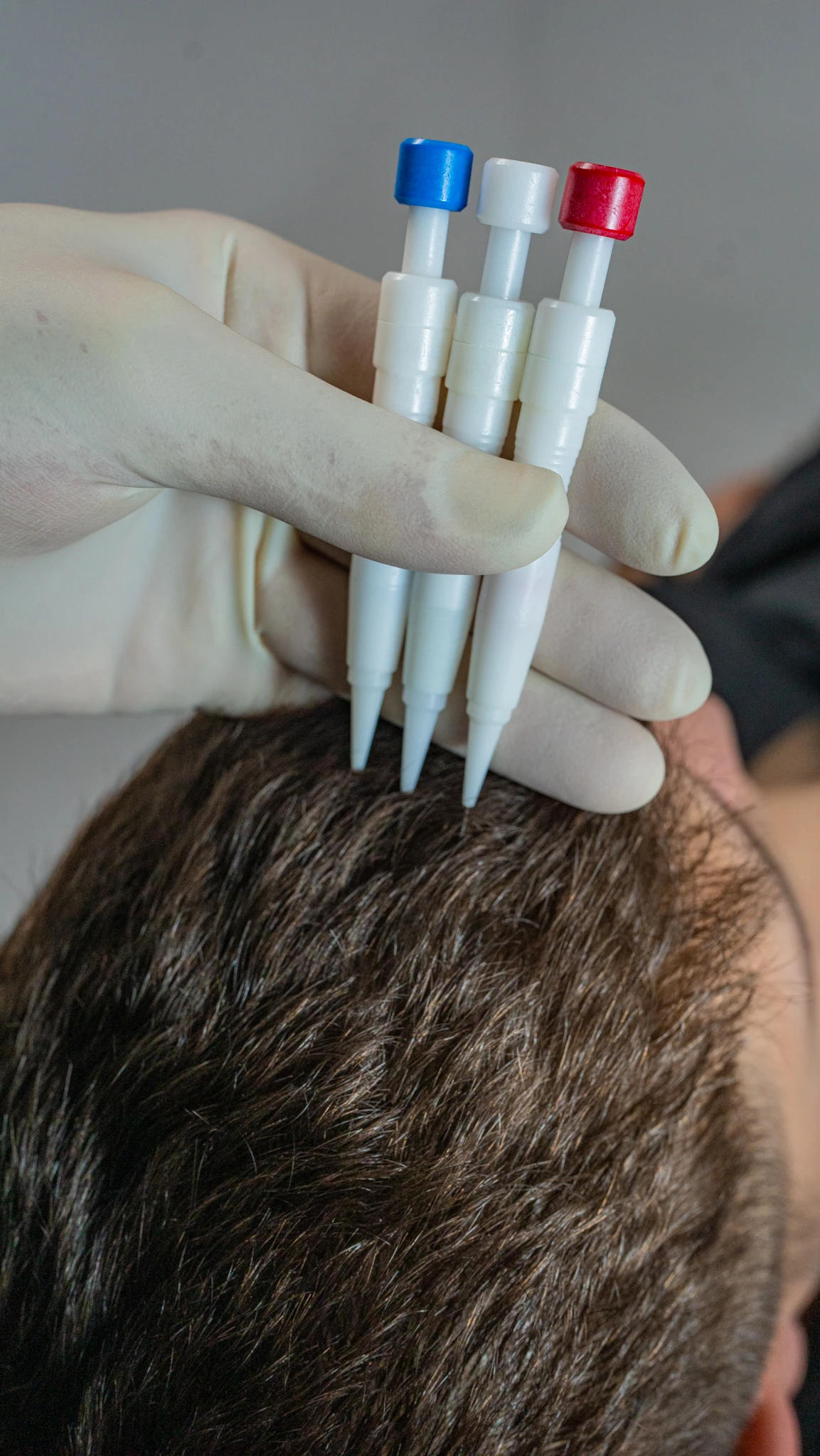
FUE refers to follicular unit extraction, while DHI describes implantation with an implanter pen.

At Elithair, grafts are harvested using FUE and implanted exclusively with DHI. Whether Manual FUE or Zero Shave FUE is suitable for harvesting depends on your assessment.

Three DHI implanter pens held directly against a patient's scalp
Treatment step Procedure at Elithair Included in the all-inclusive package?
Scalp treatment on days 14 and 28 after the procedure patented NEO FUE® serum Yes
Anaesthesia Sleep-Deep sedation, with needle-free anaesthesia as an alternative Yes
Extraction FUE at 100 to 200 revolutions per minute Yes
Harvesting, optional Manual FUE, Zero Shave FUE for an additional charge: £450 for Zero Shave FUE; the Manual FUE surcharge is confirmed during your consultation
Implantation DHI with the CHOI Implanter Pen Yes

15. What's the difference between FUE and DHI?

FUE refers to graft harvesting; DHI refers to implantation. In FUE, grafts are removed one by one from the donor area. In DHI, they're implanted with the CHOI Implanter Pen, which opens the channel in the same motion that places the graft. Every DHI treatment therefore starts with FUE harvesting. Learn more on the FUE Hair Transplant and DHI Hair Transplant pages.

16. What about FUT, the strip method?

FUT removes a strip of skin from the donor area and leaves a linear scar (Gupta et al. 2020). We don't use it. At Elithair, grafts are harvested exclusively one by one with FUE.

17. Does Elithair use the sapphire technique?

No. A sapphire blade is used to create recipient channels before implantation. The CHOI Implanter Pen used in DHI replaces this step by combining channel creation and implantation. The sapphire technique is therefore an outdated method that we no longer use.

18. Can you get a hair transplant without shaving?

Yes, with Zero Shave FUE. Neither the donor area nor the recipient area is shaved. Medium-length or long hair is not a prerequisite; this applies to both men and women (Park et al. 2019). Treatment is possible with fewer than 3,500 grafts, and optional Zero Shave FUE carries an additional charge of £450. Learn more under Zero Shave FUE.

19. What does the NEO FUE® serum do?

The patented NEO FUE® serum supports your scalp after the procedure.

You receive the set, containing a dermaroller and two ampoules of serum, at our clinic in Istanbul. Apply it to the donor and recipient areas twice: on days 14 and 28 after treatment. It is not a separate surgical technique; it supports the scalp tissue during recovery and promotes healing. Learn more under NEO FUE® Serum.

20. Is a beard transplant possible too?

Yes. We offer beard transplants as well as scalp hair transplants. The grafts usually come from the same donor area. Learn more on the Beard Transplant and Treatments pages.

White reception hall of the Elithair clinic with organically shaped columns and a glass façade
Patients with suitcases arriving in the lobby of the Elithair clinic
Clinic lobby with a large white sculpture and seating area
Clinic reception hall with an illuminated art installation
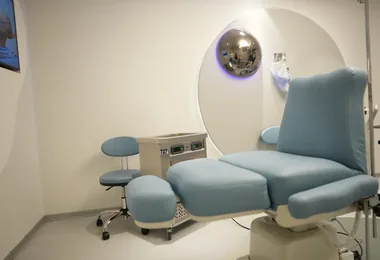
Bright treatment room with a light blue treatment chair
Patient in a transfer vehicle with comfortable leather seats
Evening view of the Istanbul skyline from the hotel
Elit Clinic waiting area with sofas and plants
Hotel Elitoria in Istanbul at dusk
Hotel Elitoria sign above Istanbul at sunset
Hotel room with a curved ceiling and a view of Istanbul
Bright hotel room with a double bed and panoramic window
Hotel room with a white bed, an orchid and a flat-screen TV
Hotel Elitoria with its illuminated entrance in the evening
Waiting lounge with a light installation on the ceiling
Aerial view of the Elit Clinic building in Istanbul
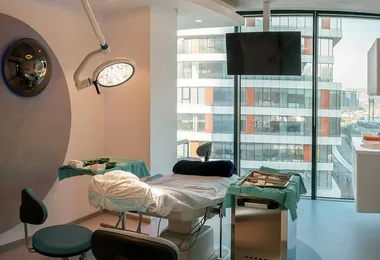
Prepared treatment room with large windows
Exterior of the clinic building in Istanbul
Hotel room with a rounded wall arch and city view
Spacious hotel room with ring-shaped ceiling lights
Patient in a transfer vehicle with comfortable leather seats
Evening view of the Istanbul skyline from the hotel
Elit Clinic waiting area with sofas and plants
Hotel Elitoria in Istanbul at dusk
Hotel Elitoria sign above Istanbul at sunset
Aerial view of the Elit Clinic building in Istanbul
Prepared treatment room with large windows
Exterior of the clinic building in Istanbul
Hotel Elitoria with its illuminated entrance in the evening
Waiting lounge with a light installation on the ceiling
Your stay in Istanbul

Procedure and pain

  1. Bright reception lounge at the Elithair clinic with seating areas in front of the glass façade

    Day 1 – Arrival and transfer

    • Arrival, airport pick-up and transfer straight to the clinic for the Pre-Test System. The results form the basis of your individual treatment plan. You then transfer to the hotel (if you arrive late in the evening, only the blood tests are done at first).
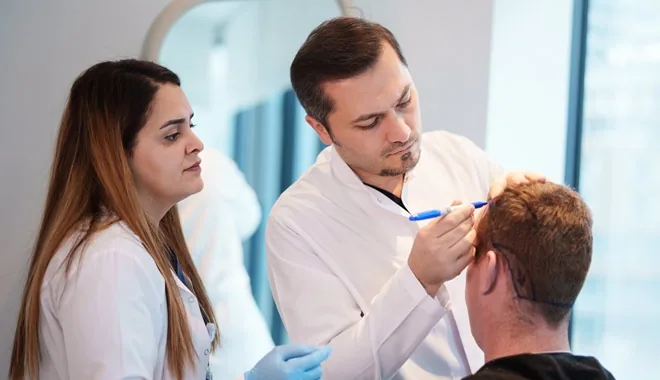
  2. Dr. Balwi marking a patient's hairline while an assistant looks on

    Day 2 – Planning and treatment

    • Completion of the remaining Pre-Test System steps if you arrived late, followed by hairline design with your doctor, Sleep-Deep sedation and treatment (around 5 to 8 hours, depending on the number of grafts)
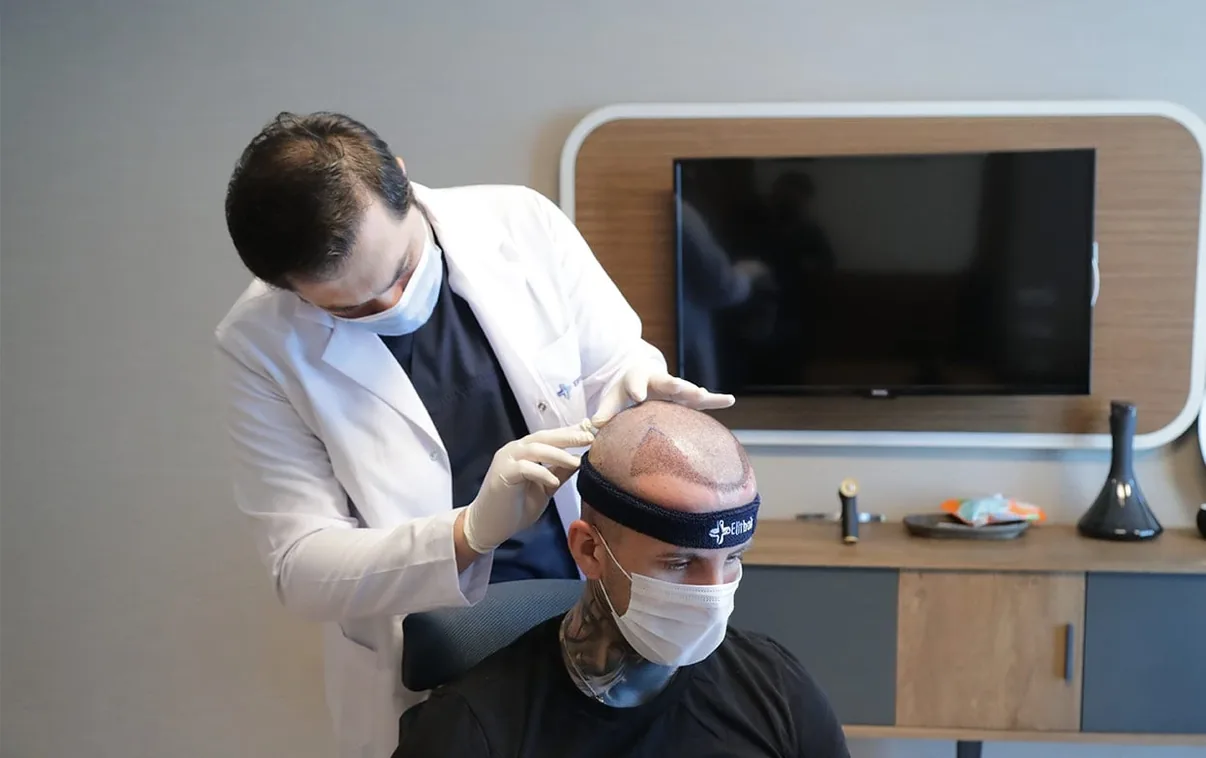
  3. Dr. Balwi examining the head of a patient wearing an Elithair headband during aftercare

    Day 3 – Bandage removal and medical check

    • Bandage removal, headband fitting, medical follow-up check and aftercare instructions; departure

21. Does a hair transplant hurt? No, thanks to the Sleep-Deep method, you experience 0% pain during treatment. The uncomfortable part is not the procedure itself, but administering the local anaesthetic through 20 to 30 injections into the scalp. This is precisely the stage you sleep through. You receive sedation through a vein beforehand and sleep for around 15 minutes while the local anaesthetic is administered. When you wake up, the treatment area is already numb. You can still feel touch and pressure, but no pain. Learn more under Hair Transplant Anaesthesia.

22. Who monitors the sedation? A specialist anaesthetist employed by the clinic who specialises in this procedure. The anaesthetist starts the sedation and monitors you throughout it. This is also one of the five medical checkpoints in your treatment. If you prefer not to have sedation or cannot meet the fasting requirements, needle-free Comfort-In anaesthesia is the alternative. For sedation, you must fast for six hours beforehand, with no water during the final two hours either.

23. How long will I be in Istanbul? Your stay in Istanbul lasts four days and three nights. We arrange transfers, accommodation and appointments; you book your flight yourself. You'll find the full itinerary under Hair Transplant Procedure.

24. What happens in the Pre-Test System? The Pre-Test System is a six-step assessment before treatment that provides both a health check and the basis for your individual treatment plan. It supports quality assurance and detailed planning at our clinic in Istanbul, directly after you arrive. Suitability is assessed beforehand through the hair analysis, before you travel. If you arrive late in the evening, the blood tests take place on arrival day and the remaining steps follow on day 2.

Step 1 – Electrocardiogram (ECG): basis for planning sedation and the procedure. Step 2 – General health blood test: ruling out infections such as hepatitis B and C, HIV and syphilis. Step 3 – Hair loss blood test: assessing possible causes. Step 4 – Hair analysis with the TrichoLAB scanner: follicle density and graft count in the donor area. Step 5 – Scalp ultrasound: scalp thickness. Step 6 – Doppler ultrasound: blood flow in the scalp. Our doctors use your scalp thickness and blood flow to determine the insertion depth of your grafts. This is why two patients with the same graft count do not receive the same treatment plan. Learn more under Pre-Test System.

25. Who performs the treatment? Under the 5-Doctor Standard, our doctors oversee and take responsibility for your treatment at five points: hair analysis, the Pre-Test System and creation of your individual treatment plan, hairline planning, anaesthesia and the final medical check. Medical specialists with at least seven years of experience in their specific treatment step harvest and implant the grafts under medical supervision. Learn more under 5-Doctor Standard.

26. What is included in the package, and what is not? Everything you need for treatment in Istanbul is included. For logistical reasons, you book your flight yourself. Optional Zero Shave FUE costs an additional £450. Manual FUE also costs extra, with the amount confirmed during your consultation. Included: treatment with FUE harvesting and DHI implantation; Pre-Test System with six examinations; Sleep-Deep sedation; patented NEO FUE® serum; 3 nights at a 4-star hotel, or a room at the clinic if preferred; all local transfers and English-speaking support; medication and care products; 1 PRP treatment; aftercare through the Elithair App. Not included: flight to Istanbul, approximately £90 to £220; optional Zero Shave FUE, with a £450 surcharge; optional Manual FUE, with the surcharge confirmed during your consultation.

The included PRP treatment takes place at the clinic in Istanbul on the day of your procedure.

27. How do I prepare for treatment? The key points are in your treatment schedule; here is a brief overview. 14 days before surgery: stop minoxidil and stop cutting your hair and beard; shaving takes place at the clinic. 7 days before surgery: stop shampoos, serums and sprays for hair loss. 3 days before surgery: no alcohol. 1 day before surgery: no smoking, coffee or tea. 6 hours before surgery: fast for Sleep-Deep, with no water during the last two hours either. You can continue taking finasteride. If you regularly take medication, particularly blood thinners, discuss this with us beforehand.

Healing Timeline

Healing and what to do afterwards

All timelines in this section come from the treatment schedule. The Elithair App sends you reminders about when you can resume each activity. You'll find the full overview under Healing Process.

Returning to activities: timelines during healing
Possible again after Activity
from day 2 Then wash your hair daily for seven days as instructed
Days 2 to 3 Daily life and office work: office work from day 2 or 3, daily activities after about five to six days, depending on the activity
2 weeks Heavy physical work, such as on a building site or in a kitchen
2 weeks Light exercise
2 weeks Alcohol and cigarettes
2 weeks Bathing and swimming without going underwater
4 weeks Moderate exercise
1 month Diving
1 month Colouring the hair in the recipient area
6 weeks Strength training
6 weeks Sauna and sunbed
6 weeks Swimming underwater
1 or 3 months Motorcycle helmet: short rides after 1 month, long rides after 3 months
from month 3 Blow-drying: not at all in the first month, cool air only in the second month, without restrictions from month 3
3 months Hair powder
6 months Styling the recipient area

28. When can I return to work? Many patients return to their daily routine after about five to six days, while office work is usually possible from day 2 or 3. Avoid heavy physical work for two weeks, because heavy sweating and exertion interfere with healing. The scabs in the recipient area have been removed by the end of day 11, after which the treatment is barely noticeable.

29. When do the scabs fall off? On days 10 and 11, use the lotion from your care kit specifically to loosen the scabs. Wash daily as instructed through day 8, deliberately skip washing on day 9 and resume your normal shampoo from day 12. Never remove scabs with your fingernails.

30. How should I sleep after treatment? For the first five days, sleep on your back with the neck pillow provided by the clinic under your neck. The recipient area must not touch the pillow during this time. From day 5, you can sleep on your side and without the neck pillow; from day 10, you can also sleep on your stomach.

31. When can I exercise again? Light exercise after two weeks, moderate exercise after four weeks and strength training after six weeks. Avoid heavy sweating for the first fifteen days. Saunas, sunbeds and swimming with your head underwater are possible again after six weeks.

32. When can I wear a hat? For the first 14 days, wear only the hat provided by the clinic, because it fits loosely and does not rub against the recipient area. Whether you need it for sun protection depends on the temperature: up to 23 °C, no head covering is needed; between 24 and 39 °C, wear it for the first 14 days; from 40 °C, wear it for one month. You can wear a motorcycle helmet for short rides after one month and for long rides after three months.

Recovery and daily life: sleep, exercise and medication

33. When can I smoke and drink alcohol again? After two weeks. Before treatment, avoid alcohol for three days and cigarettes for one day. Both reduce blood flow to the scalp, which the newly implanted grafts need (Ceran 2024).

34. When can I cut, shave and colour my hair? The timing of your first haircut depends on the area and the tool used. Scissors: donor area after 1 week, recipient area after 2 weeks. Clippers: donor area after 2 weeks, recipient area after 1 month. Wet razor: donor area after 2 weeks, recipient area after 3 months.

You can colour hair in the recipient area after one month. Keep the hair in your donor area longer than one centimetre for the first six months.

35. Which medicines can I take after treatment? Take the medicines in your care kit as instructed. You can continue finasteride immediately and resume minoxidil after two weeks. Do not use a dermaroller before day 14. For all other medicines, please contact your adviser.

36. Is healing painful? Usually not. Swelling can occur but subsides within a week at the latest, while bruising disappears after one to two weeks. Redness may remain visible for between two weeks and three months, and itching can last up to three months. Scratch the donor area only gently during the first two weeks; normal scratching is possible again from day 15.

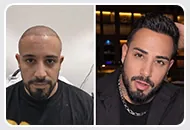
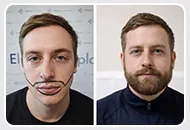
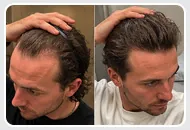
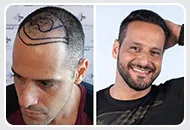
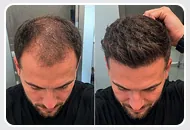
Man shortly after a hair transplant with a shaved hairline, and later with thick, styled hair.
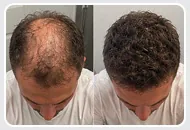
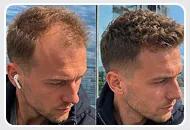
Before-and-after comparison of a man with thinning hair on top before and noticeably thicker hair afterwards.
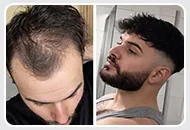
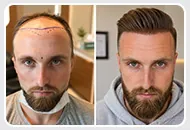
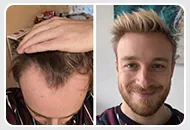
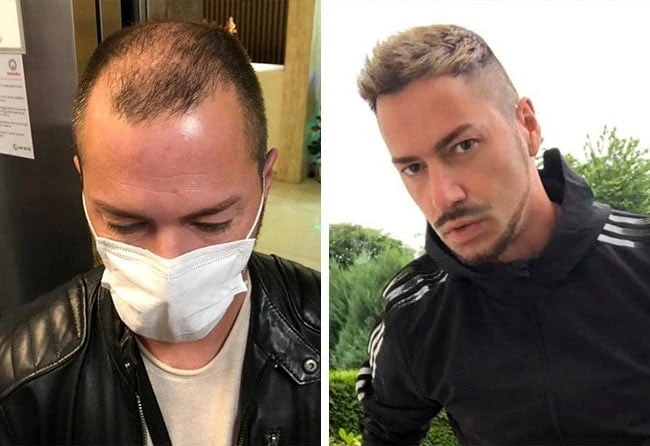
Man with thinning hair at the front before a hair transplant, and thick, dark hair afterwards.
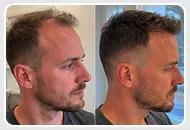
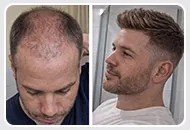
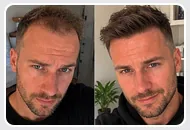
Side-by-side comparison of a man with a receding hairline before treatment and a fuller hairline with shorter sides afterwards.
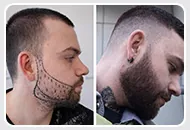
Man with marked areas of sparse beard growth before a beard transplant, and a thick, full beard afterwards.
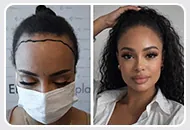
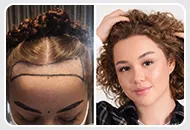
Woman with a marked, receding hairline before treatment, and thicker hair along her forehead afterwards.
Before-and-after comparison of a man with patchy beard growth before treatment and a thick, full beard afterwards.
Man with a receding hairline before a hair transplant, and a fuller hairline afterwards.
Man with a marked, receding hairline before a transplant, and a dense, lower hairline afterwards.
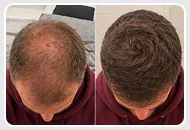
Top of a man's head before and after a hair transplant: severely thinning hair before, thick coverage afterwards.
Man with a receding hairline before a hair transplant, and thicker hair along his forehead and temples afterwards.
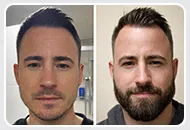
Man with a receding hairline before treatment, and thicker hair styled upwards afterwards.
Man with a shaved head and marked hairline before a hair transplant, and thick, dark hair afterwards.
Man with thinning hair at the front before a hair transplant, and thick hair afterwards.
Woman with a marked, receding hairline before a transplant, and a fuller hairline afterwards.
Man before and after a hair transplant: thinning hair at the front before, a fuller hairline afterwards.
Man with sparse beard growth on his cheeks before a beard transplant, and a thick, full beard afterwards.
Man with receding temples before treatment, and a fuller, denser hairline afterwards.
Overhead view of a man before and after a hair transplant: thinning hair at the front before, a dense hairline afterwards.
Before-and-after beard transplant comparison: marked cheeks with sparse beard growth, followed by a thick, full beard.
Woman with a marked, receding hairline before treatment, and thicker hair along her forehead afterwards.
Before-and-after comparison of a man with patchy beard growth before treatment and a thick, full beard afterwards.
Man with a receding hairline before a hair transplant, and a fuller hairline afterwards.
Man with a marked, receding hairline before a transplant, and a dense, lower hairline afterwards.
Top of a man's head before and after a hair transplant: severely thinning hair before, thick coverage afterwards.
Man before and after a hair transplant: thinning hair at the front before, a fuller hairline afterwards.
Man with sparse beard growth on his cheeks before a beard transplant, and a thick, full beard afterwards.
Man with receding temples before treatment, and a fuller, denser hairline afterwards.
Man with thinning hair at the front before a hair transplant, and thick hair afterwards.
Woman with a marked, receding hairline before a transplant, and a fuller hairline afterwards.
Questions 37 to 43

Results and longevity

37. When will I see results?

The first new hairs grow after three to four months. By month three, about 10% of the eventual hair in the recipient area is visible, with about 10% more appearing each month from month four.

TimingWhat you see
  1. Up to month 3 hardly any change; the follicles are preparing for new growth
  2. Months 3 to 4 first new hairs, still fine
  3. Month 6 a clearly visible first result
  4. Months 10 to 12 final result in the frontal area
  5. Months 15 to 18 final result in the crown area

You'll find our patients' results on the Before and After page, and patient stories on the Hair Transplant Reviews page.

38. Why might transplanted hair fall out after a few weeks?

In the first few weeks after treatment, transplanted hair may temporarily fall out. This is called shock loss, and not every patient experiences it. The hair shafts are shed, while the follicles remain in the scalp. New hairs grow from these follicles from month three or four.

39. What is shock loss, and is it permanent?

Shock loss is temporary hair shedding after treatment. It can affect transplanted hair (see question 38), but also existing, non-transplanted hair around the treated area. Shock loss can occur, but not everyone experiences it. Depending on the study, it affects existing hair in 0.15 to 15% of patients, usually in the first few weeks after treatment. The hair generally starts growing back around the third month. Women are affected more often than men.

40. How long does a hair transplant last?

Transplanted hair generally continues growing for life.

It comes from the hair at the back and sides of the head, which is genetically resistant to DHT, the hormone that triggers hereditary hair loss. The hair retains this property in its new location. Dermatologist Norman Orentreich described this as early as 1959, and it has been the basis of every hair transplant ever since.

We provide a written 20-year guarantee on your transplanted hair, provided you follow the aftercare instructions.

41. Can I still go bald after the transplant?

The transplanted hair remains, but the surrounding native hair can continue to fall out if hereditary hair loss progresses. Over time, a gap can develop between the new hairline and the remaining hair. We therefore plan your hairline to suit future hair loss too, and preserve reserves in the donor area. Discuss with your doctor whether accompanying medication would be appropriate. The professional societies' guideline lists minoxidil and finasteride for men.

42. What is the graft survival rate?

At Elithair, the graft survival rate is approximately 98%. Correct placement depth is crucial: if grafts are implanted too superficially, only about 60% survive. We therefore determine the insertion depth from your scalp thickness and blood flow in the Pre-Test System. The NEO FUE® serum protocol also contributes to graft survival.

Before and after: Andre with thinning hair on top before his hair transplant and a full head of hair afterwards, 5,200 grafts
Andre · 5,200 grafts
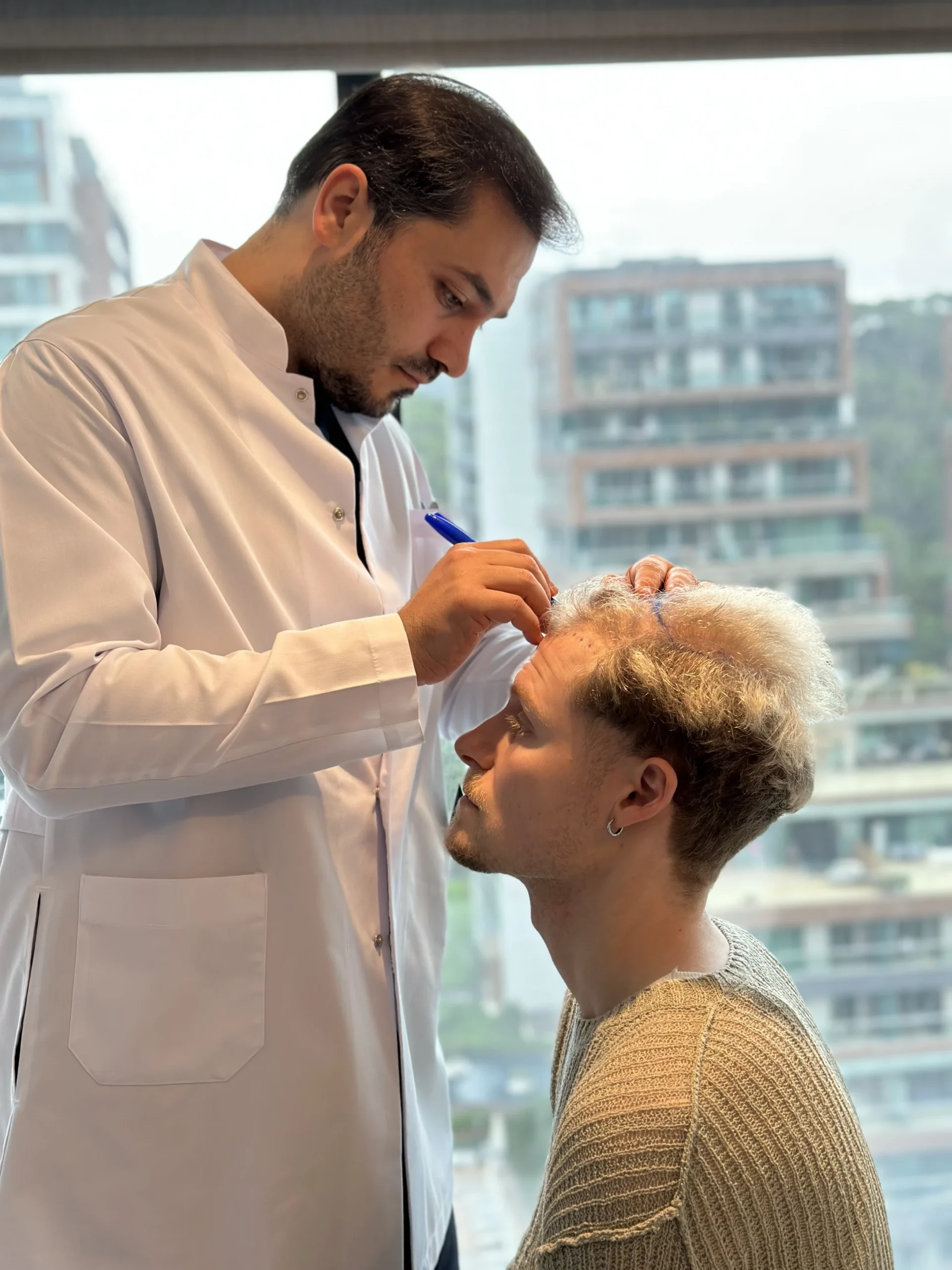
Doctor drawing the planned hairline on a patient's forehead

43. Will the result look natural?

That depends mainly on the hairline. At Elithair, a doctor draws your hairline to suit your facial proportions, forehead shape and hair growth. You discuss it in front of a mirror before the first graft is implanted. A natural hairline is slightly irregular, without a hard edge (Shapiro 2004). The grafts are implanted at the angle of your natural hair growth.

Risks and safety

44. What are the risks of a hair transplant?

A hair transplant is a low-risk procedure, and most side effects are temporary and mild (Liu et al. 2025). A 2026 review in Frontiers in Medicine analysed how frequently they occur.

Side effects, with frequency according to research and duration according to the treatment schedule
Side effect Frequency according to research Duration at Elithair according to the treatment schedule
Swelling common one week at most
Bruising occasional one to two weeks
Inflammation of individual hair follicles about 12% usually a few days; spots can occur for up to twelve months, most commonly in months 1 to 4
Temporary loss of existing hair 0.15 to 15% May occur, but not everyone experiences it. Regrowth starts around month 3
Longer-lasting numbness about 2% usually subsides
Infection under 1% treated by a doctor

The Pre-Test System, whose results form the basis of your personalised treatment plan, monitoring by the specialist anaesthetist and aftercare through the app, where our doctors review the photos you upload, all help prevent complications.

45. Will there be scars?

FUE does not leave scars in the donor area. The donor area is fully healed after about six months. We work at 100 to 200 revolutions per minute rather than the usual industry speed of around 4,000, which is gentler on the donor area. You'll find results under Donor Area Before and After.

46. Does Elithair also correct failed hair transplants?

Yes, corrective procedures are part of our everyday clinical work. Unnatural results, irregular hairlines, insufficient density or visibly overharvested donor areas often arise when procedures elsewhere have been performed without the necessary medical expertise (Williams et al. 2024). According to ISHRS data, these corrections now account for a noticeable proportion of treatments worldwide.

We assess each case individually to determine whether and how a correction is possible. The deciding factor is how much healthy donor hair remains. Simply send us photos of your current hair through our Free Hair Analysis. We assess your situation objectively and explain realistically how the appearance of the result can be improved.

47. How do I spot a disreputable hair transplant clinic?

A reputable clinic is transparent, gives you clear and thorough information, and takes responsibility for your medical care. Vague answers to straightforward questions or missing pre-treatment examinations are warning signs.
Use the following criteria to check any provider objectively, including us:

Warning signs of disreputable providers and what you should expect instead
Warning signs of a disreputable provider What you can expect instead
Unclear staffing nobody can say exactly who carries out each part of the procedure. Clear responsibilities: who carries out each step is clearly defined, and everything takes place under medical supervision.
Inadequate assessment before the procedure, you only have a basic blood count or no examination at all. Thorough pre-treatment assessment: your individual treatment plan is based on detailed checks, such as assessments of hair density and scalp condition.
A guaranteed "yes" for everyone every enquiry is accepted without checking whether the patient is suitable. An honest medical assessment: if the chances of success are too low or there is insufficient donor hair, you're advised against surgery.
An intermediary agency the contract names only a package or agency, rather than a specific clinic. Transparent details: an identifiable clinic with a permanent address, clear contact details and verifiable standards.
Fake quality marks certificates or marks are shown without a verification number or proof. Verifiable quality: official certificates with valid registration and verification numbers.
Lack of aftercare Support ends abruptly with the flight home or when you leave the clinic. Long-term support: structured aftercare over several months until the final result is visible.

You'll find our own certificates, verification numbers and quality credentials on the Hair Transplant Clinic page.

  • 5-Doctor
    Standard
  • 6-step
    Pre-Test System
  • Sleep-Deep
    0 % pain
  • DHI technique
    included
  • 20-year
    guarantee
  • 12 months
    of aftercare
Cost

Cost, treatment location and guarantee

GraftsElithair*DHI in the UK
up to 2,000£2,849£5,100
2,500£2,949£6,400
3,000£3,049£7,600
3,500£3,149£8,900
4,000£3,249£10,100
4,500£3,349£11,400
5,000+£3,449£12,700

*All-inclusive package prices

48. How much does a hair transplant at Elithair cost?

Your all-inclusive price depends on your graft band and ranges from £2,849 to £3,449. It includes treatment, the Pre-Test System, Sleep-Deep sedation, NEO FUE® serum, 3 nights at a 4-star hotel, transfers and aftercare. For logistical reasons, you book your flight yourself (approximately £90 to £220). Optional Zero Shave FUE carries an additional charge of £450. Manual FUE also costs extra, with the amount confirmed during your consultation.

Treatment costs less than in the UK because wages, rents and operating costs in Istanbul are lower, rather than because less is included. You'll find all prices under Hair Transplant Cost.

49. Does the NHS or private health insurance cover a hair transplant?

Usually not. Treatment for hereditary hair loss is considered a cosmetic procedure and is generally not covered by the NHS or private health insurance. Follow-up treatment after procedures abroad is also usually not covered.

50. Where does treatment take place, and how does the guarantee work?

Your hair transplant and Pre-Test System take place at our clinic in Istanbul. Our doctors oversee your aftercare through the Elithair App, where you upload photos for them to review. The written 20-year guarantee on your transplanted hair applies provided you follow the aftercare instructions, and is handled through the clinic in Istanbul.

Get Your Free Hair Analysis

Doctor in a white coat advising a female patient alongside the medical team

Can't find your question?

Send us photos of your hair through the Free Hair Analysis. You'll receive a no-obligation medical assessment of whether treatment makes sense in your case, including a graft count and price. You can discuss any further questions with your personal hair transplant adviser.
With over 150,000 treatments, we've encountered almost every question that arises before a hair transplant. Our patients rate us 4.9 on Google from over 11,000 reviews and 4.7 on Trustpilot.