


You coloured or bleached your hair, and ever since there have been noticeably more hairs in your brush, in the plughole and on your pillow. You are in good company: according to a 2024 survey by the German cosmetics industry association IKW, 53 per cent of women in Germany currently wear coloured hair, and among 16- to 39-year-olds it is 60 per cent. Men colour less often. According to the same German survey, 96 per cent of them wear their natural colour, yet grey coverage, beard colour and platinum blond tones raise exactly the same questions. The key point up front: hair colour works in the hair shaft, not at the hair root. What you are finding is therefore usually broken hairs, not shed ones.
The key points at a glance
- ✓Hair colour and bleach damage the hair shaft, not the hair root, which is why hair loss from colouring is usually breakage
- ✓You can tell the difference on a single hair: a pale little bulb at one end means shedding, a clean break edge at both ends means breakage
- ✓Hair colour can trigger genuine hair loss almost only by way of the scalp, for example in an allergic contact dermatitis to PPD; the warning signs are further down
- ✓Colouring your hair when you have hair loss is possible in most cases; what matters is the condition of your scalp and the technique you choose
The table of contents shows what you will find where. After that we go into detail step by step, from the at-home check on your own hair to the question of which colouring technique still makes sense on thinning hair.
Summary
- Hair loss from colouring: the short answer
- Breakage or hair loss? The at-home check on your own hair
- If it really is hair loss: telogen effluvium after colouring
- What hair colour actually does to your hair, and why the hair root is spared
- Bleaching and hair loss: the most extreme case
- Allergic reaction to hair colour: the only route to the hair root
- Colouring your hair when you have hair loss: what works and what to leave alone
- After colouring: damage control that actually helps
- Colouring more gently: the four decisions that make the difference
- Hair loss after colouring: when to see a doctor
- Colouring your hair after a hair transplant
- Frequently asked questions about hair loss from colouring
- Conclusion: hair loss from colouring is usually breakage
Hair loss from colouring: the short answer
Hair loss from colouring at the root is the exception. In the vast majority of cases it is breakage along the hair shaft. Oxidative hair colour acts inside the hair fibre, while the root sits several millimetres deep in the scalp, which a processing time of 20 to 45 minutes does not, as a rule, reach.
There is no reliable figure in the literature for how often breakage and how often genuine shedding is behind it. Reputable dermatological sources agree in qualitative terms: colouring and bleaching lead to breakage far more often than to a loss at the root. That honesty belongs here, because invented percentages will not help you make sense of your own situation.
There are three explanations for more hair in your brush after colouring. First, breakage along the lengths, by far the most common. Second, a telogen effluvium, meaning diffuse hair loss that happens to coincide with your salon appointment. Third, a reaction of the scalp: rare, but the only route with a genuine connection to the root.
After colouring is not the same as because of colouring
The most common mistake in thinking about hair loss after colouring is confusing the timeline. According to StatPearls (NCBI Bookshelf, 2023), a telogen effluvium typically shows up 2 to 3 months after the triggering event, in individual cases within a range of 1 to 6 months. The shedding therefore follows the trigger with a considerable delay.
In practice that means: someone who had a feverish bout of flu in January and goes in for colour in March sees the shedding in March and suspects the colour. The colour simply happened to be there. The timeline table below will help you place your own case roughly before you read on.
| Timing | What you see | Likely explanation | Where it is covered in this article |
|---|---|---|---|
| Immediately, while rinsing out or on the first comb-through | Hair breaks off in clumps, wet hair feels like rubber, short stubs in the brush | Breakage along the hair shaft, known after heavy lightening as a chemical haircut | At-home check on your own hair, and bleaching |
| A few hours to 3 days later | Scalp itches, burns, turns red, swells or weeps | Irritation or allergic contact dermatitis as a delayed type IV reaction | Allergic reaction to hair colour, including the warning signs |
| 2 to 4 months later | Evenly more hair across the whole head, with a small pale bulb at one end | Telogen effluvium, triggered by an event months before the colour appointment | Telogen effluvium and the trap of mistaken timing |

The most important distinction can be checked on a single hair, and for that you need neither a lab nor an appointment.
Breakage or hair loss? The at-home check on your own hair
A shed hair carries a small whitish or glassy bulb at one end, the root sheath. A broken hair has nothing but a smooth or frayed break edge at both ends and is usually much shorter than the rest of your hair. That single feature decides whether you are dealing with breakage or genuine hair loss.
At-home check in 5 steps: breakage or shedding?
- Collect 10 to 15 hairs from your brush, the plughole or your pillow. A single hair says little; only the pattern is clear.
- Lay the hairs out side by side on a sheet of white paper so the ends stand out.
- Look at both ends of every hair, using the zoom on your phone camera if you need to.
- Sort them: a small whitish or glassy bulb at exactly one end means a shed hair, a smooth or frayed edge at both ends means a broken hair.
- Compare the length with your own hair length and count which type predominates. Clearly shorter hairs point to breakage, hairs at full length to shedding.
Two more clues help. Breakage shows up mainly on the lengths and ends and makes itself felt when you comb and rinse. Genuine shedding is spread evenly over the head and the hairs are mostly full length. Hair quality tells you a lot too, because broken hair feels rough and dull, and like rubber when wet.
Breakage close to the roots is especially confusing. The short stubs grow out, stick up and look like freshly grown baby hairs. Many people are delighted by what looks like new growth when they are actually looking at broken hair. Both at once is entirely possible, by the way, and not at all rare.
| Feature | Points to breakage | Points to genuine hair loss |
|---|---|---|
| End of the hair you found | a smooth or frayed break edge at both ends, no bulb | a small whitish or glassy bulb at one end, the root sheath |
| Length of the hairs you found | short and uneven, clearly shorter than your own hair length | mostly full hair length |
| Where you notice it | on the lengths and ends, plus short hairs sticking up on top of the head | evenly over the whole head, more hair in the brush, the plughole and on the pillow |
| Timing | immediately while rinsing, combing or brushing | usually 2 to 4 months after a trigger, often with no obvious cause on the day of colouring |
| Condition of the scalp | unremarkable | unremarkable in diffuse shedding, red or flaky in scalp conditions |
| Hair quality | dry, rough, dull, stretchy like rubber when wet | unchanged, there are simply fewer hairs |
| Typical trigger | bleaching, lightening, heat, mechanical stress | infection, surgery, dieting, iron deficiency, thyroid, hormonal changes, emotional strain |
The at-home check is a rough guide and does not replace a diagnosis. If bald patches appear, your scalp is causing symptoms or you remain unsure, that belongs with a dermatologist.

If it really is hair loss: telogen effluvium after colouring
If the hairs coming out carry a root and are shedding evenly over the whole head, this is not colour damage but diffuse hair loss, usually a telogen effluvium. In that case the trigger was almost always an event that lay weeks to months before the colour appointment.
The mechanism is well described: a stress event pushes many follicles out of the growth phase and into the resting phase at the same time. Normally, according to StatPearls and a review in the IJDVL, around 10 to 15 per cent of scalp hairs are in telogen; in a telogen effluvium a scalp biopsy shows more than 15 per cent.
Typical triggers are febrile infections, surgery, crash diets, iron deficiency, a thyroid disorder, stopping the pill, childbirth and severe emotional strain. The loss becomes visible 2 to 4 months later. A salon visit often falls right into that window, and the colour gets blamed for something that happened long before.
The figure of 60 to 100 hairs shed per day is widely quoted as a benchmark. It is useful, but not methodologically standardised, because no validated counting method for daily hair loss exists. The change is more telling: clearly more than usual, over several weeks. What counts as too much is explained in the linked article.
Diffuse, breakage or pattern: three different things
Diffuse shedding over the whole head, breakage along the lengths and a pattern with a widening parting are three different pictures, and often more than one is present at the same time. Only the pattern, meaning androgenetic alopecia, is even amenable to hair growth medication or a hair transplant. Breakage needs care and a haircut; a telogen effluvium needs its cause clarified.
So if you are suddenly losing hair in clumps or have scalp symptoms, start with your GP or a dermatologist. You will find an overview of the possible causes and of hair loss in women in the linked articles.
Not sure how to read your own situation?
The free hair analysis from Elithair assesses your shedding pattern and the condition of your scalp, and clarifies up front whether breakage, diffuse shedding or an inherited pattern is the dominant issue.
For context: this analysis is a visual assessment of the pattern. It replaces neither blood tests nor a dermatological diagnosis.
What hair colour actually does to your hair, and why the hair root is spared
An oxidative hair colour has to open the cuticle to get the dye precursors into the fibre. That opening is exactly what costs the hair its substance, and that is where all the damage from colouring lies. It affects the hair that has already grown out of the scalp, which is dead keratin, and not the living root beneath.
The structure of a hair in three sentences
On the outside sits the cuticle, a layer of overlapping scales like roof tiles that protects the fibre and provides shine. Beneath it lies the cortex, the keratin fibre core that gives hair its strength and elasticity. The cortex also holds the melanin, which is your natural hair colour.
What happens during colouring
An alkaline agent, usually ammonia or ethanolamine, raises the pH and makes the hair swell so the cuticle scales lift. Hydrogen peroxide breaks down part of the melanin present. Dye precursors such as paraphenylenediamine penetrate the fibre and oxidise inside it into large colour molecules that can no longer be washed out.
Why keratin and disulphide bonds are the crux
Keratin owes its strength in part to the sulphur bridges between its cysteine building blocks, as a review on the physical chemistry of hair care (PMC9921463, 2023) describes. Oxidative processes break down part of these disulphide bonds into cysteic acid. Cross-linking in the cortex decreases, and the hair loses tensile strength and elasticity.
How large that loss turns out to be depends heavily on the treatment. For bleaching, the frequently cited cosmetic science literature by Robbins and Kelly documented a breakdown of cystine of up to 25 per cent under household conditions and up to 45 per cent under laboratory conditions, each with a corresponding rise in cysteic acid. Colouring without lightening lies well below that.
Porosity, protein loss and why wet hair is so vulnerable
As the cuticle roughens, porosity rises. Coloured hair takes up water faster, swells more, dries more slowly and feels rough. A paper on hair ageing (PMC2938585) lists lipid oxidation, split disulphide bonds and cysteic acid formation as damage factors, all of which reduce mechanical strength.
From that follows a very practical rule: hair is at its most fragile when wet. Brushing, rubbing or tying wet, freshly coloured hair into a tight ponytail produces exactly the breakage that later looks like hair loss from colouring.

What this means for the hair root
For the root it means, as a rule, nothing. As long as the product stays on the hair and the scalp is intact, the follicle carries on undisturbed, and the hair growing back has the same quality as before. The only route to the root leads through the scalp, and that route is exactly what the sections below are about.
Bleaching and hair loss: the most extreme case
Bleaching does not cause hair loss at the root, but it is by far the most common cause of massive breakage that looks like hair loss. If you have clumps of hair in your hand after lightening, you almost always have a breakage problem, not a root problem. The phrase bleaching and hair loss therefore regularly points in the wrong direction.
Why bleaching is harder on hair than colouring
Bleaching does not add colour, it removes what is there. That takes a higher pH, more hydrogen peroxide and persulphates as boosters on top. The breakdown of your own melanin is not reversible, and substance and cross-linking go with it. In this process the hair gains nothing, it only loses.
Rubber hair and the chemical haircut: what is really going on
When clients say their wet hair feels like chewing gum, they are describing over-swollen hair with heavily reduced bonds. If it breaks off in clumps while rinsing or combing, the industry calls it a chemical haircut. In dermatology, chemically triggered hair breakage is called trichoclasis, and the typical form with knotty splits at the break point is trichorrhexis nodosa.
According to Medscape and a 2025 clinical review, trichorrhexis nodosa is the most common acquired hair shaft abnormality, and chemical trauma such as bleaching, colouring and perming is among the recognised triggers. That is the usual explanation for hair loss in clumps after colouring: those hairs did not fall out, they broke off.
The reassurance is real, but it takes patience. The follicles keep working and the hair grows back, only as fast as hair actually grows, which is around 1 to 1.5 centimetres, or roughly half an inch, a month.

Risk factors that turn bleaching into damage
It gets critical above all in these situations: lightening by several levels in one appointment, repeated bleaching over already bleached lengths, bleaching hair that was previously treated with henna or metallic salts, combining it with straightening or a perm, heat styling immediately afterwards, and doing it yourself without controlling the processing time.
Can bleaching injure the scalp?
Yes, and this is the point at which bleaching genuinely becomes relevant to the root. A root bleach with a high peroxide concentration and a long processing time can cause chemical irritation, up to and including a chemical burn with blistering. If such an injury heals with scarring, it can turn into scarring alopecia in that spot, meaning permanent hair loss.
Being honest about the level of evidence: these cases are documented in case reports and case series, for example in the Journal of Clinical Medicine (2024, volume 13, no. 12, article 3542) and in a case series in the Australasian Journal of Plastic Surgery, not in large epidemiological studies. Among the cases described is a 15-year-old with a scarring alopecia plaque on the top of the head after a deep burn that took about four months to heal.
For you that means: a burning scalp during a bleach is not a sign that the product is working. It is a reason to rinse it out immediately. Everything about irritation, allergy and the warning signs is in the next section.
Plex products and bond builders: what Olaplex, K18 and the like can and cannot do
Plex products and bond builders, sold under names such as Olaplex or K18, target exactly where bleaching does its damage: the bonds inside the hair. Active ingredients such as bis-aminopropyl diglycol dimaleate are meant to capture the free thiol groups that form during bleaching and to create new links inside the hair. In vitro tensile tests on human hair show better mechanical values than for bleached hair alone, according to a paper in Pharmaceuticals (MDPI, 2025, volume 18, no. 5, article 632).
The honest reading: the independent evidence is thinner than the marketing effort suggests. Treatments like these can cushion damage that occurs during the service. They do not make already broken hair whole again. How much each level of treatment stresses the hair is shown in the comparison table in the section on gentler colouring.
That covers the hair shaft: here, care and technique determine whether hair breaks, not whether it sheds. What remains is the one route on which hair colour actually does reach the hair root. It does not lead through the hair, but through the scalp.
Allergic reaction to hair colour: the only route to the hair root
When hair colour causes genuine hair loss, it almost always does so by way of the scalp. The most important cause is an allergic contact dermatitis to paraphenylenediamine, PPD for short. What damages the follicle here is not the colour in the hair, but the inflammation of the skin the follicle sits in.
What PPD is and why it is in almost every permanent colour
PPD is the central dye precursor in permanent colours, especially in dark shades, and at the same time one of the most potent contact allergens there is. According to data from the German IVDK, the information network of dermatology departments, it is among the ten most common triggers of contact allergy in Germany. Under the cosmetics rules that apply in the UK, which go back to the EU Cosmetics Regulation (EC) No 1223/2009, PPD in oxidative hair dyes is capped at a maximum of 2 per cent, calculated as the free base after mixing.
How many people are sensitised cannot be condensed into a single number. Population-based estimates range from about 1.5 to over 10 per cent depending on the study population, and one Turkish professional society cites 0.1 to 2.3 per cent. Among occupationally exposed hairdressers, sensitisation rates are far higher at 40 to 50 per cent. Most sensitised people never experience a severe reaction.
How to recognise an allergic reaction to hair colour
Typical signs are itching and burning of the scalp, redness, flaking, weeping blisters and swelling along the hairline, on the forehead, the ears and the back of the neck. The timeline is decisive: a type IV reaction is delayed, usually appearing 24 to 72 hours after contact, and on first sensitisation sometimes only after 4 to 14 days.
Irritation or allergy? The difference determines what to do
Irritation happens immediately and can affect anyone if the concentration and the processing time are high enough. An allergy affects only those who are sensitised, appears with a delay and tends to get stronger with every further contact. That is why people who have coloured their hair for years without any trouble suddenly react: sensitisation needs prior contact.
Anyone who has reacted once belongs in a different risk group. In the European EDEN study, PPD allergy was found in 2.8 per cent of people with a previous reaction to hair dye, compared with 0.5 per cent of those without a reaction. Among those who had already had swelling of the eyelids or face after colouring, it was as high as 14.3 per cent compared with 1.2 per cent.
Your scalp is reacting after colouring: what to do now
Right away, on your own
Rinse the colour out thoroughly with lukewarm water and a mild shampoo. Do not scratch the scalp, do not apply anything else, no home remedies. Keep the packaging and the leaflet, because your doctor will need the ingredient list.
See a doctor the same day
Weeping blisters, crusts, strong or widespread redness, marked swelling along the hairline, pain or fever.
Call 999
Swelling of the eyelids, lips, tongue or throat, shortness of breath, difficulty swallowing or circulatory symptoms. A severe allergic reaction to hair colour is rare, but it is an emergency. Do not wait it out in that case.
Can this turn into permanent hair loss?
Usually not. A healing inflammation of the scalp can set off a telogen effluvium, which is reversible and resolves once the skin has healed. Permanent loss is a risk only if the inflammation reaches deep enough for follicles to scar. How an inflammation of the hair follicle unfolds is explained in the linked article.
That a dermatitis can lead to hair loss at all has been investigated mechanistically: in 2012, Seo and colleagues showed in the Journal of Dermatological Science (PMID 22269445) that hydrogen peroxide and monoethanolamine together trigger oxidative stress, dermatitis and hair loss in a mouse model and in human keratinocytes. That is evidence for the route through the skin, not evidence that normal colouring damages the root.

Black henna: the underestimated route to sensitisation
Tattoo pastes sold as black henna, the kind you come across on holiday, often contain PPD in unoxidised form and at concentrations far above the limit allowed in cosmetics. Case reports and reviews (PMC5409622) estimate that about 2.5 per cent of people who get such a tattoo become sensitised. A single tattoo can establish a lifelong allergy that only comes to light when you colour your hair.
The at-home test: what it can do and when it becomes dangerous
The package leaflet calls for a preliminary test behind the ear or in the crook of the elbow. The German Federal Institute for Risk Assessment (BfR) explicitly advises against this self-test in its opinion no. 015/2014: it can sensitise you in itself, the amount and processing time are hard to get right at home, and lay people struggle to judge the result.
This contradiction between the manufacturers’ instructions and the authorities’ advice remains. The NHS and the US Food and Drug Administration additionally stress that a negative test does not mean safety, because an allergy can develop at any time. The situation is clear on one point only: anyone who has already reacted to hair colour with itching, burning or swelling does not do another self-test with colour at home. Every further contact can intensify the reaction considerably. That testing belongs with a dermatologist, in the form of patch testing.
What to do once the allergy is confirmed?
After a positive patch test, the rule is permanent avoidance. Realistic alternatives exist, but none of them come with a guarantee: according to DermNet, around 50 per cent of people with a PPD allergy tolerate toluene-2,5-diamine sulphate, and about 10 per cent also react to semi-permanent colours. Pure plant-based hair colour without additives and direct dyes are further options.
Important for your next trip to the chemist: a PPD-free claim does not mean allergy-free. Related substances can cross-react, as Spanish and Portuguese professional societies explicitly point out. Which alternative is an option for you is something dermatology decides based on your test result, not the packaging.
Colouring your hair when you have hair loss: what works and what to leave alone
If you have hair loss, you can colour in most cases. The colour does not reach the root and does not accelerate hereditary hair loss. Whether you can colour your hair when you have hair loss comes down to two other things: the condition of your scalp and how much chemical and mechanical stress the remaining hair can still take.
When colouring is unproblematic
It is fine on a calm, irritation-free scalp, with stable androgenetic alopecia, after a telogen effluvium has settled, and for pure grey coverage without lightening. In these situations colouring changes nothing about the course of the hair loss, it only changes the colour of the hair that is there.
When to wait or skip it
Wait if you are suddenly losing hair in clumps and the cause has not been clarified, because colour obscures the assessment and will not put your mind at ease. Skip it on an inflamed, broken, weeping or heavily flaking scalp, with a known contact allergy, and in the early phase after a hair transplant.
With alopecia areata the position is somewhere in between: colour does not make alopecia areata worse, and the German S3 guideline (AWMF register 013-104, as of February 2026) describes no such link either. The scalp in the bald areas, however, is exposed and reacts more sensitively to chemical irritants.
Pregnancy and breastfeeding: your own call
Among younger women in particular, a postpartum effluvium is often behind the question. It typically begins 2 to 4 months after birth, peaks between the third and sixth month, and usually resolves within 6 to 12 months. Colouring changes nothing about it, for better or worse.
On the safety of hair colour during pregnancy and breastfeeding, the German Federal Institute for Risk Assessment finds no proven risks, because only very small amounts would be absorbed through the scalp when the product is used as intended. At the same time, many obstetricians advise restraint in the first trimester and against full-head bleaching with scalp contact. Both positions stand side by side, and you decide this with your midwife or obstetrician, not with this article.
Colouring and minoxidil on the same day
If you use minoxidil , pause it on the day you colour. The reason is the propylene glycol it contains, which makes the skin barrier more permeable and encourages irritation in its own right: for the 2 per cent solution, irritation and contact reactions are described in about 5 to 7 per cent of users, and somewhat more often for the 5 per cent solution.
In practice that means: skip it on colouring day, keep the scalp clean and dry before the appointment, and start again only once it has calmed down. There are no controlled studies on this sequence; it is a practical consensus from dermatology practices and clinics.

Foil highlights and balayage: the rule of thumb
What does not touch the scalp cannot irritate the hair root. Foil highlights and balayage are applied at a distance from the roots, which removes both the skin’s contact with PPD and the risk of irritation at the root. Can highlights cause hair loss? Not at the root, as long as no product reaches the scalp.
The hair shaft is stressed nonetheless, especially when lightening is involved. So the topic remains breakage, not shedding. For a sensitive scalp, this technique is therefore far better than a full root bleach.
Is there a special hair colour for people with hair loss?
No. There is no dermatologically defined or officially reviewed product category called hair colour for hair loss. Claims such as for coloured hair, ammonia-free or dermatologically tested are marketing statements without any set testing standard. The difference is made by the technique and by scalp contact, not by the label on the box.
Grey coverage after 50 and during the menopause
In this stage of life the wish for grey coverage often meets the early thinning at the parting that is typical of hair loss during the menopause . At the same time the hair becomes finer and more porous, grey hair takes colour less readily, which tempts people into longer processing times, and the scalp gets drier.
Men run into the same situation when grey at the temples or in the beard needs covering while the top of the head is already thinning. The practical consequence is the same in both cases: tone-on-tone instead of lightening, roots instead of lengths. Shorter intervals are no problem when you do the roots alone, because there you are treating nothing but regrown, untreated hair. What is critical is repeating the process on the same lengths.
Does colouring make thin hair more or less visible?
Colour wraps around the fibre and makes the individual hair look marginally thicker. What matters visually, however, is the contrast between hair and scalp. If your scalp is light and you colour very dark, you make the thinning more visible, not less.
A shade closer to your own scalp colour camouflages far better. Grey roots on dark hair create exactly the same contrast effect. That is why, visually, colouring thin hair is often the better choice than leaving it alone.
| Your situation | What works well | What to avoid |
|---|---|---|
| Hereditary hair loss, calm scalp | tone-on-tone root colour, grey coverage, a shade close to your scalp colour | full-head lightening, very dark shades on a light scalp, because the contrast emphasises the thinning |
| Diffuse shedding, cause clarified and subsiding | semi-permanent colour, root colour, longer intervals between appointments | bleaching over the entire length |
| Acute shedding, cause still unclear | get it checked by a doctor first, semi-permanent colour without lightening in the meantime | any lightening, any at-home application with a high peroxide concentration |
| Sensitive, itchy or flaking scalp | foil highlights or balayage without scalp contact | root bleaching, colour directly on an irritated scalp |
| Known contact allergy to hair colour | alternatives cleared by a dermatologist, pure plant-based hair colour, or going without | any colour containing PPD, including products labelled PPD-free without prior testing |
| Very fine, porous, already coloured hair | colour the roots only, leave out the lengths, intervals of 6 to 8 weeks | colouring the lengths at every appointment, two chemical processes in one day |
Extensions and tape-ins on coloured hair: when camouflage becomes the problem
Extensions, tape-ins and bonds camouflage thin hair instantly, but they put a lasting load on it. Every extension hangs its weight on a few of your own hairs, and porous, chemically damaged hair withstands that constant pull less well than untreated hair. On bleached or repeatedly coloured hair, that is the least favourable combination there is.
Sustained pull on the hair root can trigger traction alopecia, meaning hair loss from mechanical stress. It typically starts at the hairline on the forehead and temples, is reversible in the early stage, and after years of pull it can become scarring and permanent. Unlike the colour itself, this pull acts directly at the root.
Before you camouflage damaged hair with extensions
- !Not on freshly bleached or highly porous hair. Stabilise the condition of the hair first, then think about extensions.
- !No pull on already thinned zones, especially not at the hairline on the forehead and temples.
- !Pulling, pain, redness or pustules at the attachment points are a reason to have the extensions taken out, not a reason to put up with it.
- !If the hairline visibly recedes after you have worn them for a while, that belongs in a dermatologist’s hands. In the early stage traction alopecia is reversible, later it is not.
Practical rules for colouring thin hair
Colour the roots only instead of pulling the colour through the lengths every time. Work tone-on-tone or darker instead of lightening. Foil highlights instead of a full root bleach. Keep intervals of at least 6 to 8 weeks and never do two chemical processes in one day. With a sensitive scalp, have it done in the salon rather than at home.
After colouring: damage control that actually helps
Broken hair cannot be repaired, but further breakage can be prevented. The most effective levers after colouring are less friction when wet, less heat and a care routine that keeps protein and moisture in balance. Everything else is secondary.
The first 72 hours
Put off your next wash so the cuticle can lie flat again and the colour can settle. Rinse lukewarm rather than hot. An acidic after-treatment or conditioner brings the pH back into the slightly acidic range in which the cuticle lies flat.
Protein and moisture: the balance most people get wrong
Too much protein treatment makes hair hard, dull and brittle. Too much moisture without protein makes it limp, stretchy and shapeless. Coloured and especially bleached hair needs both in alternation: protein-based repair treatments at intervals, moisturising care in between.
A simple test helps: a wet hair that stretches a long way and does not spring back needs protein. A hair that snaps immediately and feels hard needs moisture. Observation beats any product promise here.
Reduce the mechanical stress
Do not brush wet hair; detangle it with a wide-tooth comb, working from the ends upwards. Instead of rubbing with a terry towel, press the water out with microfibre or a cotton T-shirt. Use heat protection and work at lower temperatures. Avoid tight plaits and rinse out chlorinated and salt water promptly.
Night-time is almost always overlooked. Eight hours of friction on cotton roughen the cuticle; coloured hair mats and breaks especially at the back of the head. A silk or satin pillowcase, a sleep cap and a loose night-time style such as a loose plait or a soft bun with no metal part in the hairband all reduce that friction.

What home remedies can do for hair loss after colouring
The best evidence is for coconut oil: in 2003, Rele and Mohile showed in the Journal of Cosmetic Science that of three oils tested, only coconut oil clearly reduces protein loss in hair, by up to 39 per cent when applied before washing. That is damage control during washing and combing, nothing more.
What oils cannot do: mend breaks or stimulate hair growth. For apple cider vinegar, beer, onion juice and coffee rinses there is no solid evidence base for breakage or hair loss after colouring. That is not a verdict against them, but it is no reason to expect an effect either.
The red line with an irritated scalp
Home remedies never belong on a red, burning, weeping or broken scalp. Acidic applications such as apple cider vinegar and irritating ones such as onion or garlic juice can intensify the inflammation on a damaged skin barrier and open the door to infection. If your scalp is causing symptoms after colouring, go to a doctor, not to the kitchen.
What hair really needs: time
Hair grows about 1 to 1.5 centimetres a month, roughly 12 to 15 centimetres or 5 to 6 inches a year. The American Academy of Dermatology gives an average of about 1.25 centimetres, or half an inch, per month. If you are carrying 30 centimetres, about 12 inches, of damaged length, you will be waiting several years until everything coloured has grown out.
That is why a haircut that removes the weakest inches is not a capitulation but the most effective remedy against ongoing breakage. A split hair keeps splitting upwards if it stays. The overview below shows what recovers over which period.
| Period | What happens in the hair | What you see |
|---|---|---|
| Month 1 to 2 | The scalp calms down, a telogen effluvium subsides, the telogen rate normalises | Daily hair loss goes down, broken lengths stay just as short |
| Month 3 to 4 | Resting follicles re-enter the growth phase, new hairs push through | Short, fine hairs at the forehead and parting that look like baby hairs |
| Month 5 to 6 | The new hairs gain length and diameter, growth runs at 1 to 1.5 centimetres a month | Density looks visibly more even, the roots stick up less |
| From month 6 on | Damaged lengths grow out at around 12 to 15 centimetres a year | The share of brittle, coloured hair goes down, and every haircut speeds that up visibly |
Scalp care is the part most people forget
The scalp is skin, and after a chemical service it needs what any irritated skin needs: mild, low-sulphate cleansing, no daily hot washing and no astringent alcohol tonics. Which active ingredients in a shampoo make sense is sorted out in the linked article.
Colouring more gently: the four decisions that make the difference
How hard colouring is on your hair comes down to four points: how far you lighten, how often you take the lengths along, how high the peroxide concentration is, and how much time passes between two services. Product promises on the box matter less than these four decisions.
Lightening or going darker
Only lightening requires breaking down your own melanin. Colouring tone-on-tone or darker is fundamentally gentler, because there the peroxide essentially oxidises the dye precursors. Going from a dark natural shade to a light one costs the most in substance, and it does so again at every appointment.
Ammonia, ethanolamine and the myth of the gentle substitute
Ammonia-free is sold as a promise of quality, but it does not hold up to a fact check. In a peer-reviewed comparison study by Bailey, Zhang and Murphy (Journal of Cosmetic Science, 2014), a 5 per cent monoethanolamine treatment reduced the tensile strength values of individual fibres by 25 per cent after one hour and by 50 per cent after nine hours. In an equimolar comparison, ethanolamine showed more protein loss and more severe cuticle damage than ammonia.
For context: the study came from employees of a manufacturer, but it was published in a peer-reviewed journal. The difference lies above all in smell and volatility: ammonia evaporates, ethanolamine stays in the hair longer. Ammonia-free is therefore not a free pass, but first and foremost a more pleasant experience.
Plant-based hair colour and henna
Pure plant-based hair colour lays itself around the outside of the fibre instead of opening it, which makes it mechanically gentler. The limits are just as clear: barely any lightening is possible, the result is hard to control, and later chemical services can react unpredictably, especially with products containing metallic salts or added PPD.
Frequency and sequence
The practical rule of thumb from the salon trade is: roots every 4 to 8 weeks, lengths far less often. There is no controlled study on the optimal frequency. The rule about sequence is more binding: never two chemical processes in one day, and leave a few weeks after straightening or a perm.
| Treatment | What happens chemically | Stress on the hair shaft | Contact with the scalp |
|---|---|---|---|
| Semi-permanent colour (direct dye) | dye deposits on the outside, the fibre stays largely closed | low | yes, but without oxidation inside the hair |
| Demi-permanent colour | low-dose hydrogen peroxide, the cuticle opens slightly | low to moderate | yes |
| Permanent colour, tone-on-tone or darker | alkaline swelling, oxidation of the dye precursors in the cortex | moderate | yes, including contact with PPD |
| Permanent colour with lift | additional breakdown of your own melanin, higher pH and more peroxide | high | yes |
| Bleaching over several levels | heavy melanin breakdown, persulphates as boosters, marked reduction of the disulphide bonds | very high | yes with a root bleach, no with foils or balayage |

Hair loss after colouring: when to see a doctor
If you are losing noticeably more hair than usual for longer than four weeks, if your scalp itches, burns, flakes or weeps, or if bald patches appear, that belongs with a doctor and not on the shelf at the chemist’s. The frequently quoted benchmark of 60 to 100 hairs a day is only of limited use here, because there is no standardised counting method. What is meaningful is the change compared with your own normal.
Dermatology is responsible for the scalp and hair loss, your GP for blood tests and underlying conditions. Your hairdresser can judge the condition of your hair well, but does not make a diagnosis. You will find guidance on when hair loss counts as too much, and an overview of the possible causes in the linked articles.
For persistent diffuse shedding, the usual work-up covers ferritin, a full blood count, TSH, vitamin D and zinc, plus the hormonal situation in women. Which blood values make sense, how iron deficiency plays out and what the thyroid has to do with the hair cycle is covered in the respective articles.
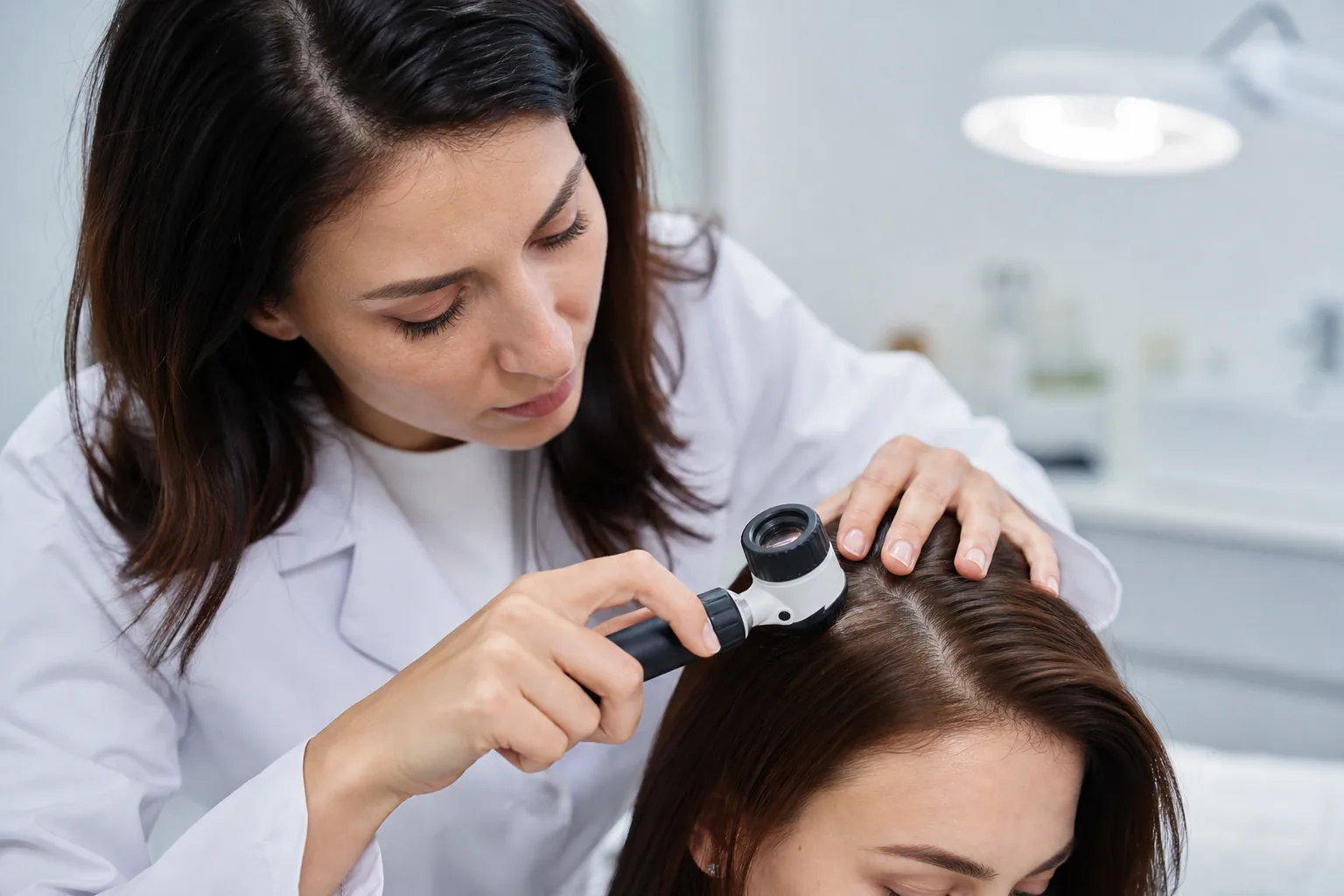
A dermatology appointment involves the history, inspection of the scalp, trichoscopy, a pull test if needed, and patch testing if an allergy is suspected. Take the packaging of the colour product with you, because the ingredient list is decisive for selecting the test substances. Photograph the reaction in case it has subsided by the time of your appointment.
Colouring your hair after a hair transplant
After a hair transplant, colouring or bleaching is postponed by several months and happens only once your doctor has given the go-ahead. Elithair deliberately does not give a blanket number of weeks, because healing is different for everyone and clearance is tied to the findings.
The reason is the skin, not the hair: in the first weeks the recipient area is a fresh wound surface, and aggressive chemistry has no place on healing skin. The same waiting times apply to the donor area, where the skin is injured as well. The transplanted hairs themselves take colour later just like the rest of your hair.
Everything else about aftercare following a hair transplant, from the first wash to exercise and sun exposure, is in the dedicated article. There you will also find the overview of what is allowed again and when.
Frequently asked questions about hair loss from colouring
Can you colour your hair if you have hair loss?
Yes, in most cases. The colour acts in the hair shaft and does not reach the root, so it does not accelerate hereditary hair loss. What matters is the condition of the scalp and the technique: tone-on-tone root colour and highlights without scalp contact are fine, full-head bleaching on an irritated scalp is not.
Does colouring damage hair?
Yes. Oxidative hair colour opens the cuticle and splits part of the disulphide bonds in the keratin; the hair loses tensile strength and becomes more porous. For bleaching, the cosmetic science literature documented a cystine breakdown of up to 25 per cent under household conditions. The hair root is left untouched in the process.
What helps against hair loss after colouring, are there home remedies?
The best evidence is for coconut oil: in 2003, Rele and Mohile showed that it reduces protein loss in hair by up to 39 per cent when applied before washing. It cannot mend breaks or stimulate hair growth. For apple cider vinegar, beer or onion juice there is no solid evidence at all, and they never belong on an irritated scalp.
Why does hair come out in clumps after bleaching?
Because it breaks off rather than falling out. Bleaching breaks down melanin and reduces the disulphide bonds so severely that the hair snaps along its length. In dermatology that is called trichoclasis, and the knotty form of breakage trichorrhexis nodosa. Whether you are dealing with breakage or shedding is answered by the at-home check on your own hair.
Does broken hair grow back, and how long does it take?
Yes, because the follicle is undamaged and keeps producing. The pace is set solely by hair growth of about 1 to 1.5 centimetres a month, roughly 12 to 15 centimetres or 5 to 6 inches a year. If you are carrying 30 centimetres of damaged length, you will be waiting several years unless the weakest inches are cut off.
How do I tell whether a hair broke off or fell out?
At the end of the hair: a shed hair carries a small pale bulb at one end, a broken one has nothing but a break edge at both ends. The five-step instructions for this are in the at-home check on your own hair.
How often can I colour thin hair?
The practical rule of thumb from the salon trade is: roots every 4 to 8 weeks, the lengths far less often. There is no controlled study on the optimal frequency. More important than the interval is that you leave out the already coloured lengths and never carry out two chemical processes in one day.
My scalp burns after colouring, what should I do?
Rinse thoroughly right away with lukewarm water and a mild shampoo, do not scratch, do not apply anything else and keep the packaging. With weeping blisters, crusts or marked swelling, see a doctor the same day. With swelling of the eyelids, lips, tongue or throat, shortness of breath or difficulty swallowing, call 999.

Is semi-permanent colour gentler than permanent colour?
Yes. A direct dye deposits colour on the outside, the fibre stays largely closed and no oxidation takes place inside the hair. A demi-permanent colour works with low-dose peroxide and sits in between. Permanent colour swells the hair and stresses it considerably more, and bleaching most of all.
Are natural hair colours and henna harmless?
Pure plant-based hair colour is mechanically gentler, because it lays itself around the outside instead of opening the fibre. That does not automatically make it harmless: mixed products can contain metallic salts or added PPD, and tattoo pastes sold as black henna are a known allergy trigger with an estimated sensitisation rate of 2.5 per cent.
Can colouring accelerate hereditary hair loss?
No. Androgenetic alopecia arises from the hormonal sensitivity of the follicles to DHT, and colour changes nothing about that because it does not reach the root. What colouring can change is the look: very dark colour on a light scalp increases the contrast and makes the thinning appear more visible.
When can I colour again after a hair transplant?
At the earliest after several months and only once your doctor has given the go-ahead. There is deliberately no fixed number of weeks, because healing is different for everyone. The reason is the skin: the recipient and donor areas are wound surfaces at first, and aggressive chemistry has no place on them. The transplanted hairs take colour normally later on.
Can highlights cause hair loss?
Not at the hair root. Foil highlights and balayage are applied at a distance from the roots, which removes contact between the scalp and PPD and the lightening product. The hair shaft is stressed nonetheless, especially when lightening. So the topic remains breakage along the lengths, not shedding at the root.
Can I colour my hair during pregnancy or breastfeeding?
In the assessment of the German Federal Institute for Risk Assessment there are no proven risks, because only very small amounts would be absorbed through the scalp when the product is used as intended. Many obstetricians nevertheless advise restraint in the first trimester and against full-head bleaching with scalp contact. You make this judgement call with your own doctor.
Is there a special hair colour for people with hair loss?
No. A dermatologically defined or officially reviewed product category of this kind does not exist. Wordings such as for coloured hair, ammonia-free or dermatologically tested are marketing claims without any set testing standard. The difference is made by the technique, scalp contact and the question of whether lightening is involved.
Conclusion: hair loss from colouring is usually breakage
Colour and bleach attack the hair shaft, while the hair root is left untouched as a rule. What ends up in your brush and the plughole after colouring is therefore usually broken hair, not shed hair, and you can recognise that from a single feature at the end of the hair. The exception is a scalp reaction, and it comes with clear warning signs.
On the second big question, the practical answer holds: colouring is possible in most cases when you have hair loss. What matters is the condition of your scalp and the choice of technique, not the colouring itself. If the loss continues, have a doctor clarify the cause before you think about treatments.
If you are unsure whether you are dealing with breakage, diffuse shedding or an inherited pattern, having it classified is the first sensible step. At Elithair, a blood test for underlying causes even checks up front whether a treatment would be the right answer to your hair loss at all. That is exactly why the process starts with clarification and not with a treatment proposal.

Sources and last update
- German Federal Institute for Risk Assessment (BfR): Opinion No. 015/2014, “Hair dyes: self-testing can cause allergies” (bfr.bund.de)
- EU Cosmetics Regulation (EC) No 1223/2009, Annex III, maximum PPD concentration 2 per cent; Commission Regulation (EU) 2017/237 (eur-lex.europa.eu)
- German AWMF register no. 013-104: S3 guideline “Diagnosis and Treatment of Alopecia Areata”, as of 02/2026 (register.awmf.org)
- Hughes M., Rambhia P.: Telogen Effluvium. StatPearls, NCBI Bookshelf (ncbi.nlm.nih.gov)
- Bailey A. D., Zhang G., Murphy B. P.: Comparison of damage to human hair fibers caused by monoethanolamine- and ammonia-based hair colorants. Journal of Cosmetic Science 2014;65(1) (library.scconline.org)
- Rele A. S., Mohile R. B.: Effect of mineral oil, sunflower oil, and coconut oil on prevention of hair damage. Journal of Cosmetic Science 2003;54(2):175-192 (unboundmedicine.com)
- Seo J. A. et al.: Hydrogen peroxide and monoethanolamine are the key causative ingredients for hair dye-induced dermatitis and hair loss. Journal of Dermatological Science 2012;66(1):12-19, PMID 22269445 (pubmed.ncbi.nlm.nih.gov)
- Chemical Scalp Burn after Hair Coloring: Case Report with Literature Review. Journal of Clinical Medicine 2024;13(12):3542 (mdpi.com)
- DermNet: Paraphenylenediamine and hair dye contact allergy (dermnetnz.org) and NHS: Hair dye reactions (nhs.uk)
- Novel Compounds for Hair Repair: Chemical Characterization and In Vitro Analysis of Thiol Cross-Linking Agents. Pharmaceuticals 2025;18(5):632 (mdpi.com)
- IKW survey 2024 on how often people colour their hair in Germany (ikw.org)
Last updated: September 2026. This article is for information purposes and does not replace a medical diagnosis or treatment. If hair loss persists, your scalp is causing symptoms or you suspect an allergy, please see a dermatologist.

Dr. Imad Moustafa
Hair transplant specialist