

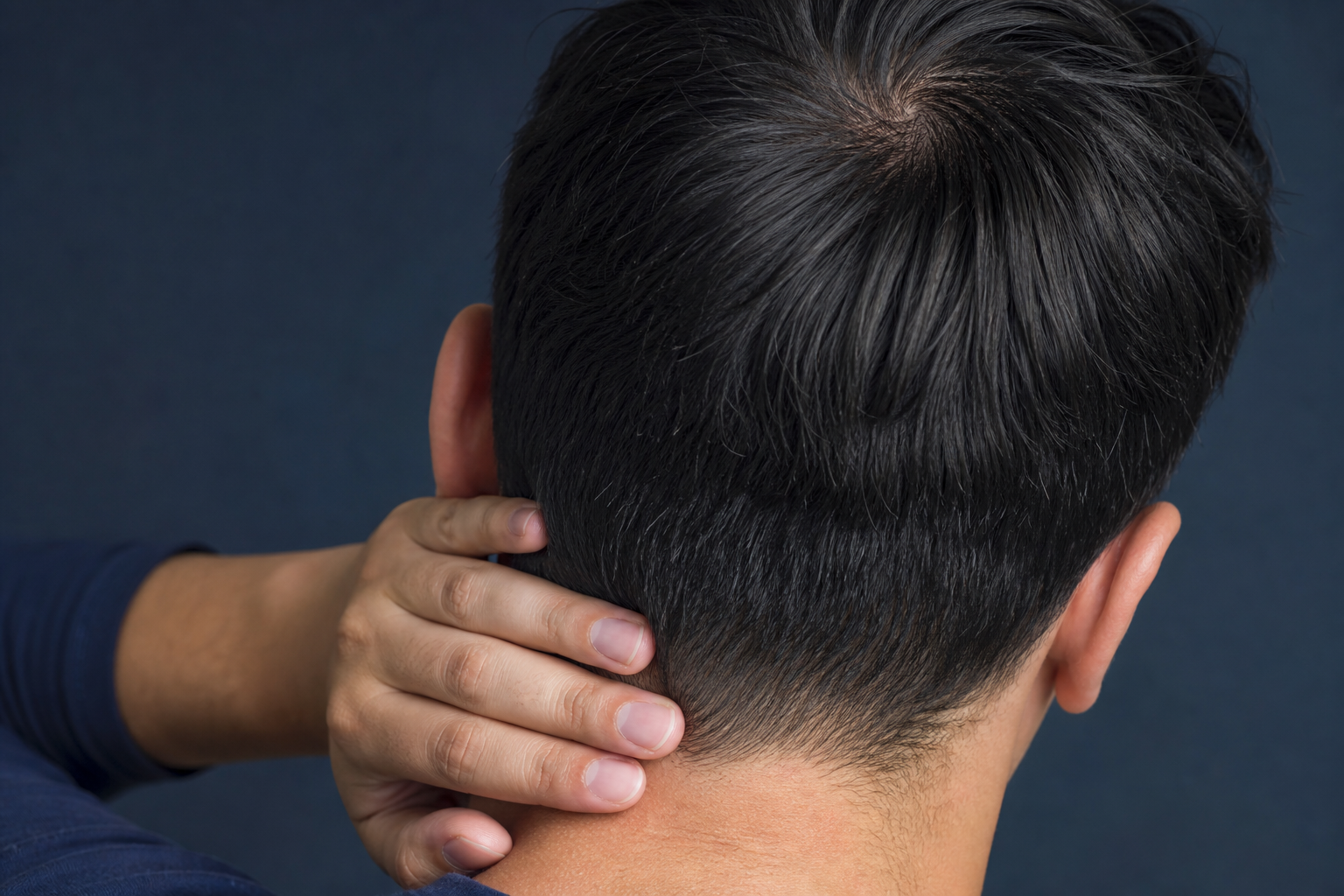
In brief: what is a hair root infection?
A hair root infection (medically, folliculitis) is the inflammation of one or more hair follicles, usually triggered by the bacterium Staphylococcus aureus, less often by fungi, friction or shaving (DermNet NZ, 2024). Typical signs are small, reddened, often pus-filled spots, each pierced by a hair, that itch or sting slightly. Superficial forms almost always heal without any lasting damage and cause no permanent hair loss.
- Most common cause: Staphylococcus aureus; 15-40% of healthy adults carry this germ on their skin without any symptoms (RKI).
- Typical feature: a spot or patch of redness with a hair in the centre.
- What helps: for mild forms, hygiene, antiseptics and a break from irritation; warning signs such as fever or deep lumps need medical assessment.
If you have just spotted a reddened spot around a hair, you mainly want to know three things: what is it, is it dangerous, and what helps. This guide puts a hair root infection into medical context, separates self-care from warning signs and explains when a harmless bit of irritation becomes a case for a doctor. Information as of: 2026.
Summary
- What is a hair root infection (folliculitis)?
- Symptoms: how do I recognise a hair root infection?
- Causes: where does a hair root infection come from?
- Is a hair root infection contagious and dangerous?
- What to do about a hair root infection: treatment step by step
- Home remedies for a hair root infection: what helps, what is a myth?
- Hair root infection after shaving (beard, intimate area, legs)
- Hair root infection after a hair transplant: is it normal?
- Can a hair root infection cause hair loss?
- How long does a hair root infection last? Course and prevention
- When should I see a doctor about a hair root infection?
- Frequently asked questions about hair root infections
- Sources
What is a hair root infection (folliculitis)?
A hair root infection, known medically as folliculitis, is inflammation of the hair follicle, the small pocket of skin from which a hair grows. Doctors classify it by depth: in the superficial form (ostiofolliculitis), only the follicle opening and the upper funnel are affected, according to DermNet NZ, while in the deep form the inflammation reaches through the entire follicle and into the surrounding connective tissue.
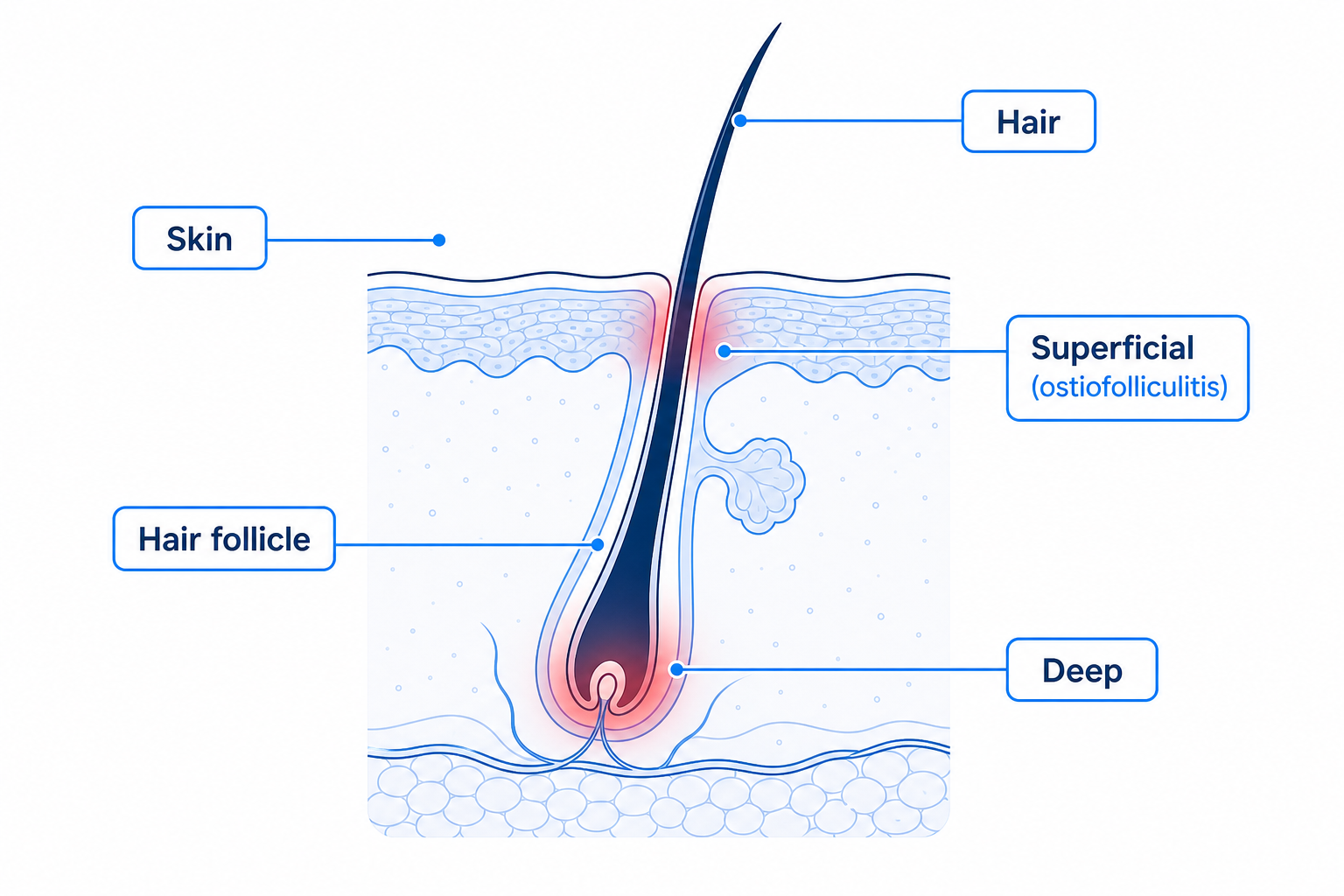
Every follicle goes through a fixed rhythm of growth, the hair cycle. A superficial infection usually disrupts this rhythm only briefly, without destroying the follicle. That is exactly why the vast majority of hair root infections heal with no lasting damage. Even so, it is important to distinguish folliculitis from deeper, larger infections, which are treated differently.
Folliculitis, boil, carbuncle or abscess?
Folliculitis is the mildest, most superficial stage of follicle-related skin infections; boils, carbuncles and abscesses are deeper, larger and more painful steps up the same spectrum. The overview below sorts the four terms by depth and size (source: IQWiG/gesundheitsinformation.de on boils and carbuncles).
The difference between folliculitis, a boil, a carbuncle and an abscess
| Finding | Depth / size | Pain | Key feature |
|---|---|---|---|
| Folliculitis | superficial, one follicle | none to mild | small spot, hair in the centre |
| Boil (furuncle) | deep, whole follicle + surroundings, roughly 0.5-2 cm | marked | cherry-stone to walnut-sized, pus-filled lump |
| Carbuncle | several merged boils | severe | large-area suppuration of several follicles |
| Abscess | pus cavity, not tied to a follicle | severe | walled-off collection of pus, can occur anywhere |
Symptoms: how do I recognise a hair root infection?
You can recognise a hair root infection by a small spot or bump sitting around a single hair, accompanied by redness, itching, mild tenderness and occasionally a tiny point of pus (DermNet NZ; Cleveland Clinic). It affects areas of the body with hair growth: the scalp, beard and face, neck, chest, back, buttocks, armpits, legs and the intimate or pubic area.
The decisive giveaway is the hair in the centre of the spot. If it is missing, other skin changes come into play. This is exactly where the most common mix-up happens: Malassezia (fungal) folliculitis looks confusingly similar to acne. In a review by Chalupczak and Lipner (2025), 75% of 110 patients had previously been treated for acne without success, and it took around 61 months on average to reach the correct diagnosis.
So if what looks like acne fails to respond to the usual acne treatments over several weeks, a targeted medical assessment is worthwhile. The matrix below helps you roughly tell the four most common look-alikes apart. It is no substitute for a diagnosis; it simply puts what you are seeing into context.
| What is this lump? | Hair in the centre? | Size / depth | Pain | Sensible first step |
|---|---|---|---|---|
| Folliculitis | yes | small, superficial | mild | antiseptic, break from irritation, observe |
| Spot / acne | usually not | small, superficial | mild | acne care; if it persists, see a doctor |
| Ingrown hair | yes, curled/visible | small, under the skin | mild to moderate | pause shaving, do not scratch it out |
| Boil / abscess | not visible | large, deep (0.5-2 cm) | severe, throbbing | seek medical advice, do not squeeze |
Causes: where does a hair root infection come from?
A hair root infection is usually caused by bacteria, less often by fungi or by purely mechanical irritation that damages the follicle and lets germs in. The typical chain of events: an irritation such as shaving or friction creates a microscopic injury in the follicle funnel, Staphylococcus aureus then enters, and inflammation develops. However, not every case of folliculitis has a mechanical trigger.
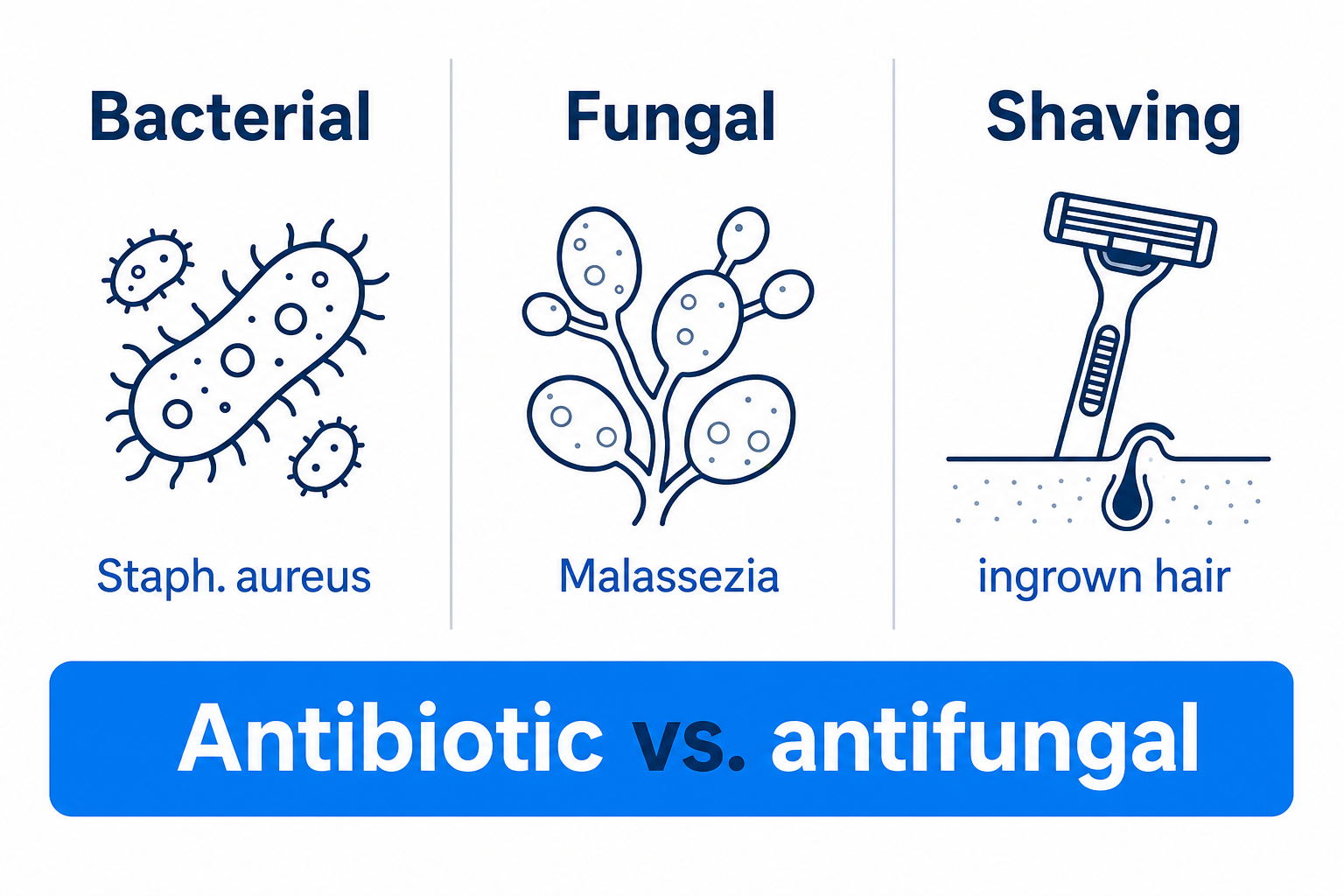
Bacterial: Staphylococcus aureus is by far the most common pathogen; gram-negative germs mainly appear after long-term antibiotic treatment for acne, according to DermNet NZ. Fungal: Malassezia folliculitis is triggered by a yeast, itches intensely and prefers the forehead, chest and back. In a cohort study, 28.8% of patients clinically classed as having acne in fact had Malassezia folliculitis (PubMed 36531566).
Mechanical: shaving, waxing, tight or airtight clothing such as sports leggings, constricting underwear or chafing rucksack straps, along with sweating and friction, all irritate the follicle; here cultures often stay sterile, so there is no genuine infection. Hot-tub folliculitis: Pseudomonas aeruginosa after a poorly chlorinated hot tub, with itchy spots on the trunk one to two days after bathing. Greasy ointments, steroid creams, diabetes, being overweight and a warm, humid climate all make it more likely.
And what about stress? A 2025 mouse study published in Science Immunology (Chan et al.) describes a possible mechanism in which stress weakens the skin’s antimicrobial defences via adrenaline and so favours S. aureus. This is a biologically plausible factor working through a weakened immune defence, but it has not been directly proven in humans for recurrent folliculitis. So stress does not cause the infection directly.
| Type | Trigger / pathogen | Typical feature | Common location | Sensible first step |
|---|---|---|---|---|
| Bacterial folliculitis | Staph. aureus | pus-filled spot around a hair | scalp, beard, legs | antiseptic, possibly a doctor-prescribed topical antibiotic |
| Malassezia (fungal) folliculitis | yeast | intensely itchy, uniform bumps, no response to antibiotics | forehead, chest, back | antifungal (not an antibiotic), medically supervised |
| Pseudofolliculitis barbae | ingrown hairs (mechanical) | bumps after shaving, no genuine infection | beard, neck, intimate area | adjust shaving technique, pause shaving |
| Hot-tub folliculitis | Pseudomonas | itchy spots 1-2 days after a hot tub | trunk | usually self-limiting, observe |
| Folliculitis decalvans | chronic, scarring | tufted hairs, bald scarred patches | scalp (back of the head) | dermatological assessment |
Is a hair root infection contagious and dangerous?
A hair root infection is not usually contagious in the classic sense, but the bacteria that trigger it can be passed on via shared razors, towels, flannels or close skin contact, especially where the skin is broken. This applies in particular to Staphylococcus aureus and Pseudomonas. The practical takeaway: do not share razors, towels or flannels with others during a flare-up.
A hair root infection is usually not dangerous and almost always clears up on its own. The risk does rise, though, if it spreads, in deep forms, and in people with a weakened immune system or diabetes. Left untreated, a deep case of folliculitis can progress to boils or carbuncles, according to IQWiG; very rarely, boils on the face can lead to more serious complications. That is why warning signs should be taken seriously (see the section “When to see a doctor”).
What to do about a hair root infection: treatment step by step
For a mild hair root infection, consistent hygiene, a break from irritation or shaving and antiseptic cleansing are usually enough; deeper or stubborn forms need doctor-prescribed antibiotics or antifungals. As self-care for individual, only mildly painful spots, warm, clean compresses (which encourage drainage) and a gentle antiseptic wash work well, combined with a break from whatever is causing the irritation.
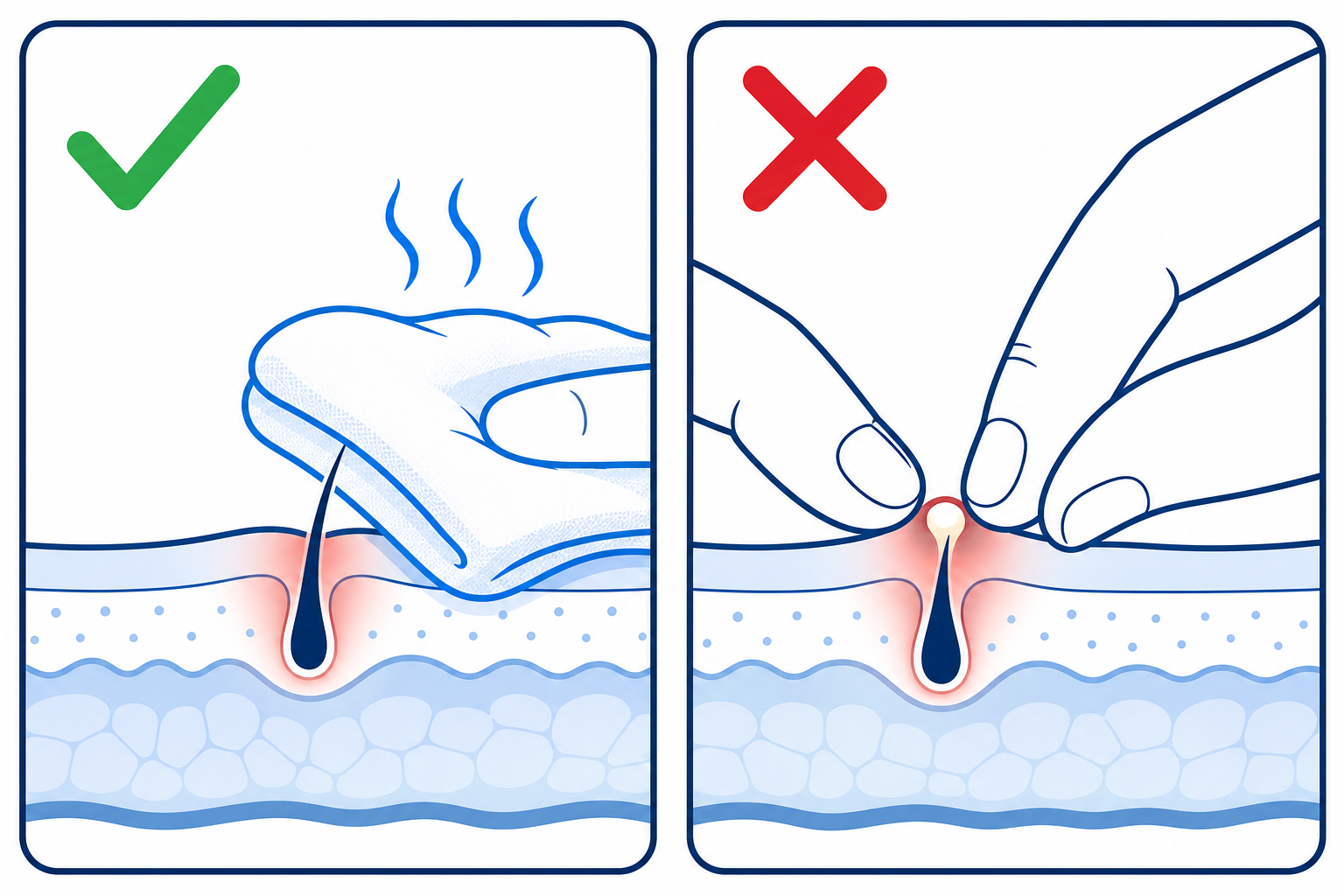
What you should absolutely avoid: squeezing or scratching the spot (risk of spreading and scarring), greasy ointments and oils, and aggressive exfoliation. If self-care is not enough, your doctor will prescribe topical or oral antibiotics (bacterial) or antifungals (fungal), depending on the pathogen. An important point from the literature: antibiotics usually do not work for Malassezia folliculitis and can even make it worse.
The table below is a guide to over-the-counter active ingredients. It deliberately names only classes of active ingredient, no brands and no dosages; the specific use belongs in a doctor’s hands, especially where a fungal cause is suspected, which non-specialists cannot reliably identify by sight.
| Class of active ingredient (generic) | What it is for | Not suitable for |
|---|---|---|
| Octenidine / polihexanide (antiseptics) | gentle cleansing, reducing germs in superficial folliculitis | deep, feverish cases (see a doctor) |
| Salicylic acid / BHA | clearing pores on oily skin | acutely inflamed, broken skin |
| Zinc pyrithione / ketoconazole shampoo | scalp, where a fungal cause has been confirmed by a doctor | use “on suspicion” without a diagnosis |
Step-by-step treatment scheme for a hair root infection
| Severity | Signs | Recommended step | What to avoid |
|---|---|---|---|
| Mild | individual spots, no pain | antiseptic, break from irritation/shaving, warm compress | squeezing, greasy ointments |
| Moderate | several or persistent patches, itching | doctor: topical antibiotic/antifungal, identify the pathogen | self-medicating with antibiotics, scratching |
| Severe | deep lumps, fever, spreading, recurrence | doctor/dermatologist: swab, systemic treatment | waiting it out, home remedies |
Exception for at-risk groups: With diabetes, immunosuppression (for example on therapy for rheumatism or with biologics), atopic dermatitis or known MRSA colonisation, the “mild, home remedies” tier does not apply. In these cases please seek medical assessment straight away, as the risk of complications such as cellulitis is higher.
In short: mild, superficial folliculitis can usually be managed at home with hygiene, antiseptics and patience; deep, extensive or recurring forms, as well as any suspicion of a fungal cause, belong in a doctor’s hands, because the wrong treatment can prolong or worsen the symptoms.
Home remedies for a hair root infection: what helps, what is a myth?
As home remedies for a mild hair root infection, warm, clean compresses and gentle antiseptic cleansing make sense, whereas squeezing, oils and aggressive exfoliation make the inflammation worse. The warm compress boosts circulation and drainage, and gentle cleansing lowers the germ load. Both are only suitable for superficial, mildly painful cases, not where there are warning signs. A drawing ointment (containing ichthammol) is also out of place for ordinary, superficial folliculitis and tends to be too aggressive; it only becomes useful for deeper boils, where, under medical supervision, it can help them come to a head and drain.
Tea tree oil is often recommended, but it should be treated with caution. According to de Groot (2016, Contact Dermatitis), undiluted tea tree oil in particular can trigger skin irritation and even an allergic contact dermatitis that resembles folliculitis. The evidence for any benefit is weak. On inflamed skin the risk outweighs the benefit, so you should rather avoid undiluted tea tree oil here.
The most important caveat concerns fungal folliculitis: for non-specialists, Malassezia folliculitis cannot reliably be told apart by sight from bacterial folliculitis or acne; in studies the rate of misdiagnosis ranged from 65 to 75%. For that reason, do not use an antifungal cream “on suspicion”. The right classification can only be made by a doctor, for example with a KOH preparation or a Wood’s lamp.
Hair root infection after shaving (beard, intimate area, legs)
A hair root infection in the beard or on shaved areas often stems from shaving itself, either as bacterial sycosis barbae or as mechanical pseudofolliculitis barbae caused by ingrown hairs. Sycosis barbae is a deeper form of beard folliculitis, usually due to S. aureus, which if left untreated can cause sinus tracts, abscesses and, in some cases, scarring with permanent gaps.
Pseudofolliculitis barbae, by contrast, is not a genuine infection: after shaving, the regrowing, sharply cut hairs pierce the follicle wall and set off a foreign-body reaction. According to DermNet NZ it disproportionately affects people with tightly curled beard hair; international studies cite 45 to 83% in Black men compared with around 18 to 20% in white men. In pronounced cases it typically heals within 4 to 6 weeks once shaving stops completely.
The bikini area is especially prone to it: the skin in the intimate area is sensitive, covered by tight underwear and subject to constant friction, so reddened spots easily develop after wet shaving or waxing. Anyone with repeated problems here is often better off trimming the hair with an electric trimmer rather than shaving it smooth with a blade, and then giving the skin a break from irritation.
Shaving and hair-removal checklist (beard, legs, intimate area)
- Keep the blade clean and sharp, and change dull blades in good time.
- Moisten and soften the skin before shaving, never dry shave.
- Shave in the direction of hair growth, and use shaving gel rather than a dry blade.
- Gentle exfoliation beforehand, avoid aggressive scrubbing.
- Use an alcohol-free aftershave, and take a break from shaving if the skin is irritated.
- Never share a razor with others, to avoid passing on germs.
If the beard area repeatedly develops scarring inflammation with permanent bald gaps, a beard hair transplant can, once everything has fully healed, refill the affected areas. The condition for this is that the inflammation has cleared up and has been inactive for some time. Where beard folliculitis is active, dermatological treatment comes first.
Hair root infection after a hair transplant: is it normal?
A mild hair root infection after a hair transplant is a common and usually harmless reaction around the implanted grafts, and it generally heals without any lasting effects. A multicentre study of 1,317 patients (Zhou et al. 2024, Plastic and Reconstructive Surgery) found an overall incidence of post-operative folliculitis of 12.11%; in the literature the figure varies between 1.1 and 20%, depending on the definition.
According to the same study, the lesions can appear between 2 days and 6 months after the procedure, usually as spots that heal without any lasting damage. Risk factors include summer surgery, very high graft numbers (from around 4,000) and a high transplantation density. An article in the Hair Transplant Forum International interprets early folliculitis more as a sterile foreign-body reaction than as an infection.
“In practice, after hair transplants we regularly see small, harmless spots around individual grafts, often caused by an ingrown hair. They almost always heal on their own. What matters is that if there is any spreading, fever or severe pain, patients contact the clinic rather than interfering with it themselves.”
Can a hair root infection cause hair loss?
A superficial hair root infection does not cause permanent hair loss; the hair grows back. Only deep, chronic scarring forms such as folliculitis decalvans destroy the follicle and lead to lasting, scarring hair loss. With superficial folliculitis the follicle stays intact, and although hair sometimes sheds temporarily more than usual (inflammation-related shedding), it then grows back.
Folliculitis decalvans is different: it is a chronic, neutrophilic, scarring scalp disease that, according to DermNet NZ, leads to permanent, scarring hair loss once the follicle is destroyed. A typical sign is tufted hairs, where several hairs grow from a single widened follicle opening. According to literature reviews it accounts for around 11% of scarring alopecias and absolutely requires dermatological treatment.
| Superficial (common) | Deep / scarring (rare) | |
|---|---|---|
| Effect on the hair | reversible, hair grows back | irreversible, scarring loss |
| Follicle | stays intact | is destroyed |
| Example | bacterial / mechanical folliculitis | folliculitis decalvans |
| Who handles it | self-care / GP | dermatology |
Whether hair loss is scarring and permanent or only temporary, and whether an inflammation is still active, is best clarified in a professional hair analysis. A hair transplant is only an option for scarred areas that have fully healed and have been inactive for some time; where inflammation is active, it is contraindicated. If you are unsure which type you have, you can have your hair and scalp analysed free of charge.
In short: only chronic scarring forms such as folliculitis decalvans and similar conditions lead to permanent hair loss; the vast majority of cases are superficial and reversible. To distinguish diffuse or patchy patterns, a blood test for hair loss and the other causes of hair loss can also play a role.
How long does a hair root infection last? Course and prevention
A mild hair root infection usually clears up within a few days to about a week, with some forms such as hot-tub folliculitis resolving in roughly 7 to 10 days (DermNet NZ, Cleveland Clinic). After shaving stops in pseudofolliculitis barbae, DermNet reckons on 4 to 6 weeks. There is no single figure that holds for every case; the duration depends on the form and the trigger.
If an inflammation has temporarily pushed hairs into their resting phase, the regrowth follows the hair cycle over several months. The timeline below shows the typical course after a superficial, reversible inflammation has subsided. It applies only to non-scarring forms in which the follicle has stayed intact.
| Period | What happens in the follicle | Visible |
|---|---|---|
| Month 1-2 | inflammation subsides, the irritation calms down, shedding slowly eases | redness and spots disappear |
| Month 3-4 | affected follicles re-enter the growth phase (anagen) | shedding stabilises |
| Month 5-6 | new hairs grow back | first fine new hairs (baby hair or vellus hair) become visible |
You can help prevent it with good shaving hygiene, breathable clothing, showering soon after exercise, your own towels and adequately chlorinated pools. During an acute case of folliculitis, it is best to avoid exercise that makes you sweat heavily, swimming in chlorinated or salt water, and sunbeds: sweat, friction and shared pools irritate inflamed follicles and carry a risk of re-infection. This is a sensible precaution, not a rigid rule.
When should I see a doctor about a hair root infection?
You should see a doctor about a hair root infection if it spreads, if fever develops, if deep painful lumps form, if it keeps coming back, or if it fails to heal after several days to one or two weeks. Any bald or scarred patches that develop are also a clear signal for dermatological assessment, as they can point to a scarring form.
Red-flag checklist: when to see a doctor?
- ☐ fever or a general feeling of illness
- ☐ redness spreads or grows
- ☐ deep, painful lumps
- ☐ no improvement after several days to 1-2 weeks
- ☐ the inflammation keeps coming back
- ☐ diabetes, a weakened immune system or known MRSA colonisation
- ☐ bald or scarred patches develop
If any one point applies, please seek medical assessment.
Frequently asked questions about hair root infections
What is a hair root infection?
A hair root infection (folliculitis) is the inflammation of one or more hair follicles, usually caused by the bacterium Staphylococcus aureus, less often by fungi, friction or shaving. It shows up as a small, reddened, often pus-filled spot with a hair in the centre.
Is a hair root infection contagious?
It is not contagious in the classic sense, but the bacteria that trigger it can be passed on via shared razors, towels, flannels or close skin contact. For that reason, do not share such items during a flare-up.
How long does a hair root infection last?
Mild forms usually clear up within a few days to about a week, and hot-tub folliculitis in roughly 7 to 10 days. After shaving stops in pseudofolliculitis barbae, DermNet NZ reckons on 4 to 6 weeks until it heals completely.
Which ointment helps with a hair root infection?
That depends on the cause: for mild cases an antiseptic is often enough, bacterial forms are treated by a doctor with topical antibiotics, and a fungal form with antifungals. Important: no antifungal cream on suspicion, as non-specialists cannot reliably tell fungi and bacteria apart by sight.
Should you squeeze a hair root infection?
No. Squeezing or scratching can push the germs deeper into the skin, spread the inflammation and raise the risk of scarring. A warm compress and patience are better, and if it gets worse, seek medical advice.
Can a hair root infection cause hair loss?
Superficial forms do not cause permanent hair loss; the hair grows back. Only chronic scarring forms such as folliculitis decalvans destroy the follicle and lead to lasting, scarring hair loss. Such cases belong in dermatological treatment.
What helps with a hair root infection in the beard or after shaving?
An adjusted shaving technique (sharp blade, in the direction of growth, damp skin) and a break from shaving when the skin is irritated help. Bacterial sycosis barbae needs medical treatment. If a scarring inflammation leaves permanent gaps, a beard hair transplant may be an option once everything has healed.
Why does my hair root infection keep coming back?
Common reasons are lasting colonisation with S. aureus (for example in the nose), persistent mechanical irritation such as shaving or friction, an overlooked fungal cause, or risk factors such as diabetes. For recurring flare-ups, a swab to identify the pathogen is worthwhile.
When should I see a doctor about a hair root infection?
If there is fever, spreading redness, deep painful lumps, no improvement after several days to one or two weeks, constant recurrence or bald patches developing. People with diabetes or a weakened immune system should seek medical advice sooner.
Sources
- DermNet NZ: Folliculitis, Bacterial folliculitis, Folliculitis decalvans, Pseudofolliculitis barbae.
- Robert Koch Institute: RKI guide to staphylococcal infections, in particular MRSA.
- IQWiG / gesundheitsinformation.de: Boils and carbuncles.
- Chalupczak NV, Lipner SR (2025): Malassezia Folliculitis: An Underdiagnosed Mimicker of Acneiform Eruptions, Journal of Fungi.
- Zhou Y et al. (2024): Characterization and Risk Factors of Folliculitis after Hair Transplantation, Plastic and Reconstructive Surgery.
- Waśkiel-Burnat A et al. (2025): Management of folliculitis decalvans: EADV task force position statement, JEADV.
- de Groot AC (2016): Tea tree oil: contact allergy and chemical composition, Contact Dermatitis.
- Cleveland Clinic: Folliculitis, Pityrosporum Folliculitis.
This article is intended as general information and is no substitute for a medical diagnosis or treatment. If symptoms persist or are deep or recurring, please consult a doctor. Information as of: 2026.

Dr. Imad Moustafa
Hair transplant specialist