


Maybe the bottle is already in your basket, or you are still standing in front of the shelf in Boots. Either way, you want to know whether three months of money and patience are worth it. One thing is worth knowing up front: the manufacturer, Dr. Wolff, now sells the line as “Plantur 21 #langehaare” (“#longhair”) and markets it for hair growth and more length, no longer primarily against hair loss (plantur.com, the company’s German product site, as of 09/2026). On top of that, Plantur 21 is a cosmetic product, not a medicine. This article draws a clean line between what a manufacturer claim, a lab finding, a human study, and a user report each actually prove, and shows you how to make your own three months of experience worth something.
The short version
- ✓Plantur 21 is a cosmetic, not a medicine: under the UK Cosmetics Regulation, no medicine-style proof of efficacy is required for it
- ✓Clinical studies on topical caffeine do exist (2025 review: nine studies, 684 people), but their reliability is mostly low to very low, and none of them tests Plantur 21 itself
- ✓Whether a shampoo can do anything for you at all depends on the pattern: diffuse, patterned, or patchy
- ✓User reports say more when someone observes under the same conditions over about three months
The table of contents shows where to find what. After that we go through it in order: the user reports, the current state of the product, the evidence on caffeine, and how to use it.
Summary
- Plantur 21 reviews: what users report and what that actually proves
- What is Plantur 21? Products, active ingredients, and target group according to the manufacturer
- Plantur 21 or Plantur 39: which product is meant for whom?
- Does Plantur 21 work against hair loss? What the evidence on caffeine says
- Plantur 21 shampoo reviews: use, contact time, and the usual mistakes
- Plantur 21 side effects: what users report
- Plantur shampoo for hair loss: where a shampoo reaches its limits
- Trying Plantur 21 yourself: a checklist for your own observation
- Alternatives to Plantur 21: what else is an option for hair loss
- Conclusion: who Plantur 21 can make sense for
- Frequently asked questions about Plantur 21 reviews
- Sources
Plantur 21 reviews: what users report and what that actually proves
Plantur 21 reviews diverge sharply, and they do so along a recognisable dividing line: people praise the care side (how the hair feels, how it handles, how the scalp feels) and criticise the lack of any visible effect on hair density. How often one or the other comes up cannot be counted honestly from publicly available reviews. This section therefore gives no percentages; it shows what kind of statement a user report can support. Both can be true at the same time, because the two groups are measuring different things.
Frequently praised
- ✓fuller, stronger-feeling hair and better handling
- ✓a pleasant, clean feeling on the scalp after washing
- ✓Tolerability: the reports are mainly of local reactions on the scalp; no frequency figures are documented
Frequently criticised
- •no noticeable effect on hair density or on the hair loss itself
- •roots that get greasy faster with daily washing, more so with some hair types than others
- •occasional scalp irritation or flaking on a sensitive scalp
- •disappointment when there is still nothing to see after a few weeks
Aggregated patterns from publicly available reviews and forums, retrieved 10 September 2026. No individual quotes, not a representative survey.
For context, one real number with an expiry date: for the Plantur 21 Nutri-Coffein-Elixir (the scalp tonic, not the #langehaare shampoo), Amazon customer reviews stood at 4.4 out of 5 stars on 10 September 2026. Figures like that are a snapshot: they change daily, nobody checks them editorially, and they apply only to the exact product being rated, not to the whole line. As an argument for or against a product, they are worth little.
The most important reason for the spread is the time frame. A hair that enters the resting phase today does not fall out until 2 to 4 months later at the earliest, which is why changes measured against the hair cycle always show up with a delay. Anyone judging after four weeks is really judging scent, lather, and how the hair feels.
The second reason is confounders. Coming off the pill, a diet, childbirth, a feverish infection, an iron supplement just started, plus the familiar seasonal shedding in the autumn: every one of these runs alongside and shifts the result, without anyone being able to untangle them after the fact. Then there is self-selection. Reviews are written disproportionately by the delighted and the disappointed, and almost nobody has a clean before photo.
That leaves one question, and it comes before every user report: what kind of statement am I actually reading here? The overview below separates the four levels that routinely get mixed up online.
| Type of statement | What it proves | What it does not prove | How to recognise it |
|---|---|---|---|
| Manufacturer advertising claim | The composition and the benefit the brand advertises | Independently verified efficacy in humans | Manufacturer’s website or packaging, a claim with no study cited |
| In vitro finding from the lab | A biological mechanism under laboratory conditions, on isolated hair follicles for instance | That the same holds in real-world use, at that concentration and with that contact time | Terms like “in vitro”, “organ culture” or “ex vivo” in the study title |
| Clinical study in humans | An effect for one particular formulation, concentration, and population over a defined period | That it automatically transfers to a different product, from a solution to a shampoo for example | The sample size, the control group, and the study registry are named |
| User report or online review | One individual, subjective experience at one point in time | Causation, generalisability, the starting point | A platform instead of a method, no comparison, no documented baseline |
| Test by a consumer magazine | An editorial review against the magazine’s own criteria, often with an eye on the ingredients | Clinical efficacy in the medical sense | The testing organisation states its method and date openly |
Scent, lather, and texture: what reviews of Plantur 21 reliably capture
Reviews of Plantur 21 reliably capture one thing above all: the sensory side, meaning scent, how it lathers, texture, and handling. Those impressions are there from the very first wash, they are honest, and they say nothing about hair density. For the question of whether you will stick with it for three months, they still matter a great deal.
With the lather, the INCI list sets the expectation. Sodium Laureth Sulfate is in position 2, Cocamidopropyl Betaine in position 3 (retrieved 10 September 2026), a classic, strongly foaming surfactant combination. So Plantur 21 is not a mild, sulfate-free shampoo with little lather. For the 2-minute contact time that is practical, because the lather stays on the scalp while you wait.
The formula is fragranced as well: Parfum, Benzyl Benzoate, and Linalool appear at the end of the same INCI list. The scent is therefore a deliberate part of the product and not a neutral side effect. Anyone who reacts to fragrance should know that, because Linalool is a known contact allergen.
The same goes for handling. On one side, people report fuller-feeling hair and a scalp that feels clean after washing; on the other, roots that get greasy faster with daily use. Whether and how strongly that happens to you depends on hair type and washing rhythm, and you can judge it yourself within a few washes. Public reviews do not support any reliable frequency figure. These are impressions of the care effect, not statements about hair loss.
What is Plantur 21? Products, active ingredients, and target group according to the manufacturer
Plantur 21 is a hair care line from the Bielefeld-based manufacturer Dr. Wolff, sold today under the name “Plantur 21 #langehaare”. On the current product page, the manufacturer advertises that caffeine penetrates to the hair roots and gives hair growth a “push” (plantur.com, the company’s German product site, as of 09/2026). That is the main positioning today: growth and length. The manufacturer does still advertise against hair loss, though. On the same page, an FAQ answer says that after around three months of daily use of a caffeine product you notice a decrease in hair loss, and the page cites five studies on caffeine shampoo in general. So anyone reaching for this line because of hair loss is not out of step with the manufacturer’s own marketing.
That shift is visible technically as well: the former product domain plantur21.com now redirects entirely to plantur.com, where Dr. Wolff bundles both lines under one brand. In the UK, the same product is sold at Boots as “Plantur 21 #Longhair shampoo”.
According to the manufacturer, the line is not tied to an age and is aimed at women who want to grow their hair. There are currently four products, designed to be used together. Where a product is stocked in the UK, the table below gives the Boots list price (as of 09/2026).
| Product | Use according to the manufacturer | Active system according to the manufacturer | Size and price (as of 09/2026) |
|---|---|---|---|
| Nutri-Coffein-Shampoo #langehaare | Massage in, leave on for 2 minutes, rinse out; daily use recommended | Nutri-Coffein-Complex: caffeine plus biotin, niacinamide, calcium, magnesium, zinc | 200 ml bottle; £11.99 at Boots |
| Nutri-Conditioner #langehaare | After the shampoo, on the mid-lengths and ends; leave on briefly, rinse out | The care complex of the line according to the manufacturer | 175 ml bottle; £8.99 at Boots |
| Nutri-Coffein-Elixir (scalp tonic) | Onto the scalp independently of washing, not rinsed out; advertised with a 24-hour reservoir effect | Scalp tonic containing caffeine | Not listed at Boots; availability depends on the importing seller |
| Booster scalp serum #langehaare | Onto the scalp, stays there | The active complex of the line according to the manufacturer | 125 ml bottle; £10.99 at Boots |
Which ingredients are in Plantur 21?
The INCI list of the Nutri-Coffein-Shampoo runs to 27 entries, and caffeine sits at position 8 (retrieved 10 September 2026). That position tells you nothing about the amount, though. Ingredients have to be listed in descending order of concentration only above 1 per cent; anything below that may appear in any order, and in the UK that rule sits in Article 19 of the UK Cosmetics Regulation. So what is documented is that caffeine is in the product, not how much. The exact percentage is a trade secret and is not public.
This formula contains no silicones and no parabens. Its main surfactant is Sodium Laureth Sulfate, so Plantur 21 is not sulfate-free, and the manufacturer does not advertise it that way either. Among the fragrances is Linalool, a known contact allergen, which matters later on for telling irritation and allergy apart.
Do the nutrients in the Nutri-Coffein-Complex achieve anything via the scalp?
According to the manufacturer, the “Nutri” part of the name stands for biotin, niacinamide, calcium, magnesium, and zinc. A sober distinction is worth making here: a nutrient deficiency arises in the body and is corrected through diet or, after a medical workup, through supplementation. A shampoo puts the substance on the scalp, and that is something different.
For biotin, uptake through the stratum corneum, the outer layer of the skin, is limited from the outset, because biotin is a water-soluble molecule. Even for oral intake, the most reliable double-blind, placebo-controlled evidence found no difference from placebo in hair growth (summarised at medizin-transparent.at, a German-language evidence review). For zinc, a link between deficiency and diffuse hair loss is described, but via the systemic supply, measurable in the blood, not via the scalp. In short: these substances in a shampoo are care, not a substitute for clarifying a deficiency.
How long does a bottle of Plantur 21 last, and where can you get it?
Plantur 21 is a German product, but in the UK it is stocked at Boots : the shampoo costs £11.99 for 200 ml, the conditioner £8.99 for 175 ml and the Longhair booster scalp serum £10.99 for 125 ml (as of 09/2026). Beyond that, the line is not part of the standard high street range; the Nutri-Coffein-Elixir in particular is not listed, so anyone who wants it has to buy from a marketplace seller importing it. In Germany, where the line comes from, it sits on the shelves of high street chemists and pharmacies in the same pack sizes.
The manufacturer gives no yield figure, only a “small amount” per wash. You can still do the maths: at 5 ml per wash, a 200 ml bottle lasts for around 40 washes, and at 10 ml for 20. With daily use a bottle therefore lasts about three to six weeks, and correspondingly less with long, dense hair.
Rough maths: what three months of Plantur 21 cost
- •Shampoo in 200 ml bottles at £11.99 (Boots, as of 09/2026)
- •Consumption of 5 to 10 ml per wash: 20 to 40 washes per bottle
- •Washing daily: one bottle lasts about three to six weeks
- •Three months of self-observation, shampoo only: at 5 to 10 ml per wash and 200 ml bottles, that comes to three to five bottles, so roughly £36 to £60
- •Depending on how you use them, the conditioner adds £8.99 per bottle and the booster serum £10.99
Our own rough calculation based on the Boots prices and the pack sizes, not a manufacturer figure. Prices as of 09/2026.
It is worth looking at the bottle when you buy. Alongside the current 200 ml “#langehaare” range, some sellers and chemists still carry the older “Nutri-Coffein Shampoo” variant in 250 ml without that label. What counts is the line Dr. Wolff lists today on its German site plantur.com (as of 09/2026); old stock can differ in packaging, size, and price.
Plantur 21 or Plantur 39: which product is meant for whom?
According to the manufacturer, Plantur 21 and Plantur 39 differ in target group and active system, not in being “stronger” or “weaker”. There is no comparative study between the two lines, so any ranking would be invented.
| Feature | Plantur 21 #langehaare | Plantur 39 |
|---|---|---|
| Target group according to the manufacturer | Women who want to grow their hair, not tied to an age | Women from around 39 and through the menopause |
| Active system according to the manufacturer | Nutri-Coffein-Complex: caffeine, biotin, niacinamide, calcium, magnesium, zinc | Phyto-Coffein-Complex: caffeine plus plant compounds from white tea, soy, and black cohosh |
| What the manufacturer intends it for | Support for hair growth, strength, and length | Preventing and easing hair loss with a hormonal component |
For the choice between the two lines that means: anyone who notices thinning during or after the menopause is closer to the target group the manufacturer has in mind with Plantur 39. How often people reach for the other line instead has never been surveyed. All that can be documented is which line the manufacturer intends for what. What happens to hair in this phase of life is covered in detail in the article on hair loss during the menopause.
Does Plantur 21 work against hair loss? What the evidence on caffeine says
For caffeine at the hair follicle there are solid lab findings and penetration data, but there is no independent clinical study, none that shows a clinically relevant effect on hair loss for a caffeine shampoo. That difference is the whole point: “not sufficiently documented” is neither “proven to work” nor “disproven”.
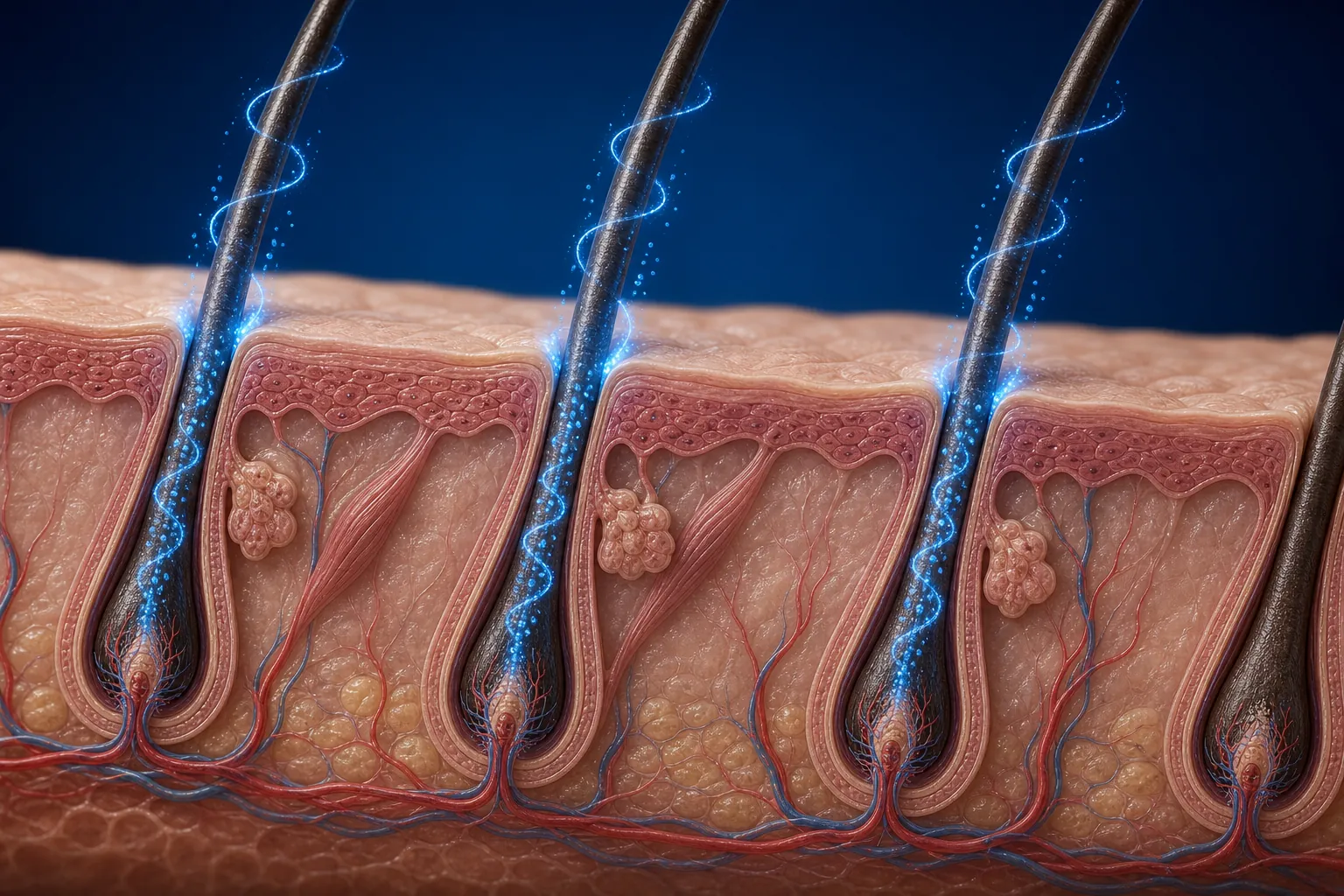
The much-quoted basis comes from Fischer et al. (2007, Int J Dermatol). There, 14 hair follicle biopsies from male patients with androgenetic alopecia were kept in a nutrient solution for 120 to 192 hours, and caffeine counteracted the growth inhibition caused by testosterone. A follow-up paper by Fischer et al. (2014, Br J Dermatol) found the same effect in male and female follicles at 0.005 to 0.0005 per cent caffeine. Both are organ cultures, not scalp and not a hair wash.
That caffeine reaches the follicle at all, by contrast, is well studied. Otberg et al. (2007/2008, Br J Clin Pharmacol) used the follicular closing technique to show that follicles speed up uptake considerably. Otberg, Lademann et al. (2010, Laser Physics) detected caffeine from a caffeine-containing shampoo in the follicles after a 2-minute contact time, and it was still measurable there 24 hours later. That takes the wind out of the common objection that two minutes are too short. It is not proof of efficacy.
Clinical studies on topical caffeine do exist; they are simply weak methodologically. A systematic review by Szendzielorz and Spiewak (Healthcare 2025) included nine clinical studies with a combined 684 people, shampoos among them. All of them came out in favour of caffeine, but under GRADE the level of evidence was moderate in only three studies, low in one, and very low in five. The authors name the main shortcomings as missing randomisation, missing placebo and control groups, and missing information on the caffeine concentration in the product. Their conclusion: worth a try, but a satisfactory result is not assured. The most-cited single study is Dhurat et al. (2017, Skin Pharmacol Physiol): 210 men with androgenetic alopecia, 6 months, a caffeine solution at 0.2 per cent against minoxidil solution at 5 per cent. The result was non-inferiority in the proportion of anagen hairs (an improvement of 10.59 versus 11.68 per cent). What was tested, however, was a solution that stays on the scalp, not a shampoo that gets rinsed out, and only men, in an open-label, that is to say unblinded, design.
| Research (author, year) | Design | Substance and concentration | Result | What that means for a caffeine shampoo |
|---|---|---|---|---|
| Fischer et al. 2007, Int J Dermatol | In vitro organ culture, 14 follicle biopsies from men with androgenetic alopecia, 120 to 192 hours | Caffeine and testosterone in the culture medium, several concentrations | Caffeine stimulated hair shaft elongation and counteracted the inhibition by testosterone | Lab relevance only. Isolated follicles in a culture medium, with no scalp involved and without the short contact time of a hair wash. |
| Fischer et al. 2014, Br J Dermatol | In vitro organ culture, male and female scalp follicles, 120 hours | Testosterone with and without caffeine, 0.005 to 0.0005 per cent | Effect demonstrable in both sexes | Lab relevance only. Confirms the mechanism in the test tube; it is no substitute for a use study in humans. |
| Otberg et al. 2007/2008, Br J Clin Pharmacol | In vivo penetration study in humans, follicular closing technique | Caffeine solution in ethanol and propylene glycol, topical | Through open follicles, caffeine entered the body considerably faster | Transfers only in part. Shows the route the substance takes, says nothing about an effect on hair loss. |
| Otberg, Lademann et al. 2010, Laser Physics | In vivo laser scanning microscopy on a caffeine-containing shampoo | Shampoo containing caffeine, 2-minute contact time | Substance detectable in the follicles after 2 minutes, and still after 24 hours | Penetration, not efficacy. It shows that the 2-minute contact time is enough for the substance to arrive, not what it does once it is there. |
| Dhurat et al. 2017, Skin Pharmacol Physiol | Open-label, randomised multicentre study, 210 men with androgenetic alopecia, 6 months | Caffeine solution at 0.2 per cent against minoxidil solution at 5 per cent | Non-inferiority in the proportion of anagen hairs, 10.59 versus 11.68 per cent improvement | Different product, different group. A solution instead of a shampoo, men only, unblinded design. |
Why convincing advertising and thin evidence fit together
Plantur 21 is a cosmetic product in the regulatory sense, covered in the UK by the UK Cosmetics Regulation, that is Regulation (EC) 1223/2009 as continued in domestic law by Schedule 34 to SI 2019/696; in Northern Ireland the EU version still applies. Article 20 of that regulation requires every advertising claim to be backed by adequate and verifiable evidence. What it does not require is a medicines authorisation procedure with controlled clinical trials, of the kind minoxidil went through.
That explains the apparent contradiction without accusing the manufacturer of anything: the evidence behind a cosmetic claim may be a laboratory finding, and no clinical endpoint has to have been tested. Accordingly, the European S3 guideline on androgenetic alopecia (Kanti et al. 2018, J Eur Acad Dermatol Venereol) does not list caffeine among the substances with enough evidence for a formal treatment recommendation. The review by Dressler et al. (2017, JDDG) likewise concludes that the benefit of caffeine-containing hair care under real-world conditions is insufficiently researched. Where anti-hair-loss shampoos stand overall is covered in the guide to shampoo for hair loss.
Plantur 21 shampoo reviews: use, contact time, and the usual mistakes
A large share of the disappointed Plantur 21 shampoo reviews comes down to how it was used, not to the product. The manufacturer’s instructions are to work a small amount into a lather in your hands, massage it in, leave it on for 2 minutes and then rinse it out thoroughly, and to do all of that daily.
Those two minutes are not a marketing detail. The penetration measurement by Otberg and Lademann (2010) showed, for exactly that contact time, that caffeine from a shampoo arrives in the follicles. So anyone who only lathers the shampoo briefly and rinses it out right away undercuts the one condition that is documented for using it at all.
Shampoo or tonic: how the two differ
Shampoo and tonic follow two different logics, and that is where most of the confusion comes from. The shampoo gets rinsed out. The Nutri-Coffein-Elixir is applied to the scalp independently of washing and stays there, according to the manufacturer as a 24-hour reservoir. Anyone who rinses the tonic out is not using it the way the manufacturer intends.
If you want your own observation to mean something, keep the conditions constant: same washing rhythm, same products, no switching products halfway through. The manufacturer recommends using shampoo and tonic together. That said, there is no evidence that using it without the tonic is the reason results fail to appear: a manufacturer recommendation is not proof that both products are necessary. And blaming disappointing experiences on user error across the board would be just as undocumented.
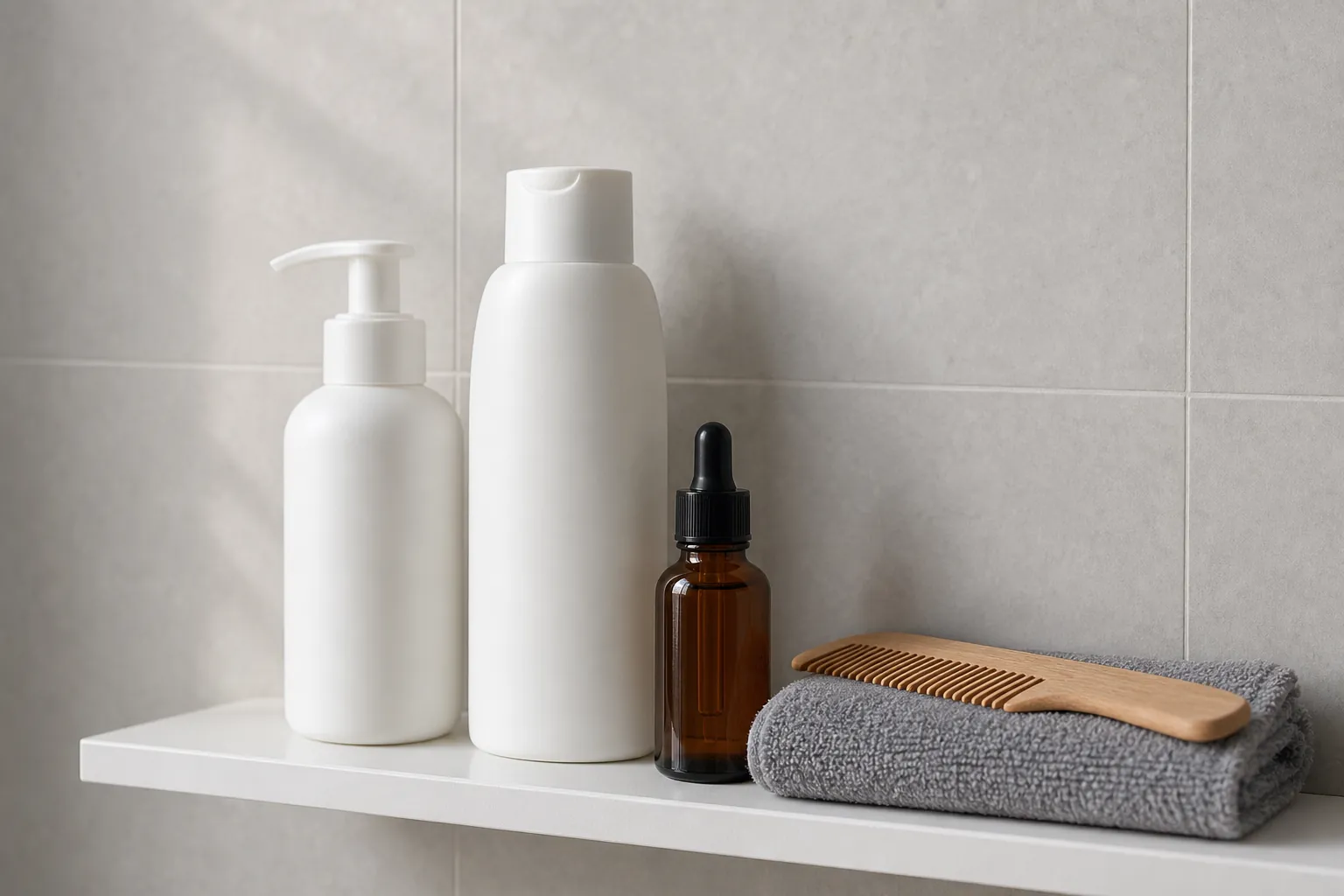
Greasy roots and weighed-down lengths: what you can do about it
One everyday issue with daily washing is not a medical one: the roots can get greasy faster, and a tonic that stays on the scalp can weigh down the lengths. How strongly depends on hair type and how oily your scalp runs. In practice it helps to put the tonic on the scalp only rather than into the lengths, to care for the lengths separately, and to adjust the interval between washes. The manufacturer’s advice to use it daily is a recommendation, not a requirement.
Plantur 21 side effects: what users report
Plantur 21 is a cosmetic product with a comparatively simple formula, free of silicones and parabens. What gets reported are local reactions on the scalp: itching, dryness, tightness, and flaking. How often that happens has not been captured in reliable data for this product, but a serious problem with a cosmetic can be reported through the Citizens Advice consumer helpline to Trading Standards.
What matters is telling the difference between irritation and allergy. Irritation usually announces itself right after use, with burning or tightness, and subsides quickly once you stop. An allergic contact reaction often sets in with a delay, persists, and shows redness, intense itching, or blisters. Since the INCI list contains the fragrance allergen Linalool, that is not a theoretical case. If symptoms persist, this is a case for a dermatologist, who can order patch testing for fragrances if there is a suspicion.
Can Plantur 21 make hair loss worse?
Many users make this observation in the first few weeks, and it deserves an honest answer rather than reassurance. No pharmacological mechanism has been described by which a cosmetic shampoo could trigger hair loss. What can be explained well, on the other hand: anyone who washes daily and massages the scalp for two minutes releases already dead telogen hairs earlier and all at once, hairs that would otherwise have come out spread over several days.
That is a coincidence in timing, not a cause, and it differs from the initial shedding described for active drug treatments such as topical minoxidil, which works by a different mechanism. There is a limit all the same: if the shedding keeps increasing over weeks or new bald patches appear, that needs a medical workup and should not be pinned on the shampoo.
What happens after stopping, and what applies during pregnancy?
A cosmetic care effect on handling and scalp feel ends when you stop using it. A withdrawal reaction or rebound, as described for some medicines, is not known for Plantur 21. That says something about the missing data, not about the biology: the classification as a cosmetic alone does not mean nothing can happen. If noticeably more hair falls out after you stop, that is a reason for a medical workup and not for assuming the stopping caused it.
For pregnancy and breastfeeding, the manufacturer states that the maximum amount of caffeine absorbed through the skin with proper use corresponds to about half a cup of coffee. That is a manufacturer figure without independent quantification. It does not add up to a blanket all-clear; if in doubt, check briefly with your GP or midwife. In the UK there is no central reporting register for cosmetics, and the MHRA Yellow Card scheme does not cover them: a problem with a cosmetic product goes to the Citizens Advice consumer helpline, which passes it on to Trading Standards, with the Office for Product Safety and Standards (OPSS) overseeing the system.
Plantur shampoo for hair loss: where a shampoo reaches its limits
Whether a Plantur shampoo for hair loss can do anything for you depends less on the product than on the cause and the distribution pattern. You can roughly tell three patterns apart in the mirror, and they lead to completely different next steps.
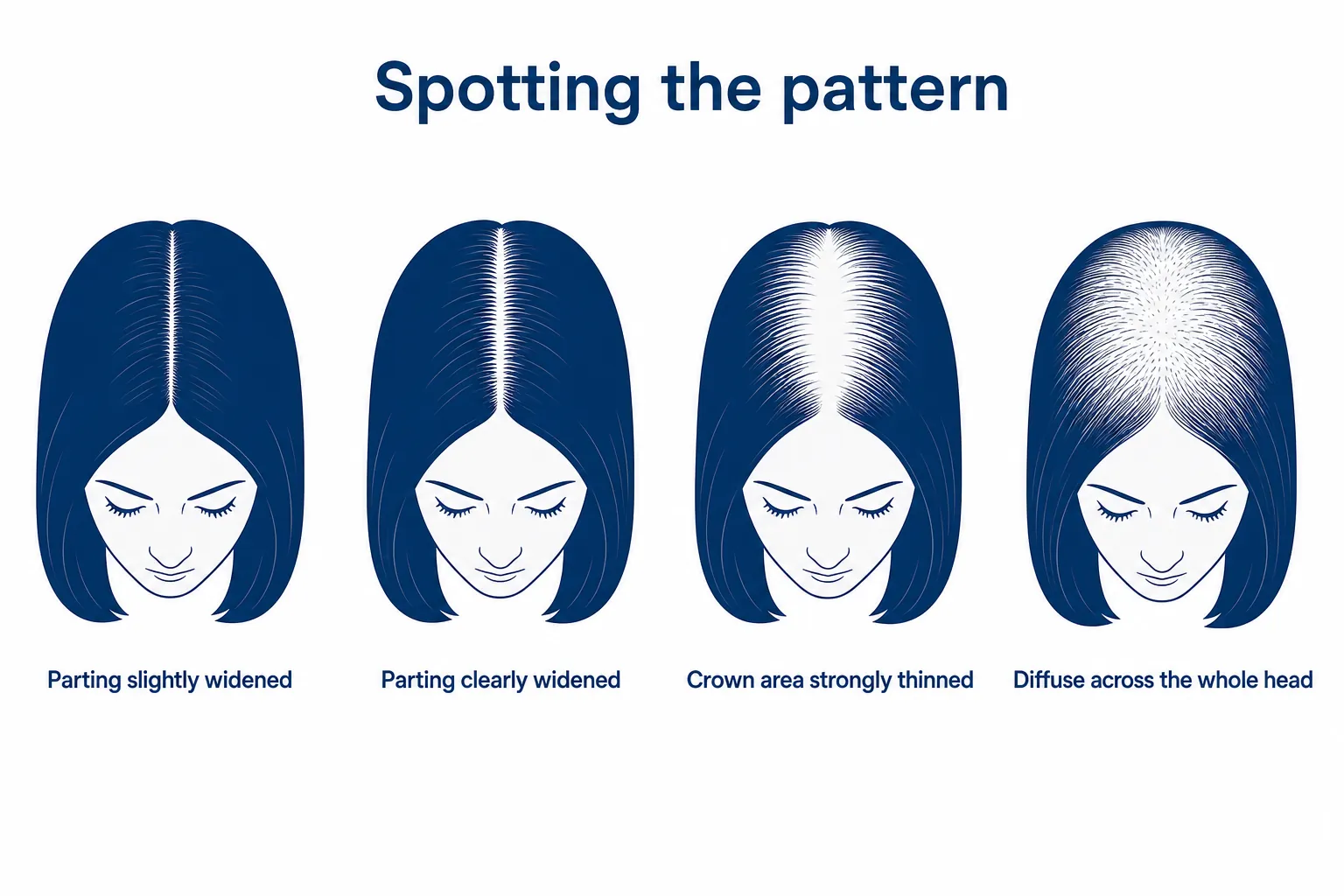
Even thinning across the whole head points more towards telogen effluvium, as it occurs after childbirth, a diet, an infection, or surgery, with iron deficiency or a thyroid disorder. Here the lever is the cause, not the shower shelf. More on that in the article on diffuse hair loss.
A centre parting that has been widening over years, by contrast, follows the Ludwig pattern of androgenetic alopecia, and in men the same principle shows up as a receding hairline. For this hormonal-genetic mechanism, no effect is documented for a cosmetic shampoo. Sharply defined, round bald patches are a condition of their own, alopecia areata, and need prompt dermatological assessment.
| What you observe | May point to | What a caffeine shampoo can realistically do here | A sensible next step |
|---|---|---|---|
| Even thinning across the whole head | Diffuse telogen effluvium after childbirth, a diet, an infection, or surgery, with iron deficiency or a thyroid disorder | Can support scalp feel and hair handling, does not act on the underlying cause | Have the cause clarified medically, including blood tests |
| A widening centre parting | Androgenetic thinning in the Ludwig pattern | No documented effect on the hormonal-genetic mechanism | Clarify the cause, have licensed medicines assessed |
| Receding hairline or thinning temples | Androgenetic pattern, more common in men | Cosmetic care, no documented mechanism against DHT-driven miniaturisation | Medical workup, have licensed medicines assessed |
| A sharply defined round bald patch | Alopecia areata, an autoimmune condition | No connection, a shampoo is not a relevant factor here | Have it assessed by a dermatologist promptly |
| Heavy shedding 2 to 4 months after childbirth, a diet, an infection, or surgery | Telogen effluvium as a delayed reaction of the hair cycle | Can accompany scalp care, does not remove the trigger | Name the trigger; if it persists, have blood tests and the cause checked |
| Shedding with an itchy, flaking scalp | Scalp irritation, seborrhoeic dermatitis, possibly a contact allergy | Can improve how the skin feels in cases of simple irritation, does not treat the cause of a condition | If it persists, see a dermatologist |
This overview is no substitute for a medical diagnosis. It is only meant to help you ask the right question.
A note about us
Before the question “which product” comes the question “which cause”. Elithair, the provider of this guide, offers a free hair analysis for exactly that. It is a first visual assessment based on your photos: it shows which distribution pattern is recognisable and which workup makes sense next. It is not a diagnosis, it does not identify a cause, and it replaces neither a dermatological examination nor a blood test at the doctor’s surgery.
Trying Plantur 21 yourself: a checklist for your own observation
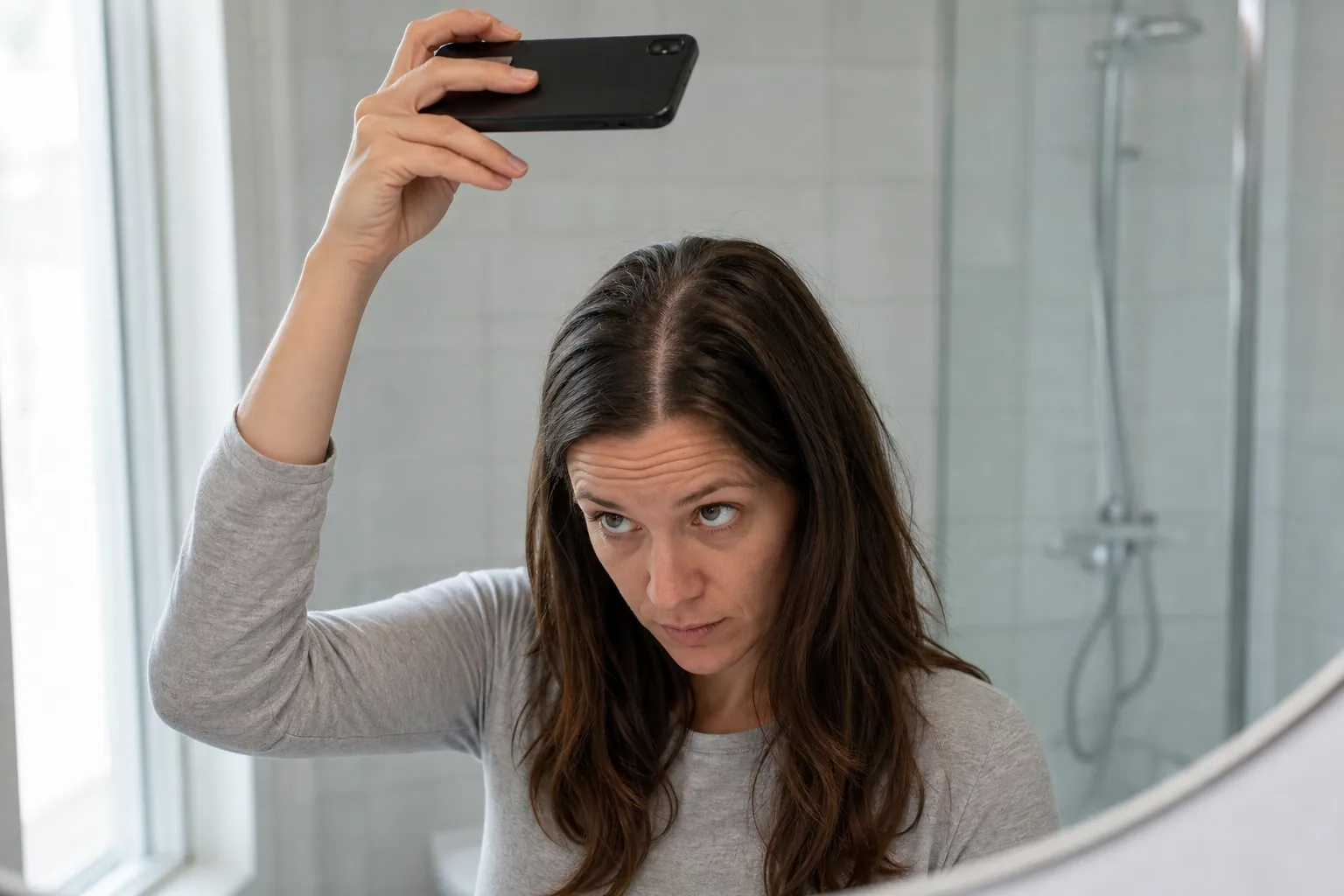
You can judge the care effect, meaning handling, lather, scalp feel, and greasy roots, after just a few washes. For everything that has to do with hair density, you need patience and constant conditions, sensibly about three months. Other people’s reports say little about your head; your own observation says a lot, provided you set it up cleanly. The reason for that time frame lies in the hair cycle: the resting phase lasts about 2 to 4 months, which is why changes only show up with a delay. One important point: an observation period is no reason to put off a workup. Anyone who is losing noticeably more hair has the cause checked medically in parallel.
Three months of clean observation
- ✓Take baseline photos: same place, same light, same parting, three angles (parting, crown, hairline)
- ✓Change only one product at a time, otherwise nothing can be attributed at the end
- ✓Keep the washing rhythm and the contact time constant through the whole phase
- ✓Always judge hair loss on the same day of the week and during the same activity, for example while combing
- ✓Note the accompanying factors: iron supplement, the pill newly started or stopped, a diet, a stressful phase, illness, the season
- ✓Repeat the photos after 6 weeks and after 12 weeks under identical conditions
- ✓Assess after about 3 months, photos against photos, not memory against gut feeling
- ✓Define stopping criteria: a persistent scalp reaction, new bald patches, or a sudden deterioration need a medical workup and are not something to wait out
What this list deliberately does not contain is a forecast. There is no reliable timetable for what you “will” see after three months of caffeine shampoo. The checklist makes your observation meaningful, it does not promise a result.
Alternatives to Plantur 21: what else is an option for hair loss
The sensible alternative to Plantur 21 depends on the cause, not on the shelf it sits on. Sorted by level of evidence, topical minoxidil comes first: it is the only topical medicine that the European S3 guideline (Kanti et al. 2018) credits with the highest level of evidence there is, for women and men in different formulations and concentrations, depending on the licensed product. In the UK all four Regaine products sit on the General Sales List, so they can be bought without a prescription in chemists, supermarkets, and online; that makes it easy to get hold of, though advice from a doctor or pharmacist is still worth having.
The other substances in the guideline are prescription-only and belong in a doctor’s hands; finasteride, for example, is for men only. If you would rather reach for something to take orally, you will find the data in the article on capsules for hair loss and in the review of experiences with Priorin, which digs into the same question of reliable evidence.
Internal medical causes are a chapter of their own. Iron deficiency or a disorder of the thyroid are not an “alternative to shampoo” but a reason to have blood tests done. Values, dosages, and self-medication do not belong in a product guide; they belong in the conversation with your doctor. Why women often have different causes than men is covered in the article on hair loss in women.
Is there a test from Stiftung Warentest or Öko-Test?
ÖKO-TEST, a German consumer magazine, examined shampoos marketed against hair loss and included Plantur 21 under its product name at the time. The publication is dated 20 October 2016 and was updated in the 2017 yearbook, so it is several years old and does not refer to today’s formula. The core finding of the overall test was that the benefit of the substances used is not scientifically documented. Stiftung Warentest, Germany’s largest consumer testing organisation, does not even include cosmetic specialty shampoos in its ratings because of the state of the evidence; its test of remedies for hair loss from 21 September 2023 covers only active substances such as minoxidil and finasteride, and Plantur does not appear in it.
And what about Elithair’s Dr. Balwi shampoo?
Transparency at this point: Elithair is a hair clinic and offers a product of its own, the Dr. Balwi shampoo. That is precisely why it is measured here by the same standard as Plantur 21. The formula is free of silicones, parabens, and sulfates and contains, among other things, Procapil (biotinoyl tripeptide, apigenin, oleanolic acid) as well as plant extracts such as aloe vera, nettle, saw palmetto, and green tea (Ingredients, Dr. Balwi shop).
And the evidence? The efficacy data on Procapil come from research by the ingredient manufacturer Sederma itself; an independent publication with a traceable primary source does not exist. That leaves Procapil in an even weaker position than caffeine: for topical caffeine there are at least nine clinical studies with 684 people, even if their reliability is mostly low, while for Procapil there is one piece of research by the ingredient manufacturer. In both cases the same applies: a manufacturer’s statement, not independent proof of efficacy for the finished product. Claiming anything else would be exactly the mistake this article criticises in others.
The comparison in one sentence
Plantur 21 and the Dr. Balwi shampoo are both cosmetic products, and for neither of them is there an independent clinical study on the finished product.
- •Plantur 21 rests on lab findings and penetration data for caffeine
- •The Dr. Balwi shampoo rests on research on Procapil by the ingredient manufacturer Sederma
- •Both are care, not a substitute for clarifying the cause
Conclusion: who Plantur 21 can make sense for
Plantur 21 is a decently formulated cosmetic product that the manufacturer positions today mainly for hair growth and length, while still advertising a decrease in hair loss alongside that. For thinning with a hormonal component, Dr. Wolff explicitly points to Plantur 39 instead.
It is worth trying for anyone who wants their hair to look cosmetically better, who values handling and scalp feel, and who is willing to observe carefully for about three months. Anyone who has been losing noticeably more hair for months, on the other hand, is probably better off putting the money for the next bottle into clarifying the cause before buying a third product. And anyone who sees sharply defined bald patches, a sudden deterioration, or an inflamed scalp takes that to a doctor and not to the next shampoo.
One distinction stays honest to the end: for caffeine at the isolated follicle there are lab findings, for uptake through the scalp there are measurements, and clinical studies in humans exist as well. The review by Szendzielorz and Spiewak (2025) counts nine of them with a combined 684 people, but rates their reliability as mostly low or very low and concludes that a satisfactory result is not assured. For Plantur 21 itself, none of these studies exists. That is not a verdict against the product. It is the state of knowledge, and when you are buying, that is worth more than any star rating.
Frequently asked questions about Plantur 21 reviews
Does Plantur 21 really work against hair loss?
For this product it is not documented. Clinical studies on topical caffeine do exist: a systematic review from 2025 included nine studies with 684 people, but rated the evidence as mostly low or very low, partly because of missing control groups and missing information on the caffeine concentration. None of these papers tests Plantur 21 itself. The manufacturer emphasises growth and length today, but still advertises a decrease in hair loss alongside that.
Is Plantur 21 a medicine or a cosmetic?
A cosmetic. In the UK, Plantur 21 falls under the UK Cosmetics Regulation, the version of Regulation (EC) 1223/2009 continued in domestic law by Schedule 34 to SI 2019/696; in Northern Ireland the EU version still applies. There is no premarket authorisation for cosmetics, but Article 20 requires every advertising claim to be backed by adequate and verifiable evidence. A medicines authorisation procedure with clinical studies is not required for a cosmetic.
What is the difference between Plantur 21 and Plantur 39?
The target group and the active system, not the strength. According to the manufacturer, Plantur 21 #langehaare is aimed at women who want to grow their hair and contains the Nutri-Coffein-Complex. Plantur 39 is intended for women from around 39 and for the menopause and contains the Phyto-Coffein-Complex. There is no comparative study between the two lines.
Is Plantur 21 also suitable for men?
Cosmetically yes, as proof of efficacy no. The manufacturer positions Plantur 21 for women; cosmetically there is nothing against men using it, but that does not amount to evidence of an effect on male hair loss. The caffeine study in 210 men (Dhurat et al. 2017) involved a solution, not a shampoo.
How long does Plantur 21 need to stay on, and is it rinsed out?
Leave it on for 2 minutes, then rinse it out. That is what the manufacturer specifies for the shampoo. The Nutri-Coffein-Elixir, by contrast, is applied to the scalp independently of washing and stays there. Otberg and Lademann (2010) detected caffeine in the follicles after a 2-minute contact time.
How long does a bottle of Plantur 21 last, and where can you buy it?
Around three to six weeks with daily washing. At 5 to 10 ml per wash, a 200 ml bottle covers 20 to 40 washes. In the UK, the line is stocked at Boots: the shampoo costs £11.99 for 200 ml, the conditioner £8.99 for 175 ml and the Longhair booster £10.99 for 125 ml (as of 09/2026). Beyond that, it is a German product and not part of the standard high street range. This yield figure is a rough calculation, not a manufacturer specification.
How long do you have to use Plantur 21 before you can judge anything?
A few washes are enough for the care effect. For everything that concerns hair density, about three months under constant conditions. The resting phase of the hair cycle lasts about 2 to 4 months, which is why changes only show up with a delay. Anyone judging after four weeks is mostly judging scent, lather, and how the hair feels.
Does Plantur 21 have side effects?
There are no reliable frequency data for this product. What gets reported are local reactions on the scalp, meaning itching, dryness, or flaking. The INCI list contains the fragrance allergen Linalool. If symptoms persist, stop using it and have it assessed by a dermatologist; a problem with a cosmetic product can be reported through Citizens Advice to Trading Standards.
Can Plantur 21 make hair loss worse?
A typical shedding reaction of the kind described for some active substances is not known for Plantur 21. That more hair stays in your hand in the first few weeks can have a mechanical explanation: washing daily and massaging for two minutes releases dead telogen hairs all at once. In an individual case that explanation is not certain, though, and irritation or a contact allergy, to the fragrance Linalool for instance, can cause symptoms as well. If the increase lasts for weeks, or if itching, redness, or burning come with it: stop using it and have it checked medically.
What happens if I stop using Plantur 21?
The cosmetic care effect on handling and scalp feel ends when you stop using it. A withdrawal reaction or rebound has not been described for Plantur 21; that means data on it are missing, not that it would be impossible for this product category. If noticeably more hair falls out after you stop, the cause needs a medical workup.
Do the micronutrients it contains achieve anything via the scalp?
There is no evidence for that. According to the manufacturer, the Nutri-Coffein-Complex contains biotin, niacinamide, calcium, and magnesium among other things. A nutrient deficiency is corrected through diet or, after a medical workup, through supplementation, not through a shampoo. For oral biotin, the placebo-controlled evidence found no difference from placebo.
How do I tell whether my hair loss can respond to a shampoo at all?
By the distribution pattern. Even thinning points more towards telogen effluvium with a correctable cause, a widening centre parting more towards an androgenetic pattern, and a sharply defined bald patch towards alopecia areata. Scalp care can fit alongside all three, but it treats the cause in none of them. What differs is the expectation: with telogen effluvium the solution lies in the correctable cause, with the other two patterns in a medical workup and a treatment decision.
Sources
- Fischer TW, Hipler UC, Elsner P. Effect of caffeine and testosterone on the proliferation of human hair follicles in vitro. Int J Dermatol. 2007. PubMed 17214716
- Fischer TW et al. Differential effects of caffeine on hair shaft elongation in male and female human hair follicles in vitro. Br J Dermatol. 2014. DOI 10.1111/bjd.13114
- Otberg N et al. The role of hair follicles in the percutaneous absorption of caffeine. Br J Clin Pharmacol. 2007/2008. PubMed 18070215
- Otberg N, Lademann J et al. Analysis of the penetration of a caffeine containing shampoo into the hair follicles by in vivo laser scanning microscopy. Laser Physics. 2010. Springer
- Szendzielorz E, Spiewak R. Caffeine as an Active Ingredient in Cosmetic Preparations Against Hair Loss: A Systematic Review of Available Clinical Evidence. Healthcare (Basel). 2025;13(4):395. PubMed 39997270
- Dhurat R et al. An Open-Label Randomized Multicenter Study Assessing the Noninferiority of a Caffeine-Based Topical Liquid 0.2% versus Minoxidil 5% Solution in Male Androgenetic Alopecia. Skin Pharmacol Physiol. 2018;30(6):298-305. Karger
- Dressler C, Blumeyer A, Rosumeck S, Arayesh S, Nast A. Wirksamkeit von topischem Koffein bei androgenetischer Alopezie des Mannes [Efficacy of topical caffeine in male androgenetic alopecia, in German]. JDDG. 2017. DOI 10.1111/ddg.13271_g
- Kanti V, Messenger A, Dobos G et al. Evidence-based (S3) guideline for the treatment of androgenetic alopecia in women and in men, short version. J Eur Acad Dermatol Venereol. 2018;32(1):11-22. DOI 10.1111/jdv.14624
- UK Cosmetics Regulation: Regulation (EC) 1223/2009 as continued in domestic law by Schedule 34 to SI 2019/696. On the evidence required for advertising claims and on the order of the ingredient list. legislation.gov.uk
- Reporting a problem with a cosmetic product: Citizens Advice and Trading Standards, overseen by the OPSS. gov.uk
- Product and manufacturer information: plantur.com, the manufacturer’s German site and boots.com, the UK retailer, retrieved 10 and 17 September 2026; INCI cross-check via hautschutzengel.de, a German ingredient database. The caffeine evidence was also placed in context using medizin-transparent.at, a German-language evidence review.
Product information as of 09/2026. This article is for informational purposes and replaces neither a medical diagnosis nor medical treatment. If your hair loss persists or suddenly increases, please see a doctor.

Dr. Imad Moustafa
Hair transplant specialist