

In short: iron deficiency and hair loss
Yes, iron deficiency is one of the most common and most often missed causes of diffuse hair loss (telogen effluvium), especially in women of childbearing age. What matters is the ferritin value, which reflects your iron stores, not haemoglobin on its own. Hair can thin long before a blood count looks abnormal.
- ✓Iron deficiency often triggers diffuse hair loss
- ✓Ferritin (your stores) is the key value, not just haemoglobin
- ✓Shedding stops after 3 to 6 months, full density after 12 to 18 months
Once your stores are topped back up, hair usually grows back. Because of the hair cycle, it typically takes 3 to 6 months for the shedding to ease off, and 12 to 18 months for visible density. One important caveat: a receding hairline or a thinning crown points to genetic (androgenetic) hair loss, and that does not respond to iron.
Summary
- How iron deficiency triggers hair loss
- The key value in iron deficiency: ferritin
- Symptoms: spotting iron deficiency
- Who is particularly affected by iron deficiency and hair loss
- Diagnosis: which blood values for iron deficiency and hair loss
- Treatment: diet, tablets and iron infusion
- When does hair grow back after iron deficiency?
- Diffuse or genetic? Why iron does not fix every hair loss
- Frequently asked questions about iron deficiency and hair loss
- Scientific sources
How iron deficiency triggers hair loss
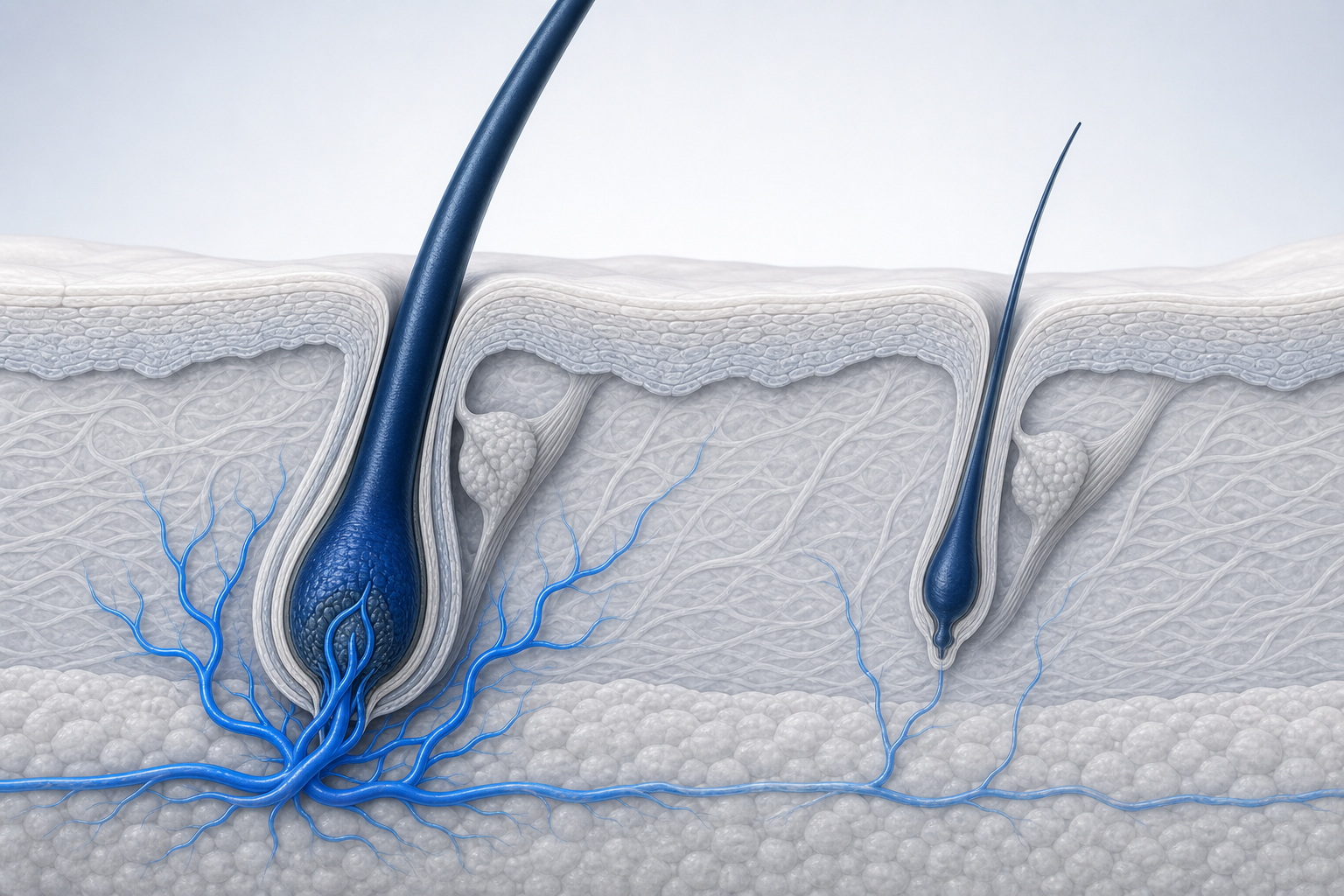
Iron deficiency triggers diffuse hair loss by slowing down the rapidly dividing hair matrix cells and pushing follicles prematurely into the resting phase (telogen). The result is called telogen effluvium. The cells in the hair matrix are among the fastest-dividing cells in the body, and that is exactly what makes them vulnerable.
The biochemical lever is ribonucleotide reductase, the rate-limiting enzyme of DNA synthesis. This enzyme needs iron as a cofactor. When available iron drops, its activity drops too, the matrix cells stop dividing fast enough, and the follicle switches into the telogen phase earlier than normal (Guo and Katta, “Diet and hair loss”, 2017).
In healthy hair, around 85 per cent of scalp hairs are in the anagen phase (growth) and about 10 to 15 per cent in the telogen phase (rest). Anagen lasts several years, the hair grows roughly 0.3 to 0.5 mm per day, and telogen lasts 2 to 4 months. In telogen effluvium this ratio tips over: with a strong trigger, up to 70 per cent of anagen hairs move prematurely into the resting phase.
The delay is typical. There are usually around 3 months (range 1 to 6 months) between the trigger and the visible shedding, because the affected hairs first have to run through the telogen phase before they fall out. The shedding is diffuse across the whole scalp, with no bald patches, and you often notice it when washing or brushing. After treatment it is reversible (telogen effluvium review, PMC4606321). You can read more about the phases in our article on the hair cycle.
The key value in iron deficiency: ferritin
When iron-related hair loss is suspected, ferritin is the central lab value. It reflects your iron stores and can be low long before haemoglobin and the blood count look abnormal. That is exactly the trap: a normal haemoglobin does not rule out iron deficiency. Anyone who only looks at the full blood count misses the early shortfall.
Anaemia or empty stores? The three-stage model
Iron deficiency develops in stages, and hair loss can appear right at the start. In the first stage the store is empty but the blood still looks normal. Only in the third stage does haemoglobin fall. This sequence explains why many people thin out despite “normal” blood values.
| Stage | What happens | Lab |
|---|---|---|
| 1. Storage iron deficiency (latent) | Iron stores empty, supply still sufficient | Ferritin low, Hb normal |
| 2. Iron-deficient erythropoiesis | Supply no longer covers blood formation | Transferrin saturation below 15 %, Hb still normal |
| 3. Iron-deficiency anaemia | Anaemia, now visible in the blood count too | Hb below normal (women under 12 g/dl, men under 13 g/dl) |
Hair loss can begin as early as stage 1 or 2, so before any anaemia is present. The WHO and the Onkopedia guideline from the medical societies describe these stages clearly. For the hair, the storage value is therefore more relevant than haemoglobin alone.
Which ferritin value counts as iron deficiency?
The established framework comes from the WHO (2020): in healthy, menstruating women without inflammation, a ferritin below 15 µg/l counts as iron deficiency. In clinical practice a deficiency is often assumed from below 30 µg/l, because that captures the majority of affected people better. The exact threshold depends on the lab and the guideline.
Strictly separate from this are the trichological target values that some hair specialists quote. Part of the hair-medicine literature would aim for ferritin levels in the region of roughly 40 to 70 µg/l for the hair, and Rushton (2002) proposed a value from 70 µg/l for women with hair loss. These targets are the recommendations of individual authors and are not backed by randomised trials. You should treat them as a rough guide, not a fixed limit.
Honesty is required here. Trost, Bergfeld and Calogeras stated explicitly in a widely cited 2006 review that there was “insufficient evidence” to recommend iron supplementation for women with hair loss and iron deficiency without anaemia. They coined the term non-anaemic iron deficiency, but considered the data too thin for general screening. Bregy and Trüeb even found no correlation in 2008 between ferritin (above 10 µg/l) and the telogen rate, and Blume-Peytavi and colleagues (2010) found iron deficiency no more common in 381 women with hair loss than in the control group.
So the honest reading is this: low ferritin and hair loss are consistently associated, but a causal effect of higher ferritin targets has not been proven by randomised trials. St. Pierre and colleagues (2010), who studied iron-dependent genes in the follicular bulge region, also criticised the weak evidence base and named no fixed threshold themselves. The association data from Kantor and colleagues (2003) are interesting: mean ferritin was 59.5 ng/ml in controls, 37.3 ng/ml in androgenetic alopecia, and 24.9 ng/ml in alopecia areata. That shows a link, but it does not prove a simple cause.
Putting ferritin values in context (rough guide table)
The table below is a rough guide, not a diagnosis and not a substitute for a medical assessment. It helps you make sense of a lab report and ask the right questions at your appointment. Note the inflammation point directly underneath.
| Ferritin range | Possible meaning (rough guide, not a diagnosis) | Possible action |
|---|---|---|
| below 15 µg/l | would point to iron deficiency according to the WHO (without inflammation) | get it checked medically, look for the cause |
| 15 to 30 µg/l | could indicate depleted stores, often already treated as a deficiency in practice | discuss with your doctor, consider a recheck or supplementation |
| 30 to 70 µg/l | guideline grey area. Part of the trichological literature would see values here as possibly too low for the hair, but this is not scientifically established | with diffuse hair loss, discuss with your doctor; the evidence for “topping up to 70” is weak |
| over 70 to 100 µg/l | stores usually well filled | iron as a cause is rather unlikely, check other causes |
| strongly raised | could indicate inflammation (acute phase) or iron overload | get it checked medically (CRP, transferrin saturation if needed) |
Important note on the table: ferritin is an acute-phase protein. Inflammation or infection raises the value (via IL-6 and hepcidin) and can mask a genuine deficiency. So a seemingly “normal” ferritin does not reliably rule out a deficiency. The WHO recommends measuring ferritin together with CRP. Never take iron without a proven deficiency and medical supervision. The tolerable upper limit (UL, USA) is 45 mg of elemental iron per day, and in genetic iron overload (haemochromatosis) unnecessary iron would be harmful.
Symptoms: spotting iron deficiency
Alongside diffuse hair loss, iron deficiency typically shows up as tiredness, pallor, brittle nails, feeling cold and trouble concentrating. Single signs are non-specific. But when several apply and diffuse hair loss is added to the mix, it is worth looking at ferritin and the blood count.

The NHS lists fatigue and exhaustion, pale skin, shortness of breath on exertion, a pounding heart, plus headaches and trouble concentrating as common symptoms. Less common but directly documented signs include increased hair shedding when brushing or washing, spoon-shaped nails (koilonychia), painful cracks at the corners of the mouth and restless legs syndrome. Feeling cold is also mentioned in the specialist literature.
Iron deficiency symptom check
- ☐ persistent tiredness, exhaustion, low energy
- ☐ pale skin or pale mucous membranes
- ☐ shortness of breath on exertion, a pounding heart
- ☐ headaches, trouble concentrating and performing
- ☐ more hair in the brush and the plughole, diffuse thinning
- ☐ brittle nails or spoon-shaped nails (koilonychia)
- ☐ cracked corners of the mouth
- ☐ restless legs, feeling cold
Do several points apply and are you shedding diffusely? Have your ferritin and blood count checked by a doctor.
Who is particularly affected by iron deficiency and hair loss
The most commonly affected are menstruating women, women in perimenopause, pregnant and breastfeeding women, people on vegetarian or vegan diets, endurance athletes, and anyone with blood loss or bowel disease. The common denominator is a mismatch between iron demand and iron intake.
Women with heavy or long periods lose iron regularly. Each cycle loses several milligrams of iron depending on the amount of blood, and with menorrhagia (over 80 ml per cycle or longer than 7 days) correspondingly more. The DGE reference values (2024) reflect this demand: premenopausal women 16 mg per day, men 11 mg, pregnant women 27 mg (the highest value), breastfeeding women 16 mg, postmenopausal women 14 mg.
Perimenopause is a double risk. First, irregular and sometimes heavier bleeding can lead to iron deficiency. Second, falling oestrogen and progesterone shorten the anagen phase, which causes diffuse thinning around the crown. Both mechanisms can overlap. There is more on this in our article hair loss in women.
Here is a surprising detail: after the menopause, oestrogen drops sharply, but ferritin usually rises by two to threefold, because the monthly blood loss disappears (study on the postmenopausal ferritin rise, PMID 19527179). Iron-deficiency hair loss is therefore more of an issue for perimenopausal women who are still menstruating. After menopause, by contrast, the androgenetic, i.e. DHT-driven, component dominates.
Vegetarians and vegans mainly take in non-haem iron, which is absorbed far less well (2 to 20 per cent versus 15 to 35 per cent for haem iron). The DGE classifies iron in a vegan diet as a potentially critical nutrient. According to data from the German National Nutrition Survey II, 58 per cent of women fall short of the recommended intake, and among vegan women under 50, around 17 per cent have empty iron stores.
Other risk groups: endurance athletes lose iron through sweat, micro-injuries in the gut and so-called footstrike haemolysis when running. After surgery, major blood loss or a blood donation (about 250 mg of iron per 500 ml), the stores drop. And in gastrointestinal disease, absorption is impaired: coeliac disease damages the small intestine at the site of absorption, Crohn’s disease shrinks the absorptive surface and causes blood loss, and a gastric bypass bypasses the duodenum as the main site of absorption.
Diagnosis: which blood values for iron deficiency and hair loss
Four values belong to the work-up of iron deficiency and hair loss: ferritin (storage iron), the full blood count with haemoglobin, transferrin saturation, and CRP as a confounder. Ferritin alone can be distorted by inflammation, so CRP always belongs with it.
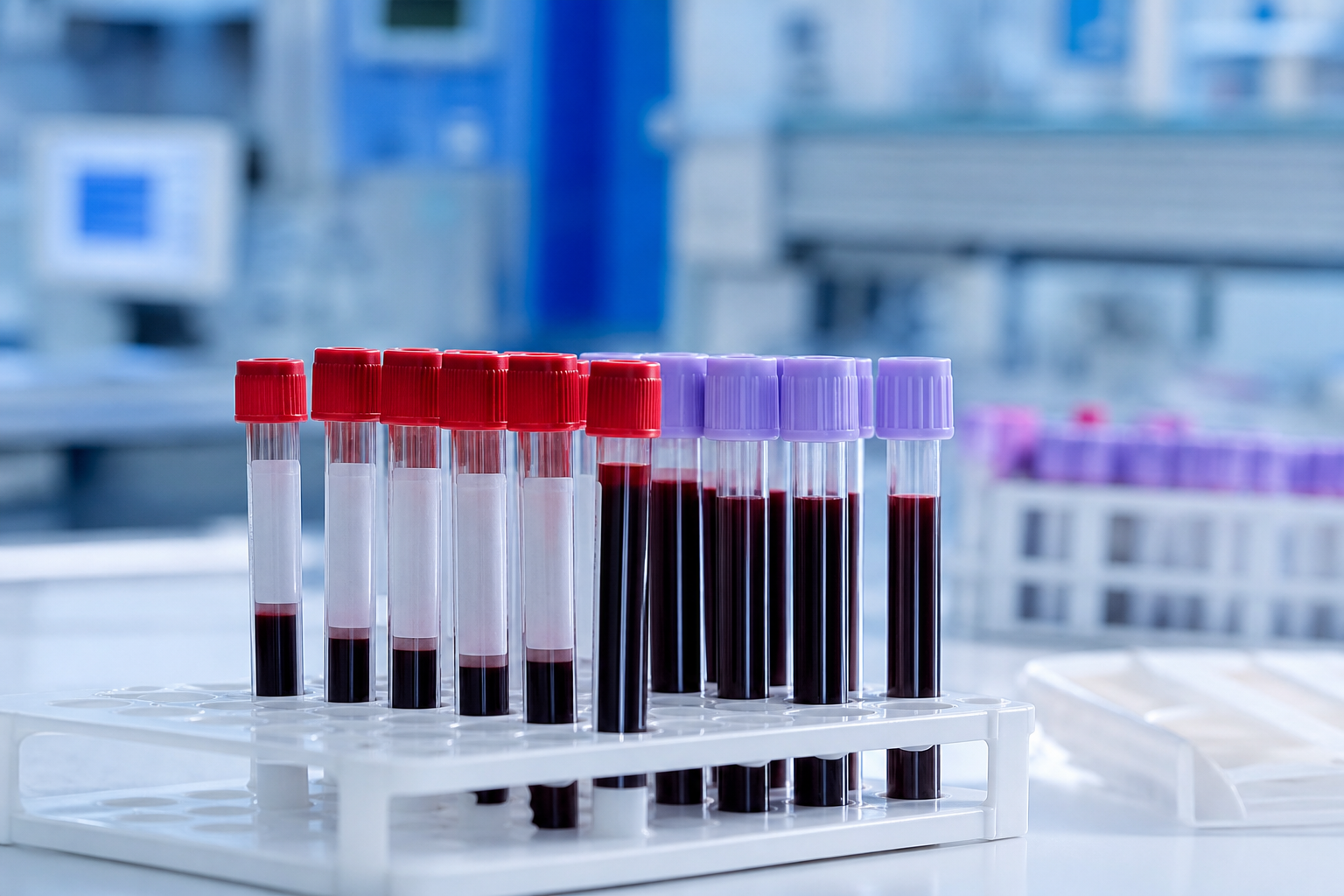
Ferritin is normally roughly 15 to 200 µg/l (men) and 15 to 150 µg/l (women). It is the central storage marker and reacts earliest. Haemoglobin only becomes abnormal at the anaemia stage (women under 12 g/dl, men under 13 g/dl), so on its own it is not enough, as the three-stage model shows.
Transferrin saturation (normally about 16 to 45 per cent, deficiency below 15 to 20 per cent) is the best functional marker and is less sensitive to the acute-phase reaction than ferritin. CRP matters so much because inflammation artificially raises ferritin and can mask a deficiency. Ideally, have ferritin measured well away from any infection. The AWMF S1 guideline on iron-deficiency anaemia (register 025/021, version 2021) states explicitly that serum ferritin is raised in liver disease or systemic inflammation and is then not a reliable parameter.
For the initial diagnosis, your GP or a physician is the right contact; for the differential diagnosis of hair loss, a dermatologist. We have summarised the wider picture of testing in our article on the causes of hair loss.
Treatment: diet, tablets and iron infusion
Diet: haem iron, non-haem iron and the right combinations
Haem iron from animal sources is absorbed far better than plant-based non-haem iron. Vitamin C boosts absorption, while coffee, tea and calcium slow it down. Haem iron is absorbed at about 15 to 35 per cent and is largely unaffected by inhibitors. Non-haem iron only reaches 2 to 9 per cent depending on the food and is strongly inhibited by phytates and polyphenols (iron absorption review, PMC9219084).
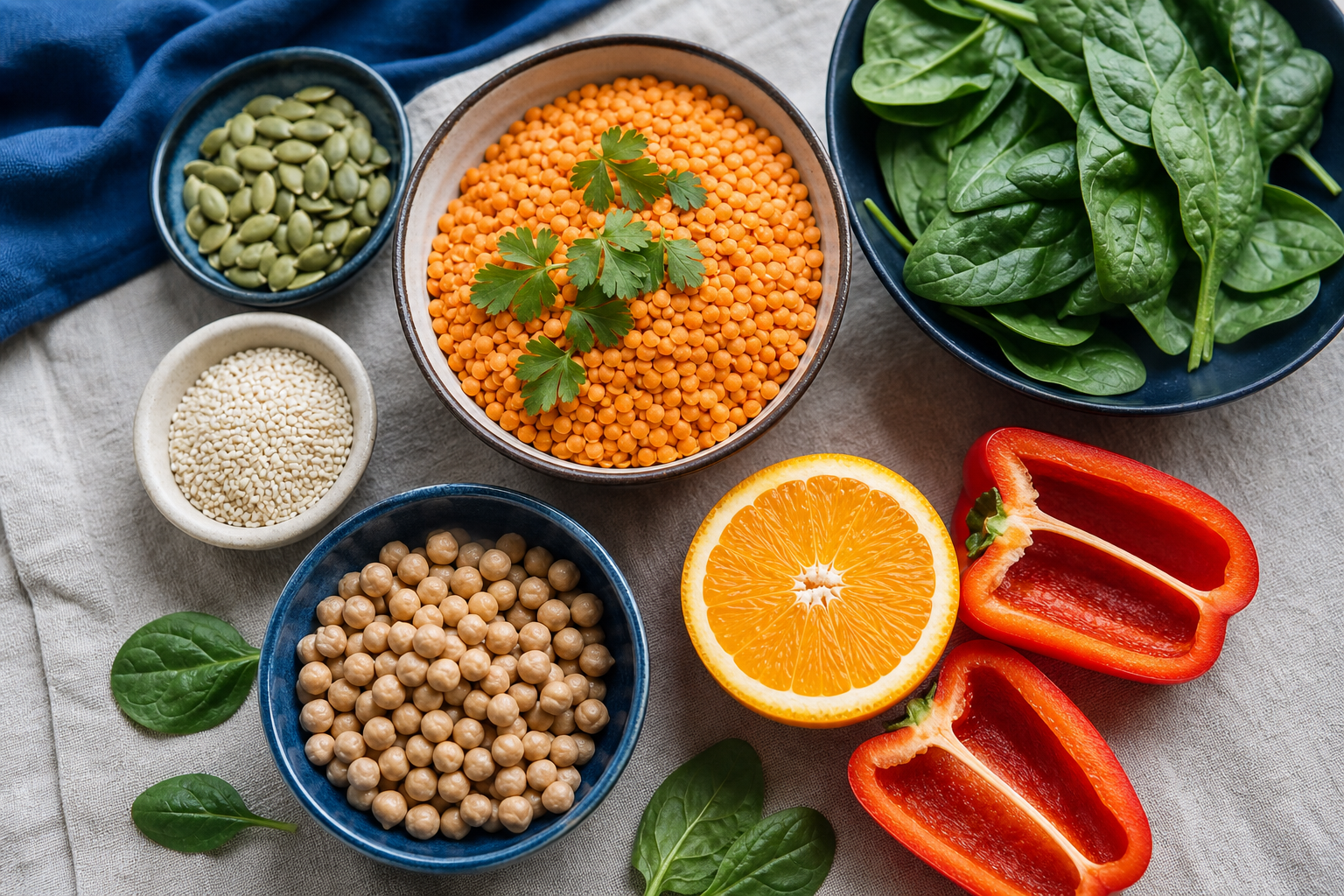
Vitamin C is the most effective lever on the plate. It reduces ferric to ferrous iron and forms soluble compounds. In studies, absorption rose from 0.8 to 7.1 per cent when the vitamin C amount was increased from 25 to 1,000 mg, so by roughly 1.65 to 9.57 times. What matters in practice is around 50 mg of vitamin C per meal, for example from peppers, lemon or orange juice.
The counterparts are well documented: phytates lower absorption by 18 to 82 per cent, tea polyphenols by 56 to 72 per cent (green tea sometimes over 85 per cent), calcium by 18 to 27 per cent. The DGE advises not drinking coffee and tea directly with iron-rich meals, but with a gap of about 2 hours. That is exactly what the building-block table below is for.
Boosting or slowing iron absorption
✓Boost absorption
Vitamin C with the iron-rich meal
- •Peppers
- •Orange juice
- •Lemon
✗Slow absorption
Leave about 2 hours from the meal
- •Coffee
- •Black and green tea
- •Milk and calcium
Iron meal builder: what to combine, what to keep apart
| Iron source | + Vitamin C booster (with it) | − Blocker (about 2 h apart) |
|---|---|---|
| Lentils, beans, chickpeas | Peppers, lemon juice, parsley | Coffee, black and green tea |
| Porridge oats | Fresh berries, orange juice | Milk and calcium (muesli with milk slows it) |
| Spinach, kale | Lemon over the vegetables, peppers | Coffee or tea straight after |
| Red meat (haem iron) | as haem, barely inhibited | space out calcium supplements |
| Tofu, tempeh | add vitamin-C-rich vegetables | Black tea with the meal |
| Pumpkin seeds, sesame | add fruit as a snack | Milky coffee straight after |
The table below shows iron-rich foods by iron content. One important note first: the values for pulses refer to the dried, raw state. Cooked, they are much lower, because the pulses take up water. The mg values come from the German food database (Bundeslebensmittelschlüssel, BLS).
| Food | Iron mg/100 g | Type |
|---|---|---|
| Pig’s liver | 17.2 | Haem |
| Sesame | 11.0 | Non-haem |
| Lentils (dried) | 8.0 | Non-haem |
| Chickpeas (dried) | 7.0 | Non-haem |
| Kidney beans (dried) | 7.0 | Non-haem |
| Beef liver | 6.9 | Haem |
| White beans (dried) | 6.1 | Non-haem |
| Pumpkin seeds | 5.1 | Non-haem |
| Tempeh | 5.0 | Non-haem |
| Porridge oats | 4.4 | Non-haem |
| Mussels | 4.2 | Haem |
| Spinach | 3.4 | Non-haem |
| Oysters | 3.1 | Haem |
| Tofu | 2.8 | Non-haem |
| Wholemeal bread | 2.7 | Non-haem |
| Beef | 2.3 | Haem |
| Kale | 1.9 | Non-haem |
Oral iron supplements: which ones and how to take them
Iron tablets are the standard therapy for a proven deficiency. Preparations with iron bisglycinate are often well tolerated, and taking them every other day improves total absorption. Iron sulphate is considered the gold standard (10 to 15 per cent bioavailability) but more often causes gastrointestinal complaints. Gluconate and fumarate work comparably.
Iron bisglycinate is at least twice as available and better tolerated. In a study by Milman and Bergholt (2024), bisglycinate caused fewer gastrointestinal complaints (16.5 versus 20.1 per cent) and far less black stool (8.1 versus 30.9 per cent), at half the elemental iron dose. Incidentally, ferrous iron is absorbed 3 to 4 times better than ferric iron.
The every-other-day schedule sounds illogical but is well documented. An iron dose from about 60 mg raises the hormone hepcidin for up to 24 hours, which blocks absorption of the next dose. Stoffel and colleagues showed in 2017 in The Lancet Haematology that alternating dosing improves both total absorption (175.3 versus 131.0 mg) and fractional absorption (21.8 versus 16.3 per cent). Usual doses are 50 to 200 mg of elemental iron per dosing day over 3 to 12 weeks, under medical guidance. Modern schedules often go for every other day, because that improves total absorption.
On how to take it: on an empty stomach, about 30 to 60 minutes before eating and with vitamin C, absorption is best. If you cannot tolerate that, you may take it with a meal instead. Gastrointestinal complaints are the most common side effect; black stool (iron sulphide) is harmless. Supplementation belongs only after a lab-proven deficiency and with medical supervision, otherwise there is a risk of unnecessary iron overload, for which documented case reports exist. There is more on supplements in our article on the vitamins for hair loss.
A common misconception: biotin or zinc do not help if iron deficiency is the sole cause of the hair loss. In that case, fill up the iron store first instead of blindly taking multivitamins.
Iron infusion: faster than tablets?
An iron infusion fills the iron stores faster than tablets, so in weeks rather than months. The hair cycle still runs at its own pace, though, and a direct hair-growth benefit of the infusion is barely backed by studies. On speed, the infusion is clearly superior: 42 days after the start of therapy, transferrin saturation had normalised in 76.9 per cent (intravenous) versus 24.1 per cent (oral).
But a faster-filled store does not mean faster-filled hair. The shedding only stops with a delay, and the visible regrowth follows even later, because the biology of the hair cycle cannot be sped up. You will find the exact timeline in the table further down. An infusion is therefore reserved for certain situations: intolerance of tablets, absorption disorders (coeliac disease, Crohn’s disease), ongoing blood loss, urgent surgery, or inflammation-driven raised hepcidin.
On the risks: severe allergic reactions are rare. The frequency of anaphylaxis is roughly 21 per 100,000 (iron sucrose), with modern preparations coming in under 1 per 250,000. On the topic of “iron infusion for hair loss”, the evidence is thin: a small, retrospective study in JAAD (2024) reported improvement or stabilisation in 64.7 per cent of patients with non-scarring alopecia, but there is no randomised trial with hair growth as the primary endpoint. An infusion “on request” without a medical indication makes no sense.
When does hair grow back after iron deficiency?
After the iron stores are topped back up, the hair cycle means it typically takes 3 to 6 months for the shedding to stop, and 12 to 18 months for full, visible density. The reason is the telogen phase: the hairs already stuck in the resting phase still fall out before new ones grow in. Patience here is not a consolation, it is biology.
Important: keep washing and brushing your hair as normal. The hairs falling out now have already been detached in the resting phase (telogen) for months; normal washing speeds up nothing.
| Phase | What happens |
|---|---|
| Month 1 to 2 | Ferritin and iron stores rise under therapy. The shedding often still continues (delayed effect). |
| Month 3 to 4 | The telogen shedding eases off. Follicles re-enter the anagen (growth) phase. |
| Month 5 to 6 | The shedding largely stops. The first new, short hairs (baby hair) appear. |
| Month 6 to 12 | New hair grows back visibly (about 1 cm per month). |
| Month 12 to 18 | Cosmetically relevant, full density is reached. |
This schedule is a rough guide, not a guarantee. It is derived from the biology of the hair cycle and the telogen effluvium literature. The exact course depends on your starting ferritin, the severity of the deficiency and the chosen therapy, and it is individual. Acute telogen effluvium is usually self-limiting (under 6 months); a chronic course drags on longer.
Diffuse or genetic? Why iron does not fix every hair loss
Iron deficiency causes diffuse hair loss across the whole head (telogen effluvium). A receding hairline or a thinning crown, on the other hand, points to genetic (androgenetic) hair loss, and only that responds to hair growth medicines or a hair transplant. The two forms often occur at the same time, which makes things confusing.
The difference can be narrowed down clinically. In telogen effluvium the hair falls out diffusely and without a pattern, often acutely and self-limiting. In androgenetic alopecia (AGA) a typical pattern develops, with a receding hairline or a thinning crown, and the hairs miniaturise, so they become thinner and shorter. The wash test by Rebora and colleagues (2005) helps: if at least 10 per cent of the shed hairs are under 3 cm long, that points to miniaturisation and therefore AGA. More than 100 hairs per standardised wash points to a chronic effluvium.
An important consequence follows from this: iron does nothing for androgenetic hair loss. If there is no deficiency, giving iron in AGA is ineffective. It only makes sense as a correction of an accompanying deficiency, on top of standard therapy. Lin and colleagues (2023) recommend correcting a ferritin below 30 to 40 ng/ml and then treating the AGA itself. Iron is no substitute for minoxidil and no substitute for finasteride. Incidentally, there is no standalone German guideline on AGA; the authority is the European S3 guideline (Kanti and colleagues, 2018). There is background on pattern recognition in our article on androgenetic alopecia and on the causes of hair loss.
This is exactly where a hair analysis comes in. Since diffuse, iron-related hair loss is not suitable for a hair transplant, and only the androgenetic pattern with stable donor hair responds to one, you should clarify which type you actually have before any treatment. Elithair’s free hair analysis is a visual pattern analysis: it helps to tell the genetic type from the diffuse type. It is not a substitute for a medical iron or blood test, though. If you suspect a deficiency, always have ferritin and a blood count checked by a doctor.
Frequently asked questions about iron deficiency and hair loss
What ferritin value does the hair need?
There is no fixed guaranteed value. Guidelines often define iron deficiency from below 15 µg/l (WHO) or below 30 µg/l in practice. Part of the trichological literature would name targets of 40 to 70 µg/l for the hair (Rushton 2002: from 70), but that is not backed by randomised trials and is disputed (counter-position Bregy and Trüeb 2008). Have your ferritin measured and discuss the value with your doctor.
Does hair grow back after iron deficiency?
Yes. The telogen effluvium caused by iron deficiency is reversible. The best prognosis comes with an early start to therapy. Full density is often reached after 9 to 18 months. Importantly, any accompanying androgenetic hair loss must be treated separately, because that does not improve with iron.
How long until something changes after iron deficiency?
The shedding stops after about 3 to 6 months; it usually only becomes cosmetically visible after 12 to 18 months. An acute telogen effluvium is self-limiting (under 6 months), a chronic one takes longer. In the first weeks the shedding can still continue despite therapy, and that is normal.
Iron tablets for hair loss: which ones and how to take them?
Iron bisglycinate is often better tolerated than iron sulphate. Best is to take it on an empty stomach with vitamin C, and every other day improves absorption (Lancet Haematology 2017). Take iron only with a proven deficiency and under medical guidance, never on suspicion.
Can iron deficiency without anaemia (normal Hb) cause hair loss?
Yes, that is documented. Low ferritin values with normal haemoglobin are common, which is what the concept of non-anaemic iron deficiency is for (Rushton 2002). Treister-Goltzman and colleagues (2022) found low ferritin values despite normal Hb in around 21 per cent. So the full blood count alone is not enough for a work-up.
Iron infusion or tablets?
The infusion fills the stores faster but is reserved for severe cases or an intolerance of tablets. The hair cycle stays at 3 to 6 months, and no randomised trial shows a hair-growth advantage of the infusion over tablets. For most people, tablets are the first choice.
Iron deficiency and hair loss during the menopause?
In perimenopause two things can overlap: iron deficiency from fluctuating, sometimes heavier bleeding, and a hormonally shortened anagen phase. After menopause, ferritin usually rises again, because the monthly blood loss disappears. The androgenetic component then tends to dominate, not iron deficiency.
Iron deficiency and hair loss despite tablets, why?
Usually it comes down to absorption or the diagnosis. Possible reasons are too short a course, inhibited absorption (coffee or tea with the tablet), the wrong iron compound, or a different cause. Often there is also a simultaneous androgenetic hair loss behind it, which does not respond to iron. Have your ferritin rechecked after a few weeks and the diagnosis reviewed.
Scientific sources
- Trost LB, Bergfeld WF, Calogeras E (2006): The diagnosis and treatment of iron deficiency and its potential relationship to hair loss. J Am Acad Dermatol. PubMed
- Rushton DH (2002): Nutritional factors and hair loss. Clin Exp Dermatol. Wiley Online Library
- Bregy A, Trüeb RM (2008): No association between serum ferritin levels > 10 µg/l and hair loss activity in women. Dermatology. Karger
- WHO (2020): Serum ferritin concentrations for the assessment of iron status. WHO Guideline (NIH Bookshelf)
- Stoffel NU et al. (2017): Iron absorption from oral iron supplements given on consecutive versus alternate days. The Lancet Haematology. The Lancet Haematology
- St. Pierre SA et al. (2010): Iron deficiency and diffuse nonscarring scalp alopecia in women. J Am Acad Dermatol. PubMed
- Kantor J et al. (2003): Decreased serum ferritin is associated with alopecia in women. J Invest Dermatol. PubMed
- AWMF S1 guideline on iron-deficiency anaemia (025/021, 2021). AWMF Register
- DGE: Reference values for iron intake (2024). German Nutrition Society
This article is for general information and does not replace medical advice or diagnosis.
Dr. Imad Moustafa
Hair transplant specialist