

The key points at a glance
Hormones and hair are closely linked. The hair cycle is co-regulated by androgens (testosterone and DHT), oestrogen, progesterone, thyroid hormones and cortisol (review PMC10968111, 2024). Behind the term hormonal hair loss lie two very different mechanisms.
- Androgenetic alopecia (permanent): a genetically determined sensitivity of the follicles to DHT, patterned and progressive. It is the most common form, affecting up to 80% of men and around 40% of women in later life (endokrinologen.de), and it often starts in early adulthood.
- Diffuse telogen effluvium (usually reversible): hormonal shifts such as pregnancy, the menopause, coming off the pill or stress push many follicles into the resting phase at the same time. Once things settle down, hair usually recovers within 6 to 12 months.
- The trigger is not your testosterone level: what matters is the inherited sensitivity of the follicles to DHT, not the amount of hormone circulating in your blood.
Straight to the practical part: which doctor to see and which blood tests to ask for, including cycle-day timing.
Summary
- What is hormonal hair loss?
- DHT and androgenetic alopecia: the most common hormonal cause
- Testosterone and hair loss: the big misconception
- Oestrogen: the hair-protecting hormone
- Progesterone and your hair
- Pregnancy and postpartum hair loss
- Perimenopause and the menopause
- Your cycle, the pill and hormonal contraception
- Cortisol and stress-related hair loss
- Thyroid hormones and hair
- Reversible or permanent? The difference that matters
- Treatment: it depends on the cause
- How long does it take for hair to grow back?
- Which doctor, and which tests?
- Frequently asked questions about hormones and hair
What is hormonal hair loss?
Hormonal hair loss is hair loss triggered either by a change in hormone levels (a rise, a drop or a shift) or by an increased sensitivity of the hair follicles to particular hormones. The term covers two mechanistically very different forms, and telling them apart is the key to the right treatment.
The first is androgenetic alopecia: a genetically fixed sensitivity of the follicles to dihydrotestosterone (DHT). It follows a pattern (a receding hairline at the temples and thinning at the crown in men, widening of the parting in women) and it progresses if left untreated. According to the review PMC10968111, it is by far the most common hormonal cause.
The second is diffuse telogen effluvium: a temporary hormonal shift (a drop in oestrogen or progesterone, a thyroid imbalance, high cortisol) pushes many follicles into the resting phase in sync. Hair thins across the whole scalp, but it usually recovers once the trigger settles. Both sexes are affected, in different patterns.
Search for hormonal hair loss online and you tend to get answers that stay on the surface. The hormone matrix below sets out every hormone involved, what it does to your hair and whether the effect is reversible, before we go through the most important ones one by one.
| Hormone | Effect on the hair | What triggers hair loss | Typical pattern | Reversible? |
|---|---|---|---|---|
| DHT (from testosterone) | Shortens the growth phase and makes sensitive follicles shrink | Inherited follicle sensitivity, not the level in the blood | Patterned (crown, receding temples) | No, progressive |
| Testosterone | Only relevant as the precursor of DHT | Conversion into DHT in sensitive follicles | Same as DHT | No (androgenetic) |
| Oestrogen | Extends the growth phase and protects the hair | A drop (after childbirth, during the menopause) | Diffuse, across the whole scalp | Usually yes |
| Progesterone | Generally considered hair-friendly (may dampen DHT) | A drop in the luteal phase or perimenopause | Diffuse | Usually yes |
| Cortisol (stress) | Pushes follicles prematurely into the resting phase | Chronically raised by long-term stress | Diffuse | Yes, once the stress ends |
| Thyroid (T3/T4) | Regulates cell division in the hair root | An underactive or overactive thyroid | Diffuse | Yes, once treatment is stable |
| Prolactin | Can interfere with the hair cycle | Markedly elevated levels | Diffuse | Usually yes |
| DHEA-S | An androgen precursor, converted into testosterone and DHT | Raised in PCOS or adrenal excess | Patterned (in women) | Partly |
A simplified overview based on the review “The Hormonal Background of Hair Loss in Non-Scarring Alopecias” (PMC10968111, 2024). It is no substitute for a medical diagnosis.
DHT and androgenetic alopecia: the most common hormonal cause
Androgenetic alopecia is the most common form of hormonal hair loss, and it is driven by the androgen DHT. The enzyme 5-alpha reductase (mainly type 2, encoded by the SRD5A2 gene) converts testosterone into dihydrotestosterone. DHT then binds to androgen receptors in the hair root of genetically sensitive follicles (Endotext NBK279028).
DHT binds to the androgen receptor roughly 2 to 5 times more strongly than testosterone does, and it detaches again more slowly (NCBI Endotext NBK279028; review PMC10968111, with the exact factors varying by measurement method). The result is gradual miniaturisation: the follicles produce ever finer, shorter hairs until growth stops altogether.
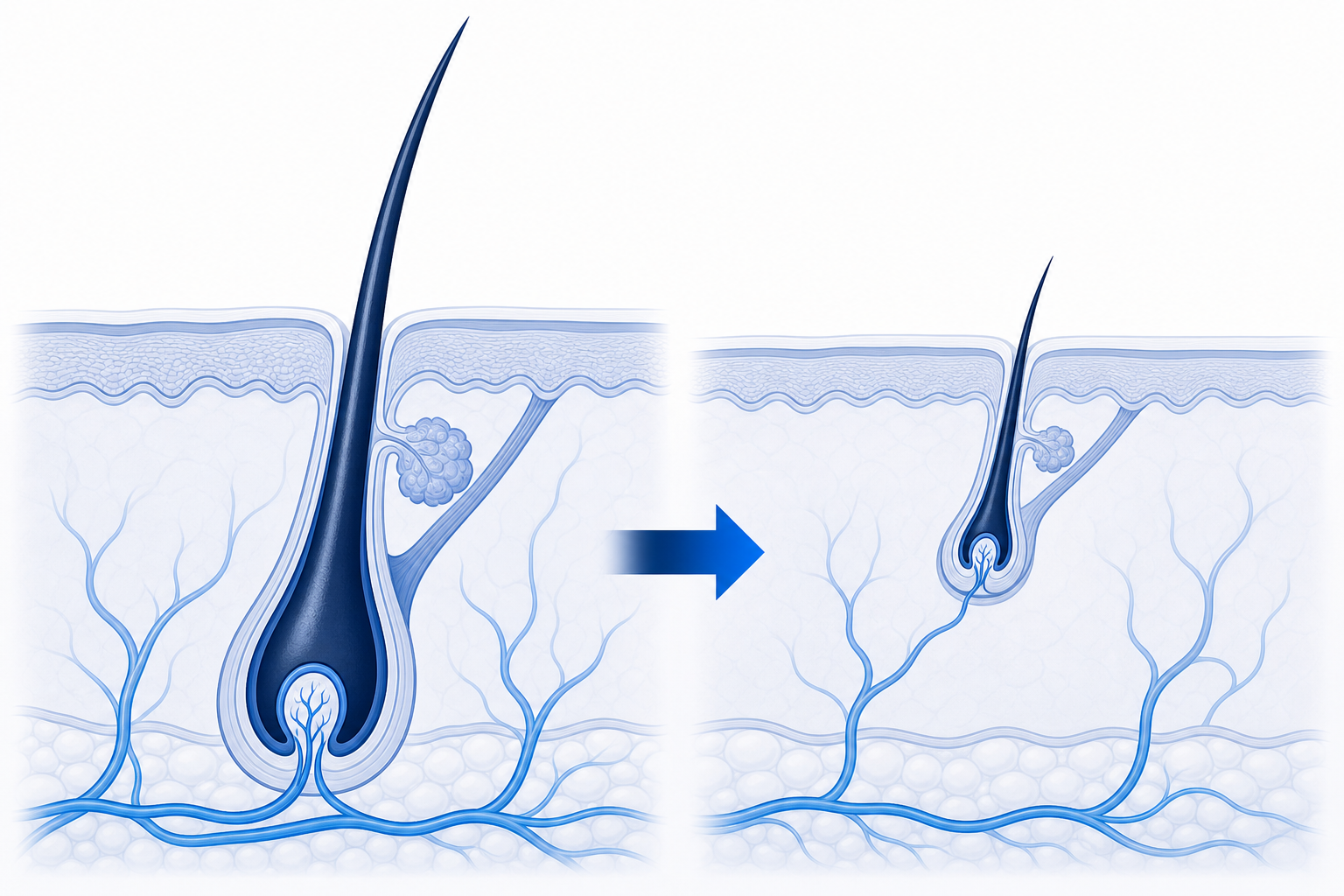
The crucial point is this: androgenetic alopecia is not driven by the testosterone level in your blood, but by the inherited sensitivity of your follicles and the activity of 5-alpha reductase. That is why this form is described as hereditary. The route from testosterone to DHT and on to miniaturisation can be set out as a short chain of events.
How androgenetic hair loss develops (chain of events)
The pattern gives the cause away. Men lose hair frontotemporally (a receding hairline at the temples) and at the vertex (the crown), graded on the seven-stage Norwood-Hamilton scale. Women show a diffuse widening of the central parting while the hairline usually stays intact (the Ludwig or Sinclair scale). You will find more on how this progresses in women in our article on hair loss in women.
One point matters for younger readers: androgenetic alopecia is not simply a sign of ageing. With the right genetic predisposition, miniaturisation can begin in early adulthood, often from the early twenties, and then progress slowly over years. It is precisely this age group that later accounts for a large share of those looking for targeted treatment.
On prevalence: according to endokrinologen.de, around 80% of men and about 40% of women over the age of 70 are affected. This is also why a hair transplant works at all: the follicles at the back of the head carry almost no DHT-sensitive receptors and stay stable for life. For the cycle behind all of this, see our article on the hair growth cycle.
Testosterone and hair loss: the big misconception
When it comes to testosterone and hair loss, one thing is clear: a high testosterone level on its own does not cause hair loss. What matters is the conversion into DHT by 5-alpha reductase and the genetic sensitivity of the follicles, not the absolute amount in your blood (review PMC10968111; Endotext NBK279028). That is why plenty of men with a full head of hair have high readings.
The myth that baldness means high testosterone, and therefore more masculinity, does not stand up to scrutiny. On average, men with androgenetic alopecia do not have higher total testosterone levels than men without hair loss. The difference lies in local follicle sensitivity and enzyme activity in the scalp, not in the systemic level.
The widespread belief that frequent masturbation or sex raises testosterone and thereby triggers hair loss is not supported either. There is no reliable evidence of a causal link between ejaculation frequency and androgenetic alopecia (Medical News Today overview as a secondary source). Short-term hormone fluctuations do not change the inherited sensitivity of your follicles.
For women the picture is different. Even mildly raised androgens, for example in PCOS or after stopping a strongly anti-androgenic pill, can trigger an androgenetic pattern in sensitive follicles. According to the review PMC10968111, around 42.5% of women with PCOS show an androgenetic pattern, compared with roughly 6% of women in the general population under 50. The adrenal precursor DHEA-S also plays a part here.
Oestrogen: the hair-protecting hormone
Oestrogen has a protective effect on hair. Oestradiol, the active form, acts through the ER-beta receptor to extend the growth phase (anagen) of the follicles and to promote cell division in the hair root. When levels are high, as they typically are in pregnancy, hair looks fuller and denser (review PMC10968111).
Oestrogen also raises sex hormone binding globulin (SHBG), which binds free androgens in the blood and so indirectly lowers the DHT burden. When oestrogen levels fall, for instance after childbirth, during the menopause or after stopping certain hormone treatments, that protection disappears. More follicles switch into the resting phase in sync, and around 2 to 4 months later diffuse hair loss becomes visible.
Progesterone and your hair
As for progesterone and hair, the picture is friendlier: progesterone is generally considered hair-friendly. One proposed mechanism is that progesterone competes with testosterone for the enzyme 5-alpha reductase. In vitro and in animal models it even shows a higher affinity for the enzyme than testosterone, which could dampen DHT production.
An important caveat: this substrate competition is well documented biochemically, but translating it into “progesterone prevents hair loss in humans” is not backed by meaningful clinical trials. Progesterone is not a recognised treatment for hair loss. Anything said about it therefore remains a hypothesis rather than an established effect.
In practice, a drop in progesterone (in the luteal phase of the cycle, during perimenopause or after stopping certain contraceptives) is seen as one of several factors that can contribute to diffuse hair loss. It usually acts together with the fall in oestrogen rather than in isolation. That is why oestrogen and progesterone are best looked at as a ratio, not separately.
Pregnancy and postpartum hair loss
Hair loss after childbirth is a classic effect of hormonal readjustment. During pregnancy, high oestrogen levels keep many follicles in the growth phase for longer than usual, so hair looks thicker. After the birth, oestrogen drops abruptly and many of those follicles switch into the resting phase together.
The result, 2 to 4 months after the birth, is diffuse hair loss: postpartum (telogen) effluvium. The literature puts the frequency at around 20% of women (review “Telogen Effluvium”, PMC6709511), although one critical paper (PubMed 27386466) questions whether it exists as a clearly defined entity at that frequency. The prevalence figures are therefore not entirely consistent.
The reassuring part: this type of hair loss is physiological and, as a rule, fully reversible within 6 to 12 months of the birth. It is not a reason to consider a hair transplant. Most women affected need patience rather than treatment while their hormones settle back down.
Perimenopause and the menopause
During the perimenopause and menopause, oestrogen and progesterone fall markedly while androgens gain relative weight. This relative androgen dominance creates a double effect: diffuse thinning caused by the hormonal drop itself, plus a possible worsening of an androgenetic pattern that was already there genetically (female pattern hair loss, FPHL; Cleveland Clinic, review PMC10968111).
Hormone replacement therapy (HRT) and bioidentical hormones are not licensed treatments for hair loss. A systematic review in the Journal of the American Academy of Dermatology (13 studies) found no consistent evidence that menopausal hormone therapy reliably improves hair loss; some individual studies even reported deterioration (summary in Medical Dialogues, a secondary source).
HRT is prescribed for other medical reasons, and a knock-on benefit for hair is not established. The only medicine licensed for female pattern hair loss remains topical minoxidil. Further options, and how hair loss progresses in women, are covered in our article on hair loss in women.
Your cycle, the pill and hormonal contraception
Whether the pill helps or harms your hair depends on the progestogen it contains. Anti-androgenic progestogens can stabilise hair, while androgenic ones can contribute to hair loss in susceptible women. After stopping the pill, a shedding phase often follows 2 to 3 months later: a hormonal readjustment that follows the telogen effluvium pattern. Whether that is purely the temporary shift, or whether an androgenetic pattern is running alongside it, can be assessed visually with a hair analysis.
| Generally hair-friendly (anti-androgenic progestogens) | Less favourable (androgenic progestogens) |
|---|---|
| Cyproterone acetate (strongest anti-androgenic effect in animal models) Dienogest, drospirenone (around 40%) Chlormadinone acetate (around 20%) |
Levonorgestrel Norethisterone |
The percentages come from comparative animal models of anti-androgenic potency, not from human studies on hair loss (endocrinology specialist portals, secondary sources). Treat them as rough guidance. Any effect takes at least 3 to 6 months to appear. The choice of pill is always a decision for your gynaecologist.
PCOS (polycystic ovary syndrome) is a special case: the excess of androgens can lead to increased body hair and, at the same time, to an androgenetic pattern of hair loss. The hormonal coil releases low-dose levonorgestrel; isolated cases of hair loss have been reported, but a robust causal link is not established. The copper coil is hormone-free and therefore neutral from a hormonal point of view.
Cortisol and stress-related hair loss
Stress can trigger hair loss. Chronic psychological or physical stress keeps cortisol levels permanently raised. Cortisol acts through CRH receptors at the follicle and impairs the build-up of the skin’s ground substance, which promotes a premature switch from the growth phase to the resting phase (review PMC10968111). The result is diffuse telogen effluvium.
The time lag is characteristic: the triggering stressful event usually lies around 3 months before the hair loss becomes visible (review “Telogen Effluvium”, PMC6709511). So if you suddenly start losing more hair, look back at the preceding weeks rather than only at the present. Once the strain is over, hair usually recovers.
Alopecia areata needs to be distinguished from this. It is an autoimmune condition in which immune cells attack the follicle, and it is not primarily hormonal or stress-related, even though stress is thought to be a possible trigger. Round, sharply defined bald patches should be assessed by a dermatologist.
Thyroid hormones and hair
The thyroid can cause hair loss. Both an underactive thyroid (hypothyroidism) and an overactive one (hyperthyroidism) trigger diffuse hair loss, because the hormones T3 and T4 control cell division in the hair root and the length of the growth phase. In hypothyroidism, cell division slows and telogen effluvium follows (review PMC10968111).
The connection is common: in one study cohort, around 31% of women with female pattern hair loss also had hypothyroidism (review PMC10968111). That is an association, not a necessary causal link. Because the topic is a broad one, you will find the details, including test values, treatment and recovery, in our separate guide to thyroid-related hair loss.
Reversible or permanent? The difference that matters
Whether hormonal hair loss grows back depends on the type described above: the diffuse hormonal type is usually reversible once the trigger settles, while the patterned androgenetic type progresses without treatment. The table below brings together the signs that let you tell the two apart in everyday life.
| Sign | Points to diffuse / reversible (hormonal shift) | Points to patterned / androgenetic |
|---|---|---|
| Distribution | Evenly thinner across the whole scalp | Parting, temples, crown |
| Trigger | Childbirth, the pill, stress, thyroid | Gradual onset, runs in the family |
| Course | A burst of shedding, then recovery | Slowly progressive |
| Hairline | Stays intact | Recedes (men) / parting widens (women) |
| Context | Clearly linked to a specific event | Increasing over years |
Guidance only, and no substitute for a medical diagnosis. Which type you are dealing with is best clarified by a professional hair analysis.
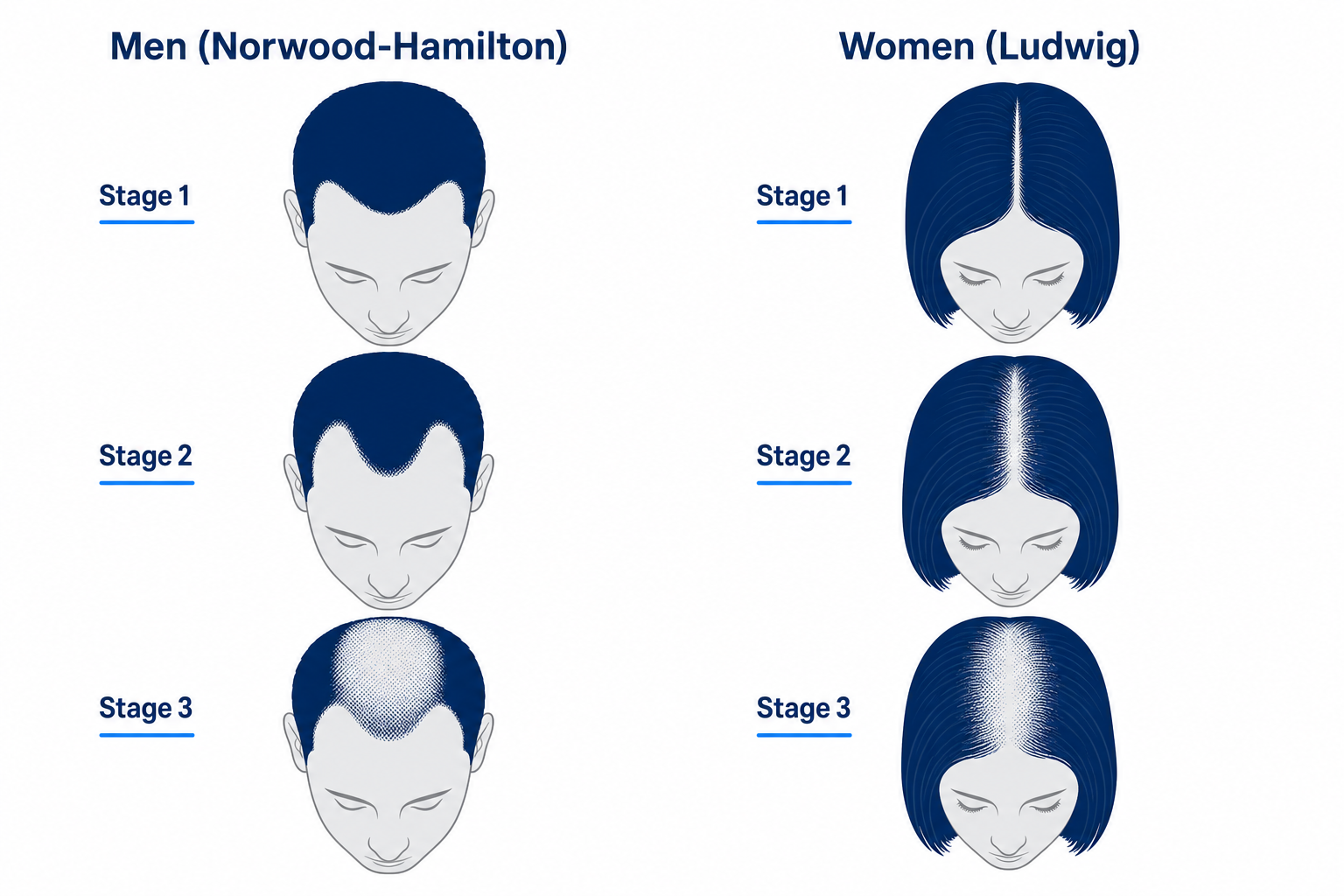
There is one nuance that rarely gets explained: a diffuse hormonal shock (stopping the pill, childbirth, severe stress) can unmask an androgenetic alopecia that was already there genetically and speed up how quickly it becomes visible. Both mechanisms then work together. That is exactly why a professional assessment beats guesswork.
For treatment this means: only the androgenetic form, with a stable, DHT-resistant donor area, responds to hair loss medication or a hair transplant. Diffuse hair loss caused by a hormonal shift is not suitable for either and usually recovers on its own. A hair analysis uses photos to classify the visible pattern and so helps to distinguish the two types. It is a visual first assessment, not a medical blood test and not hormone diagnostics, but it is an honest first step rather than a sales pitch for a treatment.
Free, with no obligation. A photo-based assessment of your pattern, not a substitute for a medical blood test.
Treatment: it depends on the cause
How hormonal hair loss is treated depends on the mechanism behind it. With the reversible, diffuse type, the cause comes first: get your thyroid treated properly, have your iron and ferritin levels checked, reduce stress, and give it time after a pregnancy or after coming off the pill. Spontaneous recovery usually takes 6 to 12 months. Over-treating a self-limiting process makes little sense.
For the androgenetic type there are effective, medically established options. The overview below classifies the two most important active substances by who they are used for, the strength of the evidence and the warnings attached. For more on the substance itself, see our article on minoxidil for hair loss.
| Active substance | Used for | Strength of evidence | Warning |
|---|---|---|---|
| Minoxidil (topical) | Men and women, applied to the scalp | The highest level of evidence according to the European S3/EDF guideline | A temporary increase in shedding in weeks 2 to 6 is normal and does not mean the treatment has failed. Not everyone responds. |
| Finasteride (oral, 1 mg/day) | Men only, prescription-only medicine | Proven effective: it inhibits 5-alpha reductase and lowers DHT levels | Sexual side effects occurred in around 3.8% of participants in studies versus 2.1% on placebo, and were mostly reversible. Post-finasteride syndrome is still being debated. Contraindicated in women. See the safety note below. |
This is context rather than a treatment recommendation. Any drug treatment belongs in the hands of a doctor.
Safety note on finasteride: European medicines regulators (CMDh/EMA) agreed measures in 2025 relating to the risk of suicidal thoughts, and some countries now require a signed information form from doctor and patient before the medicine is prescribed. Finasteride is contraindicated in women (it is teratogenic in pregnancy) and should only be taken after a detailed discussion with a doctor.
For women, anti-androgens prescribed by a doctor are an option. According to the AEDV consensus document (2023), the most effective approach in postmenopausal women is minoxidil combined with a 5-alpha reductase inhibitor; before the menopause, spironolactone can be used instead of the inhibitor. Additional aspects such as nutrients are covered in our article on hair loss capsules, and a blood test for hair loss can reveal a deficiency.
A hair transplant is an option where the androgenetic pattern is stable and the donor area is secure. In women, caution is needed: with the female pattern, the back of the head often miniaturises too, so there is frequently no reliable donor area. A transplant is only an option here after strict trichological assessment, never as a blanket solution. And not every case of diffuse hair loss is hormonal, as our articles on iron deficiency and vitamins for hair loss explain.
How long does it take for hair to grow back?
With reversible, hormonally driven hair loss, regrowth follows the natural hair cycle, and that takes patience. Once the trigger settles, the shedding slows down first, before visible new hair appears. The timeline below shows the typical course after the recovery phase begins (derived from the telogen effluvium model, PMC6709511 and PMC10968111).
| Period | What happens in the follicle |
|---|---|
| Months 1-2 | The trigger normalises (thyroid treatment settled, stress reduced, hormonal shift complete) and the shedding visibly slows down. |
| Months 3-4 | The follicles leave the resting phase and enter a new growth phase (anagen). |
| Months 5-6 | The first visible baby hairs (short, fine new hairs) appear along the hairline and on the top of the head. |
| Months 6-12 | Hair density usually recovers largely or completely in diffuse, reversible hair loss. |
These are rough guides and vary from person to person. Androgenetic hair loss does not follow this course on its own; it needs targeted treatment.
Which doctor, and which tests?
The first port of call for hormonal hair loss is your GP, for a basic blood count and a TSH reading. If the results are abnormal or there is a specific suspicion, a referral follows: endocrinologists for hormones in general, gynaecologists for the menstrual cycle, contraception, the menopause and PCOS, and dermatologists or trichologists for pattern analysis and assessment of the donor area.
For women, the timing of the blood test is crucial: without the right day of the cycle, many hormone readings say very little. You can print out the checklist below, or photograph it, and take it along to your appointment.
| Test | When to measure | Who orders it |
|---|---|---|
| Testosterone (total and free), DHEA-S, SHBG, FSH, LH, oestradiol | Cycle days 3-5 (early follicular phase) | Gynaecologist / endocrinologist |
| Progesterone | Cycle days 19-21 (about 7 days after ovulation) | Gynaecologist |
| TSH, fT3, fT4 | Any day of the cycle | GP / endocrinologist |
| Ferritin, vitamin D, prolactin | Any day of the cycle | GP |
If your cycle is irregular or you are past the menopause, have the timing set individually by your doctor. This reflects standard laboratory practice and is not a set of target values. There is more on this in our articles on blood tests for hair loss and the causes of hair loss.
A view from clinical practice
In women in particular, there is rarely just one cause. In clinical practice, a diffuse component driven by a hormonal shift (the menopause, the thyroid, iron) frequently overlaps with a genetically determined androgenetic pattern. That is why the first question is always which type you have, not which treatment to use. A careful assessment prevents reversible hair loss from being treated unnecessarily and androgenetic hair loss from being recognised too late. (Elithair Medical Board)
Frequently asked questions about hormones and hair
Which hormones cause hair loss?
The main players are DHT (derived from testosterone), a drop in oestrogen and progesterone, thyroid hormones (T3/T4), cortisol when you are under stress, and, in women with PCOS, prolactin and DHEA-S. DHT is the most common cause of permanent, patterned hair loss.
Is hormonal hair loss reversible?
That depends on the type. Diffuse hair loss caused by a hormonal shift (childbirth, the pill, stress, the thyroid) is usually reversible and recovers within 6 to 12 months. Androgenetic hair loss (DHT) progresses without treatment and does not grow back on its own.
Does testosterone cause hair loss?
No, not directly. What matters is the conversion into DHT and the inherited sensitivity of the follicles, not the testosterone level itself. On average, men with hair loss do not have higher testosterone readings than men without it.
What does progesterone do to your hair?
Progesterone is generally regarded as hair-friendly because it may dampen DHT production. That effect is documented biochemically, but it is not backed by meaningful studies in humans. Progesterone is not a recognised treatment for hair loss.
Hair loss after stopping the pill: how long does it last?
Usually it is only temporary. After you stop, a shedding phase often follows 2 to 3 months later because of the hormonal readjustment. As a rule, hair recovers afterwards. If the shedding lasts longer than 6 to 12 months, it should be assessed by a doctor.
Hair loss during the menopause: what helps?
Topical minoxidil is the option with proven evidence, and the only medicine licensed for female pattern hair loss. Hormone replacement therapy is not a licensed treatment for hair loss, and the evidence for it is inconsistent. Having the pattern assessed by a doctor is the first step.
Can stress trigger hair loss?
Yes. Chronic stress keeps cortisol raised and pushes follicles prematurely into the resting phase. The visible hair loss (telogen effluvium) typically appears around 3 months after the stressful period and usually recovers once that period ends.
Can a hair transplant stop hormonal hair loss?
Only in certain cases. It is possible with an androgenetic pattern and a stable, DHT-resistant donor area, but not with diffuse hair loss caused by a hormonal shift. In women the donor area is often affected too, which is why a strict trichological assessment is needed.
Which pill is good or bad for your hair?
It depends on the progestogen. Anti-androgenic progestogens (cyproterone acetate, dienogest, drospirenone, chlormadinone) are generally considered hair-friendly, while androgenic ones such as levonorgestrel or norethisterone are seen as less favourable. The choice of pill is always a decision for your gynaecologist.
Does masturbation cause hair loss?
No, that is a myth. There is no reliable evidence of a causal link between ejaculation frequency and androgenetic alopecia. Short-term hormone fluctuations do not change the inherited sensitivity of your follicles.
Sources
- “The Hormonal Background of Hair Loss in Non-Scarring Alopecias”, 2024 (PMC10968111). Link
- “Androgen Physiology: Receptor and Metabolic Disorders”, Endotext (NCBI Bookshelf NBK279028). Link
- “Telogen Effluvium: A Comprehensive Review” (PMC6709511). Link
- “The Postpartum Telogen Effluvium Fallacy” (PubMed 27386466). Link
- AEDV/Grupo Español de Tricología: consensus document on androgenetic alopecia, 2023 (Actas Dermo-Sifiliográficas). Link
- ANSM: “Finastéride 1 mg et chute de cheveux” (patient information requirements). Link
- Springer Medizin on the EDF/S3 guideline: “Androgenetische Alopezie: Neue Leitlinie empfiehlt Minoxidil”. Link
- endokrinologen.de: “Anlagebedingter Haarausfall” (hereditary hair loss, prevalence figures). Link
Last reviewed 2026. This article is for general information and does not replace medical advice, diagnosis or treatment. If your hair loss persists, please speak to a doctor.
Dr. Imad Moustafa
Hair transplant specialist