

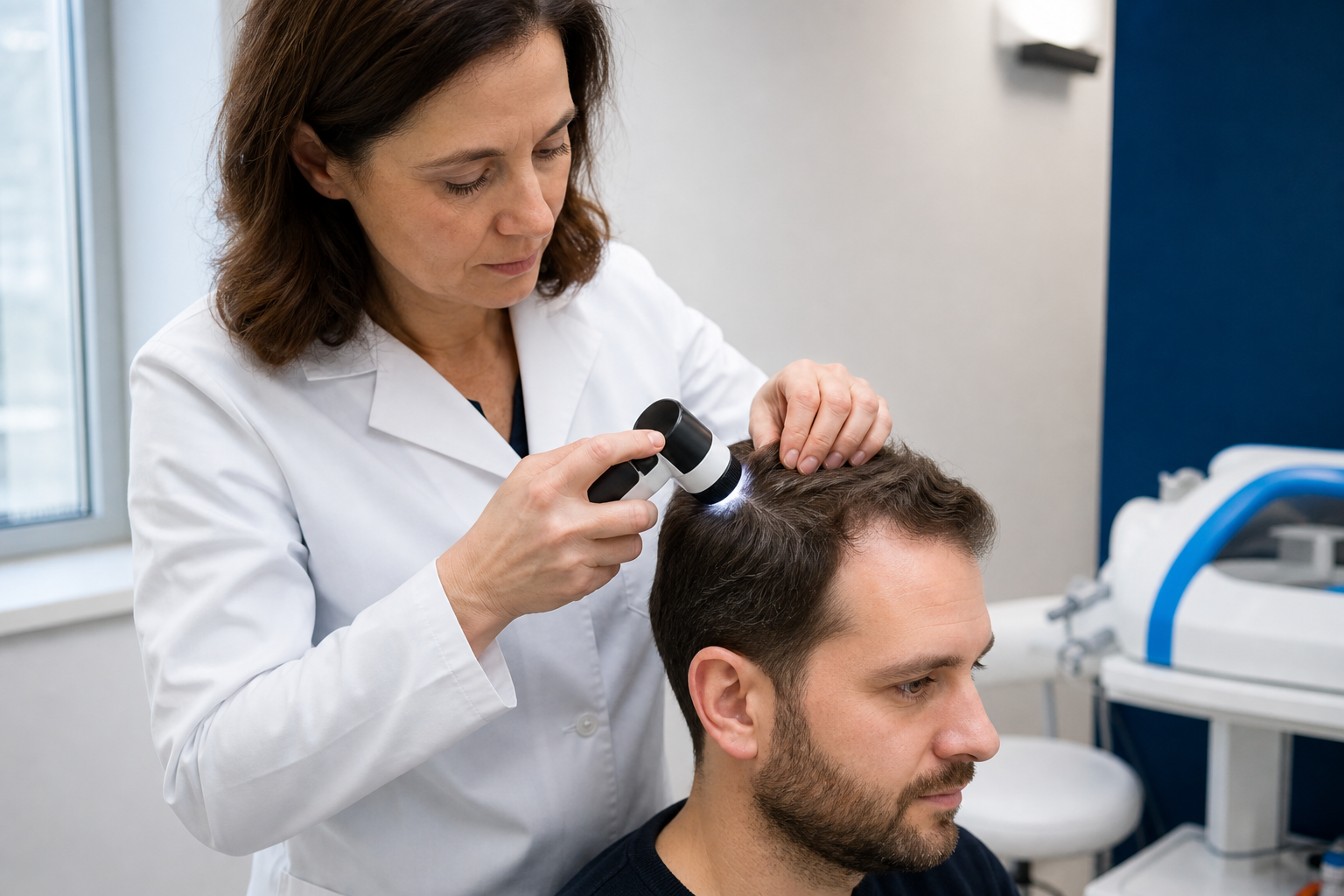
When your hair starts thinning, the first hurdle is rarely knowing the causes of hair loss. It is working out who is actually responsible. The dermatologist is the specialist for hair, follicles and scalp, but in the NHS you do not get there on your own: an NHS hospital specialist will only see you with a referral letter from your GP, and the only self-referral routes are sexual health clinics and A&E. That gateway matters, because dermatology is one of the busiest specialties in England, with 65.7 per cent of open pathways inside 18 weeks in April 2026 (NHS England). This guide shows what each person can actually do for you, from the GP practice to the hair clinic, what the NHS covers and how to be seen sooner.
The key points
- ✓For NHS care you need a referral from your GP, and whether you get one is a clinical decision, not something you can insist on
- ✓NHS care is free at the point of use, but finasteride and minoxidil cannot be prescribed on the NHS in England and Wales, and a hair transplant counts as cosmetic surgery
- ✓Women may also be referred to a gynaecologist or an endocrinologist, and for children the GP is the first stop
- ✓“Trichologist” is not a protected title in the UK, so ask whether the person is a doctor on the GMC register
The table of contents below shows you where everything is. After that we go through it one step at a time: who can do what, what it costs and how you get there.
Summary
- Which doctor should you see for hair loss? Who does what, at a glance
- When should you see a doctor about hair loss?
- The GP: the fastest way in, and the gate to specialist care
- The dermatologist: the specialist for hair and scalp
- Trichologist: not a protected title in the UK
- Specialist hair services at NHS teaching hospitals: for the difficult cases
- Specialist hair clinic and hair transplant surgeon: what they are for and what they are not
- Specific groups: women, young men and children
- Online dermatology and remote appointments for hair loss: worth it or not?
- What happens at the first appointment? How a hair loss consultation runs
- “My doctor doesn’t take my hair loss seriously”: three practical levers
- Does the NHS pay for hair loss diagnosis and treatment?
- How do I get a dermatology appointment sooner?
- Frequently asked questions: which doctor for hair loss
- Sources
Which doctor should you see for hair loss? Who does what, at a glance
Which doctor you need for hair loss depends on what you can see on your scalp, not on how bad it is. Your GP is the way in and the person who writes the referral, and the dermatologist is the specialist who makes the diagnosis and the treatment plan. Everyone else comes in alongside those two, not instead of them. The guide below shows what each one can do and how you get there.
| Who | Responsible for | What they can assess | NHS or private | Access and waiting |
|---|---|---|---|---|
| GP | first assessment, underlying conditions, medicines, referral | history, examination, blood tests where clinically indicated (full blood count, ferritin, TSH, vitamin D, zinc), referral letter | NHS, free at the point of use | book with your own practice or through the NHS App, often within days |
| Dermatologist (consultant dermatologist) | diagnosis and treatment plan for every form of hair loss | pattern recognition, trichoscopy, pull test, trichogram, scalp biopsy, targeted blood tests | on the NHS after a GP referral, free at the point of use; privately at the clinic’s own fee | NHS: referral letter needed; 18-week right, 65.7% of dermatology pathways were inside 18 weeks in April 2026 |
| Specialist hair clinic at an NHS teaching hospital | unclear, rare and scarring forms, second opinion | trichoscopy, biopsy with histology in the same building, access to trials | NHS after referral | usually only on a dermatologist’s referral, longer wait |
| Gynaecologist (for women) | periods, contraception, suspected PCOS, pregnancy, menopause | hormone tests, pelvic ultrasound, changes to contraception | NHS after a GP referral | through the GP, alongside dermatology and not instead of it |
| Endocrinologist | abnormal thyroid or androgen results, an unclear hormone picture | in-depth hormone testing and monitoring over time | NHS after a GP referral | access through the GP, waits are often long |
| Trichologist | an advisory role on hair and scalp, with no defined place in NHS care | depends entirely on the individual; trichologists are not medically qualified | private only | bookable at short notice; check the qualification first |
| Hair clinic or hair transplant surgeon | grading the pattern (Norwood or Ludwig), whether a procedure is feasible | donor density, hair quality, a realistic graft number, follow-up | analysis and consultation free of charge, a procedure is always self-funded | analysis within days; it does not replace dermatological assessment |
| Online dermatology and remote appointments | a first impression, prescription questions, a second opinion on a report | photographs only; no trichoscopy, no pull test, no biopsy | phone and video appointments with your own GP practice are NHS care; private photo services charge their own fees | often within days, bridges the wait |
There are two routes to a specialist. Route A is the NHS one and it starts with your GP: they take the history, arrange blood tests where these are clinically indicated and write the referral letter. Without that letter a hospital specialist will not see you, and the only things you can refer yourself to are sexual health clinics and A&E. Route B is private. A referral is not legally required there, although the NHS still advises getting a letter from your GP so the specialist has your history in front of them.
One thing to know before you book: whether you are referred is a clinical decision. You have the right to ask for a referral, not a right to be given one. That matters with pattern hair loss in particular, because no NHS treatment follows the diagnosis, so many GPs will explain rather than refer. If you still want a specialist opinion, say what you want it for: a documented diagnosis, other causes ruled out, or a proper look at the scalp with a dermatoscope.
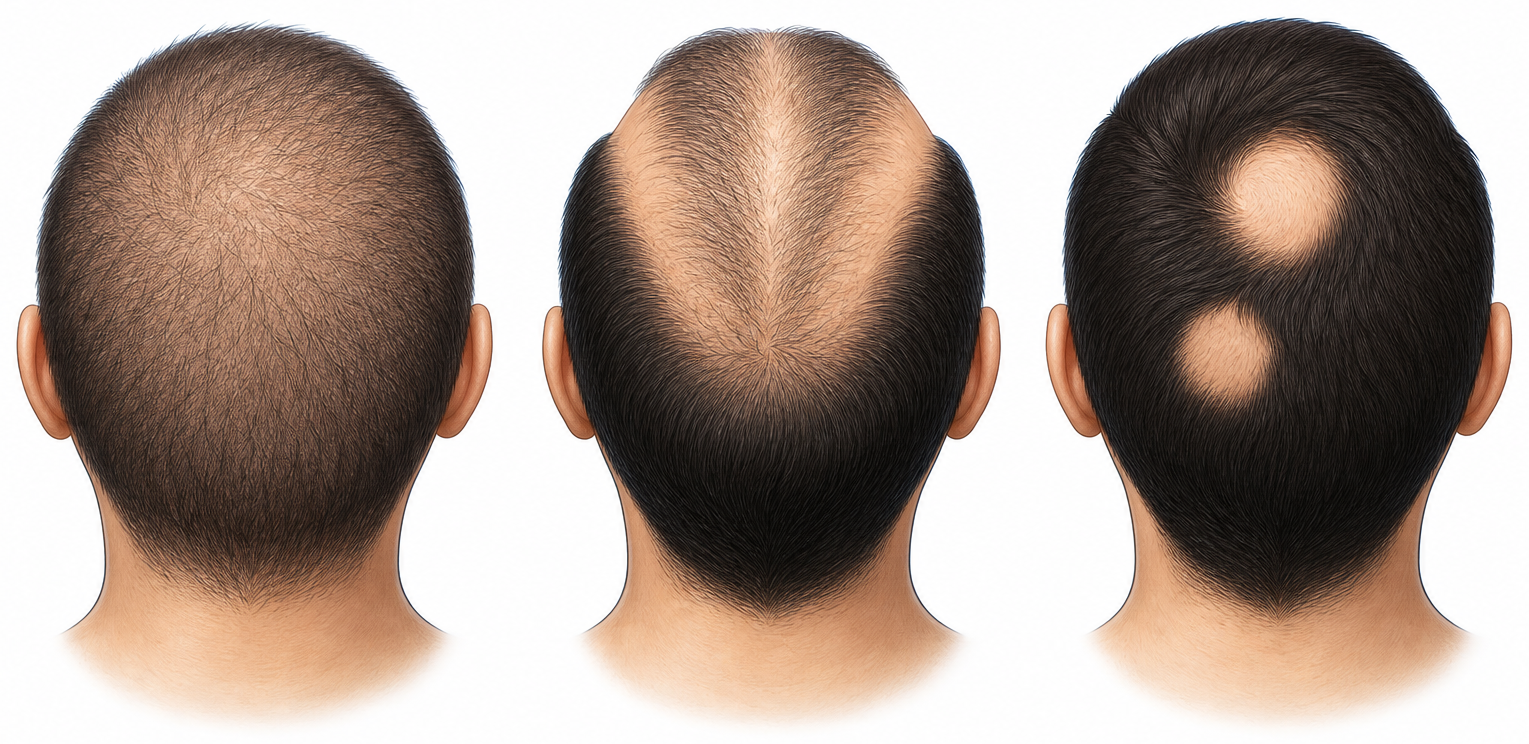
Which of these matters first for you depends on what you see in the mirror. Hair that is evenly thinner all over points towards the GP and a set of blood tests, while a pattern at the temples, crown or parting points towards dermatology. The symptom table in the next section matches each picture to the right person and to how urgent it is.
When should you see a doctor about hair loss?
See a doctor about hair loss when your normal level of shedding changes noticeably and stays changed for more than four to six weeks. As a rule of thumb, the MSD Manual puts normal loss at 50 to 100 hairs a day, and up to around 250 on the days you wash your hair. That figure swings a lot with hair length, how often you wash and the density you started with.
So the number itself is not what counts. The change is: visibly more hair in the brush and the plughole than usual, a parting that keeps widening, a hairline moving back, or scalp showing through in bright light. Watching that over a few weeks gives you a far better reason to book than any counting exercise.
Earlier is better, and not because there is any need to panic: a diagnosis says more while the changes are still recent, and with some forms the timing decides how much can be kept. In scarring alopecias, for instance, follicles are lost for good and do not come back. Those forms are rare, but they are time critical.
The symptom table below brings all of that together: what you can see on your scalp, who is responsible for it, and how urgent it is. Find the row closest to your situation and read from left to right.
| Symptom or sign on the scalp | Who to see | How urgent |
|---|---|---|
| round, bald patches that appear within days or weeks | GP, asking for a dermatology referral, because this points towards alopecia areata, which has its own diagnostic route | promptly |
| shiny, smooth areas with no visible follicular openings | GP and then a dermatologist, because this can point to a scarring alopecia, where lost follicles do not regrow | promptly |
| pain, burning, pustules, redness or heavy flaking of the scalp | GP, and dermatology if it does not settle; an inflamed scalp or inflamed follicles need the skin examined, not just the hair | promptly |
| very rapid, heavy loss | GP for the blood tests and the referral, dermatology for the scalp itself | promptly |
| hair loss with general symptoms such as fever, weight loss or joint pain | GP first for the general work-up, then dermatology for the scalp | promptly |
| hair loss in children and teenagers | GP first, who refers on to paediatric dermatology if needed | promptly |
| new diffuse shedding that lasts longer than six to eight weeks | GP for blood tests, and ask about dermatology as well, because a pattern can sit underneath a diffuse picture | in the next few weeks |
| shedding that started after a new medicine | GP or whoever prescribed it; never stop a medicine on your own | in the next few weeks |
| a receding hairline, thinning crown or widening parting (a pattern) | GP, and a dermatologist if you want the pattern confirmed with trichoscopy rather than assumed | in the next few weeks |
| a woman with changed periods, after stopping the pill or in the perimenopause | GP, who can arrange hormone tests and refer you to gynaecology or dermatology | in the next few weeks |
| a pattern that has crept on slowly over years with no other symptoms | worth raising when you next see your GP, or privately with a dermatologist if you want to make a treatment decision | keep an eye on it |
| shedding about three months after birth, an infection, an operation or a strict diet | GP, with a single blood test including ferritin as a safety net | keep an eye on it |
This table is a guide, not a diagnosis and not an all-clear: it can be worth getting checked even without any of these signs. “Promptly” here means ring your GP practice in the next few days, say exactly what you can see and ask for an urgent appointment.
The GP: the fastest way in, and the gate to specialist care
Your GP is the quickest person to see about hair loss, and in the NHS also the only route to a hospital specialist. They take the history, arrange blood tests where these are clinically indicated and write the referral letter. The tests commonly done when hair is thinning all over are a full blood count plus ferritin, TSH, vitamin D and zinc. There is no fixed NHS panel for hair loss, so which tests are done is a clinical decision, not a menu you order from.
What they can do: take the history including family history and medicines, examine you, feel the thyroid, arrange blood tests, put underlying conditions in context, go through your medicines critically and write the referral to dermatology. Your GP has also known your record for years, which with diffuse shedding is often worth more than any single blood result.
What they cannot do: trichoscopy, a trichogram, a scalp biopsy or the dermatological differential diagnosis of inflammatory and scarring forms. If you leave the surgery with a label such as “it is genetic” but nobody has looked at your scalp properly, you have an assumption, not a finding.
Cost: NHS care is free at the point of use. The National Health Service Act 2006 puts it plainly: services provided as part of the health service in England must be free of charge except where charges are expressly provided for in law. That covers the appointment, the examination and any tests the NHS arranges. Access: usually within days, through your own practice or the NHS App.
The practical lever: ask specifically about the levels that matter for hair rather than for “everything at once”, and say why you are asking. Which ones are worth measuring is set out below in the preparation checklist, so you can bring it to the appointment as a question rather than a demand.
The dermatologist: the specialist for hair and scalp
The dermatologist is the specialist for hair loss, because hair, follicles and scalp are part of dermatology, the medical field that covers the skin and its appendages. The title rests on a statutory register rather than on a job description: the General Medical Council keeps the Specialist Register, and entry normally requires a Certificate of Completion of Training in the specialty (Medical Act 1983, section 34D). Pretending to be a registered doctor is a criminal offence under section 49 of the same Act. The professional body is the British Association of Dermatologists.
What they can do: recognise the pattern, carry out trichoscopy as digital dermoscopy of the scalp, do a pull test, a trichogram or a digital hair analysis, take a scalp biopsy where a scarring form is suspected, order targeted blood tests, reach a diagnosis with a treatment plan, prescribe, and document the findings with photographs for follow-up.
Trichoscopy is the international non-invasive standard in hair disorders, painless and done in a few minutes. It raises diagnostic certainty well above a look with the naked eye, because hair calibre, miniaturisation, follicular openings and signs of inflammation all become visible. That is exactly why it is the core of a finding you can rely on.
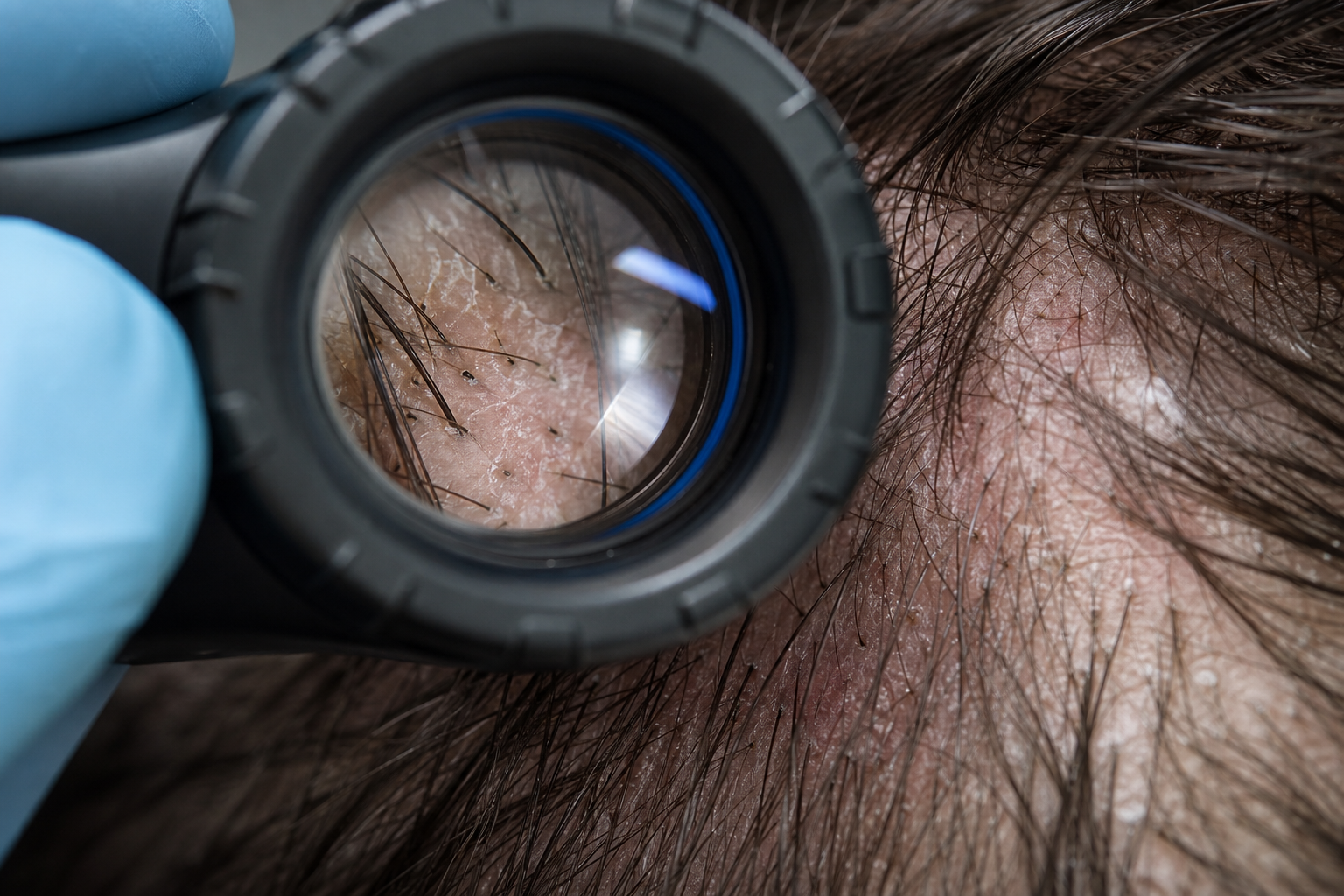
What is not guaranteed: not every dermatology service has a special interest in hair. Two minutes looking at your head and the word “androgenetic” without a dermatoscope is not a solid basis for anything. When you book, ask directly: “Do you do trichoscopy? Do you have a special interest in hair?” That question can save you weeks of waiting for an appointment that settles nothing.
Cost, in detail: on the NHS, the consultation, the examination and any tests the service arranges are free at the point of use. There is no patient-facing list of individual items as in some other health systems, so what is done is a clinical judgement, and it is fair to ask beforehand whether the service uses trichoscopy. Privately, the clinic sets its own fee, so ask for it in writing before you book, because fees vary widely and no reliable published average exists for the UK.
Access and waiting: the NHS Constitution gives you the right to start consultant-led treatment within 18 weeks of a non-urgent referral. Dermatology falls short of that in practice. In April 2026 the dermatology service in England had 379,705 open pathways, of which 65.7 per cent were inside 18 weeks (NHS England referral-to-treatment data, published 11 June 2026). Across all specialties the median wait on open pathways was 11.9 weeks and the 92nd percentile 38.7 weeks, with 65.0 per cent inside 18 weeks against a 92 per cent target. Note what that measures: referral to the start of treatment, not the time to your first appointment. The levers that actually shorten the wait are further down.
And one honest caveat about pattern hair loss: because no NHS treatment follows the diagnosis, a referral is often not offered at all. That is not your GP brushing you off. It is the reason many people with a straightforward pattern end up choosing the private route for a documented diagnosis.
Trichologist: not a protected title in the UK
“Trichologist” is not a title protected by law in the UK and it is not a medical specialty. The Health and Care Professions Council regulates professions whose designated titles are protected in law, and trichology is not among them. There is a voluntary register, the Institute of Trichologists, which is accredited under the Accredited Registers programme of the Professional Standards Authority, and the Authority states it clearly: trichologists are not medically qualified, but they do receive training of a clinical nature specific to hair and scalp. So the title on its own tells you nothing about medical qualification.
This is not a blanket criticism. Someone calling themselves a trichologist may be a doctor with a special interest in hair, and there are established professional bodies internationally. Equally, they may be a non-medical practitioner with a hair and scalp qualification, which is a legitimate advisory role but not a diagnostic one. The difference matters for your diagnosis, so a short check is worth it.
Four questions to ask before you book an appointment
- Is this person a doctor registered with the GMC, and are they on the Specialist Register for dermatology?
- Will a diagnosis be made and written down, or is the appointment mainly about selling products?
- Is the fee set out in writing before the appointment, and is it clear what it covers?
- Will the scalp be examined with a device, or does it stay at a look and a conversation?
Cost: appointments with non-medical practitioners are private and paid for by you, and they sit outside NHS care entirely. A “diagnosis” given there is not a medical finding, and it will not open the door to NHS treatment for an inflammatory or scarring condition.
Specialist hair services at NHS teaching hospitals: for the difficult cases
Unclear and rare forms of hair loss belong in a specialist hair service, usually within a dermatology department at an NHS teaching hospital. Those departments have trichoscopy, biopsy and histology in the same building, which makes the decisive difference where a scarring alopecia is suspected, for instance lichen planopilaris or frontal fibrosing alopecia.
What they can do: the difficult diagnoses, a second opinion at specialist level, access to trials and structured follow-up. What they cannot do: look after you close to home for everything else. Access: usually only on a dermatologist’s referral, with a correspondingly longer wait. Cost: NHS care, free at the point of use.
How to find the right service: when your GP refers you, the referral letter comes with a shortlist of providers in the NHS e-Referral Service, and in most cases you have the legal right to choose the hospital or service you go to, including a clinical team led by a named consultant (nhs.uk). What none of that shows you is which service has a special interest in hair. That is where a workaround helps, and hardly anyone explains it.
Finding a service with a special interest in hair: the search-engine workaround
- Search for “hair loss clinic” plus your town, and then for “hair and scalp clinic”, “trichology” or “trichoscopy” plus your town. Those words sit on clinic websites; they are not filters in any directory.
- For difficult findings: “hair clinic” or “hair loss service” plus the name of your nearest NHS teaching hospital. That is where trichoscopy, biopsy and histology sit under one roof.
- Check the “services” or “specialist interests” page. A service that lists trichoscopy, a trichogram or digital hair analysis owns the equipment.
- Ring and ask two questions: “Do you do trichoscopy?” and “Do you have a special interest in hair?” That is the only reliable filter there is. If you are going through the NHS, name that service when you ask your GP for the referral.
Specialist hair clinic and hair transplant surgeon: what they are for and what they are not
A specialist hair clinic is the right place once the cause is essentially clear and the question becomes: which pattern is this, and what is realistically possible with my donor area? It is a parallel, specialised opinion on that one question, not an escalation step and not the first stop when hair loss is unexplained.
What it can do: grade the pattern on the Norwood or Ludwig scale, assess donor density and hair quality, judge feasibility and a realistic graft number, and follow the result over time. At Elithair the hair analysis is the free step that answers exactly that question, and before any decision a blood test as part of the pre-test checks whether the procedure is suitable for you at all.
An important distinction: that blood test is not a search for the cause. It checks whether a transplant would be the right treatment in the first place, and rules out situations where it is not. Finding the medical cause stays fully with your GP and the dermatologist. Specialisation here means one thing: the feasibility question is answered by dedicated specialists and real measurements rather than by an estimate.
What it explicitly cannot do: replace the dermatologist. An inflamed scalp, bald patches, a suspected scarring alopecia and unexplained diffuse loss all need dermatological assessment before anyone talks about a procedure. A reputable provider turns you down in those cases, or points you to a specialist. Diffuse or actively progressing hair loss is a contraindication, and a reputable clinic says no after the analysis instead of operating.
Three checks are worth doing before you book anywhere in England, and the NHS itself points to them: the surgeon should be registered with the GMC and hold a valid licence to practise, membership of the British Association of Hair Restoration Surgery can be verified, and independent clinics must be registered with the Care Quality Commission, because hair transplantation counts as a regulated surgical activity.
Cost: analysis and consultation are usually free at specialist clinics, while a procedure is always self-funded. A hair transplant is not available on the NHS because it counts as cosmetic surgery, and the NHS puts the private cost at between £1,000 and £30,000, depending on the extent of the hair loss, the type of procedure, and the quality of the clinic and its team. Access: the analysis works from photographs wherever you are, within days, and there are consultation locations for a face-to-face conversation.
You do not have to wait for a dermatology appointment to do this, and you should not cancel that appointment because of it. The two run in parallel: the hair analysis is a visual assessment of the pattern in your photographs, it answers the feasibility question and it replaces neither an examination nor a diagnosis. If the pictures show an inflamed, patchy or unclear diffuse picture, we point you to a dermatologist first.
Specific groups: women, young men and children
For women, young men and children, the answer to “which doctor for hair loss?” is much the same at its core, but the way in differs. For women, a gynaecologist or an endocrinologist may come in alongside the dermatologist, for young men what counts most is seeing someone early, and for children the GP is the first stop and refers on to paediatric dermatology where needed.
Which doctor should women see for hair loss?
For women the answer is essentially the same: the GP is the way in, and the dermatologist is the specialist who can examine the scalp and grade the pattern. Because hormonal factors and low iron often play a part in women, a gynaecologist or an endocrinologist can be added as a second opinion, usually alongside dermatology rather than instead of it, and in the NHS both are reached through the GP.
One piece of context to keep expectations realistic: in women too, androgenetic alopecia is the most common form, typically as a Ludwig pattern with the parting widening diffusely rather than a receding hairline. Hormonal causes and low iron are frequent contributing factors and the reason for the extra specialists, not the usual explanation on their own.

A gynaecologist comes into play with irregular, heavy or prolonged periods, suspected polycystic ovary syndrome, signs of raised androgens such as acne and increased body hair, hair loss after stopping or changing the pill, when you are trying to conceive, after birth and in the perimenopause. If your GP suspects PCOS, they arrange blood tests to check hormone levels and insulin resistance, sometimes an ultrasound, and they may arrange tests with a gynaecologist or an endocrinologist.
An endocrinologist is for abnormal thyroid results, suspected Hashimoto’s, clearly raised androgens or a picture that stays unclear after the first round of tests. Access runs through the GP and the wait is often long. Worth knowing: routine hormone testing is not recommended as standard in female pattern hair loss, so it is the specific suspicion that justifies it, not the hair loss on its own.
| Situation | Where to start | What is looked at there | Worth adding |
|---|---|---|---|
| a widening parting with no other symptoms | GP, then dermatology on referral or privately | the pattern, trichoscopy, Ludwig grading | blood tests through the GP where clinically indicated |
| diffuse shedding after a diet, an infection or stress | GP | full blood count, ferritin, TSH, vitamin D, zinc where indicated | dermatology if it lasts longer than six to eight weeks |
| shedding about 3 months after giving birth | GP | a single blood test including ferritin as a safety net | wait and see; dermatology if it carries on beyond a year |
| after stopping or changing the pill | GP or sexual and reproductive health service | the hormone picture, contraceptive history | dermatology if a pattern is suspected |
| irregular periods, acne, increased body hair (suspected PCOS) | GP | blood tests for hormone levels and insulin resistance, sometimes an ultrasound | gynaecologist or endocrinologist on referral, dermatology for the scalp |
| menopause and perimenopause | GP | symptoms, hormone status where useful, treatment options | dermatology for the pattern diagnosis |
| tiredness, feeling cold, weight change | GP | TSH, and if abnormal fT3, fT4 and TPO antibodies | endocrinology on referral if results are abnormal |
| round bald patches | GP promptly, asking for a dermatology referral | trichoscopy, ruling alopecia areata in or out | a specialist hair service if the picture stays unclear |
| an itchy, flaking or painful scalp | GP promptly, dermatology if it does not settle | the state of the scalp, a swab or biopsy if needed | no self-treatment before it has been assessed |
One point that often gets missed: hair loss around two to three months after giving birth is a telogen effluvium triggered by the drop in oestrogen, peaking around month four or five and usually settling on its own within the first year. The honest answer here is not “see more doctors” but wait, with a blood test as a safety net. Do get it looked at if the shedding is very heavy, patchy or painful, or if it carries on beyond a year.
Where low iron is suspected, ferritin is the level that matters, not haemoglobin on its own. Iron stores can be empty while haemoglobin still looks normal, which is why the two need reading together.
Men aged 20 to 35: is it worth seeing a doctor about an early receding hairline?
Yes, and early is exactly when it pays off, because the course and the options for keeping what you have are easiest to judge in the early stages. With trichoscopy a dermatologist can see whether hairs are already regrowing thinner, long before that shows in the mirror. Buying products off the shelf without a diagnosis costs money and tells you nothing.
In practice: have the form established first, then decide. Worth knowing before you go: the two standard medicines for pattern hair loss cannot be prescribed on the NHS in England and Wales, so a private prescription and private costs are part of the picture from the start.
Hair loss in children and teenagers: start with the GP
For hair loss in children and teenagers the GP is the first stop, and they refer on to paediatric dermatology where that is needed. Common causes in this age group include a fungal infection of the scalp, tinea capitis, and alopecia areata, which in childhood can also settle on its own within the first six months.
Bald, flaking or inflamed patches on a child should be seen quickly rather than watched: tinea capitis is contagious and is treated medically. Alopecia areata in children and teenagers is managed along the same lines as in adults, with the same diagnostic steps, so the age is not a reason to wait.
Please do not treat a child’s hair loss yourself, neither with home remedies nor with products intended for adults. How heavy the shedding is relative to a child’s age can only be judged with an examination and over time, and hair loss in children belongs in the group that should be looked at promptly.
Online dermatology and remote appointments for hair loss: worth it or not?
An online consultation can bridge the wait and give you a first impression from photographs, but for the actual diagnosis remote care is usually not enough. Trichoscopy, the pull test and a biopsy are physical examinations, and no video call replaces them.
It is useful for the question “pattern or diffuse”, for prescription questions and for a second opinion on a report you already have. It is not suitable for an inflamed or patchy scalp, for a suspected scarring alopecia, or for anything that has to be touched or looked at under magnification.
Cost: phone and video appointments with your own GP practice are ordinary NHS care and free at the point of use, and the NHS App handles appointments and repeat prescriptions. Private photo-based services set their own fees, so check what the fee covers and whether a doctor actually reviews your case.
A pointer without naming names: platforms that sell you a subscription product without a real examination are not giving you a diagnosis. They are giving you an order. Worth remembering that finasteride is a prescription-only medicine in the UK, which is why any legitimate route to it involves a prescriber who has assessed you.
What happens at the first appointment? How a hair loss consultation runs
A first dermatology appointment for hair loss has four parts: the history, looking at the pattern with trichoscopy, a pull test where useful, and then blood tests or a treatment plan. None of it is painful or difficult, and it is often this uncertainty, rather than the waiting list, that keeps people from booking.
1. The history. Since when, how fast, how heavy, family history, medicines and supplements, diet, weight changes, stress, other conditions, and for women periods and contraception as well. The more specific your answers, the more targeted the tests.
2. The examination. The doctor assesses the pattern and the scalp, then does the trichoscopy. A camera lens is placed directly on the scalp, painlessly and in a few minutes. What becomes visible: hairs of clearly different thickness, follicular openings, redness and flaking.
3. The pull test. A bundle of hair is gently pulled at several spots and the loosened hairs are counted. The MSD Manual describes taking a bundle of about 40 hairs at a minimum of three sites, with normally fewer than three telogen hairs coming away per pull; more than four to six suggests a telogen effluvium. Other authors use 50 to 60 hairs and count more than 10 per cent as positive (Tsiogka et al., 2021).
The test is a guide, not a measurement: the force cannot be standardised, and when you last washed your hair affects the result.
4. What happens next. Blood tests, and in unclear cases a trichogram or a scalp biopsy under local anaesthetic, plus photographs for follow-up. By the end, three things should be settled: the likely form, the next steps, and when you will be seen again.
Preparation that hardly anyone explains: as a rule, do not wash your hair on the day of the appointment, and leave out styling products, hair fibres and any hairpiece, because they distort both the pull test and the assessment of the scalp. Some clinics prefer it differently, so it is worth a quick call to ask.

What to bring to the appointment
- a list of all your medicines and supplements with the date you started them
- photographs of your parting, crown and hairline, in the same light, taken over several weeks
- a note of when it started, how heavy it is and what has changed
- copies of earlier reports and blood results
- family history: who in your family lost hair, and when
- for women: notes on your periods and your contraceptive history
- your own questions, written down
- your NHS number and, if you have one, the referral letter
Tests you can ask about
- full blood count
- ferritin as the marker of your iron stores
- TSH, and if abnormal fT3, fT4 and TPO antibodies
- 25-OH vitamin D
- zinc
- for women, depending on the suspicion: testosterone, free testosterone, DHEAS, SHBG, prolactin
- where there is reason to: CRP, liver and kidney function, coeliac serology
This is a list of questions for the conversation, not instructions for your doctor: which tests are clinically justified is their decision, based on what they find.
Once you have a diagnosis, the next question is what to actually do about it, and that decision is much easier to make with a documented finding in your hand than with a hunch.
“My doctor doesn’t take my hair loss seriously”: three practical levers
If a doctor dismisses hair loss as normal without examining you, that is not a finding. It is the absence of one. As long as there is no trichoscopy and no blood test, there is no diagnosis you need to accept. Three levers help, and all three are entirely legitimate.
Lever 1: ask in the appointment. Say it in plain words: “Can we look at the scalp with a dermatoscope?”, “Can we check my ferritin and TSH?”, “Can you write down which form you think this is?” And if none of that happens: “If you don’t think it is needed, could you note that in my record, please?” That last sentence carries the most weight, because it turns a brush-off into a documented decision.
Lever 2: pay for one step yourself. If your GP sees no clinical reason to refer or to test, you can book a private dermatology appointment for a single opinion, with trichoscopy, and take the report back into NHS care. Ask for the fee in writing beforehand and ask what it includes, because a documented finding is worth far more than a repeat appointment that settles nothing.
Lever 3: change practice or get a second opinion. You can ask your GP to refer you to a different service, and in most cases you have the legal right to choose which hospital or service that is, including a team led by a named consultant. If the picture is unclear, a specialist hair service at a teaching hospital is the place to ask for. You can also register with a different GP practice, and you do not owe anybody a reason.
When hair loss weighs on you: the distress belongs in the consultation
How much hair loss is affecting you is a legitimate part of what you came to say, not an add-on you should leave out. With patchy or fast-moving loss in particular, the loss of control can weigh more heavily than the finding itself. So say it in the history: how much it is getting to you is information, not a weakness.
In practice that means asking your GP about support for the psychological side if you notice yourself withdrawing, ruminating or sleeping badly. NHS mental health support can be arranged through your practice, and asking for it does not push the hair loss itself down the list.
Talking to people with the same diagnosis helps too. There are patient-led support groups in the UK for alopecia, including for alopecia areata specifically. Support groups do not replace treatment, but they take away the feeling of being alone with it, and they are often a very practical source of what actually works day to day.
Does the NHS pay for hair loss diagnosis and treatment?
There is a clear split here: diagnosis yes, treatment mostly no. The consultation, the examination and any tests the NHS arranges are free at the point of use, because services provided as part of the health service in England must be free of charge unless a charge is expressly provided for in law. Treatment for pattern hair loss is where it stops: finasteride 1 mg tablets and minoxidil for external use are on the list of medicines that cannot be ordered under an NHS general medical services contract in England and Wales.
| Service | On the NHS | What that means in practice |
|---|---|---|
| history and examination at your GP or in dermatology | free at the point of use | no charge to you; dermatology needs a GP referral |
| blood tests arranged by the NHS | free at the point of use | which tests are done is a clinical decision, and there is no fixed hair loss panel |
| trichoscopy | where used, part of the dermatological examination | the NHS has no patient-facing list of individual items, so ask the service beforehand |
| digital hair analysis and photographic follow-up outside the NHS | private | fees vary widely; ask for them in writing before you book |
| private blood panels ordered on request | private | you pay; results still need a clinician to interpret them |
| treatment of androgenetic alopecia (minoxidil, finasteride) | not available on an NHS prescription | listed in Schedule 1 of the 2004 prescription of drugs regulations for England and Wales; private prescription only |
| treatment of disease forms such as alopecia areata or scarring alopecias | managed within NHS dermatology | the individual case decides; some wigs are available on the NHS, and you may have to pay unless you qualify for help |
| hair transplant | not available on the NHS | it counts as cosmetic surgery; privately the NHS puts the cost at £1,000 to £30,000 |
Two things are worth keeping apart. The medicines exclusion is a specific legal list, not a judgement on whether the treatment works, and the British Association of Dermatologists says the same to patients: minoxidil is not available on an NHS prescription, and surgical treatment is not offered on the NHS but can be sought privately. Wigs are the exception in the other direction, because some are available on the NHS, and the British Association of Dermatologists notes that only synthetic wigs are.
Privately you pay the clinic’s own fee, whether that is a dermatology consultation, a private prescription or a procedure. Ask for the fee in writing before you book, and ask what happens if a follow-up appointment is needed, because that is where private costs usually grow.
How do I get a dermatology appointment sooner?
The fastest legitimate route through the NHS is to use your right to choose. When your GP refers you, in most cases you can choose the hospital or service, including one led by a named consultant, and the referral is booked through the NHS e-Referral Service from a shortlist. You also have the legal right to ask for your appointment to be moved to a different provider if you are likely to wait longer than the maximum waiting time for your treatment, and the hospital or your integrated care board then has to offer faster alternatives.
Two things follow from that. First, a service further from home is often quicker than the busiest local one, so look at the whole shortlist rather than the nearest name on it. Second, the 18-week right refers to consultant-led treatment after a non-urgent referral, so it is worth saying clearly at the GP appointment what makes your case urgent, if it is: bald patches, an inflamed or painful scalp, or rapid heavy shedding.
Other levers that work in practice: ask the practice about cancellations and ask to be put on a cancellation list, use the NHS App for GP appointments and repeat prescriptions, ring in the morning, and ask on the phone whether the dermatology service has a special interest in hair. That last question is the difference between waiting weeks for an appointment with trichoscopy and waiting weeks for one without.
If the specialist appointment is still weeks away, make the wait productive. This timeline turns an appointment based on what you remember into one based on what you can show:
| When | What makes sense in that time | What you have afterwards |
|---|---|---|
| Week 0 | GP appointment, blood tests where indicated, and ask about a dermatology referral | a test request and, if referred, a place in the queue |
| Weeks 1–2 | get your results, keep a copy, and take the first photographs of parting, crown and hairline | baseline results plus baseline photographs |
| Weeks 2–6 | photographs every two weeks in the same light, and keep the medicines list and a short diary up to date | a documented course instead of a recollection |
| after the referral | the dermatology appointment (18-week right; 65.7% of dermatology pathways were inside 18 weeks in April 2026), or a private appointment if you would rather not wait | a trichoscopy finding, a diagnosis and a treatment plan |
| from then on | review at the agreed interval, and a further referral to a specialist hair service, gynaecology or endocrinology if that is needed | a yardstick for whether the treatment is working |
The three most common mistakes on the way to a diagnosis
- Waiting until the pattern is obvious. Better: document it early and book the appointment, because the course is easier to judge early on.
- Having only TSH or only haemoglobin checked. Better: mention ferritin specifically, because iron stores can be empty while haemoglobin still looks normal.
- Settling for “it’s genetic, you’ll have to live with it” without anyone examining the scalp. Better: ask for the examination, or find a service with a special interest in hair.
A note from the Elithair Medical Team
The most common avoidable delay we see is not the wrong doctor. It is the first appointment happening too late. People who walk in with recent blood results and a handful of photographs taken in the same light often save themselves a whole extra appointment. And once you have a confirmed dermatological diagnosis, every decision after that rests on something solid instead of a guess.
Frequently asked questions: which doctor for hair loss
Which doctor is responsible for hair loss?
The specialist is the dermatologist, because hair, follicles and scalp are part of dermatology. In the NHS your GP is the way in: they take the history, arrange blood tests where these are indicated and write the referral letter, without which a hospital specialist will not see you. For women, a gynaecologist or an endocrinologist may be added depending on what is suspected.
Do I have to see my GP first, or can I go straight to a dermatologist?
For NHS care you start with your GP. A specialist will only see you with a letter of referral, and the only NHS services you can refer yourself to are sexual health clinics and A&E. Privately you can book a dermatologist directly, because the referral rule is a rule of NHS access rather than law, but the NHS still advises getting a referral letter first so the specialist has your history.
Do I need a referral to see a dermatologist?
On the NHS, yes. Whether you get one is a clinical decision: you have the right to ask for a referral, not a right to receive one. With pattern hair loss a referral is often not offered, because no NHS treatment follows the diagnosis. For private care a referral is not legally required, although it is advised.
Which doctor should women see for hair loss?
The route is the same: the GP first, then a dermatologist, who can examine the scalp and grade the pattern. Because hormonal factors and low iron often play a part, a gynaecologist or an endocrinologist can be added as a second opinion, alongside dermatology rather than instead of it. In women too, androgenetic alopecia is the most common form, typically as a Ludwig pattern.
Can a gynaecologist help with hair loss?
Yes, where a hormonal cause is suspected: irregular periods, suspected polycystic ovary syndrome, signs of raised androgens, hair loss after stopping the pill, after birth and in the perimenopause. If your GP suspects PCOS they arrange blood tests for hormone levels and insulin resistance and may refer you on. What a gynaecologist does not do is examine the scalp with a dermatoscope; that stays with dermatology.
Is a trichologist a doctor?
Not necessarily. “Trichologist” is not a title protected by law in the UK, and it is not among the professions regulated by the Health and Care Professions Council. The Professional Standards Authority, which accredits the voluntary register of the Institute of Trichologists, states that trichologists are not medically qualified but do receive clinical training specific to hair and scalp. Ask whether the person is a doctor registered with the GMC.
How many hairs a day should make me see a doctor?
There is no hard threshold. As a rule of thumb the MSD Manual puts normal loss at 50 to 100 hairs a day, and up to around 250 on the days you wash your hair. What counts is the change from your own normal level over more than four to six weeks, together with signs such as a widening parting or scalp showing through.
What does seeing a doctor about hair loss cost, and does the NHS pay?
NHS care is free at the point of use, which covers the GP appointment, the examination and any tests the NHS arranges. Treatment for pattern hair loss is where it stops: finasteride 1 mg and minoxidil for external use cannot be prescribed on the NHS in England and Wales, and a hair transplant is not available on the NHS because it counts as cosmetic surgery. Private fees vary widely, so ask for them in writing before you book.
Which blood tests should I ask about?
The tests commonly done with diffuse hair loss are a full blood count plus ferritin, TSH, 25-OH vitamin D and zinc. For women, testosterone, free testosterone, DHEAS, SHBG and prolactin may be added depending on what is suspected. There is no fixed NHS panel for hair loss, so which tests are justified is a clinical decision; raise them as a question rather than an instruction.
What happens at a dermatology appointment for hair loss?
It runs in four parts: the history, looking at the pattern with trichoscopy, a pull test where useful, and then blood tests or a treatment plan. Trichoscopy is a camera lens placed on the scalp, painless and done in a few minutes. In unclear cases a trichogram or a small biopsy under local anaesthetic follows.
How long is the wait for a dermatology appointment?
The NHS Constitution gives you the right to start consultant-led treatment within 18 weeks of a non-urgent referral, and dermatology falls short of it in practice. In April 2026 the dermatology service in England had 379,705 open pathways, of which 65.7 per cent were inside 18 weeks. Across all specialties the median wait on open pathways was 11.9 weeks. Note that this measures referral to the start of treatment, not the time to a first appointment.
Which doctor for alopecia areata or bald patches?
Round bald patches belong with a dermatologist, and promptly, so ring your GP within a few days and ask for a referral. Shiny, smooth areas with no visible follicular openings should be seen especially quickly, because they can point to a scarring form, where lost follicles do not regrow.
Is it worth seeing a doctor if the hair loss is hereditary?
Yes, because the diagnosis is what determines the treatment, and other treatable causes are often present alongside it, such as empty iron stores or a thyroid problem. Without an examination of the scalp, “hereditary” is an assumption. And the course can only be judged against a documented starting point.
Should I wash my hair before the appointment?
As a rule, not on the day itself, and without styling products, hair fibres or a hairpiece, because freshly washed hair distorts the pull test and the assessment of the scalp. Some clinics prefer it differently, so it is worth asking briefly when you book.
Do I have to pay for blood tests for hair loss?
Tests the NHS arranges are free at the point of use. Private panels you order yourself are paid for by you, and the results still need a clinician to interpret them in context. Which tests are justified is decided by what your doctor finds, not by the length of the list.
Which doctor for hair loss in children?
For children and teenagers the GP is the first stop, and they refer on to paediatric dermatology where needed. Common causes at this age are a fungal infection of the scalp, tinea capitis, and alopecia areata. Bald, flaking patches should be looked at quickly, because tinea capitis is contagious and is treated medically.
Should a man with an early receding hairline already see a doctor?
An appointment pays off precisely because it is early: the course and the options for keeping what you have are easiest to judge in the early stages, and trichoscopy shows hairs regrowing thinner before that is visible in the mirror. Worth knowing in advance: the standard medicines are not available on an NHS prescription, so they involve a private prescription.
What do I do if my doctor does not take my hair loss seriously?
Without an examination of the scalp and blood tests there is no finding, only an assumption. Ask specifically for a look with a dermatoscope and for ferritin and TSH, and ask for it to be noted in your record if that is thought unnecessary. You can also ask to be referred to a different service, use your right to choose the hospital, or pay for a single private dermatology opinion.
Sources
- National Health Service Act 2006, section 1(4): services in England free of charge. legislation.gov.uk
- NHS: Hair loss (see a GP; commercial hair clinics). nhs.uk
- NHS: Referrals for specialist care (referral letter, 18-week right, self-referral exceptions). nhs.uk; private treatment: nhs.uk
- NHS: Your choices in the NHS (choice of hospital and consultant-led team, e-Referral Service, moving an appointment). nhs.uk
- NHS England: Referral to treatment waiting times, April 2026 (dermatology 379,705 pathways, 65.7% within 18 weeks; England median 11.9 weeks), published 11 June 2026. england.nhs.uk
- Medical Act 1983, sections 34D and 49: the GMC Specialist Register and the offence of falsely claiming registration. legislation.gov.uk, legislation.gov.uk
- National Health Service (General Medical Services Contracts) (Prescription of Drugs etc.) Regulations 2004, Schedule 1: finasteride 1 mg tablets and minoxidil for external use not to be ordered under an NHS contract (England and Wales). legislation.gov.uk
- British Association of Dermatologists: patient information on male pattern hair loss bad.org.uk and female pattern hair loss bad.org.uk
- NHS: Hair transplant (not available on the NHS as cosmetic surgery; GMC registration, BAHRS, CQC; cost range). nhs.uk
- NHS: Polycystic ovary syndrome (blood tests for hormone levels and insulin resistance, referral to a gynaecologist or endocrinologist). nhs.uk
- Health and Care Professions Council: the professions we regulate (protected titles). hcpc-uk.org; Professional Standards Authority on trichologists: professionalstandards.org.uk
- Health and Social Care Act 2008 (Regulated Activities) Regulations 2014, Schedule 1: surgical procedures for cosmetic purposes are a regulated activity. legislation.gov.uk; Royal College of Surgeons of England, Professional Standards for Cosmetic Surgery: rcseng.ac.uk
- MSD Manual, Professional Edition: alopecia (normal hair shedding, pull test). msdmanuals.com
- Tsiogka A et al.: Trichoscopy-assisted hair pull test, Australasian Journal of Dermatology 2021. pmc.ncbi.nlm.nih.gov
Medically reviewed, July 2026. The figures and rules above apply to England; health is a devolved matter, so arrangements in Scotland, Wales and Northern Ireland can differ. This article is for information and does not replace a medical diagnosis or treatment. If you have bald patches, a painful or inflamed scalp or rapid, heavy hair loss, please contact your GP promptly.
Dr. Imad Moustafa
Hair transplant specialist