

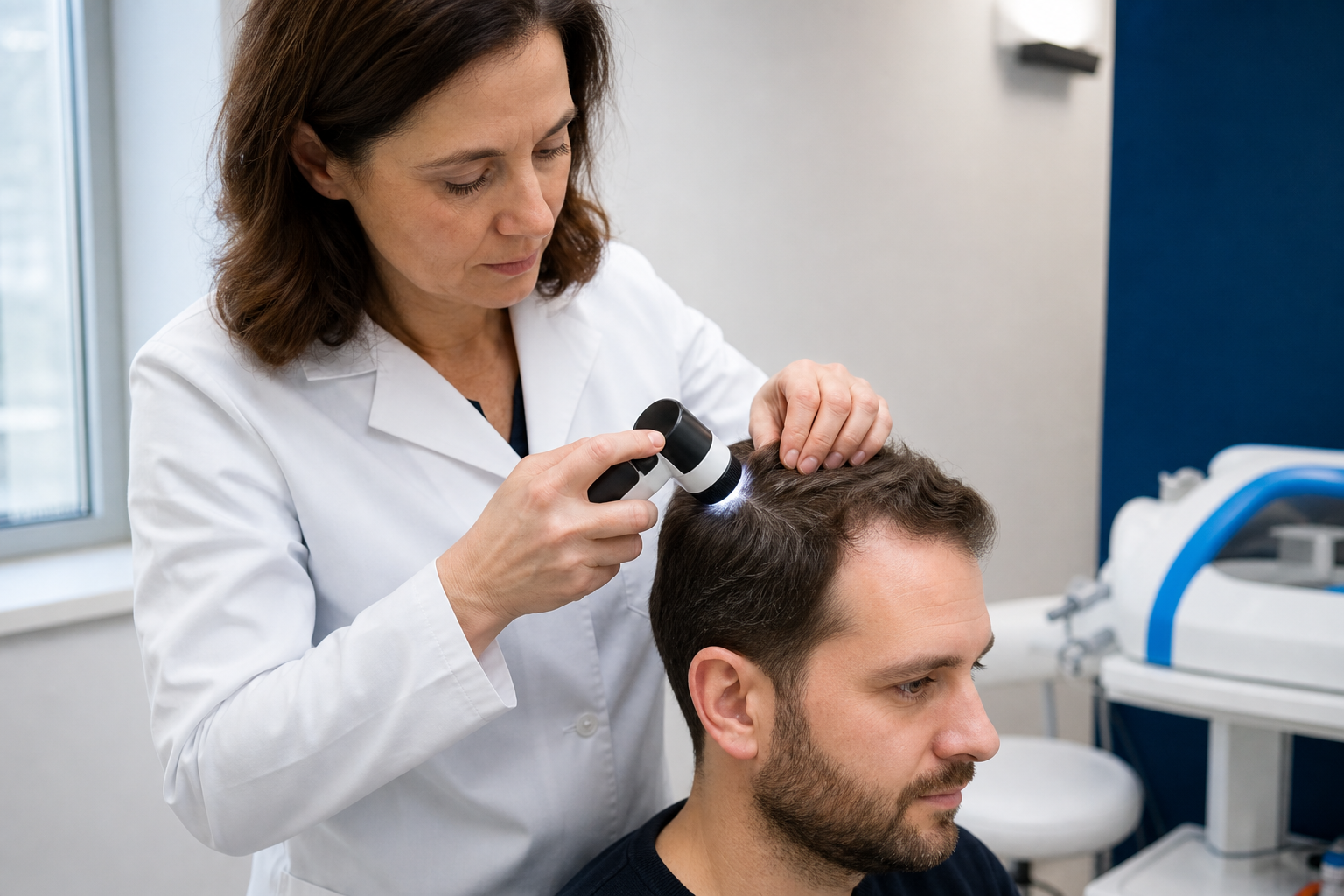
When your hair starts thinning, the first hurdle is rarely knowing the causes of hair loss. It is figuring out who to see. In the United States no federal rule sends you to a gatekeeper first, and the American Academy of Dermatology points people with hair loss straight to a board-certified dermatologist, because hair, follicles and the scalp are dermatology’s territory. Whether your plan wants a referral from a primary care physician before it pays is a question of your coverage, not of the law. This guide sorts out every option, from the first office visit to a hair clinic, and shows what is usually covered, what you pay for yourself and how to get seen faster.
The key points
- ✓No federal rule forces a referral to a dermatologist, but individual plans do; under Original Medicare you may choose any qualified provider yourself
- ✓A medically indicated exam and lab work fall into covered benefit categories, while treatment for androgenetic alopecia and a hair transplant are out-of-pocket
- ✓For women a gynecologist or endocrinologist may be added, and federal law guarantees direct in-network access to gynecologic care; for children the pediatrician comes first
- ✓A trichologist is not a physician, and board certification for dermatologists is voluntary, so check it before you book
The table of contents shows you where everything is. After that we go through the options one by one: what each can actually do, what it costs and how you get in.
Summary
- Which doctor should you see for hair loss? The short overview
- When should I see a doctor about hair loss?
- The dermatologist: the specialist for hair and scalp
- The primary care physician: fast entry with blood work and, if needed, a referral
- Trichologist: not a physician
- Academic hair clinics: for the difficult cases
- Specialized hair clinic and hair restoration surgeon: what they are for and what they are not
- Special groups: women, young men and children
- Teledermatology for hair loss: useful or not?
- What happens at the first appointment? How a hair loss visit runs
- “My doctor doesn’t take my hair loss seriously”: three concrete levers
- Does health insurance cover a doctor’s visit for hair loss?
- How do I get a dermatology appointment quickly?
- Frequently asked questions: which doctor for hair loss
- Sources
Which doctor should you see for hair loss? The short overview
Which doctor is right for hair loss depends on what the scalp looks like, not on how bad it feels: for the diagnosis and the treatment plan, the dermatologist is the specialist in charge, while a primary care physician is the practical starting point for baseline blood work and, if your plan requires it, the referral. Every other option is additive. The guide below shows what each one can do and how you get in.
| Provider | In charge of | Can diagnose | Covered or out-of-pocket | How you get in |
|---|---|---|---|---|
| Dermatologist | diagnosis and treatment plan for every form of hair loss | pattern assessment, trichoscopy, pull test, trichogram, scalp biopsy, targeted lab work | exam and lab work with a medical reason fall into covered categories; the exact amount depends on your plan | the AAD recommends going directly; some plans require a referral from your primary care physician first |
| Primary care physician | first read of the situation, underlying conditions, medications | history, baseline lab work (CBC, ferritin, TSH, vitamin D, zinc), referral | covered as a medical visit; single values ordered without an indication may end up on your own bill | book directly with the office; in plans with an assigned PCP this is the entry point anyway |
| Academic hair clinic at a university dermatology department | unclear, rare and scarring forms, second opinion | trichoscopy, biopsy with histology in house, access to clinical trials | as with any specialist visit, coverage depends on your plan and on whether the center is in network | most centers want a referral and records from your dermatologist |
| Gynecologist (for women) | cycle, contraception, suspected PCOS, pregnancy, menopause | hormone work-up, pelvic ultrasound, adjustment of contraception | covered as medical care under your plan | federal law bars plans from requiring a referral for in-network obstetric and gynecologic care; additive to the dermatologist, not instead of |
| Endocrinologist | abnormal thyroid or androgen values, unclear hormonal picture | in-depth hormone diagnostics and follow-up | covered as specialist care under your plan | no federal direct-access rule here; usually through your primary care physician or dermatologist |
| Trichologist | no defined medical role, because a trichologist is not a physician | no medical diagnosis and no prescriptions; certificates come from private associations, not from a public authority | as a rule purely out-of-pocket | privately bookable; check the qualifications first |
| Hair clinic or hair restoration surgeon | pattern staging by Norwood or Ludwig, feasibility of a procedure | donor density, hair quality, realistic graft count, follow-up | analysis and consultation free of charge, a procedure always out-of-pocket | analysis within days by photo upload; it does not replace the dermatologic work-up |
| Teledermatology | first read of the situation, prescription questions, second opinion on an existing finding | photo assessment; no trichoscopy, no pull test, no biopsy | telehealth coverage varies by plan; photo-only platforms usually bill you directly | book online; useful as a bridge, not as a substitute for an in-person exam |
There are two ways to get there. Path A goes straight to a board-certified dermatologist, which is what the American Academy of Dermatology recommends for hair loss, and no federal rule stands in your way. Path B starts with your primary care physician: easy to reach, blood work and a referral included, which makes the specialist appointment more productive.
One exception is worth knowing before you book. If your plan assigns you a primary care physician and expects a referral before it pays for specialist care, walking in on your own can leave you with the bill. Federal rules require such plans to make that referral available rather than block access, and in-network obstetric and gynecologic care is exempt from referral requirements. Under Original Medicare, by contrast, you may obtain care from any qualified provider you choose.
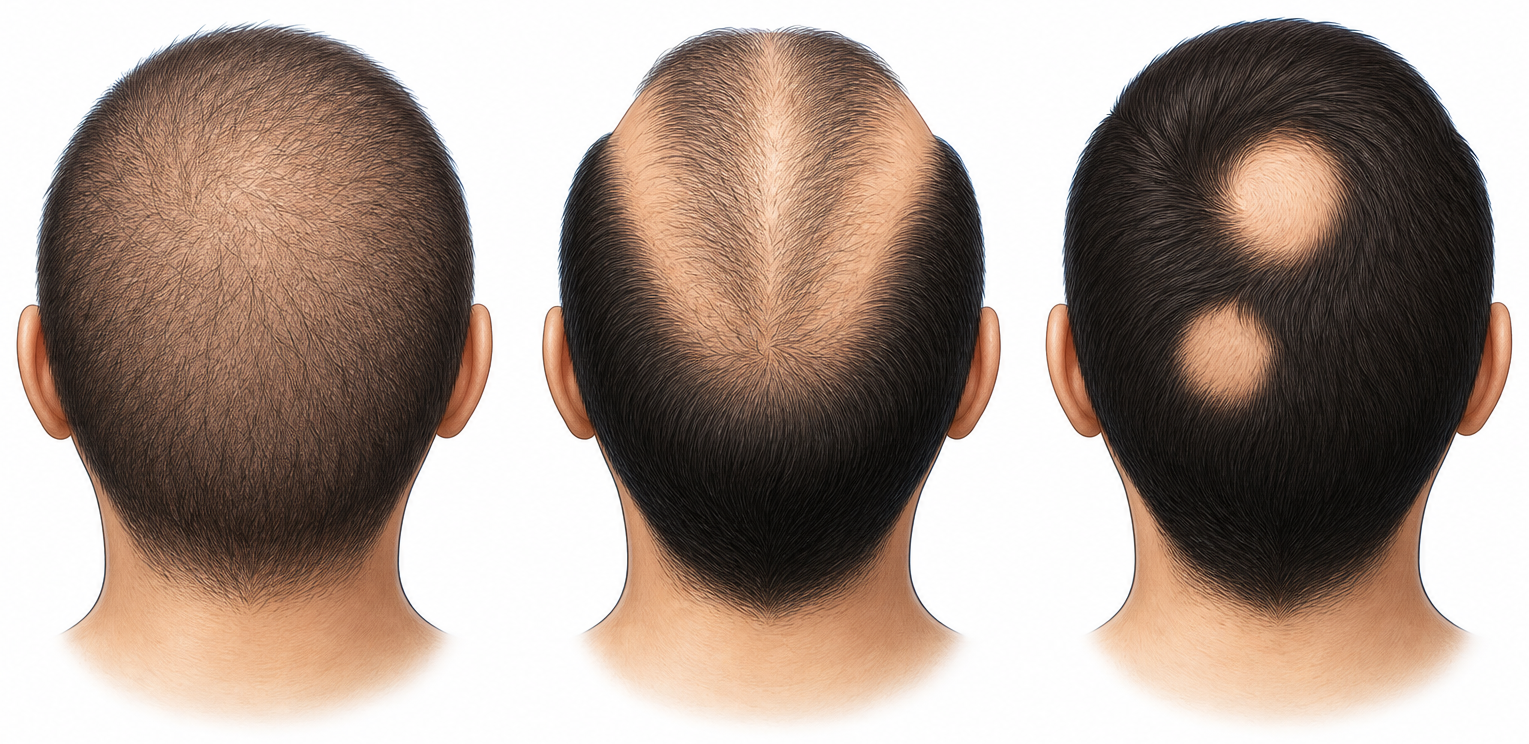
Which of these options fits you first depends on what you see in the mirror. Evenly thinner hair all over the head argues for baseline lab work early on, while a pattern at the temples, crown or part points to the dermatologist. The symptom matrix in the next section matches each of these signs to the right provider and to how urgent it is.
When should I see a doctor about hair loss?
You should see a doctor about hair loss when your usual amount changes noticeably and stays changed for more than four to six weeks. As a rule of thumb, the MSD Manual puts normal loss at 50 to 100 hairs per day, and up to roughly 250 on wash days. That number swings widely with hair length, washing routine and your starting density.
What matters, then, is not the absolute count but the change: visibly more hair in the brush and the drain than usual, a widening part, a receding hairline, or scalp showing through when the light comes from behind. Watching that over a few weeks gives you a far more solid reason to book than any counting exercise.
Earlier is better, and that is not meant as alarmism: an early finding is easier to interpret diagnostically, and with some forms the timing decides what can still be preserved. In scarring alopecias, for instance, follicles are lost permanently and do not regenerate. Those forms are rare, but they are time critical.
The symptom matrix below brings both together: what you see on your scalp, the provider responsible for it, and the urgency. Find the row closest to your situation and read from left to right.
| Symptom or sign on the scalp | Doctor to see | Urgency |
|---|---|---|
| round, bald patches that appear within days to weeks | dermatologist; this is the classic picture of alopecia areata, which has its own established diagnostic path. More on that under alopecia areata | promptly |
| shiny, smooth areas with no visible follicular openings | dermatologist, because this can point to a scarring alopecia; follicles lost there do not regenerate | promptly |
| pain, burning, pustules, redness or heavy flaking of the scalp | dermatologist; inflammatory conditions such as scalp inflammation or folliculitis need an examination of the skin, not just of the hair | promptly |
| very rapid, massive loss | dermatologist, plus your primary care physician for baseline lab work; see also extreme hair loss | promptly |
| hair loss together with general symptoms such as fever, weight loss or joint pain | primary care physician for the internal medicine work-up, then the dermatologist for the scalp | promptly |
| hair loss in children and teenagers | pediatrician first, who refers to pediatric dermatology if needed | promptly |
| new diffuse shedding that lasts longer than six to eight weeks | primary care physician for baseline lab work, and a dermatology appointment in parallel, because a pattern can hide underneath a diffuse picture | within the next few weeks |
| shedding after starting a new medication | primary care physician or the prescribing doctor; never stop anything on your own, see hair loss from medication | within the next few weeks |
| receding temples, thinning crown or a widening part (pattern loss) | dermatologist, because the pattern is a visual diagnosis that trichoscopy then confirms | within the next few weeks |
| woman with a change in cycle, after stopping the pill, or in perimenopause | dermatologist for the scalp, gynecologist in addition for the hormonal picture | within the next few weeks |
| a pattern that has advanced slowly over years without any discomfort | dermatologist if you want to make a treatment decision; otherwise bring it up at your next visit | monitor |
| shedding about three months after childbirth, an infection, surgery or a strict diet | primary care physician or gynecologist, with one blood panel including ferritin as a safety net | monitor |
This matrix is orientation, not a diagnosis and not an all-clear: a work-up can make sense even without these signs. “Promptly” here means calling within the next few days and asking specifically for an urgent or same-week slot.
The dermatologist: the specialist for hair and scalp
For hair loss, the dermatologist is the specialist in charge, because hair, follicles and scalp belong to the skin and its appendages. The American Academy of Dermatology recommends taking hair loss to a board-certified dermatologist directly, since the list of possible causes is long and most of the work-up happens right in the office. One thing to understand about the title: a state medical license is not specialty-specific, and board certification by the American Board of Dermatology is a voluntary process on top of it, so it is worth verifying rather than assuming.
What they can do: pattern assessment by eye, trichoscopy as digital surface microscopy of the scalp, a pull test, a trichogram or digital hair analysis, a scalp biopsy when a scarring form is suspected, targeted lab work, a diagnosis with a treatment plan, prescriptions, plus written findings and photo documentation for your records or your insurer. More on the steps in our piece on hair loss diagnosis.
Trichoscopy is the international non-invasive standard in hair disorders, painless and done in a few minutes. It raises diagnostic certainty considerably compared with looking at the scalp alone, because hair shaft diameter, miniaturization, follicular openings and inflammatory signs all become visible. That is exactly why it sits at the core of a finding you can rely on.
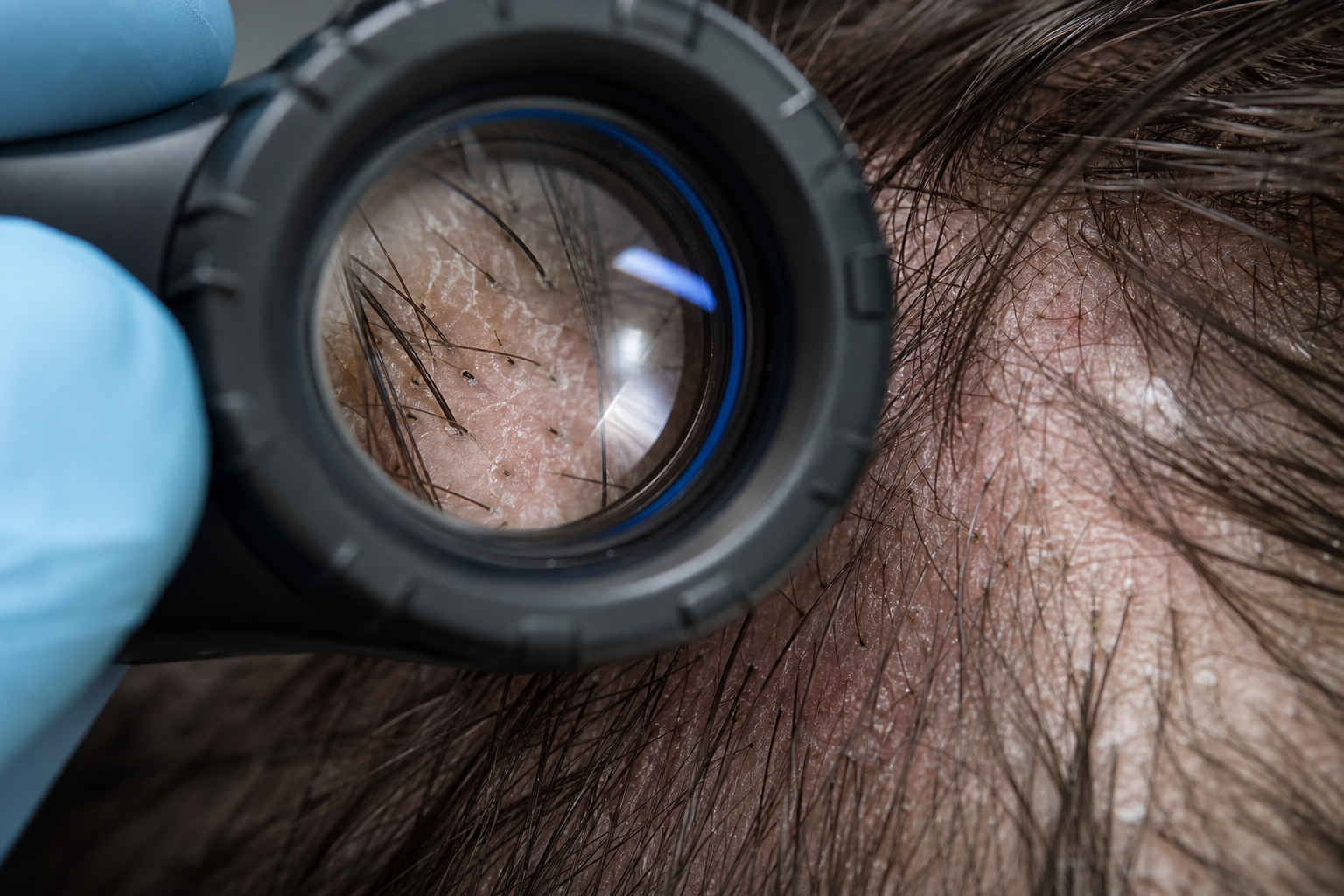
What they do not always deliver: not every dermatology practice has a hair focus. A two-minute look at your head and the word “androgenetic” without trichoscopy is not a solid basis for anything. Ask when you book: “Do you do trichoscopy? Do you have a hair loss focus?” That question can spare you weeks of waiting for an appointment that settles nothing.
Costs and coverage, in detail: when there is a medical reason, the exam and the lab work fall into covered benefit categories, not “everything to do with hair loss.” A broad hormone or vitamin panel ordered purely on request, digital hair analysis or serial photography are often billed to you directly. What you actually pay depends on your plan, your deductible and whether the practice is in network, so ask for the self-pay price in writing before you agree to anything.
Getting in: availability differs sharply by region, by practice and by network, and there is no reliable nationwide figure to plan around. Two things help more than hoping: check before you book whether your plan needs a referral, and ask the office to put you on the cancellation list. The levers that work in practice are further down.
The primary care physician: fast entry with blood work and, if needed, a referral
For hair loss, your primary care physician is often the easiest door to open, though not the one that settles the diagnosis: they take the history, order baseline lab work and write the referral your plan may require. In common practice that panel covers a complete blood count plus ferritin, TSH, vitamin D and zinc, the values that come back abnormal most often in diffuse shedding.
What they can do: a history including family and medication background, the blood draw, palpating the thyroid, placing underlying conditions in context, reviewing your medication list critically, and issuing the referral to dermatology. They have seen your record for years, which in diffuse shedding is often worth more than any single lab value.
What they cannot do: trichoscopy, a trichogram, a scalp biopsy and the dermatologic differential diagnosis of inflammatory or scarring forms. If you leave with a label like “androgenetic” and nobody examined your scalp, you have a hypothesis, not a finding.
Costs and coverage: the visit is billed as regular medical care under your plan, with the usual copay, coinsurance and deductible. Individual lab values ordered without a medical indication can end up on your own bill, so it is fair to ask what is covered before the draw. Getting in: your own office is usually the quickest route, and in plans with an assigned primary care physician it is the entry point anyway.
The practical lever: ask specifically for the hair-relevant values instead of “everything at once.” Which values make sense and how to read them is covered in our piece on the blood test for hair loss. The concrete list to take into the conversation is in the preparation checklist further down.
Trichologist: not a physician
A “trichologist” is not a physician and does not hold a medical specialty qualification. There is no medical board examination behind the word, and the certificates on offer come from private associations such as the International Association of Trichologists or the World Trichology Society, not from a public authority. Someone in that role cannot make a medical diagnosis and cannot prescribe. The label alone therefore tells you nothing about what they can do for you.
This is not blanket criticism. A person using the term may be a licensed physician with a hair focus, and there are established professional societies for hair disorders internationally. It may equally be a non-medical practitioner. The difference matters a great deal for your diagnosis, which is why a short check is worth the two minutes.
Four questions to ask before you book
- Is this person a licensed physician, and are they board certified in dermatology? You can verify that through the American Board of Dermatology.
- Will a diagnosis be made and documented, or is the visit mainly about selling products?
- Is the fee, and what it includes, put in writing before treatment starts?
- Is the scalp examined with a device, or does it stop at a look and a conversation?
Costs and coverage: services from non-medical providers are as a rule purely out-of-pocket, because there is no physician treatment relationship for an insurer to pay against. Do not expect reimbursement, and treat any “diagnosis” made there as what it is: not a medical finding.
Academic hair clinics: for the difficult cases
For unclear and rare forms of hair loss, specialized hair clinics inside university dermatology departments are the right place to go. There, trichoscopy, biopsy and histology sit under one roof, which makes the decisive difference when a scarring alopecia is suspected, for example, lichen planopilaris or frontal fibrosing alopecia.
What they can do: the difficult diagnoses, a second opinion at specialist level, access to clinical trials and structured follow-up. What they do not do: convenient all-round care close to home. Getting in: most centers want a referral and records from your dermatologist. Costs: billed as specialist care, with coverage depending on your plan and on whether the center is in network.
Here is how to find a suitable practice: the American Academy of Dermatology runs a public physician finder (aad.org), and the American Board of Dermatology lets you verify board certification directly (abderm.org). Both tools filter by specialty and region, but neither reliably shows a hair focus. That is exactly where a workaround helps, and almost nobody spells it out.
Finding a practice with a hair focus: the full-text search workaround
- Search Google for “hair loss clinic” plus your city, and additionally for “hair and scalp clinic,” “hair loss specialist” or “trichoscopy” plus city. Those words sit on practice websites; physician directories do not offer them as a filter.
- For difficult findings: “hair loss center” plus the nearest academic medical center. That is where trichoscopy, biopsy and histology are in the same building.
- On the practice website, open the “Services” or “Conditions we treat” page. A practice that lists trichoscopy, trichogram or scalp biopsy owns the equipment.
- Call and ask two questions: “Do you do trichoscopy?” and “Do you have a hair loss focus?” That is the only dependable filter there is.
Specialized hair clinic and hair restoration surgeon: what they are for and what they are not
A specialized hair clinic is the right place to go once the cause is essentially clarified and the question becomes: which pattern is this, and what is realistically possible with my donor area? It is a parallel, specialized option for that one question, not an escalation step and not a first stop when the hair loss is still unexplained.
What it can do: pattern diagnosis and staging by Norwood or Ludwig, assessment of donor density and hair quality, a judgment on feasibility and a realistic graft count, plus follow-up. At Elithair the hair analysis is the free clarifying step for exactly that, and before any decision a blood test as part of the pre-test checks whether you are suitable for the procedure.
An important distinction: that blood test is not a work-up for the cause. It checks whether a transplant would be the right treatment at all and rules out situations in which it is not. Finding the medical cause stays entirely with your primary care physician and your dermatologist. Specialization here means one thing: for the feasibility question there are dedicated specialists and measurements instead of an estimate.
What it explicitly cannot do: it does not replace the dermatologist. An inflamed scalp, bald patches, suspicion of a scarring alopecia and unexplained diffuse hair loss all belong in dermatologic hands before anyone talks about a procedure. A reputable provider declines in those cases or sends you to the specialist. Diffuse or actively progressing hair loss is a contraindication, and a reputable clinic says no after the analysis instead of operating.
Costs and coverage: analysis and consultation are usually free at specialized clinics, while a procedure is always out-of-pocket. Cosmetic surgery is explicitly excluded from Medicare coverage, and federal law lists agents used for cosmetic purposes or hair growth among the drug classes a plan may exclude, so for hereditary hair loss you should not count on any reimbursement. One more thing worth knowing in the United States: hair restoration surgery is not its own recognized specialty and a medical license is not specialty-specific, which makes verifying the surgeon’s qualification more important, not less. Getting in: you upload your photos from anywhere and get the analysis back within days.
You do not have to wait for the dermatology appointment to do it, and you should not cancel that appointment because of it. The two run in parallel: the hair analysis is a visual pattern assessment of your photos, it answers the feasibility question and replaces neither an examination nor a diagnosis. If the images show an inflamed, patchy or unclear diffuse picture, we point you to a dermatologist before anything else.
Special groups: women, young men and children
For women, young men and children the answer to “which doctor for hair loss?” is the same at its core, but the entry point differs. For women a gynecologist or endocrinologist joins the dermatologist, for young men the timing matters most, and for children the pediatrician is the first stop.
Which doctor should women see for hair loss?
Which doctor women should see for hair loss has the same core answer: the dermatologist is the first stop, because they can examine the scalp and determine the pattern. Because hormonal factors and iron deficiency often play a part in women, a gynecologist and an endocrinologist come in as a second layer, usually in parallel rather than instead.
One piece of context against false hope: in women too, androgenetic alopecia is the most common form, typically as a Ludwig pattern with diffuse widening of the part rather than receding temples. Hormonal causes and iron deficiency are frequent contributing factors and the reason for the additional appointments, not the standard explanation. Background in our piece on hair loss in women.

The gynecologist handles cycle disorders, heavy or prolonged bleeding, suspected PCOS, signs of hyperandrogenism such as acne and increased body hair, hair loss after stopping or switching the pill, fertility plans, the postpartum period and perimenopause. They can run hormone diagnostics, ultrasound and an adjustment of contraception, and federal law bars health plans from requiring a referral for in-network obstetric and gynecologic care, so you can book directly. More on that under hormonal hair loss.
The endocrinologist comes in for abnormal thyroid values, suspected Hashimoto’s, clearly elevated androgens or an unclear picture after the baseline work-up. There is no federal direct-access rule for this specialty, so access usually runs through your primary care physician or dermatologist, and your plan decides whether a referral is needed. Going deeper: hair loss and the thyroid, and hormones and hair.
| Situation | First stop | What gets examined there | Useful in addition |
|---|---|---|---|
| widening part with no other complaints | dermatologist | pattern, trichoscopy, Ludwig staging | baseline lab work with your primary care physician |
| diffuse shedding after a diet, an infection or stress | primary care physician | CBC, ferritin, TSH, vitamin D, zinc | dermatologist if it lasts longer than six to eight weeks |
| shedding about 3 months after childbirth | primary care physician or gynecologist | one blood panel including ferritin as a safety net | wait and see; dermatologist if it lasts beyond a year |
| after stopping or switching the pill | gynecologist | hormone status, contraception history | dermatologist if a pattern is suspected |
| cycle disorder, acne, increased body hair (suspected PCOS) | gynecologist | androgens, SHBG, ovarian ultrasound | dermatologist for the scalp, endocrinologist if the picture stays unclear |
| menopause and perimenopause | gynecologist | hormone status, treatment options | dermatologist for the pattern diagnosis |
| fatigue, feeling cold, weight changes | primary care physician | TSH, and if abnormal fT3, fT4, TPO antibodies | endocrinologist if values come back abnormal |
| round bald patches | dermatologist, promptly | trichoscopy, distinguishing alopecia areata | academic hair clinic if the finding stays unclear |
| itching, flaking or painful scalp | dermatologist, promptly | scalp status, swab or biopsy if needed | no self-treatment before the work-up |
One point that often goes missing: hair loss roughly two to three months after childbirth is a telogen effluvium following the drop in estrogen, peaking around month four to five and usually self-limiting within the first year. The honest answer here is not “more doctors” but waiting it out with a blood panel as a safety net. Do get it checked if the shedding is very heavy, patchy, painful or still going after a year.
When iron deficiency is suspected, ferritin is the decisive parameter, not hemoglobin alone. How to read those values is covered in our piece on iron deficiency and hair loss.
Men between 20 and 35: is a doctor’s visit worth it for early temple recession?
Yes, and early is exactly when it pays off, because the course and the options for preserving hair are easiest to judge on an early finding. With trichoscopy a dermatologist can see whether hairs are already regrowing thinner, long before that shows up in the mirror. Drugstore products bought without a diagnosis, by contrast, cost money and produce no insight.
In practice that means: have the form determined first, then decide. How to interpret an early finding is described in our piece on a receding hairline in your twenties.
Hair loss in children and teenagers: start with the pediatrician
For hair loss in childhood and adolescence the pediatrician is the first stop, and they refer to pediatric dermatology when needed. Common causes in this age group, according to established clinical practice, include a fungal infection of the scalp (tinea capitis) and alopecia areata, which in children can also resolve on its own within the first six months.
Bald, flaking or inflamed patches in a child should be shown to a doctor quickly rather than watched: tinea capitis is contagious and needs medical treatment. Alopecia areata in children and teenagers is handled along the same diagnostic lines as in adults, and the American Academy of Dermatology covers the work-up and the treatment options for it.
Please do not treat anything in a child on your own, neither with home remedies nor with products meant for adults. How heavy the shedding is relative to the child’s age can only be judged with an examination and over time, and hair loss in children generally belongs in the group of things to get checked promptly.
Teledermatology for hair loss: useful or not?
An online dermatologist can bridge the wait and give you a first read based on photos, but for the actual diagnostic work telehealth is usually not enough. Trichoscopy, the pull test and a biopsy are physical examinations, and no video call can structurally replace them.
A video visit is genuinely useful for the question “pattern or diffuse,” for prescription questions and for a second opinion on a finding you already have. It is not suitable for inflamed or patchy scalps, for suspected scarring alopecia, or for anything that has to be touched or magnified.
Costs: whether a telehealth visit is covered, and how much of it, depends entirely on your plan, so check before you book. A good service also arranges what happens next, meaning an in-person appointment, a referral or a lab order. Photo-only platforms, on the other hand, usually bill you directly.
One note without naming names: platforms that sell you a subscription product without a real examination are not delivering a diagnosis. They are taking an order.
What happens at the first appointment? How a hair loss visit runs
A first dermatology appointment for hair loss consists of four steps: history, visual assessment with trichoscopy, a pull test if indicated, and then lab work or a treatment plan. None of it is painful or elaborate, and it is precisely this uncertainty that keeps many people from booking longer than any waiting time does.
1. History. Since when, how fast, how much, family background, medications and supplements, diet, weight changes, stress levels, past medical history, and for women the cycle and contraception on top. The more concrete your answers, the more targeted the lab work.
2. Examination. The doctor assesses the pattern and the scalp, then comes trichoscopy. A camera lens is placed directly on the scalp, painlessly and in a few minutes. What becomes visible: hairs of differing thickness, follicular openings, redness and flaking.
3. Pull test. At several spots a bundle of hair is gently pulled and the doctor counts how many come out. The MSD Manual describes the approach as a bundle of about 40 hairs at a minimum of three sites, with normally fewer than three telogen hairs coming out per pull; more than four to six is considered a sign of telogen effluvium. Other authors use 50 to 60 hairs and count above 10 percent as positive (Tsiogka et al., 2021).
The test is orientation, not an exact measurement: the pulling force cannot be standardized, and your last hair wash influences the result. Why shed hairs can be counted so usefully in the first place is explained in our piece on the hair growth cycle.
4. Next steps. A blood draw, in unclear cases a trichogram or a scalp biopsy under local anesthetic, plus photo documentation for the course. By the end, three things should be settled: the suspected form, the next steps and when you come back for follow-up.
Preparation almost nobody explains: as a rule, do not wash your hair fresh on the day of the appointment, and skip styling products, fiber powders and any hairpiece, because all of that distorts the pull test and the scalp assessment. Some practices prefer it the other way around, so ask the front desk briefly.

What to bring to the appointment
- a list of all medications and supplements with start dates
- photos of your part, crown and hairline, same lighting, taken over several weeks
- a note: since when, how much, what has changed
- copies of earlier findings and old lab reports
- family history: who in the family lost hair, and when
- for women: cycle notes and contraception history
- your own questions, written down
- your insurance card and, if your plan requires one, the referral
Values you can ask about
- complete blood count
- ferritin as your iron storage marker
- TSH, and if abnormal fT3, fT4 and TPO antibodies
- 25-OH vitamin D
- zinc
- for women, depending on suspicion: testosterone, free testosterone, DHEAS, SHBG, prolactin
- where there is reason to suspect it: CRP, liver and kidney values, celiac serology
Meant as a list of questions for the conversation, not as instructions to your doctor: which values are medically justified is their call based on the findings. How to read the values: see our piece on the blood test for hair loss.
What you can actually do once you have a diagnosis is laid out in our piece on what to do about hair loss.
“My doctor doesn’t take my hair loss seriously”: three concrete levers
When a doctor dismisses hair loss as normal without examining it, that is not a result. It is a missing finding. As long as there is no trichoscopy and no lab work, there is no diagnosis you would have to accept. Three levers move things forward, and all three are entirely legitimate.
Lever 1, ask in the exam room. Say it plainly: “Can we do trichoscopy?” “Can we check ferritin and TSH?” “Can you put in writing which form you suspect?” And if none of that happens: “If you consider it unnecessary, could you note that in my chart?” The last sentence works hardest, because it documents a decision.
Lever 2, pay for the specific test yourself. If the practice sees no covered indication, you can ask to have single values or a trichoscopy done as a self-pay service. That is a regular route: ask for the price in writing before you agree, and weigh it against months of uncertainty.
Lever 3, switch or get a second opinion. Look for a practice with a hair focus through the AAD physician finder, verify board certification through the American Board of Dermatology, and for an unclear finding ask about an academic hair clinic. Switching practices is entirely your call and needs no justification.
When hair loss weighs on you: the distress belongs in the appointment
The distress that comes with hair loss is a legitimate part of what you bring to the appointment, not an extra you should leave out. With patchy or rapidly progressing loss in particular, the loss of control can weigh more heavily than the finding itself. So say it during the history: how much it is getting to you is information, not a weakness.
In practice that means asking the office about psychosocial support or shared care with a mental health professional if you notice yourself withdrawing, ruminating or sleeping badly. Your dermatologist or primary care physician can refer you, and your plan’s provider directory shows which therapists are in network.
Talking to people with the same diagnosis helps too. For alopecia areata there are patient advocacy organizations in the United States that run peer support and local groups. Peer support does not replace treatment, but it takes away the feeling of being alone with the situation, and it often delivers very practical experience.
Does health insurance cover a doctor’s visit for hair loss?
For a hair loss visit there is a clear dividing line: diagnostics yes, treatment mostly no. History, examination and medically justified lab work with a dermatologist or primary care physician fall into covered benefit categories, since Medicare Part B pays for what is reasonable and necessary to diagnose or treat an illness, and marketplace plans must cover ambulatory patient services and laboratory services. Treatment of androgenetic alopecia is a different story: federal law lists agents used for cosmetic purposes or hair growth among the drug classes a plan may exclude, and cosmetic surgery is explicitly excluded from Medicare coverage. With private plans the exact scope is set by your policy, not by federal rules.
| Service | Typical coverage status | What that means in practice |
|---|---|---|
| history and examination with a dermatologist or primary care physician | covered medical care when there is a medical reason | your copay, coinsurance and deductible still apply; check that the practice is in network |
| lab work with a medical indication | falls under covered laboratory services | which values are justified is the physician’s call based on the indication |
| trichoscopy | usually part of the physician’s examination | how it is handled and billed differs from practice to practice, so ask beforehand |
| digital hair analysis, serial photography | usually out-of-pocket | self-pay prices are set by the practice, so ask for the figure in writing up front |
| a broad lab panel on request only | usually out-of-pocket | agree on the amount before the draw, not after the bill arrives |
| treatment of androgenetic alopecia (e.g., minoxidil, finasteride) | generally excluded | federal law lists agents used for cosmetic purposes or hair growth as an excludable drug class |
| treatment of medical forms such as alopecia areata or scarring alopecias | as a rule covered medical care | medical necessity and your specific plan decide the individual case |
| hair transplant | not covered | always out-of-pocket; cosmetic surgery is explicitly excluded from Medicare coverage |
Two things are worth keeping separate. The exclusion for products aimed at improving hair growth follows from the cosmetic-purpose rules in federal law, and it is why a prescription for pattern hair loss usually lands on your own bill. Whether treatment for a medical form of hair loss is paid for is a separate question, decided by medical necessity and by the details of your plan, which is exactly why a documented dermatologic diagnosis is worth having.
There is no official fee schedule for self-pay prices in the United States, so practices set their own. Ask for the amount in writing before treatment, and ask whether the practice is in network before the visit, not after. Whether a wig or cranial prosthesis is covered after medically caused hair loss depends on your plan and the underlying diagnosis, so put that question to your insurer with a physician’s order in hand.
How do I get a dermatology appointment quickly?
There is no central appointment service in the United States, so getting in fast is a matter of working the practices directly. Book online where the practice offers it, call in the morning and ask about cancellations, and ask to be put on the cancellation list rather than only taking the first slot you are offered. Before you book anything, check whether your plan needs a referral, because that one question decides whether the visit is covered.
Under Original Medicare you may choose any qualified provider yourself, with no gatekeeper in between. In plans with an assigned primary care physician, the referral is the faster route than arguing about it afterwards, and federal rules require such plans to make that referral available rather than leave you without access to necessary specialist care.
Other levers that work in practice: widen the radius and try practices outside the city center, ask about a nurse practitioner or physician assistant slot for the intake, use teledermatology to bridge the gap, consider an academic dermatology department, and confirm the hair focus over the phone. That way you do not wait weeks for an appointment without trichoscopy.
If the specialist appointment is still some weeks out, make the wait productive. This schedule makes sure you walk in with findings instead of memories:
| Timeframe | What makes sense in that time | What you have afterwards |
|---|---|---|
| Week 0 | request a dermatology appointment, check whether your plan needs a referral, and have baseline blood work drawn | a lab order and a specialist appointment in the queue |
| Week 1–2 | pick up the lab results, keep a copy, and take the first photos of part, crown and hairline | baseline values plus starting photos |
| Week 2–6 | photos every two weeks in the same light, and keep the medication list and progress notes updated | a documented course instead of a memory |
| Appointment day | the dermatology visit, with your photos, lab results and medication list in hand | a trichoscopy finding, a diagnosis and a treatment plan |
| after that | follow-up at the agreed interval, and a referral to an academic hair clinic, gynecology or endocrinology if needed | a yardstick for whether the treatment is working |
The three most common mistakes on the way to a diagnosis
- Waiting until the pattern is obvious. Better: document early and book the appointment, because the course is easier to judge on an early finding.
- Having only TSH or only hemoglobin checked. Better: bring up ferritin specifically, because the iron store can be empty while hemoglobin still looks normal.
- Settling for “it’s genetic, you have to live with it” without trichoscopy. Better: ask for the examination, or find a practice with a hair focus.
A note from the Elithair Medical Team
The most common avoidable delay we see is not the wrong doctor. It is the first appointment happening too late. People who walk in with recent blood work and a handful of photos taken in the same lighting often save themselves an entire intermediate step. And once you have a confirmed dermatologic diagnosis, every decision after that rests on something solid instead of a guess.
Frequently asked questions: which doctor for hair loss
Which doctor is responsible for hair loss?
The dermatologist is the specialist in charge, because hair, follicles and scalp belong to the skin and its appendages, and the American Academy of Dermatology recommends taking hair loss to a board-certified dermatologist. Your primary care physician is the practical entry point for the history, baseline blood work and, if your plan requires it, the referral. For women a gynecologist or endocrinologist may be added depending on what is suspected.
Do I have to see my primary care physician first, or can I go straight to a dermatologist?
Both are possible. No federal rule forces a gatekeeper visit, and under Original Medicare you may obtain care from any qualified provider you choose. What decides it is your plan: some plans want a referral from an assigned primary care physician before they pay for specialist care. Starting with your primary care physician is still useful, because they can order the baseline blood work and write that referral.
Do I need a referral to see a dermatologist?
That depends on your plan, not on the law. Going directly is never prohibited, but without a required referral you may end up paying the bill yourself. Federal rules require plans that insist on referrals to make one available rather than block access to medically necessary specialist care, so call your insurer or check your plan documents before you book.
Which doctor should women see for hair loss?
For women too, the dermatologist is the first stop, because they can examine the scalp and determine the pattern. Because hormonal factors and iron deficiency often play a part, a gynecologist and an endocrinologist come in as a second layer, in addition rather than instead. In women as well, androgenetic alopecia is the most common form, typically as a Ludwig pattern.
Can a gynecologist help with hair loss?
Yes, when a hormonal cause is suspected. The gynecologist handles cycle disorders, suspected PCOS, signs of hyperandrogenism, hair loss after stopping the pill, the postpartum period and perimenopause, and can run hormone diagnostics, ultrasound and an adjustment of contraception. Federal law also bars plans from requiring a referral for in-network gynecologic care. What they do not do is examine the scalp with trichoscopy; that stays with the dermatologist.
Is a trichologist a doctor?
No. A trichologist is not a physician, cannot make a medical diagnosis and cannot prescribe, and the certificates on offer come from private associations rather than a public authority. Someone using the term may be a licensed physician with a hair focus, or a non-medical practitioner. Ask whether the person is a licensed physician and whether they are board certified in dermatology, which you can verify through the American Board of Dermatology.
How many hairs a day means I should see a doctor?
There is no hard threshold. As a rule of thumb, the MSD Manual puts 50 to 100 hairs per day in the normal range, and up to roughly 250 on wash days. What matters is the change from your usual amount over more than four to six weeks, along with signs such as a wider part or scalp showing through.
What does a hair loss visit cost, and does insurance pay?
History, examination and medically justified lab work fall into covered benefit categories, with your copay, coinsurance and deductible still applying. Digital hair analysis, serial photography and lab panels ordered without an indication are usually on your own bill. Treatment of androgenetic alopecia and a hair transplant are out-of-pocket, since federal law treats agents for hair growth as cosmetic and excludes cosmetic surgery from Medicare. There is no official fee schedule for self-pay prices, so ask for the amount in writing beforehand.
Which blood values should be checked?
Common practice in diffuse hair loss is a complete blood count plus ferritin, TSH, 25-OH vitamin D and zinc. For women, testosterone, free testosterone, DHEAS, SHBG and prolactin may be added depending on what is suspected. Which values are medically justified is the physician’s call based on the findings, so raise them as a question, not as an instruction.
What happens at a dermatology visit for hair loss?
The appointment runs in four steps: history, visual assessment of the pattern with trichoscopy, a pull test if indicated, and then lab work or a treatment plan. Trichoscopy is a camera lens on the scalp, painless and done in a few minutes. In unclear cases a trichogram or a small biopsy under local anesthetic follows.
How quickly can I get a dermatology appointment?
That varies widely by region, practice and network, and there is no reliable nationwide figure to plan around. What helps: check the referral question with your plan before booking, use online scheduling, ask to be put on the cancellation list, call in the morning, look at practices outside the city center, and use teledermatology to bridge the gap. Confirming the hair focus over the phone saves you an appointment that clarifies nothing.
Which doctor treats alopecia areata or bald patches?
For round, bald patches the dermatologist is responsible, and promptly. Alopecia areata has an established diagnostic path, and the American Academy of Dermatology covers the work-up and the treatment options. Shiny, smooth areas with no visible follicular openings should be looked at especially quickly, because they can point to a scarring form.
Is a doctor’s visit worth it if the hair loss is hereditary?
Yes, because the diagnosis determines the treatment, and other treatable causes are often present alongside it, such as an empty iron store or a thyroid disorder. Without trichoscopy, “hereditary” is a hypothesis. On top of that, the course can only be judged against a documented starting point.
Should I wash my hair before the appointment?
As a rule not freshly on the day, and without styling products, fiber powders or a hairpiece, because freshly washed hair distorts the pull test and the assessment of the scalp. Some practices prefer it differently, so ask briefly when you book.
Is the blood test for hair loss covered or do I pay for it?
When there is a medical indication, lab work falls under covered laboratory services, with your usual cost sharing. A broad panel ordered purely on request without an indication is typically billed to you, so agree on the price beforehand. Which values are justified is decided by the physician based on your symptoms.
Which doctor treats hair loss in children?
For children and teenagers the pediatrician is the first stop, and they refer to pediatric dermatology when needed. Common causes in childhood are a fungal infection of the scalp (tinea capitis) and alopecia areata, which in children can also resolve on its own within the first six months. Bald, flaking patches should be checked quickly.
As a man with early temple recession, should I already see a doctor?
An appointment pays off precisely while the finding is still early, because the course and the options for preserving hair are easiest to judge then. Trichoscopy shows hairs regrowing thinner before that becomes visible in the mirror. Products bought without a diagnosis cost money and produce no insight.
What do I do if my doctor does not take my hair loss seriously?
Without trichoscopy and lab work there is no finding, only a hypothesis. Ask specifically for trichoscopy and for ferritin and TSH, and ask to have it noted in your chart if both are considered unnecessary. Alternatively you can request individual services as self-pay, or look for a practice with a hair focus through the AAD physician finder or an academic hair clinic.
Sources
- 42 U.S. Code § 1395a(a), free choice of provider guaranteed under Medicare. law.cornell.edu
- 42 CFR § 422.112(a)(1) and (a)(3), Medicare Advantage referral requirements and direct access to a women’s health specialist. law.cornell.edu
- 45 CFR § 147.138(a)(3), no authorization or referral required for in-network obstetric and gynecologic care. law.cornell.edu
- 42 U.S. Code § 1395y(a)(1)(A) and (a)(10), Medicare: services that are reasonable and necessary, exclusion of cosmetic surgery; implementing rule 42 CFR § 411.15(h). law.cornell.edu, 42 CFR § 411.15
- 42 U.S. Code § 1396r-8(d)(2)(C), agents used for cosmetic purposes or hair growth as an excludable drug class. law.cornell.edu
- 42 U.S. Code § 18022(b)(1), essential health benefits including ambulatory patient services and laboratory services. law.cornell.edu
- American Academy of Dermatology: Hair loss, diagnosis and treatment (history, scalp examination, pull test, dermatoscope, blood test or scalp biopsy in the office). aad.org, physician finder: aad.org/public
- American Board of Dermatology: what board certification means, and licensure versus certification. abderm.org, verification search: abderm.org/public/dermatologist-search
- AMA Code of Medical Ethics, Opinion 9.6.1 Advertising and Publicity and Opinion 2.1.1 Informed Consent. code-medical-ethics.ama-assn.org, informed consent
- MSD Manual, Professional Edition: Alopecia (normal hair shedding, pull test). msdmanuals.com
- Tsiogka A et al.: Trichoscopy-assisted hair pull test, Australasian Journal of Dermatology 2021. pmc.ncbi.nlm.nih.gov
Medically reviewed, as of July 2026. This article is for information and does not replace a medical diagnosis or treatment. If you have bald patches, a painful or inflamed scalp, or rapid and heavy hair loss, please contact a dermatology practice promptly.
Dr. Imad Moustafa
Hair transplant specialist