

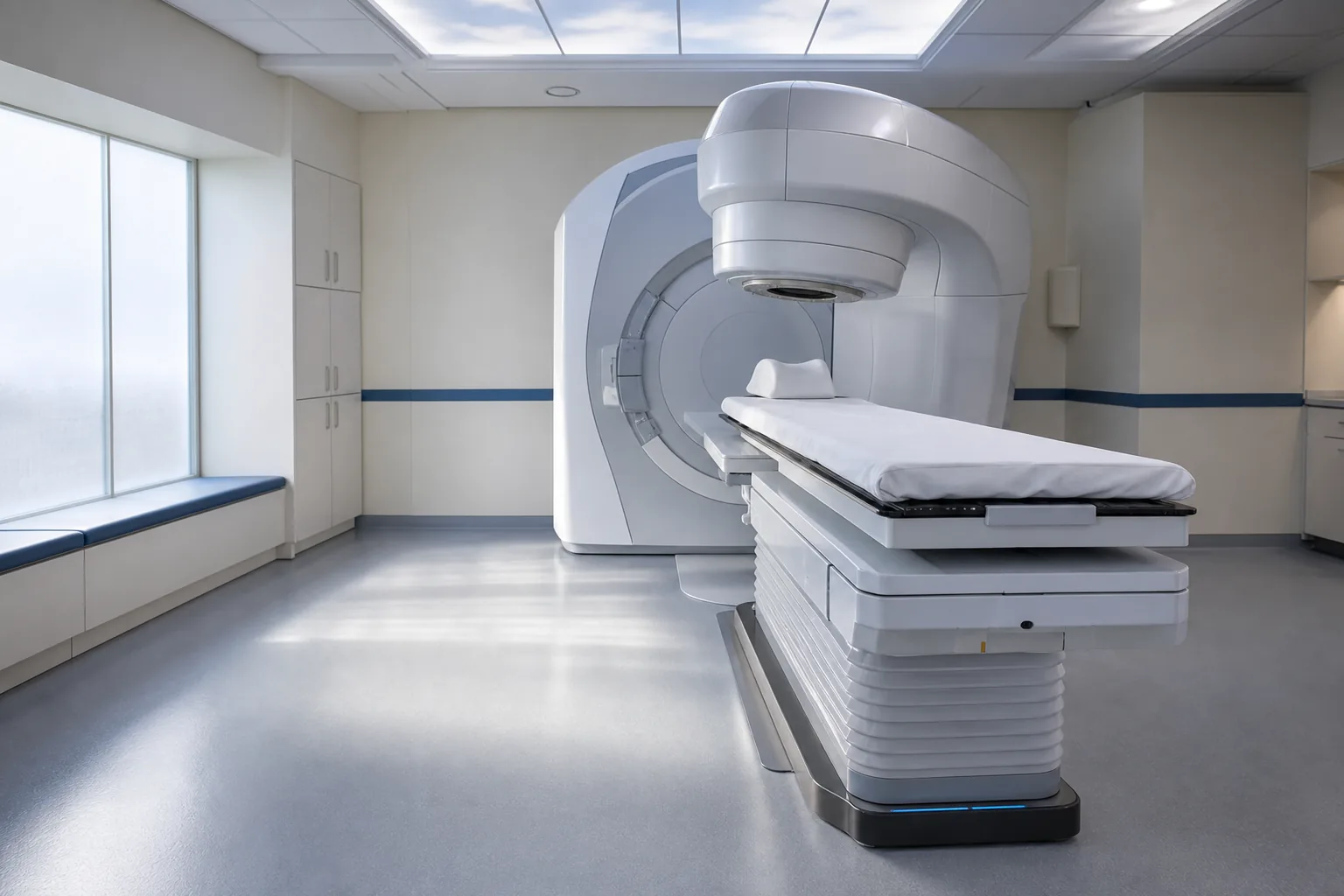
Their hair is one of the most common concerns people bring up before radiation therapy, and for most of them the answer comes as a relief. Radiation therapy only acts where the beam is aimed. Scalp hair therefore only falls out if the scalp lies inside the radiation field: with radiation to the breast it is spared, while hair inside the field itself can be lost, in the armpit for example. The German Cancer Information Service at the DKFZ puts it this way: radiation therapy only damages the hair in the area the beams reach, whereas hair loss across the entire head usually comes from chemotherapy. If the head lies inside the radiation field, the loss usually begins 2 to 3 weeks after the first session.
Key takeaways
- ✓Radiation therapy acts locally: hair only falls out inside the treated field, not all over the body
- ✓With radiation to the breast, scalp hair is spared; the underarm hair on the treated side may be affected
- ✓Hair loss usually starts in the 2nd to 3rd week of treatment, and visible regrowth can be expected roughly 3 to 6 months after treatment ends
- ✓Whether the loss is temporary or permanent depends above all on the radiation dose reaching the scalp
The table of contents shows what is covered where: from the question of scalp hair during breast radiation to the timeline and the role of the radiation dose, through to scalp care, hair prostheses and regrowth.
Summary
- Radiation for breast cancer: does the hair on your head fall out?
- Why radiation therapy causes hair loss
- Hair loss after radiation to the head: only inside the treated field
- Radiation therapy or chemotherapy: two different kinds of hair loss
- How long does hair loss last after radiation?
- Does hair grow back after radiation?
- Temporary or permanent: the role of the radiation dose
- Scalp care during radiation
- Wigs and hair prostheses: sorting out coverage
- Hair transplant after radiation therapy: what is realistically possible
- When hair loss is temporary and when to have it assessed by a doctor
- Hair loss after radiation: your next steps
- Frequently asked questions about hair loss after radiation
Radiation for breast cancer: does the hair on your head fall out?
Radiation to the breast does not cause hair loss on the head. Radiation therapy acts exclusively in the area being treated, and the scalp lies outside that field. Cancer Research UK describes scalp hair loss in breast cancer only for cases in which the head is irradiated as well because of brain metastases.
Hair inside the radiation field itself can fall out. When the lymphatic drainage pathways are treated as well in breast cancer, this often affects the underarm hair on the treated side; the fine hair on the chest wall and upper chest can thin out too. These areas usually recover, because the dose reaching the follicle there is lower than during radiation to the head.
The hair loss across the whole head that many breast cancer patients experience almost always comes from chemotherapy. Anyone receiving both treatments goes through them at different times and can easily attribute the loss to the wrong one. The section on radiation therapy and chemotherapy further down, including a comparison table, shows how to tell the two apart.
A third cause is often overlooked: endocrine therapy. In a case series of 112 patients reported in 2018 in the journal hautnah dermatologie, the thinning was attributable to aromatase inhibitors in 75 women and to tamoxifen in 37, and in more than 90 percent of cases it was only mild. More on this in the article on hair loss caused by medication.
Common assumption: Every course of cancer radiation causes hair loss. In fact: Only the hair that lies inside the radiation field falls out.
Common assumption: With breast cancer, radiation makes the hair on your head fall out. In fact: Radiation to the breast does not affect scalp hair; loss across the whole head almost always comes from chemotherapy given at the same time.
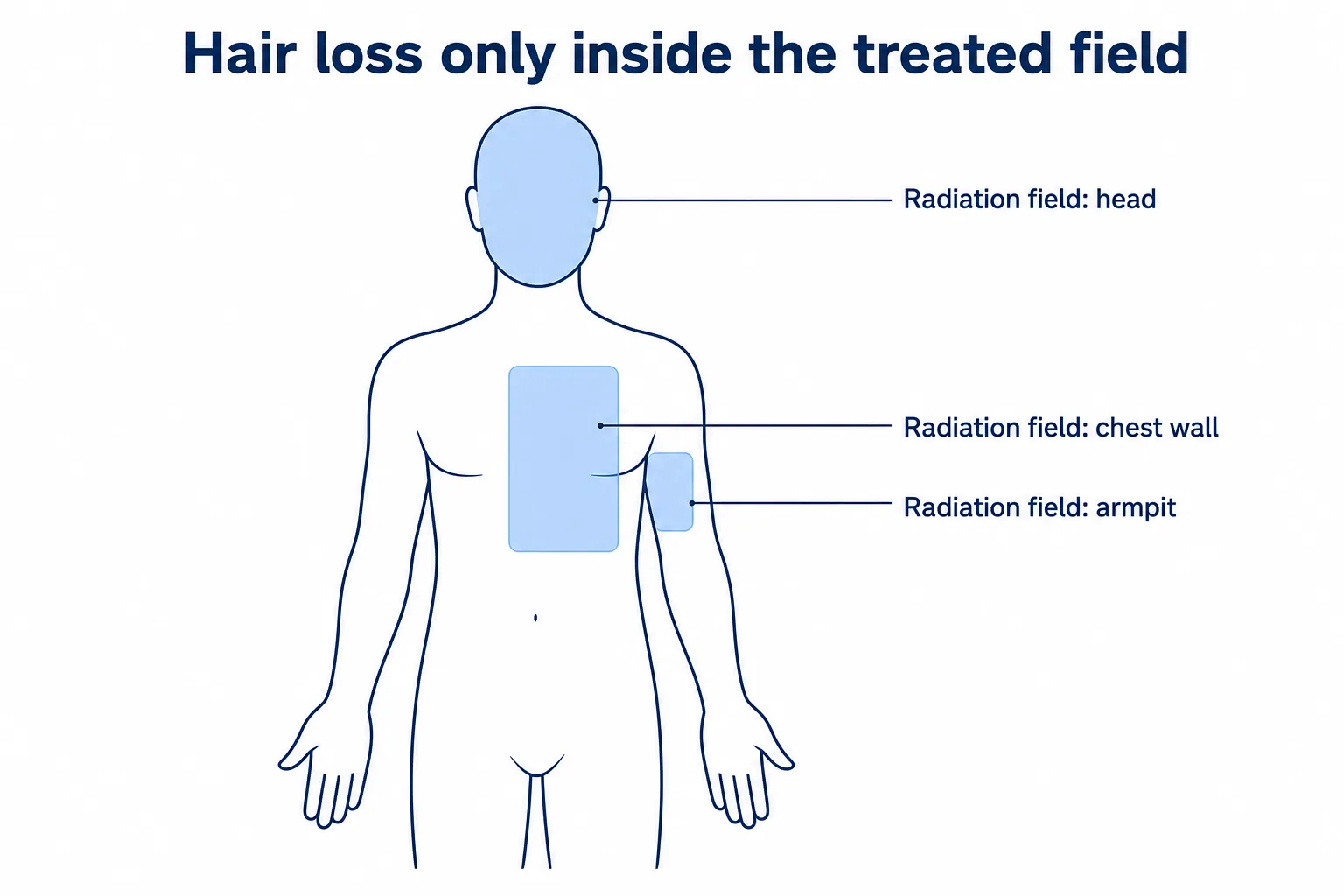
| Irradiated region | Scalp hair affected? | Other hair in the field | Typical course |
|---|---|---|---|
| Breast and chest wall | No | Fine hair on the chest wall and upper chest possible | Usually temporary, dose at the follicle lower than on the head |
| Armpit and lymph node region | No | Underarm hair on the treated side | Usually temporary |
| Head, for a brain tumor or brain metastases | Yes, inside the radiation field | Scalp hair inside the field, often at the exit point as well | Dose-dependent, permanent loss possible at high doses |
| Whole-brain radiation | Yes, the entire head | All scalp hair | Higher risk of permanent loss at high total doses |
| Head and neck region | Yes, wherever the scalp lies inside the field | Beard hair; close to the face, eyelashes and eyebrows as well | Depends on the exact course of the field |
| Pelvis and lower abdomen | No | Pubic hair inside the field | Usually temporary |
| Total body irradiation before a stem cell transplant | Yes, the entire head | All body hair | Usually combined with chemotherapy, course depends on the dose |
Why radiation therapy causes hair loss
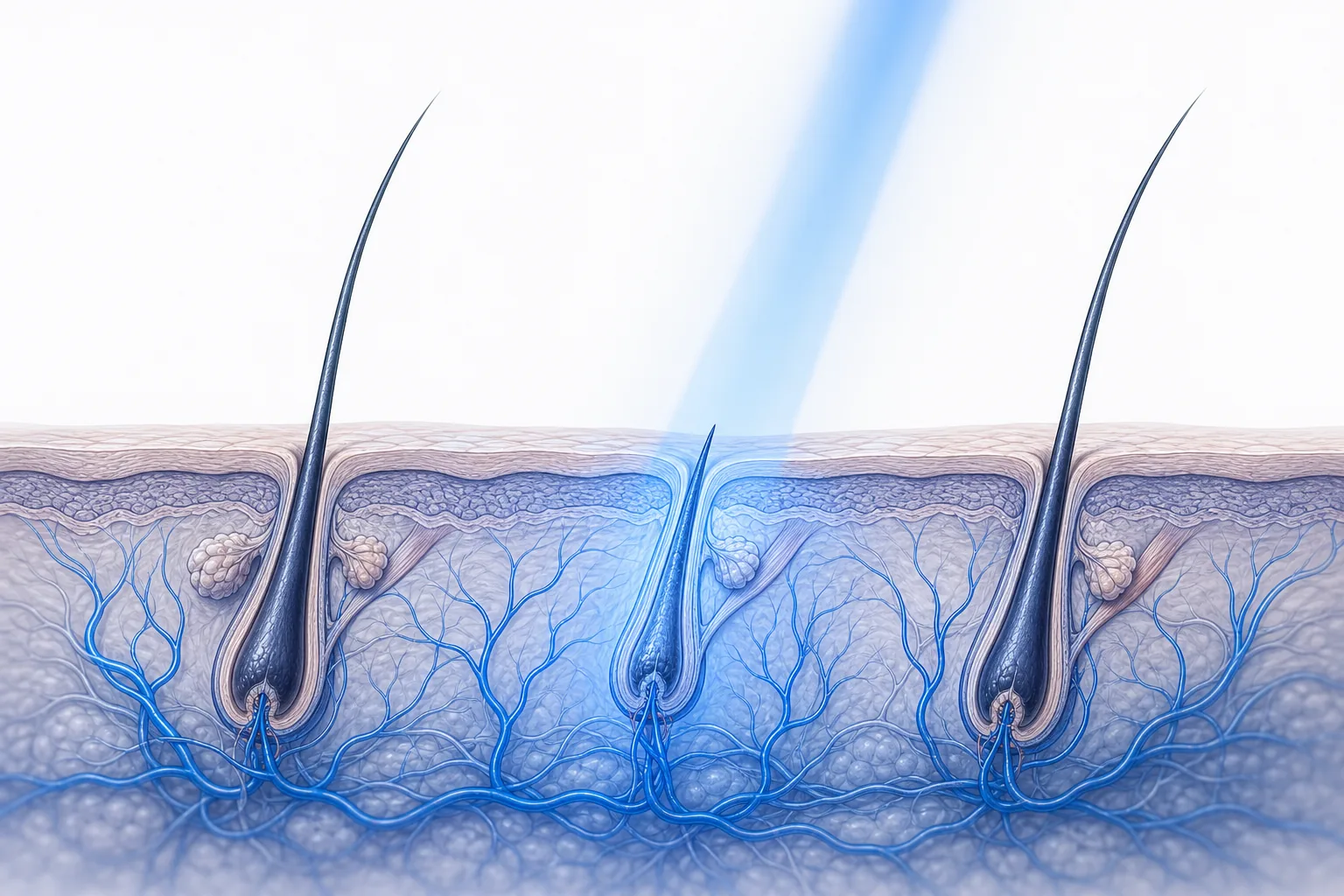
Ionizing radiation hits rapidly dividing cells hardest, and that includes the matrix cells of the hair follicle during the growth phase. The acute hair loss seen with radiation therapy is therefore called anagen effluvium: the hair breaks off or falls out inside the treated field, while the follicles outside the field remain untouched.
To reach the tumor, the beam passes through the scalp and the hair follicles located there. Even with carefully planned radiation, this cannot be avoided entirely. The higher the dose arriving at the follicle and the larger the field, the greater the risk of hair loss.
This has to be distinguished from telogen effluvium: a diffuse hair loss that only sets in weeks after a trigger such as a serious illness or surgery and affects the whole head. The two forms are tied to different phases of the hair cycle, which explains why they run such different courses.
The radiation itself follows the treatment plan drawn up by radiation oncology. Hair loss is a side effect that recedes in many cases, and it is no reason to skip a session or postpone treatment. If the hair loss is weighing on you, bring it up with your treatment team.
Hair loss after radiation to the head: only inside the treated field
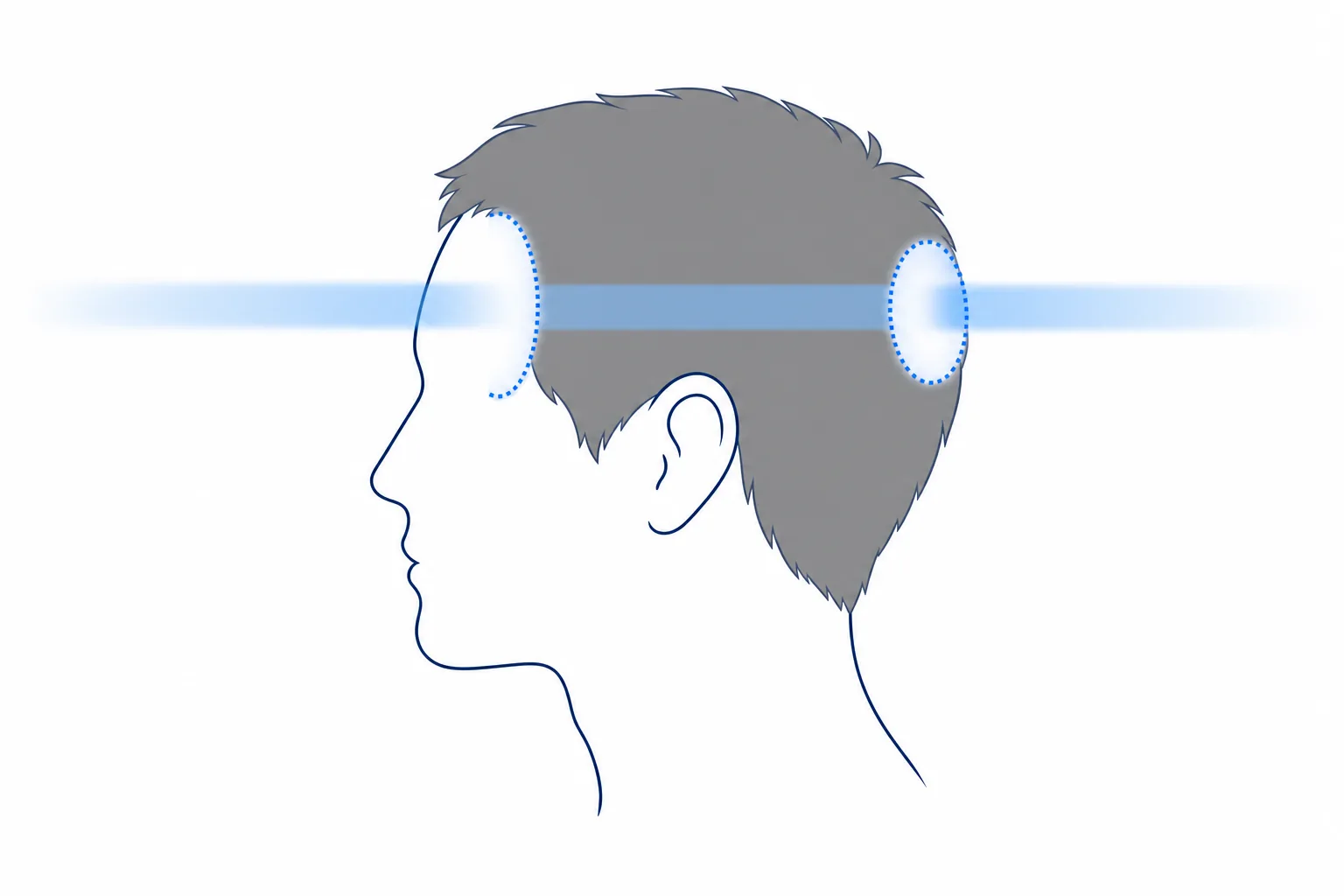
Hair loss after radiation to the head almost always affects exactly the treated area, not the whole head. The typical pattern is circumscribed, often roundish, with a blurred edge. Diffuse loss across the entire scalp is rare with radiation to the head alone.
What surprises many people: the hair often falls out on the opposite side as well, where the beam exits the head. Cancer Research UK describes this exit point explicitly, and Macmillan Cancer Support names both the entry and the exit area of the beam as affected.
The whole head is only affected if the field covers it, that is, with whole-brain radiation or with total body irradiation before a stem cell transplant. The American Cancer Society notes that nearly all patients receiving external radiation to the head, neck or central nervous system experience hair loss.
If loss does occur across the entire head, neither the radiation nor the psychological strain is usually responsible. The cause is most often chemotherapy given at the same time, and less often telogen effluvium after a serious illness or surgery. For help telling the patterns apart, see the article on diffuse hair loss.
What happens to eyebrows and eyelashes?
Eyebrows and eyelashes only fall out during radiation therapy if they lie inside the radiation field. In practice this only happens with radiation to the head and neck region, when the field reaches close to the face; the American Cancer Society lists head, neck and central nervous system radiation as the situations in which hair loss occurs almost as a rule. With radiation to the breast or the pelvis, brows and lashes are untouched.
If you lose scalp hair, eyebrows and eyelashes at the same time, that argues against radiation as the cause. This pattern fits chemotherapy, which travels through the bloodstream and reaches every hair root in the growth phase, and not a locally confined treatment. If in doubt, ask your team which areas your radiation field actually covers.
The same logic applies to regrowth as on the head: at a lower dose inside the field the follicles are likely to recover, while at a high dose permanent loss is possible here too. The literature does not provide solid figures specifically for brows and lashes. Many people fill the gap cosmetically with an eyebrow pencil or stick-on brows; on irritated skin inside the field, the same caution applies as with any other product.
What people typically report after radiation to the head
Anyone looking for accounts of hair loss caused by radiation to the head will find four observations that come up again and again and that are also documented in the patient information from Cancer Research UK and Macmillan: the bald patch at the exit point on the opposite side, the sharp edge between irradiated and non-irradiated hair, the changed texture of the regrowth, and a scalp that feels tight or burns even before the hair falls out.
You will find no invented personal accounts here, and that is deliberate. Anyone looking to connect with others going through the same thing can do so through psychosocial cancer counseling services and support groups; the social work team at the center where you are treated, or a national cancer organization, can point you to the ones near you.
Radiation therapy or chemotherapy: two different kinds of hair loss
Hair loss during radiation therapy and during chemotherapy arises in two different ways. Chemotherapy acts systemically through the bloodstream and reaches every hair root in the growth phase, while radiation therapy acts locally and only inside the treated field. This results in different patterns, different courses and different prospects for regrowth.
After chemotherapy, the hair virtually always comes back, usually within a few weeks to months after treatment ends and at first as fine fuzz. After radiation, whether it returns depends on the dose, and regrowth tends to set in more slowly. The literature gives no reliable figures for how much more slowly.
Scalp cooling caps are of no help during radiation. Their lack of effect in radiation therapy has been published under the title “No prevention of radiotherapy-induced alopecia by scalp cooling” (PMID 26381532); with chemotherapy, by contrast, the effect is documented, among others in the HOPE trial. The reason lies in the mechanism: cooling reduces blood flow and thereby keeps the drug away from the follicle, and that offers no protection against ionizing radiation.
| Feature | Radiation therapy | Chemotherapy |
|---|---|---|
| How it acts | Locally, only inside the treated field | Systemically through the bloodstream, throughout the body |
| Areas affected | Only the treated area, often the exit point as well | Scalp hair, eyebrows, eyelashes and body hair |
| Onset | Usually 2 to 3 weeks after treatment starts | Usually 2 to 3 weeks after the first dose |
| Pattern | Circumscribed, with a blurred edge | Diffuse across the entire head |
| Return of the hair | Dose-dependent: usually yes at a low dose, not certain at a high dose | Virtually always, once treatment has ended |
| Speed of regrowth | Tends to be slower | Comparatively fast, often within weeks as fine fuzz |
| Permanent loss possible? | Yes, at a high cumulative dose at the follicle | Rarely, only with certain intensive protocols |
| Scalp cooling cap effective? | No, documented to be ineffective (PMID 26381532) | Yes, effect documented (HOPE trial) |
How long does hair loss last after radiation?
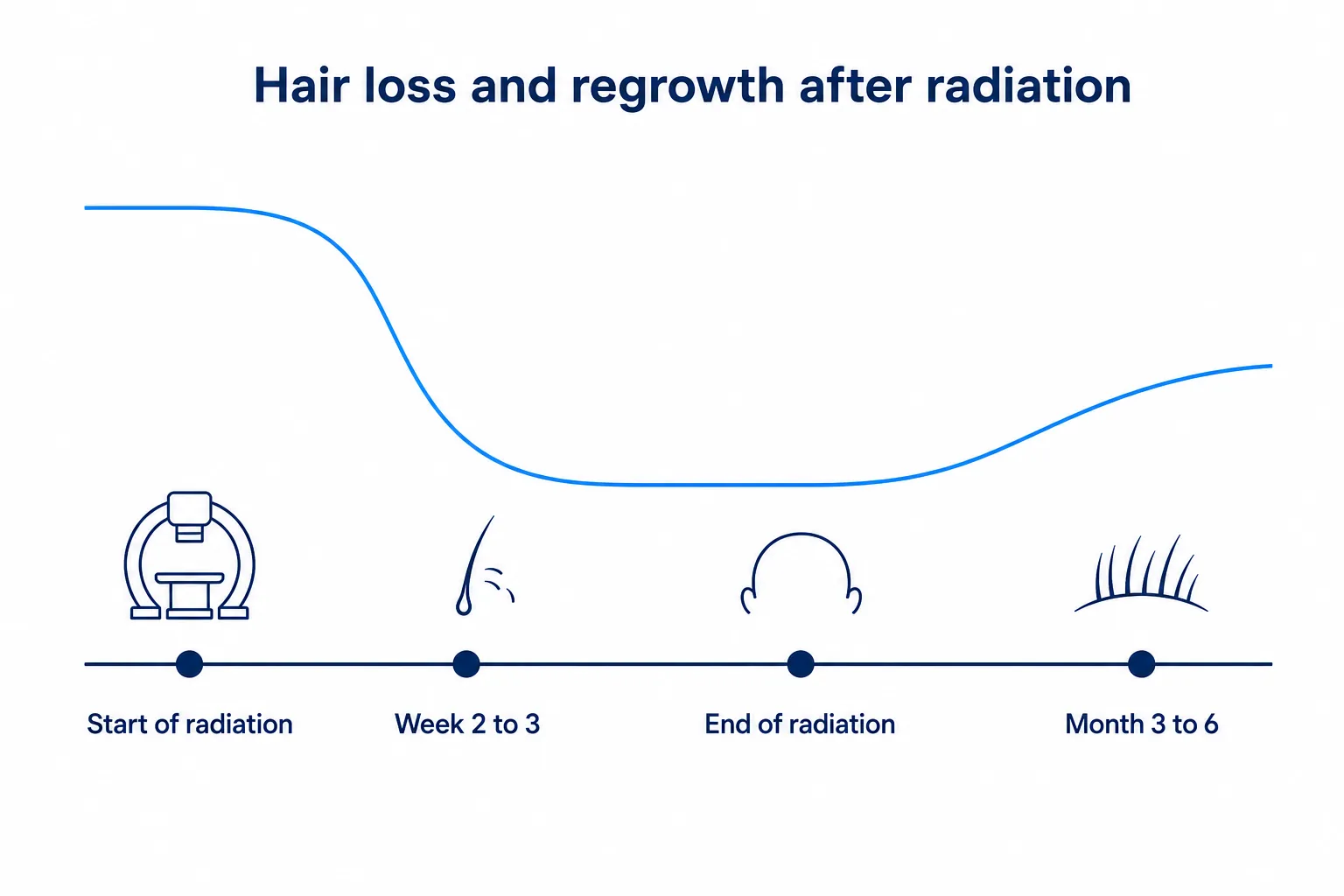
Hair loss after radiation usually begins 2 to 3 weeks after the first session. This time frame is given consistently around the world, among others by Cancer Research UK, Macmillan Cancer Support, the American Cancer Society and the German Cancer Information Service at the DKFZ. Once the loss has begun, Macmillan says it takes about another week until the hair inside the field has fallen out completely.
The literature does not name a precise low point. Clinically it falls toward the end of the radiation series or shortly afterward, because the loss comes to a standstill once the radiation ends. According to patient information, visible regrowth is to be expected roughly 3 to 6 months after treatment ends, as a guide value and not as a firm promise.
How long hair loss lasts after radiation depends on several factors at once: on the dose arriving at the scalp, on the size of the field, on the fractionation schedule, on any concurrent chemotherapy and on any previous radiation to the same region. Two people with the same diagnosis can therefore experience very different courses.
| Point in time | What happens to the hair | What you can do |
|---|---|---|
| Start of treatment | No visible loss yet | Arrange the prescription and a fitting for a hair prosthesis now, while your own color and volume can still serve as a template |
| 2nd to 3rd week of treatment | The loss begins inside the treated field | Cleanse the scalp gently, avoid friction, report changes to your team |
| About 1 week after the loss begins | The hair inside the field has usually fallen out completely | Wear a soft head covering, protect bare areas from the sun consistently |
| End of radiation | The loss comes to a standstill | Keep your follow-up appointments, let the skin reaction heal |
| About 3 to 6 months after treatment ends | First visible fuzz, density builds up gradually | Stick with gentle care, keep holding off on coloring and chemical treatments |
| From 6 to 12 months with no regrowth | Permanent loss becomes more likely | Have it assessed by radiation oncology and dermatology |
Does hair grow back after radiation?
In most cases yes: the hair grows back after radiation once treatment is complete, although more slowly than after chemotherapy. How completely depends above all on the dose that reached the follicles inside the field.
It can take weeks to months after radiation before the first hairs become visible on bald or heavily thinned areas. With chemotherapy, fine fuzz often appears shortly after the drugs are stopped. With shorter, lower-dose radiation, the hair roots usually recover on their own.
The regrowing hair can change. Macmillan Cancer Support mentions thinner, uneven hair and a different color, and the American Cancer Society additionally mentions a changed texture, straight instead of curly for example. How pronounced this is varies from person to person; the literature gives no figure for how often it happens. In many cases the hair evens out again over the following months.
There is no documented number of weeks after which regrown hair may be colored or toned again. As a rule of thumb: only once the skin reaction on the scalp has healed completely and after checking with your treatment team, because freshly regrown hair and irradiated skin can react more sensitively.
If nothing grows back after 6 to 12 months, this should be assessed by radiation oncology and dermatology. Behind it can lie permanent radiation-induced alopecia, in which the follicles inside the field have been destroyed. What tips the balance is explained in the next section.
Temporary or permanent: the role of the radiation dose
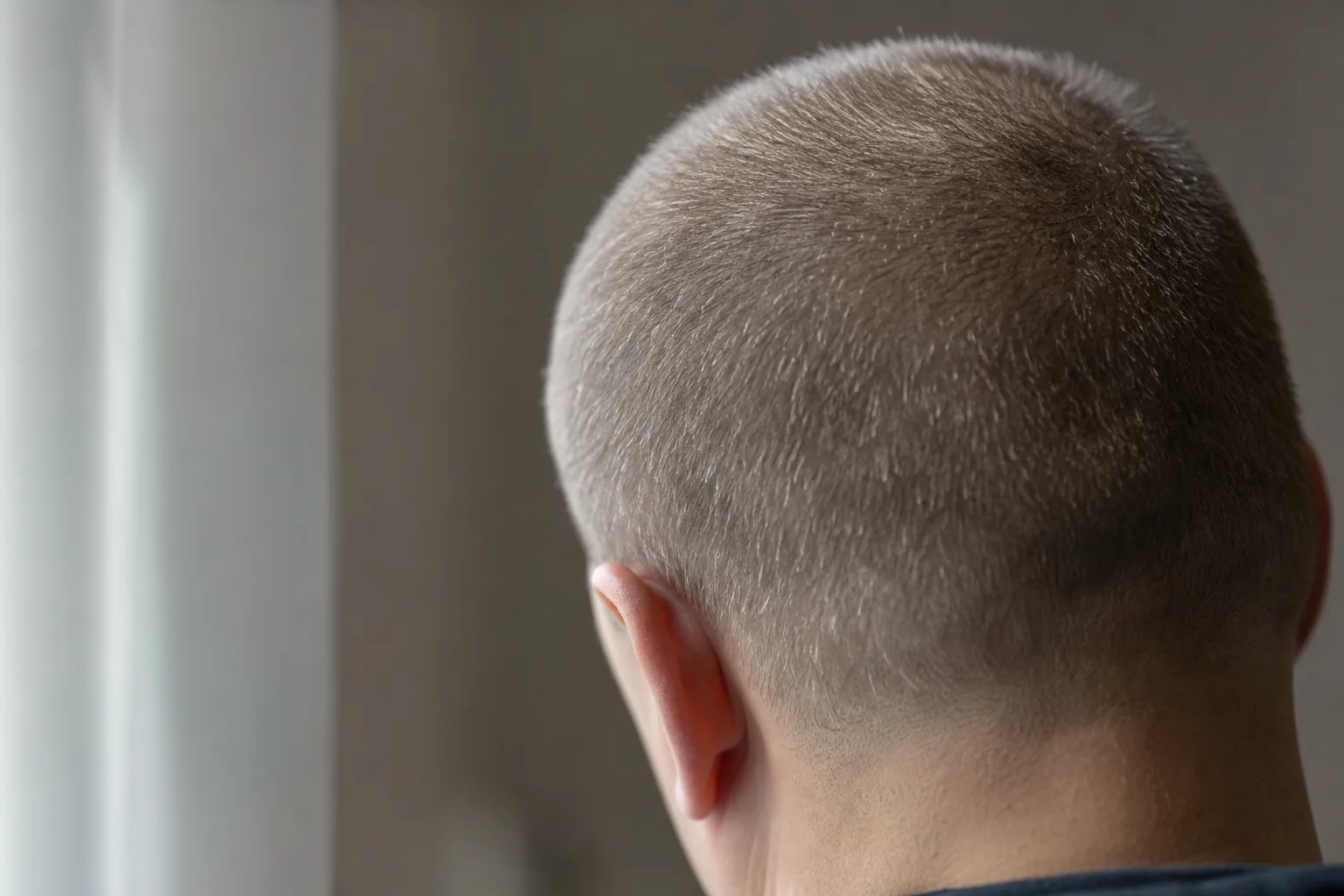
Whether the hair comes back is decided above all by the radiation dose that reached the scalp. Below certain thresholds the follicles usually recover, and as the dose rises the risk of permanent alopecia increases. The published threshold values, however, differ widely depending on the study, the technique and the patient group.
Writing in the International Journal of Radiation Oncology, Biology, Physics in 2004, Lawenda and colleagues reported a cumulative follicle dose of about 43 Gy at which half of the patients developed permanent alopecia. Phillips and colleagues, writing in JAMA Dermatology in 2020, placed temporary loss at around 20 Gy and above, and permanent loss rather above 30 to 36 Gy mean dose.
A prospective study by Jia-Mahasap and colleagues (2024) found thresholds for the scalp as a whole of around 22 Gy for temporary and around 37 Gy for permanent loss, each as a D2 value and assessed after six months. These figures are reference points from individual cohorts and not a universally valid limit for the individual case.
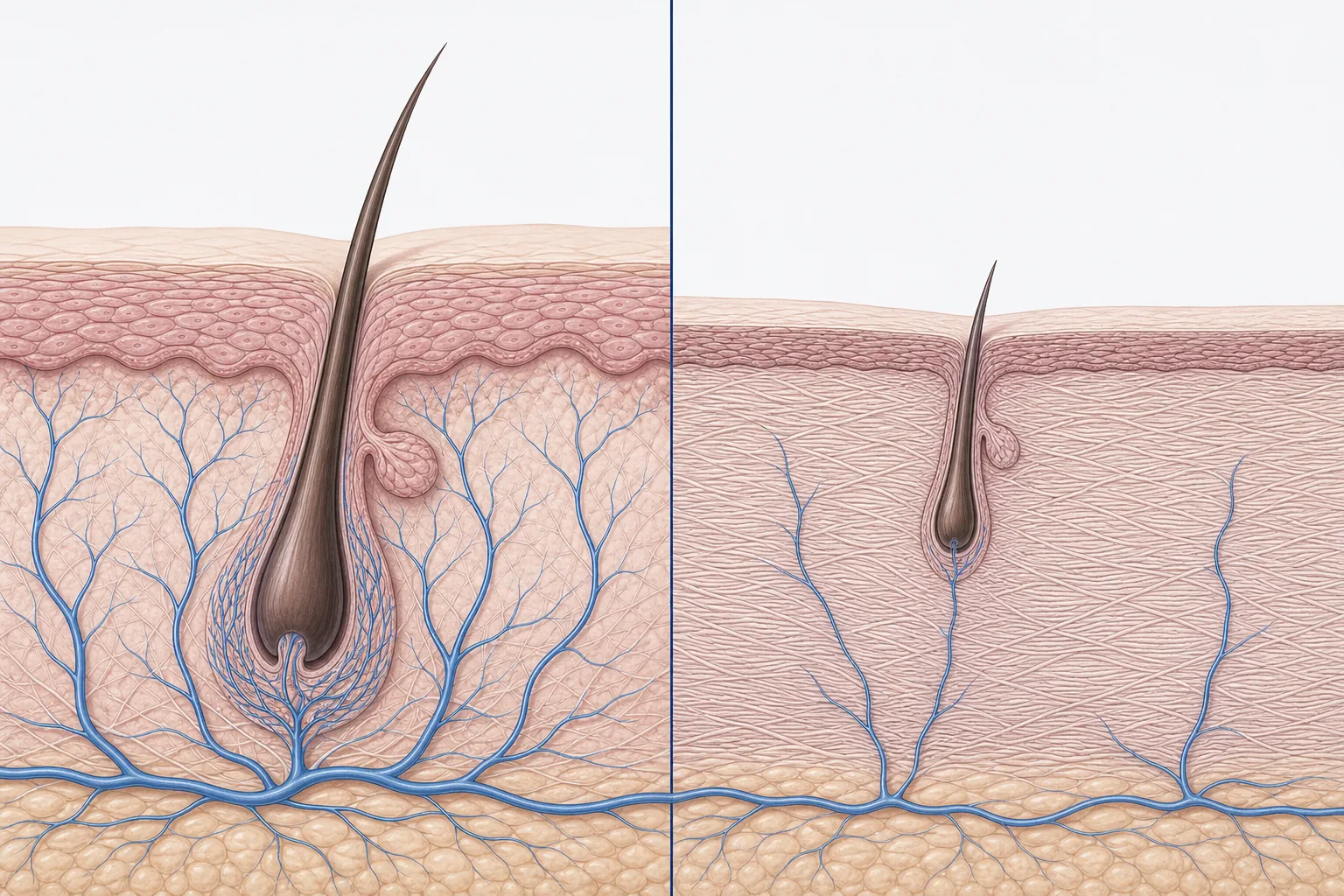
In technical terms, two processes exist side by side. In temporary alopecia the follicle survives and merely pauses its growth phase. In permanent, scarring radiation-induced alopecia the follicle is destroyed: studies of irradiated skin describe a thinned epidermis, atrophied follicles, denser collagen and a reduced blood supply. This is the same underlying process as in scarring hair loss.
So radiation to the head does not automatically leave the scalp free of scarring. The risk rises further with repeat radiation to the same field, with very large fields and with concurrent chemotherapy: in the pediatric group in Phillips (2020), the threshold for permanent loss under combination therapy was already around 21 Gy. Pre-existing hereditary hair loss is likely to overlay the picture further, although the dose studies do not document this.
Temporary or permanent: how to classify it by dose and situation
✓ If the dose inside the field was low
Roughly below the lower documented thresholds of about 20 Gy follicle dose, the hair loss is usually temporary. Regrowth after treatment ends is likely.
✓ If the dose was in the middle range
Roughly between 20 and 40 Gy, depending on the study, the risk of delayed or incomplete regrowth increases. The course varies widely from person to person here.
✓ If the dose was high or the whole brain was irradiated
Roughly above 40 to 50 Gy cumulative follicle dose, depending on the study, the risk of permanent, scarring alopecia is clearly increased.
✓ If the same field was irradiated again
The doses add up at the follicle. That further increases the risk of permanent damage, even if the individual series was low-dose on its own.
✓ If radiation and chemotherapy came together
The hair loss tends to be more pronounced and to last longer. In children on combination therapy, a lower threshold for permanent loss was observed (Phillips 2020).
This classification is not a prognosis for the individual case. The dose your scalp actually received is recorded in your radiation treatment plan and can only be assessed by radiation oncology.
Scalp care during radiation
An irradiated scalp is more sensitive than healthy skin. Gentle cleansing, consistent sun protection and as little mechanical irritation as possible are what you can do yourself during radiation. The instructions from your radiation therapy team always take priority, because the skin markings and the clinic’s own rules come into play there as well.
Specialist articles on preventing radiation dermatitis, including reports from the German Society of Radiation Oncology (DEGRO), recommend pH-neutral cleansing products free of fragrances and irritants as well as urea-based creams for care. Powder is advised against, because it dries the skin out further.
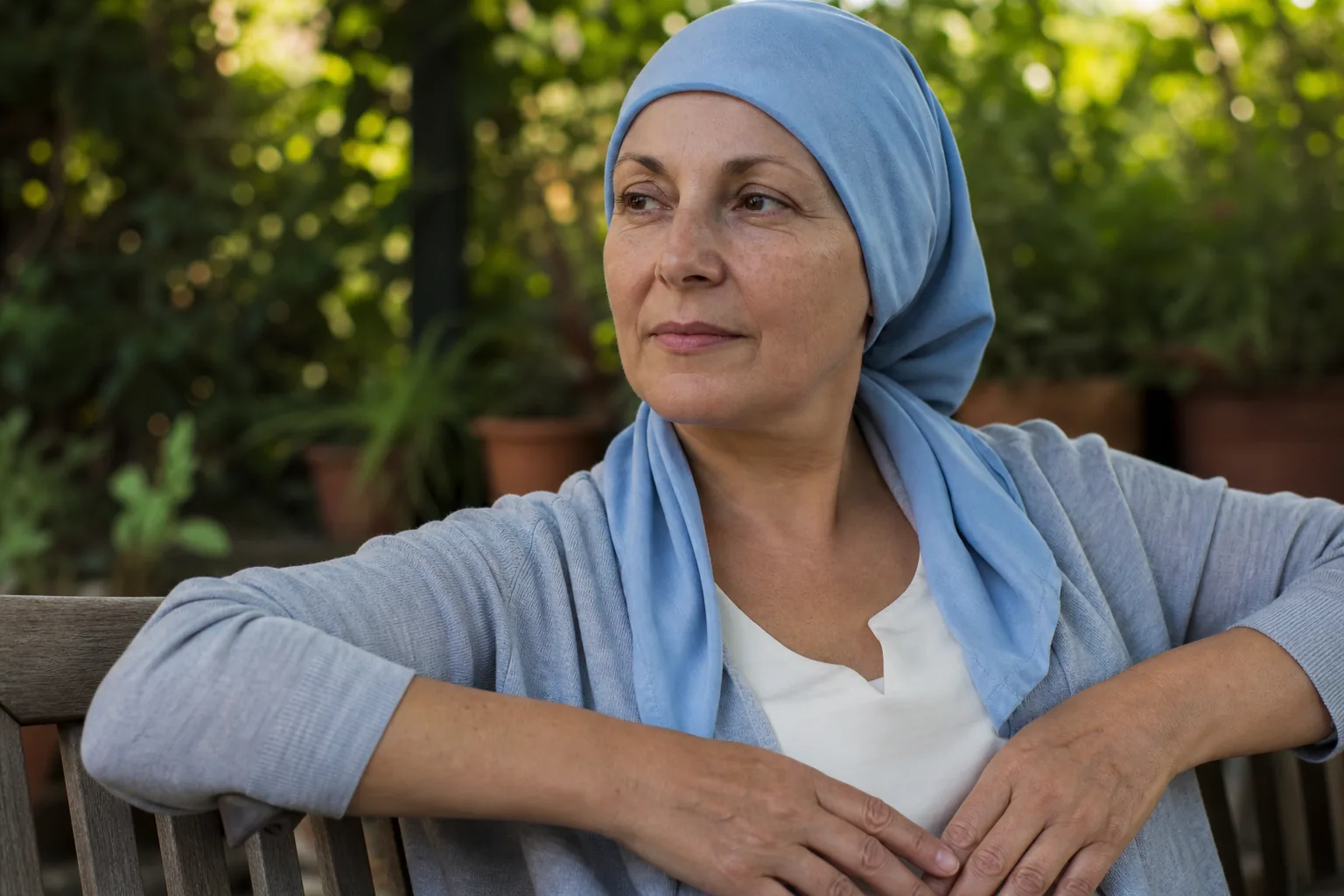
Once the hair inside the field falls out, the scalp loses its natural UV protection. The Spanish cancer society AECC points out explicitly that the scalp is then no longer protected from the sun and should be covered. Which products are suitable on irradiated skin is something to clarify with your treatment team.
With head coverings, the material makes the difference. Smooth cotton, silk, modal and bamboo viscose are soft and breathable; they sit without scratching and do not trap heat. Avoid coarse wool, stiff inner seams, labels at the neck and tight bands, because pressure and chafing inside the treated field intensify the skin reaction, something the DEGRO recommendations warn about explicitly.
A scalp that feels tight, burns or is tender to pressure, often even before the hair falls out, is a known side effect and is described as radiation dermatitis. That is not unusual and is no sign that anything has gone wrong. Redness, itching and flaking should still be brought up rather than treated on your own.
There is no universal rule about wearing a wig during the radiation session itself. With radiation to the head using a fixation mask there is usually no room for one anyway, and material on the skin can increase the skin dose, an effect described for thermoplastic masks. As a rule, no wig is worn during the session; what applies in your case is something your team on site will tell you.
No hair growth products on irradiated scalp without medical advice
Inside the treated field the skin barrier is disrupted. The prescribing information for minoxidil products notes that a disrupted skin barrier can lead to increased absorption of the active ingredient; alcohol-based solutions and propylene glycol can also sting badly. Minoxidil has not been studied specifically on acutely irradiated scalp, which is why the precautionary principle applies here. The same goes for home remedies, oils and tinctures on irritated skin.
| Area | Recommendation | Background |
|---|---|---|
| Washing | Lukewarm water, a mild pH-neutral shampoo without fragrances, gently and without rubbing | Irritants and hot water intensify radiation dermatitis (DEGRO) |
| Drying | Let it air-dry or blow-dry on a cool setting | Heat puts additional strain on already damaged skin |
| Brushing and styling | Soft brush, no tight braids, no clips | Pulling and friction irritate the scalp inside the field mechanically |
| Coloring and chemical treatments | Pause during treatment and the recovery phase | Principle: no irritants on sensitive skin. There is no dedicated study on hair dye during radiation |
| Sun protection | Cover bare and irradiated areas consistently, discuss product choice with your team | Without hair, the scalp lacks its natural UV protection (AECC, DEGRO) |
| Head covering | Smooth cotton, silk, modal or bamboo viscose; no coarse wool, no scratchy seams, nothing that presses on the irradiated area | Pressure and chafing inside the field add to the skin reaction |
| Shaving | Electric rather than wet shaving inside the treated field | Precautionary principle on irritated, vulnerable skin |
| Itching and redness | Raise it with your treatment team, do not treat it yourself | Your clinic knows your field and your dose and can prescribe something targeted |
| Hair growth products | Do not apply them on irradiated skin without medical advice | A disrupted skin barrier can increase absorption (minoxidil prescribing information) |
Wigs and hair prostheses: sorting out coverage
When hair loss is caused by illness, a hair prosthesis is a reimbursable benefit in many countries. How much is covered differs from country to country, and often from region to region as well. In the US a hair replacement is prescribed medically as a “cranial prosthesis,” and whether and how much of it is reimbursed depends on your insurance plan.
The practical route is the same everywhere: obtain a prescription or a written confirmation of medical necessity from your doctor, and do it early. Clarify coverage before you buy, not afterward, and have the prescription written accordingly. You can get binding information from the social services department at your treating hospital, from patient support at your cancer center or directly from your insurance plan.
In practical terms, an early appointment pays off: ideally the prescription and the fitting before the hair falls out, while your own color and volume can still serve as a template. Several European cancer societies give this same advice. During the treatment period a hair prosthesis is often the simplest solution, because nothing about the scalp itself has to change.
For many people, visible hair loss is the most distressing part of treatment. There are places to turn to for this: hospitals and cancer centers usually have social work and psycho-oncological support, and cancer organizations run counseling services that are often free of charge. Ask about what is available where you are treated, and ask early rather than once the strain has built up.
Hair transplant after radiation therapy: what is realistically possible
After radiation therapy, a hair transplant comes into consideration at the earliest once the oncological treatment is complete, the scalp has healed stably and the treating physicians have given their approval. And on irradiated skin, the starting conditions are worse than on a healthy scalp.
The reason lies in the tissue. Studies of irradiated skin describe a thinned epidermis, denser collagen, atrophied hair follicles and a reduced blood supply. That blood supply is exactly what transplanted follicles need in order to take. In the professional forum of the International Society of Hair Restoration Surgery, transplantation on irradiated scalp is accordingly listed among the difficult cases.
On timing: treatment completed, a stable situation and no repeat radiation planned for the same region. Freshly transplanted follicles would not survive renewed radiation in the same field. How long the interval has to be is decided by oncology, not by the wish for denser hair.
Whether a transplant is possible at all, and to what extent, is decided by a medical examination in each individual case. With extensive fibrosis the achievable result can be limited; sometimes several smaller sessions or a lower density are the more realistic plan. In methodological terms, the starting situation resembles a hair transplant on scars.
That also includes an honest no: after high-dose radiation, the tissue can be so severely damaged that a transplant is out of the question. In that case a medical hair prosthesis is the solution that holds up permanently, and it is not a step backward. With an irradiated scalp, no one can responsibly promise you in advance that a procedure will succeed.
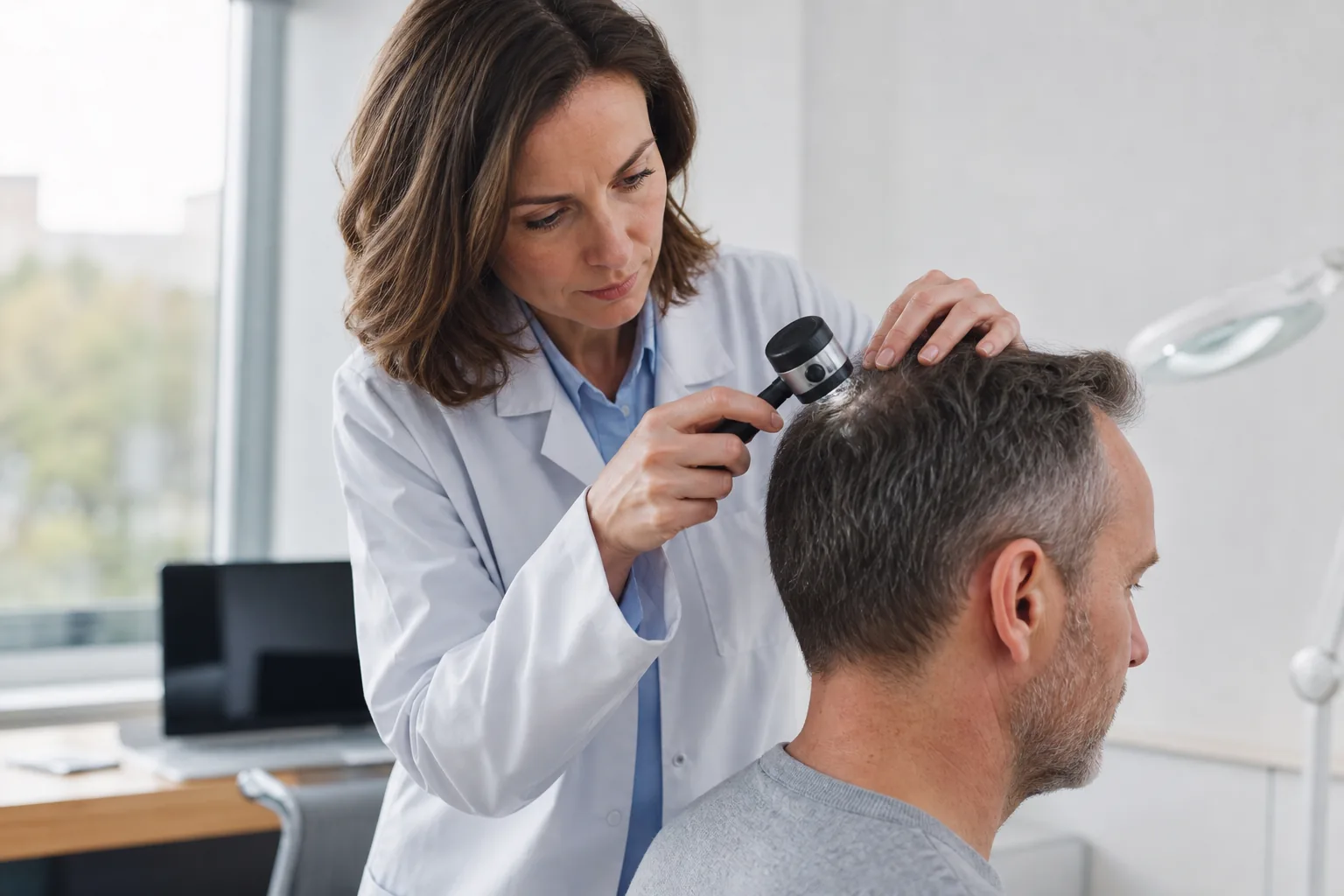
Before any of this comes the question of what kind of hair loss is actually present: a radiation effect inside the field, a temporary effluvium after a serious illness, or an unrelated hereditary hair loss that happens to be progressing at the same time. A hair analysis classifies the pattern visually and is therefore one step toward clarity, not a finding and no substitute for a medical work-up.
With an irradiated scalp, this classification has a clear limit: radiation-induced fibrosis cannot be seen in photos. Whether the scalp meets the requirements for a procedure is only shown by a physical examination on site, with palpation of the skin and assessment of the blood supply, and exclusively after clearance from the treating oncologists. The visual analysis therefore only answers the preliminary question of which hair loss pattern is present in the first place.
The free hair analysis classifies your hair visually. It does not assess an irradiated scalp, does not provide a diagnosis and replaces neither the conversation with your oncology team nor an examination on site.
When hair loss is temporary and when to have it assessed by a doctor
Whether hair loss after radiation therapy remains temporary depends on the radiation dose and the duration of treatment. With shorter, lower-dose series the hair roots usually recover on their own, and it is not unusual for hair that had already been given up for lost to grow back around six months after treatment ends without any further intervention.
And this is not limited to radiation for brain tumors. Hair loss on the head can occur with any radiation in which the scalp lies in the beam path: with brain tumors and brain metastases, with head and neck tumors, with skin tumors of the scalp, with whole-brain radiation and with total body irradiation before a stem cell transplant.
Patience is the right approach in the first months, because the follicles need time to recover. There are four situations in which that does not apply. In those cases you should have the hair loss assessed medically, by radiation oncology with your treatment team or by a dermatology practice.
When to have your hair loss assessed by a doctor
✓ No regrowth after 6 to 12 months
From this point on, permanent loss becomes more likely. In the dose studies, too, permanence is not assessed until six months at the earliest.
✓ Inflamed, weeping or shiny, scarred scalp
That can point to a scarring change inside the field and should be looked at promptly, regardless of hair growth.
✓ Sudden diffuse loss across the whole head
That does not fit locally confined radiation and points instead to a telogen effluvium or a drug effect. For context, see the article on extreme hair loss and on hair loss caused by medication.
✓ Round bald patches outside the radiation field
Sharply defined round patches beyond the treated area point instead to alopecia areata, a separate diagnosis with its own treatment.
Hair loss after radiation: your next steps
When it comes to hair loss after radiation, there are six things you can take into your own hands, no matter where you currently stand in your treatment. The order follows the timeline, from the planning consultation to follow-up care.
1. Ask at the planning consultation whether your scalp lies inside the field
That is the question that determines whether you will lose scalp hair. Have them show you which region will be irradiated and whether the beam passes through the scalp on its way to the tumor. With radiation to the breast, the answer is no.
2. Arrange the prescription for a hair prosthesis early
When hair loss is caused by illness, a hair prosthesis is a reimbursable benefit in many places; in the US it is prescribed as a cranial prosthesis. Have the medical necessity documented, clarify coverage before you buy, and schedule the fitting while your own color and volume can still serve as a template, that is, before the hair falls out.
3. Switch your hair care from the first session onward
Lukewarm water, a mild pH-neutral shampoo without fragrances, no rubbing, a soft brush, no tight braids. Put coloring, bleaching and flat irons on hold until after the recovery phase.
4. Cover bare areas and do not apply anything of your own
Without hair, the natural UV protection is missing. A soft head covering of cotton, silk or bamboo viscose, and sun protection products only after checking with your team. Hair growth products, oils and home remedies do not belong on irradiated skin without medical advice.
5. Note the date of your last session
From that day the clock starts running for regrowth: as a guide value, 3 to 6 months until the first visible fuzz. If nothing happens after 6 to 12 months, have it assessed by radiation oncology and dermatology instead of continuing to wait.
6. Speak up about the strain if it persists
For many people, visible hair loss is the most distressing part of treatment. Cancer information services and cancer societies keep directories of psychosocial cancer counseling services, whose counseling is usually free of charge.
A hair transplant only becomes a topic once the oncological treatment is complete, the scalp has healed stably and a physician has given clearance, and even then only after an examination on site. Until then the question stays open, and with an irradiated scalp that is the more honest answer than any promise.
Frequently asked questions about hair loss after radiation
Does radiation for breast cancer make the hair on your head fall out?
No. Radiation therapy acts only in the treated field, and with radiation to the breast the scalp lies outside it. Hair inside the field itself can fall out, above all the underarm hair on the treated side. The hair loss across the whole head that many breast cancer patients experience almost always comes from chemotherapy given at the same time.
Does radiation make eyebrows and eyelashes fall out too?
Only if they lie inside the radiation field. In practice this only concerns radiation to the head and neck region whose field reaches close to the face. With radiation to the breast or the pelvis, brows and lashes are preserved. If scalp hair, brows and lashes fall out at the same time, that points to chemotherapy as the cause.
How long does hair loss last after radiation?
The loss usually begins 2 to 3 weeks after the first session and is complete inside the field about a week later, as Cancer Research UK and Macmillan Cancer Support describe it. Once the radiation ends, the loss comes to a standstill. Visible regrowth can be expected as a guide value 3 to 6 months after treatment ends.
Does hair grow back after radiation?
In most cases yes, but more slowly than after chemotherapy. What matters is the dose that reached the follicles. At lower doses the hair roots usually recover on their own; at high doses the loss can be permanent. If nothing grows back after 6 to 12 months, you should have it assessed.
Does hair grow back differently after radiation?
That does happen. Macmillan Cancer Support mentions thinner, uneven hair and a changed color, and the American Cancer Society additionally mentions a different texture. How pronounced this is varies from person to person, and the literature gives no figure for how often it occurs. In many cases the hair evens out again over the following months.
At what point is hair loss after radiation permanent?
There is no fixed limit; what matters is the dose at the follicle. Lawenda and colleagues (2004) named about 43 Gy as the dose at which half of the patients developed permanent alopecia; Phillips and colleagues (2020) placed permanent loss rather above 30 to 36 Gy mean dose. The values vary considerably depending on the study and the technique.
May I wash and color my hair during radiation?
Washing yes, coloring no. Lukewarm water and a mild, pH-neutral shampoo without fragrances are recommended, applied gently and without rubbing. Coloring, bleaching, perms and flat irons stay out of the picture during treatment and the recovery phase. The instructions from your radiation therapy team take priority over any general recommendation.
When can I color my regrown hair again?
There is no documented number of weeks for this. As a rule of thumb: only once the skin reaction on the scalp has healed completely and after checking with your treatment team. Freshly regrown hair and irradiated skin react more sensitively, which is why a later date is the safer one.
May I keep my wig on during the radiation session?
As a rule no, but ask your team. With radiation to the head using a fixation mask there is usually no room for one, and material on the skin can increase the skin dose, an effect described for thermoplastic masks. There is no universal rule; what matters is your radiation treatment plan.
Does insurance cover a wig for hair loss caused by cancer treatment?
In many places yes, but the details differ. When hair loss is caused by illness, a hair prosthesis is a reimbursable benefit in many countries, and how much is covered differs from country to country and often from region to region. In the US it is prescribed medically as a cranial prosthesis, and whether and how much is paid depends on your insurance plan. The route is the same everywhere: obtain a prescription or documentation of medical necessity early and clarify coverage before you buy, with your insurance plan, the social services department of your treating hospital or the patient support at your cancer center.
Is a hair transplant possible after radiation therapy?
Only under certain conditions and after an individual medical assessment. The oncological treatment must be complete, the scalp healed stably and clearance given by the treating physicians. Irradiated skin is often fibrotic and less well supplied with blood, which worsens the starting conditions. With extensive damage, a medical hair prosthesis is the solution that holds up.

Sources
- German Cancer Information Service (DKFZ): Hair loss during cancer treatment (local effect, timeline)
- Cancer Research UK: Hair loss and radiotherapy (field relation, exit point)
- Macmillan Cancer Support: Hair loss during treatment (onset after 2 to 3 weeks, changed regrowth)
- American Cancer Society: Hair Loss (Alopecia) (head, neck and CNS radiation, changed texture)
- Lawenda BD et al.: Permanent alopecia after cranial irradiation, dose-response relationship. Int J Radiat Oncol Biol Phys 2004, PMID 15465206
- Phillips GS et al.: Assessment and Treatment Outcomes of Persistent Radiation-Induced Alopecia in Patients With Cancer. JAMA Dermatol 2020, PMID 32756880
- Jia-Mahasap B et al.: Scalp dose analysis for transient and permanent alopecia following conventional cranial irradiation (IGRT), PLOS ONE 2024
- No prevention of radiotherapy-induced alopecia by scalp cooling, PMID 26381532 (scalp cooling caps during radiation)
- DEGRO, the German Society of Radiation Oncology: New findings on preventing dermatitis following radiation therapy (scalp care, radiation dermatitis)
- Coverage for a hair prosthesis: information from your insurance plan or the social services department of your treating clinic (wig and cranial prosthesis coverage)
- German Cancer Information Service (DKFZ): Cancer counseling centers (psychosocial support services)
Last updated: September 2026. This article is for information purposes and does not replace a conversation with your treating radiation oncology and oncology team. The instructions from your radiation therapy take priority over any general recommendation in this text.

Dr. Imad Moustafa
Hair transplant specialist