


Losing up to about 100 hairs a day is normal: the American Academy of Dermatology puts the range at 50 to 100 hairs daily. What matters more than the absolute number is whether your shedding has changed compared with your own baseline. If you suddenly lose noticeably more for weeks, spread evenly across the whole scalp, the reason is usually telogen effluvium, which review articles describe as self-limiting in most cases and ending after 3 to 6 months. This article shows you how to count your shedding in a way that actually means something, where to look for the trigger, and when to take it to a doctor.
The key points
- ✓The trigger almost always sits 2 to 3 months in the past, not in the past few days
- ✓Wash day is deceiving: everything that came loose between two washes comes out at once, which is a collection and not an increase
- ✓With diffuse shedding, the cause gets treated. It is not an indication for a hair transplant
- ✓Sharply defined bald patches, an inflamed scalp, or symptoms such as heavy fatigue should be checked by a doctor soon
Use the table of contents to jump straight to what you need. After that, we go in the order that actually helps: first put the number in context, then look back for the trigger, then act.
Summary
- How many hairs a day are normal? How to count correctly
- Check it yourself: the hair pull test and part-line photos
- What you do not need to do about heavy hair loss right now
- Why the sudden heavy hair loss? The 2 to 3 month time lag
- The four most common conditions behind extreme hair loss
- Extreme hair loss in women: the most common causes
- Sudden heavy hair loss in women: the hormonal life stages
- Diffuse or pattern? The decisive fork in the road
- Warning signs with extreme hair loss: see a doctor right away
- Heavy hair loss: what to do? The first steps in the right order
- When does the shedding stop and when does hair grow back?
- Frequently asked questions about extreme hair loss
- Sources
How many hairs a day are normal? How to count correctly
Losing up to roughly 100 hairs a day counts as normal. The American Academy of Dermatology (AAD) gives a range of 50 to 100 hairs per day, and a practice review from the German Medical Association’s Drug Commission (AkdÄ) gives 60 to 100. Both sources stress the same point: what matters more than the absolute number is the change compared with your own baseline.
The reason you lose hair every day is the hair cycle. At any given moment about 10 to 15 percent of scalp hairs sit in the resting phase (telogen) while roughly 80 to 90 percent are actively growing, as a review of the hair growth cycle (PMC9917549) summarizes. At the end of each resting phase, the hair releases. So a baseline loss is built in, not a defect. There is more on this in the article on the hair cycle.
The most common false alarm happens on wash day. Between two washes, hairs that have already released stay caught in the rest of your hair and only come out when you wash. If you wash every three days, wash day shows you three days of shedding at once. That is a collection, not an increase.
Counting sensibly therefore means counting across a whole week and taking the average instead of judging single days. Here is how to do it:
- Photograph your pillow in the morning, before you make the bed.
- Collect the hairs from the shower drain and from your brush after every use.
- Save everything for one week, one envelope per day, and mark the wash days in your log.
- At the end of the week, add it all up and divide by seven. That daily average is the number to discuss with your doctor.
| Observation | Normal | Keep watching | See a doctor |
|---|---|---|---|
| Hairs per day (weekly average) | up to about 100 (AAD: 50 to 100) | clearly more than usual for you, over several weeks | so much for so long that your hair visibly thins |
| Hair pull test | up to 2 loosened hairs from a bundle of 40 to 60 (McDonald et al. 2017) | 3 to 5 loosened hairs | more than 5, or the same number at several spots on the scalp |
| Distribution | even, part line the same width as always | part looks wider, ponytail thinner, hairline sparser | sharply defined bald patches or round spots |
| Duration | under 6 weeks after a clear trigger | 6 weeks to 3 months | more than 6 months with no improvement |
| Scalp | unremarkable | mild itching, dry flakes | redness, pustules, pain, shiny hairless areas |
| Other symptoms | none | mild fatigue, cold hands | weight change, heart palpitations, feeling cold, cycle changes, nail changes |
Check it yourself: the hair pull test and part-line photos
Two observations help you put heavy hair loss in context: a single, gentle pull test and a series of part-line photos over time. Both give you a sense of where you stand, and neither is a diagnosis. The diagnosis comes from a dermatologist, using trichoscopy and a standardized pull test among other things.
For the pull test, grasp a bundle of about 40 to 60 hairs close to the scalp and draw it through your fingers with gentle traction, without yanking. A study in 181 people (McDonald et al., Journal of the American Academy of Dermatology 2017, PMID 28010890) found no more than 2 loosened hairs in 97.2 percent of healthy participants, with a mean of 0.44 hairs. More than 2 to 3 loosened hairs can therefore be notable.
The older rule of thumb, which called it abnormal only above 10 percent of the grasped hairs, is far cruder and, according to the same study, not supported by the data. Another finding from the same work: the timing of the last hair wash made no difference, so the old instruction to “not wash for five days” is considered outdated.
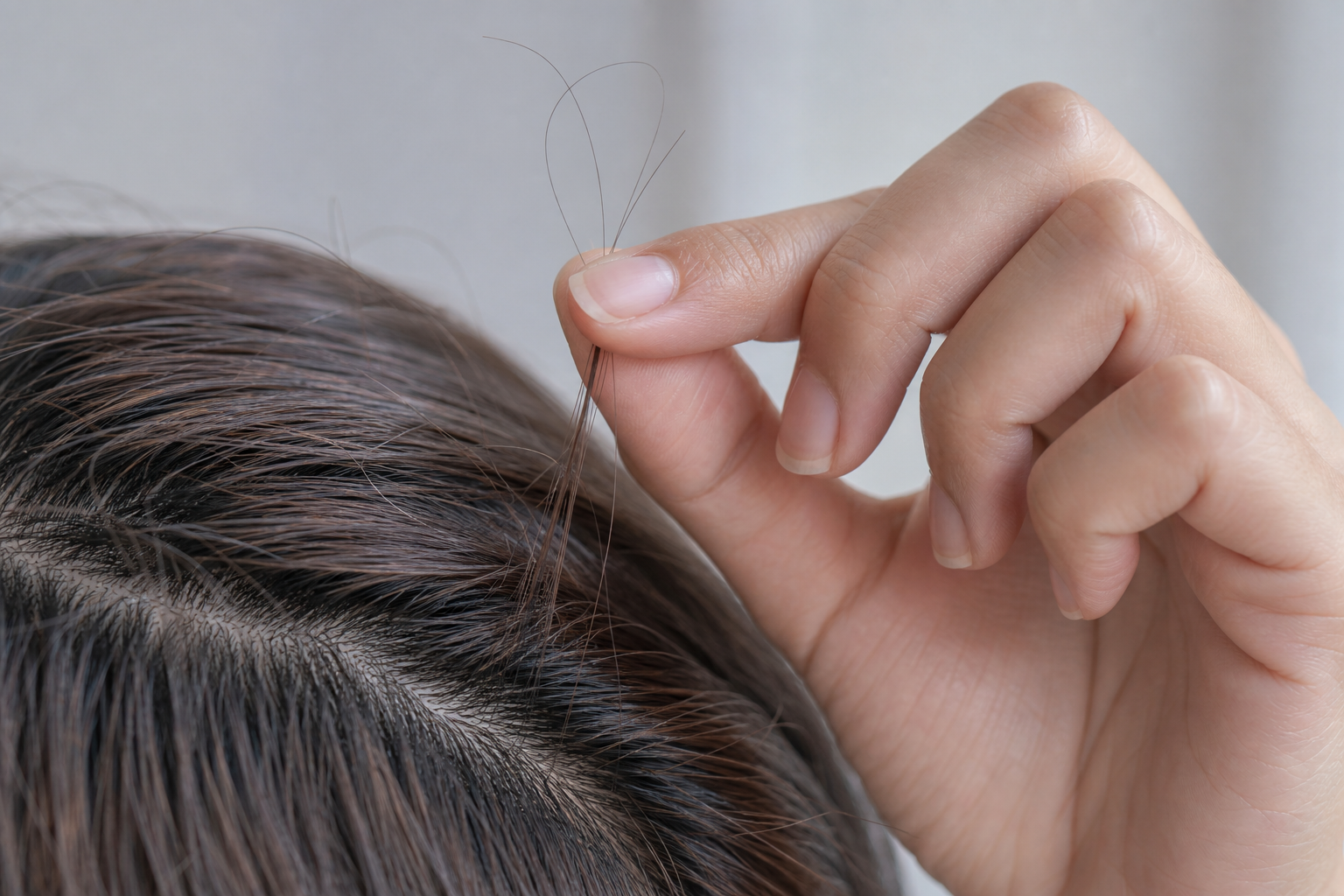
Important for safety: do the test at most once a week, not at several spots in a row, and never on children. Repeated pulling does not give you better information. It only stresses the hair and distorts what you see.
How to photograph your part line for your doctor
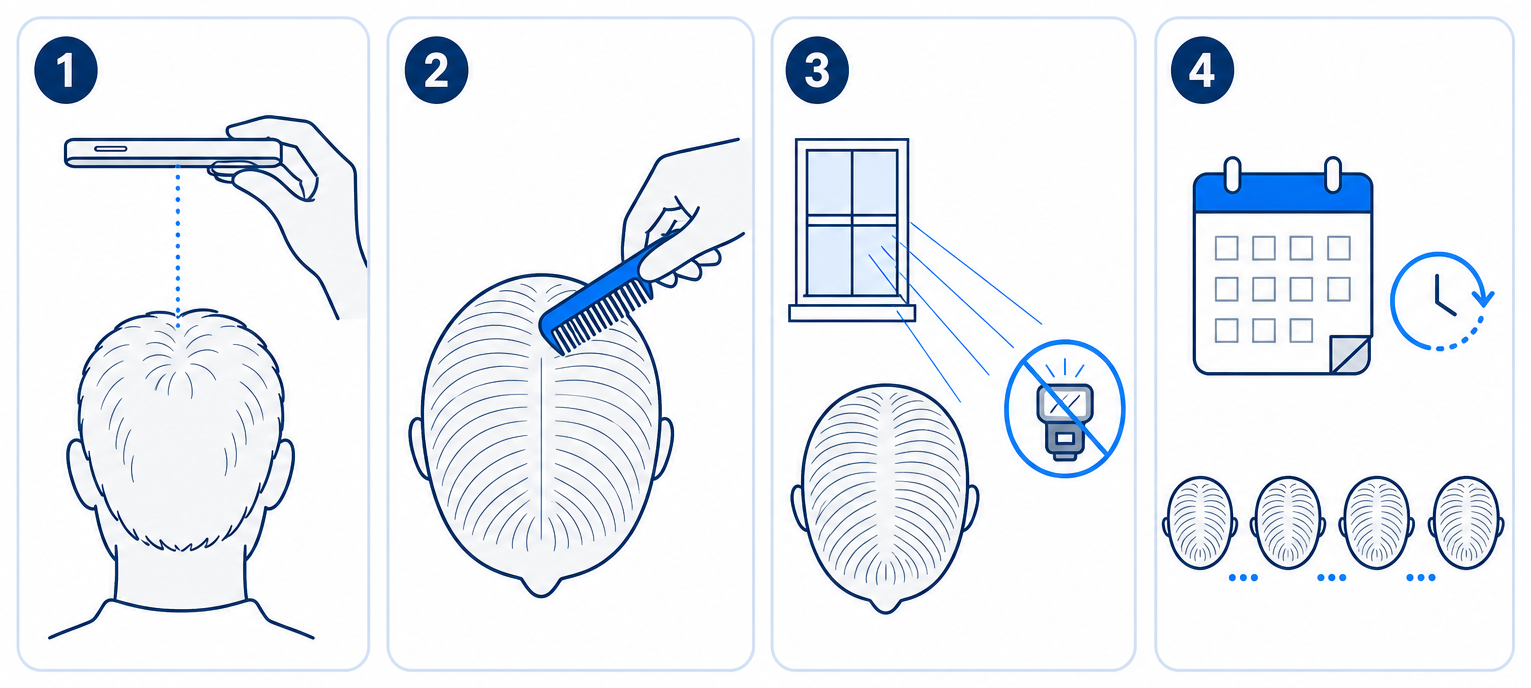
The more informative and completely risk-free self-test is a series of part-line photos. It shows the thinning that everyday glances miss, and it is exactly what is missing in the exam room: hard data on how things changed in the weeks before the appointment. Four rules make the images comparable.
Photo protocol: 4 rules for comparable part-line images
- Always the same time of day and the same light. Daylight by a window, no direct flash, no changing ceiling lamps.
- Comb a clean part line and always use the same line.
- Camera straight down from above, same distance, hair dry and unstyled.
- Note the date, repeat every 4 weeks. Two images a month apart say more than twenty taken on one day.
For women with long hair, ponytail circumference is the most convenient measure over time: mark the circumference with a piece of thread, date the thread, and measure again after 4 and after 12 weeks. The method measures passively, with no pull on the hair, and it picks up volume loss early.
One distinction saves a lot of worry: breakage is not hair loss. Shed hairs with a small whitish thickening at the end are telogen hairs that released normally. Short hairs broken at both ends with no root point to mechanical damage from heat, coloring, or tight ties. That is a different problem with a different solution.
What you do not need to do about heavy hair loss right now
With acute heavy hair loss, you cannot shorten the shedding that is already underway. What you can influence is the trigger, and you can avoid the wrong reactions. Five of them are especially common, and they cost you peace of mind, money, or hair.
Mistake 1: washing less often to slow the shedding
Washing less often does not slow shedding. The hairs are not falling out because of the wash. They have already released and would come out anyway. Gentle washing on your usual schedule is dermatological consensus. If you put off washing out of fear, you just meet the same hairs in a bigger clump on the next wash day.
Mistake 2: cutting your hair so less falls out
Cutting does not reduce the shedding rate. Hair length has no influence on it, because the process happens at the root and not at the tip. A shorter cut can look fuller and make daily life easier. That is a style decision, not a medical measure.
Mistake 3: taking high-dose supplements on suspicion
Supplements without a documented deficiency do nothing for heavy hair loss and can backfire in excess. The NIH Office of Dietary Supplements sets a tolerable upper limit of 400 micrograms per day for selenium against a daily requirement of just 55 micrograms, and hair loss is one of the typical signs of long-term excess. For zinc, the upper limit is 40 milligrams per day.
Those amounts are rarely reached with standard products at normal doses. It gets risky when several products are taken at once, or when someone takes high doses without lab evidence of a deficiency. The articles on vitamins for hair loss and on capsules for hair loss explain what makes sense and what does not.
Mistake 4: constantly tugging at your hair to check
Constant checking distorts your own picture of the shedding. Every extra pull releases hairs that would otherwise have held for weeks, so the number in your hand only seems to rise. Counting once a week and taking a part-line photo every four weeks is entirely enough.
Mistake 5: waiting for an anti-hair-loss shampoo to work
No shampoo ends acute hair loss. Caffeine shampoos, anti-hair-loss shampoos, and thickening shampoos can make hair look and feel fuller. That is cosmetic, and by dermatological consensus it is not treatment of the cause. Spending weeks waiting for an effect costs you the window in which the trigger can still be pinned down reliably.
Why the sudden heavy hair loss? The 2 to 3 month time lag
With sudden heavy hair loss, the trigger almost always lies 2 to 3 months in the past, in individual cases up to 4 months. An acute event pushes many hair follicles out of the growth phase into the resting phase at the same time and ahead of schedule. Those hairs can only fall out at the end of the resting phase. That is exactly why the shedding feels like it came out of nowhere even though it has a clear cause.
The medical name for this pattern is telogen effluvium. A review on the topic (Malkud, Journal of Clinical and Diagnostic Research 2015, PMC4606321) describes visible shedding about 3 months after the triggering event, and the German AkdÄ practice review gives 2 to 4 months for everyday practice. The practical consequence: do not look for the trigger in the past few days, look at your calendar from two or three months ago.
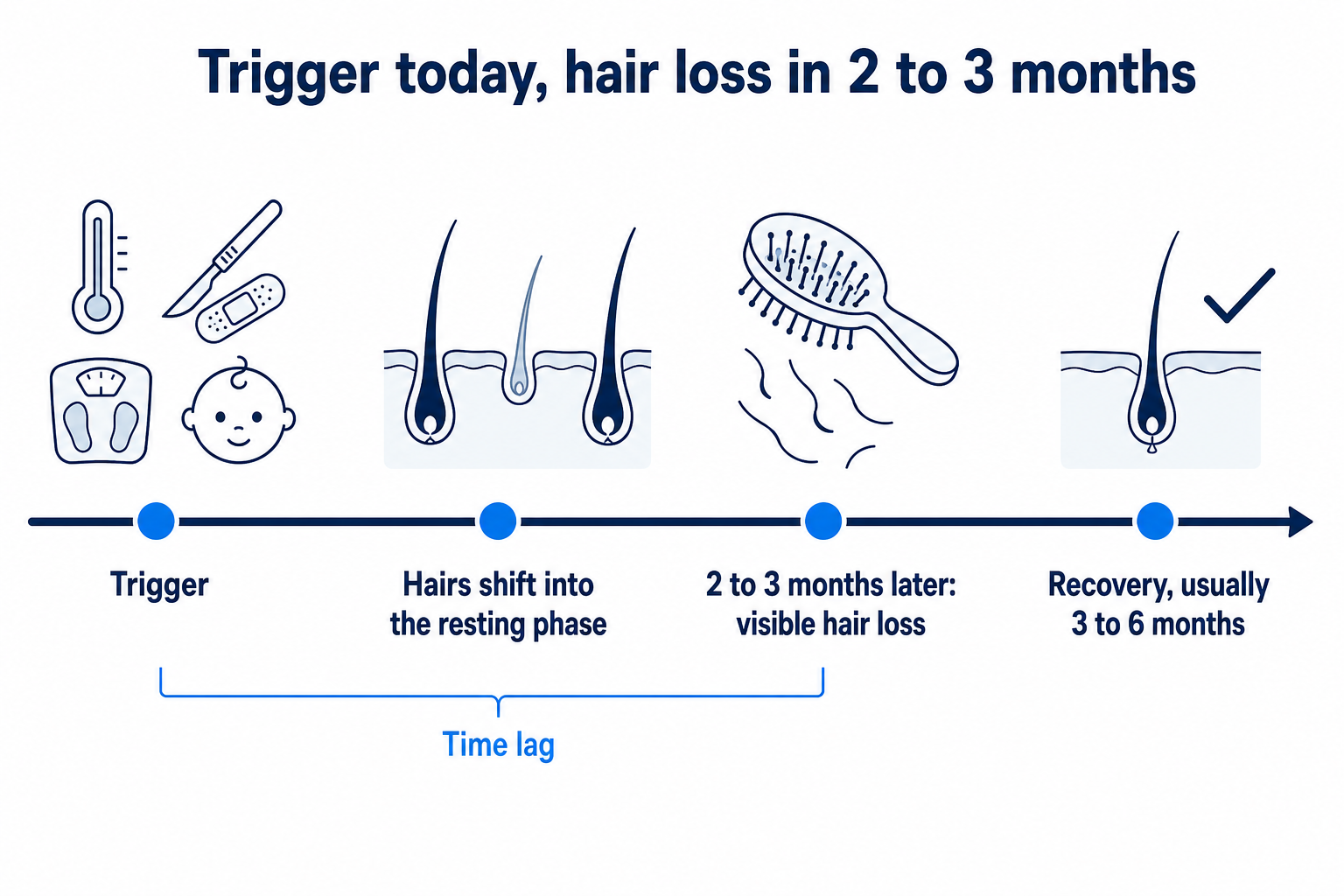
Acute telogen effluvium is usually self-limiting. According to the same review, the increased shedding typically lasts 3 to 6 months and stops once the trigger is gone. If it keeps going for longer than 6 months, it is called a chronic course, and that should be evaluated by a doctor.
Documented triggers include febrile infections, surgery and anesthesia, heavy blood loss, childbirth, strict diets and rapid weight loss (the AAD names roughly 20 pounds as an example threshold), stopping or switching hormonal contraceptives, acute stress or grief, and new medications. You will find the detail on each trigger in the overview of the causes of hair loss.
New on that list are the GLP-1 weight-loss medications. A systematic review by Gupta et al. (2026, PMC13100445) calculated a rate of 6.0 cases per 1,000 patient-years on GLP-1 agonists versus 0.8 per 1,000 on placebo; in one tirzepatide trial it was 5.4 percent versus 0.9 percent. The most likely mechanism is the rapid weight loss acting as a metabolic stressor, not direct damage to the hair root by the drug. The authors describe the shedding as mostly self-limiting, with improvement within 3 to 6 months once weight stabilizes. Never stop a prescribed medication on your own. Talk to the doctor who prescribed it.
The table below is meant to be filled in and brought along to your appointment. Go through it with your calendar and check off what applies to you.
| Trigger to check off | Typical lag until shedding | Time window to check | How long the shedding usually lasts |
|---|---|---|---|
| ☐ Febrile infection, flu, COVID-19 | 2 to 3 months | today minus 2 to 3 months | usually 3 to 6 months |
| ☐ Surgery or general anesthesia | 2 to 3 months | today minus 2 to 3 months | usually 3 to 6 months |
| ☐ Heavy blood loss, very heavy periods, blood donation | 2 to 4 months | today minus 2 to 4 months | often longer, as long as iron stores stay low |
| ☐ Childbirth | 2 to 4 months, peak around month 4 (AAD) | today minus 2 to 4 months | usually resolves within 6 to 12 months |
| ☐ Strict diet, fasting, or weight loss of about 20 pounds or more | 2 to 3 months | today minus 2 to 3 months | usually 3 to 6 months after weight stabilizes |
| ☐ Started a GLP-1 weight-loss medication or raised the dose | 2 to 4 months | today minus 2 to 4 months | per the review usually 3 to 6 months, with medical follow-up |
| ☐ Stopped, switched, or started birth control pills | 2 to 4 months | today minus 2 to 4 months | usually temporary, sometimes over several months |
| ☐ Started a new medication | weeks to months after starting therapy | today minus 1 to 4 months | usually recedes after a medically supervised switch |
| ☐ Acute stress, crisis, or grief | 2 to 3 months | today minus 2 to 3 months | usually 3 to 6 months |
| ☐ Change of diet, for example vegetarian or vegan | months, gradual onset | today minus 3 to 6 months | until iron and protein intake are balanced again |
The four most common conditions behind extreme hair loss
Behind extreme hair loss there are almost always four conditions: telogen effluvium after a trigger, iron deficiency and thyroid causes, medication side effects, and alopecia areata, the patchy form of hair loss. They differ clearly in pattern, in timing, and in treatment, which is why it is worth sorting them out before you try anything.
Telogen effluvium. Diffuse thinning across the whole scalp, a trigger 2 to 3 months earlier, often a sensitive scalp. Usually reversible and self-limiting once the trigger is gone.
Iron deficiency, thyroid, nutrients. Also diffuse, but with a more gradual onset, often with additional signs such as fatigue, feeling cold, heat sensitivity, or nail changes. Ferritin and TSH belong in the basic workup. There is more depth in the articles on iron deficiency and hair loss and on hair loss from the thyroid.
Medication side effect. The shedding usually starts weeks to months after therapy begins and often recedes after a medically supervised switch. Never stop a drug on your own, not even as a trial. Which drug classes can be involved is covered in the article on hair loss from medications.
Alopecia areata. Instead of diffuse thinning you see sharply defined, smooth bald patches, sometimes in the beard or the eyelashes, often in flares. For diagnosis and treatment, the German Dermatological Society has had a current S3 guideline in place since September 2025 (AWMF register 013-104). This form always belongs with a dermatologist, and there are details in the article on patchy hair loss.
| Form | Where and how it shows | Timing and accompanying signs | First step | Usually reversible? |
|---|---|---|---|---|
| Telogen effluvium | diffuse across the whole scalp, part line and ponytail get thinner | trigger 2 to 3 months earlier, usually lasts 3 to 6 months, often a sensitive scalp | look back for the trigger and remove it | yes, usually self-limiting |
| Iron deficiency, thyroid, nutrients | diffuse, often visible at the center part first | gradual onset over weeks to months, fatigue, feeling cold, nail changes, cycle changes | blood work ordered by a doctor, including ferritin and TSH | yes, once the deficiency is corrected or the thyroid is stabilized |
| Medication side effect | usually diffuse, severity varies by drug | starts weeks to months after therapy begins, other side effects possible | talk to the prescribing doctor, never stop on your own | usually yes after a medically supervised switch |
| Alopecia areata (patchy) | sharply defined, smooth patches, beard or eyelashes possible too | can come in flares, occasionally pitted nails | get a dermatological evaluation soon | variable, spontaneous regrowth possible but not predictable |
| Androgenetic pattern (for contrast) | receding temples and a thinning crown in men, a widening center part in women | slowly progressive over years, no accompanying symptoms | dermatological assessment of the pattern | no, it is hereditary and needs treatment, and it is not self-limiting |
Extreme hair loss in women: the most common causes
In women, the most common causes of extreme hair loss are iron deficiency, thyroid disorders, hormonal shifts, and periods of heavy stress or dieting. The shedding is typically diffuse: hair gets thinner overall, the part looks wider, the ponytail thinner. Sharply defined bald patches are not part of that picture.
Iron is the first thing to look at. Periods, pregnancy, breastfeeding, and a vegetarian or vegan diet all lower the stores. As a storage marker, ferritin says more than hemoglobin, because the store runs empty long before the blood count shows it. A study of ferritin levels in women with telogen effluvium (PMC12839778) shows this connection even when hemoglobin is formally normal. Target ranges are for your doctor to judge, not for a self-assessment.
The thyroid is the second big area. Both an underactive and an overactive thyroid can trigger diffuse hair loss, usually with accompanying signs: weight change, feeling cold or heat sensitivity, heart palpitations, cycle changes. That is why TSH belongs alongside ferritin in the basic workup. Which tests make sense and how to read a result is explained in the article on blood tests for hair loss.
One thing that often goes unsaid and takes away a lot of fear: women with diffuse hair loss do not usually go bald. The hair gets thinner, and it mostly recovers once the cause is addressed. For a broader view of how hair loss progresses in women, see the article on hair loss in women.
Sudden heavy hair loss in women: the hormonal life stages
Four life stages explain a large share of sudden heavy hair loss in women: the time after childbirth, stopping or switching the pill, breastfeeding with low iron stores, and menopause. What they have in common is a drop or a shift in estrogen levels, which sends many hairs into the resting phase at the same time.
After childbirth. Postpartum hair loss typically starts 2 to 4 months after delivery, according to the AAD with a peak around the fourth month, and usually resolves within 6 to 12 months. It is the rule rather than the exception, even if it feels dramatic.
After stopping or switching the pill. The pattern mirrors the postpartum course, with a delay of a few months. Here too the shedding is usually temporary. If it continues beyond 6 months, it needs to be checked out.
Breastfeeding. The critical part here is less the nursing itself than the combination of blood loss during delivery, higher requirements, and little time for balanced meals. Iron status is the most checkable factor in this phase.
Menopause. Falling estrogen with relatively stronger androgen action can also set off female pattern hair loss, visible as thinning at the center part. The Spanish dermatology association AEDV puts the frequency of androgenetic alopecia in women at 5 to 10 percent, compared with up to 50 percent in men by age 50. Telling those two apart is the single most important distinction in this whole topic.
If cycle irregularities, increased body hair, or late-onset acne come along with it, a hormonal workup can make sense, either gynecological or endocrinological. That is a pointer to a possible path, not a diagnosis. How hormones act on hair is covered in the article on hormones and hair.
Diffuse or pattern? The decisive fork in the road
The most important question with heavy hair loss is not “how much” but “where.” Diffuse hair loss affects the whole scalp evenly and usually has a fixable cause. Pattern hair loss shows up as receding temples and a thinning top of the head in men, or as a widening center part in women, is hereditary, and progresses slowly. Both can be present at the same time, which makes the acute shedding look worse.
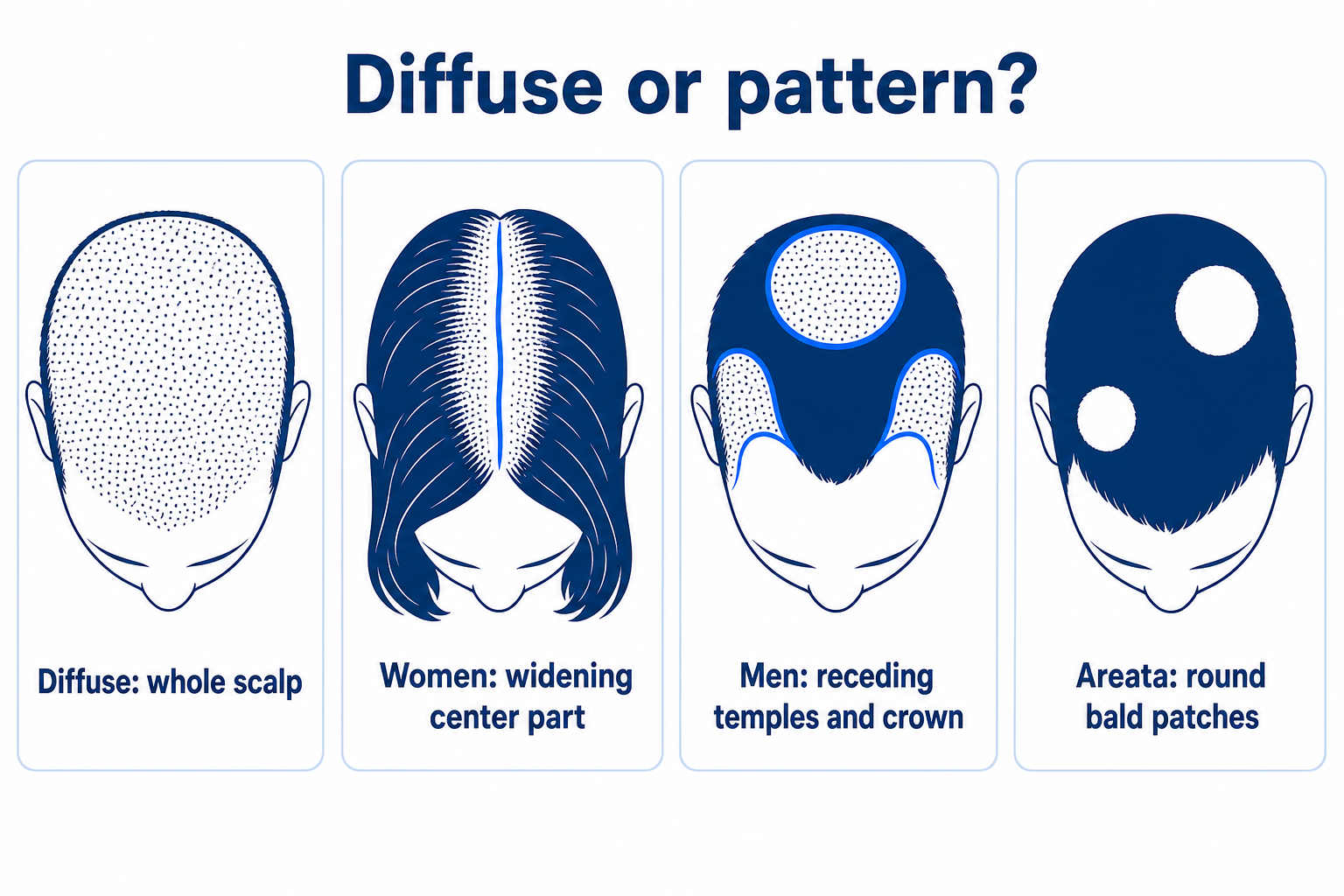
That leads to a clear statement you will not find on many clinic websites: sudden diffuse hair loss is not an indication for a hair transplant. With diffuse shedding, the cause gets treated, not transplanted. A transplant requires a stable, hereditary pattern and a stable donor area, and neither of those is present during an acute effluvium.
Sudden heavy hair loss in men: usually not hereditary hair loss
Losing hair in clumps out of nowhere in young men is usually not the hereditary hair loss they fear. Androgenetic hair loss progresses gradually over years, with a receding hairline and a thinning crown, and it practically never announces itself overnight. Acute diffuse shedding across the whole scalp, on the other hand, fits telogen effluvium.
The triggers in men are the same as in women: a febrile infection, surgery, a strict diet or rapid weight loss, a stressful period, a new medication. In men too, the trigger then usually sits 2 to 3 months in the past, and according to the review by Malkud (2015, PMC4606321) this form typically subsides within 3 to 6 months.
The two can overlap. Anyone who is already thinning for hereditary reasons notices an added effluvium more, because there is no reserve. So the sensible order is the same as for women: place the pattern, look back for the trigger, get a medical evaluation. For the course and treatment of the hereditary pattern, see the article on androgenetic alopecia.
If you are still unsure after the self-check and the part-line photos whether you are looking at a diffuse picture or a pattern, a dermatologist can settle it. Elithair’s free hair analysis also uses your photos to assess whether the distribution looks diffuse or patterned. It is a visual pattern assessment and replaces neither a blood test nor a dermatological diagnosis. If the assessment comes out diffuse, the next step is finding the cause.
Warning signs with extreme hair loss: see a doctor right away
In most cases extreme hair loss is distressing but not dangerous. Five situations still call for a doctor soon, because a treatable condition can be behind them, and because with one of them, how fast you act affects the outcome.
Get a medical evaluation soon if you have
- sharply defined bald patches or round spots, including in the beard or the eyelashes (a possible sign of alopecia areata).
- scalp inflammation: redness, scaling, pustules, itching, burning, or pain.
- smooth, shiny, hairless areas with no visible follicle openings. That can point to scarring alopecia. Time matters here, because destroyed follicles do not come back.
- shedding in flares or shedding that lasts longer than 6 months even though the cause has been addressed.
- accompanying symptoms: heavy fatigue, weight change, heart palpitations, feeling cold, cycle irregularities, increased body hair, nail changes, fever, or joint or skin problems.
Also have a doctor look at hair loss in children and shedding that starts shortly after a new medication.
The third point is the biggest time factor. A standard review on scarring alopecias (Whiting, PMC3855115) describes smooth, shiny areas without recognizable follicle openings as the hallmark, often with burning, itching, or tenderness, and explicitly recommends early specialist evaluation because the follicle destruction is irreversible. The UK’s National Health Service likewise names sudden patchy shedding and scalp problems as reasons to see a doctor.
That leaves the question many people Google late at night: can something serious be behind this? Hair loss on its own is not a typical first sign of a serious illness. What is meaningful is the combination with the accompanying symptoms listed above. That is exactly why a medical evaluation is the sensible route, rather than reading through disease descriptions.
Heavy hair loss: what to do? The first steps in the right order
With heavy hair loss, the order decides everything: count first, then look for the trigger, then get a medical evaluation, then treat the cause. Flip that order and buy products on a hunch, and you lose months without finding the cause. This chain matches the diagnostic sequence that the German AkdÄ practice review also describes: history with a look back, clinical examination, targeted lab work, then treatment.
- Count for a week and do the pull test once. Note the daily average and mark the wash days.
- Fill in the trigger calendar (table above) and go through the window 2 to 4 months before the shedding started.
- Make an appointment with a dermatologist and bring your counting log, your part-line photos, and the complete list of your medications and supplements.
- Bring up blood work in the conversation instead of interpreting results on your own.
- Get the cause treated: replace iron, stabilize the thyroid, have the medication reviewed by a doctor, have alopecia areata treated dermatologically.
- Wait out the telogen phase. Even after the cause is fixed, the shedding already set in motion keeps going for a few weeks.
On blood work, a deliberately cautious wording: ask your doctor to check levels such as ferritin, TSH (with fT3 and fT4 added if anything looks off), vitamin D, zinc, vitamin B12, and a complete blood count, among others. With cycle irregularities, an additional hormonal workup can make sense. Reference ranges differ between labs and countries, so the interpretation belongs in the exam room and not in an online forum.

Your first stop is a dermatologist, in part because of trichoscopy and, if needed, a biopsy. If a thyroid or hormonal cause is suspected, endocrinology or gynecology comes in as well. One thing worth knowing: “trichologist” is not a licensed medical title, so there may or may not be medical training behind it.
Checklist: how to walk into the appointment prepared
Bring with you
- One week of counting logs with the daily average and the wash days marked
- Your filled-in trigger lookback calendar
- Part-line photos 4 weeks apart, same light, same angle
- A complete list of all medications and supplements with doses
- Family history: who in your family started thinning early?
Tests your doctor may order with diffuse hair loss, among others
- Ferritin as the iron storage marker, more informative than hemoglobin alone
- TSH, with fT3 and fT4 added if anything looks off
- Vitamin D, zinc, vitamin B12
- Complete blood count
- With cycle irregularities, an additional hormonal workup
This is a conversation list, not an order form. Which tests make sense in your case and how to interpret them is decided by the doctor treating you.
When your hair loss gets dismissed as “it’s just stress”
Diffuse thinning is hard to see in an exam room, especially with long hair and in women. That is exactly why appointments often end with “that’s stress, it will come back.” What helps in that situation is not accusations but data that make your observation verifiable.
Put your counting log with the daily average and your part-line photos taken four weeks apart on the table, and name a concrete time frame instead of saying “for a while now.” Add the accompanying symptoms, including the seemingly unrelated ones such as feeling cold, fatigue, heart palpitations, cycle changes, or nail changes. That combination is the actual diagnostic clue.
Then ask specifically for the basic labs, including ferritin, TSH, and a complete blood count. The German AkdÄ practice review on hair loss describes exactly this chain of history, clinical examination, and lab workup depending on the situation, with an explicit look at iron status in women. So this is not a special request, it is standard workup.
If all you get is a quick look, ask for a follow-up visit with a progress check in about 6 weeks, or for a referral to a dermatologist who does trichoscopy. A second specialist opinion is legitimate with ongoing, unexplained shedding, and in many cases it is the step that finds the cause.
This article deliberately stays with the acute case. Once the cause is clear and it comes to comparing treatment options, from minoxidil through PRP to a hair transplant, you will find the full overview in the article What to do about hair loss.
When does the shedding stop and when does hair grow back?
With telogen effluvium, the increased shedding usually ends within 3 to 6 months once the trigger is gone (Malkud 2015, PMC4606321). Visibly denser hair comes later: first the follicles have to re-enter the growth phase, and hair grows only about 0.35 millimeters per day, roughly 1 centimeter per month. That is why recovery usually shows up only after 6 to 12 months.
| Time frame | What happens in the follicle | What you notice |
|---|---|---|
| Month 1 to 2 | The trigger is gone and the telogen rate slowly normalizes | The shedding eases off, the shower drain gets emptier |
| Month 3 to 4 | The follicles re-enter the growth phase (anagen) | No further loss, but density stays the same for now |
| Month 5 to 6 | New hairs push through the scalp | Short stubby hairs along the hairline and the part, often finer and lighter |
| Month 7 to 12 | The new hairs keep growing at about 1 centimeter per month | The lengths even out, part and ponytail feel fuller again |
One more thing that heads off a second wave of panic: those short stubby hairs at the part in month 5 or 6 are a good sign, not new shedding. Many people take them for broken hairs and get scared all over again. It is the new growth.
If there is no recovery after 6 months, another medical evaluation is worth it. At that point the possibilities are a chronic effluvium, an undetected deficiency, or a pattern hair loss running in the background.
What we see at Elithair
When people come to us losing hair in clumps, our first question is not what they should take today, but what happened two to three months ago. In a great many cases the trigger is right there, and the shedding turns out to be temporary.
Just as important is the distinction: diffuse shedding across the whole scalp is a case for finding the cause, not for a transplant. Only once there is a stable, hereditary pattern does a hair transplant even come into the conversation.
Frequently asked questions about extreme hair loss
Why is my hair falling out in clumps?
Hair comes out in clumps when many hairs have shifted into the resting phase at the same time and release together at the end of that phase. When you comb or wash, they then come out in a bundle. That points to telogen effluvium and not to destroyed hair roots.
Extreme hair loss in women: will I go bald?
Women with diffuse hair loss do not usually go bald. The hair gets thinner, the part looks wider, and the fullness mostly recovers once the cause is addressed. A center part that widens over years, on the other hand, can point to female pattern hair loss, which should be assessed by a dermatologist.
Can stress cause extreme hair loss?
A period of acute stress or grief counts as a typical trigger of telogen effluvium. The shedding usually starts only 2 to 3 months after the stressful phase and generally ends within 3 to 6 months once the strain has eased. Everyday work stress on its own rarely explains heavy shedding.
What does heavy hair loss mean if all my blood work is normal?
Then there are mainly three explanations: a delayed telogen effluvium, which can look unremarkable in the lab, a ferritin level at the low end of the reference range that is technically normal but tight for you, or early pattern hair loss. A dermatological exam with trichoscopy usually gets you further here than more blood work.
I have had hair loss for 4 to 6 months: is that still normal?
Acute telogen effluvium typically lasts 3 to 6 months. Within that window, ongoing shedding is explainable. If it continues beyond 6 months, it is called a chronic course, and then it should be checked again medically to see whether a cause was missed.
Can a serious illness be behind extreme hair loss?
Hair loss on its own is not a typical first sign of a serious illness. What is meaningful is the combination with accompanying symptoms such as heavy fatigue, weight change, heart palpitations, fever, cycle irregularities, or skin and joint problems. That is exactly why a medical evaluation is the right route.
Does a hair transplant help with sudden heavy hair loss?
No. Sudden diffuse hair loss is not an indication for a hair transplant, it is a case for finding the cause. A transplant requires a stable, hereditary pattern and a stable donor area. With diffuse shedding, the cause gets treated.
Sources
- American Academy of Dermatology: “Do you have hair loss or hair shedding?” aad.org (50 to 100 hairs per day, triggers, postpartum course)
- Drug Commission of the German Medical Association (AkdÄ): “Haarausfall in der Praxis, was tun?”, Arzneiverordnung in der Praxis 2015. akdae.de (German source: 60 to 100 hairs per day, lag of 2 to 4 months, diagnostic sequence)
- Malkud S.: “Telogen Effluvium: A Review”, Journal of Clinical and Diagnostic Research 2015. PMC4606321 (lag, duration of 3 to 6 months, chronic course from 6 months)
- McDonald KA et al.: “Hair pull test: Evidence-based update and revision of guidelines”, Journal of the American Academy of Dermatology 2017;76(3):472-477. PMID 28010890 (pull test method, normal value up to 2 hairs)
- “Integrative and Mechanistic Approach to the Hair Growth Cycle and Hair Loss”. PMC9917549 (telogen share of 10 to 15 percent, growth of about 1 centimeter per month)
- German Dermatological Society: S3 guideline “Diagnostik und Therapie der Alopecia areata”, AWMF register no. 013-104, in force since September 2025. register.awmf.org
- Whiting DA: “Primary cicatricial alopecia: diagnosis and treatment”. PMC3855115 (warning signs of scarring alopecias, irreversibility)
- Gupta AK et al.: “GLP-1 therapies and hair loss: A systematic review of current evidence and implications for counseling”, 2026. PMC13100445 (rate of 6.0 versus 0.8 per 1,000 patient-years, mechanism, reversibility)
Last updated: July 2026. This article is for general information and does not replace a medical diagnosis or treatment. If you have heavy or sudden hair loss, an inflamed scalp, or accompanying symptoms, please see a dermatologist.

Dr. Imad Moustafa
Hair transplant specialist