

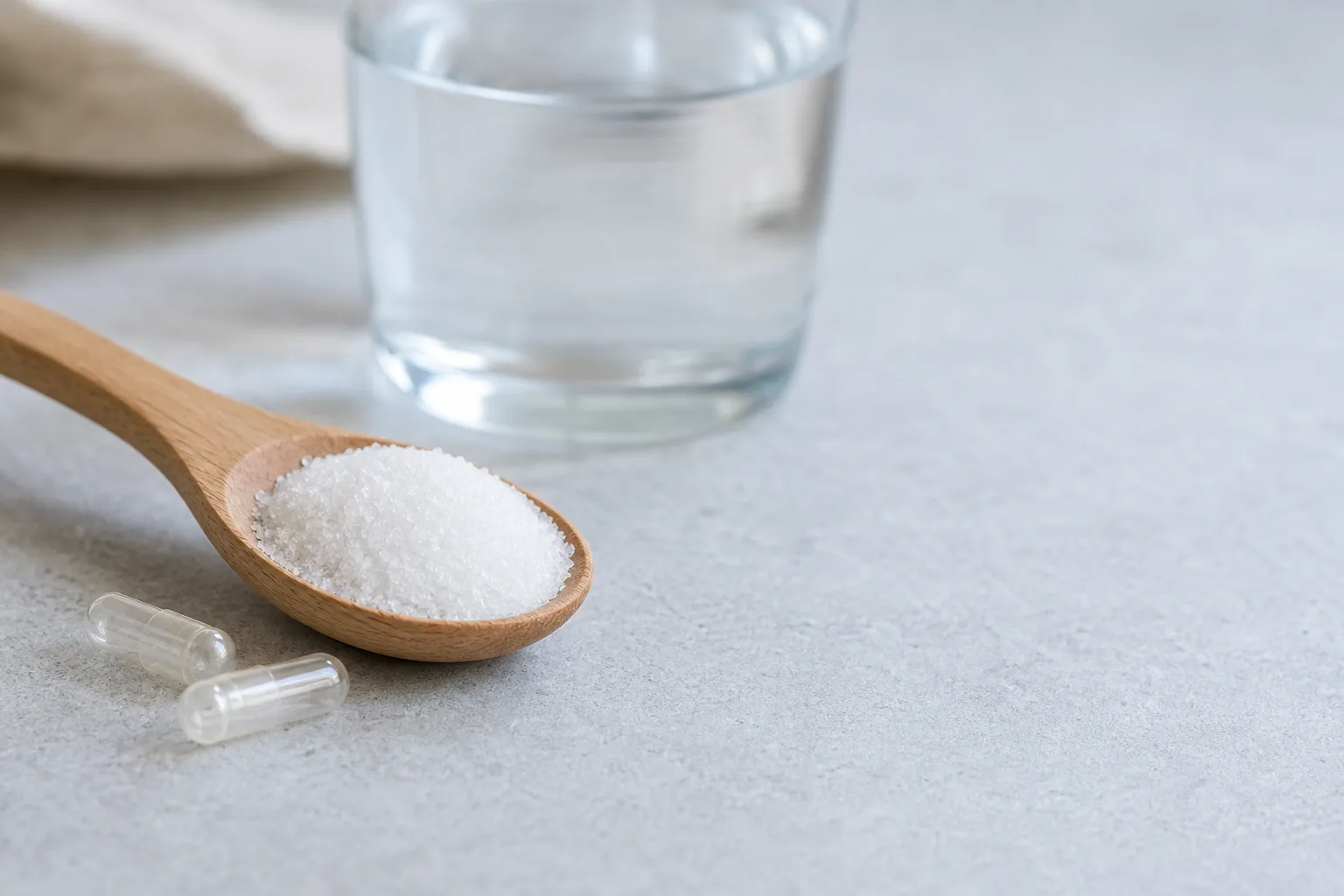
On TikTok and Instagram the clips run on a loop: a spoonful of MSM powder, three months later a visibly fuller before-and-after shot, a discount code underneath. That is how most people end up on this topic, and the question behind it is always the same: does this actually do anything for your hair, or are you paying for nothing? The most solid answer comes from a regulator. In 2010, the European Food Safety Authority (EFSA) reviewed several applications for permission to advertise MSM as helping to maintain normal hair, and it authorized not a single one of them (EFSA Journal 2010;8(10):1746). This article shows what has actually been studied on MSM and hair, which amounts were tested in those studies, and where the limits are.
Key takeaways
- ✓MSM supplies sulfur, and sulfur really is part of hair keratin, by way of the amino acid cysteine
- ✓That does not mean extra sulfur produces denser hair: according to the German Nutrition Society (DGE), a normal diet already delivers 2.3 to 6.8 g of sulfur-containing amino acids per day
- ✓The only human study on MSM and hair condition to date is from 2019, covered 63 women and was co-funded by the manufacturer
- ✓For hereditary hair loss there is no proven MSM effect, and a dietary supplement is no substitute for finding the cause
The table of contents shows what you will find where. After that we go step by step through the biochemistry, the evidence, how it is used and where it ends.
Summary
- What is MSM?
- How does MSM affect hair?
- Sulfur for hair: what cysteine and methionine do in keratin
- What studies on MSM and hair loss really show
- How do you use MSM for hair?
- MSM: side effects, interactions and who should skip it
- MSM user experiences for hair: what is realistic
- MSM in comparison: what is proven to work for hair loss
- When medical diagnosis matters more than supplements
- Conclusion: MSM is no miracle cure for hair loss
- Frequently asked questions about MSM and hair
- Sources
What is MSM?
MSM is short for methylsulfonylmethane, an organic sulfur compound with the molecular formula (CH3)2SO2. Chemically it is related to DMSO and carries two methyl groups on a central sulfur atom. Sulfur is an essential building block of countless processes in the body and is involved, among other things, in forming proteins and enzymes.
MSM occurs naturally in small amounts in fruit, vegetables, grains and cow’s milk, and also in coffee, tea and beer. The review by Butawan and colleagues (Nutrients 2017) puts these levels in the trace range, in hundredths of a part per million. So you do take in MSM through a normal diet, but at levels far below what sits in a capsule.
As a dietary supplement, MSM has been used for years mainly for joint complaints, inflammatory processes and general cell health. In recent years it has also moved into focus in connection with hair loss and hair health, though with clear limits that deserve a careful medical look. As an aside: MSM can be produced synthetically, which also makes it suitable for people living vegan.
Legal status: a dietary supplement with no approved hair claim
In the United States, MSM is sold as a dietary supplement, not as a drug. That is more than a formality. It means no manufacturer has ever had to prove an effect on hair before being allowed to sell MSM, because supplements are not reviewed for effectiveness by any authority before they reach the shelf.
In 2010, EFSA, Europe’s food safety authority, assessed several proposed health claims for MSM, expressly including the maintenance of normal hair (claim IDs 353, 1741, 1874), normal nails (IDs 1695, 1741, 1874), normal cysteine synthesis (ID 392) and normal collagen formation. Not one of these claims was authorized (EFSA Journal 2010;8(10):1746). A separately assessed claim for the joints was likewise rejected in 2009 (EFSA Journal 2009;7(9):1268).
In practice this means: the only authority that has ever formally examined the question found the evidence insufficient. A US manufacturer may describe what a supplement is meant to do for the structure or function of the body, but the label has to state that the claim has not been evaluated by the FDA and that the product is not intended to diagnose, treat, cure or prevent any disease. Where a package promises hair growth outright anyway, that says something about how the seller handles the rules, not about the quality of the product.
MSM, sulfate, sulfite and sulfonamide: four words, four classes of substance
MSM is neither a sulfite nor a sulfate nor a sulfonamide. The four terms sound alike and mean completely different things: sulfites are preservatives, sulfates are the surfactants in many shampoos, sulfonamides are a class of antibiotics, and MSM is chemically a sulfone.
This mix-up is behind one of the most common questions on the topic. Anyone with a sulfonamide allergy reacts to a class of drugs, not to every sulfur-containing substance; cross-reactivity with MSM is not to be expected chemically. That is information about classes of compounds and not an allergy clearance: with a known sulfonamide allergy, this question goes to your doctor or pharmacist before you start.
How does MSM affect hair?
The assumed effect of MSM on hair runs through sulfur. By way of the amino acid cysteine, sulfur is a fixed component of keratin, the material the hair shaft is built from. Whether additional MSM improves anything about that is an entirely different question, and the section on the evidence further down answers it.
One correction up front, because it appears in almost every text on MSM: sulfur is said to be a component of keratin and collagen. That is true for keratin, but not for collagen. Type I collagen is roughly one third glycine, proline accounts for about 17 percent of the residues, and cysteine is practically absent from it (Fu et al., Journal of Food Composition and Analysis, PubMed 28687386). The sulfur-collagen connection is therefore a widespread error.
The three-step argument manufacturers routinely blur
The effect of MSM on hair is almost always justified in three steps, only the first two of which are established. The third step is the leap where biochemistry turns into a sales pitch. Placed side by side, it stands out immediately.
The three steps of the MSM argument
- 1Sulfur is bound via the amino acid cysteine into the keratin of the hair.
established - 2MSM supplies sulfur, the molecule (CH3)2SO2 carries a sulfur atom at its center.
chemically undisputed - 3More MSM sulfur leads to more or thicker hair.
not proven
For step 3 there is no evidence in the reviewed literature. Anyone who names the first two steps is describing biochemistry. Anyone who quietly attaches the third is selling a product. As the hair cycle shows, hair density depends on the number of active follicles and on the length of the growth phase, not on the availability of a single building block. The body also builds keratin from methionine and cysteine out of dietary protein, not from free sulfur.

What is behind the anti-inflammatory effect
MSM is credited with anti-inflammatory properties, and that attribution is partly supported by evidence, just not on the scalp. In cell experiments MSM inhibits the transcriptional activity of NF-kappa-B and reduces the formation of the messengers IL-1, IL-6 and TNF-alpha in a dose-dependent way (Butawan et al. 2017). In animal work, cytokine levels and CRP fall in arthritis models.
In humans there are controlled studies on knee osteoarthritis, such as the randomized trial by Debbi and colleagues (2011) with 50 participants and 6 g of MSM per day over 12 weeks, and a placebo-controlled study by Ostojic and colleagues (Nutrients 2023) with 2 g per day. A trial in 180 young military recruits with 3 g over 8 weeks, by contrast, found no significant effect.
What matters for this topic is the gap: there is no study that has examined an anti-inflammatory effect of MSM on the scalp or the hair follicle. Perifollicular microinflammation is regarded in dermatology as a possible cofactor in androgenetic alopecia, but the step from joint data to the scalp environment is an unproven extrapolation. We flag it here explicitly as a gap in the data instead of quietly carrying it along.
Sulfur for hair: what cysteine and methionine do in keratin
Hair keratin is one of the most cysteine-rich proteins in the human body. More recent analyses put the cysteine content of hair keratin at around 16 to 18 mole percent, while older work reports considerably lower values of around 7.6 percent for individual fractions. The exact figure depends on method and fraction, but the order of magnitude is undisputed: every one of these cysteine units brings a sulfur atom with it.
So the connection between sulfur and hair is real, not invented. But it only answers the question of what hair is built from, not the question of whether more building material means more hair. Keeping those two questions apart is the heart of this topic.
How disulfide bridges make hair strong
Two cysteine residues link up through their sulfur atoms to form a disulfide bridge, a covalent cross-link between two keratin strands. These bridges give hair its tensile strength and its shape. The denser the cross-linking, the more resilient the fiber.
You can see how powerful this mechanism is at the salon. Perms and chemical straightening work by reductively opening exactly these sulfur bridges, putting the hair into a new shape and then closing the bridges again oxidatively. Nothing else is happening in the hair. Sulfur, then, is not just some trace element in hair, it is the glue of its structure.
Where the body gets the sulfur for keratin
The sulfur in hair keratin comes from dietary protein, not from sulfur as a mineral. Cysteine is formed in the body from the essential amino acid methionine via the transsulfuration pathway, with homocysteine as an intermediate. Anyone eating enough high-quality protein automatically supplies the material for keratin formation.
The German Nutrition Society (DGE) puts the methionine requirement of adults at around 13 mg per kilogram of body weight per day. For cysteine there is no separate intake recommendation at all, because the body makes it from methionine itself; the daily requirement of roughly 780 to 900 mg is largely covered by this endogenous synthesis. A typical Western diet supplies 2.3 to 6.8 g of sulfur-containing amino acids per day according to the DGE, several times the minimum.
From this follows the decisive point for judging MSM: with a normal protein intake, sulfur is not the limiting factor in keratin formation. Whether MSM sulfur is measurably incorporated into hair keratin at all has not been shown in a dedicated study so far. All that is described is that MSM is absorbed and distributed in tissue (Butawan et al. 2017).

Is there such a thing as a sulfur deficiency?
An isolated sulfur deficiency is not a described clinical condition in people with an adequate protein intake. Neither the DGE reference values nor the reviewed papers on MSM describe a distinct deficiency syndrome defined by sulfur. What is relevant for hair instead is a protein deficit under a severely restricted calorie intake, along with confirmed deficiencies of iron, zinc or vitamin D.
This point is uncomfortable, but it carries the whole assessment: unlike iron or vitamin D, MSM does not replenish any store described in humans. If you have no deficiency, you cannot gain anything by topping one up. Which nutrients hair actually needs is set out in the overview of vitamins for hair loss; the most common measurable cause of diffuse thinning is iron deficiency, and that one can be confirmed in a blood test.
| Food | Provides methionine and cysteine | Notes |
|---|---|---|
| Eggs | yes, very good source | regarded in nutritional science as the reference for high-quality protein |
| Meat and poultry | yes, very good source | a serving of about 57 g provides roughly 300 to 500 mg of methionine and 150 to 250 mg of cysteine (guide values based on USDA data) |
| Fish such as salmon and tuna | yes, very good source | in a similar range to poultry |
| Dairy products | yes, good source | cottage cheese and hard cheese also supply protein in compact form |
| Legumes | yes, plant source | methionine is the limiting amino acid here, so combine them with grains |
| Nuts, especially Brazil nuts | yes, good source of methionine | small amounts, high density |
| Whole grains and oats | yes, good source | combines with legumes into a complete amino acid profile |
| Onions, garlic, cabbage | no | supply sulfur compounds such as allyl sulfides, but not the amino acids keratin is built from |
The last row matters so that no new myth takes hold: onions, garlic and cabbage are rich in sulfur, but their sulfur sits in aroma compounds, not in methionine or cysteine. For building hair, what counts is the protein, not the smell.
What studies on MSM and hair loss really show
On MSM and hair loss there is so far no meaningful human study that has tested MSM on its own in hair loss. The available data come from a small trial on the hair condition of healthy women, from an animal model with a combination of active ingredients, and from cell experiments. That is not a footnote, it is the central finding of this research.
One distinction belongs here, because it often gets lost. “Not proven” does not mean “disproven.” Missing studies mean that nobody has answered the question cleanly, not that the answer is settled. That is exactly why you will find no claim here that MSM does nothing. What is written here is that the evidence is missing, and for a purchasing decision that is the more relevant information.
What has actually been studied
The only direct human study on MSM and hair comes from Muizzuddin and Benjamin (Natural Medicine Journal, 2019). Sixty-three middle-aged women were studied over 4 months, comparing two doses of the same preparation, 1 g against 3 g per day. Hair and nail condition improved compared with baseline, and the higher dose performed better.
Three limitations belong right alongside that. The sample is small. In the publicly available information the work is described as a comparison of two doses, and it does not clearly document an independently verifiable placebo group. And the funding sits close to the manufacturer: one of the authors is head of research at the manufacturer of the MSM raw material used, and the co-author received funds from the same company for preparing the manuscript.
Naming this conflict of interest is not an insinuation. It is a recognized criterion in assessing evidence, and in a study that forms the sole data basis for an entire product segment it weighs more heavily than usual.
Why combination products allow no statement about MSM
If MSM sits in a product together with biotin, zinc, iron and amino acids and the hair gets better, the effect cannot be attributed to any single substance. That is not a detail for statisticians, it is the reason most positive reports about MSM capsules say nothing about MSM.
A second confounder comes on top: if participants had a confirmed iron or zinc deficiency beforehand, correcting that alone explains the result completely. Anyone who wants to know what MSM does needs a study in which MSM is the only thing that differs between the groups. For hair loss, no such study exists.
What the animal model and the cell experiment do and do not tell us
The only work found on topical MSM and hair growth is an animal experiment. Shanmugam, Baskaran and colleagues treated the shaved back skin of male C57BL/6N mice for 20 days with magnesium ascorbyl phosphate (MAP, a vitamin C derivative) at 7.5 percent, with or without MSM at 1, 5 or 10 percent.
The result is often reported incorrectly. In it, MSM showed no hair growth effect of its own. It increased the uptake of the vitamin C derivative into the skin in a dose-dependent way, at 10 percent MSM by up to 200-fold (802 µg per cm²). In this work MSM was therefore a penetration aid for the skin, not the active ingredient.
For transferring this to humans: rodent skin has a differently timed hair cycle than the human scalp, and a topically applied combination says nothing about the effect of a swallowed capsule. That does not devalue the research, it only limits its reach.

Where there is no data at all on MSM and hair
This list is the most honest part of the article. On the following points, all of them claimed regularly in advertising, the research found not a single study:
- MSM and hereditary hair loss: no study on androgenetic alopecia
- MSM and hair density, measured with the methods standard in dermatology: no study
- MSM and the rate of hair growth in centimeters per month: no study
- Topical MSM on the human scalp, for example as a shampoo or tonic: no human data
- MSM and hair pigmentation, meaning protection against gray hair: no study, pure marketing claim
- Long-term use over several years with regard to hair: no data
| Claim about MSM | What was studied | Study type, size, year | Strength of evidence |
|---|---|---|---|
| MSM supplies sulfur that is distributed in the body | absorption and tissue distribution of MSM | review of the pharmacokinetics, Butawan et al. 2017 | basic mechanism described, direct proof of incorporation into hair keratin missing |
| MSM improves hair and nail condition | 1 g against 3 g of MSM daily, 4 months | small human study, n = 63, 2019, manufacturer-funded | weak: positive result, small sample, placebo control not clear-cut, conflict of interest |
| MSM has an anti-inflammatory effect | cytokines, CRP, pain scales | cell experiment, animal model, human studies on knee osteoarthritis (Kim 2006, Debbi 2011, Ostojic 2023) | moderate, but exclusively outside the scalp |
| MSM stimulates hair growth (topically) | MSM as a penetration enhancer for a vitamin C derivative | animal experiment in mice, combination of active ingredients | weak: MSM with no effect of its own, not transferable to humans |
| MSM helps with hereditary hair loss | nothing | no study found | not proven |
| MSM speeds up hair growth | nothing | no study found | not proven |
| MSM works against gray hair | nothing | no study found | not proven |
How to read the last column: “moderate” means controlled human studies exist, but on a different organ. “Weak” means there is data, but with methodological limitations. “Not proven” means nothing was found, not that something has been disproven.
How do you use MSM for hair?
For hair, MSM is almost always taken orally, as a capsule, tablet or powder. In the only human study on hair condition, 1 g and 3 g per day were tested over 4 months; in studies on other indications the range runs from 2 g to 6 g daily. There is no established or officially confirmed dose for hair.
That is why this article deliberately gives no dosage recommendation of its own. We report which amount was tested in which trial. For a specific product, the manufacturer’s instructions are what count, and when in doubt the question belongs with your doctor or pharmacist, especially with existing conditions or ongoing medication.

| Question studied | Daily dose tested | Duration | Source |
|---|---|---|---|
| hair and nail condition (the only human study on hair) | 1 g or 3 g | 4 months | Muizzuddin & Benjamin 2019 |
| knee osteoarthritis, pilot study | 3.375 g | 12 weeks | Kim et al. 2006 |
| knee osteoarthritis, randomized controlled | 6 g | 12 weeks | Debbi et al. 2011 |
| mild knee pain, placebo-controlled | 2 g | 12 weeks | Ostojic et al. 2023 |
| knee pain prevention in young adults | 3 g | 8 weeks | randomized trial 2017, no significant effect |
| allergic rhinitis | 2.6 g | 30 days | cited in Butawan et al. 2017 |
| safety assessment by the US Food and Drug Administration (FDA) | classified as safe up to around 4,845 mg | not assessed for a limited period | GRAS assessment, cited in Butawan et al. 2017 |
This table describes only what has been studied. No dose for hair can be derived from an amount tested in an osteoarthritis trial.
Capsules, tablets or powder: what the difference is
Between the forms MSM comes in there are no proven differences in effectiveness; the dose studies always refer to the total amount, not to the form. Searching for “MSM capsules for hair” is therefore a decision about handling and price, not about effect.
| Form | Practical properties | Evidence | What to check |
|---|---|---|---|
| Powder | cheap per gram, freely dosable, pronounced bitter taste | no form-specific studies | purity statement and manufacturing process; stir it into liquid |
| Capsules | convenient, tasteless, more expensive per gram | no form-specific studies | check the amount per capsule, not the amount per recommended daily serving |
| Tablets | compact, contain pressing and anti-caking agents | no form-specific studies | read the list of additives |
| Shampoo and topical products | short contact time on the scalp | no human data, only one animal model with a combination of active ingredients | read the effect claims on the packaging critically |
How long until you might see something in hair growth?
The lower limit is set not by the supplement but by the hair cycle. Scalp hair grows at around 1 to 1.5 cm per month, and what happens in the follicle today only becomes visible on the scalp two to three months later. An assessment is therefore possible after three to six months at the earliest, whatever product you use.
If you see a difference after two weeks, you are not seeing hair growth. Body, shine and combability change with care products, water hardness and the season; they are no signal for new hair. The table below describes what the hair cycle allows in terms of timing, not an expected effect of MSM.
| Time frame | What happens in the hair cycle | What you can see |
|---|---|---|
| Week 1 to 4 | nothing changes on the hair shaft that has already formed | no change in density; shine and feel are no growth signal |
| Month 2 to 3 | follicles respond to changed conditions, telogen hairs fall out | at the earliest, fewer hairs in the brush and the drain |
| Month 3 to 6 | new anagen hairs grow in | first short new hairs at the hairline and in the part |
| from month 6 | regrown hairs reach a visible length | only now can a change in density be judged at all |
Important for judging your own case: with diffuse hair loss, anyone who sees an improvement after six months has often experienced the natural fading of the trigger and not the effect of a product. Why that is so is explained further down in the section on user reports.
MSM in shampoo and topical use
For MSM in shampoos or care products there is no human data on hair growth. The only work on topical MSM is the mouse experiment described above, in which MSM increased the skin uptake of a vitamin C derivative without growing any hair itself.
There is also a practical objection that applies to every active-ingredient shampoo: contact time decides the effect. A substance that sits on the scalp for a minute and is then rinsed off has hardly any opportunity to do anything. As a cleanser and conditioner such a shampoo is harmless; as a treatment for hair loss it is unproven.
Combination products and the vitamin C myth
“MSM only works in synergy with high-dose vitamin C” is one of the most persistent claims on the subject, and it appears exclusively on sales pages, not in independent scientific literature. The research found no peer-reviewed human study on this supposed synergy.
The likely root of the myth is the mouse study on topical MSM plus magnesium ascorbyl phosphate. That study was about a vitamin Cderivative, not about a vitamin C supplement you swallow, about topical application instead of ingestion, about animals instead of people, and about skin penetration instead of a stronger effect inside the body. Four non-transferable conditions have turned into a sales argument.
In practice MSM rarely sits alone in a jar anyway; it usually comes together with biotin, zinc, millet and amino acids. Such products can make sense with a confirmed deficiency, but they do not replace finding the cause. What hair loss capsules can do, and where combination products such as Priorin reach their limits, we have written up separately.
One detail that genuinely deserves a warning: high-dose biotin, as found in many hair capsules, can distort lab values, thyroid and cardiac markers among them. So if you are having blood drawn, mention such products in the conversation with your doctor, otherwise a false value may end up being treated.

Product check: what you can look for in an MSM supplement
- ✓The purity statement and the manufacturing process are given on the package or the product page
- ✓The amount is stated per capsule, not only per recommended daily serving of four capsules
- ✓The ingredient list is manageable and the additives are named
- ✓An independent batch analysis is available or is provided on request
- ✓The country of manufacture and a contact you can reach are given
- ✓There is no promise to cure hair problems on the label (a supplement is not allowed to claim it treats a condition anyway, and such wording is a good warning sign)
- ✓The price per gram has been worked out, not the price per package
This list is a buying aid, not a product recommendation. It deliberately names no brand.
MSM: side effects, interactions and who should skip it
MSM is considered well tolerated in the amounts studied. The US Food and Drug Administration (FDA) classified an amount of around 4,845 mg per day of a branded MSM product as safe (cited in Butawan et al. 2017). Good tolerability, however, is not the same as effectiveness, and it does not apply equally to everyone.
Known side effects of MSM
The complaints reported most often in the safety assessments are the following. The available reviews provide no reliable frequency figures in percent, so no number appears here that does not exist:
- gastrointestinal complaints such as nausea, diarrhea and abdominal pain
- headaches
- skin rashes and allergic reactions
- with topical use, occasional mild skin and eye irritation
The question of odor deserves its own mention, because it occupies many users. The familiar garlic-like breath and body odor is an effect of DMSO, which is broken down in the body to dimethyl sulfide. For MSM taken as a dietary supplement, the research found no documented odor effect. The two substances are chemically related, but on this point they are not the same.
Interactions with medications
On interactions with MSM there is hardly any hard data, and that honesty belongs here. Interactions with anticoagulant medications are discussed, as is an influence on alcohol metabolism. Both are theoretically derived or anecdotal; for alcohol metabolism the review by Butawan and colleagues expressly notes that no studies exist.
For you that is neither an all-clear nor an alarm. Anyone on long-term medication, blood thinners in particular, discusses a new dietary supplement with a doctor or pharmacist before the first dose. And nobody stops a prescribed medication or changes its dose because of a supplement.

Who should not take MSM without medical advice
In the following situations there is either no solid data or there are reasons to clear the use with a doctor beforehand:
- Pregnancy and breastfeeding: there is no solid human data. A study in pregnant rats with 1 g per kilogram of body weight over 14 days showed no abnormalities, but it does not replace human data. Specialist sources therefore advise caution
- Children and adolescents: no studies on use in this age group
- Kidney or liver disease: altered excretion and metabolism, so clear it medically
- ongoing medication, anticoagulants in particular
- before planned surgery: declare all dietary supplements in the pre-op consultation
The myth of the detox reaction
Headaches, a skin rash or diarrhea at the start of taking MSM are readily interpreted in sales settings as “detoxing” or as a Herxheimer reaction. The research found no evidence for such a detox syndrome caused by MSM, and no Herxheimer-like reaction has been described for MSM.
This reinterpretation is tricky precisely because it declares the very signals that could point to an intolerance to be a good sign. Anyone who notices new complaints after starting a product has them assessed medically instead of sitting them out.
The same goes for the claim that MSM initially triggers increased hair loss which then turns into stronger growth. No such shedding has been described for MSM. With minoxidil an initial increase in hair loss is documented and mechanistically explained, and it usually settles within the first six weeks (patient information, NHS Royal Berkshire, October 2025). The difference is a good illustration of what a documented effect looks like and what an extrapolation without evidence looks like.
MSM user experiences for hair: what is realistic
Reports from people using MSM for their hair vary widely, and there are systematic reasons for that. Hair loss runs in episodes, many forms improve on their own, and before-and-after photos practically never keep the shooting conditions constant. That is why you will find no user reports here, but a guide to reading other people’s observations and your own correctly.
We deliberately quote no forums, invent no testimonials and show no generated result images. For a dietary supplement that would be the convenient but dishonest answer. The useful answer is the question of the conditions under which an observation means anything at all.
Why before-and-after pictures say little about supplements
A hair photo is a measurement, and every measurement has confounders. With “MSM hair before and after” at least six of them act at once, and together they explain more difference than any product could ever produce in four months:
- Light and angle: raking light from above makes any scalp shine through, diffuse light from the front hides it
- Hair length and styling: shorter hair stands up and looks denser, product at the roots changes the picture completely
- wet or dry: wet hair reveals the scalp, dry hair covers it
- Position of the part: a shift of a few millimeters noticeably changes how wide the part looks
- Season: the rate of hair shedding varies over the course of the year
- Starting point: most people start a product exactly when the shedding is at its worst, that is, at the moment with the greatest natural prospect of improvement
Regression to the mean, placebo and telogen effluvium
The most common reason for an enthusiastic user report is the natural course. An acute telogen effluvium after an infection, a diet, childbirth or heavy strain remits on its own in a large share of cases within about three to six months, once the trigger falls away; StatPearls describes acute telogen effluvium as a self-limited, spontaneously reversible condition with full recovery of hair density once the trigger has been addressed (StatPearls, “Telogen Effluvium”).
Anyone starting a product in this phase experiences a real improvement. It simply cannot be attributed to the product. Exactly this pattern produces convinced users and good reviews by the dozen, entirely without an effect. If the hair loss lasts longer than six months, the same source recommends a systemic workup. More on this in the article on diffuse hair loss.
How to test for yourself whether something is working
If you want to try MSM despite the thin evidence, at least turn it into a clean test. The effort is small, and at the end you get an answer that actually tells you something instead of a feeling.

Self-test: how to make your own before-and-after comparison meaningful
- ✓Always the same lighting, ideally the same room at the same time of day
- ✓Always the same distance and the same camera angle, bracing the phone against a marker if need be
- ✓Always the same position of the part, redrawn with a comb
- ✓Always dry, unstyled hair
- ✓Note the start date and take photos every four weeks, each time the crown, the part and the hairline
- ✓Only one change at a time, otherwise you will not know at the end what worked
- ✓Keep it up for at least six months; before that, the hair cycle does not allow an assessment
This checklist is a documentation aid and not a diagnostic procedure. Whether a treatment makes sense is decided by a medical assessment.
MSM in comparison: what is proven to work for hair loss
For hereditary hair loss, minoxidil and finasteride are the established medications. MSM is a dietary supplement with no approved claim for hair. The two therefore do not belong in the same comparison, but on different levels.
Three levels can be cleanly separated. First, treating the cause: correcting confirmed deficiencies, getting thyroid function under control, checking for a drug side effect. Second, the approved medications for androgenetic alopecia, medically supervised and used continuously. Third, supplementation as a possible component in the case of a confirmed deficiency, not as a therapy.
The line that carries this section: a supplement can correct a deficiency. It cannot treat a cause that is not a deficiency. And because no isolated sulfur deficiency has been described in humans, MSM, unlike iron or vitamin D, does not top up any confirmed store either. That means the product lacks precisely the level on which supplementation otherwise demonstrably works.
| Approach | Status in the US | Proven effective for | Duration of use | Doctor required |
|---|---|---|---|---|
| MSM | dietary supplement, no approved hair claim | not proven for hair | no established duration | talking it through makes sense |
| Correcting a confirmed deficiency | food, supplement or medication depending on the product | a deficiency confirmed in the blood | until the store is replenished | yes, blood values needed |
| Minoxidil | approved drug, topical | androgenetic alopecia in women and men | continuous, otherwise the effect is lost | no, available without a prescription; medical assessment still advisable |
| Finasteride | prescription-only drug, 1 mg oral | androgenetic alopecia in men (approved for adult men) | continuous | yes |
| Hair transplant | medical procedure | patterned hair loss with a stable donor area | one-off procedure, the transplanted hair stays | yes |
The basis for the two medication rows is the European S3 guideline of the European Dermatology Forum on treating androgenetic alopecia. It calls for an assessment after four to six months at the earliest; after stopping, the effect is lost again within four to six months (the French medicines agency ANSM). On finasteride 1 mg, agencies such as Italy’s AIFA have published safety information on possible psychiatric side effects. Both substances therefore belong in a conversation with a doctor; this table only puts things in order and recommends nothing.
Does MSM boost a treatment with minoxidil or finasteride?
An additional benefit of MSM alongside minoxidil or finasteride is not proven. No study exists on this combination, neither one showing a stronger effect nor one describing an interaction. In this constellation the proven effect comes entirely from the medication.
In practice, two things follow from that. MSM does not replace either substance, whose effect the European S3 guideline describes and which is lost again within four to six months after stopping (ANSM). And anyone who wants to take both in parallel discusses it with a doctor beforehand, especially with anticoagulant medication and before a planned blood draw.
One point often gets overlooked here: if you start two things at once, you can no longer tell afterwards which of them worked. If you want to judge an effect, change only one thing at a time and record the start with a date.
Before you buy a product on suspicion, a blood test is the cheaper and more informative step. Which values make sense is set out in the article on the blood test for hair loss, and who is responsible for it is answered by the article on which doctor helps with hair loss.
What we regularly see in the hair analysis
In the hair analysis we regularly see people who have been taking supplements for months without ever having had a blood value measured. That is why, for us, clarifying the cause comes before any treatment decision: only once it is clear which form of hair loss is present and whether a measurable cause lies behind it can we say whether treatment is the right step at all. For exactly this reason, a considerable share of inquiries does not lead to surgery with us.
When medical diagnosis matters more than supplements
Medical diagnosis always takes precedence over a supplement when it is unclear which form of hair loss is present at all. That is no formality: diffuse and hereditary hair loss look similar in the mirror but call for opposite steps. Without that classification, you are trying products against a problem you do not know.
An acute telogen effluvium subsides on its own in a large share of cases within three to six months after the trigger falls away (StatPearls, “Telogen Effluvium”). Androgenetic alopecia carries on regardless. For the one, waiting plus looking for the cause is right; for the other, a medically supervised treatment. Mixing the two costs time.
In many cases the pattern alone makes the distinction. Even thinning across the whole head points to a trigger that can be identified and addressed, such as a confirmed deficiency, a thyroid disorder, a medication or heavy strain. A receding hairline and a thinning crown with a dense back of the head point to androgenetic alopecia. Often both are present at the same time, and then it is the pattern that shows up more clearly first.

| Feature | Points more to diffuse hair loss | Points more to hereditary hair loss |
|---|---|---|
| Distribution | even across the whole head, including the back | receding temples and the crown area, the back of the head stays dense |
| Course | rather sudden, often a few weeks after a trigger | creeping over years |
| Recognizable trigger | infection, diet, childbirth, medication, confirmed deficiency | no single trigger identifiable |
| Family history | none typical | common |
| Age at onset | any age | often from the second decade of life |
| Response to treating the cause | improves when the trigger falls away | carries on regardless |
This overview describes features, it is not a diagnostic tool and not a decision tree. Both forms often occur at the same time, so it does not replace a medical assessment. A broader overview is given in the article on the causes of hair loss.
Is a hair transplant an alternative to MSM?
A hair transplant is not an alternative to MSM, because the two concern different situations. A dietary supplement can at most correct a nutrient deficiency. A transplant relocates existing hair roots and is an option only for patterned, hereditary hair loss with a stable donor area.
The line “if the capsules don’t help, then surgery it is” is therefore wrong, and wrong in both directions. Diffuse hair loss across the whole head is not an indication for a transplant, it is a reason to look for the cause. First it is established which form is present, and only then does it become clear what is on the table at all.
If androgenetic alopecia is present and the donor area is stable, transplanting your own hair follicles is a medically established option with a permanent result. Individual follicles are taken from the genetically stable area at the back of the head and placed precisely into the affected areas. Growth direction, density and hairline are planned individually, and with us the hairline design is done 100 percent by the doctor.
Whether that applies to you at all is determined by an assessment of your hair status, not by a supplement. So first find out which form of hair loss you have: the free hair analysis classifies your pattern visually and is a step toward clarity, not a treatment promise. It does not replace a medical blood test; if a measurable cause is suspected, the lab work belongs first.
Conclusion: MSM is no miracle cure for hair loss
MSM supplies organic sulfur, and by way of cysteine sulfur really is a building block of hair keratin. What MSM is not is a solution that works on its own or holds up over time against progressive hair loss. As of 2026 there is exactly one small, manufacturer-funded human study on hair, and the only authority that has ever formally assessed a hair claim for MSM, Europe’s EFSA, refused to authorize it.
Two sentences sum up the assessment. First: “not proven” is not the same as “disproven,” so nobody can seriously tell you that MSM does nothing for you, only that there is no evidence for it. Second: finding the cause comes before any product, because a cause that has been found is treatable and a suspected one is not.
MSM remains sensible at most as a supporting component in an approach that includes a balanced diet, a targeted search for the cause and suitable hair care. With advanced, patterned hair loss this kind of support reaches its limits; whether a hair transplant is then an option depends on the diagnosis and the donor area and not on whether a supplement worked. Individual advice from a specialist doctor helps to assess that realistically.

Frequently asked questions about MSM and hair
Does MSM really help against hair loss?
No, proof of an effect of MSM against hair loss is missing. The only human study on hair (n = 63, 2019) looked at the hair condition of healthy women and was co-funded by the manufacturer; in 2010 EFSA did not authorize the claim on maintaining normal hair. Not proven does not mean disproven here, it means never sufficiently studied.
How long do you have to take MSM for your hair before you see anything?
Three to six months is the earliest point at which anything can be judged at all. The hair cycle sets this lower limit, because scalp hair only grows around 1 to 1.5 cm a month. If you notice something after two weeks, you are seeing care effects, not hair growth.
How much MSM per day is usual for hair?
There is no established dose for hair. In the only hair study, 1 g and 3 g daily over 4 months were compared, while studies on other indications worked with 2 g to 6 g. The manufacturer’s instructions are what count; when in doubt, ask your doctor or pharmacist.
Does MSM speed up hair growth?
No, there is no evidence for that: no study exists on MSM and the rate of hair growth. Scalp hair generally grows about 1 to 1.5 cm per month, and no dietary supplement has been shown to increase that rate.
Does MSM make hair thicker?
No, there is no scientific evidence that MSM makes hair thicker. The only human study assessed hair and nail condition in 63 women comparing two doses, not hair thickness with standard dermatological methods. Independent confirmation is missing.
Does MSM help with hereditary hair loss?
No, on MSM in hereditary hair loss there is not a single study. For androgenetic alopecia, minoxidil and finasteride are the medications described in the European S3 guideline.
Can you take MSM in addition to minoxidil or finasteride?
There is no proven added benefit, and no described interaction either. No study exists on combining MSM with minoxidil or finasteride; in this constellation the proven effect comes from the medication. Even so, discuss taking them in parallel with a doctor beforehand.
Which is better for hair, MSM or biotin?
Neither of the two is proven superior for hair. Both help at most with a confirmed deficiency. A biotin deficiency is rare with a normal diet, and an isolated sulfur deficiency has not been described in humans at all. More useful than choosing between the two is a blood test.
Is MSM the same as the sulfate in shampoo?
No. MSM is chemically a sulfone. Sulfates are surfactants for cleansing, sulfites are preservatives. The words sound alike, the classes of substance have nothing to do with each other.
Can I take MSM if I have a sulfonamide allergy?
This question belongs with a doctor before the first dose, and there is no blanket clearance here. Sulfonamides are a class of antibiotics, MSM is chemically a sulfone; cross-reactivity is not to be expected. That is information about classes of compounds and not an allergy clearance.
What side effects can MSM have?
The most commonly reported are gastrointestinal complaints such as nausea and diarrhea, headaches, and skin rashes and allergic reactions. Applied topically, mild skin and eye irritation occasionally occurs. The reviews give no reliable frequencies in percent.
Can MSM cause more hair loss at first?
That has not been described for MSM. With minoxidil, such initial shedding is documented and usually settles in the first six weeks. Anyone losing more hair while taking MSM should have the cause investigated.
Are detox symptoms at the start normal?
No, there is no evidence for a detox syndrome caused by MSM. Complaints at the start are better classified as a side effect or an intolerance and belong in a medical assessment rather than being read as a good sign.
Can I take MSM during pregnancy or breastfeeding?
That cannot seriously be answered with yes, because solid human data is missing. An animal study in pregnant rats showed no abnormalities, but it does not replace human data. Specialist sources therefore advise caution; the decision belongs in a conversation with a doctor.
When do you take MSM, in the morning or the evening, with or without food?
There are no proven rules on timing. In practice many users take MSM with a meal, because gastrointestinal complaints are the most common side effect. Stick to the manufacturer’s instructions.
Capsules or powder: which is better for hair?
For hair the form makes no proven difference, since the dose studies refer to the total amount. Powder is cheaper and freely dosable but tastes bitter; capsules are more convenient and more expensive per gram.
How do I recognize a good MSM product?
By verifiable information: purity and manufacturing process named, amount per capsule instead of only per daily serving, a short ingredient list, an available batch analysis, country of manufacture and a contact. A promise to cure hair problems on the label is a warning sign, and a supplement is not permitted to claim it treats a condition.
Does MSM work topically as well, for example in shampoo?
That is not proven, human data is missing entirely. The only work on topical MSM is a mouse experiment in which MSM increased the skin uptake of a vitamin C derivative without triggering hair growth itself. With shampoo, the very short contact time comes on top.
Are MSM before-and-after pictures meaningful?
As a rule, no. Light, camera angle, hair length, wet or dry hair, the position of the part and the season often change the picture more than any product does. On top of that, most people start exactly when their hair loss is at its peak.
Do you have to take MSM together with vitamin C?
No, that is not necessary: there is no independent human study on this synergy. The claim probably goes back to a mouse experiment in which topical MSM increased the skin uptake of a vitamin C derivative. That cannot be transferred to a capsule.
Does MSM make you smell of sulfur?
Probably not: the familiar garlic-like odor is an effect of DMSO, which is broken down to dimethyl sulfide. For MSM taken as a dietary supplement, the research found no documented odor effect.
Does MSM help against gray hair?
There is no evidence for that. On MSM and hair pigmentation no study exists. The claim that sulfur prevents gray hair is a pure marketing statement.
Is MSM worth it if I eat a balanced diet?
With a balanced diet there is little to suggest an added benefit. According to the DGE, a normal diet supplies 2.3 to 6.8 g of sulfur-containing amino acids per day, and an isolated sulfur deficiency has not been described in humans. Where there is no deficiency, there is nothing to gain by topping up.
Which foods supply the sulfur-containing amino acids for hair?
Eggs, fish, meat and poultry, dairy products, legumes, nuts and whole grains. Onions, garlic and cabbage do supply sulfur compounds, but not methionine and cysteine.
When should I see a doctor about hair loss instead of reaching for a supplement?
At the latest when the hair loss lasts longer than six months, suddenly increases sharply, comes with bald patches or scalp complaints, or is joined by symptoms such as fatigue and weight changes. And before any longer supplement trial, a blood test is the more sensible step.

Sources
Basis of the assessment. Manufacturer sites, shops and forums were not used as evidence.
- Butawan et al. (2017): Methylsulfonylmethane. Nutrients 9(3):290
chemistry, occurrence, dose, safety - EFSA NDA Panel (2010): Health claims related to MSM. EFSA Journal 8(10):1746
rejection of the claims on hair and nails - Muizzuddin & Benjamin (2019): Sulfur-Containing Supplement on Hair and Nail Condition
the only human study on hair, n = 63, manufacturer-funded - Shanmugam, Baskaran et al.: MSM and Hair Growth Promotion of Magnesium Ascorbyl Phosphate
the only work on topical MSM, animal model - Debbi et al. (2011): MSM supplementation on osteoarthritis of the knee
randomized controlled, 6 g daily - Fu et al.: Amino acid composition in determination of collagen origin
amino acid profile of collagen - StatPearls: Telogen Effluvium
spontaneous remission in diffuse hair loss - European Dermatology Forum: S3 Guideline Androgenetic Alopecia
guideline status on minoxidil and finasteride - DGE: FAQ Protein and indispensable amino acids
requirement for methionine and cysteine
Note: This article is for information and does not replace medical advice, diagnosis or treatment. With persistent hair loss, pre-existing conditions, during pregnancy and breastfeeding or with ongoing medication, discuss taking it with a doctor beforehand. Last updated: September 2026.

Dr. Imad Moustafa
Hair transplant specialist