

Quick answer: Does minoxidil work for hair loss?
Minoxidil is a vasodilating agent (a potassium channel opener) that, applied topically to the scalp or taken orally at a low dose, slows hereditary hair loss (androgenetic alopecia) and reactivates miniaturized hair follicles. In most users, hair loss stabilizes; in a smaller subset, visible new hair grows back. The effect lasts only as long as minoxidil is used.
- Drug class: vasodilating potassium channel opener (vasodilator)
- Standard topical dosing: men 5%, women 2% (or 5% foam once daily), twice a day, maximum 2 ml/day
- Status: topical available over the counter (OTC), no prescription needed; oral is prescription-only and off-label for hair loss
- Works for: androgenetic alopecia on the crown and vertex; effect is reversible after you stop
- Timeframe: first results after roughly 3-6 months, a valid assessment no earlier than 4 months, full effect up to 12 months
- Efficacy (Olsen et al. 2002): +19 hairs/cm² on 5% versus +13 on 2%
Safety note: Use only according to the package insert or your doctor’s advice. Oral minoxidil for hair loss is off-label and may only be prescribed by a physician. Do not use during pregnancy or breastfeeding. Keep away from pets.
Summary
- How does minoxidil work for hair loss?
- Does minoxidil really work? The evidence and success rate
- How fast does minoxidil work? The results timeline
- Initial shedding: why more hair falls out at first
- Minoxidil 2% or 5%, solution, foam, or tablet?
- How to apply minoxidil correctly: step by step
- What side effects does minoxidil have?
- Solving minoxidil problems: troubleshooting
- Why doesn’t minoxidil work for some people? Non-responders
- What happens when you stop minoxidil?
- Minoxidil for women
- Minoxidil, finasteride, or a hair transplant?
- Diffuse or genetic? When minoxidil is the right and when the wrong approach
- Conclusion: minoxidil for hair loss at a glance (2026)
- Frequently asked questions about minoxidil for hair loss
- Sources
How does minoxidil work for hair loss?
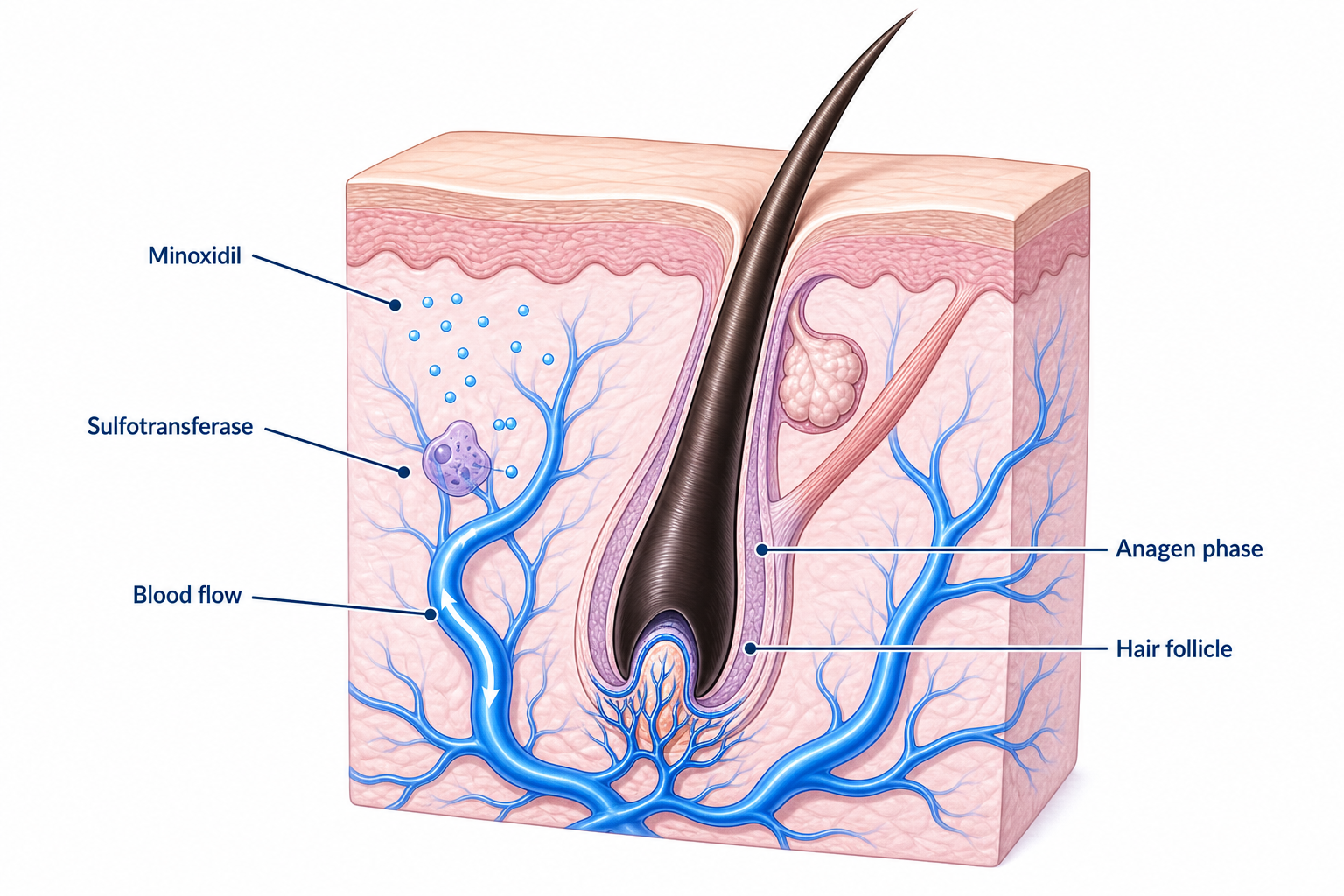
Minoxidil works against hair loss by increasing blood flow to the scalp and extending the growth phase (anagen) of the hair cycle. It is a prodrug: in the scalp, the enzyme sulfotransferase (SULT1A1) converts it into minoxidil sulfate, the actual active form (PMC review on SULT1A1, 2022).
Minoxidil sulfate opens ATP-sensitive potassium channels in the vascular smooth muscle cells, which widens the blood vessels and stimulates growth factors such as VEGF (drug reference profile for minoxidil). This reactivates miniaturized, shrinking follicles so they once again produce thicker, longer-growing hair on the crown.
Important to understand: minoxidil does not lower DHT levels, so it does not address the hormonal cause of androgenetic alopecia. It treats the effect (the shrunken follicle), not the cause. That is the fundamental difference from Finasteride, and it explains why the two are often combined.
How strongly minoxidil works depends heavily on the individual’s sulfotransferase activity in the scalp. If that activity is low, very little of the drug is converted into its active form. This is the central reason for so-called non-responders, more on which below. Our article on the hair growth cycle covers this interplay in detail.
Does minoxidil really work? The evidence and success rate
Yes, minoxidil for hair loss is effective, but the most common effect is stabilization, not restoration. In the pivotal study by Olsen et al. (2002) with 393 men over 48 weeks, the count of non-vellus hairs rose by +19/cm² on 5% and by +13/cm² on 2%, both significantly better than placebo.
The patient satisfaction score in that study was 51 out of 100 points on 5% versus 41 on 2%. The European S3 guideline on androgenetic alopecia lists minoxidil as the only topical agent with the highest recommendation grade for both men and women (reporting by journalmed.de and springermedizin.de).
As a rough guide, some rule-of-thumb figures circulate (secondary aggregation, not a primary study): in about 70-80% of users, hair loss can be halted; in roughly 30%, visible new hair grows; and in only 10-20% does this lead to a result the user considers satisfying. Anecdotal reports from forums like Reddit point in the same direction but are no substitute for study data.
Put honestly: maintenance and stabilization are the more common outcome, visible thickening the rarer one. A full return to your original hair density is unrealistic and is not supported by any of the studies cited here. Anyone expecting that will be disappointed; anyone who sets stabilization as the goal has it right.
How fast does minoxidil work? The results timeline
Minoxidil does not work against hair loss overnight: the first visible signs usually appear after 3-6 months, and the full effect can take up to 12 months (Apotheken Umschau). The Rogaine for Men label specifies a minimum use of 4 months before treatment success can be judged at all.
If the effect is still completely absent after those 4 months, the label recommends stopping use and seeking medical advice. The timeline below summarizes the typical course. It follows the telogen and anagen logic of the hair cycle and the study durations (Olsen: 48 weeks).
| Timeframe | What happens in the follicle | What you notice |
|---|---|---|
| Month 0-2 | Follicles are pushed synchronously into a new phase | Start, possible initial shedding (usually begins in weeks 2-4) |
| Month 2-4 | Resting follicles re-enter the growth phase | Increased shedding usually subsides, hair stabilizes |
| Month 4-6 | New anagen hairs grow in | First fine baby hairs possible, earliest point to assess |
| Month 6-12 | Hairs become thicker and longer | Visible thickening in a portion of users |
| Month 12 onward | Maintenance phase, effect tied to continued use | Plateau, continued use needed to keep the result |
Initial shedding: why more hair falls out at first
Initial shedding (forum slang: “dread shed”) is an expected, temporary sign that minoxidil is starting to work against hair loss. The drug shortens the telogen (resting) phase, so older resting hairs are shed synchronously before new anagen hairs grow in (PMC review 2024, PMC11067493).
The timeframe varies by source: the increased shedding usually begins 2-4 weeks after starting, lasts about 3-8 weeks, and has subsided in most users within 4 months. So it is not a sign that minoxidil is harmful, but that a hair turnover is being triggered.
Even so, there is a clear limit: if the heavy shedding lasts longer than 4-6 months or is unusually severe, you should have it checked by a doctor rather than reflexively dismissing it as normal shedding. Another cause cannot be ruled out at that point. Do not stop minoxidil in a panic after just a few weeks during the shedding phase.
Minoxidil 2% or 5%, solution, foam, or tablet?
Which form of minoxidil for hair loss is right depends on sex, tolerability, and the situation of use. For men, the 5% preparation is standard (more effective than 2%, Olsen 2002); women classically start with 2%. Minoxidil 5% as a foam usually contains no or less propylene glycol and therefore causes irritation less often.
Oral low-dose minoxidil is an option for those who do not respond to the topical form or who have trouble applying it. In a large 2021 safety study of 1,404 patients (Ramos, Sinclair et al.), hypertrichosis was the most common side effect at 15.1%; systemic side effects such as dizziness (1.7%) or edema (1.3%) remained rare.
Important YMYL note: Oral minoxidil is approved solely for the treatment of severe, treatment-resistant hypertension. Its use for hair loss (even at low doses of 0.25-5 mg) is off-label. It may only be prescribed by a physician and monitored because of possible cardiovascular effects. Never take it on your own.
| Form | Concentration | For whom | Advantage | Disadvantage | Status |
|---|---|---|---|---|---|
| Solution | 5% | Men (standard) | Best-documented topical strength (Olsen 2002) | Higher irritation rate (4% severe irritation) | over the counter, no prescription |
| Foam | 5% | Men, irritation-prone women (S3 guideline) | Usually no or less propylene glycol, better tolerated | Slightly higher hypertrichosis risk in women | over the counter, no prescription |
| Solution/foam | 2% | Women (standard dose) | Lower irritation and hypertrichosis risk | Slightly lower efficacy than 5% | over the counter, no prescription |
| Tablet (low-dose) | 0.25-5 mg | Non-responders, application problems | No local irritation, easy to take | Systemic side effects (hypertrichosis 15.1%) | prescription-only AND off-label |
How to apply minoxidil correctly: step by step
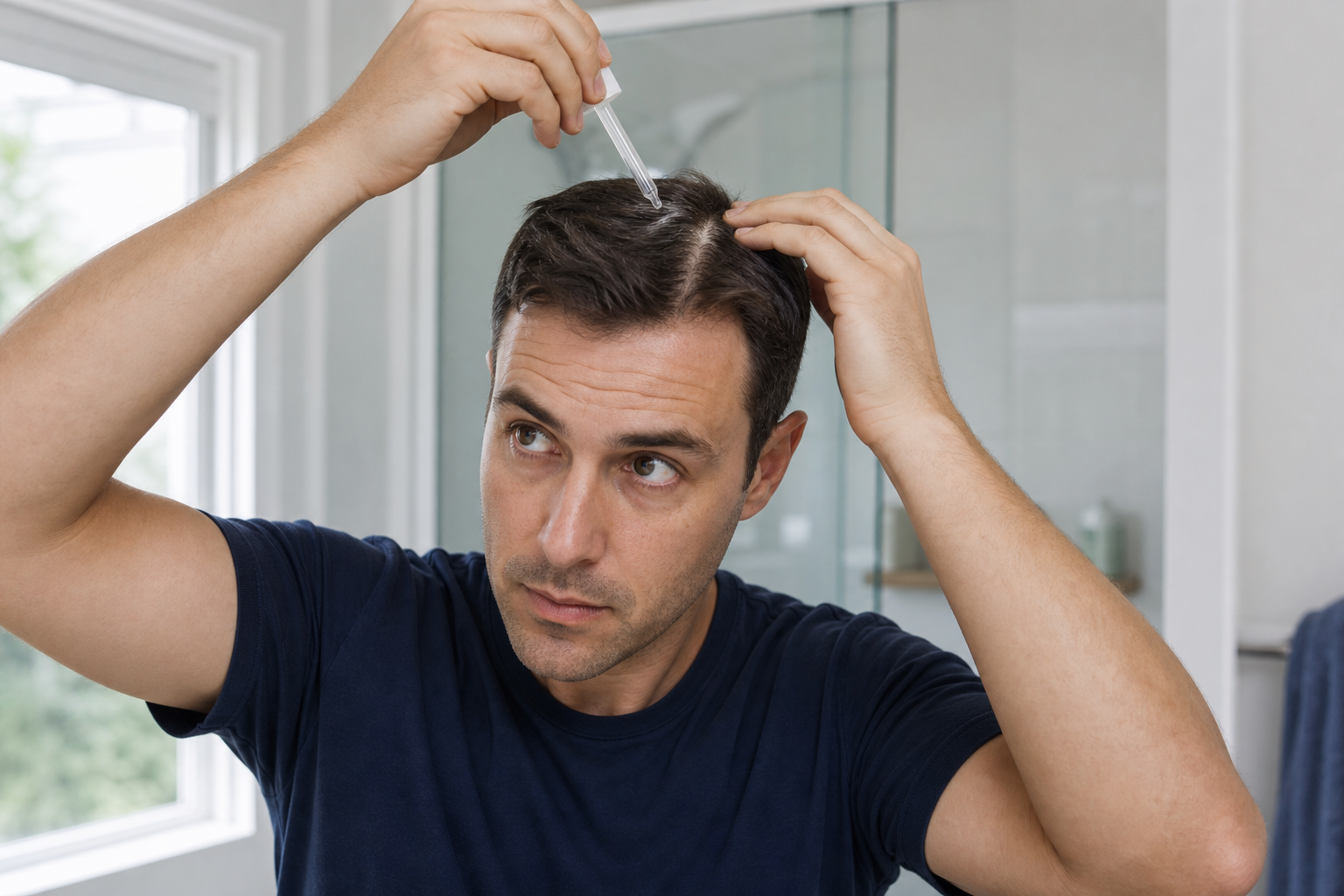
According to the label, minoxidil for hair loss is applied twice daily, 1 ml at a time, directly onto the dry scalp, a maximum of 2 ml per day, regardless of the size of the affected area (Rogaine for Men label). It is not approved for use in people under 18. Here is how to do it correctly:
- Prepare the scalp clean and dry, not right after a shower on wet hair.
- Measure the exact amount: 1 ml of solution or one foam portion (about half a cap).
- Apply directly to the scalp, not into the hair, and spread it evenly over the affected area.
- Gently massage it in with your fingertips.
- Wash your hands thoroughly to avoid transfer to your face, other people, or pets.
- Do not wash, blow-dry, or style with gel/spray for at least 4 hours (absorption time per the label).
Tip from safety guides: ideally apply minoxidil at least an hour before going to bed so that as little as possible transfers onto your pillow (relevant because of the toxicity to pets, see FAQ). Gel and hairspray are fine only after the absorption time; avoid blow-drying with heat immediately after application.
Do
- ✅ Apply to a dry scalp
- ✅ Exact amount: 1 ml per application, max. 2 ml/day
- ✅ Twice a day at the same times
- ✅ Directly onto the scalp, not into the hair
- ✅ Wash your hands after every application
- ✅ Stick with it for at least 4 months before judging
Don’t
- ❌ Apply into the hair instead of onto the scalp
- ❌ Increase the dose above 2 ml/day on your own
- ❌ Blow-dry with heat or wash right afterward
- ❌ Use gel/spray before the absorption time is up
- ❌ Panic and quit during the initial shedding
- ❌ Leave an open bottle or leftovers within reach of pets
What side effects does minoxidil have?
With topical use, the side effects of minoxidil are predominantly local and mild. According to the package insert (Rogaine for Men), headaches are very common (10% or more), and scalp irritation, increased facial hair, and weight gain are common (1-10%). More serious cardiovascular signals are rare with topical use and are classified as not known.
The most frequent trigger of local irritation is propylene glycol in the classic solutions; foam formulations usually do not contain it. With oral low-dose minoxidil, hypertrichosis is the most common at 15.1% because of systemic absorption, followed by edema (1.3%) and tachycardia (0.9%) (Ramos, Sinclair et al. 2021).
| Side effect | Frequency (topical) | Cause | What to do |
|---|---|---|---|
| Headaches | very common (≥10%) | minimal systemic absorption | usually mild; see a doctor if symptoms persist |
| Scalp irritation, itching, flaking | common (1-10%) | often propylene glycol in solutions | switch to foam, do not increase the dose on your own |
| Facial hair (hypertrichosis) | common topical, 15.1% oral | effect on follicles outside the scalp | wash hands, consult a doctor, adjust the dose if needed |
| Initial shedding | regularly seen in studies | shortened telogen phase, synchronous hair turnover | usually normal up to 4 months, get it checked after that |
| Edema, palpitations, dizziness | rare topical, 0.9-1.3% oral | systemic absorption, vasodilation | see a doctor immediately for shortness of breath, chest pain, or severe edema |
| Contact dermatitis, allergic reaction | not known | hypersensitivity to the active or inactive ingredients | stop use, see a dermatologist |
Solving minoxidil problems: troubleshooting
Many users quit minoxidil for hair loss too early because they misread small problems. The table below sorts out the most common situations and names the right response. It is no substitute for medical advice, but it helps you avoid typical mistakes and not give up prematurely.
| Problem | Likely cause | What to do |
|---|---|---|
| Scalp itches and flakes | often propylene glycol in the solution | consider switching to foam, ask your pharmacist |
| Increased shedding in weeks 2-8 | initial shedding (PMC11067493) | usually keep going; get it checked if it lasts beyond 4-6 months |
| White residue, sticky feel | applied too much or washed too soon | adjust amount and timing, respect the absorption time |
| No effect after 6-12 months | possible non-responder situation | have a doctor confirm whether it is AGA; consider oral/microneedling |
| Unwanted facial hair | hypertrichosis from contact/transfer | wash hands, avoid contact, adjust dose/form with a doctor |
Why doesn’t minoxidil work for some people? Non-responders
Minoxidil for hair loss does not work for everyone, because activation in the follicle depends on sulfotransferase (SULT1A1) activity. If that activity is too low, minoxidil is not converted into its active form in sufficient amounts, regardless of correct application (PMC review SULT1A1). The estimated share of non-responders is around 30-40%.
That figure is an estimate, not a firmly confirmed rate. A follicular enzyme test has been described in a few smaller studies with high discriminatory power (ruling out roughly 95.9% of non-responders), but it is not a broadly validated standard test in routine care. It is a procedure offered by individual providers that you should evaluate critically.
If the effect fails to appear, there are several options: patience over at least 6-12 months, a medical assessment of whether androgenetic alopecia is even present, or combination with microneedling. In the pilot RCT by Dhurat et al. (2013, 100 patients), 82% of the microneedling-plus-minoxidil group reported more than 50% improvement versus 4.5% on minoxidil alone.
That study is promising, but it is a pilot with a small sample and no substitute for large RCTs. Switching to oral low-dose minoxidil (physician-supervised, off-label) is another possible strategy for non-responders. What matters remains: first clarify whether the diagnosis is right before switching the product.
What happens when you stop minoxidil?
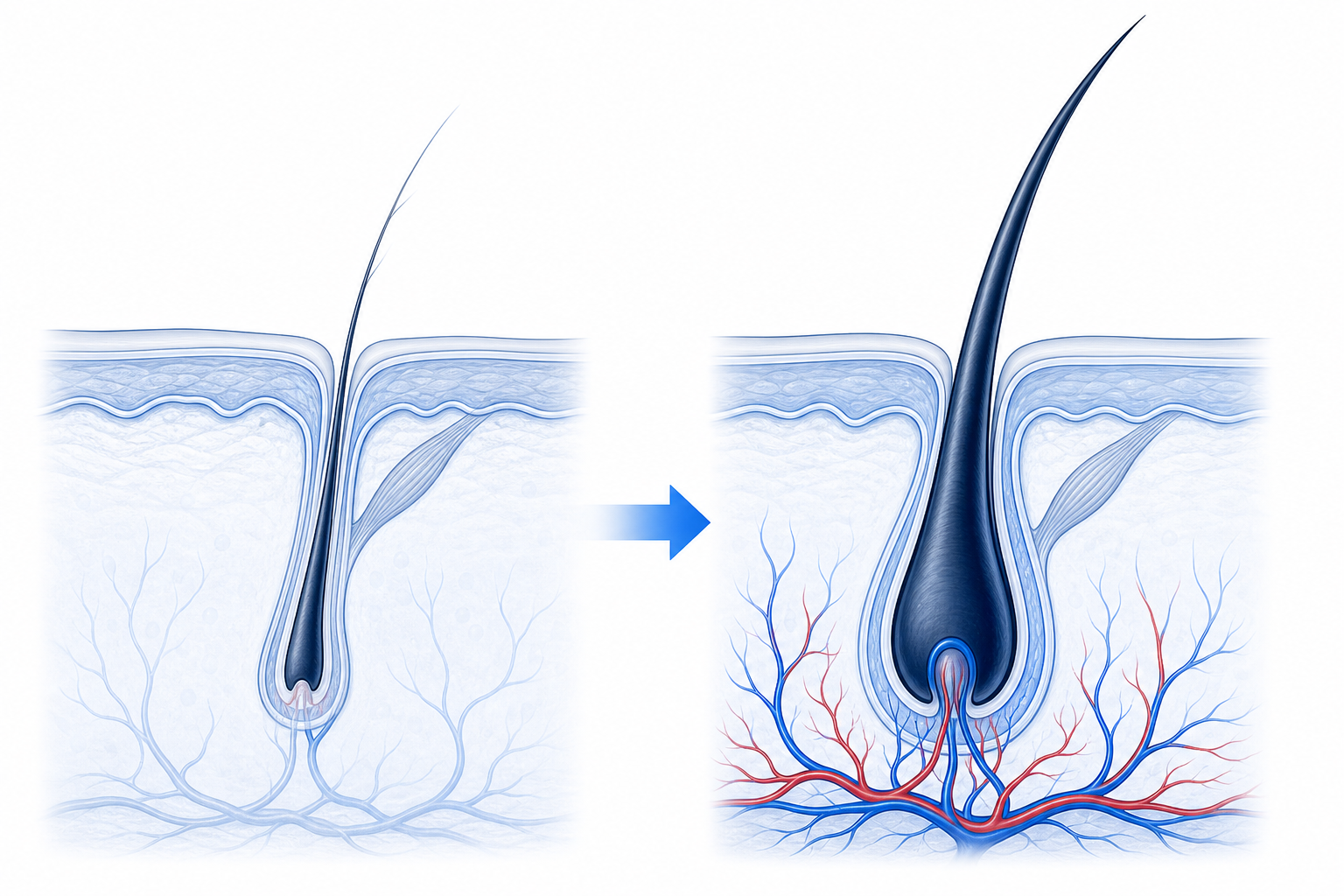
If you stop minoxidil for hair loss, the effect is reversible: according to consistent secondary sources, hair loss returns to its genetically predetermined course within about 3-6 months, and all of the gain achieved with minoxidil is lost during that time (ZAVA, Sons).
Gradual tapering, for example by applying it less often, is discussed in some guides. It may feel subjectively gentler, but according to the current evidence it does not reliably prevent renewed shedding, because nothing changes about the underlying mechanism. So it is not a proven method for avoiding the loss.
The core message: minoxidil is a long-term therapy, not a one-time course you complete and finish. The effect lasts only as long as you use the product consistently. This honest foundation is decisive for the question of whether minoxidil alone is the right strategy or a permanent solution would make more sense.
Minoxidil for women
Minoxidil for hair loss is also approved for women, classically as a 2% solution twice daily. The European S3 guideline now additionally allows 5% foam once daily as an equivalent alternative. Minoxidil works for female androgenetic alopecia and diffuse thinning with a recognizable pattern on the crown.
The central trade-off for women is the hypertrichosis risk, that is, unwanted facial hair, which is higher on 5% than on 2%. In the oral low-dose cohort of Ramos and Sinclair (2021, 67.2% women), hypertrichosis occurred in 15.1%. This is why the choice of concentration is especially individual for women.
Strict contraindication: Minoxidil, whether topical or oral, must not be used during pregnancy or breastfeeding (fetotoxicity in animal studies at high exposure, documented passage into breast milk). If you are planning a pregnancy, stop it under medical guidance well in advance and discuss alternatives. Do not experiment when in doubt.
Whether you actually have an androgenetic pattern or rather a diffuse hair loss caused by hormones or a nutrient deficiency is decisive for the choice of therapy. Our article Hair Loss in Women explains how to tell them apart in detail, and Hormones and Hair examines the hormonal connections.
Minoxidil, finasteride, or a hair transplant?
Minoxidil for hair loss, finasteride, and the hair transplant are not mutually exclusive; they address androgenetic alopecia on different levels. Minoxidil treats the symptom (the shrunken follicle), finasteride lowers the causal DHT in men, and the hair transplant permanently relocates DHT-resistant follicles into bald zones.
Key point: Minoxidil and finasteride stand for hair preservation (preventing and stabilizing the hair you still have), the hair transplant for hair restoration (restoring zones that are already bald). The two principles do not compete; they act at different points in the same process.
The combination of minoxidil and finasteride is considered the standard dual therapy for male androgenetic alopecia. A 2025 meta-analysis of seven RCTs with 396 men found the combination significantly superior to minoxidil monotherapy for hair density (mean difference 9.22; p=0.04) and global photographic assessment (p<0.00001).
| Criterion | Minoxidil | Finasteride | Combination | Hair transplant |
|---|---|---|---|---|
| Mechanism | revitalize follicles | lower DHT (cause) | both mechanisms | relocate follicles |
| Use | topical/oral, 1-2×/day | daily tablet | daily | one-time procedure |
| Works for | crown/vertex, diffuse | androgenetic (men) | androgenetic | already bald zones |
| Duration | ongoing | ongoing | ongoing | one-time, lasting |
| Reversible | yes | yes | yes | no (permanent) |
| For women | yes (2% / 5% foam) | usually no | limited | yes, if suitable |
| Typical side effect | irritation, hypertrichosis | sexual function | combined | surgical risks, possible temporary shock loss |
Diffuse or genetic? When minoxidil is the right and when the wrong approach
Through its approval and the guideline, minoxidil for hair loss is aimed at androgenetic (pattern) alopecia on the crown and vertex. Diffuse hair loss across the whole scalp due to iron deficiency, a thyroid disorder, or an acute telogen effluvium, by contrast, first needs its cause to be identified, not primarily minoxidil.
One stubborn myth concerns a receding hairline: because the early FDA approval study focused on the vertex, minoxidil is often considered ineffective there. Newer data on the 5% foam show measurable improvements at the front of the scalp as well, though the evidence for the frontal area is thinner overall than for the vertex. A medical blood test and hair analysis clarify which type is present.
Here lies the decisive limit: minoxidil can revitalize existing, miniaturized follicles, but it cannot regrow areas where the follicle is already completely lost. In such zones, the hair transplant (at Elithair, FUE extraction combined with DHI implantation) is the established option for permanently relocating DHT-resistant hair from the donor area.
This is exactly where preservation and restoration complement each other: using minoxidil alongside a transplant is common practice to protect the non-transplanted, still genetically vulnerable native hair. An international expert consensus (2023, 38 specialists from 17 countries) sees indications that concurrent minoxidil can ease postoperative shock loss, which is practical experience, not proven by large RCTs.
Which type and stage of hair loss you have cannot be judged from a screen. A free medical hair analysis places your case in context and shows which options (minoxidil, a combination, or possibly a transplant) even make sense. It is a visual pattern analysis and does not replace a medical blood test if diffuse causes are suspected.
Perspective from Elithair’s practice
In our consultations, we repeatedly see minoxidil misunderstood as a one-time course. It is a long-term therapy: the success lasts only as long as it is used consistently, and the benefit is lost again after you stop. The right diagnosis is just as important. Minoxidil can support miniaturized follicles, but it cannot create hair in zones that are already bald. That is why we often use it alongside a transplant, to stabilize the non-transplanted native hair.
Dr. Imad Moustafa, Elithair Medical Board
Conclusion: minoxidil for hair loss at a glance (2026)
Minoxidil for hair loss is an effective but long-term therapy for androgenetic alopecia, and it holds the highest topical guideline recommendation grade for both men and women. The effect takes patience (3-6 months to first results, up to 12 months for the full effect) and ends as soon as you stop using it. It does not replace hair in zones that are already bald, but it combines well with finasteride or a transplant.
Pros
- ✅ Topical form available over the counter
- ✅ Works without affecting hormone balance (no DHT effect)
- ✅ Suitable for men and women
- ✅ Combinable with finasteride and a hair transplant
- ✅ Highest topical guideline recommendation grade
Cons
- ❌ Long-term therapy, effect reversible after stopping
- ❌ Initial shedding possible at the start
- ❌ Estimated 30-40% non-responders
- ❌ Local irritation, hypertrichosis possible
- ❌ No hair in zones that are already bald
Frequently asked questions about minoxidil for hair loss
Is minoxidil available without a prescription, and what does it cost?
Yes, topical minoxidil is available over the counter, no prescription needed. Reference values (prices vary by country and retailer): a multi-month supply of branded 5% minoxidil (Rogaine) typically runs about $40-50, the women’s version is in a similar range, and generic versions are cheaper. Oral minoxidil for hair loss is prescription-only and off-label.
Does it have to be the pricey brand name (Rogaine), or do generics work just as well?
No, what matters is not the brand name but the active ingredient and concentration. Generics with an identical minoxidil concentration (say 5%) are pharmaceutically equivalent to the brand. The differences lie mainly in the inactive ingredients and the dosage form: classic solutions often contain propylene glycol, which promotes irritation, whereas foam versions usually go without it. If you react sensitively, look at the formulation rather than the price.
Can you apply too much minoxidil?
Yes, but more product brings no added benefit and only raises the risk of irritation and systemic side effects. The label limits topical minoxidil to a maximum of 2 ml per day. Olsen et al. (2002) showed more severe scalp irritation on 5% (4%) than on 2% (1%). Stick to the approved dose.
Does minoxidil help with a receding hairline?
Yes, but often more weakly than at the back of the head. The widespread assumption that minoxidil only works on the vertex comes from the design of early approval studies. Newer data on the 5% foam show measurable density improvements at the front of the scalp as well. The evidence for the frontal area is thinner than for the vertex, though, which is why the effect at a receding hairline is often smaller.
Can you combine minoxidil with microneedling?
Yes, the combination is considered promising. In the pilot RCT by Dhurat et al. (2013, 100 patients), 82% of the microneedling-plus-minoxidil group reported more than 50% improvement versus 4.5% on minoxidil alone. It is a small pilot study, no substitute for large RCTs, and it should be done under medical supervision.
Do I have to take minoxidil before or after a hair transplant?
No, it is not mandatory, but it is often used alongside to protect the non-transplanted native hair. Starting it after the transplant usually happens only after about three weeks, once redness and crusts have healed. Coordinate the exact timing with your treating physician.
Does minoxidil work with hair coloring, gel, or blow-drying?
Generally yes, but not right after application. Respect the absorption time of at least 4 hours before washing, blow-drying, or using gel or hairspray. Coloring should be done in an application-free window so the irritated scalp is spared. Avoid blow-drying with heat immediately after application.
What happens if I miss an application?
A single missed application is nothing to worry about. Simply continue with the next regular application and do not double the dose. Minoxidil’s effect builds over months and only becomes visible after 3-6 months, so consistency over time matters more than any single application. Only a longer break of several weeks lets the achieved benefit slip away again.
Is minoxidil toxic to cats and dogs?
Yes, and considerably so. For cats, even a single drop (0.05 ml) or one or two licks can potentially be fatal; lethality in one case series was around 13% (Clinitox, University of Zurich). More than 88% of the poisonings occurred through licking a human. Store leftovers safely, wash your hands, and go to the vet immediately if poisoning is suspected.
Does minoxidil cause wrinkles or dark under-eye circles?
No, a causal link is not established. There are no controlled studies connecting minoxidil to wrinkles or under-eye circles. A genuinely documented mechanism can look similar, though: fluid retention, or periorbital edema (0.3% on oral minoxidil, Ramos/Sinclair 2021), can make the eye area look temporarily puffy.
Does minoxidil help with beard growth?
Not as intended: minoxidil is not approved for the beard area, though people in forums still use it there. A commonly reported effect is drying of the facial skin. This is a different area of use than scalp hair loss. If you want to encourage beard growth, you will find the details in our article on stimulating beard growth.
Sources
- Olsen EA et al. “A randomized clinical trial of 5% topical minoxidil versus 2% topical minoxidil and placebo in the treatment of androgenetic alopecia in men.” J Am Acad Dermatol 2002. sciencedirect.com
- Ramos PM, Sinclair RD et al. “Safety of low-dose oral minoxidil for hair loss: A multicenter study of 1404 patients.” J Am Acad Dermatol 2021. jaad.org
- Dhurat R et al. “A Randomized Evaluator Blinded Study of Effect of Microneedling in Androgenetic Alopecia: A Pilot Study.” 2013. PMC3746236
- Systematic review and meta-analysis: minoxidil-finasteride combination vs. minoxidil alone, 2025. PMC12537375
- “Sulfotransferase SULT1A1 activity in hair follicle, a prognostic marker of response to the minoxidil treatment.” PMC9326921
- “Combating ‘dread shed’ during oral minoxidil initiation.” PMC 2024. PMC11067493
- Gelbe Liste, active-ingredient profile for minoxidil and off-label use. gelbe-liste.de
- European S3 guideline on androgenetic alopecia (trade-press coverage). springermedizin.de
- Clinitox toxicology database (University of Zurich), minoxidil poisoning in cats/dogs. vetpharm.uzh.ch
Note: This article is for general information and does not replace medical advice, diagnosis, or treatment. Minoxidil is a medication with possible side effects. Use, dosing, and concentration should be coordinated with a doctor or pharmacist, and oral minoxidil for hair loss only under medical prescription. As of 2026.

Dr. Imad Moustafa
Hair transplant specialist