

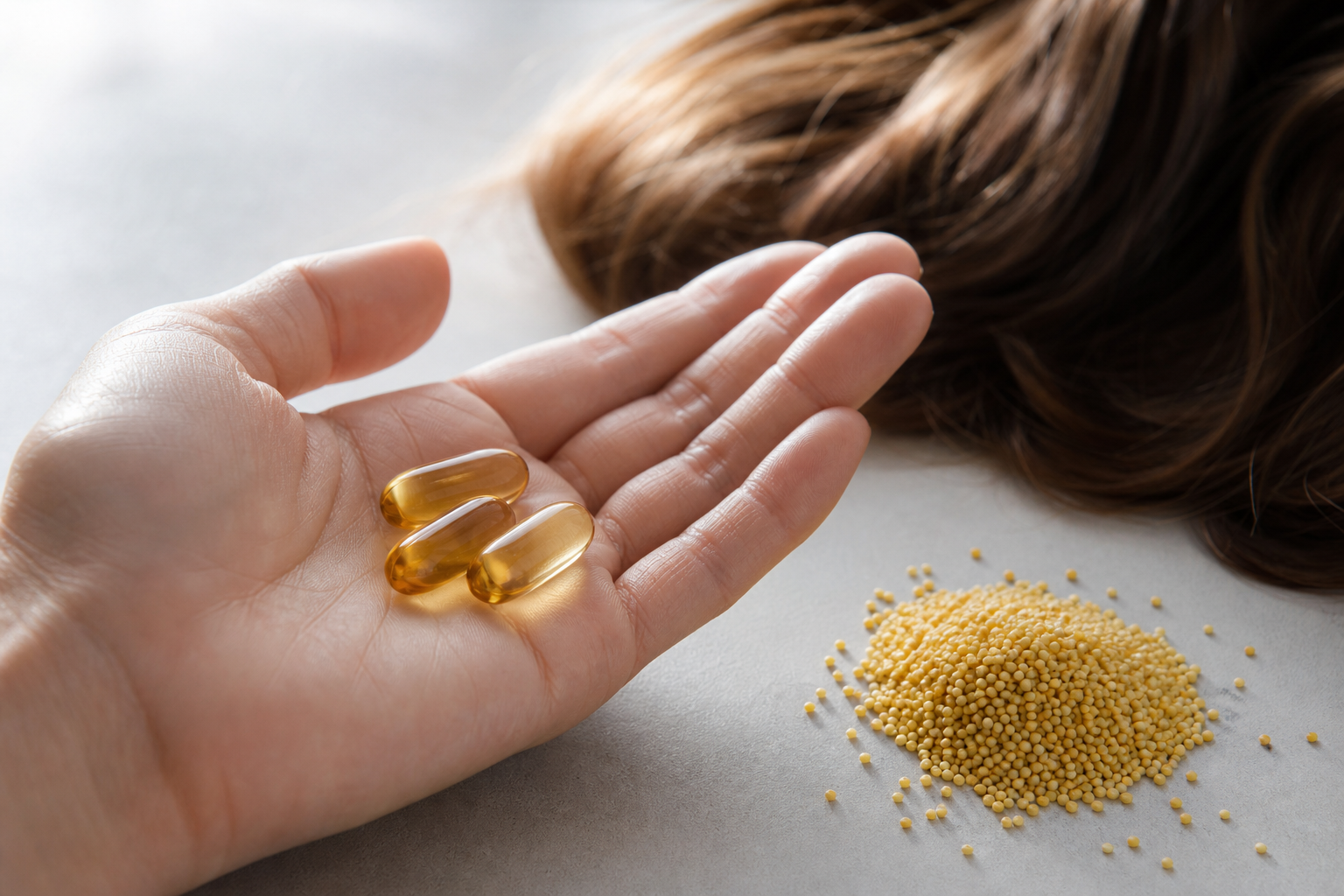
Priorin for hair loss is one of the best-known pharmacy products for thinning hair. Before you commit to a course that runs for months, it’s worth asking honestly: What can Priorin realistically do, which type of hair loss is it actually meant for, and what do independent sources say about how well it works?
Quick answer: Does Priorin work against hair loss?
- Priorin is an over-the-counter dietary product from Bayer, classified in Europe as a food for special medical purposes, not an approved medication.
- The classic Priorin capsules contain, per capsule, millet extract 140 mg, pantothenic acid (vitamin B5) 9 mg, and L-cystine 2 mg. Biotin is only in the separate product “Priorin Biotin,” not in the classic capsules.
- Priorin may help with diffuse, nutrition-related hair loss (telogen effluvium). A scientifically established benefit for hereditary (androgenetic) hair loss, by contrast, has not been proven.
- Realistic time frame per the manufacturer: at least 12 weeks, with a full cycle running 3 to 6 months.
- Medical consensus: Priorin is not a miracle cure. The European S3 guideline and Germany’s official health information service (gesund.bund.de) name minoxidil and finasteride, not supplements, as effective options for hereditary hair loss.
Summary
- What is Priorin? The product and how to classify it
- The ingredients in Priorin capsules: What’s inside?
- Does Priorin really help against hair loss? The evidence, honestly
- Which type of hair loss is Priorin meant for, and which is it not?
- Safety, side effects, and interactions of Priorin
- Taking Priorin correctly: dosage, duration, and expectations
- Priorin reviews: What do users really report?
- Priorin for women, during menopause, and for men
- Frequently asked questions about Priorin for hair loss
- Sources
What is Priorin? The product and how to classify it
Priorin is an over-the-counter dietary product classified in Europe as a food for special medical purposes, made by Bayer Vital GmbH in Leverkusen, Germany. It is explicitly not a drug in the legal sense. That is the key difference: a food for special medical purposes does not go through the same approval and efficacy testing as a medication, and its stated purpose is a manufacturer’s claim.
The product family includes several variants that are often confused. The Priorin capsules (millet extract, pantothenic acid, L-cystine) are the main product and the focus here. “Priorin Biotin” is a separate product with a different formulation and a different intended use. Priorin Liquid and shampoo are purely cosmetic products for external use, not supplements.
Priorin is available over the counter as a dietary supplement, without a prescription. Availability, pack sizes, and price vary by country and retailer, so it’s worth comparing before you buy. One point that matters to many people: Priorin capsules are not vegan and not suitable for strict vegetarians, because the capsule shell contains gelatin and the product also contains yellow beeswax.
The ingredients in Priorin capsules: What’s inside?
The classic Priorin capsules contain three active ingredients: millet extract 140 mg, pantothenic acid (vitamin B5) 9 mg, and L-cystine 2 mg per capsule (ingredient data per the Shop-Apotheke product data sheet). Contrary to common belief, the classic capsules contain no biotin. Biotin is only in the separately sold “Priorin Biotin.”
Millet extract supplies miliacin and silicon compounds, among other things, and has traditionally been associated with hair growth. Solid clinical evidence for isolated millet extract is thin, however; the available evidence comes almost entirely from combination preparations in which several substances are given at once.
L-cystine is a sulfur-containing amino acid and a central building block of keratin, which makes up much of the hair. Its biochemical role is plausible. The clinical evidence, though, comes mostly from higher-dosed preparations: the study cited below used 20 mg of cystine per capsule, ten times the 2 mg in Priorin.
Pantothenic acid (vitamin B5) is a cofactor in the cells’ energy metabolism. The DGE reference value for adults is 5 mg per day, and according to the German Nutrition Society a deficiency “has so far not been observed” with a normal mixed diet. Pantothenic acid is present in almost all foods, so a true deficiency is the rare exception.
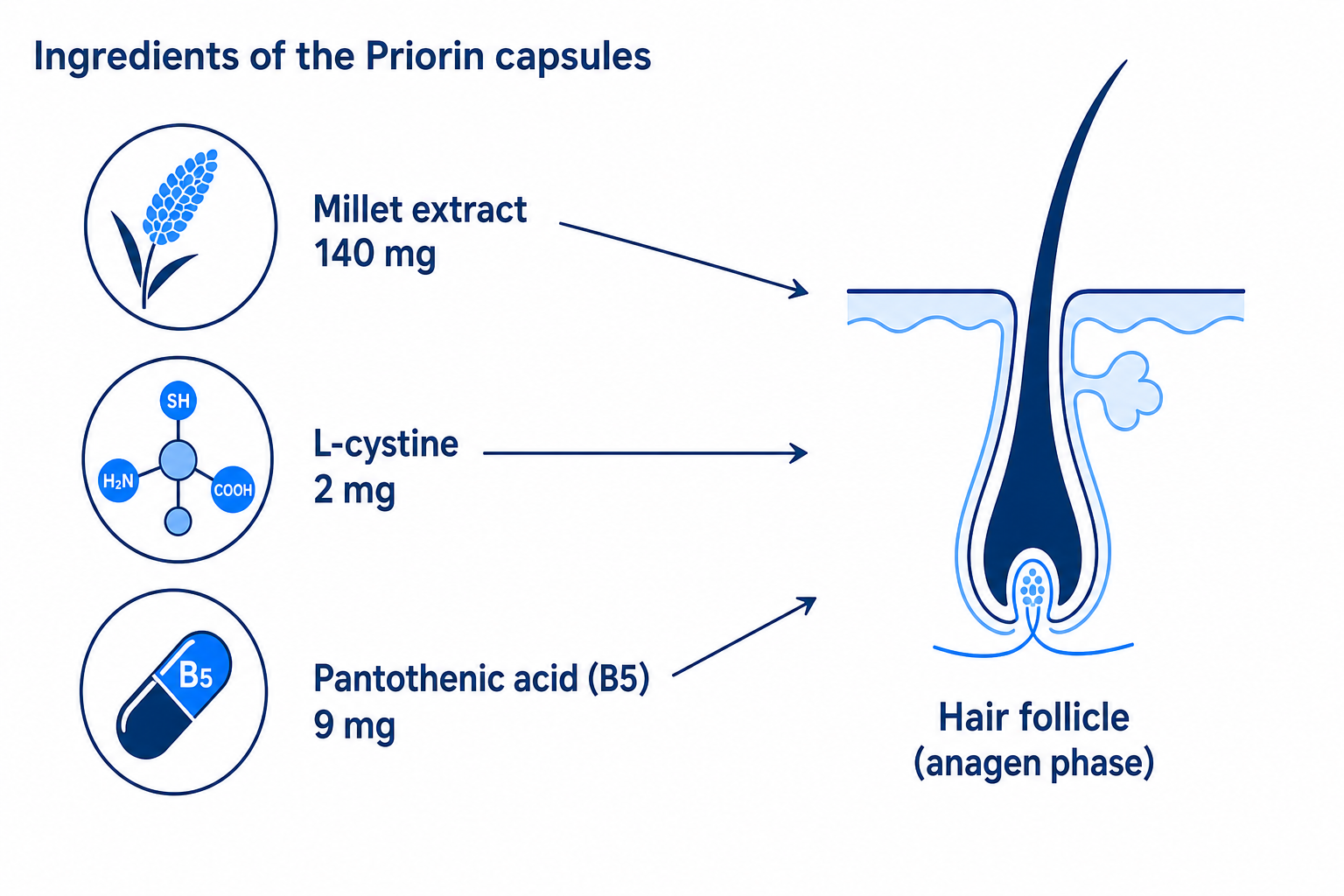
The table below places each ingredient in honest context: its role for hair, the state of the research, and what that means in practice.
| Ingredient | Role for hair | State of research / level of evidence | Honest assessment |
|---|---|---|---|
| Millet extract (140 mg) |
Supplies miliacin and silicon compounds, traditionally credited with supporting hair growth | Low. Almost no standalone evidence for millet extract, data only from combination products | Plausible, but the specific contribution cannot be cleanly isolated scientifically |
| L-cystine (2 mg) |
Sulfur-containing amino acid, a keratin building block of hair | Moderate for the ingredient class, but from clearly higher doses (20 mg) in combination products | The biochemically strongest candidate; the 2 mg in Priorin is far below the study doses |
| Pantothenic acid (B5) (9 mg) |
Cofactor in the energy metabolism of follicle cells | Benefit plausible only in deficiency; DGE: deficiency not observed on a mixed diet | Added benefit questionable in well-nourished people, since a deficiency practically never occurs |
| Biotin (only in “Priorin Biotin,” 100 µg) |
Involved in keratin metabolism | Benefit only with a proven deficiency (Patel 2017); deficiency rare per DGE | No proven effect with normal supply; can also skew lab values (see side effects) |
Cheaper alternatives from the pharmacy and drugstore
Similar nutrient combinations of amino acids and B vitamins are also available from other brands, sometimes considerably cheaper. The mechanism behind many hair supplements is similar: a mix of L-cystine, B vitamins, and plant extracts or yeast. So Priorin is not unique; it’s one representative of an entire product class.
At the pharmacy, Pantogar, for example, is a comparable combination product (with medicinal yeast and higher-dosed L-cystine instead of millet extract). Drugstores carry cheaper combination products, for instance from Doppelherz or Plantur, often labeled as regular dietary supplements. Important context: none of these products has a proven benefit for hereditary hair loss. Comparing prices is worthwhile; comparing their effect against androgenetic hair loss comes up empty across the board.
Does Priorin really help against hair loss? The evidence, honestly
Priorin may help support hair density in diffuse, nutrition-related hair loss, but the evidence specifically for Priorin is limited. There is no large, independent study proving that the specific Priorin formulation works for hereditary hair loss. The argument rests mainly on data about the ingredient class, not on the product itself.
The most frequently cited evidence comes from Lengg, Heidecker, Seifert, and Trüeb (2007): a randomized, double-blind, placebo-controlled study of 30 women with telogen effluvium over 6 months. On the preparation, the anagen rate normalized significantly (p=0.003); on placebo it did not (p=0.85). Important: this study was conducted on Pantogar, not on Priorin. Pantogar has a different formulation (among other things, 20 mg L-cystine and medicinal yeast instead of millet extract). The study is therefore usable only as analogous evidence for amino acid and B-vitamin complexes in diffuse hair loss, not as proof of Priorin’s efficacy.
As for Priorin’s own body of data, the consumer magazine Öko-Test concluded that there is not enough published data to support the manufacturer’s claim of “hormonal, hereditary hair loss in women.” Broader reviews (Almohanna et al. 2019) also emphasize: micronutrients help hair mainly when a proven deficiency is the cause. In well-nourished people, consistent evidence is lacking.
Which type of hair loss is Priorin meant for, and which is it not?
Priorin targets diffuse hair loss (telogen effluvium), not hereditary (androgenetic) hair loss. The diffuse type shows up as even thinning across the whole head, often triggered by stress, dieting, pregnancy, nutrient deficiency, or hormonal fluctuations. This is where the indirect evidence for the ingredient class lies. For androgenetic hair loss with a receding hairline and a thinning crown, by contrast, no benefit has been proven.
In androgenetic alopecia, the follicles are genetically prone to react sensitively to the hormone DHT and shrink. The European S3 guideline (Blume-Peytavi et al. 2018) and Germany’s official health information service (gesund.bund.de) recommend, based on evidence, minoxidil (women: 2% solution twice daily or 5% foam once daily) and, in men, additionally oral finasteride, not supplements. The two forms often occur together, especially in women during perimenopause.
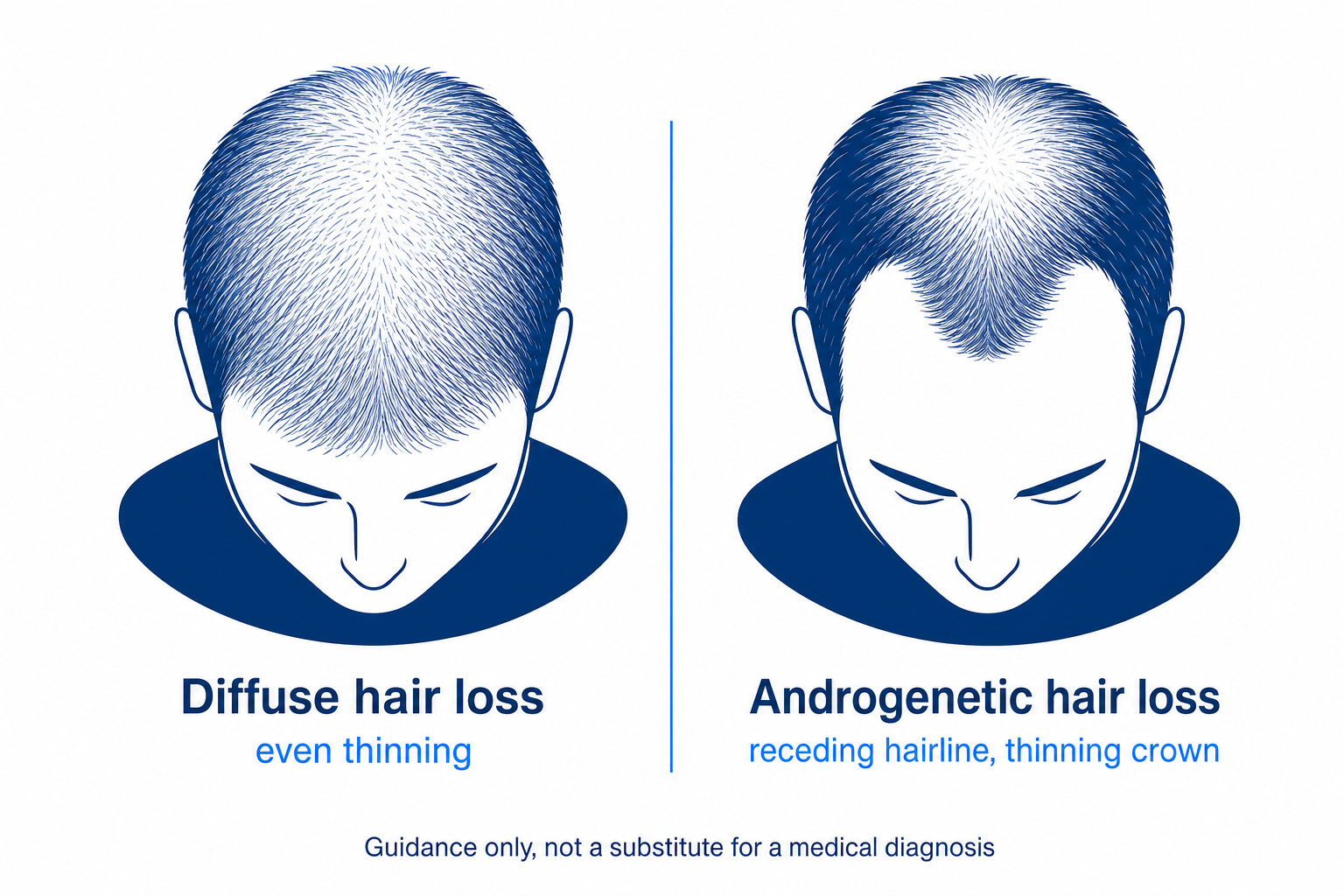
The orientation guide below shows the typical patterns side by side. It is a decision aid, not a substitute for a medical diagnosis.
| Diffuse hair loss (Priorin possibly useful) | Pattern hair loss / androgenetic (no proven Priorin benefit) |
|---|---|
| Even thinning across the whole head | Receding hairline, thinning part, or crown |
| Often after stress, dieting, pregnancy, or deficiency | Gradual, runs in the family |
| Hairline usually stays intact | Hairline and crown recede |
| Often reversible once the cause is addressed | Progressive without targeted treatment |
Before you invest months and money in a product, it’s worth knowing which type you actually have. The free Elithair hair analysis is a visual pattern analysis that serves as an open-ended diagnostic filter: it helps determine whether your hair loss is more likely diffuse or hereditary, and it distinguishes androgenetic alopecia from a diffuse pattern. That gives you a first read before you buy anything or see a doctor. A visual analysis, however, does not replace a medical blood test: for a confirmed diagnosis, seeing a doctor remains decisive (blood count, trichogram).
Safety, side effects, and interactions of Priorin
As a dietary product, Priorin is generally considered well tolerated, with few known side effects. Occasionally reported are gastrointestinal complaints such as bloating or nausea, and rarely skin reactions or allergies to ingredients like soy lecithin or wheat germ oil. There is no public manufacturer statistic with frequency figures; when in doubt, the package insert or your pharmacist can clarify.
Among Priorin’s side effects, there is a circulating worry that it makes you gain weight or stimulates appetite. There is no solid scientific source for this. B vitamins like pantothenic acid are involved in energy metabolism, but at the doses contained here that does not justify any proven appetite- or weight-increasing effect. This claim is an unsubstantiated rumor.
Priorin side effects and tolerability at a glance
- Gastrointestinal: occasional bloating or nausea, mostly when taken on an empty stomach.
- Allergies: rarely skin reactions to ingredients (soy, wheat germ oil).
- Vegan/vegetarian: not suitable, since it contains gelatin and yellow beeswax. Gluten-free per the manufacturer.
- “Makes you gain weight”: an unsubstantiated rumor with no scientific basis.
- Pregnancy/breastfeeding: not enough studies, only after consulting a doctor.
Interactions with other medications
No specific pharmacokinetic interaction is documented for Priorin. As a general pharmaceutical principle, though: thyroid hormones such as L-thyroxine should be taken at a different time from other oral preparations, since taking them together can impair absorption. If you take medication regularly, discuss the timing gap with your doctor or pharmacist.
Biotin and skewed lab values (applies to “Priorin Biotin”)
This point applies specifically to “Priorin Biotin,” not the classic Priorin capsules, which contain no biotin. According to an FDA safety communication, biotin can skew lab values, in particular troponin (a heart-attack marker, falsely low) and thyroid values (TSH, FT3, FT4). The key is to understand this correctly: biotin distorts the test results; it does not cause any illness.
Practical takeaway: anyone taking biotin should tell their doctor or lab before blood tests (especially thyroid and cardiac markers). The usual recommendation is to pause intake about 48 to 72 hours before the blood draw. That prevents misinterpretation. More on this in the article Blood test for hair loss.
Taking Priorin correctly: dosage, duration, and expectations
According to the manufacturer, for the first three months you take two Priorin capsules in the morning and one in the evening (three per day), swallowed whole with liquid. After that comes a maintenance dose of one capsule daily. The recommended minimum duration of use is 12 weeks. For milder hair growth problems, one capsule per day throughout may be enough.

Why the patience? The hair cycle takes several months before changes show. A follicle has to move from the resting phase (telogen) back into the growth phase (anagen). That fits the study design of Lengg and Trüeb, where the effect became statistically clear only after 6 months. A “shedding” phase like the one with minoxidil is not typical of a pure nutrient product and is not to be expected.
The timeline below shows what realistically happens over each period and how the dosing changes, so you can gauge the commitment involved. Cost depends on pack size and where you buy.
| Time frame | What happens in the hair cycle | Dosing |
|---|---|---|
| Month 1–2 | The nutrient supply stabilizes, acute shedding slowly eases. No visible new hair yet. | Starting phase: 3 capsules per day |
| Month 3–4 | Resting follicles re-enter the anagen (growth) phase. | Transition to the maintenance dose (1 capsule per day) |
| Month 5–6 | First new, still-fine hairs (baby hair) become visible; density may stabilize. | Maintenance dose for about 3 months |
| 6-month cycle overall | A realistic point to evaluate: has anything changed? | A full course runs about 6 months; overall cost depends on pack size and retailer |
What should you do if nothing improves after about 6 months? Then you should have the cause re-evaluated by a doctor or trichologist rather than taking it indefinitely. A blood count with ferritin and thyroid values makes sense, as does a trichogram if needed. More on this under Causes of hair loss and Capsules against hair loss.
Priorin reviews: What do users really report?
Priorin reviews are mixed, and that can be explained well by the professional literature. There is no methodologically sound, aggregated collection of user reports; pharmacy and shop ratings are subject to selection bias. That’s why this article deliberately includes no invented or paraphrased individual quotes, only a serious assessment.
What matters is the expectation effect: many forms of diffuse hair loss (telogen effluvium) also improve on their own over time, once the triggering stress is over. A noticeable success is therefore hard to separate cleanly from the natural course and from the placebo component, as reviews by Almohanna (2019) and Patel (2017) emphasize for the entire ingredient class.
Still, one pattern does emerge from the literature: positive feedback clusters around diffuse hair loss with consistent use over months. Disappointed reports cluster when users had expected an effect against hereditary hair loss. So whether Priorin fits your hair loss depends decisively on the type.
Priorin for women, during menopause, and for men
According to the manufacturer’s intended use, Priorin capsules are aimed specifically at women. Diffuse hair loss in women occurs more often after pregnancy and the postpartum period, during perimenopause, and with stress and dieting. In these situations, supporting the nutrient supply is understandable, provided no underlying deficiency is left untreated.
During menopause it gets more complicated: the hormonal shift can additionally trigger or intensify an androgenetic component (FAGA), which, per the guidelines, does not respond to Priorin. The two forms often overlap. That’s exactly why a targeted evaluation is worthwhile here. For more depth: Hair loss in women.
In men, androgenetic hair loss clearly dominates in numbers. Since this is precisely where Priorin has no proven benefit, the effect to be expected in men is correspondingly limited. A man who notices a receding hairline or a bald spot at the crown should discuss the evidence-based options with a doctor rather than relying on supplements alone.
Frequently asked questions about Priorin for hair loss
Does Priorin really help against hair loss?
Priorin may help with diffuse, nutrition-related hair loss (telogen effluvium). A scientifically established benefit for hereditary (androgenetic) hair loss has not been proven. The existing studies concern mainly the ingredient class, not Priorin itself.
What are the ingredients in Priorin?
The classic Priorin capsules contain, per capsule, millet extract 140 mg, pantothenic acid (vitamin B5) 9 mg, and L-cystine 2 mg. Biotin is only in the separate product “Priorin Biotin,” not in the classic capsules.
How long do you have to take Priorin before it works?
The manufacturer recommends a minimum use of 12 weeks. Realistically it’s 3 to 6 months, because the hair cycle needs that long to show visible changes. If nothing improves after about 6 months, you should have the cause evaluated by a doctor.
What side effects does Priorin have?
Priorin is considered well tolerated. Occasionally gastrointestinal complaints (bloating, nausea) occur, rarely skin reactions or allergies to ingredients. The circulating claim that Priorin makes you gain weight is not scientifically proven.
Does Priorin help with hereditary hair loss?
A benefit for androgenetic alopecia has not been proven. Bayer’s package insert does mention “hormonal, hereditary” hair loss in women, but independent assessments and the European S3 guideline do not support that. Guidelines recommend minoxidil and finasteride here.
Does Priorin help with hair breakage?
Hair breakage and hair loss are two different problems. With hair breakage, the length of the hair snaps off (often from heat, coloring, or mechanical stress), but the hair stays in the root. Priorin targets nutrition-related hair loss from the root, not brittle lengths. Against hair breakage, gentle care and heat protection help more.
Priorin during pregnancy and breastfeeding: is it allowed?
There are not enough controlled studies on Priorin during pregnancy and breastfeeding. Intake should therefore only take place after consulting a doctor or pharmacist. Taking it on your own is not advisable.
What happens if I stop taking Priorin?
Priorin does not treat the cause of a disease; it is meant to support the nutrient supply. If the actual cause of the hair loss persists, the hair may worsen again after stopping. When the cause has been addressed (for example, after a period of stress), that is less often the case.
Is Priorin available without a prescription?
Yes. Priorin is sold over the counter as a dietary supplement, without a prescription. Availability, pack sizes, and price depend on the country and the retailer.
Are Priorin capsules vegan or vegetarian?
No. The capsule shell contains gelatin, and yellow beeswax is also used, both of animal origin. Priorin capsules are therefore neither vegan nor suitable for strict vegetarians. According to the manufacturer, they are gluten-free.
Can you open or split Priorin capsules?
The manufacturer recommends taking the capsules whole with plenty of liquid. There is no approval for opening or splitting the capsule. Anyone with trouble swallowing should not open the capsule on their own but discuss the approach with a pharmacist.
Does Priorin make you gain weight or stimulate appetite?
There is no solid scientific source for this claim. The B vitamins it contains are involved in energy metabolism, but at the doses contained that does not justify any proven appetite- or weight-increasing effect.
Can I take Priorin with other medications like thyroid pills?
No specific interaction is documented for Priorin. Since oral preparations can impair the absorption of L-thyroxine, you should keep a time gap between doses and coordinate this with your doctor or pharmacist.
Sources
- Lengg N, Heidecker B, Seifert B, Trüeb RM (2007): Dietary supplement increases anagen hair rate in women with telogen effluvium. Therapy 4(1):59–65 (study on Pantogar, not Priorin). Full-text PDF
- Patel DP, Swink SM, Castelo-Soccio L (2017): A Review of the Use of Biotin for Hair Loss. Skin Appendage Disord. PubMed (PMID 28879195)
- Almohanna HM et al. (2019): The Role of Vitamins and Minerals in Hair Loss. Dermatol Ther (Heidelb) 9(1):51–70. Reference
- EDF/AWMF S3 guideline on androgenetic alopecia (Blume-Peytavi et al. 2018): recommendations for minoxidil/finasteride. Summary
- gesund.bund.de: Hereditary hair loss (official German federal health information). Source
- German Nutrition Society (DGE): reference values Pantothenic acid and Biotin
- FDA Safety Communication: Biotin Interference with Troponin and Other Lab Tests. Source
- Product data (formulation, ingredients, dosage, price): Shop-Apotheke product data sheet for Priorin capsules (retail source); Öko-Test (secondary citation, primary test paywalled). Shop-Apotheke
Note: This article is for general information and does not replace a medical diagnosis or consultation. For persistent or pronounced hair loss, consult a doctor or dermatologist. As of: July 2026.
Dr. Imad Moustafa
Hair transplant specialist