


In short: hair loss from medication
- Mechanism: Usually a telogen effluvium, meaning diffuse hair loss across the entire scalp. With cytostatic drugs (chemotherapy), it is an anagen effluvium with faster, more severe shedding.
- Onset: With telogen effluvium, typically 2 to 4 months after starting, switching, or stopping a medication; with cytostatic drugs, as early as 1 to 3 weeks (review article “Telogen Effluvium: A Review,” PMC).
- Most common triggers: Cytostatic drugs, retinoids, anticoagulants, beta-blockers, GLP-1 analogs, anti-seizure medications, and thyroid medications.
- Prognosis: As a rule, diffuse and reversible. The hair usually grows back once the cause is addressed.
Core rule: Never stop a medication on your own. Always discuss any suspicion with the prescribing physician.
Summary
- Which medications cause hair loss? An overview of the drug classes
- Why do medications cause hair loss? Anagen vs. telogen effluvium
- Is medication-induced hair loss reversible? Reversibility and regrowth timeline
- The most important drug classes in detail
- Medications for hair loss: don’t confuse them with the triggers
- How do I know if the medication is to blame?
- What to do about medication-induced hair loss
- Diffuse or genetic? When medications aren’t the whole explanation
- Frequently asked questions about medication-induced hair loss
- Sources
Which medications cause hair loss? An overview of the drug classes
Which medications cause hair loss cannot be answered as a complete list: the medical literature describes more than 500 active substances that have been associated with hair loss in individual cases (review article “Culprits of Medication-Induced Telogen Effluvium,” JAAD/PubMed 2024). It therefore makes more sense to sort them by drug class with solid evidence behind them.
The overview below groups the relevant classes of medications that can trigger hair loss, along with their mechanism, onset, and frequency. The last column matters most: not every drug affects the same number of people. The range is enormous, from “very common” with cytostatic drugs to “rare” with beta-blockers or statins.
| Drug class | Examples (use) | Type | Onset | Frequency | Reversible? |
|---|---|---|---|---|---|
| Cytostatic drugs / chemotherapy | Doxorubicin, cyclophosphamide, taxanes (cancer therapy) | anagen | 1–3 weeks | very common | usually yes |
| GLP-1 analogs | Semaglutide, tirzepatide (diabetes, obesity) | telogen | 2–3 months | occasional | yes |
| Retinoids / vitamin A | Isotretinoin, acitretin (acne, psoriasis) | telogen | 1–3 months | dose-dependent | yes |
| Anti-seizure medications | Valproate, lamotrigine (epilepsy) | telogen | 2–6 months | dose-dependent | yes |
| Thyroid medications | Levothyroxine, antithyroid drugs | telogen | 6–12 weeks | during adjustment | yes |
| Anticoagulants | Heparin, warfarin, phenprocoumon (blood thinning) | telogen | 3 weeks–3 months | occasional | yes |
| Hormones / contraceptives | Birth control pill (especially stopping/switching) | telogen | 2–4 months | occasional | yes |
| Antidepressants / lithium | SSRIs (fluoxetine, sertraline), lithium | telogen | first 3 months | rare | usually yes |
| Beta-blockers / blood pressure drugs | Propranolol, metoprolol, ACE inhibitors | telogen | 2–4 months | rare | yes |
| Glucocorticoids | Cortisone (high dose / withdrawal) | telogen | 2–4 months | rare | yes |
| Statins / fibrates | Atorvastatin, simvastatin (cholesterol) | telogen | variable | very rare | yes |
Frequency as a category, not an exact individual figure. The data partly come from case series and spontaneous reporting databases with varying methodology. Sources for each class are listed below.
Why do medications cause hair loss? Anagen vs. telogen effluvium
Medications trigger hair loss through two fundamentally different pathways: as a telogen or an anagen effluvium. The difference determines how quickly and how severely the hair falls out. Each targets a different point in the hair cycle, which is why the onset and pattern differ so much.
With telogen effluvium (TE), the most common type with non-chemo medications, the drug pushes many follicles into the resting phase at the same time. The diffuse shedding across the entire scalp begins after a delay of about 3 months (review “Telogen Effluvium: A Review,” PMC). It is self-limiting and usually lasts around six months.
With anagen effluvium (AE), cytostatic drugs directly damage the highly active dividing cells of the hair matrix during the growth phase. The hair shaft breaks off because it is only partially keratinized. The shedding begins as early as 1 to 3 weeks after treatment starts and is often nearly complete (StatPearls “Anagen Effluvium,” NCBI).
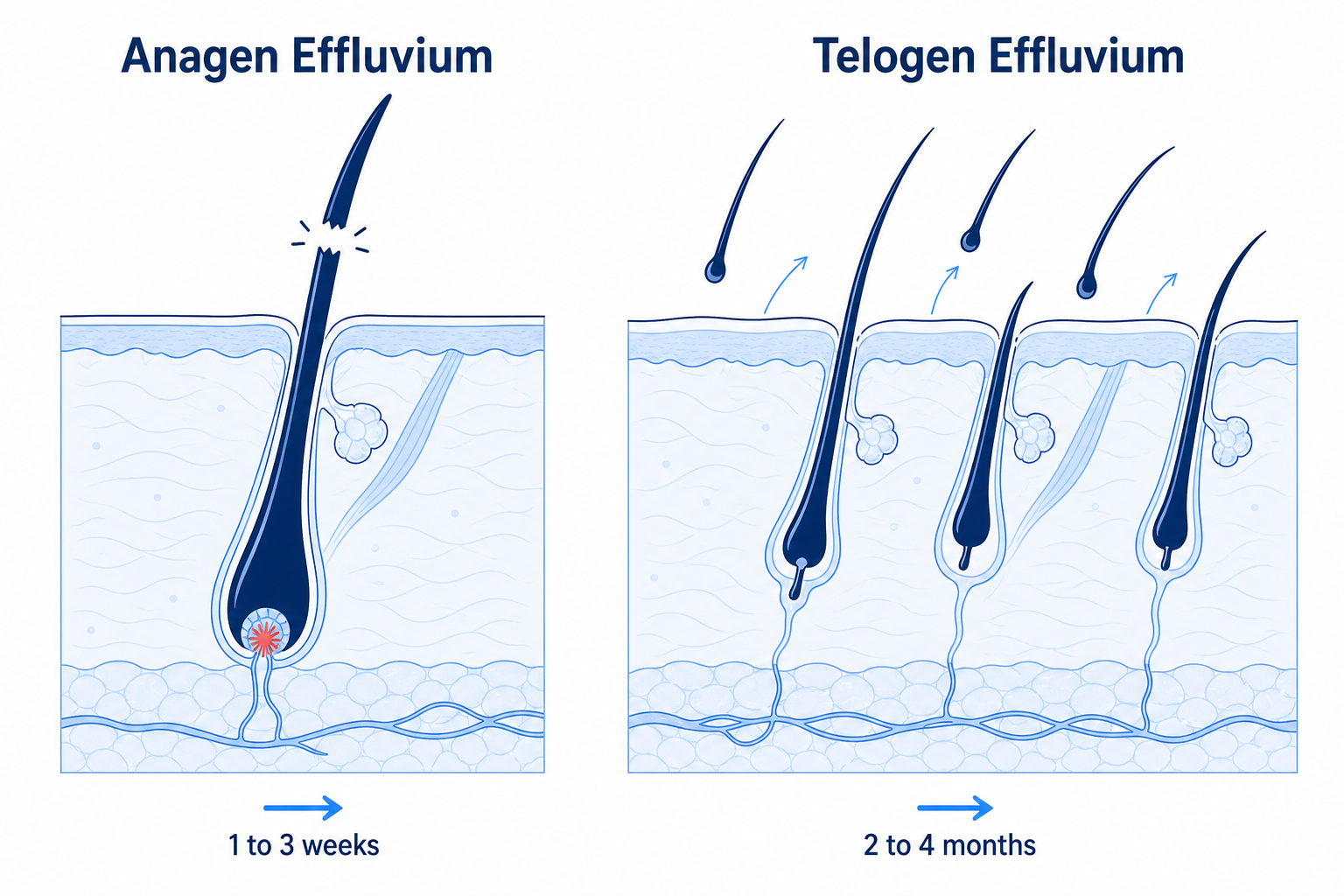
| Feature | Telogen effluvium | Anagen effluvium |
|---|---|---|
| Typical trigger | Most non-chemo medications, fever, stress, iron deficiency, childbirth | Cytostatic drugs / chemotherapy |
| Onset | 2–4 months | 1–3 weeks |
| Extent | Diffuse, usually less than 50% of scalp hair | Often nearly complete, sometimes including body hair |
| Reversibility | Usually complete | Usually yes, rarely persistent |
How the hair cycle moves between the growth, transition, and resting phases is explained in detail in our article on the hair growth cycle. This basic understanding helps you correctly interpret onset times and the later regrowth.
Is medication-induced hair loss reversible? Reversibility and regrowth timeline
Medication-induced hair loss is reversible as a rule. A telogen effluvium usually resolves completely after stopping or switching the drug. Even after chemotherapy, the hair grows back in the vast majority of people, often changed at first in texture or color (the well-known “chemo curls”).
The timeline follows the hair cycle. After the shedding, it takes several months for the follicles to re-enter the growth phase. With a telogen effluvium, the shedding subsides after 3 to 6 months, but noticeable cosmetic fullness can take 12 to 18 months, according to the PMC review.
| Time frame | What happens |
|---|---|
| Month 0 | Trigger identified, medication stopped or switched (only with a doctor) |
| Month 1–2 | The shedding gradually subsides |
| Month 3–4 | Follicles re-enter the growth phase (anagen) |
| Month 5–6 | First visible new, fine hairs (“baby hair”) |
| Month 12–18 | Noticeable full cosmetic density |
A general orientation model for a drug-induced telogen effluvium, derived from the onset and recovery figures in the PMC review article. The individual course varies.
There are two honest exceptions. Rarely, a persistent chemotherapy-induced alopecia occurs, defined as hair that has not fully grown back six months after chemotherapy ends. It is far more common with taxanes: about 23% after docetaxel and around 10% after paclitaxel (PMC, adjuvant docetaxel study). Details are in the article on hair transplants after cancer treatment.
The second exception involves radiation therapy: within the radiation field, permanent, scarring hair loss can develop above certain threshold doses. Studies describe permanent alopecia of the scalp starting at a dose of around 37 Gy (D2 value), and lower still in children (PLOS ONE, scalp dose analysis). More on this in the article on hair loss after radiation therapy.
The most important drug classes in detail
The individual drug classes differ greatly in mechanism, onset, and frequency. The sections below organize each group by the same framework: which type of effluvium, how long until shedding, how common, and whether it is reversible. That makes it easy to find your own medication.
Cytostatic drugs and chemotherapy
Cytostatic drugs (e.g., doxorubicin, cyclophosphamide, taxanes) cause an anagen effluvium. Onset: 1 to 3 weeks. Frequency: very common to inevitable, depending on the protocol. Reversible: usually yes. They damage the actively dividing hair matrix directly, which is why the shedding begins so early and so heavily.
For prevention, scalp cooling (a cooling cap) is a recognized measure that reduces blood flow, and therefore the follicles’ exposure to the drug, during the infusion. After treatment ends, regrowth usually begins within a few weeks. The rare persistent form mainly involves taxanes (see the reversibility section above).
GLP-1 analogs: Ozempic, Wegovy, and Mounjaro
GLP-1 analogs (semaglutide, tirzepatide) usually cause a telogen effluvium. Onset: 2 to 3 months. Frequency: occasional, dose- and weight-dependent. Reversible: yes. The key nuance: the hair loss is largely a consequence of the rapid weight loss, not direct toxicity of the drug.
In the Wegovy approval trial, alopecia occurred in 3.5% versus 1.0% on placebo; people who lost more than 20% of their body weight were affected more often, at 5.3% (systematic review, SAGE 2026). The pattern resembles what happens after significant weight loss or bariatric surgery. Once weight stabilizes, the shedding usually improves within 3 to 6 months.
The topic is covered in depth in the article on Ozempic and hair loss, including the question of how adequate protein, iron, and vitamin intake during the weight-loss phase affects the hair.
Beta-blockers and blood pressure medications
Beta-blockers and blood pressure medications (propranolol, metoprolol, ACE inhibitors) cause a telogen effluvium. Onset: 2 to 4 months. Frequency: rare, mostly isolated cases. Reversible: yes. Case reports show near-complete recovery about four months after stopping, with recurrence upon rechallenge.
Because high blood pressure has to be treated consistently, stopping on your own is especially risky here. The right approach is to talk about a possible alternative within the same drug class, without jeopardizing blood pressure control.
Anticoagulants and blood thinners
Anticoagulants (heparin, warfarin, phenprocoumon) cause a telogen effluvium. Onset: 3 weeks to 3 months. Frequency: occasional, classically described. Reversible: yes. The exact mechanism has not been fully clarified (Springer, “Traditional Anticoagulants and Hair Loss”).
One documented case describes improvement of the hair loss after switching from warfarin to the direct oral anticoagulant apixaban (PMC case report). Whether a change of drug is an option is decided solely by the treating practice, based on the thrombosis risk.
Retinoids and high-dose vitamin A
Retinoids (isotretinoin, acitretin) cause a telogen effluvium. Onset: 1 to 3 months. Frequency: dose-dependent. Reversible: yes. A systematic review found hair loss in about 3.2% on a low dose (under 0.5 mg/kg/day) versus 5.7% on a standard or high dose (PMC).
High-dose vitamin A from supplements can also trigger hair loss: the WHO lists alopecia as a consequence of chronic vitamin A toxicity. It usually becomes a concern from about 25,000 to 50,000 IU daily over months, while the safe upper limit is around 10,000 IU per day (StatPearls “Vitamin A Toxicity”). This toxicity does not develop from a normal diet.
Antidepressants and psychiatric medications
Antidepressants (SSRIs such as fluoxetine or sertraline, as well as lithium) rarely cause a telogen effluvium. Onset: within the first 3 months. Frequency: rare and individual. Reversible: usually yes. A cited systematic review reports improvement after stopping in around 63% of those affected.
Lithium stands out a bit more, at 12 to 19%, partly mediated by lithium-induced hypothyroidism, which can itself cause an effluvium. With psychiatric medications in particular, keep in mind: abrupt discontinuation can dangerously destabilize the underlying condition, so only adjust it in consultation with your doctor.
Anti-seizure medications: valproate and lamotrigine
Anti-seizure medications (especially valproate) cause a telogen effluvium. Onset: 2 to 6 months. Frequency: dose-dependent. Reversible: yes. For valproate, studies cite a range of 3.5 to 12%, and according to the FDA prescribing information, 24% on a high dose versus 13% on a low dose (PMC, “Dose-dependent valproate-induced alopecia”).
Lamotrigine is affected less often than valproate. How the shedding behaves specifically with this drug and what those affected can do is covered in detail in the article on lamotrigine and hair loss.
Thyroid medications such as levothyroxine
Thyroid medications (levothyroxine, antithyroid drugs) cause a telogen effluvium. Onset: 6 to 12 weeks. Frequency: mainly during the adjustment phase. Reversible: yes. The paradox is that both an overactive and an underactive thyroid can cause hair loss, and the adjustment itself temporarily makes it worse.
Various patient resources report that up to 30% lose more hair during the first twelve weeks of adjusting to levothyroxine, usually as a temporary adaptation response. The connection between the thyroid and the hair is explored further in the article on hair loss from hypothyroidism.
Hormone medications and the pill
Hormone medications (the combination pill, especially when stopping or switching) cause a telogen effluvium. Onset: 2 to 4 months after the change. Frequency: occasional. Reversible: yes. When you stop, estrogen levels drop abruptly, and many follicles shift into the resting phase at the same time.
Stopping is not the only factor: starting or switching to a formulation with androgenic progestins can also actively promote hair loss in women who are genetically predisposed, because such progestins can act on the hair follicles in an androgen-like way. Conversely, anti-androgenic formulations are sometimes used specifically against genetic hair loss. Which formulation has which effect should therefore be discussed with a gynecologist. The connections between hormones and hair are explored further in the article on hormones and hair.
The shedding can last up to nine months, peaking around month three to six. Details are in the article on hair loss from switching the pill. Because this topic affects almost only women, the article on hair loss in women is also worth reading.
Glucocorticoids (cortisone): the special case
Glucocorticoids (cortisone, systemic at a high dose or during withdrawal) can cause a telogen effluvium. Onset: 2 to 4 months. Frequency: rare, dose-dependent. Reversible: yes. The special case: cortisone treats some forms of hair loss (such as alopecia areata), yet in another situation it can cause hair loss itself.
An important safety note: systemic corticosteroids must never be stopped abruptly on your own, because an adrenal crisis can result. Tapering off is done exclusively under medical supervision. The drug’s dual role is explained in the article on glucocorticoids and hair loss.
Statins and other substances
Statins (atorvastatin, simvastatin) can very rarely cause a telogen effluvium. Frequency: fewer than 1 in 1,000 according to the prescribing information. Reversible: yes. In spontaneous reporting databases, hair loss accounts for 0.6 to 1.6% of all reported rosuvastatin side effects. That is a reporting share, not a population incidence. The large JUPITER trial found no significant signal.
As further, rarer triggers of a telogen effluvium, review articles name allopurinol (gout), interferons and immunomodulators, and amphetamines, among others. For these substances there are usually only case reports rather than solid percentages, and reversibility is the rule.
Acid reducers (PPIs) such as pantoprazole and omeprazole
Acid reducers (proton pump inhibitors such as pantoprazole or omeprazole) are not considered classic, direct triggers of hair loss. Because they are prescribed very often, they frequently come under suspicion, but a solid direct link to a telogen effluvium is not well documented in the medical literature.
If there is a connection at all, it is mainly discussed as an indirect one: long-term use can impair the absorption of vitamin B12 and iron, and a resulting deficiency could in turn promote diffuse hair loss. So rather than stopping on your own, it makes more sense with long-term use to have your nutrient status (B12, ferritin) checked by a doctor.
Painkillers and antibiotics: usually a misconception
Painkillers and antibiotics are often blamed for hair loss, but they are rarely the true cause. With antibiotics, the trigger is almost always the febrile infection being treated: a fever above 101°F (38.3°C) disrupts the hair cycle and leads to a telogen effluvium months later (Cleveland Clinic, “Telogen Effluvium”).
For NSAIDs such as ibuprofen, acetaminophen, or aspirin, the evidence remains at the level of case reports; controlled studies are lacking. Anyone who suspects these everyday drugs should first check whether an illness, high fever, or surgery occurred at the same time. That is the classic post hoc fallacy.
Myth check: these drugs are often wrongly blamed
- Antibiotics: Usually the accompanying febrile infection is the trigger, not the antibiotic itself.
- Ibuprofen and other NSAIDs: Only isolated case reports, no solid body of evidence.
- Acetaminophen and aspirin: No established link with diffuse hair loss.
- Standard-dose vitamins: Harmless at usual doses. It only becomes a problem with high-dose vitamin A.
Medications for hair loss: don’t confuse them with the triggers
Medications for hair loss are something entirely different from the substances that cause it. Which one helps depends on the type of hair loss. For genetic (androgenetic) hair loss, minoxidil and finasteride are used; for alopecia areata, JAK inhibitors and cortisone, among others.
It’s important to know about the initial shedding paradox: at the start of minoxidil or finasteride therapy, hair often falls out more, because follicles shift in a synchronized way into a new growth phase. This “dread shed” typically lasts 4 to 8 weeks and is considered a sign that the treatment is starting to work, not a treatment failure.
The key point: minoxidil and finasteride do not help with a drug-induced diffuse effluvium. There, addressing the cause is the real lever. How minoxidil works is explained in the article on minoxidil for hair loss; for the medication-based approach to alopecia areata, see the article on Olumiant for hair loss.
How do I know if the medication is to blame?
Whether a medication is causing the hair loss shows up mainly in the timing: did the diffuse shedding start about 2 to 4 months after a new drug or a dose change? A pull test and a trichogram also help confirm the diagnosis, and other causes are ruled out.

The most common error in reasoning is “post hoc ergo propter hoc”: someone who briefly took a medication because of a severe flu, COVID, or surgery blames the drug, even though the febrile infection itself triggered the effluvium 2 to 4 months later. So always check whether an illness, fever, surgery, or a crash diet occurred at the same time.
Self-check: is my medication to blame?
- New medication or dose change in the last 2 to 4 months?
- Shedding diffuse across the entire scalp, not just at the temples?
- Clearly more hair in your brush, on your pillow, or in the drain than before?
- Was there a severe flu, COVID, high fever, surgery, or crash diet 2 to 4 months ago?
- Have other causes such as iron deficiency, the thyroid, or major stress been checked?
- No bald, clearly defined patches (those point to other forms)?
How to read it: Several “yes” answers suggest a timing link that should be discussed with the prescribing physician. This does not replace a diagnosis.
Blood work helps with the differentiation, especially ferritin (iron stores), TSH (thyroid), and a complete blood count. For ferritin there is no single cutoff; the literature cites values ranging from under 15 to under 70 ng/mL, which is why the interpretation remains a matter for the doctor. More on this in the article on blood tests for hair loss.
What to do about medication-induced hair loss
With medication-induced hair loss, the most important rule is: never stop it or change the dose on your own. The underlying condition almost always outweighs the hair loss, and with some drugs, such as cortisone, stopping abruptly is downright dangerous. The first step is always the conversation with the prescribing practice.

Together you can clarify whether the medication really is the cause, whether an equivalent alternative without this side effect exists, and whether waiting is reasonable. Because a telogen effluvium is self-limiting, “watchful waiting” is often a legitimate option. In parallel, your nutrient status (ferritin, vitamin D) can be optimized.
Some therapies you simply have to see through, such as chemotherapy or essential long-term medication. In that case, coping strategies help: a cooling cap during chemo, a wig or head covering, and realistic expectations about regrowth. A broader overview is provided in the guide on what to do about hair loss.
Checklist: well prepared for the doctor’s appointment
- Bring a complete list of your medications with the start date for each.
- A note or photo: since when and how much shedding.
- Questions to ask: Is the hair loss from the medication? Is there an equivalent alternative?
- Is waiting reasonable, given that the shedding may resolve on its own?
- Which blood values make sense (ferritin, TSH)?
- Don’t stop on your own; decide every change together.
Diffuse or genetic? When medications aren’t the whole explanation
Not all hair loss that occurs while taking medication comes from the medication alone. Diffuse shedding across the entire scalp with a clear timing link points to a reversible effluvium. A receding hairline and a thinning crown, on the other hand, point to an androgenetic pattern that continues independently. Often both exist at the same time.
A medication can “unmask” an already existing genetic predisposition: it pushes additional follicles into the resting phase in a synchronized way and makes the areas that were thinning anyway more noticeable. That is why a clean classification of the type is so important before you start thinking about treatment steps.
This is exactly where the free Elithair hair analysis comes in as a diagnostic filter: it classifies the visible pattern (diffuse and reversible vs. genetically driven). Diffuse, drug-induced hair loss is practically never a case for a hair transplant, because it is usually reversible and the follicles are not permanently damaged.
Only a permanently scarred loss (for example within a radiation field, or in rare cases of persistent chemo alopecia) would even come into consideration as a rare, exceptional case. And even when genetic and drug-induced hair loss coexist, the rule holds: a hair transplant is never planned during the acute flare. First the trigger has to be removed and the effluvium has to heal.
A perspective from the clinic
Patients very often report diffuse hair loss two to three months after starting a new long-term medication. The understandable reflex to stop the drug immediately is the wrong and, in some cases, dangerous path. The sensible approach is to establish the timing, rule out other causes, and consult the prescribing practice. In the vast majority of cases, the hair recovers on its own once the trigger is removed or the drug is switched.
Frequently asked questions about medication-induced hair loss
Which medications most often cause hair loss?
The most common are cytostatic drugs (chemotherapy), followed by retinoids, anticoagulants, beta-blockers, GLP-1 analogs, anti-seizure medications such as valproate, and thyroid medications. Cytostatic drugs almost always cause hair loss; most of the others only occasionally or rarely.
How long after starting a medication does the hair fall out?
With most medications (telogen effluvium), the shedding begins after a delay of about 2 to 4 months. With cytostatic drugs (anagen effluvium), by contrast, it starts as early as 1 to 3 weeks after treatment begins.
Will the hair grow back after stopping the medication?
Yes, in the vast majority of cases. A telogen effluvium usually resolves completely after stopping or switching. The shedding subsides after 3 to 6 months, but noticeable cosmetic fullness can take 12 to 18 months.
Can I stop the medication if I develop hair loss?
No, never on your own. The underlying condition almost always outweighs it, and with substances like cortisone, stopping abruptly is downright dangerous. Discuss any suspicion with the prescribing physician to consider alternatives or waiting.
Do beta-blockers or antidepressants cause hair loss?
Both can cause a telogen effluvium, but rarely. Beta-blockers and antidepressants (SSRIs) are mostly isolated cases and reversible after switching. Lithium stands out a bit more, at 12 to 19%, partly through hypothyroidism.
Do painkillers or antibiotics cause hair loss?
Usually not. With antibiotics, the trigger is almost always the febrile infection being treated, not the antibiotic. For NSAIDs such as ibuprofen, acetaminophen, or aspirin, there are only isolated case reports, no solid body of evidence.
Is Ozempic-related hair loss from the drug or from losing weight?
Mostly from the rapid weight loss, not directly from the drug. In the Wegovy approval trial, alopecia occurred in 3.5% versus 1.0% on placebo, and more often with over 20% weight loss. Once weight stabilizes, the shedding usually improves within 3 to 6 months.
What helps with hair loss if I have to keep taking the medication?
Since a telogen effluvium is self-limiting, waiting under medical supervision is often sensible. Optimize your nutrient status (ferritin, vitamin D), consider a cooling cap during chemo, and use coping strategies. Minoxidil and finasteride don’t help here; they work against genetic hair loss.
Can cortisone cause hair loss even though it treats it?
Yes. Cortisone treats certain forms such as alopecia areata, but at a high dose or during withdrawal it can cause a telogen effluvium itself. Important: never stop systemic cortisone abruptly; always taper off under medical supervision.
Sources
- Telogen Effluvium: A Review – PMC. pmc.ncbi.nlm.nih.gov
- Anagen Effluvium – StatPearls / NCBI Bookshelf. ncbi.nlm.nih.gov
- Culprits of Medication-Induced Telogen Effluvium (JAAD review) – PubMed. pubmed.ncbi.nlm.nih.gov
- GLP-1 therapies and hair loss: A systematic review (2026) – SAGE Journals. journals.sagepub.com
- Dose-dependent valproate-induced alopecia – PMC. pmc.ncbi.nlm.nih.gov
- Isotretinoin-induced hair loss, dose comparison – PMC. pmc.ncbi.nlm.nih.gov
- Persistent major alopecia following adjuvant docetaxel – PMC. pmc.ncbi.nlm.nih.gov
- Scalp dose analysis for alopecia after cranial irradiation – PLOS ONE. journals.plos.org
- Vitamin A Toxicity – StatPearls / NCBI Bookshelf. ncbi.nlm.nih.gov
- Telogen Effluvium – Cleveland Clinic. my.clevelandclinic.org
Note: There is no dedicated clinical guideline specifically for medication-induced hair loss; the core statements are based on the international medical literature cited above. Research current as of: 2026.
Medical disclaimer: This article is for general information and does not replace medical advice, diagnosis, or treatment. Never stop a medication on your own, and discuss any suspicion with the prescribing physician.

Dr. Imad Moustafa
Hair transplant specialist