


When your part starts to look wider, your ponytail feels thinner and there is more hair in the drain than there used to be, that is not your imagination during menopause. And it is not vanity that this gets to you: hair is part of how you see yourself, and losing it means losing a piece of something you always took for granted. Numbers do not take that feeling away, but they do put it in context. Female pattern hair loss affects around 20 percent of all women and up to 42 percent after menopause, according to the European S3 guideline on androgenetic alopecia (Kanti et al., 2018), and very often there is diffuse shedding on top of it, which has a different cause and is treated differently. This article shows you how to tell the two apart, which lab values make sense and which treatments in women are actually backed by evidence.
The key points at a glance
- ✓A widening part with an intact frontal hairline points to female pattern hair loss, while even thinning across the whole scalp points to diffuse shedding
- ✓“Menopause” is not a diagnosis of exclusion: ferritin, TSH, vitamin D and a complete blood count belong on the list
- ✓Topical minoxidil is approved for women in the U.S. and sold over the counter; results can be judged after 3 to 6 months at the earliest
- ✓Nutrients only do something for your hair when a deficiency has been documented, not on suspicion
The table of contents shows what you will find where. After that we go into detail step by step, from telling the two forms apart to the blood work and a realistic timeline.
Summary
- Is hair loss during menopause normal?
- Causes: how the hormone balance triggers hair loss during menopause
- Thinning hair during menopause: why hairs become finer
- Pattern or diffuse: the two forms of hair loss during menopause
- Other causes: what needs checking besides menopause
- Diagnosis: which blood tests make sense for hair loss during menopause
- Treatment: what can really stop hair loss during menopause
- Does hormone therapy help against hair loss during menopause?
- Everyday life and camouflage: what helps immediately with thinning hair during menopause
- How long does it take for hair to grow back? The realistic timeline
- Hair transplant for women during menopause: when it is an option
- Your next three steps
- Frequently asked questions about hair loss during menopause
- Scientific sources
Is hair loss during menopause normal?
Hair loss during menopause is common. Female pattern hair loss affects about 20 percent of women in the general population and up to 42 percent after menopause (European S3 guideline, Kanti et al., J Eur Acad Dermatol Venereol 2018). The condition has two peaks, one in the teenage years and one after menopause.
“Common,” however, does not mean “nothing can be done.” Common and treatable are not opposites. The sooner it is clear which form you have, the more hair substance is still there to preserve. That is the real reason it pays to ask early.
It helps to place this in time across three phases. The first is perimenopause when cycles turn irregular and hormone levels swing widely, in many women as early as their early forties. The next phase is menopause itself, the final menstrual period, on average around age 51 in the United States (MedlinePlus). After that begins postmenopause.
Hair changes typically start during the swings of perimenopause, not only afterward. Just how closely hair is tied to a woman’s sense of self, far more than it is for men, is something the people around her regularly underestimate. For a general overview of the forms in women, see our article on hair loss in women.
Briefly explained: five terms that show up in every report
Female pattern hair loss (androgenetic alopecia in women, FPHL): genetically driven thinning over the top of the scalp, where hairs grow back progressively finer under the influence of androgens.
Miniaturization: the process in which a hair follicle produces a thinner, shorter and lighter hair with every cycle, until it is barely visible any more.
Telogen effluvium: diffuse shedding, because many follicles switch into the resting phase prematurely at the same time, typically 2 to 3 months after a trigger.
Perimenopause: the transitional phase with strongly fluctuating hormone levels before the final period, when the hair changes usually begin.
Ludwig scale: the three-stage classification of female pattern hair loss based on how wide the thinning along the part is, the female counterpart to the male Norwood-Hamilton scale.
Causes: how the hormone balance triggers hair loss during menopause
The cause of hair loss during menopause is not an excess of androgens but the loss of estrogen: the balance shifts, and androgen-sensitive follicles on the top of the scalp produce ever finer hairs.
In detail: during perimenopause estrogen levels fall, while the adrenal glands and the ovaries keep producing androgens. That shifted balance hits androgen-sensitive follicles on the top of the scalp. The enzyme 5-alpha-reductase converts testosterone into DHT, and with every cycle the follicle produces a slightly thinner, shorter hair. That is exactly what miniaturization is.
One caveat belongs here: how strongly estrogen actually protects the hair follicle has not been conclusively established scientifically. Medical societies describe the connection as plausible and well observed clinically, not as a mechanism proven down to the last detail. Anyone who tells you otherwise is oversimplifying.
The widespread misconception deserves its own clarification. In the vast majority of women, male hormones are not elevated; what has dropped is estrogen. “Too many male hormones” is the wrong story. Genuinely elevated androgens are the exception and a reason to measure specifically.
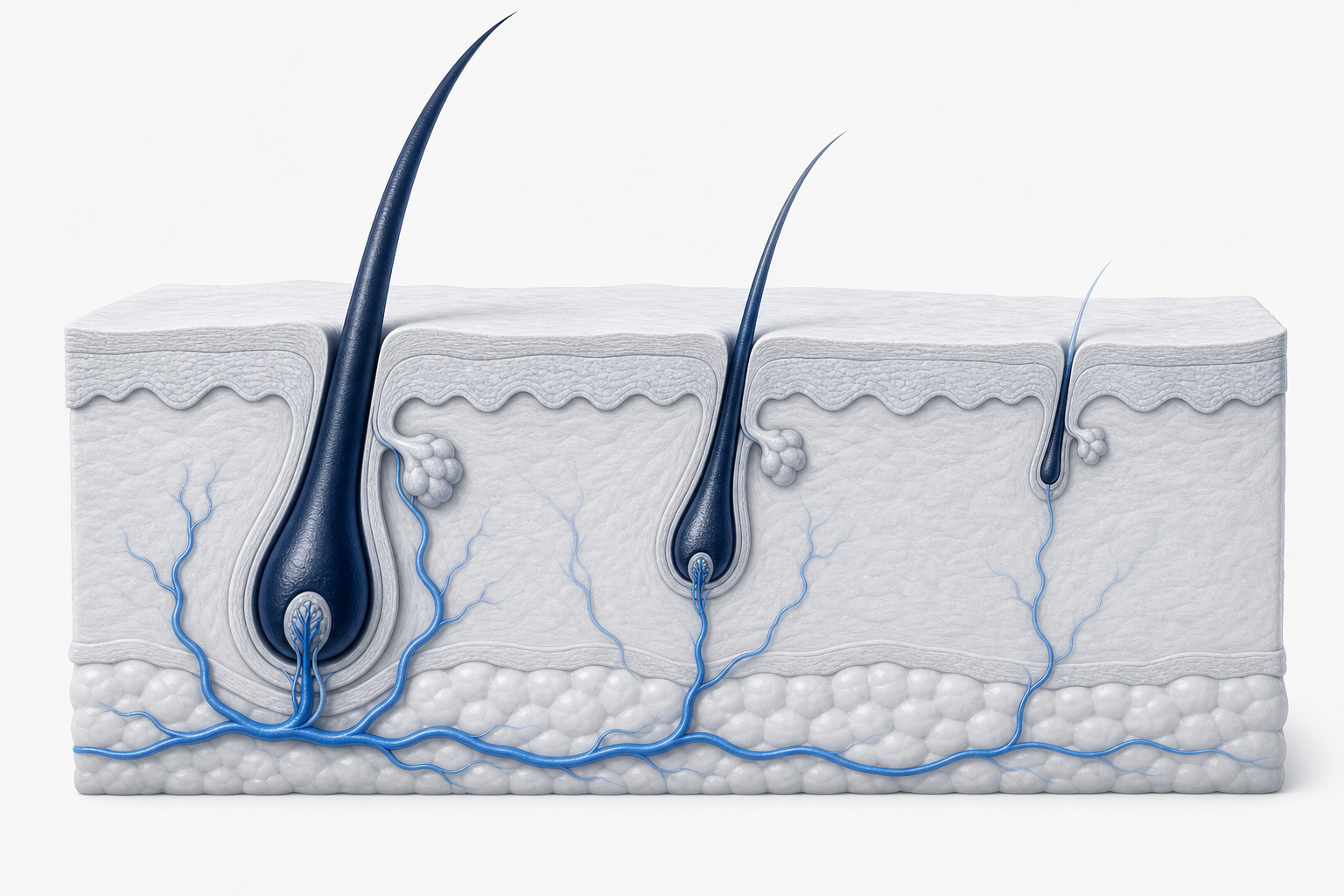
Whether it happens to you also depends on your predisposition: how sensitive your follicles are to DHT is genetically determined. Menopause triggers that sensitivity, it does not create it. That is why it often affects exactly those women whose mother or sister had thinner hair at a similar age. More on the mechanics in our article on hormonal hair loss.
The same shift also explains an observation that unsettles many women: individual hairs on the chin and the upper lip become coarser while things get finer on top. That is not a contradiction. Androgen-dependent areas react in opposite directions, with miniaturization on the scalp and stronger growth on the face.
There is a second mechanism, and it is the reason this article keeps the two forms strictly apart. Fluctuating hormones, disrupted sleep, hot flashes and stress also push many follicles into the resting phase at the same time. The result is telogen effluvium: diffuse shedding across the whole scalp which, according to the review resource StatPearls, typically starts 2 to 3 months after the trigger, while the resting phase itself lasts around 3 months on average. Background on this in our article on the hair cycle.
Thinning hair during menopause: why hairs become finer
Thinning hair during menopause is usually not a quantity problem but a diameter problem: every single hair becomes finer and the overall volume drops, even though there is no more hair in your comb than before.
That is exactly what many women experience: they are not losing a striking amount of hair, and yet the style falls flat and the ponytail feels thin. In technical terms this is about hair shaft diameter, which decreases with every cycle of the miniaturizing follicles. Why that happens is explained in the section above.
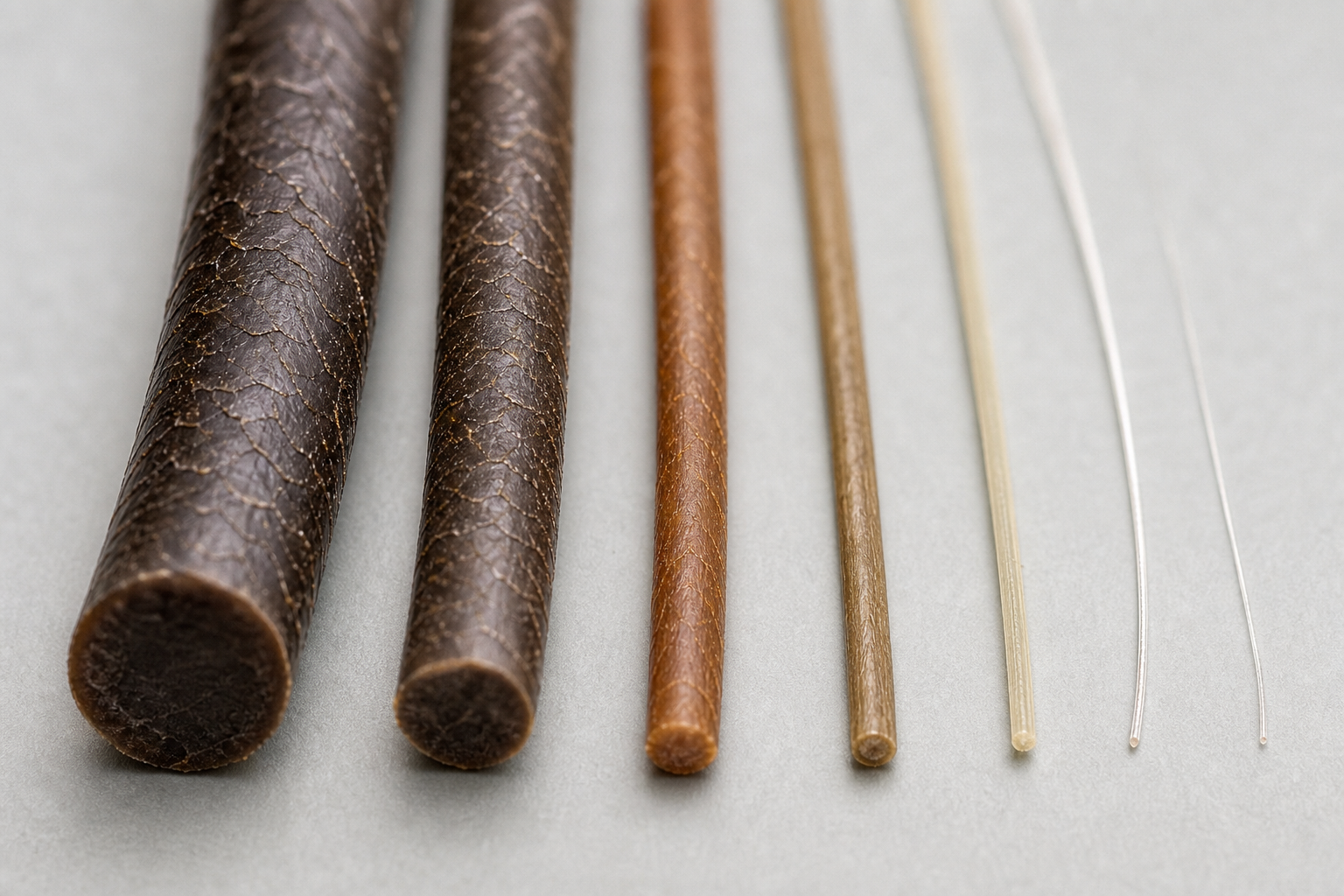
There are three tangible markers that beat the impression you get in the mirror. Measure your ponytail circumference with a tape measure around the gathered hair and note the value in centimeters, then again every three months. Count how many times the hair tie goes around. And photograph your part in the same light and with the same head position.
This is not a measurement with reference ranges; it is an aid to observation. Its value lies in giving you something to compare against later, so you can tell at all whether a treatment achieved anything. Without a baseline, all you have after six months is a gut feeling, and that misleads in both directions.
Hair texture and scalp change as well. Less sebum and an altered lipid film make hair drier, duller, sometimes frizzier or more wiry, and the scalp feels tight, flakes finely or itches slightly. That is not hair loss, though it is often taken for it, and it is treated differently: with care rather than with a drug.
Two distinctions save a lot of frustration. Persistent intense itching with redness, pustules or pain belongs in a dermatologist’s office, because inflammatory scalp conditions are a separate diagnosis. And hair breakage from heat, coloring and tension looks like hair loss: broken hairs have no whitish bulb at the end.
Pattern or diffuse: the two forms of hair loss during menopause
Hair loss during menopause comes in two basic forms: as female pattern hair loss, which thins the top of the scalp and leaves the frontal hairline standing, and as diffuse shedding, which costs hair evenly across the whole scalp.
Everything else depends on which of the two you have: the workup, the treatment and the question of whether the hair comes back on its own. Very often both are present at once, and the pattern form only becomes obvious once a bout of shedding makes it visible. Three self-checks bring you closer to the answer.
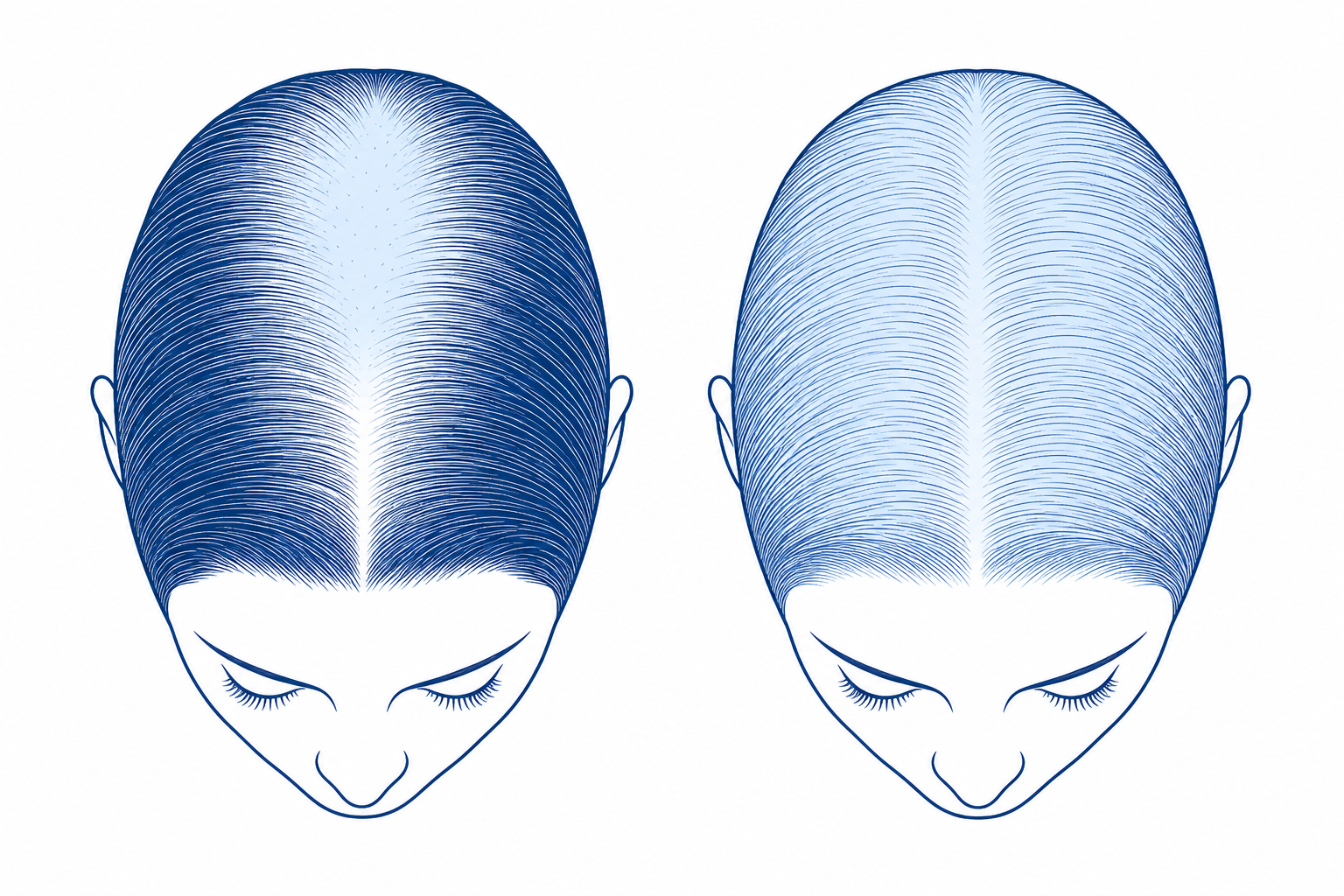
1. The part test. Part your hair down the middle and look at the part line in daylight from front to back, ideally comparing it with an older photo. A gap that widens noticeably at the front while the frontal hairline stays put is the hallmark of the pattern form. If the scalp shows through evenly everywhere, including at the sides and at the back, that points to diffuse shedding.
2. The pull test. At several spots, gently grasp a bundle of about 50 to 60 hairs at the base and pull smoothly through to the tips without jerking. If several hairs come out again and again, that points to active shedding. In the pure pattern form the test is usually unremarkable, because there it is not that more hairs fall out but that thinner ones grow back.
Two caveats belong with the pull test. Do not wash your hair for 24 hours beforehand, otherwise the result is worthless. And there is no uniform, strictly validated cut-off: the frequently quoted threshold of more than 10 percent of the grasped hairs is explicitly criticized as inconsistent in an evidence-based update in the Journal of the American Academy of Dermatology. Take the result to your appointment as an observation, not as a diagnosis.
3. The course over time. The pattern form progresses slowly over years, and you notice it in your volume, not in your brush. Shedding sets in relatively suddenly, usually 2 to 3 months after a trigger, and shows up as clearly increased hair loss. Asking yourself what was going on two to three months ago often produces the answer.
The illustration below shows both forms from above: on the left, female pattern hair loss with the widening center part and an intact frontal band; on the right, diffuse shedding with evenly reduced density across the whole scalp.
| Feature | Female pattern hair loss (Ludwig) | Diffuse shedding | What that means for you |
|---|---|---|---|
| Where it thins | Center part and top of the scalp | Evenly across the whole scalp, including the sides and the back | Location is the most important feature. Check it in daylight. |
| Frontal hairline | Usually stays intact | Stays intact, looks thinner overall | A receding hairline fits neither of the two forms and needs to be checked out. |
| The part line | Widens toward the back, most clearly at the front | Scalp shows through evenly | A photo of your part in the same light shows the trend better than the mirror does. |
| Amount of hair falling out | Barely increased | Clearly increased, visible in the brush and in the drain | A lot of hair in the drain points more to shedding than to the pattern form. |
| Thickness of the regrowing hairs | Varying thickness, many fine short hairs | Normal thickness | This variation in caliber is the core feature of the pattern form and is visible on trichoscopy. |
| Onset | Gradual, over years | Relatively sudden, usually 2 to 3 months after a trigger | Think back: what happened 2 to 3 months ago (illness, dieting, surgery, major stress)? |
| Pull test | Usually unremarkable | Often positive | Only an observation for the doctor’s appointment, not a diagnosis. |
| Typical trigger | Hormonal shift plus predisposition | Iron deficiency, thyroid, dieting, illness, stress, medication | With shedding you treat the trigger, not the hair. |
| Without treatment | Slowly keeps progressing | Usually comes to a stop on its own | That is exactly why telling them apart decides the entire approach. |
One note that fits into no column: both forms frequently occur at the same time. The table is a guide for your doctor’s appointment, not a diagnosis. Above all it helps you ask the right question in the exam room.
Ludwig instead of Norwood: how female pattern hair loss is classified
Female pattern hair loss is classified by the Ludwig scale into three stages, which Elisabeth Ludwig described in 1977 in the British Journal of Dermatology based on the clinical observation of 468 women. Stage I is the beginning widening of the part, stage II the marked thinning of the top of the scalp with a preserved frontal band of 1 to 3 centimeters, stage III the pronounced thinning of the central area.
The Norwood-Hamilton scale by contrast describes the male course with a receding temporal hairline and a bald spot at the crown, and it does not fit women. In addition, specialists use the Savin and Sinclair scales as well as the Christmas tree pattern described by Olsen, in which the thinning grows wider toward the front. We explain how both scales work in our article on the Norwood-Hamilton scale.
In practice the distinction matters for three reasons. Shedding usually comes to a stop on its own once the trigger has been dealt with, and the hair grows back. The pattern form does not stop on its own and needs ongoing treatment. And for a hair transplant, one form is a prerequisite and the other a contraindication.
Other causes: what needs checking besides menopause
“Menopause” is not a diagnosis of exclusion: iron deficiency, thyroid disorders, new medications and stopping the pill cause hair loss in the same stage of life, and very often there is a combination of them.
Several other, readily treatable causes cluster in exactly this stage of life. Anyone who chalks hair loss up to hormones across the board regularly overlooks an iron or thyroid finding that could have been cleared up in a few weeks.
Iron deficiency and low ferritin. During perimenopause periods often become heavier and more irregular before they stop altogether, and that is exactly when iron stores run down. Typical accompanying signs are fatigue, pallor and brittle nails. In detail in our article on iron deficiency and hair loss.
Thyroid. An underactive or overactive thyroid and Hashimoto’s thyroiditis also cause diffuse hair loss. Their symptoms overlap almost completely with those of menopause: fatigue, weight changes, mood swings, feeling cold or sweating. That is why the thyroid is missed particularly often in this age group. Details in our article on hair loss and the thyroid.
Nutrient gaps and medications. A vitamin D deficiency only matters if it has been documented. In this age group new long-term medications also come into play, such as blood pressure drugs, statins, antidepressants or thyroid hormones while the dose is being adjusted. Note the start dates and have the connection assessed by your doctor; do not stop anything on your own.
Stopping or switching hormonal contraception around age 50. If you have taken a pill with an antiandrogenic progestin for years, stopping it removes an effect that was there before. The pattern form was masked and becomes visible within months. This is observed regularly in clinical practice and is pharmacologically plausible, but it has not been quantified in dedicated studies. The same applies when switching to a menopause preparation with a different progestin, a good point for the conversation with your gynecologist.
Classic triggers of shedding. Major weight loss, one-sided diets, protein deficiency, febrile illness, surgery and high psychological stress push follicles into the resting phase, with the typical delay of 2 to 3 months. For how hormones and hair are connected in general, read our article on hormones and hair.
When the frontal hairline recedes: the warning sign that does not fit the pattern form
A receding frontal hairline is precisely what does not fit female pattern hair loss, in which the frontal band of hair almost always stays put. If loss of the eyebrows comes with it, often with reddened, rough follicular openings along the hairline and a pale, smooth-looking strip in front of the new hairline, a scarring alopecia may be behind it, in particular frontal fibrosing alopecia.
This form predominantly affects women after menopause. In a Spanish observational study of 306 cases the mean age at onset was 59.5 years. It is rare; prevalence figures vary between about 0.015 percent and 0.15 percent depending on the population studied and are not directly comparable with one another. Since it was first described in 1994 it has been diagnosed more and more often, partly because physicians are watching for it more closely.
Why this is here even though it is rare: scarred follicles do not come back, and the usual hair growth products do not work there. Time really does matter in a case like this. That is no reason to panic and certainly not a remote diagnosis, but it is a good reason not to push a dermatology appointment out to next year.
Have this checked by a dermatologist promptly
- •A receding frontal hairline, especially together with thinning eyebrows
- •Round, smooth bald patches that appear within weeks, as in alopecia areata
- •A painful, burning, heavily flaking or infected, inflamed scalp
- •Very rapid, massive loss over a few weeks, see severe hair loss
- •Rapidly increasing signs of virilization such as a deeper voice or noticeable beard growth; in that case androgens really should be measured
This list is a guide, not a diagnosis. It rules nothing out and is no substitute for an examination.
From the exam room: the most common mistake in classification
In a hair loss consultation, the most common mistake with women going through menopause is not the wrong treatment but the failure to tell the two forms apart. Very often there is a pattern form that has progressed unnoticed for years, and on top of it an episode of shedding, for example from a low ferritin level. Treat only one of the two and you will be asking yourself months later why nothing is happening.
Diagnosis: which blood tests make sense for hair loss during menopause
The basic workup for hair loss during menopause covers four values: ferritin, TSH, 25-OH vitamin D and a complete blood count. FSH and estradiol are not needed for it.
There is one reason these four values are the standard set: they cover the most common treatable contributing causes and match the usual dermatological approach to diffuse hair loss (Kanti et al. 2018, Trost et al. 2006). Anything beyond that is added when your history points to a specific suspicion.
| Value | What it shows | If it is abnormal |
|---|---|---|
| Complete blood count | Hemoglobin along with red and white blood cells, signs of anemia | Further workup of the cause, usually together with the ferritin level |
| Ferritin | Your iron stores. Inflammation can push it falsely high, which is why CRP is considered alongside it | Clarify the cause of the iron losses; supplementation only under medical supervision |
| TSH | The control of the thyroid, whose symptoms overlap strongly with menopausal complaints | In addition fT3, fT4 and TPO antibodies |
| 25-OH vitamin D | Your vitamin D status | Supplementation only with a documented deficiency and at a dose set by your doctor |
| Androgens (testosterone, DHEAS, SHBG) | A possible excess of androgens. Not a standard panel, only when there is a corresponding suspicion | Targeted gynecological or endocrinological workup |
| FSH and estradiol | Nothing reliable about perimenopause, because both values fluctuate strongly in this phase | As a rule not needed for deciding what to do about your hair |
Where to go first: scalp and hair belong in a dermatologist’s office. A gynecologist’s office adds to that when menopausal symptoms are up for discussion anyway. A primary care office is usually the fastest route to the lab results. These three do not rule one another out; they answer different questions.
Ferritin is worth putting in context, because a lot of half-knowledge circulates about it. In routine labs the lower end of the reference range usually starts at about 15 to 30 ng/mL. Part of the trichology literature proposes higher target values of around 40 to 70 ng/mL for women with hair loss (Rushton and colleagues). These target values are individual opinions and are not backed by randomized trials.
The opposing view belongs here as well: Trost, Bergfeld and Calogeras concluded in 2006 in the Journal of the American Academy of Dermatology that the evidence for routine iron supplementation in hair loss without anemia is insufficient. In practice that means: have the value measured, interpret it in the context of your symptoms and make the decision with your doctor.
What you can save yourself: an FSH or estradiol level does not prove menopause. The German S3 guideline on peri- and postmenopause (AWMF 015-062, valid 2020 version) makes clear that the diagnosis is made clinically, because both values fluctuate strongly during perimenopause. For the question of what to do about your hair, they change nothing.
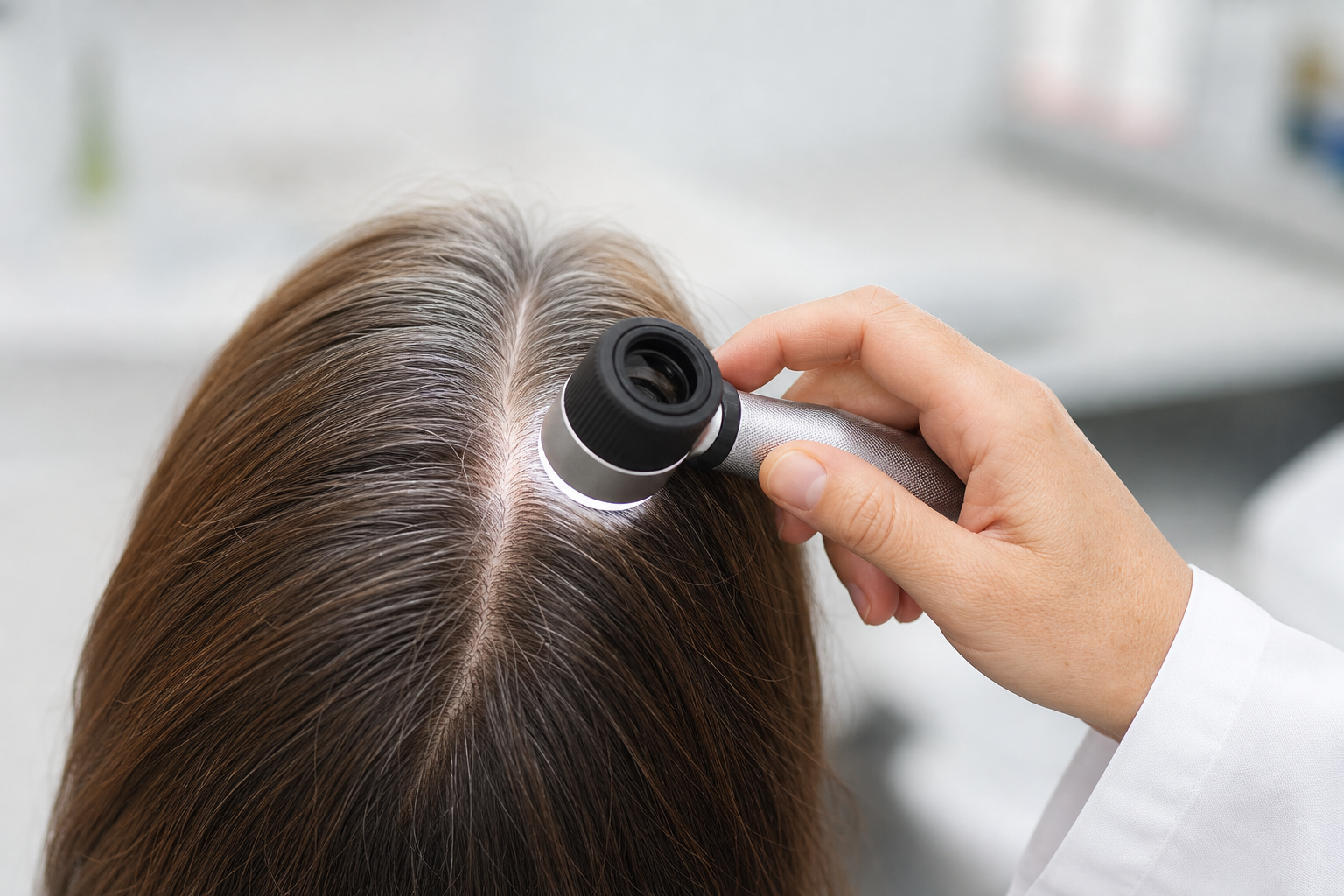
In practice the examination usually goes like this: history (since when, cycle, medications, weight, family), visual assessment of the pattern, then trichoscopy. This dermoscopic examination is painless, takes a few minutes and shows the variation in hair shaft caliber that is typical of the pattern form. Rakowska and colleagues defined criteria for it in 2009 in the International Journal of Trichology which, in combination, reach a specificity of 92 percent.
A sober word on the cost: history, examination and medically indicated lab work are usually covered by health insurance, though the details depend on your plan. Individual values requested purely at your own wish, digital hair analysis or serial photography are frequently billed to you directly. The treatment of androgenetic alopecia, by contrast, is generally regarded as cosmetic and is not reimbursed, so you pay for minoxidil out of your own pocket.
Lab card for the doctor’s appointment
Take a screenshot now and you will have the list on your phone in the waiting room. Phrased as questions you can ask, not as instructions for your doctor’s office.
Values you can ask about
- ✓Complete blood count
- ✓Ferritin (if abnormal, CRP as well, since it distorts the reading)
- ✓TSH (if abnormal, fT3, fT4, TPO antibodies)
- ✓25-OH vitamin D
- ✓Zinc and vitamin B12 when there is a corresponding suspicion
- ✓Only if an excess of androgens is suspected: testosterone, DHEAS, SHBG and, if needed, prolactin
What to bring
- ✓A list of all medications and supplements with their start dates
- ✓Photos of your part and the top of your scalp in the same light over several weeks
- ✓A note: since when, how fast, in bursts or evenly
- ✓Your cycle over the last 12 months and your contraceptive history
- ✓Weight history, family history, older lab reports, your measured ponytail circumference
Questions you can ask
- ✓“Do you see a pattern or more of an even thinning?”
- ✓“Can we do a trichoscopy?”
- ✓“Which values do you consider useful, and which ones will I have to pay for myself?”
- ✓“When should we recheck the result?”
Do not wash your hair for 24 hours before the appointment and do not use styling products, otherwise the pull test and the assessment of your scalp will be distorted.
Before the blood draw, say which supplements you are taking. High-dose biotin from hair supplements can interfere with laboratory assays. Whether and for how long you pause it is decided by the doctor’s office or the lab.
Treatment: what can really stop hair loss during menopause
Hair loss during menopause can be slowed in many cases, but not simply switched off: for the pattern form, topical minoxidil is the treatment with the best evidence; with diffuse shedding you treat the trigger, not the hair.
So the honest answer comes in two parts. The one drug therapy approved for women in the United States is topical minoxidil and it is available over the counter; the alfatradiol scalp solution used in Germany and Austria is not marketed here. With shedding, the lever lies with the cause instead, for example a documented iron deficiency. The sections below go through each option one by one, including what it does not deliver.
Topical minoxidil: the standard treatment for female pattern hair loss
Minoxidil prolongs the growth phase of the hair follicle and improves its blood supply. In the United States two over-the-counter options are available for women: the 2% solution applied twice a day and the 5% foam applied once a day. The European S3 guideline (Kanti et al. 2018) gives both the strongest recommendation; minoxidil has the highest level of evidence there in women and in men.
For expectations, one documented number: in the pivotal study data in women (Lucky et al., J Am Acad Dermatol 2004) the gain after 24 weeks was around 13 additional non-vellus hairs per square centimeter with 2% minoxidil, compared with around 10 with placebo. The effect is real and measurable, but moderate. Anyone expecting a return to the hair density they had at 25 will be disappointed.
The most important practical point is initial shedding. In the first weeks more hair can temporarily fall out, because many follicles switch into a new cycle in sync. That is not a sign that the treatment is harming you or failing. Stopping in shock during this phase means losing that hair for nothing and starting over at the next attempt. How long the shedding lasts has not been properly studied; reliable figures on it come only from commercial sources.
Three more points belong before you start. At the earliest, the effect can be judged after 3 to 6 months. It only lasts with continued use; after stopping, the gain is lost again over the following months. And side effects include scalp irritation, itching and flaking, occasionally also unwanted hair growth on the face if the product is transferred there. So wash your hands after applying it. More on this in our article on minoxidil for hair loss.
Topical alfatradiol (17α-estradiol): not available in the U.S.
Alfatradiol is a scalp solution approved in Germany and Austria for women and men, for “increasing the reduced anagen hair rate in mild androgenetic alopecia.” In the United States it is not marketed and is therefore not an option here. The active ingredient is a stereoisomer of the body’s own 17β-estradiol and, according to the German prescribing information, has only a very low affinity for the estrogen receptor, so systemic estrogenic effects are not expected.
Soberly assessed: the studies on alfatradiol are older and smaller than the minoxidil evidence. Even where it is sold, it is a supplementary option with a weaker evidence base, not an equal substitute. Outside Germany and its neighboring countries the ingredient plays hardly any role, which is why it does not appear in treatment plans in the United States.
Antiandrogen options: a medical decision, off-label in this indication
Antiandrogens act on the effect of androgens at the follicle. For female pattern hair loss in the United States there is no approval, which makes any use off-label and a case-by-case medical decision. Spironolactone has been used off-label internationally for decades and is discussed in a review in the Journal of the American Academy of Dermatology (2025) primarily for premenopausal women.
A safety point belongs in the same paragraph: cyproterone acetate, an antiandrogen that is prescribed for this purpose in some countries but is not approved in the United States, has been linked to an increased risk of meningioma that rises with the cumulative dose. Where it is used, it is contraindicated in anyone with a current or previous meningioma, and it is stopped immediately if one is diagnosed. Finasteride and dutasteride are not approved in women and are contraindicated when pregnancy is possible.
This section is meant to put you in a position to raise the topic in the exam room, not to get hold of something yourself. Dosages, choice of preparation, monitoring and the question of contraception while pregnancy is still possible belong exclusively in medical hands.
Low-dose oral minoxidil
Low-dose minoxidil in tablet form is discussed in recent reviews as an emerging option, but it is not approved for this indication and is therefore off-label. Because minoxidil was originally a blood pressure drug, monitoring of blood pressure and edema is part of it. This is strictly a matter for the doctor’s office.
Nutrients: only with a documented deficiency
Supplementation does something for your hair when a deficiency is the cause, and it does nothing when there is none. High-dose combination products without a blood test cost money, and with some substances an overdose is not harmless. The simple rule is: test first, then supplement. On the most common product question we have a separate article on Priorin for hair loss.
Safety note: biotin can distort lab results
Many hair supplements contain high-dose biotin. The U.S. Food and Drug Administration warns in its safety communication, last updated on November 5, 2019, that biotin can interfere with certain laboratory tests. Affected tests include thyroid values (TSH can come out falsely low, fT3 and fT4 falsely high) and the heart attack marker troponin, which can be measured falsely low.
For you that means: before every blood draw, say which supplements you are taking. How long beforehand you should pause them depends on the dose; the recommendations from laboratories range from a few hours to several days. Clear that up with the doctor’s office or the lab, not by gut feeling.
What is discussed as an add-on
Microneedling, PRP (platelet-rich plasma), low-level laser devices, rosemary oil and caffeine shampoos are discussed as add-ons for hair loss during menopause. The evidence on them is inconsistent and clearly weaker than for minoxidil. That means neither that none of them does anything nor that any of them replaces a basic treatment.
With shampoos a clear distinction is worthwhile: they can make hair look fuller and take care of the scalp. They change nothing about the miniaturization of the follicle. That is no knock on the products; it is a question of having the right expectations.
| Option | What it is for | Prescription | Approval for women in the U.S. | Cost | Earliest point to judge results |
|---|---|---|---|---|---|
| Topical minoxidil | Female pattern hair loss | Over the counter, no prescription | Approved: 2% solution twice daily, 5% foam once daily | Out of pocket | 3 to 6 months |
| Topical alfatradiol (17α-estradiol) | Mild androgenetic alopecia, in countries where it is sold | Not available in the U.S. | Not approved and not on the market in the U.S.; approved in Germany and Austria, weaker evidence than minoxidil | Not applicable in the U.S. | 3 to 6 months where it is used |
| Antiandrogen options | Case-by-case medical decision | Prescription only | No approval for female pattern hair loss, use is off-label | Out of pocket in this indication | As directed by your doctor |
| Low-dose oral minoxidil | Only discussed under medical supervision | Prescription only | No approval for this indication, off-label | Out of pocket in this indication | As directed by your doctor |
| Hormone therapy | Menopausal symptoms, not the hair | Prescription only | Hair loss is not an approved indication | Usually covered by insurance when medically indicated | Not something to judge by the hair |
| Iron or vitamin supplementation | Only with a documented deficiency | Over the counter or prescription, depending on the product | Not a hair growth product, but the correction of a deficiency | Depends on the indication and the product | 3 to 6 months |
| Microneedling and PRP | Discussed as an add-on | Medical or cosmetic procedure | No drug approval, inconsistent evidence | Out of pocket | Not reliably assessable |
| Low-level laser devices | Discussed as an add-on | Available without a prescription | Medical device, inconsistent evidence | Out of pocket | Not reliably assessable |
| Shampoos and cosmetics | Camouflage and scalp care | Available without a prescription | Cosmetic, no effect on miniaturization | Out of pocket | Visible immediately, but purely cosmetic |
| Hair transplant | Only with a stable pattern and a stable donor area | Medical procedure after an examination | Not indicated with active diffuse loss | Out of pocket | Several months until the result |
The question almost every woman asks at this point is the one about hormone therapy. It gets its own section, because it follows a logic of its own.
Does hormone therapy help against hair loss during menopause?
Hormone therapy is not started because of the hair: hair loss is not a recognized indication, and the data on the hair are thin. The decision is weighed on menopausal symptoms.
One thing at a time: in the research for this article, no robust analysis of randomized trials was found that documents a clear effect of hormone therapy on hair density. Individual women report fuller hair while on therapy, but no treatment goal can be derived from that.
One development is remarkable nonetheless: in the ongoing update of the German S3 guideline on peri- and postmenopause (AWMF 015-062), “alopecia, hair loss, thinning hair” is explicitly listed as a relevant symptom of this stage of life. The version from September 2020 is still the valid one, and the update is in its consultation phase. So the topic is being taken seriously in the field, but there are no finished treatment recommendations for it yet.
Hormone therapy has a risk-benefit profile of its own, which is weighed against menopausal symptoms, not against hair density. The position statement of The Menopause Society (NAMS 2022) puts the additional absolute risks for events such as venous thrombosis in the rare range, with fewer than 10 additional cases per 10,000 woman-years. For combined therapy over five years, some analyses cite around 3 additional breast cancer cases per 1,000 women.
This assessment comes from the North American specialty society and is no substitute for a conversation with your doctor. What matters is the timing: the balance of benefit and risk turns less favorable when therapy is started more than 10 years after menopause or beyond the age of 60. Weighing it up belongs in the gynecologist’s office, with your history and your family history on the table.
One point is still worth raising in that conversation if therapy is on the agenda anyway: progestins differ pharmacologically in their androgenic or antiandrogenic activity. Whether and how the choice of progestin affects androgen-sensitive follicles has not been documented in dedicated studies for postmenopause, but it is plausible. If you are considering hormone therapy solely because of your hair, have the form of your hair loss clarified first.
Everyday life and camouflage: what helps immediately with thinning hair during menopause
With thinning hair during menopause, only cosmetic measures work immediately: less tension and heat, volumizing cuts, hair building fibers and, with more pronounced thinning, a topper or hairpiece.
Care does not replace treatment, but it prevents avoidable additional loss and makes the hair you have look considerably fuller. This is the part you can put into practice right away while the workup and the treatment decision are still running. For thinning hair during menopause, what counts most is tension, heat and the cut.
In concrete terms that means: cut back on tight ponytails, extensions and narrow hair ties always in the same spot, go easy on heat and aggressive chemical treatments, and take care of your scalp as well. Volumizing cuts and layers do more for the look than any mask. A root color close to your own shade makes the part look narrower, because the scalp showing through contrasts less.
Hair building fibers and scalp powders work immediately. They treat nothing, but they camouflage the part within seconds and take the pressure off many women while the actual treatment needs months. On nutrition, one sentence will do: plenty of protein, good iron sources, no crash diets in this phase.
Toppers, hairpieces and wigs: the underrated option with more pronounced thinning
With pronounced thinning on the top of the scalp, meaning in the higher Ludwig stages, a topper is the most realistic solution for many women. A topper is a partial hairpiece that covers only the part and the top of the head and sits in your own hair on small clips. It adds density exactly where the pattern form takes it and leaves the edge of your own hair visible.
This is not a second-best stopgap; it is an answer in its own right to a situation in which minoxidil only thickens moderately and a procedure is out of the question. Good models made of human hair can be styled and matched to your own shade; synthetic hair is cheaper and easier to care for. Wigs remain the option when the thinning covers a large area.
Two practical notes belong with this. Change the position of the clips regularly, because constant tension at the same spot puts additional strain on your own hair. And at a wig studio or hair replacement specialist, ask to try on several models before you buy. Whether your insurance will cover part of the cost is something your insurer can tell you on request; as a rule you will need a prescription from your doctor.
What you can save yourself
The three most common misconceptions
- ✗“It’s the hormones, nothing can be done.” The form decides, and both forms are treatable.
- ✗“Once menopause is over, it will grow back.” Shedding usually recovers, while the pattern form slowly keeps progressing without treatment.
- ✗“I’ll take a hair vitamin first and see what happens.” That way months go by in which the cause remains unclear.
What costs money or does harm
- ✗High-dose combination products without a blood test
- ✗Biotin shortly before a blood draw, because it can distort lab results
- ✗Stopping minoxidil after four weeks because more hair falls out at first
- ✗Thickening shampoos as a substitute for a diagnosis
- ✗Hormone level self-tests off the internet
- ✗Letting yourself be brushed off with “that’s just your age” without an examination
How long does it take for hair to grow back? The realistic timeline
A treatment for hair loss during menopause can be judged after 3 to 6 months at the earliest; visible length shows after 9 to 12 months. Hair grows about 1 centimeter per month.
The reason lies in biology, not in anyone stalling you: a follicle that has switched into the resting phase needs around 3 months before it even restarts, and after that about 1 centimeter is added every month. Only once several generations of follicles have switched over does the difference become visible in a photo.
| Time frame | What happens in the follicle | What you notice | What to do now |
|---|---|---|---|
| Month 0 to 1 | The trigger has been dealt with or the therapy has begun; many follicles are still in the resting phase | The shedding continues; with minoxidil there may even be more shedding at first | Take baseline photos, measure your ponytail circumference, note the date |
| Month 2 to 3 | The resting phase is ending, the first follicles re-enter the growth phase | The shedding slowly eases off | Keep applying consistently, take a photo every 4 weeks |
| Month 3 to 4 | New hairs grow at about 1 cm per month | Short new hairs along the part and the hairline | Do not judge yet, keep documenting |
| Month 6 | Several generations of follicles have switched their cycle | A first honest assessment in the photo comparison becomes possible | Discuss the result at your doctor’s office and adjust the approach |
| Month 9 to 12 | The newly started hairs have reached visible length | Volume and ponytail circumference change measurably | Keep up the monitoring, change the treatment only after talking to your doctor |
What makes this stretch of time easier is monitoring the same way every time: every 4 weeks one photo from above and one from the front, same light, same part, plus your ponytail circumference in centimeters every 3 months. Anyone who only looks in the mirror sees no progress, because changes of this magnitude are too slow to notice day by day.
On expectations: the realistic goal is preservation and partial thickening, not the hair density you had before. Follicles that have fully regressed do not come back. That is exactly why it is worth having the form clarified early instead of waiting two years.
Hair transplant for women during menopause: when it is an option
A hair transplant is only an option for women during menopause with a stable pattern and a stable donor area. With active diffuse hair loss it is not indicated.
Spelled out, that means it is only an option when two conditions are met at the same time: the hair loss shows a stable, clearly delimited pattern, and the donor area at the back of the head is not thinning itself. Both have to be examined beforehand, otherwise the question of feasibility cannot be answered at all.
In women this is the case less often than in men, and there is a factual reason for that. Female pattern hair loss frequently runs more diffusely across the whole top of the scalp, and the sensitivity of the follicles to DHT does not always stop at the edge of the donor area at the back of the head. If hairs are transplanted from a zone that is miniaturizing itself, they will thin out just the same later on.
An active telogen effluvium is additionally a contraindication. In this phase neither the extent of the loss nor the stability of the surrounding hair can be assessed. With diffuse loss a transplant is not indicated, and a reputable provider will decline in a case like this or send you back to dermatology for further workup.
It can make sense with stable, circumscribed thinning after a completed workup and with sufficient donor density, as a rule only after drug treatment has stabilized the course. So the order is: first clarify, then treat, and only much later think about a procedure.
A note on our own service
Our service: the free hair analysis
This note concerns our own offer, which is why it is set apart from the medical part. If you are at exactly this point and want to know whether what you have is a pattern or a diffuse loss, what your donor area looks like and whether anything is feasible at all, you can use our free hair analysis as a step toward clarity. It assesses the visible pattern and the donor density.
What it does not do belongs here as well: it replaces neither a medical examination nor a blood test. The search for the cause stays with your primary care physician or dermatologist, and the question of ferritin, TSH and vitamin D is answered only by a lab.
Your next three steps
- Take stock. Photograph your part and the top of your scalp in daylight today, measure your ponytail circumference and note the date. Without a baseline there is nothing to judge in six months.
- Have the basic values measured. Make an appointment with your primary care physician and take the lab card from this article along as a screenshot (ferritin, TSH, vitamin D, complete blood count). State all the products you are currently taking, because of possible lab interference.
- Have the form clarified. Make a dermatology appointment and ask there explicitly about the distinction between pattern and diffuse and about a trichoscopy. Only then decide on a treatment.
Frequently asked questions about hair loss during menopause
How long does hair loss during menopause last?
That depends on the form. A telogen effluvium usually starts 2 to 3 months after a trigger and, once that trigger is dealt with, generally settles down within a few months. Female pattern hair loss, by contrast, is a slowly progressing process over years that does not end on its own without treatment.
Does hair loss stop again after menopause?
The diffuse component often calms down once the hormonal swings ease and possible triggers have been dealt with. The pattern form does not stop with that; on the contrary, its frequency rises markedly after menopause, to as much as 42 percent (Kanti et al., S3 guideline 2018). That is why it is worth looking at the two components separately.
Can I go bald as a woman during menopause?
Complete baldness as in the male pattern practically never develops with female pattern hair loss. What is typical is thinning on the top of the scalp with an intact frontal hairline, more or less pronounced depending on the Ludwig stage. Bald, sharply defined patches have other causes and need to be checked out.
Is hair loss during menopause hereditary?
What is hereditary is the predisposition, not the timing. How sensitive the hair follicles are to DHT is genetically determined. Menopause triggers that sensitivity, because estrogen drops away and the hormone balance shifts, but it does not create it. That is why it often affects women whose mother or sister had thinner hair at a similar age.
Is it normal for more hair to fall out at the beginning?
A temporary increase in shedding during the first weeks of minoxidil treatment is well known and is called initial shedding. It happens because many follicles switch into a new cycle in sync. There are no reliable figures on how long it lasts. Do not stop in shock, but discuss the course with your doctor.
How do I know whether my ferritin level is too low for my hair?
Two yardsticks sit side by side here. The routine laboratory reference range usually starts at about 15 to 30 ng/mL, while part of the trichology literature proposes higher target values of around 40 to 70 ng/mL for women with hair loss (Rushton and colleagues). These target values are individual opinions and are not backed by randomized trials. Trost, Bergfeld and Calogeras even concluded in 2006 that the evidence for routine iron supplementation without anemia is insufficient. That is why the interpretation of your value belongs in the conversation with your doctor, together with CRP as a distorting factor.
Which supplements help with hair loss during menopause?
Supplementation helps your hair when a deficiency has been documented, and it does not help when there is none. High-dose combination products without a blood test are therefore rarely useful. Important: according to an FDA safety communication, high-dose biotin can distort lab values such as TSH and troponin. Before every blood draw, state what you are taking.
Do women get a receding hairline at the temples too?
Female pattern hair loss generally leaves the frontal hairline intact; a receding temporal hairline belongs to the male Norwood pattern. If a woman’s hairline recedes, especially together with thinning eyebrows and reddened follicular openings, there is usually another cause behind it and it should be checked by a dermatologist.
Scientific sources
- Kanti V, Messenger A, Dobos G et al. (2018): Evidence-based (S3) guideline for the treatment of androgenetic alopecia in women and in men. J Eur Acad Dermatol Venereol. Wiley Online Library
- Ludwig E (1977): Classification of the types of androgenetic alopecia (common baldness) occurring in the female sex. Br J Dermatol. DOI 10.1111/j.1365-2133.1977.tb15179.x
- Rakowska A, Slowinska M, Kowalska-Oledzka E et al. (2009): Dermoscopy in Female Androgenic Alopecia. Int J Trichology. PubMed Central
- DGGG/OEGGG (2020): German S3 guideline on peri- and postmenopause, diagnosis and interventions (AWMF 015-062), short version. PubMed Central
- The Menopause Society (2022): Hormone Therapy Position Statement. menopause.org (PDF)
- Antiandrogens in female pattern hair loss: off-label use under medical supervision; for cyproterone acetate, which is not approved in the United States, an increased meningioma risk that rises with the cumulative dose is documented internationally. Overview of antiandrogens
- U.S. FDA (2019): Safety communication on biotin interference in laboratory tests. FDA (PDF)
- Alfatradiol (17α-estradiol): approved in Germany and Austria, not marketed in the United States. No U.S. product listing
- Trost LB, Bergfeld WF, Calogeras E (2006): The diagnosis and treatment of iron deficiency and its potential relationship to hair loss. J Am Acad Dermatol. PubMed
- Vañó-Galván S et al.: Frontal Fibrosing Alopecia, Observational Single-Center Study of 306 Cases. PubMed Central
- StatPearls/NCBI Bookshelf: Telogen Effluvium (continuously updated review resource). NCBI Bookshelf
- MedlinePlus (NIH): Menopause, symptoms and treatment (average age at menopause). MedlinePlus
Research current as of 2026. This article provides general information and does not replace medical advice, diagnosis or treatment.
Dr. Imad Moustafa
Hair transplant specialist