

Key takeaways
Hormones and hair are closely connected. The hair cycle is co-regulated by androgens (testosterone and DHT), estrogen, progesterone, thyroid hormones and cortisol (review PMC10968111, 2024). The term hormonal hair loss actually covers two very different mechanisms.
- Androgenetic alopecia (permanent): a genetically determined sensitivity of the follicles to DHT, patterned and progressive. It is the most common form, affecting up to 80% of men and roughly 40% of women in later life (endokrinologen.de), and it often starts in early adulthood.
- Diffuse telogen effluvium (usually reversible): hormonal shifts such as pregnancy, menopause, stopping the pill or heavy stress push many follicles into the resting phase at once. Once the trigger settles, recovery usually takes 6 to 12 months.
- The trigger is not your testosterone level: what decides the outcome is the inherited sensitivity of your follicles to DHT, not the amount of hormone circulating in your blood.
Straight to the practical part: which doctor to see and which blood values matter, including cycle-day timing.
Summary
- What is hormonal hair loss?
- DHT and androgenetic alopecia: the most common hormonal cause
- Testosterone and hair loss: the big misconception
- Estrogen: the hair-protecting hormone
- Progesterone and your hair
- Pregnancy and postpartum hair loss
- Perimenopause and menopause
- Cycle, the pill and hormonal contraception
- Cortisol and stress-related hair loss
- Thyroid hormones and hair
- Reversible or permanent? The difference that decides everything
- Treatment: it depends on the cause
- How long does it take for hair to grow back?
- Which doctor and which tests?
- Frequently asked questions about hormones and hair
What is hormonal hair loss?
Hormonal hair loss is hair loss triggered by a change in hormone levels (a rise, a drop or a broader shift) or by an increased sensitivity of the hair follicles to certain hormones. The term covers two forms that work in completely different ways, and telling them apart is the key to the right treatment.
The first form is androgenetic alopecia: a genetically determined sensitivity of the follicles to dihydrotestosterone (DHT). It follows a pattern (receding temples and a thinning crown in men, a widening part in women) and progresses without treatment. According to the review PMC10968111, it is by far the most common hormonal cause.
The second form is diffuse telogen effluvium. A temporary hormonal shift (a drop in estrogen or progesterone, a thyroid imbalance, high cortisol) pushes many follicles into the resting phase at the same time. The hair thins across the whole scalp but usually recovers once the trigger normalizes. Both sexes are affected, in different patterns.
Telling them apart is exactly where most online sources stay on the surface. The overview below sorts every hormone involved by its effect on the hair and by how reversible the resulting hair loss is, before we go through the most important ones one by one.
| Hormone | Effect on the hair | What triggers hair loss | Typical pattern | Reversible? |
|---|---|---|---|---|
| DHT (from testosterone) | Shortens the growth phase, makes sensitive follicles shrink | Inherited follicle sensitivity, not the level in the blood | Patterned (part line, receding temples) | No, progressive |
| Testosterone | Relevant only as the precursor of DHT | Conversion into DHT at sensitive follicles | Same as DHT | No (androgenetic) |
| Estrogen | Extends the growth phase, protects the hair | A drop after childbirth or during menopause | Diffuse, across the whole scalp | Usually yes |
| Progesterone | Generally seen as hair-friendly (may dampen DHT) | A drop in the luteal phase or in perimenopause | Diffuse | Usually yes |
| Cortisol (stress) | Pushes follicles into the resting phase too early | Chronically elevated under ongoing stress | Diffuse | Yes, once the stress ends |
| Thyroid hormones (T3/T4) | Control cell division in the hair root | An underactive or overactive thyroid | Diffuse | Yes, once levels are managed |
| Prolactin | Can interfere with the hair cycle | Clearly elevated levels | Diffuse | Usually yes |
| DHEA-S | Androgen precursor, converted into testosterone and DHT | Elevated in PCOS or adrenal androgen excess | Patterned (in women) | Partly |
Simplified overview based on the review “The Hormonal Background of Hair Loss in Non-Scarring Alopecias” (PMC10968111, 2024). Not a substitute for a medical diagnosis.
DHT and androgenetic alopecia: the most common hormonal cause
Androgenetic alopecia is the most common form of hormonal hair loss, and the androgen behind it is DHT. The enzyme 5-alpha-reductase (mainly type 2, encoded by the SRD5A2 gene) converts testosterone into dihydrotestosterone. DHT then binds to androgen receptors in the hair root of genetically sensitive follicles (Endotext NBK279028).
DHT binds to the androgen receptor roughly 2 to 5 times more strongly than testosterone does, and it detaches more slowly (NCBI Endotext NBK279028; review PMC10968111, with factors varying by measurement method). The result is gradual miniaturization: the follicles produce ever finer, shorter hairs until growth stops altogether.
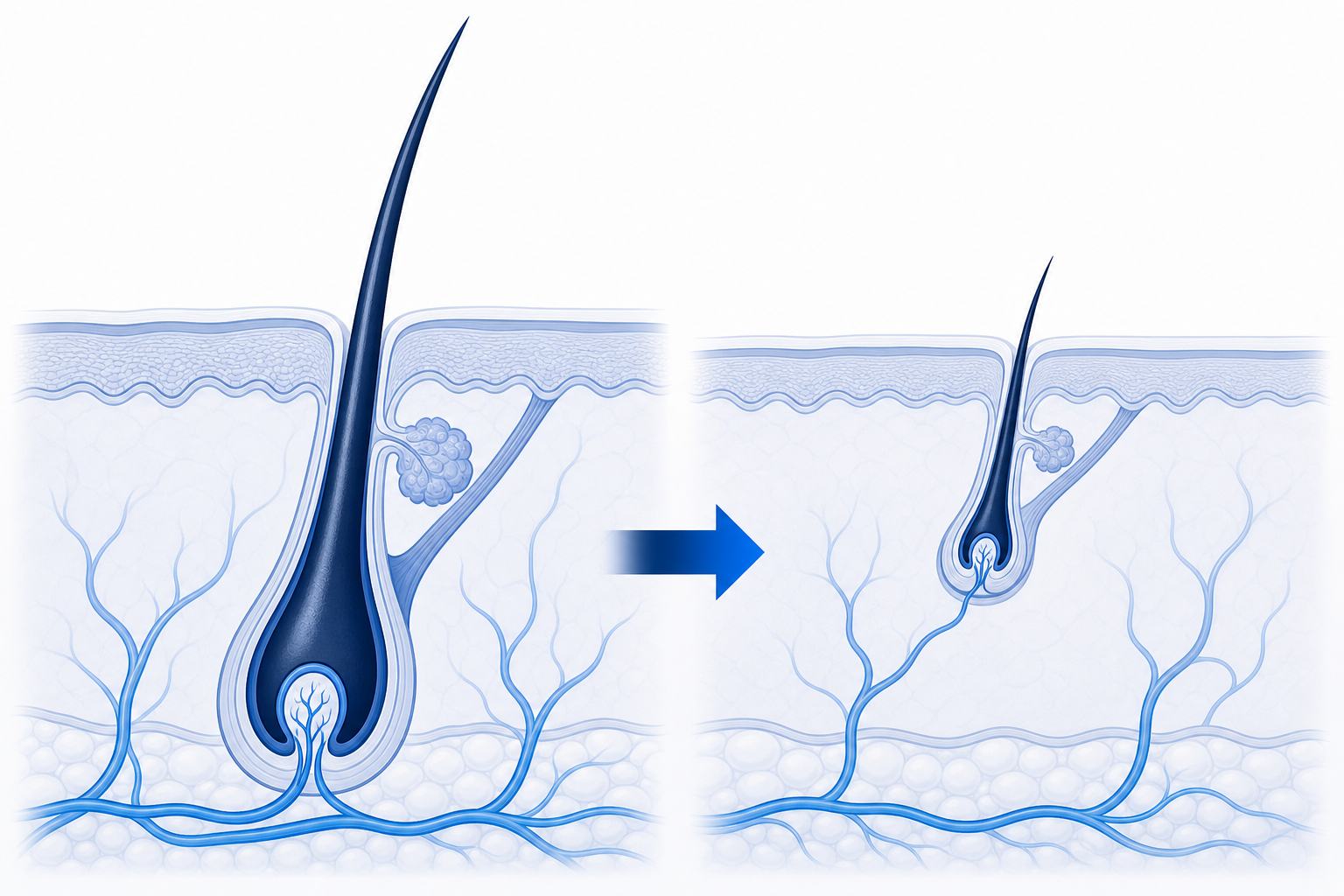
Here is the crucial point: androgenetic alopecia is not driven by the testosterone level in your blood, but by the inherited sensitivity of your follicles and the activity of 5-alpha-reductase. That is why this form is called hereditary hair loss. The route from testosterone to DHT and on to miniaturization looks like this:
How androgenetic hair loss develops (chain of events)
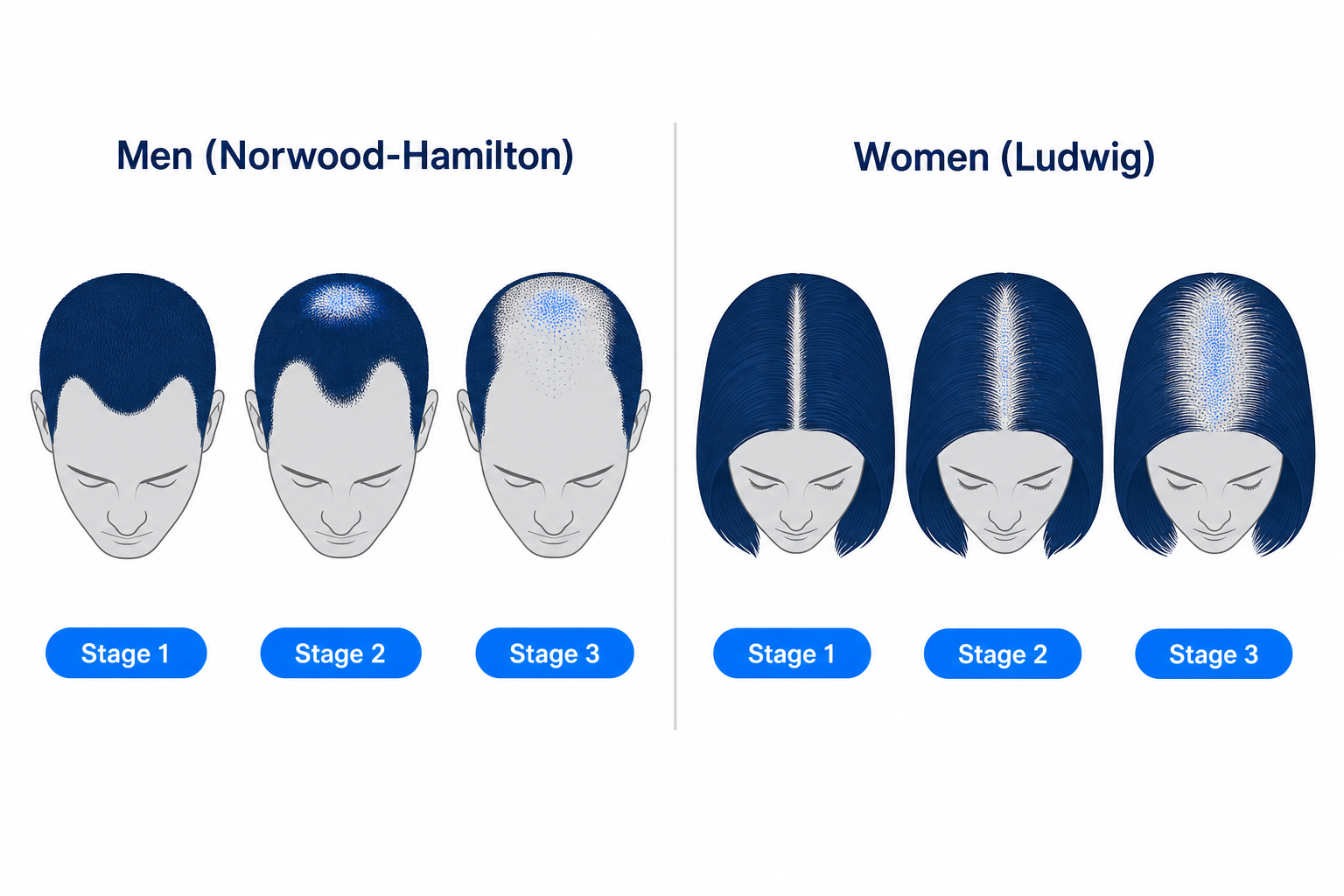
The pattern gives away the cause. Men lose hair at the temples and at the crown, staged on the seven-step Norwood-Hamilton scale. Women show a diffuse widening of the central part while the hairline usually stays intact, staged on the Ludwig or Sinclair scale. How hair loss in women progresses is a topic of its own, because the female pattern can go unnoticed for years.
One point matters for younger readers: androgenetic alopecia is not simply a sign of aging. With the right genetic predisposition, miniaturization can start in early adulthood, often in the early twenties, and then creep forward over years. That same age group later makes up a large share of the candidates for targeted treatment.
According to endokrinologen.de, around 80% of men and about 40% of women over the age of 70 are affected. This also explains why a hair transplant works at all. The follicles at the back of the head carry hardly any DHT-sensitive receptors and stay stable for life. Behind all of it sits the hair cycle, in which every follicle alternates between a growth phase, a short transition phase and a resting phase.
Testosterone and hair loss: the big misconception
When it comes to testosterone and hair loss, one thing holds true: a high testosterone level on its own does not cause hair loss. What matters is the conversion into DHT by 5-alpha-reductase and the genetic sensitivity of the follicles, not the absolute amount in the blood (review PMC10968111; Endotext NBK279028). That is why plenty of men with a full head of hair have high readings.
The myth that baldness means lots of testosterone and therefore more masculinity does not survive a look at the mechanism. On average, men with androgenetic alopecia do not have higher total testosterone levels than men without hair loss. The difference lies in the local sensitivity of the follicles and in enzyme activity at the scalp, not in the systemic level.
The widespread belief that frequent masturbation or sex raises testosterone and therefore causes hair loss is not supported either. There is no solid evidence of a causal link between ejaculation frequency and androgenetic alopecia (overview by Medical News Today as a secondary source). Short-term hormone fluctuations do not change the inherited sensitivity of your follicles.
For women the situation is different. Even mildly elevated androgens, for example with PCOS or after stopping a strongly antiandrogenic contraceptive, can set off patterned hair loss in sensitive follicles. According to the review PMC10968111, around 42.5% of women with PCOS show an androgenetic pattern, compared with about 6% of women under 50 in the general population. The adrenal precursor DHEA-S plays a role here as well.
Estrogen: the hair-protecting hormone
Estrogen has a protective effect on hair. Estradiol, its active form, acts through the ER-beta receptor to extend the growth phase (anagen) of the follicles and to support cell division in the hair root. When levels are high, as they typically are in pregnancy, the hair looks fuller and denser (review PMC10968111).
Estrogen also raises sex hormone-binding globulin (SHBG), which binds free androgens in the blood and so indirectly lowers the DHT load. When estrogen drops, after childbirth, during menopause or after stopping certain hormone treatments, that protection falls away. More follicles switch into the resting phase at the same time, and roughly 2 to 4 months later the diffuse shedding becomes visible.
Progesterone and your hair
Progesterone is generally seen as hair-friendly. One proposed mechanism is that it competes with testosterone for the enzyme 5-alpha-reductase. In vitro and in animal models it even shows a higher affinity for the enzyme than testosterone, which could dampen DHT production.
An important caveat: this substrate competition is well documented biochemically, but the leap to “progesterone prevents hair loss in humans” is not backed by meaningful clinical trials. Progesterone is not an established hair loss therapy. Any statement about it stays in the realm of hypothesis rather than proven effect.
In practice, a drop in progesterone (in the luteal phase of the cycle, in perimenopause or after stopping certain contraceptives) is discussed as one of several factors that can encourage diffuse hair loss. It usually acts together with the estrogen drop rather than on its own. That is why estrogen and progesterone are best looked at as a ratio, not separately.
Pregnancy and postpartum hair loss
Hair loss after childbirth is a classic effect of a hormonal shift. During pregnancy, high estrogen keeps many follicles in the growth phase longer than usual and the hair looks denser. After delivery, estrogen falls abruptly and many of those follicles move into the resting phase together.
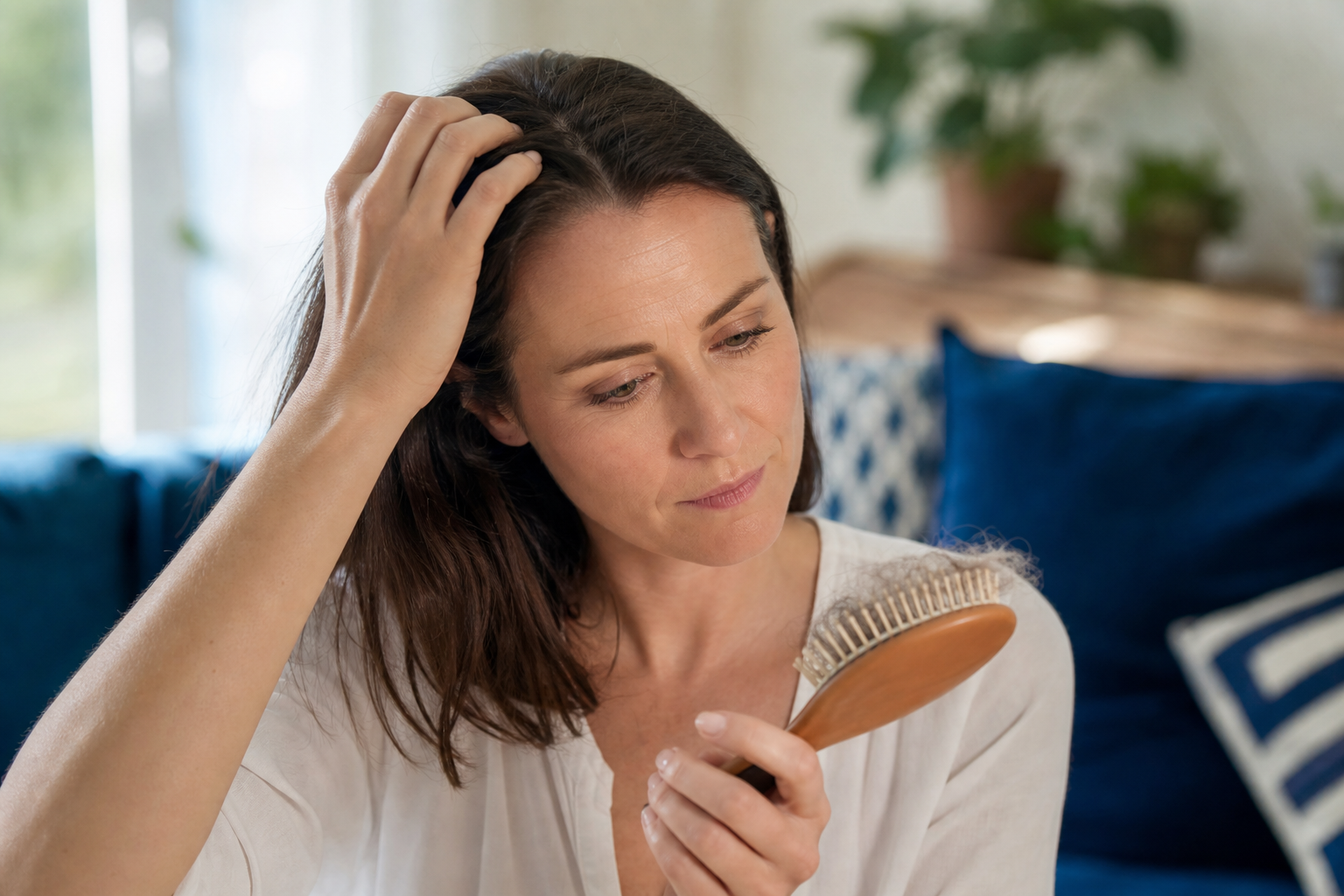
The result, 2 to 4 months after birth, is diffuse hair loss: postpartum (telogen) effluvium. The literature puts the frequency at around 20% of women (review “Telogen Effluvium”, PMC6709511), while a critical publication (PubMed 27386466) even questions whether it exists as a clearly defined entity at that frequency. In other words, the prevalence figures are not entirely consistent.
The reassuring part: this hair loss is physiological and, as a rule, fully reversible within 6 to 12 months of delivery. A hair transplant is not the answer here. Most women who go through it need patience rather than treatment while their hormones settle back down.
Perimenopause and menopause
During the menopausal transition, estrogen and progesterone drop markedly while androgens gain relative weight. This relative androgen dominance creates a double effect: diffuse thinning from the hormone drop itself, plus a possible acceleration of an androgenetic pattern that was already genetically in place (female pattern hair loss, FPHL; Cleveland Clinic, review PMC10968111).
Hormone replacement therapy (HRT) and bioidentical hormones are not treatments for hair loss. A systematic review in the Journal of the American Academy of Dermatology (13 studies) found no sufficiently consistent evidence that menopausal hormone therapy reliably improves hair loss, and individual studies even reported worsening (summary via Medical Dialogues, secondary source).
HRT is prescribed for other medical reasons, and a benefit for the hair is not established. Topical minoxidil remains the only medication with an approved indication for female pattern hair loss. Which other options make sense for women depends on the pattern and on the individual findings.
Cycle, the pill and hormonal contraception
Whether the pill helps or harms your hair depends on the progestin it contains. Antiandrogenic progestins can stabilize the hair, while androgenic progestins can encourage hair loss in susceptible women. After stopping the pill, a shedding episode often shows up 2 to 3 months later, a hormonal readjustment that follows the telogen effluvium pattern. Whether that is only the temporary shift or whether an androgenetic pattern is running alongside it can be assessed visually with a hair analysis.
| More hair-friendly (antiandrogenic progestins) | Less favorable (androgenic progestins) |
|---|---|
| Cyproterone acetate (strongest antiandrogenic effect in animal models) Dienogest, drospirenone (around 40%) Chlormadinone acetate (around 20%) |
Levonorgestrel Norethindrone |
The percentages come from animal models comparing antiandrogenic potency, not from human studies on hair loss (endocrinology specialist portals, secondary sources). Treat them as rough guidance. Any effect takes at least 3 to 6 months to appear. The choice of contraceptive is always a decision for your gynecologist.
PCOS (polycystic ovary syndrome) is a special case. The androgen excess can lead to more body hair and, at the same time, to an androgenetic hair loss pattern. The hormonal IUD releases low-dose levonorgestrel; isolated cases of hair loss have been reported, but a robust causal link is not established. The copper IUD is hormone-free and therefore hormonally neutral.
Cortisol and stress-related hair loss
Stress can trigger hair loss. Chronic psychological or physical stress keeps cortisol permanently elevated. Cortisol acts through CRH receptors at the follicle and impairs the build-up of the skin’s supporting matrix, which encourages an early switch from the growth phase into the resting phase (review PMC10968111). The result is diffuse telogen effluvium.
The time lag is typical: the triggering stress event usually falls around 3 months before the visible hair loss (review “Telogen Effluvium”, PMC6709511). So if you are suddenly losing more hair, think back to the weeks before, not just to the present moment. Once the strain is over, the hair generally recovers.
Alopecia areata is a separate condition: an autoimmune disease in which immune cells attack the follicle. It is not primarily hormonal or stress-related, even if stress is discussed as a possible trigger. Round, sharply defined bald patches should be evaluated by a dermatologist.
Thyroid hormones and hair
The thyroid can cause hair loss. Both an underactive thyroid (hypothyroidism) and an overactive one (hyperthyroidism) cause diffuse hair loss, because the hormones T3 and T4 control cell division in the hair root and the length of the growth phase. With hypothyroidism, cell division slows down and telogen effluvium follows (review PMC10968111).
The connection is common: in one study cohort, around 31% of women with female pattern hair loss also had hypothyroidism (review PMC10968111). That is an association, not a mandatory cause. Thyroid-related hair loss needs its own workup, from the lab values to getting them back into range. The hair then takes several months to recover.
Reversible or permanent? The difference that decides everything
Whether hormonal hair loss grows back depends on the type described above. The diffuse hormonal type is usually reversible once the trigger normalizes, while the patterned androgenetic type progresses without treatment. The table below pulls together the signs that let you tell the two apart in everyday life.
| Sign | Points to diffuse / reversible (hormonal shift) | Points to patterned / androgenetic |
|---|---|---|
| Distribution | Evenly thinner across the whole scalp | Part line, temples, crown |
| Trigger | Childbirth, the pill, stress, thyroid | Gradual onset, runs in the family |
| Course | One episode, then recovery | Slowly progressive |
| Hairline | Stays intact | Recedes (men) / part line widens (women) |
| Context | Clearly tied to a single event | Increasing over years |
Guidance only, not a substitute for a medical diagnosis. A professional hair analysis establishes which type you have.
One nuance rarely gets explained: a diffuse hormonal shock (stopping the pill, giving birth, heavy stress) can unmask androgenetic alopecia that was genetically in place anyway and speed up its visible progression. At that point both mechanisms interlock. This is exactly why a professional assessment beats guessing on your own.
For treatment, that means: only the androgenetic form with a stable, DHT-resistant donor area responds to hair growth medication or to a hair transplant. Diffuse hair loss caused by a hormonal shift is not suited to either and usually recovers on its own. A hair analysis classifies the visible pattern from photos and helps separate the two types. It is a visual first assessment, not a blood test or hormone panel, but it is an honest first step instead of a sales pitch for a procedure.
Free and without obligation. A photo-based assessment of your pattern, not a replacement for a medical blood test.
Treatment: it depends on the cause
Treatment for hormonal hair loss follows the mechanism. With the reversible, diffuse type, the cause comes first: have any thyroid problem treated, check iron and ferritin, reduce stress, and allow time after a pregnancy or after stopping the pill. Spontaneous recovery usually takes 6 to 12 months. Overtreating a self-limiting process makes little sense.
With the androgenetic type there are effective, medically established options. The overview below sorts the two most important active ingredients by who they are for, how strong the evidence is and what to watch out for. Minoxidil in particular has an extensive body of evidence behind it.
| Active ingredient | Who it is for | Level of evidence | What to watch out for |
|---|---|---|---|
| Minoxidil (topical) | Men and women, applied to the scalp | Highest level of evidence according to the European S3/EDF guideline | A temporary increase in shedding during weeks 2 to 6 is normal and does not mean the treatment is failing. Not everyone responds. |
| Finasteride (oral, 1 mg/day) | Men only, as a prescribed therapy | Proven effective: inhibits 5-alpha-reductase and lowers DHT levels | Sexual side effects in studies at around 3.8% versus 2.1% on placebo, usually reversible. Post-finasteride syndrome remains under debate. Contraindicated in women. See the safety note below. |
Context rather than a treatment recommendation. Any drug treatment belongs in a physician’s hands.
Finasteride safety note: Possible psychiatric side effects, including depressed mood and suicidal thoughts, have been examined in drug safety reviews, and product information has been updated accordingly. Finasteride is contraindicated in women (it is teratogenic in pregnancy) and should only be taken after a detailed medical consultation.
For women, antiandrogens prescribed by a physician are an option. According to the AEDV consensus document (2023), the most effective approach in postmenopausal women is minoxidil combined with a 5-alpha-reductase inhibitor, while in premenopausal women spironolactone can be used instead of the inhibitor. Nutrients play a supporting role at best: supplements only help when there is an actual deficiency, and it takes a blood test to reveal one.
A hair transplant is an option with a stable androgenetic pattern and a secure donor area. In women, caution is needed: with the female pattern, the back of the head often miniaturizes as well, so there is frequently no safe donor area. A transplant is only considered here after a strict trichological assessment, not as a blanket solution. And not every case of diffuse hair loss is hormonal, since iron deficiency and a lack of vitamins or other nutrients can produce the same picture.
How long does it take for hair to grow back?
With reversible, hormonally driven hair loss, regrowth follows the natural hair cycle and takes patience. Once the trigger normalizes, the shedding slows down first, before visible new hair appears. The timeline below shows the typical course during the recovery phase (derived from the telogen effluvium model, PMC6709511 and PMC10968111).
| Time frame | What happens in the follicle |
|---|---|
| Month 1-2 | The trigger normalizes (thyroid treated, stress reduced, hormonal shift complete) and the shedding visibly slows down. |
| Month 3-4 | The follicles leave the resting phase and enter a new growth phase (anagen). |
| Month 5-6 | The first visible “baby hairs” (short, fine new hairs) show up along the hairline and on top of the head. |
| Month 6-12 | Density usually recovers largely or completely in diffuse, reversible hair loss. |
Rough guidance; the timeline varies from person to person. Androgenetic hair loss does not follow this course on its own; it needs targeted treatment.
Which doctor and which tests?
The first stop with hormonal hair loss is your primary care physician, for a basic blood panel and a TSH test. If the results look off or there is a specific suspicion, a referral follows: endocrinologists for hormones in general, gynecologists for cycle, contraception, menopause and PCOS, dermatologists or trichologists for pattern analysis and for assessing the donor area.
For women, the timing of the blood draw is decisive: without the right cycle day, many hormone values say very little. Print the checklist below or take a photo of it and bring it to your appointment.
| Value | When to measure | Who orders it |
|---|---|---|
| Testosterone (total/free), DHEA-S, SHBG, FSH, LH, estradiol | Cycle day 3-5 (early follicular phase) | Gynecologist / endocrinologist |
| Progesterone | Cycle day 19-21 (about 7 days after ovulation) | Gynecologist |
| TSH, fT3, fT4 | Any day of the cycle | Primary care physician / endocrinologist |
| Ferritin, vitamin D, prolactin | Any day of the cycle | Primary care physician |
With an irregular cycle or after menopause, have the timing set individually by your doctor. This reflects standard laboratory practice and is not a set of target values. It is worth discussing the blood test and the wider causes of your hair loss at the same appointment.
From clinical practice
In women especially, there is rarely just one cause. In clinical practice, a diffuse component from a hormonal shift (menopause, thyroid, iron) often overlaps with a genetically determined androgenetic pattern. That is why the first question is always which type you have, not which treatment to start. A careful assessment prevents reversible hair loss from being treated unnecessarily and androgenetic hair loss from being recognized too late. (Elithair Medical Board)
Frequently asked questions about hormones and hair
Which hormones cause hair loss?
The main players are DHT (from testosterone), a drop in estrogen and progesterone, thyroid hormones (T3/T4), cortisol under stress and, in women with PCOS, prolactin and DHEA-S. DHT is the most common cause of permanent, patterned hair loss.
Is hormonal hair loss reversible?
That depends on the type. Diffuse hair loss from a hormonal shift (childbirth, the pill, stress, thyroid) is usually reversible and recovers within 6 to 12 months. Androgenetic hair loss (DHT) progresses without treatment and does not grow back on its own.
Does testosterone cause hair loss?
Not directly, no. What matters is the conversion into DHT and the inherited sensitivity of the follicles, not the testosterone level itself. On average, men with hair loss do not have higher testosterone readings than men without it.
What does progesterone do to your hair?
Progesterone is generally seen as hair-friendly because it may dampen DHT production. That effect is documented biochemically, but it is not backed by meaningful studies in humans. Progesterone is not an established hair loss therapy.
Hair loss after stopping the pill: how long does it last?
Usually it is only temporary. After stopping, a shedding episode often appears 2 to 3 months later because of the hormonal readjustment. As a rule, the hair recovers afterwards. If the shedding lasts longer than 6 to 12 months, it should be evaluated by a physician.
Hair loss during menopause: what helps?
The evidence supports topical minoxidil, the only medication approved for female pattern hair loss. Hormone replacement therapy is not an approved hair loss treatment, and the evidence for it is inconsistent. Having the pattern assessed medically is the first step.
Can stress trigger hair loss?
Yes. Chronic stress keeps cortisol elevated and pushes follicles into the resting phase too early. The visible hair loss (telogen effluvium) typically shows up around 3 months after the stressful period and usually recovers once it ends.
Can a hair transplant stop hormonal hair loss?
Only in certain cases. It is possible with an androgenetic pattern and a stable, DHT-resistant donor area, but not with diffuse hair loss caused by a hormonal shift. In women the donor area is often affected too, which is why a strict trichological assessment is required.
Which birth control pill is good or bad for your hair?
That depends on the progestin. Antiandrogenic progestins (cyproterone acetate, dienogest, drospirenone, chlormadinone) are generally seen as hair-friendly, while androgenic ones such as levonorgestrel or norethindrone are considered less favorable. The choice of contraceptive is always a decision for your gynecologist.
Does masturbation cause hair loss?
No, that is a myth. There is no solid evidence of a causal link between ejaculation frequency and androgenetic alopecia. Short-term hormone fluctuations do not change the inherited sensitivity of your follicles.
Sources
- “The Hormonal Background of Hair Loss in Non-Scarring Alopecias” (2024, PMC10968111). Link
- “Androgen Physiology: Receptor and Metabolic Disorders”, Endotext (NCBI Bookshelf NBK279028). Link
- “Telogen Effluvium: A Comprehensive Review” (PMC6709511). Link
- “The Postpartum Telogen Effluvium Fallacy” (PubMed 27386466). Link
- AEDV / Grupo Español de Tricología: consensus document on androgenetic alopecia, 2023 (Actas Dermo-Sifiliográficas). Link
- ANSM (French medicines agency): “Finastéride 1 mg et chute de cheveux”, safety information on finasteride. Link
- Springer Medizin on the EDF/S3 guideline: “Androgenetische Alopezie: Neue Leitlinie empfiehlt Minoxidil” (new guideline recommends minoxidil). Link
- endokrinologen.de, the professional association of German endocrinologists: “Anlagebedingter Haarausfall” (prevalence figures). Link
Last reviewed 2026. This article is for general information and does not replace medical advice, diagnosis or treatment. If your hair loss persists, please see a physician.
Dr. Imad Moustafa
Hair transplant specialist