

Quick answer: Does the thyroid cause hair loss?
Yes. Both an underactive thyroid (hypothyroidism) and an overactive thyroid (hyperthyroidism) can trigger hair loss, because the thyroid hormones T3 and T4 directly control the hair cycle. The loss is typically diffuse, meaning an even thinning across the entire scalp without bald patches (telogen effluvium). Hair loss occurs in roughly 30% of newly diagnosed overt hypothyroidism cases (American Thyroid Association). Once the thyroid is brought back to normal levels (euthyroidism), the hair usually grows back over the course of several months.
- The shedding is diffuse across the whole scalp, not patchy.
- There is no fixed TSH value at which hair starts to fall out.
- Once euthyroidism is reached, the loss is usually reversible.
When your hair starts thinning and fatigue, weight changes or feeling cold show up at the same time, the thyroid quickly comes under suspicion. And rightly so: thyroid hormones are among the strongest control signals for hair growth. This article explains the exact mechanism, breaks down underactive and overactive thyroid as well as Hashimoto’s, clears up the confusing shedding after starting levothyroxine and shows which values you should really have measured. Research current as of June 2026.
Summary
- How the thyroid controls hair growth
- Underactive thyroid (hypothyroidism) and hair loss
- Overactive thyroid (hyperthyroidism) and hair loss
- Does the thyroid change the hair structure?
- Hashimoto’s thyroiditis and how to tell it apart from alopecia areata
- Hair loss since starting levothyroxine: what is behind the shedding
- Diagnosis: which thyroid values to have measured for hair loss?
- Treatment and hair regrowth in thyroid hair loss
- Diffuse thyroid hair loss or genetic hair loss?
- Frequently asked questions about hair loss and the thyroid
How the thyroid controls hair growth
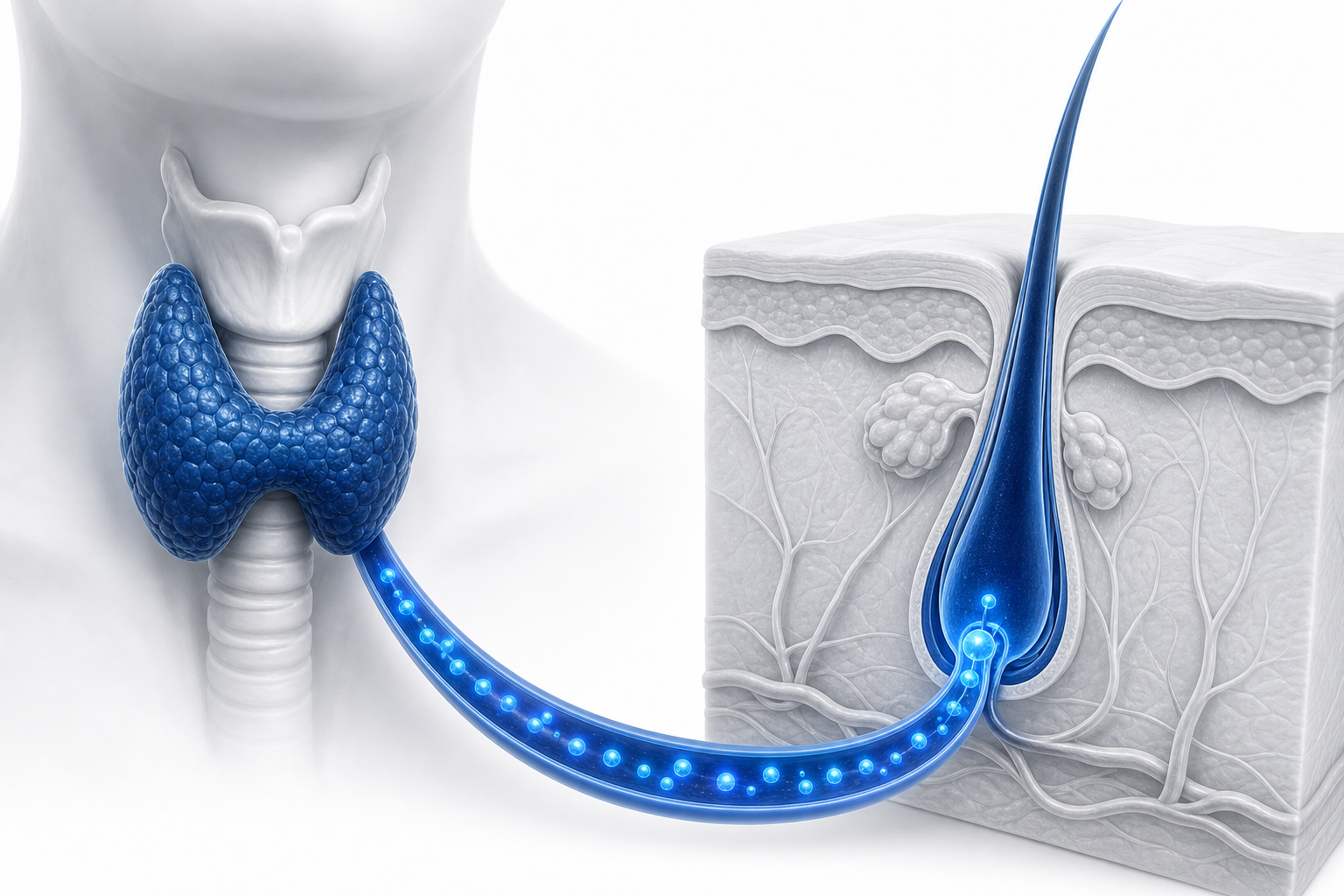
The thyroid controls hair growth because the hair follicles carry their own thyroid hormone receptors and process thyroid hormone locally. Billoni et al. showed in the British Journal of Dermatology (2000) that the human hair follicle expresses thyroid hormone receptors, with the TRβ1 isoform dominating. So the hair responds not only indirectly through metabolism, but directly to the hormone.
The central study on this comes from van Beek et al. (Journal of Clinical Endocrinology & Metabolism, 2008). In vitro, T4 extends the growth phase (anagen) of the hair follicles, boosts the division of hair matrix cells and promotes pigmentation. Notably, the follicle transcribes the deiodinase genes D2 and D3, converting T4 on site into the more active T3 itself.
Put simply: without the right amount of thyroid hormone at the hair root, the hair switches too early from growth mode into shedding mode. The chain of action in short: T4 enters the follicle, the enzyme D2 locally produces T3 from it, this binds to the TRβ1 receptor and throttles the anagen inhibitor TGF-β2. As a result, the growth phase stays active longer. If the hormone balance tips toward deficiency or excess, this reverses: the follicles slip prematurely into the resting phase (telogen) and the hair sheds diffusely. How the individual phases interact is explained in our article on the hair cycle.
The effect also shows up at the stem cell level: in a mouse model, switching off the receptors TRα1 and TRβ blocks the mobilization of hair follicle stem cells out of the resting phase, mediated by a disrupted Wnt/β-catenin pathway (Contreras-Jurado et al., 2015). This explains why a thyroid disorder not only slows the supply of new hair, but throws the entire cycle out of sync. It is precisely this shared timing of many follicles that is the reason the loss appears diffusely across the whole scalp rather than in isolated patches.
Underactive thyroid (hypothyroidism) and hair loss
An underactive thyroid causes diffuse hair loss: an even thinning of the entire scalp without bald patches. Overt hypothyroidism affects roughly 1% to 2% of the U.S. population, while the latent (subclinical) form runs at about 4% to 10% depending on age and assay (American Thyroid Association). The often-cited figure of around 5 in 100 people affected combines both forms.
Typical for the hair in hypothyroidism, alongside the thinning, is dry, brittle hair as well as the possible loss of eyebrow and body hair (Cleveland Clinic). A classic sign is the so-called Hertoghe sign, the loss of the outer third of the eyebrows. However, it is nonspecific and on its own no proof, more on that in the FAQ section.
Accompanying symptoms often include fatigue, weight gain, feeling cold and dry skin (NHS). When an abnormal value needs to be worked up, U.S. clinicians follow the American Thyroid Association guidelines for the diagnosis and management of hypothyroidism. A deeper look at the underactive thyroid is available in our detailed article on hair loss from hypothyroidism.

Overactive thyroid (hyperthyroidism) and hair loss
An overactive thyroid also causes diffuse, non-scarring hair loss. The hair often looks fine, soft and silky, has less tensile strength and breaks more easily. The outer third of the eyebrows, the eyelashes as well as armpit and pubic hair can also be affected (NIH/PMC review “Impact of Thyroid Dysfunction on Hair Disorders”).
The mechanism is essentially the mirror image of the underactive thyroid: an excess of T3 and T4 shortens the growth phase and speeds up the transition into the telogen phase, and on top of that oxidative stress damages the follicles. Accompanying symptoms are typically increased sweating, weight loss, a racing heart and inner restlessness.
On frequency, the figure circulates that hair loss affects up to 15% of patients with an overactive thyroid (German Thyroid Center). This number comes from a secondary source and should be understood as a rough guide. What matters is the message behind it: not only too little, but also too much thyroid hormone costs hair.
In practice, this means an overactive thyroid is easily overlooked when searching for the cause, because many people first think only of the underactive form. Anyone noticing fine, brittle hair together with a racing heart, restlessness and unexplained weight loss should have the overactive thyroid specifically checked. Here too the rule applies: first stabilize the dysfunction, then the hair cycle usually recovers over the course of several months.
Does the thyroid change the hair structure?
Yes, a thyroid disorder often changes the hair structure itself, not just the density. In an underactive thyroid the hair typically becomes dry, brittle, fragile and looks straw-like to wiry (NIH/PMC review; Cleveland Clinic). Many people notice the change in texture earlier than the actual loss.
In an overactive thyroid the opposite shows up: the hair becomes fine, soft and silky, with some describing a “fluffy” hair that barely holds its shape (NIH/PMC review). This change in texture is a practical clue for your own assessment. But it remains an indicator, not proof. Only the blood test provides certainty.
Hashimoto’s thyroiditis and how to tell it apart from alopecia areata
Hashimoto’s thyroiditis is the most common cause of an underactive thyroid and an autoimmune disease. Diagnostically, it usually shows an elevation of the TPO antibodies (antibodies against thyroid peroxidase), occasionally also the Tg antibodies. The hair loss here follows the diffuse pattern of the underactive thyroid.
Important is the distinction from alopecia areata, patchy hair loss. Both autoimmune processes frequently occur together: a population-based case-control study with 33,401 affected individuals (Wohl et al., JDDG 2026) found an odds ratio of 1.67 (95% confidence interval 1.58 to 1.77) for the association between Hashimoto’s and alopecia areata. A Mendelian randomization (Frontiers in Endocrinology, 2024) supports a causal indication from hypothyroidism to alopecia areata (OR 1.43), but not from the overactive thyroid.
Decisive for those affected: alopecia areata is a different disease than thyroid hair loss. It runs a patchy course, with coin-sized, sharply bordered bald spots, and is based on a T-cell attack on the follicle. Simply normalizing the TSH does not cure alopecia areata. So anyone who, alongside diffuse thinning, suddenly discovers round bald spots should have this evaluated separately by a dermatologist.
| Feature | Thyroid hair loss (telogen effluvium) | Alopecia areata (patchy hair loss) |
|---|---|---|
| Pattern | diffuse, entire scalp | patchy, round sharply bordered spots |
| Cause | hormone deficiency or excess shifts the hair cycle | autoimmune T-cell attack on the follicle |
| Response to thyroid stabilization | usually reverses after euthyroidism | not cured by normalizing TSH |
Special case after pregnancy (postpartum thyroiditis)
Not all hair loss after giving birth is the normal postpartum hair loss that resolves on its own. It can also be down to a temporary inflammation of the thyroid after birth, postpartum thyroiditis. It often runs through a phase with an overactive thyroid followed by an underactive one and can shift the hair cycle in the same way. If the hair loss after pregnancy is unusually heavy or persists beyond the usual window, the thyroid values should be checked by a doctor.
Hair loss since starting levothyroxine: what is behind the shedding
Hair loss right after starting or adjusting the dose of levothyroxine is a frequently described phenomenon and seems paradoxical at first. The explanation: many follicles that were stuck in the resting phase are reactivated at the same time (telogen release) and push out their old hairs all at once. A second possible reason is a dose that is not yet correctly adjusted, meaning either a still persisting underactive or a temporary overactive thyroid.
This shedding usually begins a few months after starting, because the follicles respond with a delay, and it typically lasts only a few months. As the TSH value stabilizes, it usually subsides. The evidence for this comes mostly from patient and pharma information portals (such as Paloma Health, Drugs.com), not from hard primary literature. Precise week-by-week figures would therefore be unreliable.
Important context
Do not stop levothyroxine on your own in response to such shedding. The flare is usually temporary, and stopping would worsen the underlying underactive thyroid. The hairs shed during this phase are not permanently lost, they make room for new, healthy hair. Discuss the observation with your doctor and wait for the correct dose adjustment.
Diagnosis: which thyroid values to have measured for hair loss?
Working up thyroid-related hair loss includes the baseline value TSH as well as the free hormones fT3 and fT4, supplemented by the antibodies TPO-Ab and, if Graves’ disease is suspected, TRAb. Important up front: all reference ranges are lab- and assay-dependent, so they only apply “depending on the lab.” And the units mU/L, mIU/L and µIU/mL are identical 1:1, even though they are written differently on lab reports.
The aha moment when reading the report: TSH behaves inversely to fT3 and fT4. In an underactive thyroid the TSH is elevated, while fT3 and fT4 are low. In an overactive thyroid it is the other way around. This is due to the feedback loop between the pituitary gland and the thyroid, in which the TSH, as the control hormone of the pituitary, drives the thyroid. In addition, a sonography (ultrasound of the thyroid) can be useful.
The antibodies separate the causes from one another: elevated TPO-Ab point to Hashimoto’s thyroiditis, while a positive TRAb speaks for Graves’ disease and usually stays negative in pure Hashimoto’s. The TPO-Ab cutoff is strongly assay-dependent and ranges from about 9 to 60 IU/mL depending on the lab, which is why a single number without the reference range of the respective lab says little. This is exactly why every report should carry the lab’s own normal range, which is what you should orient yourself by.
| Value | Underactive | Normal range | Overactive | Unit |
|---|---|---|---|---|
| TSH | elevated (above approx. 4.2) | 0.27–4.20 | suppressed (below approx. 0.27) | µIU/mL (= mIU/L = mU/L) |
| fT4 (free T4) | low | 0.8–1.8 | elevated | ng/dL |
| fT3 (free T3) | low | 2.0–4.4 | elevated | pg/mL |
| TPO-Ab | elevated in Hashimoto’s | below 34 (negative) | usually normal | IU/mL |
| TRAb | usually normal | below 1.0 (negative) | elevated in Graves’ | mU/L (= IU/L) |
Reference ranges vary by lab and assay. The TPO-Ab cutoff lies between about 9 and 60 IU/mL depending on the assay; 34 IU/mL is a common laboratory value. Sources: Endokrinologikum Hamburg, German Thyroid Center.
If your primary care doctor only measured the TSH and your hair keeps falling out, it is worth a targeted visit to an endocrinologist with a clear list of values. You can print out or screenshot the following checklist to bring along. The role blood values play in hair loss in general is covered in depth in our article on the blood test for hair loss.
Endocrinologist briefing: values to bring along
Request these values from the endocrinologist when only the TSH was determined and your hair keeps falling out:
- ☐ fT3 (free T3) – thyroid function
- ☐ fT4 (free T4) – thyroid function
- ☐ TPO-Ab – autoimmune marker (Hashimoto’s)
- ☐ TRAb – autoimmune marker (Graves’ disease)
- ☐ Ferritin – iron stores, a common contributing cause of diffuse hair loss
- ☐ Vitamin D (25-OH) – a common deficiency
- ☐ Selenium – only in the context of Hashimoto’s and with a documented deficiency, under medical supervision
No self-diagnosis: this list is a basis for the conversation at your doctor’s appointment, not a substitute for medical assessment.
Treatment and hair regrowth in thyroid hair loss
Treating thyroid hair loss consists of correcting the underlying dysfunction, not treating the hair separately. In an underactive thyroid, levothyroxine replaces the missing T4. After a dose change, the TSH is usually checked every 6 to 8 weeks (NHS). Once euthyroidism is reached, the hair cycle usually normalizes on its own.
In an overactive thyroid, antithyroid drugs throttle hormone production. The telogen effluvium then usually reverses over the course of several months (NIH/PMC review). In both cases the rule applies: normalizing the telogen rate takes time, because the resting phase of the affected follicles must run its course first before new hair pushes through.
How long this takes can only be given as a rough guide. A visible improvement typically shows in the range of 3 to 6 months after normalization, while full density may only be reached after 9 to 12 months, and in long-standing disease even later (Forum Schilddrüse). The following timeline shows the usual pattern.
| Time frame | What happens in the follicle |
|---|---|
| Month 1–2 | The hormone level normalizes, the shedding slowly stops. |
| Month 3–4 | The follicles re-enter the growth phase (anagen). |
| Month 5–6 | The first new, still thin hairs (baby hair) become visible. |
Rough guide. The 3 to 6 month window corresponds roughly to the duration of the telogen phase before new hair pushes through.
A reassuring practical note: normal washing, combing or coloring does not speed up the loss. The affected hairs are already in the telogen phase and will detach anyway, daily handling only brings them into view a little sooner instead of costing additional hairs.
Selenium in Hashimoto’s: what the evidence actually shows
Selenium is often promoted as a supplement in the context of Hashimoto’s, but the evidence for it is weak and inconsistent. A Cochrane review (van Zuuren et al., 4 randomized studies, 463 participants) states verbatim that the data on selenium supplementation in Hashimoto’s is “incomplete and not reliable,” meaning not solid enough for clinical decisions. Individual studies showed a reduction in TPO-Ab, but their clinical significance remains unclear.
A more recent meta-analysis from 2024 (35 studies) likewise sees a TPO-Ab reduction, but at low evidence quality and with strong heterogeneity (I² = 90%). No general recommendation can be derived from this. Selenium comes into question at most with a documented deficiency and under medical supervision, not as a standard therapy and not on your own. Which nutrients make sense and when is covered in our article on vitamins for hair loss.
Diffuse thyroid hair loss or genetic hair loss?
Thyroid hair loss is diffuse and affects the entire scalp, while genetic (androgenetic) hair loss follows a pattern: a receding hairline and thinning crown in men, a widening part in women. The mechanism is fundamentally different, a shift of the hair cycle driven by hormone deficiency on one side, a DHT-mediated miniaturization of the follicles on the other.
| Feature | Thyroid (telogen effluvium) | Androgenetic alopecia (AGA) |
|---|---|---|
| Pattern | diffuse, entire scalp | receding hairline and crown (men), widening part (women) |
| Mechanism | shift of the hair cycle into the telogen phase | DHT-mediated follicle miniaturization |
| Reversibility | usually reversible after euthyroidism | progressive, not reversible without treatment |
Both can be present at the same time, and that is not rare. In a study of women with androgenetic alopecia, 31.25% additionally had hypothyroidism (NIH/PMC review). A Mendelian randomization, however, showed no causal link from the thyroid to androgenetic alopecia (p above 0.05). The two causes are independent and can overlap. More on the pattern type can be read in our article on androgenetic alopecia.
For practice, this means: the first step is to find out which type is present. Diffuse thyroid- or TE-related hair loss should be treated internally and is not suitable for a hair transplant. Only genetic, pattern-type hair loss responds to hair growth medication or a hair transplant.
To clarify whether you even have a genetic (pattern-type) hair loss that a treatment can target, the free Elithair hair analysis helps. It cannot assess the thyroid status itself. That must be clarified by a doctor through bloodwork.
Frequently asked questions about hair loss and the thyroid
Which TSH value causes hair loss?
There is no fixed TSH threshold for hair loss. The American Thyroid Association explicitly states that there is no reliable relationship between the level of TSH, T3 or T4 and the severity of symptoms. Hair loss can already occur in a subclinical underactive thyroid. A single cutoff value therefore cannot be given responsibly.
Does the hair grow back after the thyroid is stabilized?
As a rule, yes. After euthyroidism is reached, the hair cycle usually recovers over the course of several months, with a visible improvement often after 3 to 6 months. Full density can take longer.
Hashimoto’s and hair loss: what to do?
Have the thyroid stabilized by a doctor (usually levothyroxine) and, alongside the TSH, have the TPO-Ab as well as accompanying values checked. If round, sharply bordered bald spots additionally appear, you should think of alopecia areata. That is a disease in its own right, treated separately.
Can an overactive thyroid also cause hair loss?
Yes. An overactive thyroid also triggers diffuse hair loss, often with finer, softer hair that breaks more easily (NIH/PMC review). After the overactive thyroid is stabilized, the hair loss usually reverses over the course of months.
Does the thyroid make you lose your eyebrows?
Loss of the outer (lateral) third of the eyebrows is possible, the so-called Hertoghe sign. It is considered classic, but is nonspecific and also occurs in atopic dermatitis and other conditions. On its own it is no proof of a thyroid disorder (DocCheck Flexikon; QJM Oxford 2023).
Hair loss since starting thyroid medication: is that normal?
An initial shedding at the start of levothyroxine therapy is frequently described and usually temporary. Do not stop the tablets on your own, but discuss the observation with your doctor and wait for the correct dose adjustment.
How long does regrowth take?
3 to 6 months until a visible improvement sets in. Full density may only be reached after 9 to 12 months or later, because the hair cycle first has to make up for the completed telogen phase.
Scientific sources
- van Beek N et al.: Thyroid hormones directly alter human hair follicle functions. J Clin Endocrinol Metab (2008). PubMed
- Billoni N et al.: Thyroid hormone receptor beta1 is expressed in the human hair follicle. Br J Dermatol (2000). PubMed
- Wohl Y et al.: Association of Hashimoto’s thyroiditis and alopecia areata (OR 1.67). JDDG (2026). Wiley Online Library
- van Zuuren EJ et al.: Selenium supplementation for Hashimoto’s thyroiditis (Cochrane review). Cochrane Database Syst Rev (2013). PubMed
- Hussein RS et al.: Impact of Thyroid Dysfunction on Hair Disorders (review). NIH/PMC (2023). PMC
- American Thyroid Association: Hair loss and thyroid disorders (no fixed TSH threshold). Clinical Thyroidology for Patients. thyroid.org
- DEGAM: AWMF S2k guideline 053-046 “Elevated TSH value in primary care” (2024). AWMF Register
- IQWiG / gesundheitsinformation.de: Underactive thyroid (hypothyroidism), prevalence data. gesundheitsinformation.de
This article is for information purposes and does not replace a medical diagnosis or treatment. If you experience hair loss and suspect a thyroid disorder, please consult your doctor.
Related topics from our hair loss cluster: vitamins for hair loss, iron deficiency and hair loss, plus the overview of the causes of hair loss. Especially for women, our article on hair loss in women is worth a read, as is the overview of hormones and hair.

Dr. Imad Moustafa
Hair transplant specialist