

The surgery is behind you, and now comes the part that is in your own hands. The first two weeks matter most, because that is how long the transplanted grafts stay mechanically vulnerable: in the controlled pull test by Bernstein and Rassman (Dermatologic Surgery, 2006), tugging on a transplanted hair on day 1 to 2 dislodged the graft every single time, and by day 9 it no longer did. After that it gets easier fast, and the rest is patience. Here is what is allowed in each phase, what is normal, and when you should call your clinic.
The key points
- ✓The first 10 to 14 days are the critical window: no pressure, no friction, no sweat, no direct shower stream, and sleep on your back with your upper body elevated
- ✓The first hair wash usually happens from day 2 to 3 following your clinic’s instructions, and the crusts come off on their own within 10 to 14 days and are never picked at
- ✓The transplanted hairs falling out around month 2 to 4 (shedding) is normal and does not mean the grafts are lost, because the root stays in the scalp
- ✓Visible new growth starts at around month 4, and the final result usually shows after twelve months, or 10 to 18 months according to the NHS
The table of contents below shows you where everything is. After that the article follows the timeline of your healing: first the overview of all phases and the when-can-I-again matrix with every time window, then day 1 to 3, week 1, week 2, month 1, the shedding phase around month 2 to 4, and the road to the final result.
Summary
- Healing after a hair transplant: the phases at a glance
- What can I not do after a hair transplant, and when can I do it again?
- Day 1 to 3: how should I behave right after a hair transplant?
- Week 1: when can I wash my hair after a hair transplant?
- Week 2: what helps against itching, and what is allowed again?
- Month 1: when are exercise, sauna and swimming allowed again after a hair transplant?
- Month 2 to 4: why do the transplanted hairs fall out again?
- Month 6 and month 12: when do you see the final result of a hair transplant?
- Bumped your head after a hair transplant: what now?
- Sweating after a hair transplant: why sweat is a risk
- Smoking, alcohol and medication after a hair transplant
- How important is aftercare following a hair transplant?
- Warning signs: when to get medical advice after a hair transplant
- The most common misconceptions about behavior after a hair transplant
- FAQ: more questions about behavior after a hair transplant
- Sources
Healing after a hair transplant: the phases at a glance
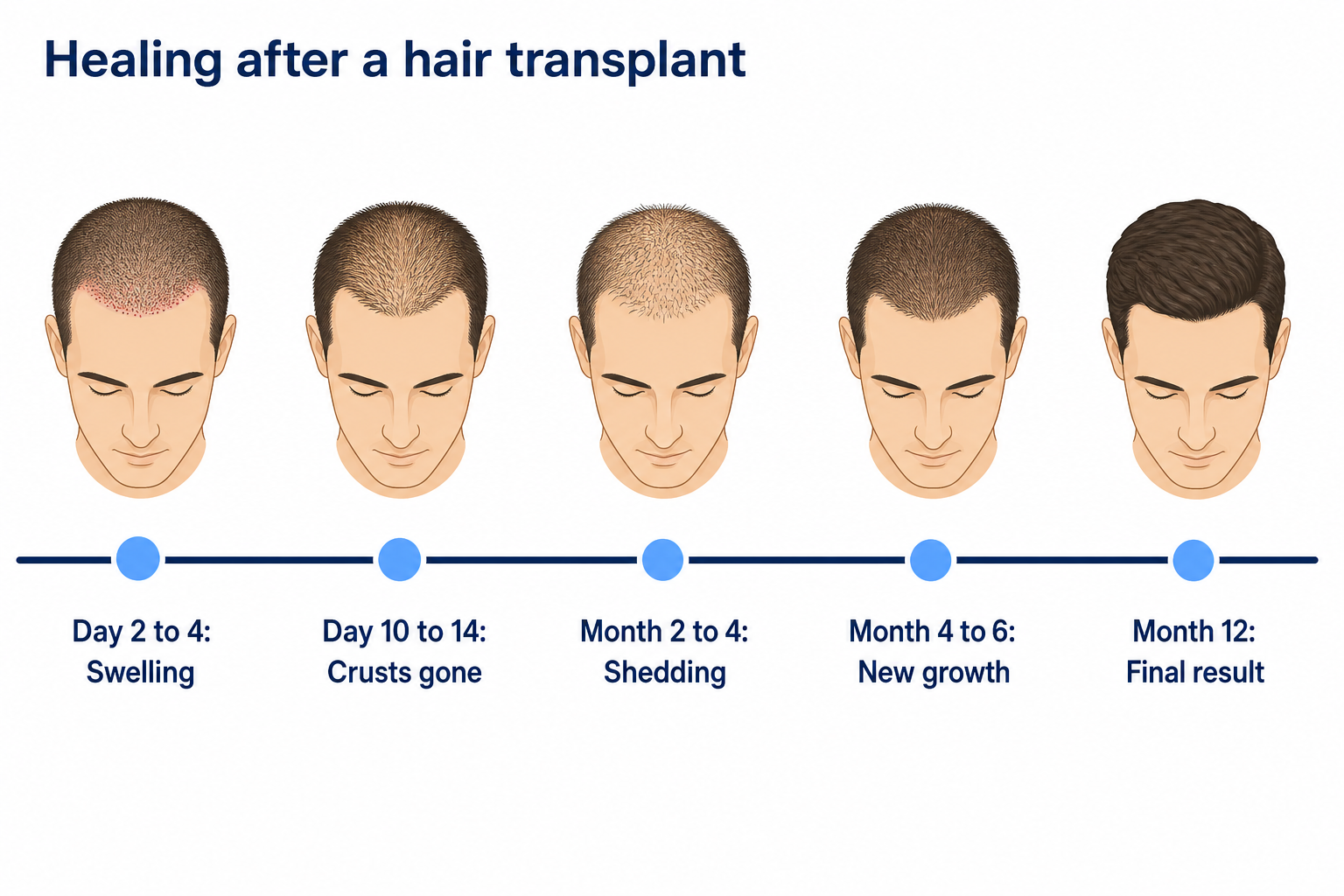
Healing after a hair transplant runs through distinct phases: wound closure in the first three days, crusts coming off in week 1 to 2, the transplanted hairs shedding around month 2 to 4, new growth from about month 4, and the final result after roughly twelve months. The UK’s National Health Service (NHS) gives a range of 10 to 18 months for the full result.
One thing makes all of this easier to understand: you have two wound areas, and they behave differently. The recipient area consists of thousands of tiny implantation channels, forms crusts and is sensitive to pressure. The donor area, meaning the extraction zone at the back of the head, often feels tight and numb, but usually heals faster.
The numbness at the back of the head comes from irritation of fine nerve fibers, which regrow slowly, at roughly one millimeter per day. It fades over weeks to months, and in some cases longer. More on the extraction site in the article Donor area after a hair transplant.
There is a simple reason for the gap between implantation and growth: after the procedure the transplanted follicles enter the resting phase (telogen) and only then start a new growth phase (anagen). How that rhythm works is explained in the article on the hair cycle.
| Phase | What happens in the scalp | What you see and feel |
|---|---|---|
| Day 1 to 3 | wound closure, the grafts are not yet anchored | small crusts, redness, swelling often starting |
| Day 4 to 10 | fine blood vessels form, the grafts anchor themselves | crusts loosen slowly, swelling goes down |
| Day 10 to 14 | mechanical anchoring largely complete (no pull risk from day 9, Bernstein and Rassman 2006) | crusts mostly gone, recipient area still pink, itching possible |
| Week 3 to 8 | follicles enter the resting phase (telogen) prematurely | redness fades, small pimples possible |
| Month 2 to 4 | telogen effluvium: the visible hair is shed, the root stays | the transplanted hairs fall out (shedding) |
| Month 3 to 6 | new growth phase (anagen), the hair pushes through | fine, sometimes lighter hairs, visible progress from month 4 to 6 (NHS: about 4 months) |
| Month 6 to 12 | hair diameter and density increase | final result usually after twelve months, 10 to 18 months according to the NHS |
Timeline based on Bernstein and Rassman (2006), the NHS and common clinical practice.
What can I not do after a hair transplant, and when can I do it again?
In short: after a hair transplant, the things to avoid are pressure, friction, sweat, heat, UV radiation, nicotine and alcohol. Most of these restrictions apply for two to four weeks, unprotected sun exposure considerably longer.
There are really only five principles behind everything you have to avoid after a hair transplant. Once you know them, you can judge any everyday situation yourself, including the ones no list covers. Everything below is a version of “nothing disturbs the fresh grafts.”
The five principles behind every restriction
- Mechanics: pressure, friction, scratching, tight headwear, helmets, contact sports.
- Moisture and germs: sweat, swimming pools, the ocean, hot tubs, unsuitable care products.
- Heat and UV: sauna, steam room, tanning beds, direct sun, hot water, blow dryers.
- Circulation and wound healing: nicotine, alcohol, blood thinners, blood pressure spikes.
- Chemistry: coloring, bleaching, aggressive styling products.
The matrix below answers all the “when can I do this again” questions at a glance: the what, the when, and a short reason. How to build your training back up or which product to choose is covered in the article linked for each topic. What to do week by week in everyday life follows chronologically below.
| Topic | Earliest again from | Why the wait | |
|---|---|---|---|
| First hair wash as instructed | day 2 to 3 once cleared, later in some protocols | softens the crusts and keeps the wounds clean, without pressure | Shampoo |
| Showering with the stream directly on the head | about week 2 | water pressure can dislodge grafts | Shampoo |
| Sleeping flat or on your side | about day 7 to 10 | contact and pressure on the recipient area | Swelling |
| Crusts fully gone | day 10 to 14, on their own | never scratch them off, the graft can come with them | Crusts |
| Light activity, walking | from day 3 to 5 | avoid blood pressure spikes and sweating | Exercise |
| Moderate exercise without heavy sweating | about week 3 to 4 | sweat softens crusts and raises the risk of germs | Exercise |
| Intense weight training, running | about week 4 | blood pressure, sweat, tension on the donor area | Running |
| Contact sports, boxing, ball sports | about week 6 to 8 | risk of impact and injury to the head | Boxing |
| Swimming pool and ocean | about 4 weeks | chlorine, salt and germs on young skin | Swimming |
| Sauna, steam room, tanning bed | about 4 to 6 weeks | heat and UV put strain on healing | Sauna and tanning beds |
| Direct sun without protection | about 3 months | UV prolongs redness and shifts pigmentation | Sun |
| Loose, soft headwear | about day 10 to 14 | friction and pressure on the grafts | |
| Tight cap, motorcycle or bike helmet | only after your doctor clears it | localized pressure and friction | |
| Styling products, gel, wax | about 4 weeks | chemical irritation, washing out involves friction | Hair gel |
| Barber: scissors in the recipient area | once cleared, usually from week 4 | tension on the hair, no clippers | Month 1 section |
| Coloring or bleaching your hair | several months at the earliest, once cleared | harsh chemicals on healing skin | Month 1 section |
| Smoking and nicotine | abstain during the first weeks | vasoconstriction, poorer blood supply to the grafts | Smoking |
| Alcohol | none at all in the first days, then as instructed | bleeding tendency, interaction with medication | Smoking and alcohol section |
| Sex and other physical exertion | about 1 week, once cleared | blood pressure spikes, sweat, risk of friction | Day 1 to 3 section |
| Eyeglasses or sunglasses | as soon as the arms do not press on the donor area | localized pressure on the extraction sites | Donor area |
| Driving | once you are off pain medication and can move your head freely | reaction time and safety | Day 1 to 3 section |
| Flying | usually possible within a few days | avoid pressure and contact with headrests | Flying |
| Restarting minoxidil or finasteride | only after your doctor clears it | open skin absorbs active ingredients differently | Hair growth products |
Consensus values from clinical practice, not study data. Your clinic decides the actual timing.
Day 1 to 3: how should I behave right after a hair transplant?
In short: for the first 72 hours after a hair transplant the rules are simple: sleep on your back with your upper body elevated, do not touch the recipient area at all, do not wash your hair yourself, do not bend over, no exercise, no nicotine and no alcohol. In the pull test by Bernstein and Rassman (2006), pulling on a graft on day 1 to 2 dislodged it every time.
The reason for the strictness: at this stage the grafts sit in the implantation channels without their own blood supply and without any adhesion. New fine blood vessels typically only start forming around the third day. Every touch, every bit of pressure and every bit of friction can shift a graft or pull it out.
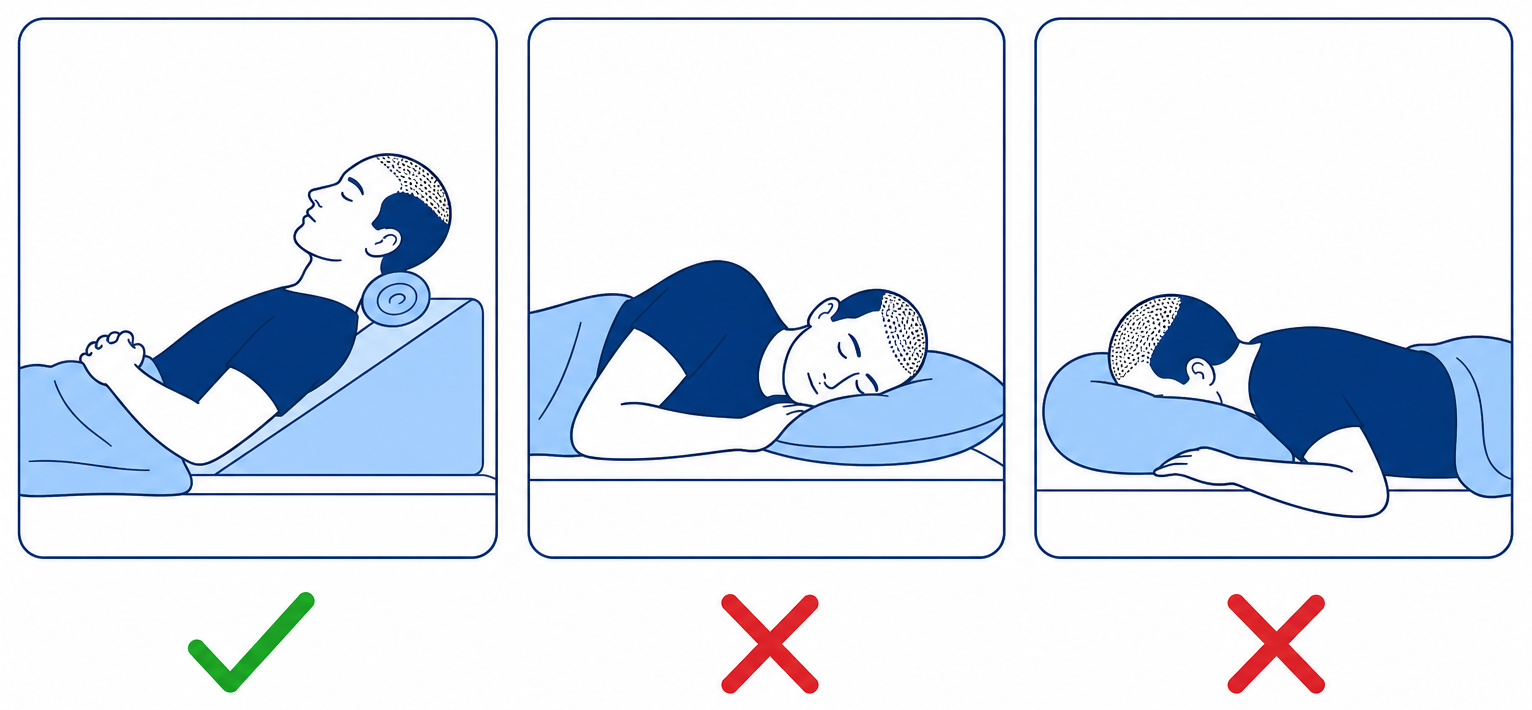
Sleeping position: on your back, upper body elevated about 35 to 45 degrees, with a neck pillow or travel pillow so that nothing touches the recipient area. If you roll onto your side in your sleep, that is not an emergency, but it is a reason to rebuild your setup. A travel pillow around your neck holds your head more reliably than a tall stack of pillows.
Touching and washing: do not scratch, do not rub, do not wipe anything off. Moisten the scalp only with the spray or lotion you have been given. Do not wash your hair yourself before the appointment your clinic has cleared, often day 2 to 3. A shower stream directly on your head stays completely off limits this week.
Swelling and slight oozing: the swelling often starts on day 2 and, driven by gravity, drifts down into the forehead and around the eyes. Cool only your forehead and the bridge of your nose, never the recipient area. Slight oozing occurs in the first days; apply gentle pressure with a sterile compress only if your clinic tells you to. Persistent bleeding needs medical attention. More on this in the article Swelling after a hair transplant.
Movement, nicotine, alcohol: no bending over with your head down, no heavy lifting, no exercise, no blood pressure spikes. Strictly avoid nicotine and alcohol in this phase; the reasoning follows further down. Headwear is only allowed if your clinic approves a loose style that does not touch the recipient area anywhere.
Medication: take pain medication and antibiotics exactly as your clinic prescribes. Blood thinners such as aspirin can increase bleeding and need to be discussed with your doctor beforehand, as do blood pressure and diabetes medication. Do not stop anything on your own and do not start anything new on your own.
Everyday life in the first days: drive only once you are off pain medication and can move your head freely. Wear eyeglasses and sunglasses only if the arms do not press on the extraction sites. Go easy on coffee and energy drinks, and avoid very spicy food, since it promotes sweating and redness. Sex and other physical exertion only once cleared, roughly one week as a guide.
What you can actively do for healing on day 1 to 3
Much of this phase is about not doing things. These three points are the opposite: things that are genuinely in your hands.
- Drink enough, spread across the day. Fluid is injected into the scalp during surgery, and the body flushes it back out over the first days. Water and unsweetened tea support that, while alcohol and strong coffee work against it.
- Keep salt low. Salt binds water in the tissue, and the swelling around day 2 to 4 is already heading toward the forehead thanks to gravity. Skipping prepared meals, fast food and very salty snacks this week pays off.
- Eat normally and get enough protein instead of fasting. Wound healing means building tissue. Dieting, intermittent fasting or days without appetite are a poor start, and supplements do not replace a proper meal.
| Period | Graft status | Sleeping | Washing and care | Avoid |
|---|---|---|---|---|
| Day 1 | not yet anchored, every touch is critical | elevated on your back, 35 to 45 degrees | only moisten as instructed, do not touch | bending over, lifting, nicotine, alcohol, heat |
| Day 2 to 3 | adhesion beginning, still very sensitive | elevated on your back | first wash once cleared: let the lotion soak in, rinse without pressure, pat dry only | shower stream, rubbing, scratching, exercise |
| Day 4 to 7 | increasingly stable, still mechanically vulnerable | still elevated, neck pillow | daily wash as instructed, let the crusts soften | sweat, sun, headwear that makes contact |
| Day 8 to 10 | largely stable, crusts are coming off | flatter is possible, still avoid contact | as before, treat itching with moisture instead of scratching | scratching, exercise, water pressure |
| Day 11 to 14 | firmly anchored, normal care is enough | normal position usually possible | crusts mostly gone, keep washing gently | sweating, swimming pools, sauna, tight caps |
Graft status derived from the pull test by Bernstein and Rassman (2006).
Week 1: when can I wash my hair after a hair transplant?
In short: in the FUE and DHI protocols used by clinics, the first hair wash after a hair transplant usually happens from day 2 to 3, always following instructions. The NHS gives day 6 for the first careful wash by hand. Both timings are real, because protocols differ, and your clinic sets the date.
This is the point where the recommendations diverge more than anywhere else in the healing process, and both sides have good reasons: clinics with their own care lotion start early in order to soften the crusts. Protocols without such products wait longer so the grafts are not moved at all. After that, week 1 usually involves a daily wash.
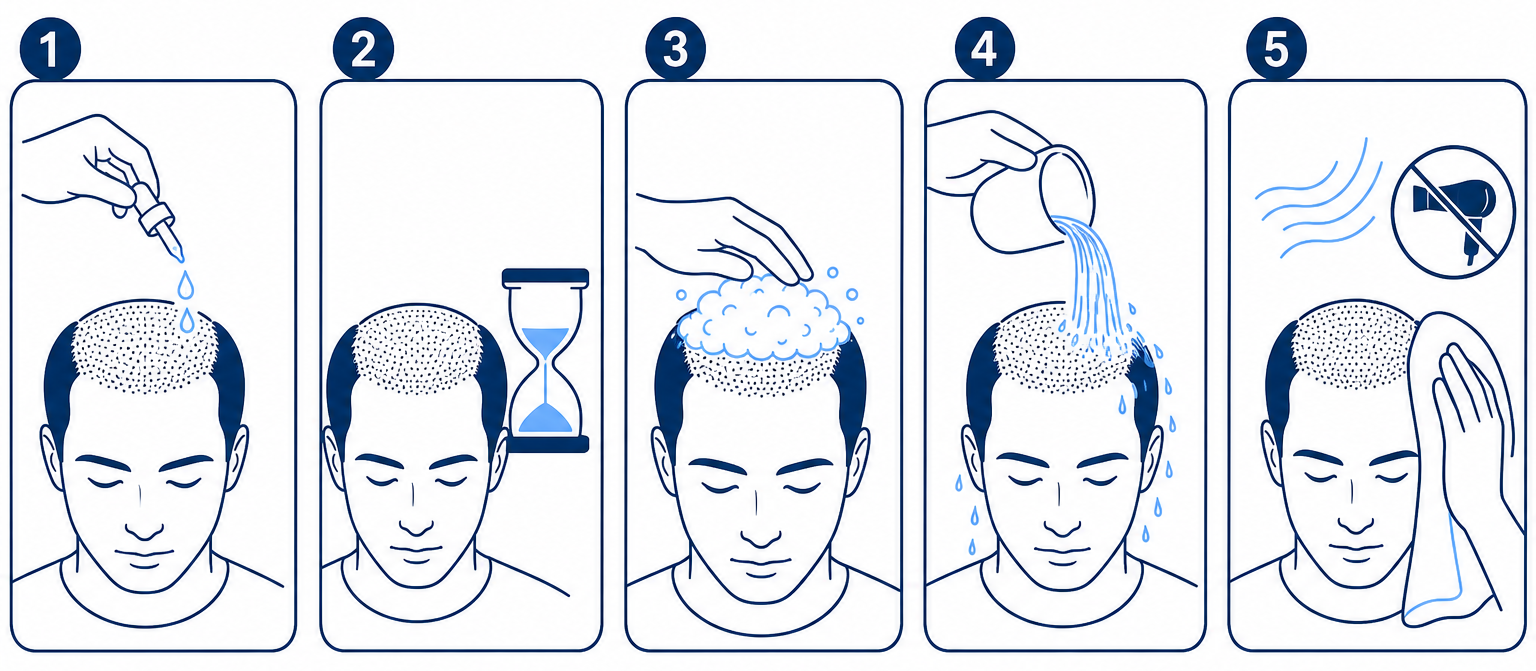
How to wash: lukewarm water, no force. Apply the care lotion and let it soak in, apply the shampoo lather gently instead of massaging it in, rinse with a cup or a weak stream without pressure, pat dry with a clean towel and never rub, then let it air dry without a blow dryer. Which product is suitable is covered in the article Shampoo after a hair transplant.
When are the crusts gone after a hair transplant?
Crusts are part of healing, not dirt. Thanks to the daily washes they usually come off on their own within 10 to 14 days, and patient information from the ISHRS, the international professional society, gives a range of 4 to 14 days. Picking, scratching or pulling is the most common self-inflicted cause of lost grafts.
The evidence here is solid: in the pull test by Bernstein and Rassman, pulling on a crust that was still attached brought the graft with it every time up to day 5. That is why even a half-detached crust stays where it is. Timing and details in the article Removing crusts after a hair transplant.
How long does the swelling last after a hair transplant?
The swelling is usually strongest on day 2 to 4 and typically gone within a week. Gravity pulls it down into the forehead and around the eyes, which looks more dramatic than it is. Staying upright, sleeping elevated and cooling the forehead all help, and you never cool the recipient area.
Numbness and a feeling of tightness in the donor area also belong to this week. They come from irritation of fine nerve fibers and fade over weeks to months, and in some cases longer.
Work and travel: desk work is often possible within a few days, and the American Society of Plastic Surgeons (ASPS) puts non-physical work at 2 to 5 days. Physical work takes considerably longer, and how much time off you need is a decision for your doctor. Flying is usually possible early on if you avoid pressure and contact with headrests (see the article Flying after a hair transplant).
Week 2: what helps against itching, and what is allowed again?
In short: in week 2 after a hair transplant the grafts can no longer be dislodged by pulling from day 9 onward, according to Bernstein and Rassman, and the daily wash now takes most of the crusts off. For the typical itching, moisturizing helps and scratching never does. Clinics usually clear showering with a direct stream and loose headwear from day 10 to 14.
Week 2 is the week of the first easing of restrictions, and that is exactly where the risk lies. The recipient area is still pink and the skin over the grafts has only just closed. Sweat, heat and friction therefore remain off limits, even though your head already looks much more normal.
Itching is a sign of healing, not a warning signal. Do not scratch; moisturize as instructed and keep washing gently. What else helps is covered in the article Itchy scalp after a hair transplant.
Showering and exercise: normal showering with a direct stream is usually cleared from around week 2, still without pressure and without rubbing. Light activity is fine, sweaty exercise is not yet. Which load fits when is covered in the article Exercise after a hair transplant.
Headwear and styling: clinics usually clear loose, soft headwear from day 10 to 14. Nothing tight, nothing with an inner seam, no helmet. Styling products stay away, dry shampoo included (see the article Hair gel after a hair transplant).
Sun: keep avoiding direct sun. According to StatPearls and DermNet, UV exposure intensifies and prolongs redness and pigment changes in healing skin, which is why consistent broad-spectrum sun protection is the standard recommendation. Why that matters right now is covered in the article Avoiding sun after a hair transplant.
Month 1: when are exercise, sauna and swimming allowed again after a hair transplant?
In short: after a hair transplant, moderate exercise is usually cleared from week 3 to 4, intense training from about week 4, swimming pools and the ocean from about four weeks, sauna and tanning beds from four to six weeks, and contact sports more like week 6 to 8. Avoid unprotected direct sun considerably longer, roughly three months as a guide.
After about four weeks the transplanted grafts are firmly anchored and everyday life is back to normal. The only remaining limits concern water, heat, chemicals and heavy strain. These time windows are consensus values from clinical practice rather than study data, which is why they are deliberately given as ranges.
Exercise: moderate training usually from week 3 to 4, intense weight training and running from about week 4, contact and ball sports more like week 6 to 8. Building your training back up and special cases are covered in the articles on Exercise, Running and Boxing after a hair transplant.
Water and heat: swimming pools and the ocean usually from about four weeks (see the article Swimming), and sauna, steam rooms and tanning beds usually from four to six weeks (see the article Sauna and tanning beds). Unprotected direct sun should be avoided considerably longer, roughly three months as a guide.
Hair and chemicals: in the donor area, trimming is usually fine earlier; in the recipient area only with scissors and without tension, and no clippers until you are cleared. Coloring or bleaching has to wait several months, because harsh chemicals have no business on healing skin. Mild styling products are usually fine from about four weeks.
If the recipient area is still red: erythema, meaning persistent redness, can last for weeks and usually fades slowly, often staying visible longer on fair skin. A slightly bumpy surface (cobblestoning) does occur and usually smooths out over weeks to months.
Both are normal as long as they are decreasing. If the redness increases, spreads or feels warm, see the warning signs section further down.
Month 2 to 4: why do the transplanted hairs fall out again?
In short: roughly two to four months after a hair transplant the transplanted hairs fall out. This shedding is a normal part of healing and does not mean the grafts are lost, because only the visible hair is shed while the root stays in the scalp. According to the NHS, visible new growth starts at around month 4.
The trigger is the surgical stimulus itself: it pushes the follicles into the resting phase prematurely. This happens with practically every hair transplant and says nothing about the later result. Anyone who expects it is less alarmed when hairs end up in the drain during a wash.
The technical term for this process is telogen effluvium. The follicle stays intact, rests in telogen for a few weeks and then starts a new anagen phase in which it pushes out a new hair. The NHS puts the start of visible new growth at around four months.
Shock loss, by contrast, affects the surrounding native hair: some of it can temporarily thin out because of the procedure. Experience shows this reverses over months in most cases, and it should not be confused with losing the transplanted grafts. More on this in the article Hair loss after a hair transplant.
The back of the head can also look patchy or thinned out in the first months, because the extraction sites stand out at first and some hairs there likewise go into the resting phase. This usually resolves as the hair grows back (see the article Donor area).
What to do in this phase: normal, gentle care, no plucking and no test tugs on your hair, and keep protecting the scalp from the sun. Whether and when you restart active ingredients such as minoxidil belongs in a conversation with your doctor, not in a blanket number of weeks.
Getting through the shedding phase in everyday life
Medically, the shedding phase after a hair transplant is unremarkable, and yet it is the stretch where most patients struggle: between the hair falling out around month 2 to 4 and visible new growth from about month 4 there are weeks in which nothing seems to happen, or in which things even look thinner than before the procedure. That is not a setback, it is the gap in the hair cycle.
In practice, a short, even haircut helps more than any attempt to cover something up: it takes the edge off the contrast between thinner and denser spots. Loose headwear has long been cleared by this phase. Clear hair fibers, powders and thickening sprays with your clinic first, since they have to be washed out with friction.
If you catch yourself checking the mirror every day, one simple method helps: one photo per month, always the same spot, same light, same distance, ideally on dry hair. Comparing with the previous month shows progress your eye misses day to day. Comparing with the picture in your head only shows frustration.
And at work: no explanation is needed if you do not want to give one. If you do explain, one sentence (“minor procedure, it’s growing back”) gets you further than any amount of detail. If your mood slips for weeks and it weighs on you, that is a good reason to raise it at your follow-up appointment. That is what aftercare is there for too.
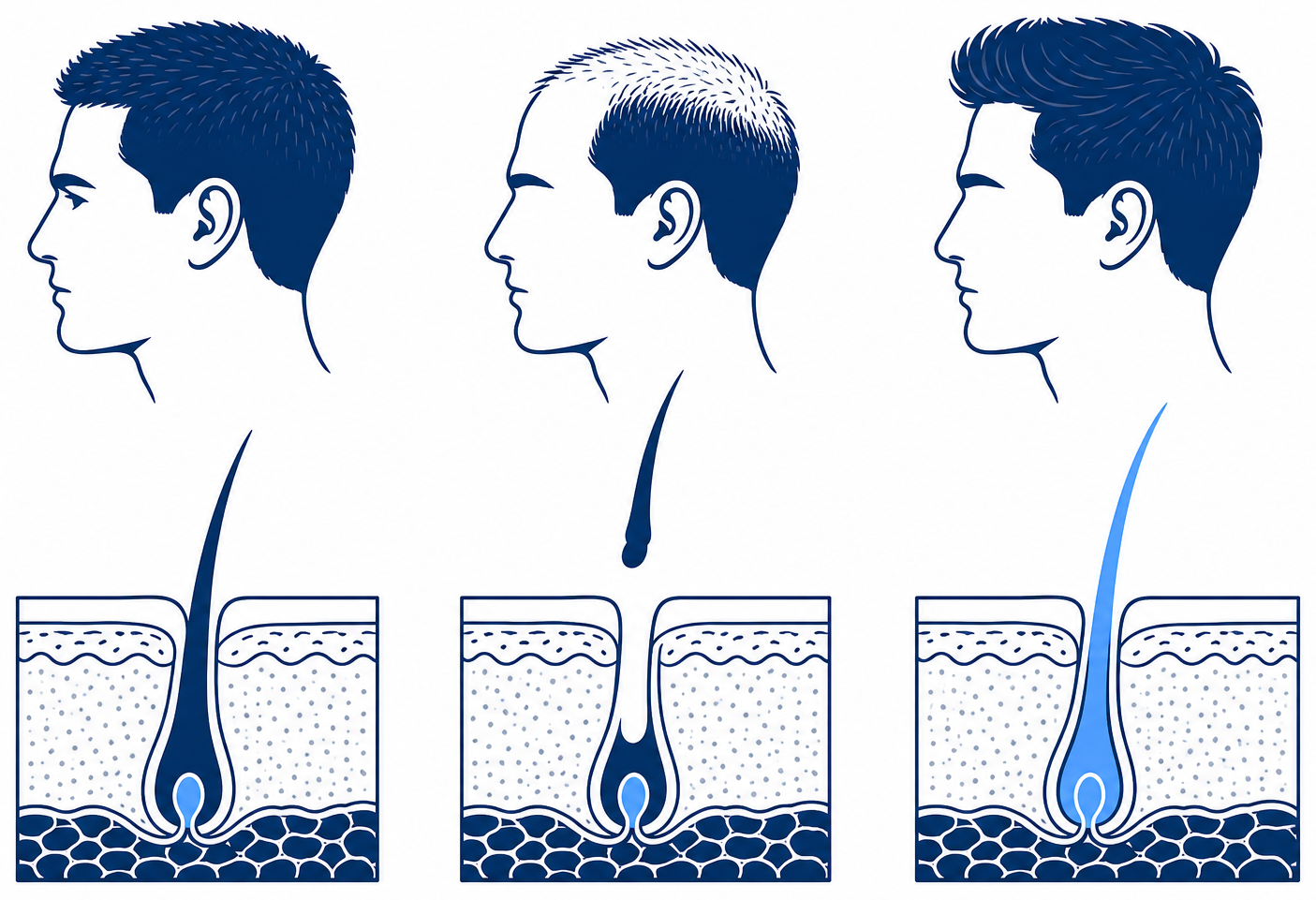
Month 6 and month 12: when do you see the final result of a hair transplant?
In short: after about six months a clear interim result is visible, and the final result of a hair transplant usually shows after twelve months. The NHS gives a range of 10 to 18 months for the full result, and for the crown and densely transplanted areas specialists report 15 months or more from experience.
The reason for the longer wait on the crown is anatomical: blood supply is lower there, and the whorl runs in several directions, so the density fills in visually later. Anyone judging by the whorl alone regularly underestimates their result at twelve months.
Between month 4 and 6, fine and sometimes lighter hairs grow in first; they darken and gain diameter. It is normal for areas to start unevenly, because the follicles do not enter the growth phase in sync. One side healing faster than the other is also common.
Between month 6 and 12, density and structure increase, the hairline looks increasingly natural, and the areas grow together. Month 12 is the point to take stock: from then on it is worth talking with your clinic about whether adding density makes sense.
In the long run: the transplanted hairs come from the DHT-resistant donor area and therefore usually stay for good. That is a biological property of the hair root, not a promise of success. The surrounding native hair can continue to fall out, which is why medical follow-up remains sensible (see the article How long a hair transplant lasts).
Bumped your head after a hair transplant: what now?
If you have bumped your head after a hair transplant, in most cases you will not lose a graft because of it. A bump matters most in the first days, while the grafts are not yet anchored, and whenever the skin splits open or bleeds. From day 9 onward the grafts are, according to Bernstein and Rassman, considerably less sensitive mechanically.
- Do not press on it and do not poke around. Every touch increases the risk of loosening a graft.
- Check in the mirror: bleeding, an open spot, missing hair at the point of impact, a noticeable bump.
- If it bleeds slightly, place a sterile compress on it without friction, but only if your clinic tells you to. Do not wipe.
- Inform your aftercare team, especially within the first ten days, ideally with a photo.
- Get medical attention right away in case of persistent bleeding, rapidly increasing swelling, an open wound, fever or severe pain.
For perspective: with several thousand transplanted grafts, a single lost graft usually makes no visible difference to the overall result. So a bump almost never puts the result at risk.
You should report the bump anyway, so that an infection at the site can be ruled out. The real risk is an unnoticed open wound, not the single graft.
Prevention is easier than repair: doorframes, car doors, the towel over your head, kids, pets, crowded buses and trains. For the first two weeks it pays to keep your head in mind with every movement.
Sweating after a hair transplant: why sweat is a risk
After a hair transplant, sweat is a risk above all in the first two weeks, because it softens the crusts, brings salts and germs onto the fresh implantation channels and thereby encourages inflammation. A multicenter study of 1,317 patients found postoperative folliculitis in 12.11 percent, and having the procedure in summer was a risk factor in its own right (odds ratio 1.772).
The mechanisms in detail: sweat softens crusts so that they come off too early. Salt irritates healing skin. The warm, moist environment favors germs. The added itching tempts you to scratch. Exercise adds rising blood pressure and the risk of bumps on top of that.
What helps: cool rooms, no sweaty activity, no blow dryer and no heat on the head, and airy headwear only once cleared. If you have sweated after all, rinse gently as your clinic instructs instead of wiping or rubbing.
Sweating stops being a problem once the crusts have healed, usually after about two weeks. For intense exercise it takes longer (see the article Exercise after a hair transplant). In summer it is also worth reading the articles Hair transplant in summer and Avoiding the sun.
Smoking, alcohol and medication after a hair transplant
Nicotine and alcohol are the two factors most under your own control after a hair transplant. Nicotine acts as a vasoconstrictor, meaning it narrows the fine blood vessels and worsens the oxygen supply to the grafts. Alcohol impairs wound healing and immune function, and in the first days its effect on bleeding tendency is another reason to hold back.
For smoking there is good surgical evidence: the systematic review by Sørensen (Archives of Surgery, 2012) pooled 140 cohort studies and found postoperative wound healing complications significantly more often in smokers. After quitting, tissue oxygen supply normalizes within days and inflammation-related cell function in about four weeks.
The usual recommendation is therefore to abstain in the first weeks after the procedure, and ideally beforehand as well: a Cochrane review (Thomsen et al.) shows that smoking cessation programs starting four to eight weeks before surgery are more effective than short-term ones. E-cigarettes, hookah and nicotine patches are no free pass, because the critical substance is the nicotine itself (see the article Hair transplants and smoking).
Avoid alcohol entirely in the first days, and after that follow your clinic’s instructions. The reasons are bleeding tendency, interactions with pain medication and antibiotics, and its dehydrating effect. Surgical reviews show more infections and wound complications in patients who drink heavily around the time of surgery.
Medication stays firmly in your doctor’s hands. Take pain medication and antibiotics only as your clinic prescribes. Discuss blood thinners such as aspirin, as well as blood pressure or diabetes medication, with your doctor beforehand, and never stop them on your own. If you are on long-term anticoagulation, your doctor manages that anyway (see the article Hair transplants for patients on blood thinners).
Minoxidil and finasteride after surgery: timing and clearance belong in a conversation with your doctor. Topical minoxidil has no business on skin that has not yet closed, because it stings there and is absorbed differently. That is why this article deliberately gives no number of weeks (see the article Hair growth products after a hair transplant).
Vitamins and supplements are no substitute for aftercare. They mainly make sense in case of a documented deficiency, not as a growth accelerator (see the article Vitamins after a hair transplant).
How important is aftercare following a hair transplant?
Aftercare following a hair transplant is the part of the treatment that helps determine wound healing, infection risk and how well the grafts take. It consists of clear washing instructions, defined check-ups over time and a reachable contact person during the first weeks. The folliculitis study of 1,317 patients shows how much rides on this: starting initial care more than three days late was a risk factor in its own right (odds ratio 1.555).
In practice, aftercare does four things: wound monitoring with early detection of inflammation, correcting mistakes in how you wash, putting swelling, itching and shedding into context so that nobody intervenes out of panic, and follow-up until the result is in. The most common mistake, by the way, is too much pressure while rinsing.
How to recognize serious aftercare
- written, specific instructions for washing, sleeping and medication, not just spoken advice
- a named contact person who is genuinely reachable during the first weeks, including after you travel home
- defined check-up dates over time instead of “get in touch if something comes up”
- care products whose use is explained, not just handed over
- follow-up until the result is in after about twelve months
Elithair specializes in hair transplants and treats aftercare as part of the procedure, not as an add-on. The procedure is signed off by a physician, DHI implantation is standard and included, patients receive fixed instructions plus a contact person for the healing phase, and the transplanted grafts come with a 20-year guarantee. What happens technically is explained on the hair transplant page.
If you were treated elsewhere and nobody answers there anymore: contact a local dermatologist, especially if there are signs of inflammation. What you need then is not a second opinion on the result, but someone who looks at the wound.
Perspective from Elithair’s aftercare practice
Most questions reach our aftercare team not in week 1, but in the third month, when the transplanted hairs fall out. That is exactly when we have the most to explain and the least to treat. Anyone who knows in advance that this shedding is part of healing saves themselves weeks of worry. In week 1, on the other hand, it is almost always the same two things: too much pressure while rinsing, and the question of whether the crusts really have to stay on. They do.
If you are still planning a procedure, find out beforehand what the aftercare actually looks like: which instructions you get, who is reachable in the first week, and which check-up appointments are scheduled. The free hair analysis starts by assessing whether a hair transplant makes sense for you, and how.
Warning signs: when to get medical advice after a hair transplant
In short: most complaints after a hair transplant are normal steps in healing. Fever, pus, increasing pain, rapidly increasing or one-sided swelling, and spreading warm redness all need prompt medical assessment. The NHS explicitly recommends contacting the treating clinic in case of severe pain or unexpected symptoms.
The traffic-light table below sorts the most common observations into three levels: green means carry on, yellow means report it and keep watching, red means have it looked at by a doctor today. It is no substitute for a diagnosis; it simply takes the guesswork out of whether a phone call is justified.
It helps to know how common the harmless findings are: in a retrospective analysis of 73 procedures (International Journal of Trichology, 2014), edema at 42.47 percent and sterile folliculitis at 23.29 percent were the most frequent complications, while paresthesia was at 10.96 percent. The cohort was predominantly FUT, so the figures are a historical reference point and not directly transferable to modern FUE and DHI procedures.
| Level | What you observe | What to do now |
|---|---|---|
| ● Green normal in the healing process |
• crusts and slight redness in week 1 to 2 • swelling on day 2 to 4, decreasing afterward • itching from week 2 • numbness in the donor area • a few small pimples after several weeks • persistent redness (erythema) and slightly bumpy skin that is decreasing • a patchy donor area in the first months • one side healing faster than the other • the transplanted hairs falling out from month 2 |
Carry on as instructed and change nothing. Raise it at your next check-up if it is on your mind. |
| ● Yellow watch it and report it |
• redness that is not decreasing after weeks • crusts still firmly attached after 14 days • several pimples that spread or feel tender • slight oozing after day 3 • swelling that does not go down after day 4 to 5 • a bump to the head in the first ten days, even without an open wound |
Take a photo and inform your aftercare team, the same day if you are within the first two weeks. Do not treat anything yourself and do not scratch anything off. |
| ● Red get prompt medical assessment |
• fever or chills • pus, foul odor, weeping areas • pain that increases instead of decreasing • spreading, warm redness • persistent bleeding or an open wound after a bump • rapidly increasing or severe one-sided swelling • dark discoloration or skin that looks dead • a bald, shiny patch with no signs of healing • hair loss with pain, weeping or hardening |
Contact the treating clinic or a dermatologist the same day, and go to urgent care or an emergency room in case of fever or severe pain. Do not wait it out. |
This overview is not a diagnosis. If you notice warning signs, contact the treating clinic or a dermatologist promptly.
When in doubt: reporting once too often beats reporting once too rarely. A phone call costs nothing, while an untreated infection can cost grafts.
The most common misconceptions about behavior after a hair transplant
Most mistakes in how people behave after a hair transplant come not from carelessness but from well-meant overcaution: too much cooling in the wrong place, washing too thoroughly, and intervening too early with the crusts. These are the six misconceptions we hear most often.
Myth
An ice pack placed directly on the transplanted areas helps against the swelling.
Fact
You cool only the forehead and the bridge of the nose, never the recipient area. Pressure and cold on the fresh grafts are a risk, not a benefit.
Myth
The more thoroughly you wash, the faster the crusts are gone.
Fact
Crusts come off through soaking time, not through force. Pressure and friction are the main risk of the first week.
Myth
The transplanted hairs are falling out, so the procedure has failed.
Fact
The shedding around month 2 to 4 affects only the visible hair. The root stays in the scalp and pushes out a new hair later.
Myth
A cap protects the new hairs.
Fact
In the first days the opposite is true, because tight headwear rubs and presses. Your clinic clears it, usually from day 10 to 14 and only in a loose fit.
Myth
E-cigarettes and nicotine patches are harmless.
Fact
The critical factor is the nicotine, not the smoke. It narrows the blood vessels regardless of how it enters the body.
Myth
Plenty of vitamin supplements speed up growth.
Fact
Without a documented deficiency, no additional benefit has been shown. Aftercare and patience do more here than capsules.
One important note to close
All the time frames in this article are reference values from the professional literature and common clinical practice, not individual treatment instructions. What is binding is always the instruction from your treating clinic. Clarify any deviations, uncertainties and anything unusual with your treating physician.
FAQ: more questions about behavior after a hair transplant
How do I have to sleep after a hair transplant, and for how long?
On your back, with your upper body elevated about 35 to 45 degrees and a neck or travel pillow, so that nothing touches the recipient area. Most clinics ask you to keep this position for about seven to ten days. If you roll onto your side in your sleep, that is not an emergency, but it is a reason to build a more stable setup.
When are the transplanted hairs secure and no longer at risk?
According to the controlled pull test by Bernstein and Rassman, grafts could no longer be dislodged by pulling from day 9 onward. In practice, clinics work with a two-week safety margin, because the crusts still carry a residual risk during that time.
When can I go back to the barber or color my hair?
In the donor area, trimming is usually fine earlier. In the recipient area the rule is: once cleared, usually from week 4, only with scissors and without tension, no clippers. Coloring or bleaching has to wait several months, because harsh chemicals have no business on healing skin.
When can I use minoxidil again after a hair transplant?
That is your doctor’s call, which is why no number of weeks appears here. Topical minoxidil does not belong on skin that has not yet closed, because it stings there and is absorbed differently. Have the restart cleared medically, and the same goes for finasteride.
How much time off work do I need after a hair transplant?
For non-physical work the American Society of Plastic Surgeons (ASPS) gives 2 to 5 days, while physically demanding work takes considerably longer. How long you stay off is something to settle with your doctor, depending on your job, the swelling and wound healing.
When can I drive again after a hair transplant?
As soon as you are no longer under the influence of pain medication, can move your head freely and the headrest does not touch the recipient area. In the first days swelling and tightness add to that, which is why having someone drive you home after the procedure makes sense.
When can I wear eyeglasses or sunglasses?
As soon as the arms do not press on the extraction sites at the sides and the back of your head. Wide, soft arms are better than thin metal ones in the first days, and you should put the glasses on slowly, without dragging them across the recipient area.
Why is my scalp still red weeks after the hair transplant?
That is usually erythema, a persistent redness of healing skin. It can last for weeks and typically fades slowly, often staying visible longer on fair skin. According to StatPearls and DermNet, UV exposure intensifies and prolongs such discoloration, which is why sun protection is standard in this phase.
Why does my donor area at the back of my head look thinned out?
Because the extraction sites stand out at first and some of the hairs there temporarily go into the resting phase. That can make the back of the head look patchy in the first months. It usually resolves as the hair grows back. If a spot stays bald and shiny, it needs to be looked at by a doctor.
Can I drink coffee after a hair transplant?
Go easy in the first days, because caffeine can raise blood pressure and blood pressure spikes are unwelcome in this phase. After that, coffee is not a problem. The same applies to energy drinks, which also tend to come with a lot of sugar and are often mixed with alcohol.
Sources
- Bernstein RM, Rassman WR (2006): Graft anchoring in hair transplantation. Dermatologic Surgery 32(2):198-204, PMID 16442039. pubmed.ncbi.nlm.nih.gov
- Sørensen LT (2012): Wound healing and infection in surgery. The clinical impact of smoking and smoking cessation. Archives of Surgery 147(4):373-83, PMID 22508785. pubmed.ncbi.nlm.nih.gov
- Characterization and Risk Factors of Folliculitis after Hair Transplantation: A Multicenter Retrospective Study (1,317 patients), PMID 37904273. pubmed.ncbi.nlm.nih.gov
- Complications of Hair Restoration Surgery: A Retrospective Analysis. International Journal of Trichology, 2014. pmc.ncbi.nlm.nih.gov
- Thomsen T et al.: Interventions for preoperative smoking cessation. Cochrane Database of Systematic Reviews, CD002294. cochrane.org
- NHS: Hair transplant (recovery timeline, warning signs). nhs.uk
- American Society of Plastic Surgeons: Hair Transplant Recovery. plasticsurgery.org
- StatPearls (NCBI Bookshelf): Postinflammatory Hyperpigmentation, and DermNet NZ on the same topic (UV protection during the healing phase). ncbi.nlm.nih.gov
As of 2026. This article is for general information and does not replace medical advice, diagnosis or treatment. All time frames are reference values; what is binding are the instructions of your treating clinic.
Dr. Imad Moustafa
Hair transplant specialist