

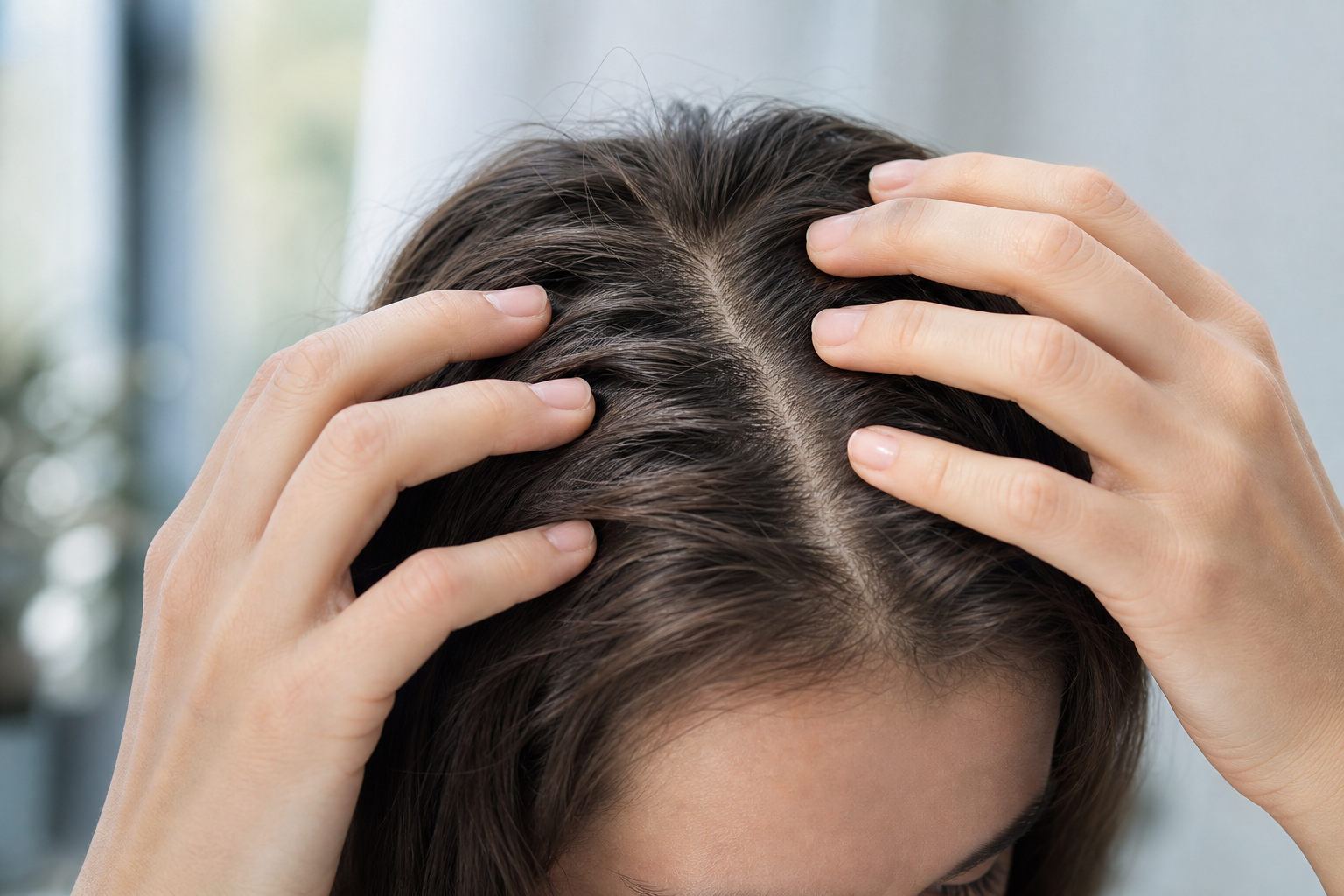
Quick answer: What is scalp inflammation?
Scalp inflammation is an irritated, inflamed scalp with redness, itching, burning, scaling, blisters, or weeping. The most common triggers are seborrheic dermatitis, folliculitis, psoriasis (psoriasis capitis), a contact allergy, or a fungal infection (tinea capitis).
- Most forms respond well to treatment. Any accompanying hair loss is then usually reversible (telogen effluvium) and often regrows starting around months 3–6.
- According to the medical literature, seborrheic dermatitis affects roughly 3–5% of the population; the scalp is involved at some point in about 80% of people with psoriasis (RKI, Hagenström et al. 2024).
- Warning signs to see a dermatologist: pus, pustules, pain, fever, spreading patches, bald or scarred areas, persistent hair loss, or no improvement after about two weeks of self-care.
An itchy, red, or painful scalp quickly becomes unsettling, especially when hair also starts collecting in your brush. This guide helps you figure out which condition might be behind your symptoms, whether it could cost you your hair for good, and what actually helps depending on the cause. It is not a substitute for a medical diagnosis; it helps you size up the situation.
Summary
- Recognizing scalp inflammation: typical symptoms
- Causes: the most common forms of scalp inflammation
- Special case, children: an inflamed scalp in babies and toddlers
- Scalp inflammation and hair loss: does the hair grow back?
- An inflamed scalp from care mistakes and external triggers
- What to do about scalp inflammation? Treatment by cause
- Home remedies for an inflamed scalp: what helps, what harms
- When to see a doctor? Warning signs of an inflamed scalp
- Proper scalp care and prevention
- Scalp inflammation or genetic hair loss: the right diagnosis
- Frequently asked questions about scalp inflammation
- Sources
Recognizing scalp inflammation: typical symptoms
Scalp inflammation usually shows up as a combination of several symptoms. According to DermNet, redness (erythema), scaling, itching, and sometimes pustules or localized hair loss are among the hallmark symptoms of inflammatory scalp conditions. Which signs dominate offers a first clue to the cause. Typical signs include:
- Redness (erythema) of the scalp, sometimes sharply, sometimes vaguely defined
- Itching, often the first and most distressing sign
- Burning or a feeling of tightness in the skin
- Scaling, either greasy and yellowish or dry and white
- Pustules or papules, sometimes centered around individual hairs
- Crusting or weeping with more severe inflammation
- Localized hair loss in the affected area
Inflamed scalp or just dry flakes?
An inflamed scalp differs from a merely dry scalp by the signs of inflammation: a purely dry scalp lacks redness, pustules, weeping, and pain. Fine, white, loose flakes without redness point more toward harmless dry dandruff (pityriasis simplex). Greasy, yellowish scales with clear redness, on the other hand, point more toward seborrheic dermatitis, according to DermNet.
Where is the inflammation? Location as a clue
Where the inflammation sits can make it easier to classify. Sharply defined, thick, silvery plaques that extend beyond the hairline point more toward psoriasis capitis, according to Springer Medizin. Vaguely defined, dull-red inflammation with greasy scaling points more toward seborrheic dermatitis. Individual pustules centered around a single hair fit better with folliculitis.
Important: mixed forms such as sebopsoriasis, an overlap of psoriasis and seborrheic dermatitis, do occur. A reliable self-diagnosis is therefore often not possible. With unclear or persistent symptoms, a dermatological exam gives the dependable answer, not a look in the mirror.
When the scalp itches and burns but there is nothing to see
Sometimes the scalp burns or hurts without any visible redness. Behind this can be trichodynia, an abnormal scalp sensation that often goes hand in hand with hair loss. In hair-loss clinics, it has been reported in up to 34% of patients. Muscular tension from stress and the neuropeptide substance P are discussed as possible contributing factors, though the evidence is considered inconclusive.
Causes: the most common forms of scalp inflammation
The causes of scalp inflammation range from harmless to conditions that need treatment. The most common are seborrheic dermatitis, folliculitis, psoriasis, contact dermatitis, and the fungal infection tinea capitis. The table below compares the typical forms at a glance, followed by a short rundown of each.
| Form / cause | Trigger / pathogen | Hallmark symptom | Itches / hurts | Treatment direction |
|---|---|---|---|---|
| Seborrheic dermatitis | Malassezia yeast, sebum | greasy yellowish scales, redness | itches | antifungal shampoo (ketoconazole, selenium sulfide, zinc pyrithione) |
| Folliculitis | bacteria (Staph. aureus) / Malassezia | pustules around individual hairs | hurts / itches | antiseptic, antibiotic if needed |
| Psoriasis capitis | autoimmune-inflammatory | thick silvery scales, sharply defined | itches | salicylic acid, topical steroids, vitamin D analogs |
| Contact dermatitis | hair dyes (PPD), products | redness / weeping after a new product | itches severely | avoid the trigger, short steroid course if needed |
| Atopic dermatitis (eczema) | atopic predisposition, impaired skin barrier | dry, reddened skin, fine scales | itches severely | emollient basic care, steroid if prescribed |
| Tinea capitis (fungus) | dermatophytes | bald, scaling, contagious patches | itches | oral antifungals (prescribed by a doctor) |
| Scarring forms (rare) | folliculitis decalvans, lichen planopilaris | pustules plus permanently bald, scarred areas | hurts | see a dermatologist urgently |
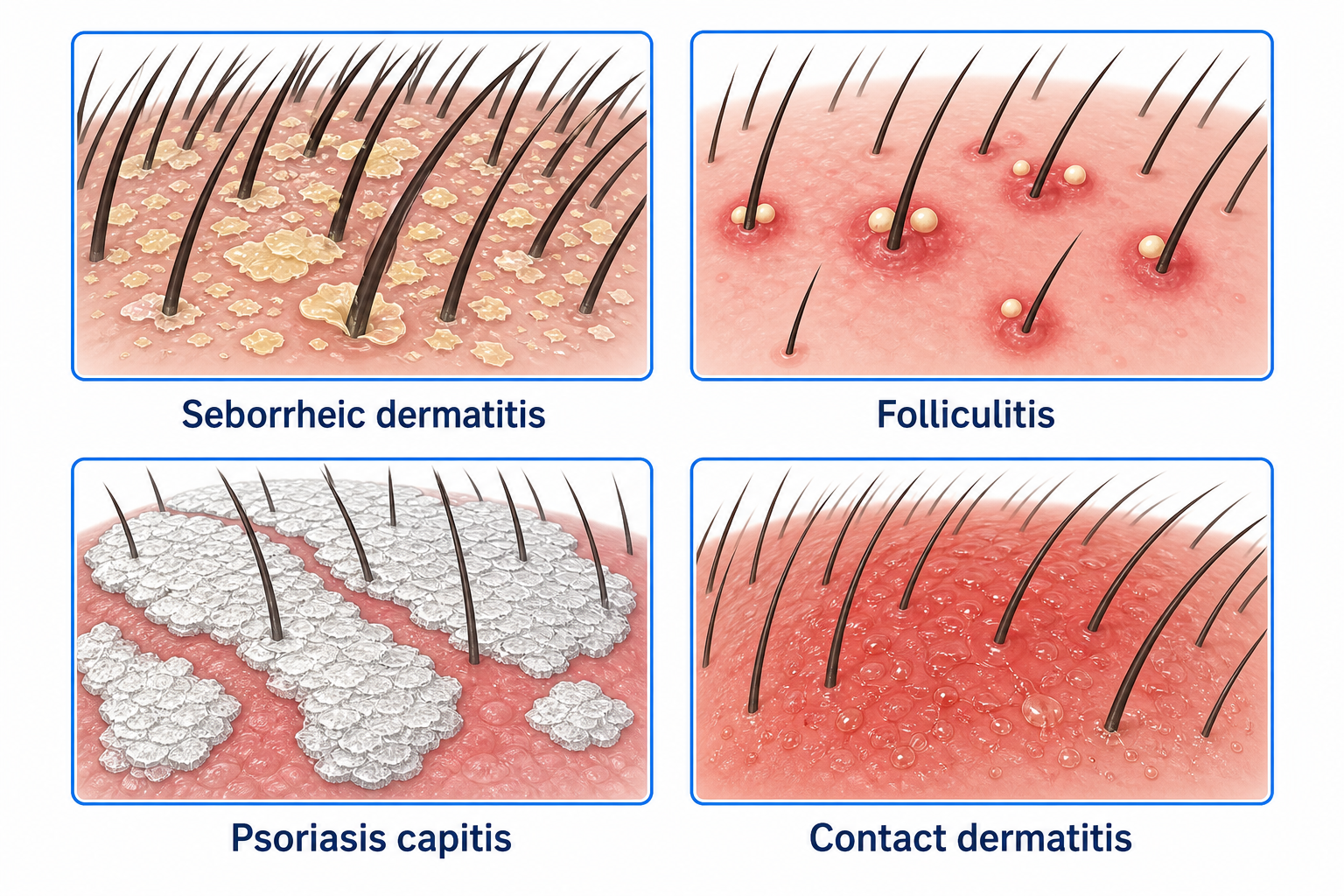
Seborrheic dermatitis: the most common scalp inflammation
Seborrheic dermatitis is the most common form of scalp inflammation and, according to the medical literature, affects about 3–5% of the general population, and up to 80% of people with HIV or Parkinson’s disease. Typical signs are greasy, yellowish scales, redness, and itching on oil-rich areas. The yeast Malassezia is considered an important contributing factor, but a clear causal link has not been conclusively established, according to PubMed.
The condition runs a chronic, relapsing course in flares and has two peaks: in infants during the first months of life (as cradle cap) and in adults between the ages of 30 and 70. It is not contagious. It is usually treated with antifungal shampoos, often followed by a less frequent maintenance therapy.
Hallmark symptom: greasy, yellowish scales with redness and itching on oil-rich areas. Key feature: chronic and relapsing, not contagious, with Malassezia yeast as a contributing factor. Standard treatment: antifungal shampoos (ketoconazole, selenium sulfide, zinc pyrithione), then a less frequent maintenance therapy.
Folliculitis: inflamed hair roots
Folliculitis is an inflammation of individual hair follicles that shows up as pustules centered around a hair. The most common pathogen, according to the Mayo Clinic, is Staphylococcus aureus, and less often the yeast Malassezia (pityrosporum folliculitis). Contributing factors include shaving, friction, hours of occlusion from hats or helmets, heavy sweating, and minor skin injuries.
According to the Mayo Clinic, mild folliculitis often clears within a few days without consequences using basic care. Only severe, recurring, or untreated cases can, in rare instances, lead to scarring and permanent hair loss. If you repeatedly get pustules after shaving, adjust your blade hygiene and shaving technique.
Hallmark symptom: individual pustules centered around a hair that hurt or itch. Key feature: encouraged by shaving, friction, occlusion, and sweating; usually harmless. Standard treatment: antiseptic cleansing, and antibiotics if a doctor identifies a bacterial cause.
Scalp psoriasis (psoriasis capitis)
Psoriasis capitis is an autoimmune-inflammatory psoriasis of the scalp with sharply defined, thick, silvery-white plaques that often extend beyond the hairline. In Germany, according to the RKI and Hagenström et al. (2024), roughly 2–2.5% of the population has psoriasis; the scalp is involved at some point in about 80% of cases, often as the first site.
Hair loss with scalp psoriasis is rare and usually reversible. According to the current S3 guideline (AWMF reg. no. 013-001, dated 08/2025), treatment includes salicylic acid to loosen scales, topical corticosteroids, and vitamin D3 analogs, among others. Studies show that adding salicylic acid improves the effect of topical steroids because it helps them penetrate.
Hallmark symptom: sharply defined, thick, silvery-white plaques, often extending beyond the hairline. Key feature: autoimmune-inflammatory, not contagious, with hair loss that is rare and usually reversible. Standard treatment: salicylic acid to loosen scales, topical corticosteroids, vitamin D3 analogs (per the S3 guideline).
Contact dermatitis and allergy: an inflamed scalp after dyeing
Contact dermatitis is an allergic or irritant scalp inflammation after contact with a trigger, often with intense itching and weeping. A common trigger is para-phenylenediamine (PPD) in hair dyes, one of the most significant contact allergens in Europe. Depending on the group studied, research puts the share of PPD-related contact eczema at over 30% in some cases.
PPD is not approved as a hair dye in Germany but reaches the market through imported products. If you develop an irritated scalp after a new color or a new care product, you should avoid the product. The AWMF S1 guideline on contact eczema (013-055) recommends an epicutaneous patch test at the dermatologist for clarification.
Hallmark symptom: intense itching, redness, and sometimes weeping after contact with a new product. Key feature: a common trigger is PPD in hair dyes; not contagious. Standard treatment: avoid the trigger, a short steroid course if prescribed, and clarification via an epicutaneous patch test.
Atopic dermatitis (eczema) of the scalp in adults
Atopic dermatitis (eczema) can affect the scalp in adults too, mainly showing up as dry, reddened skin with fine scales and often distressing itching. Unlike seborrheic dermatitis, the focus here is not greasy, yellowish scales but marked dryness and an impaired skin barrier on the basis of an atopic predisposition. Other areas of the body, such as the inner elbows or the backs of the knees, are often affected as well.
Telling them apart matters because the two forms call for different care: with atopic eczema, the priority is gentle, emollient basic care and avoiding irritants, not antifungal shampoos. With intense or persistent itching and a dry, inflamed scalp, a dermatological workup is worthwhile to pin down the right therapy.
Hallmark symptom: dry, reddened scalp with fine scales and intense itching. Key feature: atopic predisposition, impaired skin barrier, extreme dryness instead of greasy scaling, not contagious. Standard treatment: emollient basic care, avoiding irritants, and a topical steroid if prescribed.
Rare but serious forms: scarring scalp inflammation
Rare but not to be taken lightly are deep-follicular, scarring forms of scalp inflammation. These include folliculitis decalvans, lichen planopilaris along with its special form frontal fibrosing alopecia, and perifolliculitis capitis (dissecting cellulitis). In these primary scarring alopecias, the chronic inflammation permanently destroys the hair follicles, so no hair regrows in the affected areas.
That is exactly why early detection is crucial. According to the review articles by Kanti et al. (2018), persistent pustules together with enlarging, bald, shiny areas should be evaluated by a dermatologist promptly, often with a biopsy. If the inflammation is stopped early, further follicles can be protected. Other causes of an itchy scalp not covered in depth here include head lice or shingles of the scalp.
Hallmark symptom: persistent pustules together with enlarging, bald, shiny areas. Key feature: rare, but the follicle destruction is irreversible. Standard treatment: prompt dermatological workup, often with a biopsy, to stop the inflammation early.
Special case, children: an inflamed scalp in babies and toddlers
In babies and toddlers, an inflamed scalp often has different causes than in adults. In infancy, cradle cap and infantile atopic eczema (milk crust) dominate; in preschool and elementary-school age, the contagious fungal infection tinea capitis. Because children’s skin is more sensitive, extra caution applies here, and when in doubt, an early visit to the pediatrician.
Milk crust or cradle cap? An inflamed scalp in babies
In babies, two similar-looking forms are often confused. Cradle cap (infantile seborrhea) appears in the first weeks of life up to about the third month, shows yellowish, greasy, non-itchy scales, and usually clears up on its own. Milk crust, by contrast, is a form of atopic eczema, tends to start in the third to sixth month with itchy, hard crusts, and can point to a tendency toward atopic dermatitis.
As a rule of thumb: cradle cap is not a disease in the strict sense and does not itch, while milk crust is inflammatory and does itch. With extensive, weeping, or intensely itchy findings, the pediatrician should examine the baby rather than picking off crusts yourself.
Tinea capitis: the contagious fungal infection of the scalp
Tinea capitis is a fungal infection of the hairy scalp caused by dermatophytes and mainly affects children, with a peak between the ages of 3 and 7. According to Springer Medizin, the prevalence in children is about 5–15%, and a rising incidence is being reported in Germany. Typical signs are bald, scaling patches, often with broken hairs.
Tinea capitis is highly contagious, through direct skin contact and through shared items such as combs, brushes, hats, pillows, or towels, and sometimes through animals. So the rule is: do not share these things during an infection. According to the AWMF S1 guideline (013-033), it is always treated systemically with oral antifungals, supplemented by topical agents, under medical supervision.
Hallmark symptom: bald, scaling patches with broken hairs, especially in children. Key feature: highly contagious through contact and shared items. Standard treatment: always systemic oral antifungals plus topical agents, prescribed and monitored by a doctor.
Scalp inflammation and hair loss: does the hair grow back?
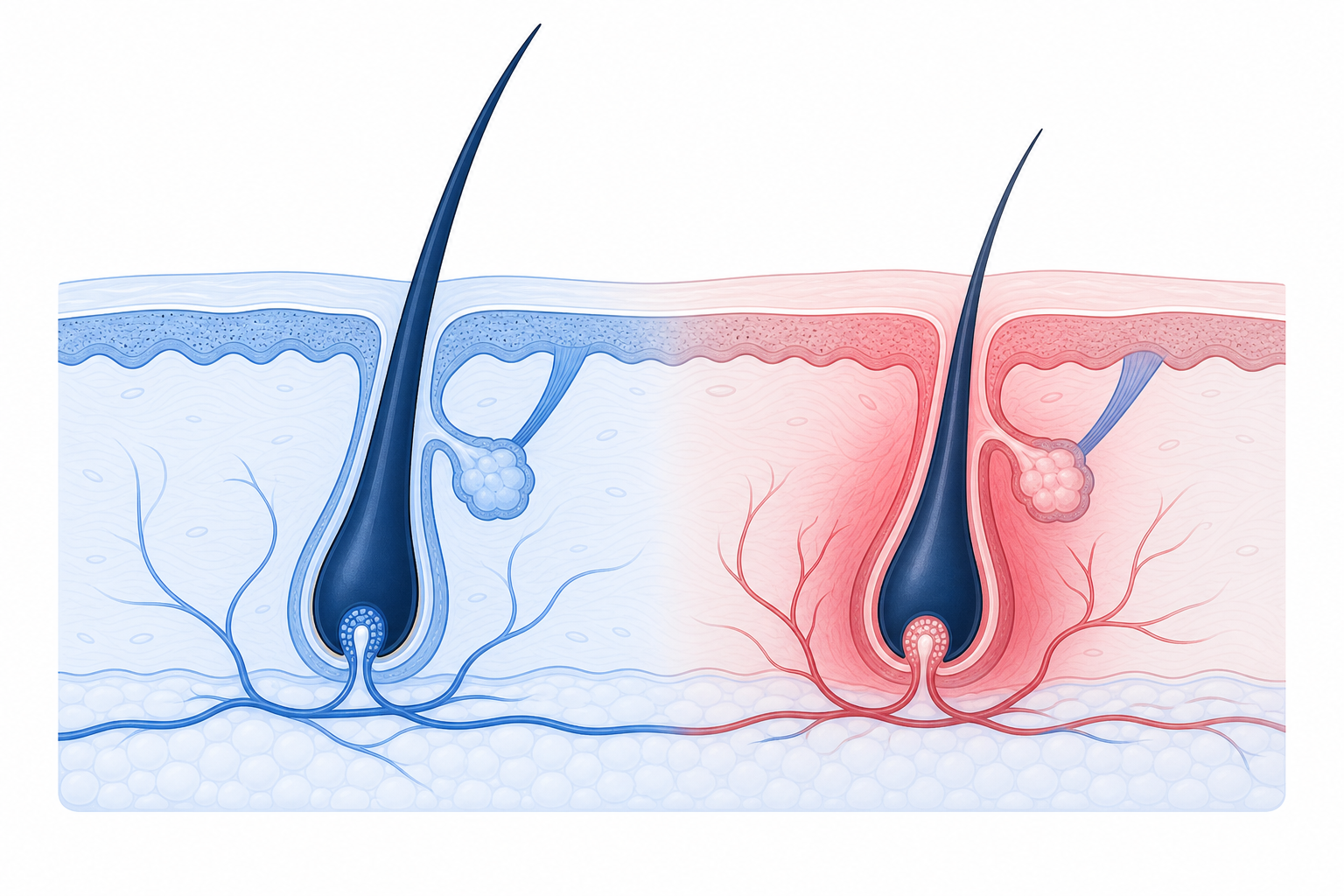
Hair loss from scalp inflammation is reversible in most cases. The inflammation pushes hair follicles prematurely into the resting phase, producing telogen effluvium, a diffuse hair loss without bald spots. Once the inflammation subsides, the follicles leave the resting phase again. According to the Cleveland Clinic, the first new hairs typically become visible after 3–6 months.
Because the resting phase (telogen) itself lasts about 2–4 months, the increased shedding often only appears two to three months after the inflammation itself. How the hair cycle switches between the growth and resting phases is explained in more detail in our article on the hair cycle. The key distinction is reversible versus scarring.
The timeline below applies to the reversible form after the inflammation has subsided. With the rare scarring forms, by contrast, no regrowth is possible in the destroyed areas because the follicles are lost. That is the heart of the assessment and the reason warning signs should be taken seriously.
| Time after subsiding | What happens in the follicle | What you notice |
|---|---|---|
| Months 0–3 | follicles leave the resting phase (telogen) | shedding may still continue |
| Months 3–6 | follicles enter the growth phase | first thin, new hairs visible |
| Months 6–12 | regrowth thickens | for most, 80–90% of hair volume returns |
| Months 12–18 | hair reaches normal length (about 1 cm/month) | density looks full again |
If you want to know in general how long hair growth takes, you’ll find details in our article on how fast hair grows. And if there may be more behind the loss than the inflammation, our overview of the causes of hair loss can help.
The Elithair Medical Team’s take
In practice, the common, easily treatable scalp inflammations can almost always be told apart from the rare scarring forms if you look early enough. What matters is not panic but a timely visit to the dermatologist as soon as bald or shiny, scarred areas appear. As long as the follicles are only resting, the hair loss is, as a rule, temporary.
An inflamed scalp from care mistakes and external triggers
Not every inflamed scalp is a disease. Common external triggers include harsh shampoos, hair dyes, too much heat, friction from headwear, sweat, sunburn, and stress. They irritate the skin barrier or worsen an existing inflammation. In most cases, simple adjustments go a long way here before medical treatment becomes necessary.
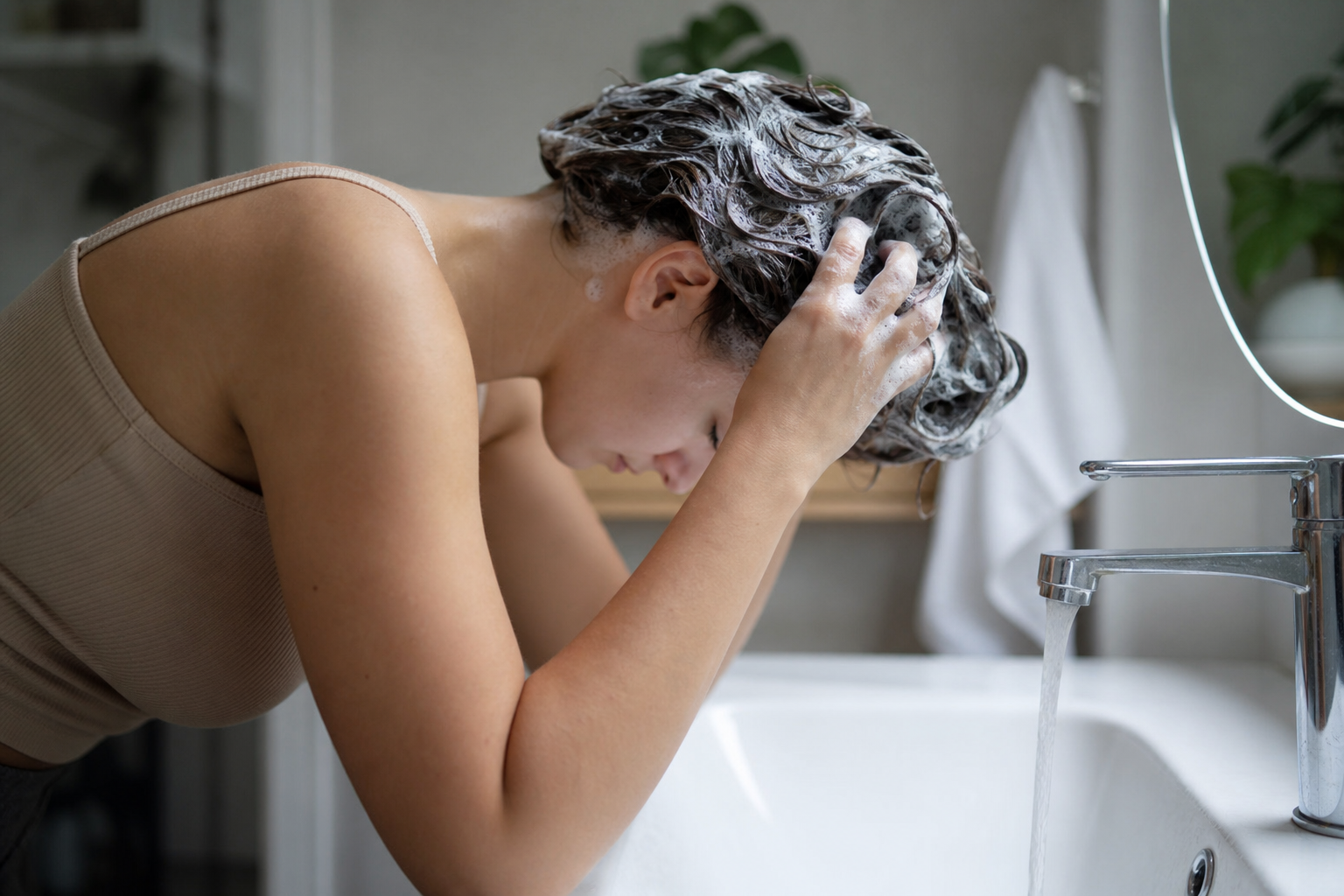
Harsh, sulfate-containing shampoos and frequent over-washing can disrupt the protective lipid film. The widespread belief that washing less often spares the scalp doesn’t hold up as a blanket statement: there is no sensor that throttles sebum production when you skip washing. The right washing frequency is individual and depends on your scalp type.
Hair dyeing can cause irritation through an allergy to dyes like PPD, so before any coloring, do a patch test at least 48 hours beforehand on unaffected skin. Heat from a blow dryer or flat iron dries the scalp out further. Tight hats or helmets worn for hours encourage occlusion and folliculitis. Stress can set off flares of psoriasis and seborrheic dermatitis but is rarely the sole cause.
What to do about scalp inflammation? Treatment by cause
What helps with scalp inflammation depends on the cause. For seborrheic dermatitis, antifungal shampoos take priority; for folliculitis, antiseptic to antibiotic measures; for psoriasis, salicylic acid and steroids; for a contact allergy, avoiding the trigger; and for tinea capitis, oral antifungals. There is no one-size-fits-all miracle shampoo for every form.
For seborrheic dermatitis, ketoconazole 2%, according to the body of evidence summarized in a Cureus review, produces improvement in about 89% of those treated, compared with 44% on placebo. A Cochrane review (Okokon et al. 2015) confirms that topical antifungals are effective overall. Alternatives are zinc pyrithione, selenium sulfide, or ciclopirox, often twice a week for about four weeks, then less often to prevent recurrence.
Cortisone preparations can be useful for inflammatory forms like psoriasis over the short to medium term and under medical supervision. The scalp is considered a relatively cortisone-resistant zone. With continued long-term use, however, the effect wears off (tachyphylaxis) while the risk of side effects remains. When cortisone is used for hair loss at all is explained in our article on glucocorticoids for hair loss.
Important warning: never apply cortisone blindly
Never apply cortisone on your own to an unclear, blistering, or pustular rash before a doctor has ruled out a fungal infection. With an unrecognized tinea, cortisone masks the clinical picture (tinea incognito), delays the correct diagnosis, and lets the fungus keep spreading in the meantime. This phenomenon has been documented in the medical literature for decades.
As a rule of thumb for self-medication: mild anti-dandruff and care shampoos are acceptable for mild symptoms. Prescription-only agents such as oral antifungals or cortisone solutions, on the other hand, belong in a doctor’s hands, including the choice and dosing. This is especially true for children, during pregnancy, and with unclear, spreading findings.
Home remedies for an inflamed scalp: what helps, what harms
Home remedies can help soothe an inflamed scalp as a supportive measure, but they are no substitute for a diagnosis with persistent or severe symptoms. Gentle, mild care such as aloe vera is considered low-irritant, though solid studies specifically on scalp inflammation are lacking. Harsh home recipes, on the other hand, further irritate the damaged skin barrier and can even trigger an allergy.
For acute itching, a simple physical trick helps: a cool, damp compress with a clean cotton cloth on the affected area. Cold dampens the itch sensation without chemically stressing the irritated skin, and it is far lower-risk than aggressive home remedies. The important thing is not to scratch, since scratching intensifies the inflammation and raises the risk of infection.
Special caution applies to tea tree oil. According to Germany’s Federal Institute for Risk Assessment (BfR), undiluted tea tree oil carries a high risk of irritation and allergy, especially once it has oxidized with age. In a multicenter study, about 3% of participants showed sensitization. Lemon and undiluted apple cider vinegar additionally disrupt the pH. Coconut oil can clog pores on an oily scalp, so use it sparingly.
What helps (do)
- use mild, low-sulfate shampoos
- wash with lukewarm water instead of hot
- rinse thoroughly
- pat the scalp dry instead of rubbing
- a cool compress with a cotton cloth for acute itching
- test hair dyes before use
- reduce stress
What makes it worse (don’t)
- hot water and hot blow-drying
- harsh scrubs and alcohol-based tonics
- scratching
- undiluted tea tree oil, lemon, or vinegar
- wearing tight hats for hours
- untested hair dyes
When to see a doctor? Warning signs of an inflamed scalp
You should see a dermatologist for an inflamed scalp when warning signs appear: pus or pustules, pain, fever, spreading patches, bald or scarred areas, persistent hair loss, or no improvement after about two weeks of self-care. Recurring symptoms should also be evaluated. The self-check below helps you assess the situation but is no substitute for a medical diagnosis.
Green · self-care 1–2 weeks
mild itching, fine scales, no pain, no hair loss
Yellow · make a doctor’s appointment
no improvement after 2 weeks, recurring, thick scales, symptoms after a new product
Red · see a dermatologist promptly
pus, pustules, pain, fever, spreading, bald or scarred areas, visible hair loss, children with bald scaling patches
This decision aid is no substitute for a medical diagnosis.
Two groups deserve special attention. Children with scaling, bald patches should be examined promptly because of contagious tinea capitis. During pregnancy, active ingredients should not be chosen on your own but coordinated with your OB-GYN and dermatologist. Persistent burning without a visible finding should also be evaluated after a few weeks.
Proper scalp care and prevention
A scalp prone to inflammation needs gentle care: low-sulfate cleansing, lukewarm rather than hot water, thorough rinsing, and patting dry instead of rubbing. Cut back on heat from blow dryers and flat irons, and avoid hours of occlusion from tight headwear. These basics noticeably lower the risk of irritation and flare-ups.
Because seborrheic dermatitis runs a chronic, relapsing course, maintenance to prevent recurrence makes sense after it clears, for example anti-dandruff shampoos with ketoconazole or zinc pyrithione at a reduced frequency. If you have a known tendency toward contact allergies, a patch test at least 48 hours beforehand on unaffected skin is recommended before every new dye or care product.
Scalp inflammation or genetic hair loss: the right diagnosis
Not every case of hair loss with an irritated scalp is inflammation-related. Inflammatory, diffuse hair loss affects the whole head, comes with redness or itching, and is usually reversible. Genetic (androgenetic) hair loss, by contrast, shows a pattern with a receding hairline or a thinning part, without signs of inflammation. Both can occur at the same time, which makes self-assessment harder.
If hair loss persists after a scalp inflammation has subsided, a hair analysis can help gauge whether the follicles are only resting (reversible) or whether scarred areas are already present. This analysis is a visual pattern assessment and is no substitute for a medical blood test or a dermatological exam. With diffuse loss, it’s also worth looking at possible causes, as in our article on blood tests for hair loss.
Important context: a hair transplant is off the table during active scalp inflammation. It is only an option after complete healing, a resting period, and medical clearance, and only for genuinely scarred areas. The analysis here serves as a first visual orientation and assessment of the hair situation, but it is no substitute for a medical diagnosis and is not a solution for the inflammation itself. Women with diffuse thinning will find additional information in our article on hair loss in women.
Frequently asked questions about scalp inflammation
Is scalp inflammation contagious?
Whether scalp inflammation is contagious depends on the cause. The main contagious ones are the fungal infection tinea capitis and, in part, a bacterial folliculitis with close skin or object contact. Seborrheic dermatitis, psoriasis, and contact eczema, by contrast, are not contagious.
How long does it take for an inflamed scalp to heal?
How long an inflamed scalp takes to heal is highly variable and depends on the cause. A mild folliculitis often clears within a few days. Seborrheic dermatitis runs a chronic, relapsing course and usually improves under treatment within 2–4 weeks. Tinea capitis requires several weeks of medically supervised therapy until the pathogen is no longer detectable.
Which shampoo helps with an inflamed scalp?
Which shampoo helps with an inflamed scalp depends on the cause. For seborrheic dermatitis, antifungal shampoos with ketoconazole, zinc pyrithione, selenium sulfide, or ciclopirox help. For a contact allergy or irritation from care mistakes, on the other hand, a mild, fragrance-free basic shampoo (for example with urea or panthenol) makes more sense than a strong antifungal. There is no single shampoo for every cause. If the cause is unclear, the dermatologist determines what fits.
Does hair grow back after scalp inflammation?
After scalp inflammation, hair grows back with the common, reversible form (telogen effluvium). According to the Cleveland Clinic, the first new hairs are usually visible after 3–6 months, and full density often after 12–18 months. With rare scarring forms, no hair regrows in the destroyed areas.
Can scalp inflammation cause permanent bald spots?
Scalp inflammation can cause permanent bald spots, but only with rare, deep-follicular, scarring forms such as folliculitis decalvans, lichen planopilaris, or perifolliculitis capitis, as well as with severe, untreated folliculitis. That is exactly why bald or scarred areas should be evaluated by a dermatologist early.
What quickly helps an itchy, inflamed scalp?
What quickly helps an itchy, inflamed scalp is a cool, damp compress with a cotton cloth, mild care, and not scratching, which intensifies the inflammation. Avoid harsh home remedies. With intense or persistent itching, a medical workup makes more sense than self-treatment with irritating agents.
Scalp inflammation from hair dyeing, what to do?
With scalp inflammation from hair dyeing, you should avoid dyeing, especially with a known or suspected contact allergy to dyes like PPD, and consider an epicutaneous patch test at the dermatologist. Before any coloring, a patch test at least 48 hours beforehand on unaffected skin is recommended.
When do I need to see a doctor for an inflamed scalp?
You should see a doctor promptly for an inflamed scalp with pus, pustules, pain, fever, spreading patches, bald or scarred areas, persistent hair loss, or if there is no improvement after about two weeks of self-care. For children with bald scaling patches, get it evaluated quickly as well.
Can I wash and dye my hair with scalp inflammation?
With scalp inflammation, washing your hair with mild, recommended products is usually possible and sensible. Dyeing during an active inflammation, on the other hand, is generally not advised until the scalp has healed. When in doubt, check with your dermatologist.
Sources
- DermNet NZ: Diagnosis of scalp rashes. dermnetnz.org
- AWMF S3 guideline for the treatment of psoriasis vulgaris, reg. no. 013-001, dated 08/2025. register.awmf.org
- AWMF S1 guideline on tinea capitis, reg. no. 013-033, dated 02/2026. register.awmf.org
- Okokon EO et al.: Topical antifungals for seborrhoeic dermatitis, Cochrane Review CD008138 (2015). cochrane.org
- RKI health reporting, issue 11 on psoriasis. edoc.rki.de
- Cleveland Clinic: Telogen Effluvium. clevelandclinic.org
- Ketoconazole Shampoo for Seborrheic Dermatitis of the Scalp: A Narrative Review (PMC). pmc.ncbi.nlm.nih.gov
- German Federal Institute for Risk Assessment (BfR): Use of undiluted tea tree oil as a cosmetic product. bfr.bund.de
- Kanti V et al.: Scarring alopecias, JDDG 2018. pubmed.ncbi.nlm.nih.gov
Medically reviewed, as of 2026. This article is for information and is no substitute for a medical diagnosis or treatment. For persistent, painful, or spreading symptoms, please consult a dermatologist.
Dr. Imad Moustafa
Hair transplant specialist