

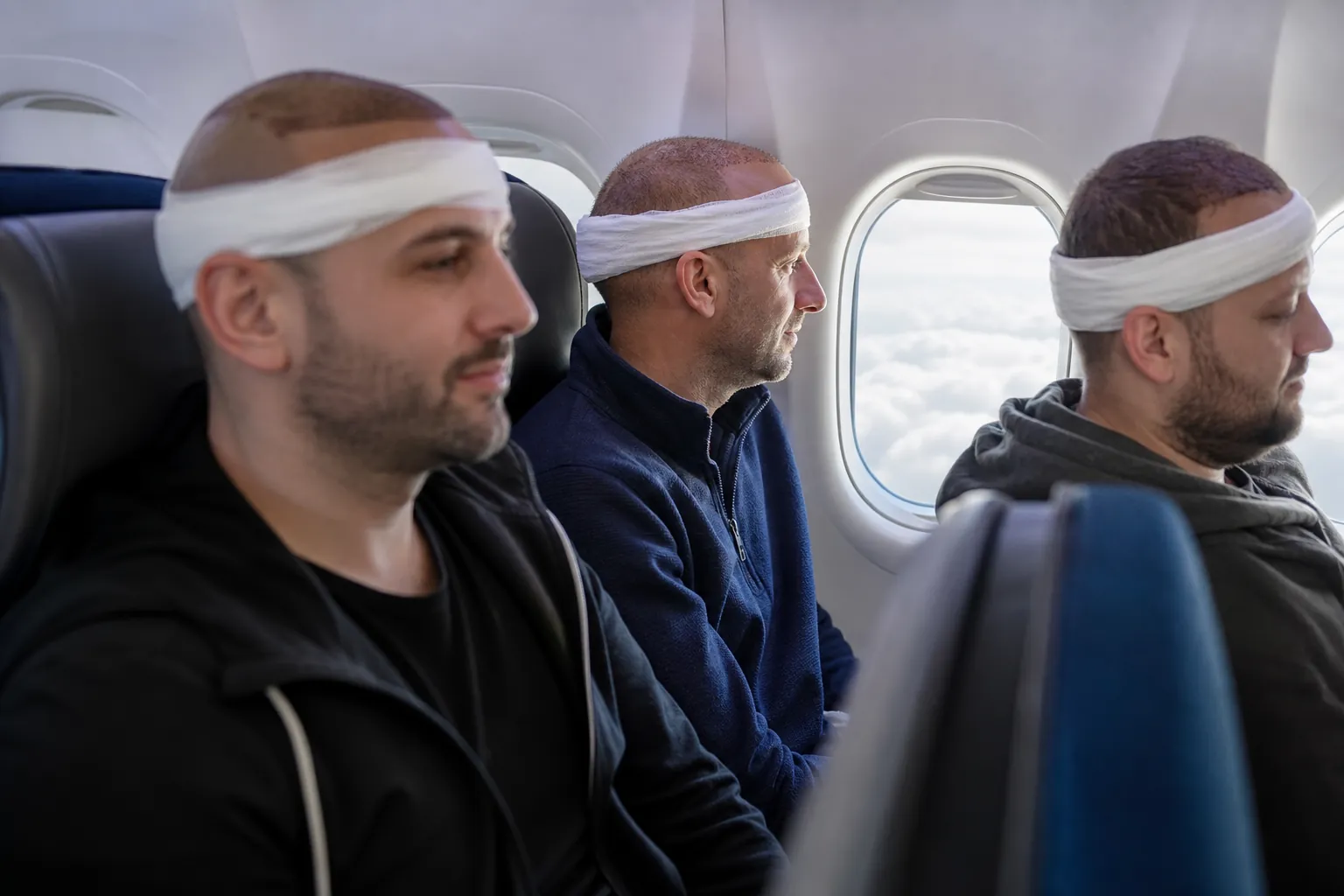
“Turkish Hairlines” is a play on words combining “Turkish Airlines” and “hairline”, and it refers to a hair transplant in Turkey, almost always in Istanbul, because a striking number of men fly home from there wearing a headband. Behind it lies a real market: according to the review by Haider et al. (2025) in the journal Aesthetic Plastic Surgery, Turkey is the centre of global hair transplant tourism, with an estimated volume of around one billion US dollars a year. This article explains the term, states the price and what is included at Elithair, walks through the procedure step by step, and gives you a framework for vetting any clinic.
The key points at a glance
- ✓“Turkish Hairlines” is internet slang built from “Turkish Airlines” and “hairline”, and it stands for having a hair transplant in Istanbul, not for a technique or a travel package
- ✓At Elithair, the package price ranges from £2,849 to £3,449 depending on the number of grafts, with DHI and the Pre-Test System included; the flight and the no-shave treatment cost extra
- ✓The result is decided by the doctor’s planning of the hairline and the donor area, not by the destination
- ✓You can recognise a vetted clinic by verifiable licensing, clear medical responsibility, and a written scope of services with no surcharges added on site
The table of contents shows where to find what. After that, we go through the term, the price, the hairline, the donor area, the procedure, aftercare, choosing a clinic, and corrective work, in that order.
Summary
- What does “Turkish Hairlines” mean?
- Why so many people fly to Turkey for their hair
- Turkish Hairlines price: what a hair transplant in Istanbul costs
- The hairline decides: what is behind “hairline”
- Donor area: why the back of the head decides the final result
- The on-site examination: why measurements decide the result
- FUE and DHI: two steps, not alternatives
- The procedure: from arrival to the return flight
- Aftercare from 1,550 miles away
- How to recognise a vetted clinic in Turkey
- Can a “Turkish hairline” be corrected?
- Who “Turkish Hairlines” is right for, and who it is not
- Frequently asked questions about “Turkish Hairlines”
What does “Turkish Hairlines” mean?
“Turkish Hairlines” is a colloquial play on “Turkish Airlines” and the English word “hairline”. It refers to having a hair transplant in Turkey, usually in Istanbul. The expression describes neither a clinic nor a surgical technique nor a bookable flight or travel package.
The term spread through social media and press coverage. On some days, return flights from Istanbul carry several men sitting side by side in headbands, each with a freshly treated back of the head, and that image is exactly what gave the phenomenon its nickname. There is no single, datable moment of coinage.
Elithair is one of these Istanbul clinics. That is why this article does not explain the process in the abstract, but through a concrete approach: what actually happens before, during, and after the procedure. Everything that concerns our own practice is marked in the text as a company statement and kept separate from the professional sources.
Why so many people fly to Turkey for their hair
So many people fly to Turkey for their hair because Istanbul is the centre of a highly specialised market and the same treatment costs considerably less there than in the UK. The review by Haider et al. (2025, Aesthetic Plastic Surgery) puts global hair transplant tourism at around one billion US dollars a year and names Turkey, and Istanbul in particular, as the epicentre.
The authors explicitly name two drivers: significantly lower costs and attractive all-inclusive packages. A substantial part of the cost difference is structural and comes down to staffing, rent, and operating costs. That is not a quality guarantee for the market as a whole, though: how much effort and material actually go into a price can only be checked at the specific clinic, and that is exactly what the questions further down are for. Based on our own market observation, a comparable procedure in the UK typically costs between £3,500 and £8,000, which works out to roughly £2 to £4 per graft.
The same paper warns in the same breath about aggressive digital marketing, about technicians working unsupervised, about “bait and switch” practices, and about a market described as a “data black hole” because reliable complication data is missing. At the same time, it notes that individual centres deliver effective treatments and high growth rates.
One thing to keep in mind: this is a narrative review and not an original cohort study, so the level of evidence is not high. The sober conclusion is still clear: a country’s price level says nothing about who does good work. That is precisely why there is a checklist further down that lets you vet any clinic yourself.
Turkish Hairlines price: what a hair transplant in Istanbul costs
The price for “Turkish Hairlines” at Elithair ranges from £2,849 to £3,449, tiered by the number of grafts (company information, prices as of 10 August 2026). Up to 2,000 grafts it is £2,849; at 5,000 grafts and above it is £3,449. It is billed as a package rather than per graft, and the amount covers the treatment, accommodation, transfers, and aftercare.
Two points belong on the table, because they come up constantly in consultations. The flight is not included; depending on the route and timing, a return flight costs around £70 to £150. And the no-shave treatment carries a £450 surcharge (as of 7 September 2026). DHI implantation, on the other hand, is standard with us and included in the package; it is not a paid upgrade.
If we see on the day of treatment that a better result is possible with more grafts, we discuss that with you beforehand. Each additional 500 grafts then adds a flat surcharge, agreed with you in advance. If fewer grafts are needed than planned, the price drops accordingly. For a full overview of what a hair transplant costs, see our price page.
| Service | What you get from it | Included in the package |
|---|---|---|
| DHI implantation with the CHOI pen | The graft is placed in a single step, without a separate channel being opened first. Angle and depth stay controllable graft by graft. | Yes, included |
| Patented NEO FUE | A plant-based stem cell serum that you apply to your scalp yourself for seven days before the trip and again the day before. The set is sent to your home in advance. | Yes, included |
| Sleep-Deep sedation | About 15 minutes of twilight sleep while the local anaesthetic is administered. Monitored by a specialist anaesthetist. | Yes, included |
| Pre-Test System with six analyses | A blood panel plus Doppler, scalp, depth, structure, and donor area analyses produce your treatment plan instead of an estimate. | Yes, included |
| Three nights at the Elitoria Hotel | A luxury hotel near the clinic with its own medical wing, so distances are short on the day of surgery and on the check-up day. | Yes, included |
| VIP airport transfer | Collection from the airport and every journey between the hotel and the clinic, about 30 minutes each way. | Yes, included |
| One PRP treatment | Platelet-rich plasma therapy from your own blood to support the scalp after the procedure. | Yes, included once |
| Care package and medication | Special shampoo, lotion, and the prescribed medication for the first ten days. | Yes, included |
| Follow-up examination the next day | A medical check before your return flight, plus guidance on aftercare. On this day, the hair is deliberately not washed. | Yes, included |
| Aftercare through the Elithair app | Twelve months of uploading photos, asking questions, and getting feedback, all from home. | Yes, included |
| No-shave treatment (Zero Shave) | The recipient area stays unshaved, which is often possible with smaller numbers of grafts. For anyone who has to face people again as soon as they get home. | No, £450 surcharge |
| Flight to Istanbul | You book it yourself, so you stay flexible on dates and departure airport. | No, around £70 to £150 for a return flight, depending on route and timing |
According to Haider et al. (2025), this cost advantage is the main reason people travel to Istanbul, and at the same time the point where dubious providers get a foot in the door. A low entry price that is renegotiated on site is the pattern the professional literature describes as “bait and switch”. That is why a written scope of services before booking matters more than any discount campaign.
The hairline decides: what is behind “hairline”
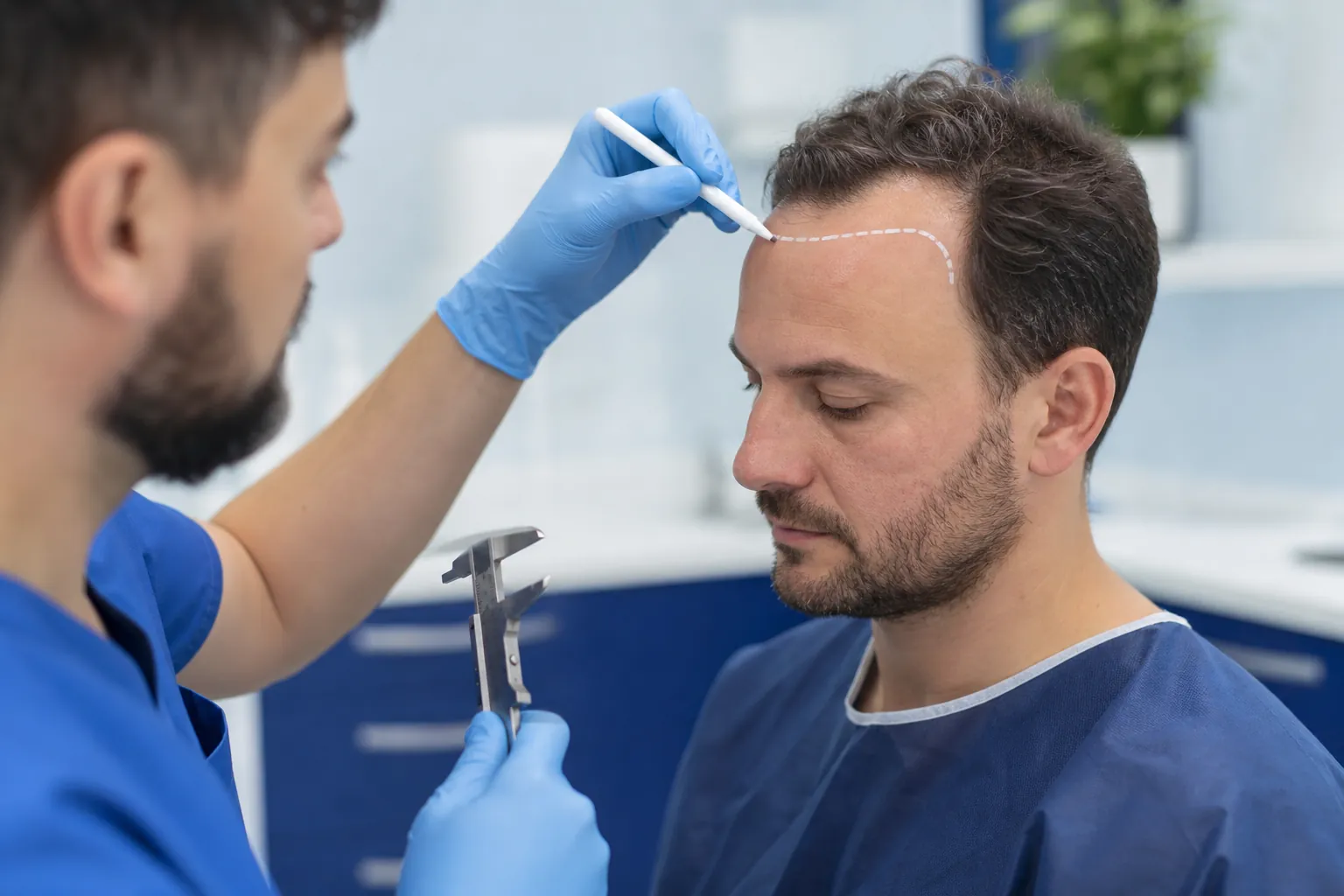
Whether a hair transplant looks natural is decided by the hairline, not by the number of grafts. At Elithair, the doctor plans it 100 per cent: forehead height, facial proportions, the course of the transition zone, the exit angle of the hairs, and a deliberately irregular single-hair front. Depending on the zone, the implantation angle is between 15 and 35 degrees.
That hairline design is a doctor’s task is settled professionally as well. In its position statement on qualifications for scalp surgery (as of 13 July 2024), the International Society of Hair Restoration Surgery (ISHRS) explicitly counts preoperative diagnostics, surgical planning, extraction, preparation of the recipient sites, aftercare, and indeed hairline design among the tasks reserved for doctors. The same statement treats instruments, including robot-assisted ones, as “extensions of the hand of the operator”.
Online, the expression “turkish hairline” often stands for something else: a very low, ruler-straight, conspicuously dense line. There is no independent professional source documenting this as a phenomenon; the description comes from forums and comparison sites. It still works as a cautionary example, because a ruler-straight edge is exactly what makes a result look done years later.
The opposite principles are professionally established: a soft curve at the temples instead of a straight edge, single-hair grafts right at the front and stronger grafts behind them, plus an irregular contour. A line that looks good at 20 can look wrong at 45, because it does not age along with the face. Planning it with the coming decades in mind also uses up less donor hair along the way.
In practice, here is how it works with us: the doctor draws the line before the procedure, you see and discuss it in the mirror, and only then is it approved. No step happens without medical sign-off. You can see how different such lines turn out depending on the face and the starting point in our patient results.
Donor area: why the back of the head decides the final result
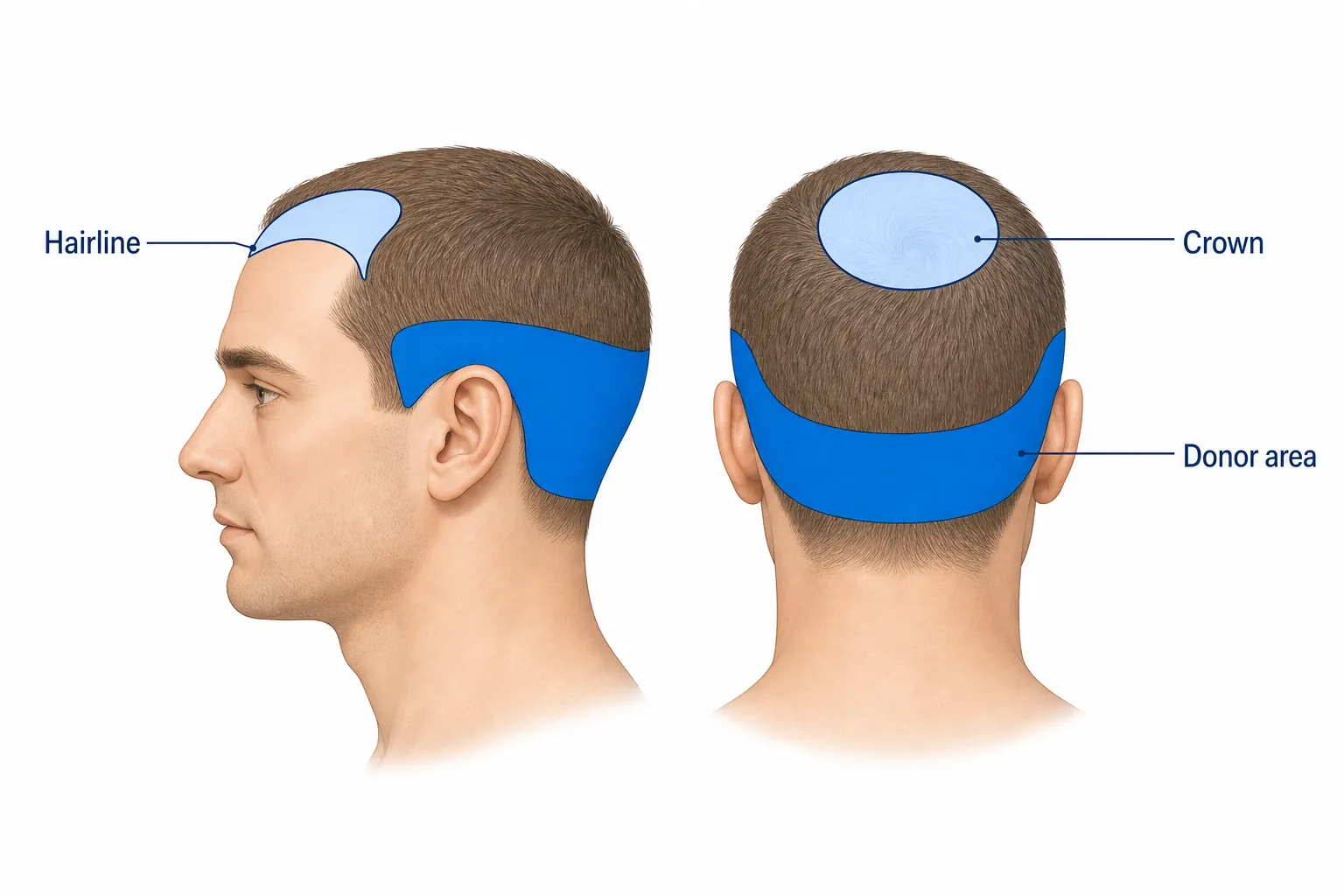
The donor area at the back of the head and above the ears is the resource that every result draws on. For genetic reasons it is largely insensitive to DHT, although that does not apply to the same extent in everyone and depends on the individual case. Above all, it is limited and does not grow back.
That leads to a priority order: the hairline gets single-hair grafts for the soft transition, and behind it, grafts with two to four hairs provide density. On average, a graft contains 2.2 hairs. How many grafts a zone realistically needs depends on the pattern. For receding temples together with the hairline, we allow for 2,000 to 3,500 grafts; rough figures for the other zones are in our article on how many grafts are possible.
Hardly anyone asks the most important question before booking: what happens if I am still losing hair ten years from now? Anyone who has the maximum extracted in the first procedure looks denser in the short term and has nothing left for a second session. And a donor area thinned out too far becomes visible in its own right. That is why the assessment of the donor area in the Pre-Test determines how much is extracted and what stays in place as a reserve.
The on-site examination: why measurements decide the result
The on-site examination determines whether a treatment plan is measured or estimated. Hairline, insertion depth, and graft distribution can only be set once the scalp, blood flow, hair structure, and follicle depth are known. How many examinations a clinic schedules for this, and which decision follows from each one, is therefore one of the questions to ask before booking.
Before every treatment, Elithair runs six analyses that produce your individual treatment plan: blood panel, blood circulation by Doppler, scalp analysis, graft depth by ultrasound, hair structure by TrichoLAB, and the assessment of the donor area. This is not a box-ticking check-up. Each measurement steers a concrete decision on the day of treatment, from insertion depth and angle to the distribution of grafts across the zones.
The blood panel has a clearly limited job. It exists for the medical clearance and for assessing contraindications, such as abnormal values that could jeopardise growth or point to another cause of the hair loss. It does not replace a full internal medicine workup. If there is any sign of another cause, a transplant is not the first step; clarifying the cause is.
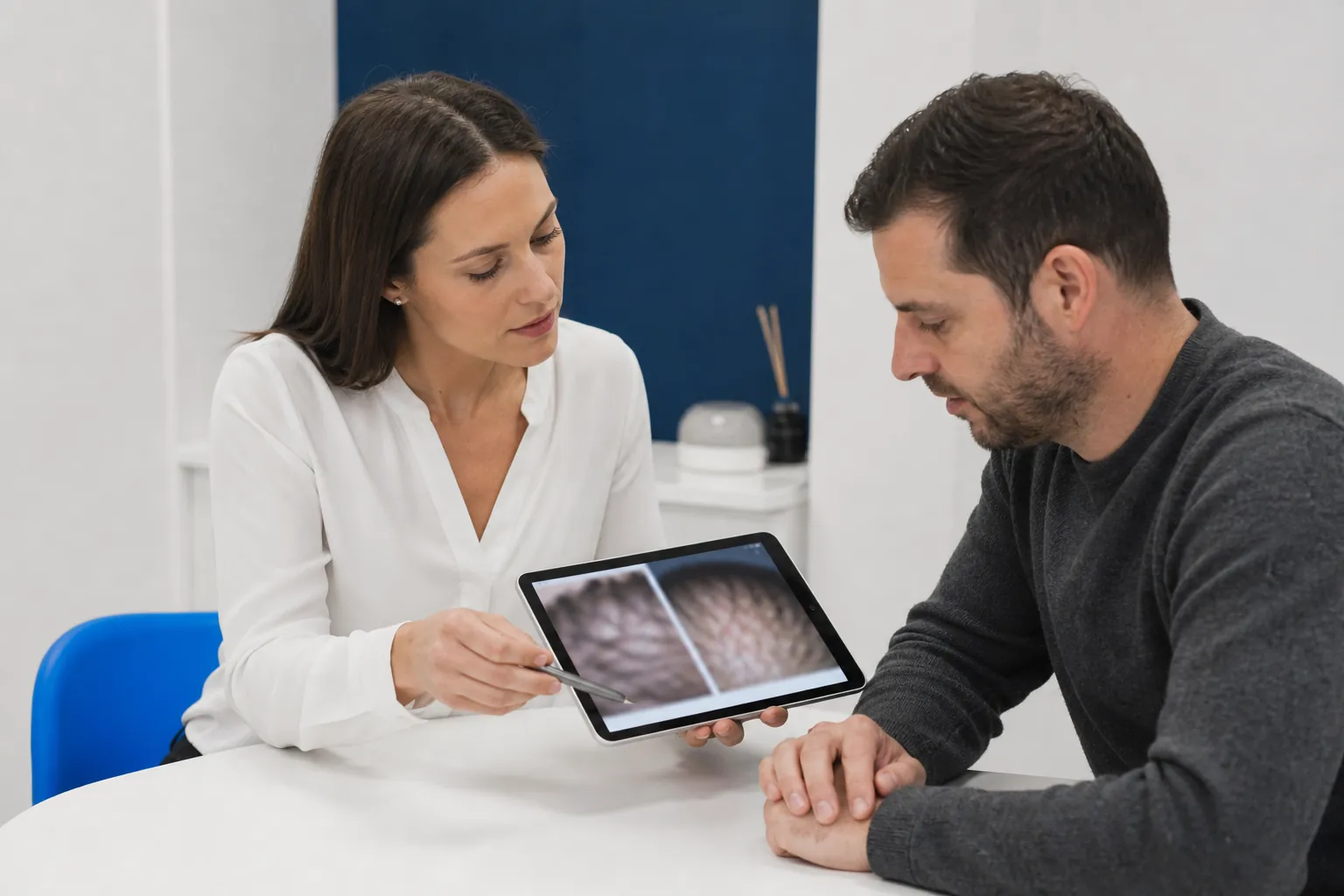
The distinction one step earlier matters too: the free hair analysis based on your photos is an initial assessment that lets you discuss the pattern, the rough number of grafts, and feasibility. It is not diagnostics. Measuring happens on site. More on how it works is on the page about the Pre-Test System.
Our figure for the growth rate is approximately 98 per cent. That is a company statement from our own evaluation, not the result of an independent study, and not proof that the calculated insertion depth causes that figure. There is no methodologically verified comparison with and without individual planning. No promise about your own outcome can be derived from it.
| Analysis | What is measured | Which decision follows from it |
|---|---|---|
| Blood panel | Blood values that could make a procedure inadvisable, such as clotting values, signs of inflammation, or abnormal nutrient levels. | Medical clearance or postponement. Abnormal values are an indication that the cause of the hair loss should be clarified first. |
| Blood circulation (Doppler) | Blood flow in the recipient zone. | How densely grafts can be placed in a zone without jeopardising their blood supply. |
| Scalp analysis | Condition, elasticity, and resilience of the scalp. | Whether and how much the scalp may be stressed in a single session. |
| Graft depth (ultrasound) | The depth at which the follicles sit in the scalp. | The insertion depth for each zone, instead of a single rule-of-thumb value for every patient. |
| Hair structure (TrichoLAB) | Density, hair calibre, and the number of hairs per graft. | How many grafts are needed for the look you want and where single-hair grafts belong. |
| Assessment of the donor area | Available density at the back of the head and above the ears. | The graft budget for this session and the reserve that stays in place for a later procedure. |
FUE and DHI: two steps, not alternatives
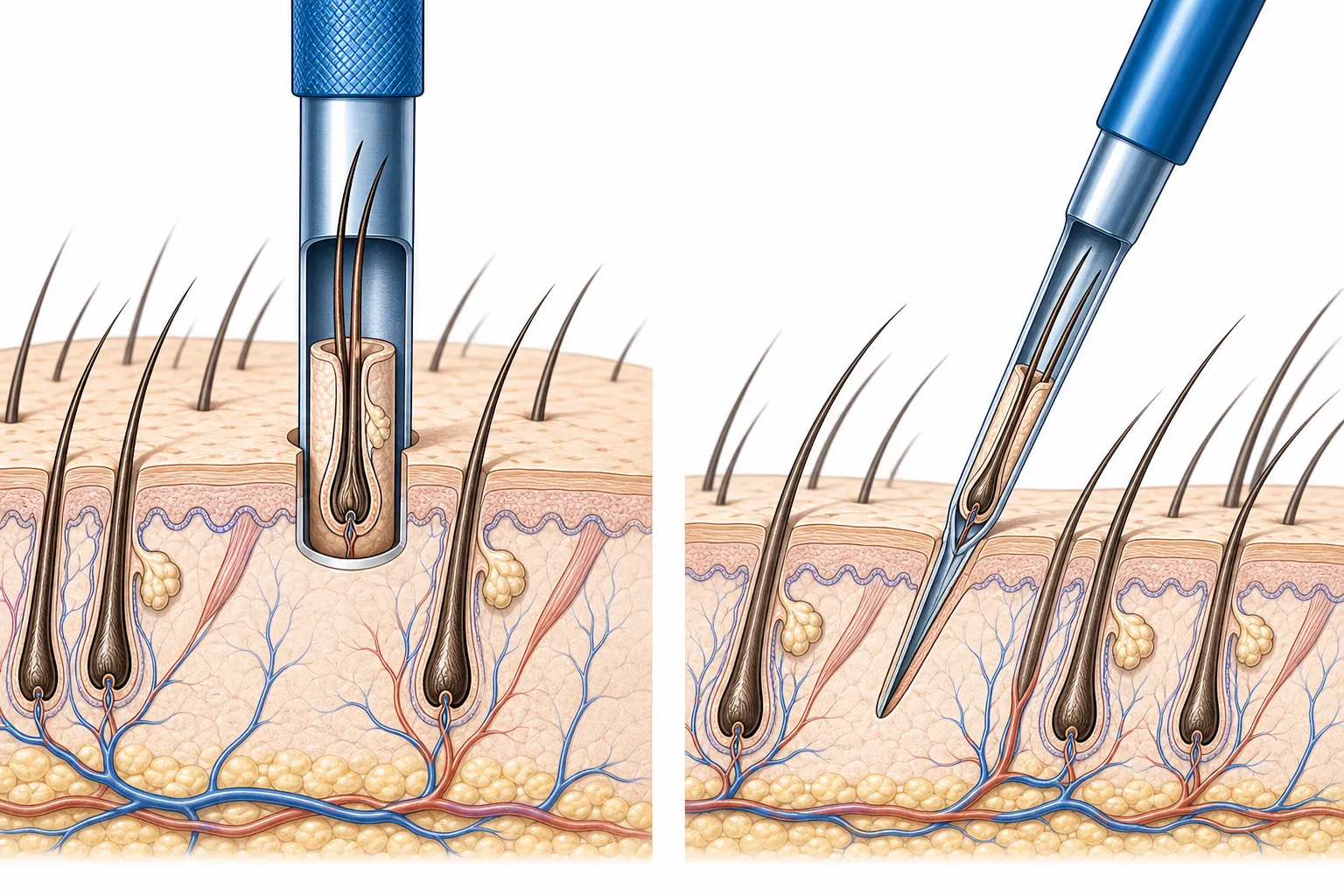
FUE and DHI are not competing methods but two steps of the same procedure. FUE refers to extracting the grafts from the donor area, DHI to placing them with the CHOI pen, where opening the channel and implanting happen in a single step. At Elithair, both are used together; DHI is standard and included in the price.
Before that comes the preparation with Patented NEO FUE. The plant-based stem cell serum is sent to your home before the trip, and you apply it to your scalp yourself for seven days and once more the day before. So the order is: preparation at home, FUE extraction, DHI implantation.
Who is allowed to carry out which step is regulated in Turkey. Under Article 9 of the Regulation on Hair Transplant Units (Official Gazette of 6 May 2023, last amended on 12 September 2025), opening the channels is reserved for certified doctors and specialists. Certified assistants may take on the extraction and placement of the follicles, exclusively under the supervision and responsibility of one of these doctors. A certified doctor may be responsible for a maximum of five treatment rooms at the same time.
The procedure: from arrival to the return flight
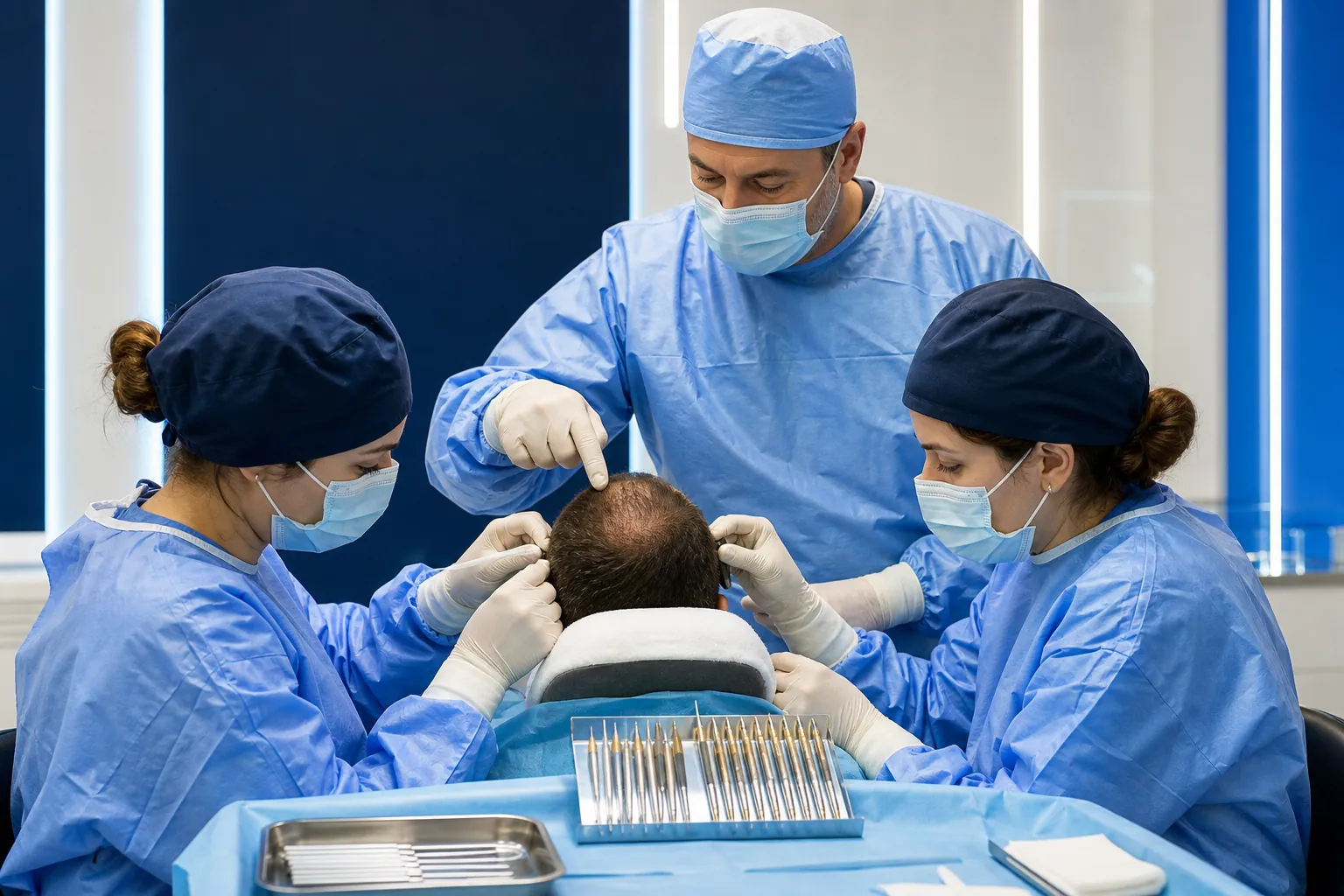
For “Turkish Hairlines” you need two to three days on site. The procedure itself is one single long day. The American Academy of Dermatology gives four to eight hours as a general guide for a hair transplant. With us, the entire treatment day, including preliminary examinations, planning, breaks, and the final check, usually takes longer, on average more than ten hours per patient. So set the whole day aside. The medical follow-up examination takes place the next day, after which you can fly home.
On the day of treatment, the Pre-Test analyses come first, then the doctor draws the hairline and approves it after discussing it with you. Informed consent along with photo documentation of the donor and recipient areas is mandatory in Turkey (Article 10 of the Regulation on Hair Transplant Units), as is treating only one patient at a time in any given treatment room.
Does a hair transplant hurt?
What you feel most is the local anaesthetic being administered, meaning the injections at the beginning. That is exactly what Sleep-Deep sedation is there for: about 15 minutes of twilight sleep. It is monitored by a specialist anaesthetist who, during that time, does nothing other than keep an eye on your circulation and breathing. With sedation, their presence is mandatory in Turkey anyway (Article 9, paragraph 5).
During extraction and implantation, the area is numb. The AAD describes the procedure as one in which patients stay awake and the scalp is anaesthetised. So realistically: nearly pain-free, a feeling of pressure can remain, and after such a long day you are mainly tired. Sleep-Deep sedation is twilight sleep and not deep sleep, and pain-free in the literal sense would be promising too much.
The second most common concern in our consultations is not pain but visibility at work. The honest answer: on days 1 to 3, crusts form, along with redness and slight swelling. If you follow our instructions, office work is usually possible again after two to three days, and redness normally subsides within 7 to 14 days. The procedure is not invisible during that time.
| Phase | What happens medically and who is responsible | What that means for you |
|---|---|---|
| Before the trip | Online initial assessment by the consulting team based on your photos and details, followed by dispatch of the Patented NEO FUE set. | You apply the serum to your scalp yourself for seven days and again the day before. The initial assessment is a preliminary review, not a diagnosis. |
| Day 0: arrival | VIP transfer from the airport, check-in at the Elitoria Hotel, about a 30-minute drive. | Nothing medical happens on this day. You arrive and get some sleep. |
| Day 1, morning: Pre-Test and planning | Six analyses, after which the doctor draws the hairline and signs it off. Informed consent with photo documentation is mandatory in Turkey. | You see your future hairline in the mirror and discuss it before anything happens. |
| Day 1: sedation and FUE extraction | A specialist anaesthetist administers the Sleep-Deep sedation while the local anaesthetic is placed. The extraction is carried out by the specialists under medical supervision. | Administering the anaesthetic is the most unpleasant part, and it is exactly the part you sleep through. After that the area is numb, though a feeling of pressure can remain. |
| Day 1: DHI implantation and discharge | Placement of the grafts with the CHOI pen in the planned order and at the planned angle, medical sign-off, discharge the same day. Only one patient is treated in a treatment room at a time. | Expect a long day overall. The American Academy of Dermatology gives four to eight hours for a hair transplant. |
| Day 2: check-up and return flight | Medical follow-up examination, guidance on aftercare. On this day, the hair is deliberately not washed. | You fly home with a headband and a visibly reddened donor and recipient area. Wear a loose head covering only after checking with us. |
| First days at home | Crusting, redness, and slight swelling on days 1 to 3, then daily care as instructed with the set for the first ten days. | Elithair states that office work is usually possible again after two to three days. The procedure is still visible during this time. |
| Weeks 2 to 8 | The crusts fall off, and normal washing is possible again from week 2. Between weeks 2 and 8, the transplanted hair shafts fall out while the roots remain. | This shedding is expected and, according to the American Academy of Dermatology, part of the normal course. In Elithair’s experience, redness usually subsides within 7 to 14 days; exercise only after four to six weeks. |
Aftercare from 1,550 miles away
The treatment does not end at the airport: at Elithair, aftercare continues for twelve months, digitally through the Elithair app. You upload photos at set intervals, ask questions, and get feedback. This also includes one PRP treatment, the care package with medication for the first ten days, and the washing instructions.
One clarification, because it is often misunderstood: there are no local walk-in clinics for the aftercare of the hair transplant itself. It runs for twelve months through the Elithair app and your personal patient contact. What to do and what to avoid in the weeks afterwards is covered in detail in the article on healing after a hair transplant.
We give a written 20-year guarantee on the transplanted hair. The commitment refers to the transplanted, DHT-insensitive follicles staying in place, not to a particular overall result and not to your own future hair loss in other areas. A guarantee claim requires that the donor area still yields enough grafts and that the first treatment was at least twelve months ago. Many Turkish clinics make a commitment like this; it is not a unique selling point.
When it comes to timing, it is worth separating general professional information from our own milestones. The AAD states: between the second and eighth week, the transplanted hairs fall out; in the third month, the hair can temporarily look thinner; the result usually shows six to nine months after the procedure. We assess the result conclusively after twelve months, and maximum density can keep increasing until month 18. Nobody can promise a perfect result.
How to recognise a vetted clinic in Turkey
You can recognise a vetted clinic in Turkey by four verifiable points: the state authorisation for international health tourism, a quality certification with a number and a named issuer, clear medical responsibility in the treatment room, and a written scope of services with no surcharges that only appear once you are on site.
The legal framework is tighter than many assume. In Turkey, a hair transplant unit may only exist within a licensed health facility and needs an operating permit from the provincial health directorate following an on-site inspection. Since the amendment of 12 September 2025 (Official Gazette No. 33015), inspections follow the general regulation on the supervision of private health facilities, with its own set of criteria. For personnel already working in such units, the deadline for obtaining the official assistant certificate was extended to 31 December 2026.
What we ourselves can show: an ISO 9001:2015 certification issued by TÜV Thüringen under certificate number 151002611856 to our operating company Estelit Sağlık Hizmetleri A.Ş., plus the Turkish Ministry of Health’s authorisation for international health tourism, which you can look up in the ministry’s public list. In our own experience, the clinic is inspected unannounced once or twice a month. That is our own statement, not a legally prescribed frequency.
The 2025 ISHRS member survey shows that the choice of clinic is the decisive lever: 59 per cent of the surgeons surveyed report black-market clinics in their own city (2021: 51 per cent), and corrective procedures following a previous black-market treatment accounted for a median of 5 per cent of all cases among respondents, and 10 per cent on average. This is a worldwide survey among members of a professional society, not a figure for Turkey.
The possible complications are the same as with any surgical procedure: infections, wound healing disorders up to and including necrosis, an unnaturally placed hairline, and an overharvested donor zone. Most of them are consequences of planning and execution, not of the destination. We cover them in detail in the article on the risks of a hair transplant.
| Criterion | Why it matters | How to check it yourself |
|---|---|---|
| Authorisation for international health tourism | Only authorised facilities may treat international patients. In Turkey, a hair transplant unit may only exist within a licensed health facility to begin with. | Ask for the entry in the Turkish Ministry of Health’s list of authorised facilities and look it up in the public list. |
| Quality certification with a number | A seal without a number and without an issuer cannot be verified. | Ask for the certificate number and the issuing body and look them up with the certifier. The clinic should be able to name which company the certificate is issued to. |
| Who draws the hairline and who signs off on it | According to the ISHRS position statement, hairline design is a doctor’s task, as are diagnostics and planning. | Ask in advance: who draws the line, who approves it, when do I get to see it? A clinic that does not answer this clearly will not answer it on site either. |
| Responsibility in the treatment room | In Turkey, opening the channels is reserved for certified doctors. Certified assistants may take on extraction and placement, but only under medical supervision and responsibility. | Ask which doctor is responsible on the day of treatment and whether a specialist anaesthetist is present. With sedation, their presence is mandatory. |
| Scope of the on-site examination | An initial assessment from photos does not replace an examination. Without measurement, depth, angle, and graft count are estimated. | Have it put in writing which examinations take place on the day of treatment and which decision follows from each. |
| Written scope of services | Surcharges renegotiated on site are one of the patterns the professional literature on treatment tourism warns about. | Ask for a list before booking: what is included, what costs extra, is the flight part of it, what happens if more grafts are needed than planned? |
| Guarantee and aftercare | A commitment without conditions and without a contact you can actually reach is of little use to you from 1,550 miles away. | Request the guarantee text including its conditions and clarify which channel aftercare runs through and how long it applies. |

Can a “Turkish hairline” be corrected?
A hairline you are not happy with can be corrected under certain circumstances. Whether that is possible in a given case is decided by a medical assessment, above all on the basis of the remaining donor area; no success rate can be given for it. That is exactly where the limit lies: a corrective procedure rebuilds an existing result instead of planning on untouched scalp. What is possible is determined by the remaining donor density, not by the wish for more density at the front.
Typical tasks in a correction are softening an overly straight edge with single-hair grafts, filling in zones that are too sparsely covered, correcting faulty exit angles, and relocating individual misplaced grafts. Visibly thinned or scarred extraction sites are a topic of their own; for that, read the article on hair transplants on scars.
The timing matters too. Before a correction, the initial result should have matured, usually after twelve months, because before that neither density nor progression can be conclusively assessed. If the donor area is already overharvested, the goal shifts: it then becomes about a calm, coherent overall appearance rather than maximum density at the front.
Corrective work is not rare, as the ISHRS survey cited above shows. With correction enquiries, we therefore first follow the same path as with an initial procedure: donor density, scar location, scalp, and hair structure are measured on site before any commitment is even possible. An initial assessment based on your photos only shows in advance whether the trip is worth it.
Part of being honest is saying what is not possible: a line set too low can be raised and softened, but an exhausted donor area cannot be refilled. For a realistic sense of how many grafts are still available at all, see our article on how many grafts are possible. And we never promise anyone a perfect result.
Who “Turkish Hairlines” is right for, and who it is not
Not every case of hair loss is a case for a hair transplant. In our own experience, we turn down around 40 per cent of enquiries because the result would not be good enough or because another treatment makes more sense. The European S3 guideline on androgenetic alopecia (Kanti, Messenger et al., 2018) points in the same direction: transplantation is considered an accepted option for a stable, genetically determined pattern.
It usually fits when the pattern has been stable over a longer period, the donor area is sufficient, and there is nothing medically against it. We have no age limit; every case is assessed individually, and we do not treat minors. It does not fit yet when hair loss is diffuse across the whole head, is currently active, or has an unclear cause. In that case, the cause should be clarified first.
Three pointers, in case your situation is different: for women with diffuse thinning and a widening parting, separate planning rules apply, and there is a page on hair transplants for women. For gaps in the beard, a beard transplant is the right procedure; the growth angle there is 10 to 15 degrees. And anyone who cannot risk a visible shave for professional reasons should ask about the no-shave treatment.
The sober first step is not a booking but an assessment: is your donor area sufficient, does the pattern fit, is the timing right? A first assessment comes from the free hair analysis based on your photos, with no obligation and with an honest answer, even if that answer is no. It is a visual initial assessment and not a diagnosis: whether a treatment makes medical sense and whether another cause is behind it is something a doctor determines, together with the measurements on site.
Frequently asked questions about “Turkish Hairlines”
What does “Turkish Hairlines” mean?
“Turkish Hairlines” is a play on “Turkish Airlines” and the English word “hairline”. Colloquially, it refers to having a hair transplant in Turkey, usually in Istanbul. It is not a clinic, not a surgical technique, and not a bookable travel package. The spelling variants “turkish hairline” and “turkish hair lines” refer to the same topic.
How do you recognise a naturally planned hairline?
By its contour. The professionally established markers are a soft curve at the temples instead of a straight edge, a deliberately irregular front line, single-hair grafts right at the front and stronger grafts behind them, plus a height that suits facial proportions and age. A very low, ruler-straight, conspicuously dense line, by contrast, stands out later as done. Whether a line that has already been placed can be corrected depends on the individual case and on the remaining donor area, and it has to be assessed by a doctor.
Does “Turkish Hairlines” have anything to do with Turkish Airlines?
The expression plays on the sound of the airline’s name, but it refers exclusively to the phenomenon of hair transplant trips to Istanbul. No Elithair package includes a flight: depending on the route and timing, a return flight costs around £70 to £150, and you book it yourself.
What does a hair transplant in Istanbul cost?
At Elithair, the package price ranges from £2,849 to £3,449 depending on the number of grafts (company information, prices as of 10 August 2026). Included are, among other things, the DHI implantation, the Pre-Test System with six analyses, three hotel nights, all transfers, one PRP treatment, and twelve months of app-based aftercare. Not included are the flight and the no-shave treatment with its £450 surcharge.
Who determines the new hairline?
At Elithair, the doctor plans the hairline 100 per cent, and you approve it in the mirror before the procedure. The International Society of Hair Restoration Surgery likewise counts hairline design among the tasks reserved for doctors in its position statement (as of 13 July 2024), as it does diagnostics, planning, extraction, and aftercare.
How long do I have to stay in Istanbul for “Turkish Hairlines”?
Two to three days. Day 0 is the arrival, day 1 covers the Pre-Test, hairline planning, and the procedure, and day 2 brings the medical follow-up examination, after which the return flight is possible. For the procedure itself, the American Academy of Dermatology gives four to eight hours.
Am I even a suitable candidate for a hair transplant?
That depends on the pattern, on how stable the hair loss is, on the donor area, and on your health, not on your age. In our own experience, we turn down around 40 per cent of enquiries. With diffuse hair loss or hair loss of unclear cause, the cause should be clarified first. The free hair analysis is the first step for that, with no obligation.
When do you see the result?
According to the American Academy of Dermatology, the transplanted hairs fall out between the second and eighth week after the procedure, in the third month the hair can temporarily look thinner, and the result usually shows six to nine months afterwards. Elithair assesses the result conclusively after twelve months, and density can keep increasing until month 18.
Sources and status
Content reviewed and updated in September 2026. Price information according to the internal price table of 10 August 2026; the surcharge for the no-shave treatment as of 7 September 2026. Legal status of the Turkish regulation: amendment of 12 September 2025.
- Haider SA, Hasanzade S, Borna S et al.: The Allures and the Alarms of the Hair Transplant Tourism Industry. Aesthetic Plastic Surgery 2025;49(17):4745–4753. link.springer.com
- Kanti V, Messenger A, Dobos G et al.: Evidence-based (S3) guideline for the treatment of androgenetic alopecia in women and in men. J Eur Acad Dermatol Venereol 2018;32(1):11–22 (European Dermatology Forum). onlinelibrary.wiley.com
- International Society of Hair Restoration Surgery: Position Statement on Qualifications for Scalp Surgery, as of 13 July 2024. ishrs.org
- International Society of Hair Restoration Surgery: 2025 Practice Census Results. ishrs.org
- Turkish Ministry of Health: Saç Ekimi Birimleri Hakkında Yönetmelik (Regulation on Hair Transplant Units), Official Gazette 6 May 2023 No. 32182, amended on 3 November 2023 and 12 September 2025 (No. 33015). shgmesdb.saglik.gov.tr
- Provincial Health Directorate of Antalya (Ministry of Health): explanatory note on the regulatory amendment of 12 September 2025. antalyaism.saglik.gov.tr
- Turkish Ministry of Health: list of facilities authorised for international health tourism. shgmturizmdb.saglik.gov.tr
- American Academy of Dermatology: A hair transplant can give you permanent, natural-looking results. aad.org
This article is for information purposes and does not replace a medical examination, diagnosis, or consultation. Whether a hair transplant is an option for you is determined by an individual medical assessment.
Dr. Imad Moustafa
Hair transplant specialist