

Have you ever experienced a dry feeling on your skin after using tap water? Then you probably live in one of the hard water areas of the UK. Although hard water has benefits for our health, it can also be unpleasant for our hair.
Learn more about the downsides of hard water for your hair and how it can contribute to hair loss in our article.
First things first: hard water does not cause hair loss. It changes how your hair feels and looks, not whether it grows. Hard water is simply tap water with a lot of calcium and magnesium in it; from around 200 mg of calcium carbonate per litre the Drinking Water Inspectorate classes it as hard, although there is no statutory hardness limit in the UK. When you wash, those minerals react with your shampoo to form limescale soap, which stays behind on the hair shaft and gives you that dull, rough feel. This article sets out what the evidence actually supports, what you can do about it, and when hair loss has an entirely different cause behind it.
The key points in brief
- ✓Hard water changes the texture of your hair and how your scalp feels; it does not change hair growth at the root
- ✓The four laboratory studies available contradict each other: two found lower tensile strength, two found no difference
- ✓Your own water hardness comes from your water company, usually through a postcode search; the soft, moderate and hard bands come from the Drinking Water Inspectorate’s table, which is guidance rather than a legal limit
- ✓What works: a chelating shampoo every few weeks, a cooler final rinse, less product. What is overrated: the shower filter
The contents list shows you where to find what you need. After that we go into detail question by question, from the research to the hardness bands to the measures that are genuinely worth the effort.
Summary
- Does hard water cause hair loss?
- What hard water really does to your hair
- Hard water and the scalp: itching, tightness and flaking
- Checking your water hardness: how hard is my water?
- What actually helps against hard water in your hair
- Is soft water better for your hair?
- Hard water on coloured and bleached hair
- When it is not the water: the real causes of hair loss
- Three myths about hard water and hair
- Hard water after a hair transplant
- Conclusion: hard water and your hair at a glance (2026)
- Frequently asked questions about hard water and hair
- Sources
Does hard water cause hair loss?
No. Hard water does not cause hereditary hair loss. According to the German government health portal gesund.bund.de, androgenetic hair loss is caused by the hair follicles being oversensitive to 5α-dihydrotestosterone (DHT), a process that takes place at the hair root inside the scalp. The minerals in your washing water never reach it.
The single most important sentence for anyone finding hair in the plughole: breakage is not hair loss. A broken hair is a short piece with a frayed end and no root. A shed hair is full length and has a small pale bulb at the end, the hair root. Hard water can contribute to breakage through friction. It does not pull hair out of the root.
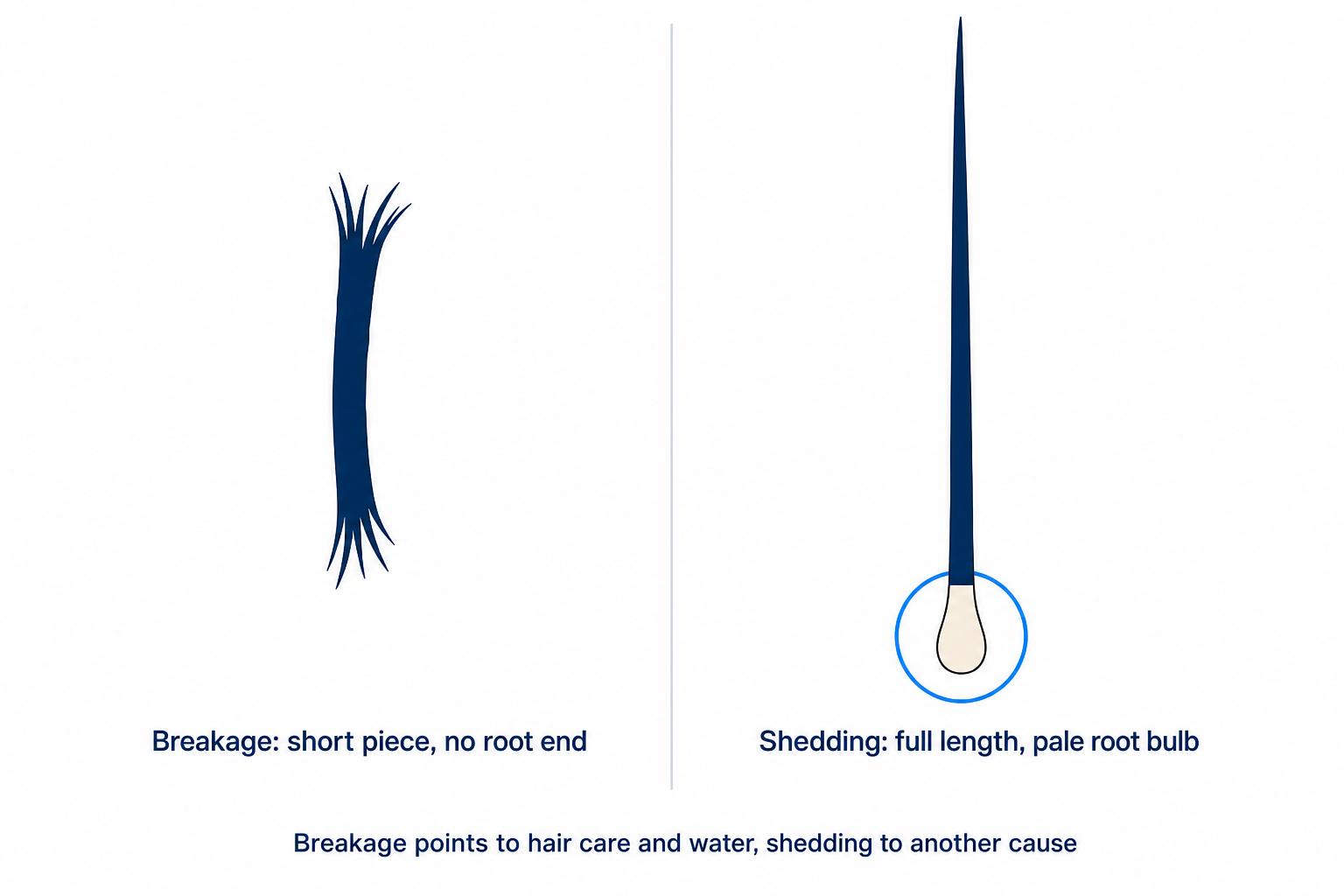
Between 50 and 100 shed hairs a day is considered normal, because part of your scalp hair is always in the shedding phase. That figure is a professional convention, not a measurement from a single study. How the switch between the growth phase and the resting phase works is explained in our article on the hair cycle.
On the question of hard water and hair loss there is no robust clinical evidence. What does exist is four small ex vivo studies on cut strands of hair, measuring tensile strength, elasticity and surface structure after treatment with hard water versus distilled water. They tell you something about hair as a material in the lab, nothing about hair growing on a head.
| Study (year) | Sample and method | Result |
|---|---|---|
| Srinivasan et al., Int J Trichology (2013) | India, 15 participants, two sets of hairs each in hard versus distilled water, 30 days, tensile strength and elasticity measured on a testing device | No significant difference (tensile strength p = 0.858; elasticity p = 0.874). The authors conclude that water hardness does not impair tensile strength or elasticity. |
| Luqman et al., J Pak Med Assoc (2016) | Pakistan, 76 male participants, each hair sample split between hard and deionised water, 3 months | Significantly lower tensile strength with hard water (238.49 versus 255.36; p = 0.001) |
| Luqman et al., Int J Trichology (2018) | Pakistan, 70 male participants, three groups (control, deionised water and hard water) | Significantly lower tensile strength with hard water (234.16 versus 254.84; p = 0.001) |
| Alahmmed et al., Indian J Dermatol Venereol Leprol (2017) | Saudi Arabia, 20 participants, hard versus soft water, 3 weeks, scanning electron microscopy of the surface | No significant structural difference on the surface, but significantly more magnesium deposition (p = 0.001); calcium deposition showed no significant difference (p = 0.28) |
So two of the four studies found an effect on tensile strength and two did not. That is not a question of fine margins, it is genuine disagreement, and it comes from very small samples of 15 to 76 people. What is best evidenced is that minerals settle on the hair, not that hair growth is damaged.
Plausible laboratory findings about hair structure are one thing, a proven effect on hair growth is another. Anyone who treats the two as the same thing is usually selling something. That said, hard water is not entirely without consequences either: scalp irritation and hair breakage are real issues, just different ones from hair loss.
What hard water really does to your hair
Hard water leaves limescale soap and mineral deposits on the hair shaft. Calcium and magnesium ions combine with the fatty acid components of the washing agents to form salts that barely dissolve. This limescale soap does not rinse away; it settles as a film on the cuticle, the outer scale layer of the hair.
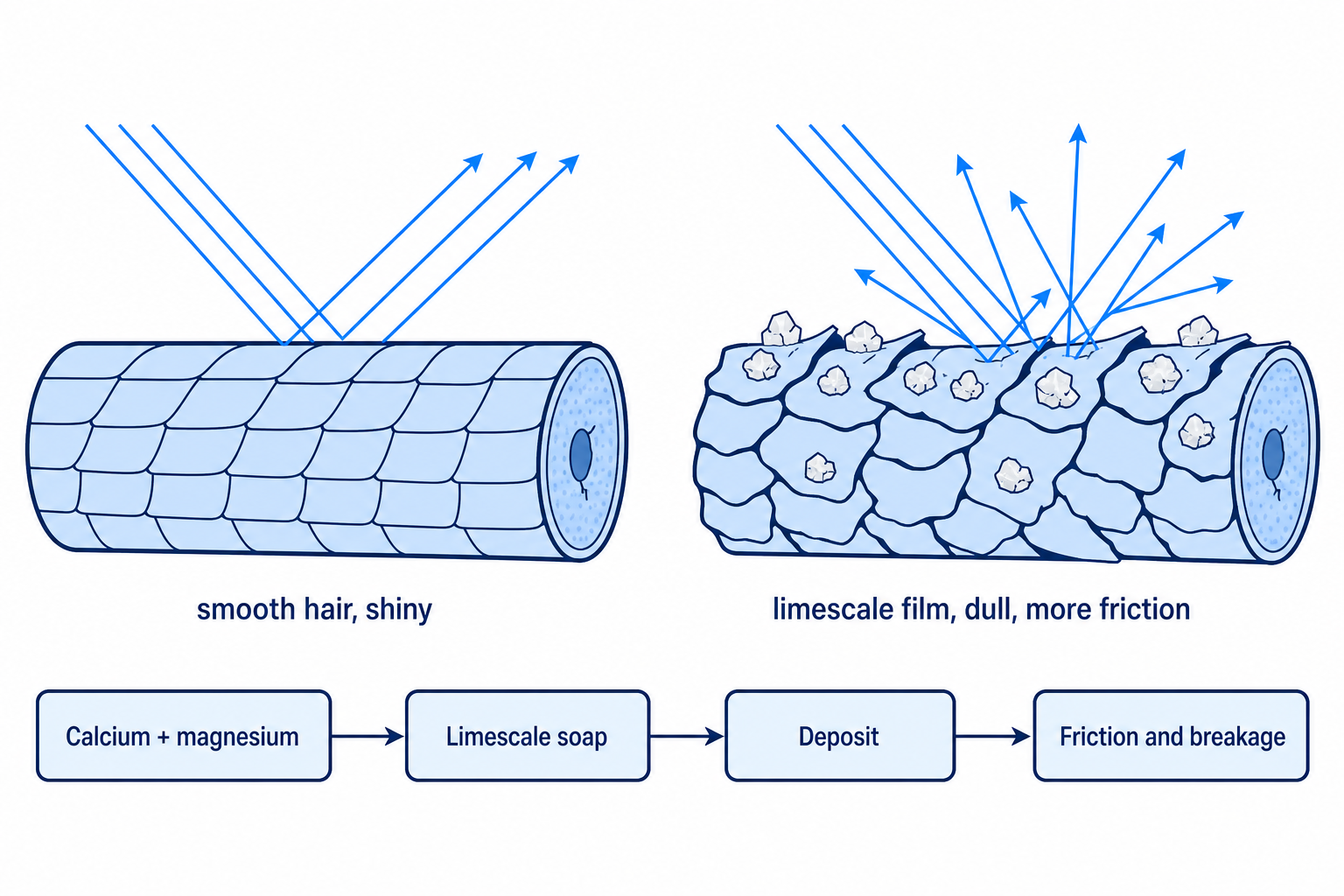
Limescale in the water affects your hair in four steps, and each one comes with an everyday experience that plenty of people will recognise:
- Limescale soap forms, so the lather is poor. Some of the surfactant is bound up by the minerals and is no longer available for washing. You use more shampoo and wash for longer.
- Deposits build up on the cuticle, so the hair feels dull. The cuticle no longer lies flat, so light is scattered instead of being reflected in one direction. You see the result as a loss of shine.
- More friction, so more mechanical stress. Rough hair snags when you comb it and takes more force to get through, and that is exactly where breakage happens. The real damage is usually the friction, not the limescale itself.
- Build-up from residues and styling products. Hair feels heavy and flat and goes greasy faster, even though you have only just washed it.
This is why hair often suddenly looks better on holiday, without anything about your routine changing. It is not the climate; it is usually the softer water where you are staying. Back home the film builds up again over a few weeks, and the change is easy to miss because it comes on slowly.
One point plenty of guides get wrong: pure calcium mainly makes hair dull, not discoloured. Green, yellow and rusty tints come from other metals, and there is more on that in the section on coloured hair below. How the hair shaft is built up in the first place is explained in our article on keratin and hair structure.
Hard water and the scalp: itching, tightness and flaking
Hard water can irritate a sensitive scalp, because limescale soap and surfactant residues rinse away less easily and stay on the skin for longer. Typical signs are tightness straight after washing, itching and fine, dry flaking. It is not the limescale itself that irritates, it is what fails to come off and disrupts the skin barrier.
This dry flaking is not the same as dandruff in the medical sense. Seborrhoeic dermatitis comes from the interplay of excess sebum and an overgrowth of the yeast Malassezia furfur, not from water hardness. Hard water can make an existing sensitivity more uncomfortable, but it does not create that condition. There is more on this in our article on scalp inflammation.
There is genuine clinical research on whether hard water puts strain on the skin barrier, although it looks at atopic dermatitis rather than the scalp. In a cross-sectional study by Perkin et al. (Journal of Allergy and Clinical Immunology, 2016) of 1,303 three-month-old infants, babies in households with above-average water hardness had a statistically significantly higher risk of visible eczema, independently of the chlorine content of the water.
The counter-finding matters at least as much. In the randomised Softened Water Eczema Trial (SWET) by Thomas et al. (2011), 336 children aged between 6 months and 16 years with moderate to severe eczema in hard water areas had an ion-exchange water softener installed at home for 12 weeks. The result: no additional benefit over usual treatment. What was studied was eczema on children’s bodies, explicitly not the scalp and not hair growth.
An association in observational data and a benefit from an expensive countermeasure in an experiment are two different things. That gap is precisely why we are so cautious about water softeners and shower filters further down. The SWET trial cannot be transferred to hair anyway; that would be the same mistake the vendor websites make.
There is one indirect link to hair loss, and it runs through the skin rather than the hair. A badly itching scalp gets scratched, scratching creates micro-injuries, and folliculitis, an inflammation of the hair follicle, can develop from those. An inflamed scalp can lead to temporarily increased hair loss. Where it stays superficial the follicles are usually preserved, so the effect is reversible.
Persistent itching, red patches, yellowish crusts, pustules, weeping areas or hair loss in defined spots are not a water problem. Those need a dermatologist, and that comes before any fine-tuning of your washing routine.
Checking your water hardness: how hard is my water?
In the UK, water hardness is given in milligrams of calcium carbonate per litre (mg/l). There is no statutory hardness limit here, because calcium and magnesium are not a health concern. What does exist is the informative table published by the Drinking Water Inspectorate (DWI), which runs from soft (up to 100 mg/l) through slightly hard (100 to 150) and moderately hard (150 to 200) to hard (200 to 300) and very hard (above 300). For this article we group those five steps into three, with the practical dividing line at 200 mg/l.
The three hardness bands, based on the DWI table
soft
up to 100 mg/l CaCO3
DWI: soft
Change nothing
moderate
100 to 200 mg/l CaCO3
DWI: slightly to moderately hard
Clarify occasionally
hard
over 200 mg/l CaCO3
DWI: hard to very hard
Adjust your routine
Bands based on the hardness table published by the Drinking Water Inspectorate, which draws on the WHO guidelines. It is informative guidance: there is no legal hardness limit in the UK, so no water company has to meet a particular hardness figure. The DWI itself works with five steps (soft, slightly hard, moderately hard, hard, very hard), which we have grouped into three here.
| Hardness band | DWI classification | mg/l CaCO3 | What you notice day to day | What it means for your hair | What makes sense |
|---|---|---|---|---|---|
| soft | soft | up to 100 | Barely any limescale marks on taps and shower head, shampoo lathers strongly, you need very little detergent | Practically irrelevant. Straw-like hair almost always has a different cause here | Change nothing. Look at heat, the hairdryer, colouring and how often you wash instead |
| moderate | slightly to moderately hard | 100 to 200 | Slight white marks, normal lather, the kettle furs up slowly | Noticeable now and then, usually only after weeks, as a light coating and less shine | Use less product, rinse thoroughly, and a chelating shampoo every few weeks if your hair feels coated |
| hard | hard to very hard | over 200 | Clear limescale crusts on the shower head, white marks on dark tiles, high shampoo consumption | Regular build-up likely: dull feel, more friction when combing, more risk of breakage | A chelating shampoo every few weeks plus conditioning afterwards, a cooler rinse, a leave-in before combing. A water softener only if you were planning one anyway |
Regionally the picture in the UK is unusually clear-cut, at least in broad strokes. Thames Water states that all of the water across its supply region is hard, and South East Water draws most of its supply from chalk aquifers, which makes that water hard too. Scotland is the other way round: the Drinking Water Quality Regulator for Scotland classes most Scottish drinking water as soft. Beyond that contrast there are no official regional averages worth quoting.
As a rough rule, then: south-east and eastern England are hard, while Scotland is mostly soft. You should not rely on that alone, because the DWI itself points out that there is local variation the maps do not show, and the figure can differ within a single town depending on which treatment works supplies it. So it is worth checking your own postcode.
Checklist: find out your water hardness in five minutes
- Your water company’s website. Look for the water quality or hard water page and enter your postcode. Companies publish the hardness for each supply zone, usually as a table or a downloadable report. This is the quickest and most accurate route.
- Your water bill or annual water quality report. It gives the hardness band, often together with the figure in mg/l. It is usually filed away somewhere already.
- Test strips from the chemist or a DIY shop. A few pounds, and worth it mainly if you have your own borehole or you want to know precisely. A rough classification, not a laboratory value.
- The bottle test in 60 seconds. Fill a clear bottle one third full with tap water, add a few drops of pure liquid soap and shake it hard. Plenty of stable lather and clear water point to soft water; little lather and a milky, flaky cloudiness point to hard water. That cloudiness is the limescale soap this whole article is about. Chemically plausible, but a rule of thumb rather than a measurement.
Two notes: The figure for the next town along is not a reliable guide, because it is often supplied by a different treatment works. And the information on the detergent packet does not help either: that only gives the dosage recommendation per hardness band, not your own water hardness.
A realistic note to finish on: it is only in the “hard” band that changing your routine is worth the effort at all. In the soft band, straw-like hair is almost always down to something else, usually heat, the hairdryer, bleaching or washing too often with too much product.
What actually helps against hard water in your hair
Two things reliably help against limescale in your hair: removing deposits from time to time, and letting fewer of them form in the first place. The six measures that do this are set out below, in order of how much they are worth the effort.
The short version: six measures against limescale in your hair
- Use less shampoo and rinse it out more thoroughly. Less surfactant means less limescale soap. Costs nothing, applies in every hardness band.
- Finish with a cooler rinse. Heating water makes limescale come out of solution; cooler water keeps more calcium carbonate dissolved.
- A chelating shampoo every one to three weeks, always followed by a mask or conditioner. That dissolves mineral and product deposits. The interval is a practical recommendation, not a research finding.
- A leave-in or conditioner before combing. With hard water, friction is the real cause of breakage, not the limescale itself.
- An acidic rinse now and then, heavily diluted. A cosmetic shine effect for in between, not a permanent solution.
- Before important occasions, do the final rinse with still bottled water. That way no new minerals land on your hair at the last contact.
What you can save your money on: the shower filter as a limescale solution, and a water softener bought purely for the sake of your hair. The reasons are explained further down.
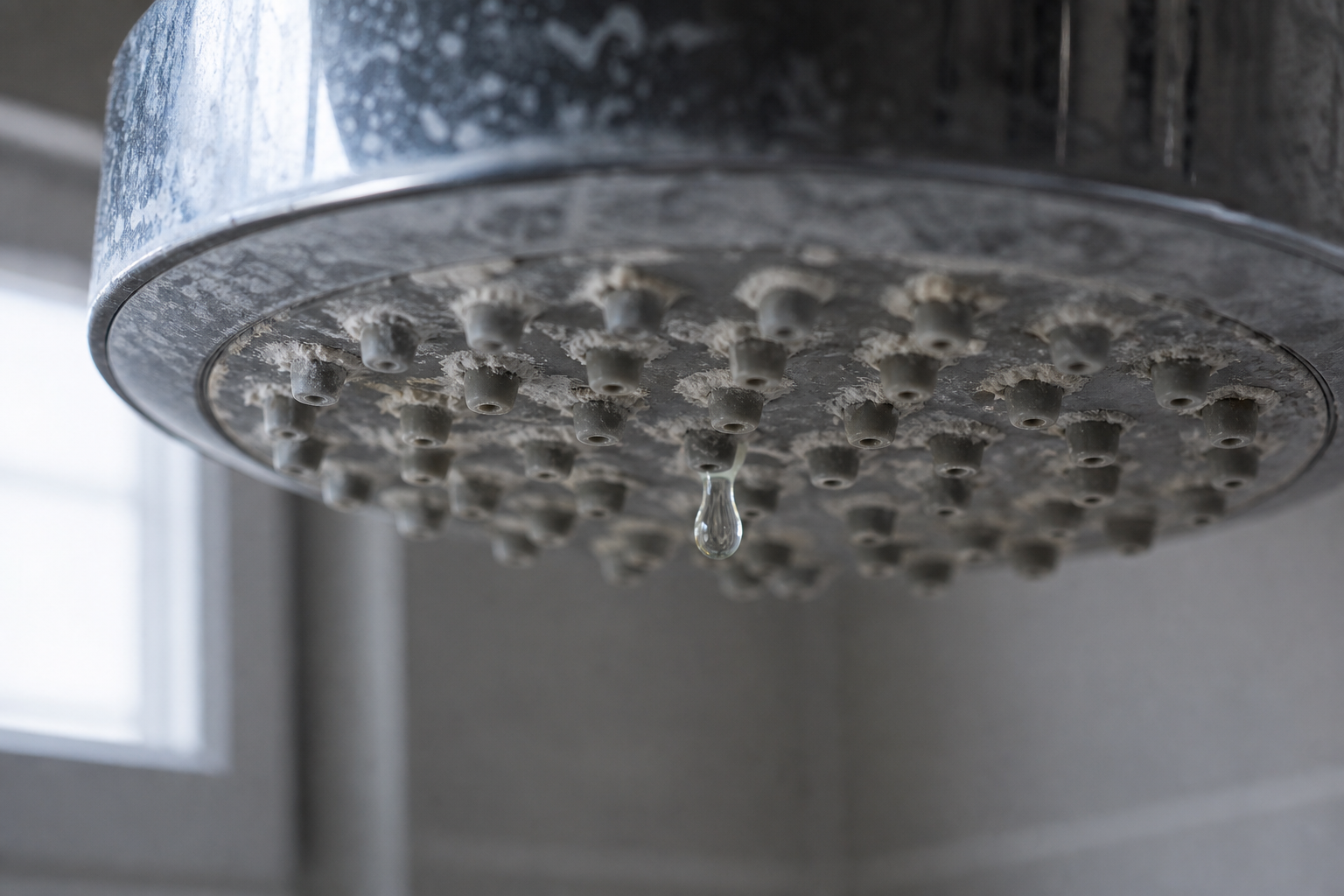
The sections that follow go through each measure one at a time: what it can do, what it cannot do and how often it makes sense. Everything else in circulation on this topic ranges from “helps a bit” to “expensive and poorly evidenced”.
Clarifying shampoo and chelating shampoo: the difference is what counts
A clarifying shampoo uses stronger surfactants to wash out product residue. A chelating shampoo also contains complexing agents such as EDTA, citric acid, phytic acid or sodium gluconate, which bind calcium, magnesium, copper and iron ions and make them rinsable. Against mineral deposits from hard water, the chelating agent is the part that actually works.
Neither belongs in your bathroom on a daily basis. The same cleaning power that dissolves deposits also strips lipids from hair and scalp. Trade and manufacturer sources independently recommend an interval of roughly one to three weeks, at most twice a month. That is a practical recommendation, not a research finding: no controlled study of the optimal frequency exists.
What happens afterwards is what matters. Once clarified, hair is more open and more receptive, so a conditioner or mask should follow straight away. Clarify without conditioning and you simply swap a limescale coating for dryness.
An acidic rinse with vinegar or citric acid
An acidic rinse briefly lowers the pH, lays the cuticle flatter and dissolves some of the limescale residue. Hence the shine you can see immediately. Skin and hair naturally sit at a pH of about 4.5 to 5.5, while undiluted vinegar is at 2 to 3. Diluting it is therefore not an option, it is a precondition.
Shower filters: the marketing promise and the evidence
Shower filters are advertised as “removing limescale”, but technically the common cartridges made of KDF, activated carbon or vitamin C do something else: they act mainly on chlorine and on individual metal ions. They do not meaningfully reduce calcium and magnesium, which is what water hardness actually is. Buy a filter to turn hard water soft and you are usually buying something other than what you think.
There are no independent, peer-reviewed data on shower filters and hair quality. The reduction figures in circulation come from commercial advice sites that sell filters themselves and have not been independently checked. The recognised process for reducing hardness is ion exchange to the NSF/ANSI 44 standard, and that means a unit for the whole house, not an attachment on the shower head.
To be fair: in areas with heavily chlorinated water a filter can make a subjective difference, because chlorine genuinely is reduced. As a solution to limescale, it is mis-sold.
Water softeners: cost and when they are worth it
An ion exchanger swaps calcium and magnesium for sodium and is therefore the only measure that genuinely reduces water hardness. European vendor guides and comparison sites put a unit at roughly €519 to €2,500 depending on the size of the household, with professional installation adding €200 to €800, plus around €100 to €250 a year in running costs for regeneration salt, electricity and servicing. Those are European guide prices rather than UK figures, so treat them as a rough order of magnitude and get a local quote. There are no official price statistics on this.
A family home gets through around 5 to 10 kilograms of regeneration salt a month. In rented accommodation a softener is usually out of the question anyway, because it means work on the household plumbing. For sodium, the legally binding limit in drinking water is 200 mg/l under the Water Supply (Water Quality) Regulations 2016; softening raises the sodium level by roughly 46 mg/l for every 100 mg/l of calcium carbonate removed, which is why at least one cold tap for drinking and cooking is normally left unsoftened.
A softener is worth it if you own your home and want to protect the boiler, taps and appliances anyway. Buying one purely for the sake of your hair is not backed by anything: in the only randomised study of water softeners and skin, the SWET trial mentioned above, the softener brought no additional benefit.
The free changes you can make every day
Often it is the things that cost nothing that do the most. Use less shampoo and rinse for longer, cut down on styling products, do not comb wet hair through, squeeze it out with a microfibre towel instead of rubbing, and use a leave-in as friction protection before you pick up the brush. That takes the pressure off the step at which hair really does break when the water is hard.
Water temperature is the most underrated of them. Calcium carbonate behaves differently from most salts: when water is heated, carbon dioxide escapes, the dissolved calcium hydrogen carbonate turns into insoluble calcium carbonate and comes out of solution. That is exactly what furs up your kettle. Hot showers encourage it, so a cooler rinse is the simplest free measure there is, and it lays the cuticle flatter into the bargain.
Boiling helps, but only halfway. It removes the temporary hardness only, that is, the hydrogen carbonates that precipitate as scale. The sediment has to stay in the pan, so pour carefully. The permanent hardness from sulphates and chlorides stays in the water. For everyday use this is impractical; for the final rinse before an important occasion, or on bleached hair, it is usable. Still bottled water does the same job with no effort.
Natural curls and wavy hair: where the limescale film shows first
Curly hair usually notices hard water sooner than straight hair, and not as hair loss but as a loss of spring. A curl has points at every bend where the cuticle does not lie as flat. That is exactly where the coating settles: the hair looks dull, the curl drops and it becomes harder to define.
There is no evidence for this: the four available laboratory studies did not look at curly hair separately, and there is no dedicated data on curl structure. The connection is plausible nonetheless, because curly hair naturally distributes less sebum along its length and therefore looks dry sooner once a film changes the surface.
In practice the same applies as for straight hair, just more consistently: a chelating shampoo every few weeks and, without fail, a moisturising treatment afterwards, a cool rinse, a leave-in on wet hair before detangling, and squeezing the curls out with a microfibre towel rather than rubbing. With curly girl routines that use a lot of leave-in products, the occasional clarifying step matters even more, because product and mineral residues otherwise add up.
For reference, here are all the measures from this section side by side once more, with what each one can do, what it cannot do and how solid the evidence behind it is:
| Measure | What it really can do | What it cannot do | Risk, effort and cost | Evidence | Who it makes sense for |
|---|---|---|---|---|---|
| Chelating or clarifying shampoo | Dissolves mineral and product deposits from the hair shaft; feel and shine come back | Changes nothing about the water hardness, does not prevent new build-up | Dries the hair out if used too often. Conditioning afterwards is a must. Chemist prices | The chemistry of the chelating agents is established, the frequency is only a practical recommendation | From the “hard” band upwards, when hair feels coated |
| Acidic rinse (vinegar, citric acid) | Lays the cuticle flatter, immediately visible shine, dissolves some of the residue | Does not replace clarifying, does not last | Smell, potential to irritate a sensitive scalp, can affect colour. Pennies | No dermatological guideline on dilution or frequency | In between washes, for dull hair without scalp problems |
| A milder shampoo, used more sparingly | Less surfactant means less limescale soap and less residue | Does not remove existing deposits | No risk, just getting used to it | Follows directly from the chemistry of limescale soap | All hardness bands, the very first step to take |
| Final rinse with still or boiled water | Stops new minerals being deposited at the last contact | Not a routine for every day, removes nothing that is already there | Effort with every wash; boiling removes the temporary hardness only | Chemically plausible, no studies on hair quality | Before important occasions, on bleached hair |
| Leave-in or conditioner as friction protection | Reduces friction when combing, the step at which hair breaks | Dissolves no minerals, can add to build-up | Too much product makes the hair feel heavy. Moderate cost | Friction as a cause of breakage is uncontroversial, product-specific data are missing | Long hair, curls, chemically treated hair |
| Shower filter | Depending on the cartridge, reduces chlorine and individual metal ions | Does not meaningfully reduce water hardness, does not turn hard water soft | Regular cartridge changes, ongoing costs with no proven benefit for hair | No independent efficacy data on hair quality | At most for heavily chlorinated water, not against limescale |
| Water softener (ion exchanger) | Genuinely reduces the water hardness throughout the house | Is not a hair treatment and does not grow new hair | Around €519 to €2,500 plus €200 to €800 to install and €100 to €250 a year (European guide prices), usually impossible in rented homes | The SWET trial found no additional benefit for eczema in children | Only if you own the property and were planning to protect your appliances anyway |
| Doing nothing at all | Is the factually correct answer for soft and moderate water | Does not help if the hair is visibly coated in very hard water | No risk, no cost | There is no evidence that hard water harms hair growth | Anyone whose water is soft or moderate |
| When | What | Why |
|---|---|---|
| With every wash | A mild shampoo, used sparingly but rinsed out thoroughly; finish with a cooler rinse | Less surfactant means less limescale soap, and cooler water keeps more calcium carbonate dissolved |
| After every wash | Conditioner or leave-in through the lengths, and only then comb | With hard water, friction is the real cause of breakage |
| Every one to three weeks | A chelating shampoo, always followed by a mask or conditioner | Removes mineral and product deposits; used more often it dries the hair out |
| Occasionally | An acidic rinse, heavily diluted | A short-term shine effect when the hair looks dull |
| Before important occasions | A final rinse with still bottled water | No new minerals reach the hair at the last contact |
Is soft water better for your hair?
Soft water solves the limescale problem, but it brings quirks of its own. Without meaningful amounts of calcium and magnesium no limescale soap forms, so shampoo lathers far more and is harder to rinse out. Many people describe a slippery feeling afterwards, as though their hair never quite got clean.
That feeling is easy to explain. In hard water, part of the washing substance binds to the minerals and disappears as limescale soap. Take that away and more active surfactant is left on hair and skin. So the slippery feeling is a sign of leftover washing substance, not of dirt.
There are downsides all the same. Fine hair goes flat and heavy faster in soft water, because people tend to overdose conditioning products and because the hair gets no mineral “grip” at all. Volume is lost. The practical consequence is simple: half your usual amount of shampoo is often enough, rinse for longer and choose lighter conditioning products.
Anyone thinking about a water softener should know that ion exchangers swap calcium for sodium, which is why one cold tap for drinking and cooking is normally left unsoftened. The figures are in the section on water softeners above.
There is no ideal degree of hardness for hair. The middle band is the least troublesome, and everything else is a question of routine. You adapt your hair care to what comes out of the tap, not the other way round.
Hard water on coloured and bleached hair
Chemically treated hair reacts far more sensitively to hard water. Colouring and bleaching open the cuticle and make the hair more porous, so minerals settle more easily and more deeply. The colour washes out faster, the tone looks flat, and when you recolour, the hair takes the colour unevenly.
With discolouration it pays to look closely, because there is a great deal of nonsense about it online. The classic green tint in blonde hair typically comes from copper, either from pipework or from swimming pool water, where copper compounds are used as algicides and form greenish complexes with chlorine. Rusty and yellow tints are more likely to come from iron. Pure calcium makes hair dull, not green.
In practice that means a chelating shampoo belongs before your colour appointment, not after it, so that the metals are out before the colour goes on. Leaving a few days in between matters. Clarifying immediately before or on the day of the appointment is a bad idea, because a strongly cleansing shampoo removes the protective sebum film from the scalp, and bleach applied straight afterwards can sting considerably more. When in doubt, your stylist decides when to clarify.
For heavily bleached hair there is one more rule: no experiments with concentrated acids or home remedies. Use an acidic rinse sparingly, and the final rinse with still bottled water before important occasions is what does the most here.
Three side questions in brief. The same principle applies to a beard; it is just less noticeable because the hair is shorter. Extensions, hairpieces and wigs react most sensitively of all, because no sebum comes through from the scalp and deposits build up permanently. And hard water does not cause grey hair. Greying happens because melanin production in the follicle declines; deposits only make grey hair look duller and yellower.
When it is not the water: the real causes of hair loss
A pattern is the opposite of a water problem. Hard water hits every hair on your head equally, so it cannot create a receding hairline, a thinning crown, a bald patch or a parting that gets wider month by month. If you are seeing any of that, you are looking for the cause in the wrong place.
These are the causes that genuinely come into question, each with the feature that identifies it:
- •Androgenetic alopecia: the typical pattern of a receding hairline and a thinning crown, or in women a widening parting. Background in our article on androgenetic alopecia.
- •Telogen effluvium: even thinning across the whole head, usually two to three months after an infection, fever, surgery, a diet, severe stress or pregnancy. More on this under severe hair loss.
- •Nutrient and hormone causes: such as iron deficiency, a thyroid disorder or an inadequate vitamin supply. These forms are measurable and can be put right.
- •Medication: hair loss as a side effect often starts weeks to months after treatment begins and affects the whole head.
- •Scalp conditions: redness, pustules, crusts, severe itching or flaking should be checked out, see scalp inflammation.
- •Mechanical and chemical damage: tension, heat, bleaching. This is the only point at which hard water plays a part as an amplifier, and it does so through breakage, not through the root.
| What you are seeing | More likely hard water | More likely another cause | Next step |
|---|---|---|---|
| Hair feels dull and rough | Yes, a classic sign of mineral coating | Only if there is itching and redness as well | Look up your water hardness, clarify once and condition |
| Shampoo lathers poorly, you get through more of it | Yes, typical limescale soap | Rarely | Use less, try a milder shampoo |
| Short broken pieces of hair in the basin | Yes, breakage from friction is plausible | Heat, bleaching and tension cause breakage too | Reduce friction: leave-in, do not comb wet hair through |
| Full-length hairs with a pale bulb at the end | No, that is a shed hair from the root | Yes, that is genuine hair loss | Track the amount over a week; if it increases, see a doctor |
| Noticeably more hair over several weeks | No | Yes, possibly telogen effluvium | Look for a trigger two to three months back, have your blood values checked |
| Receding hairline or thinning crown | No, water does not act in one specific area | Yes, the typical pattern of androgenetic alopecia | Have the cause assessed by a doctor |
| A widening parting | No | Yes, a common pattern in women | Have it checked medically, including ferritin and thyroid values |
| A defined bald patch | No | Yes, this always needs checking | See a dermatologist promptly |
| Redness, pustules, itching, crusts | Irritation is possible, but not this picture | Yes, a sign of a scalp condition | See a dermatologist, no home remedies |
| Improvement on holiday, back to how it was at home | Yes, very typical of softer water | Less likely | Adjust your routine, clarify occasionally |
| No improvement despite soft water | No | Yes, in that case it is not the water | Have the cause identified instead of carrying on tweaking your hair care |
If you can see a pattern, or you are losing noticeably more hair over months, the order of priority is clear, and it starts with a doctor. Anything inflammatory or clearly defined belongs in a dermatology practice: a red or weeping scalp, pustules, crusts, eczema, a suspicion of alopecia areata. That is also where blood values belong, such as ferritin and thyroid values. Which values are worth testing is set out in our article on blood tests for hair loss.
A different question is whether what you are seeing fits the typical pattern of hereditary hair loss, in other words a receding hairline, a thinning crown or a widening parting. Assessing that pattern and stage is done visually, and that is exactly what the free hair analysis at Elithair is for. It is a pattern assessment based on photos, free and without obligation. It does not replace a dermatological diagnosis or a medical blood test, and it is not a decision in favour of treatment.
Three myths about hard water and hair
Myth: hard water causes hair loss
The reality: Hard water changes the structure and feel of the hair, not growth at the root. Anything that comes out at full length with a pale root bulb has a different cause.
Myth: a shower filter turns hard water soft
The reality: The common cartridges act on chlorine and individual metal ions, not meaningfully on calcium and magnesium. Only an ion exchanger reduces hardness, and it does not hang off the shower head.
Myth: hard water turns your hair grey
The reality: Greying happens in the follicle, because melanin production declines. Mineral deposits only make grey hair look duller and yellower, they do not cause it.
Hard water after a hair transplant
In the first days and weeks after a hair transplant, it is not the water hardness that sets the pace but your clinic’s washing instructions. What matters is when you first wash, the water temperature, the water pressure and how you apply everything. The minerals in the water are secondary.
What is specifically relevant: no hard jet of water on the recipient area, lukewarm rather than hot, a mild shampoo as instructed, no rubbing and no picking at the crusts. The washing procedure step by step is described in our article on what to do after a hair transplant.
What has no place on your head in this phase: clarifying shampoo, chelating shampoo, acidic rinses and home remedies. These products are meant for healthy, stressed lengths, not for healing skin. You only go back to routines like that once healing is complete and your treating clinic has given the go-ahead. That go-ahead outranks any timescale you read online.
If you have very hard water and a sensitive scalp, you can wash with boiled and cooled water or still bottled water during the first few weeks, provided your clinic does not say otherwise. That is an option, not a necessity.
Conclusion: hard water and your hair at a glance (2026)
Hard water is a hair care topic, not a hair loss topic. Limescale soap settles on the hair shaft, the hair becomes dull and rougher, it drags more when you comb it and therefore breaks more easily. The four laboratory studies available contradict each other; what is best evidenced is the deposit itself. You can find your own water hardness in two minutes from your water company, and it is only from the “hard” band, above 200 mg of calcium carbonate per litre, that changing your routine is worth the effort. What helps is unspectacular: less product, a cooler rinse, a chelating shampoo every few weeks with conditioning afterwards. What you can save your money on is the shower filter as a limescale solution. And if you can see a pattern or a lasting increase, that is not a water problem.
Frequently asked questions about hard water and hair
How do I tell whether my hair is breaking or falling out?
By the length and the end of the hair. A broken hair is a short piece with a frayed end and no root. A shed hair is full length and has a small pale bulb at the end, the hair root. Breakage points to hair care and water, shedding to a different cause.
What happens if I use a chelating shampoo too often?
The same cleaning power that dissolves minerals also strips lipids from hair and scalp. Used daily it therefore leaves the hair dry and straw-like, and the scalp tight and finely flaking. That is why trade and manufacturer sources recommend an interval of roughly one to three weeks, at most twice a month, always followed by a mask or conditioner. There is no controlled study on the optimal frequency.
Does hard water make fine hair thicker, or just heavier?
Just heavier. The film of minerals and limescale soap settles on the hair shaft, which makes the individual hair feel stiffer and coarser, but no real volume is created. Fine hair often looks flatter instead, because the coating weighs it down and the lift at the roots is lost. After a clarifying step the difference is usually clearly noticeable.
What helps against straw-like hair after the swimming pool?
Here it is less the limescale than the chlorine and copper in the pool water. Rinse your hair with tap water straight after swimming rather than letting it dry in, and after several days of swimming work in a chelating shampoo, because complexing agents bind copper and iron too. On blonde hair, that copper is exactly what causes the green tint.
When should I see a doctor about hair loss?
If you are losing noticeably more hair over several weeks, you notice a pattern such as a receding hairline or a widening parting, you can see a defined bald patch, or your scalp is red, itchy, weeping or showing pustules. None of these have anything to do with water hardness, and they need a dermatological assessment.
Sources
- Drinking Water Inspectorate: water hardness and the hardness bands for drinking water
- Thames Water: hard water and hardness levels by postcode
- gesund.bund.de: hereditary hair loss (DHT mechanism)
- Srinivasan G et al.: Effects of hard water on hair. Int J Trichology 2013
- Luqman MW et al.: Effect of topical application of hard water in weakening of hair in men. J Pak Med Assoc 2016
- Luqman MW et al.: Changes in baseline strength of hairs after deionized and hard water. Int J Trichology 2018
- Alahmmed LM et al.: Scanning electron microscopy study of hair shaft changes related to hardness of water. Indian J Dermatol Venereol Leprol 2017
- Perkin MR et al.: Association between domestic water hardness, chlorine, and atopic dermatitis risk in early life. J Allergy Clin Immunol 2016
- Thomas KS et al.: Randomised controlled trial of ion-exchange water softeners for eczema in children (SWET). PLoS Medicine 2011
- legislation.gov.uk: the sodium limit in drinking water, Water Supply (Water Quality) Regulations 2016, Schedule 1
As of August 2026. This article is provided for information and does not replace medical advice, diagnosis or treatment. If hair loss persists, or you have scalp symptoms or unexplained changes, please consult a dermatology practice.

Dr. Imad Moustafa
Hair transplant specialist