

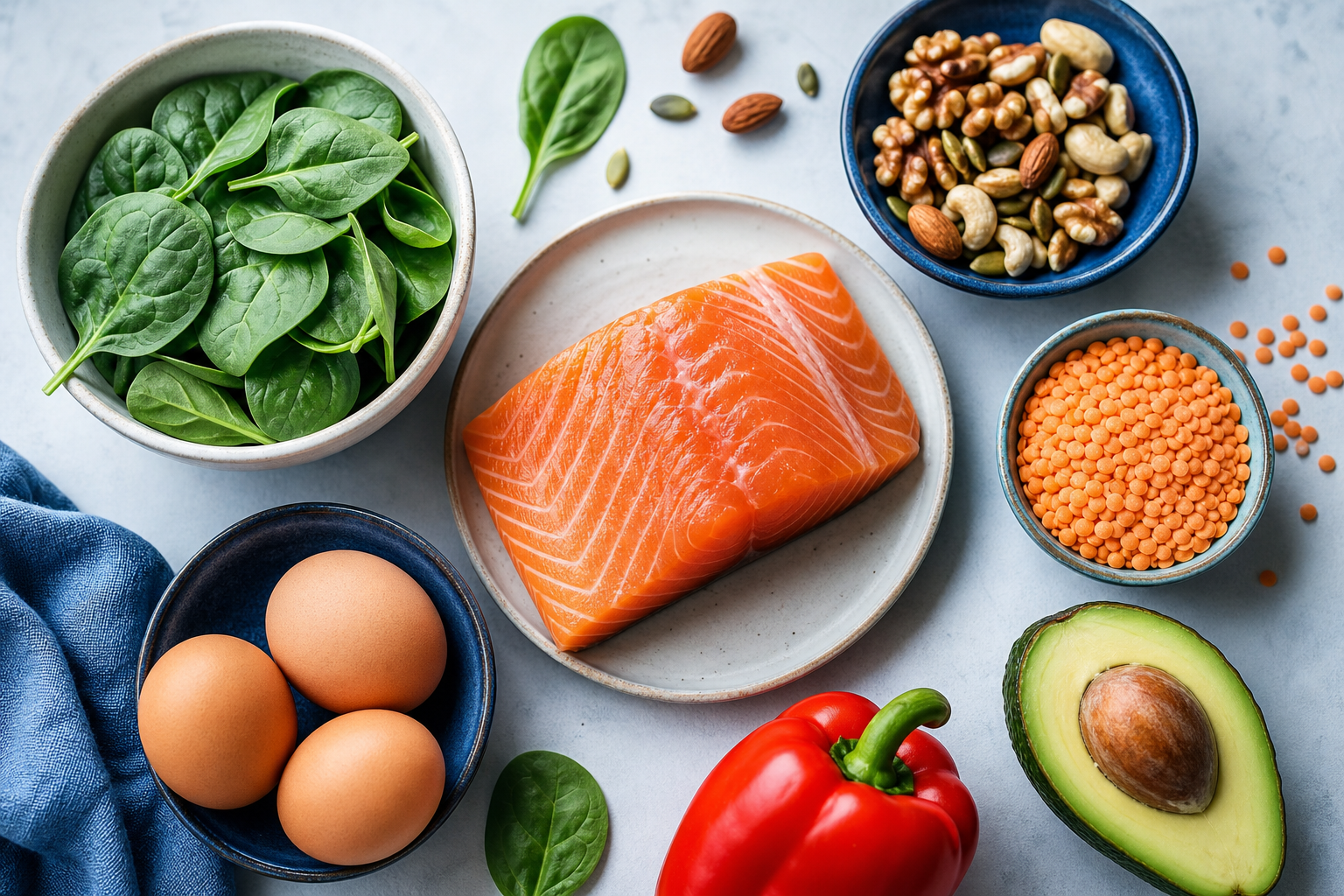
Quick answer: do vitamins help against hair loss?
Vitamins for hair loss only work when a deficiency confirmed in a blood test is the cause. The most common hair-relevant shortfalls are iron deficiency (ferritin), vitamin D deficiency and zinc deficiency. With genetic (androgenetic) hair loss, supplements do not touch the underlying mechanism of DHT and predisposition.
Measure first, then take: a blood test decides whether vitamins make sense. Once a deficiency is corrected, the first improvements usually show after 3 to 6 months, the full picture after 6 to 12 months. Biotin without a deficiency has no proven benefit and can even skew lab results.
- ✓A blood test decides: measure first, then take.
- ✓Most common shortfalls: iron/ferritin, vitamin D, zinc.
- ✓Biotin without a deficiency does nothing and skews lab results.
Summary
- Can vitamins really stop hair loss?
- The most important vitamins and nutrients for your hair
- The biotin myth: why the much-marketed hair vitamin usually does nothing
- Can supplements actually make hair loss worse?
- When and how should you take hair vitamins?
- Spotting a vitamin deficiency: which blood values in hair loss?
- Supplement reality check: what do hair-vitamin products really do?
- Food over pills: the hair plate
- Regrowth timeline: how long does it take after correcting the deficiency?
- Diffuse or genetic? When vitamins do not help
- Common questions about vitamins against hair loss
Can vitamins really stop hair loss?
Vitamins can slow hair loss or bring it to a halt, but only when a confirmed nutrient deficiency is the cause. In healthy people without a shortfall, the review by Almohanna et al. (2019, Dermatol Ther) found no proven benefit. There, micronutrients are described as a modifiable risk factor, not a cure-all.
The reason lies in the hair cycle. Every hair goes through a growth phase (anagen, 2 to 7 years), a short transition phase (catagen, 2 to 3 weeks) and a resting phase (telogen, around 3 months), at the end of which it sheds. More on this in the article on the hair growth cycle.
Inside the hair follicle, keratinocytes divide very quickly, one of the most metabolically active cell types in the body. When building blocks such as iron, zinc or B vitamins are missing, the body pushes follicles into the telogen phase early. The result is diffuse hair loss across the whole scalp that typically only becomes visible 2 to 4 months after the trigger.

This so-called telogen effluvium is reversible once the cause is fixed. The current systematic review by Wang et al. (2024, Mol Nutr Food Res) reaches a clear conclusion, though: without an accompanying deficiency, the evidence for any benefit from supplements is inconsistent. The decisive step therefore remains the blood test, not reaching for the pill box.
The most important vitamins and nutrients for your hair
In hair loss, iron, vitamin D and zinc matter most, followed by biotin, vitamin B12, folate, vitamin A, vitamin C, vitamin E, selenium, omega-3 and protein. Each of these nutrients has a clear role in the follicle, a typical deficiency sign in the hair and a daily requirement. The evidence check below ranks the most important ones first, then the matrix sums up all twelve at a glance.
| Nutrient | Role for the hair | Deficiency sign in the hair | Daily requirement | Top foods |
|---|---|---|---|---|
| Iron (ferritin) | Cofactor of DNA synthesis in the follicle; the body prioritises blood over hair | Diffuse thinning, >100 hairs/day, dull lustre | Women 16 mg, men 11 mg (DGE 2024) | Beef liver (15 mg/100 g), lentils, pumpkin seeds |
| Vitamin D | Steers follicle reactivation via the VDR receptor | Diffuse thinning, slowed growth | 20 µg/day (800 IU) | Wild salmon, herring, egg yolk (sun is the main source) |
| Zinc | Cofactor for >300 enzymes, keratin and sebaceous gland function | Dull hair, diffuse thinning | Men around 14 mg, women around 8 mg | Oysters, beef, pumpkin seeds |
| Biotin (B7) | Cofactor for keratin formation; requirement is very small | Brittle hair (deficiency extremely rare) | 40 µg/day | Liver, cooked eggs, mushrooms |
| Vitamin B12 | DNA synthesis and cell division in the follicle | Diffuse thinning, often with anaemia | 4 µg/day | Liver, mackerel, Gouda |
| Folate (B9) | Cofactor for cell division and blood formation | Diffuse hair loss, brittle nails | 300 µg folate equivalents | Liver, kale, lentils |
| Vitamin A | Regulates epithelial cells; an excess is harmful | Both deficiency AND overdose cause hair loss | Women 700 µg, men 850 µg (UL 3,000 µg) | Carrots, sweet potatoes (beta-carotene, safe) |
| Vitamin C | Collagen synthesis, improves iron absorption | Corkscrew hairs in scurvy, hair breakage | Women 95 mg, men 110 mg | Peppers, broccoli, citrus fruit |
| Vitamin E | Antioxidant, protects cell membranes in the follicle | Rare; deficiency brings oxidative stress, hair breakage | Women 12 mg, men 15 mg | Sunflower oil, almonds, avocado |
| Selenium | Antioxidant protection, thyroid and keratin function | Both deficiency AND overdose (selenosis) cause hair loss | Women 60 µg, men 70 µg (UL 300 µg) | Brazil nuts (highly variable), tuna, eggs |
| Omega-3 | Membrane building block, anti-inflammatory | Dry, brittle hair, scalp inflammation | 250 mg EPA + DHA/day (EFSA) | Wild salmon, herring, flaxseed |
| Protein | Hair is around 95% the protein keratin | Heavy thinning (up to 300 hairs/day) | 0.8 g/kg body weight (min. 40 to 60 g) | Chicken breast, eggs, lentils |
Daily requirements based on the reference values of the German Nutrition Society (DGE), as of 2024. UL = tolerable upper limit (EFSA).
Iron is the most common hair-relevant deficiency in women
Iron is a cofactor of ribonucleotide reductase and therefore indispensable for the DNA synthesis of follicular keratinocytes. When iron is short, the body prioritises haemoglobin and pushes hair follicles into the resting phase early. Women of childbearing age are particularly often under-supplied, according to the DGE and the German National Nutrition Survey II.
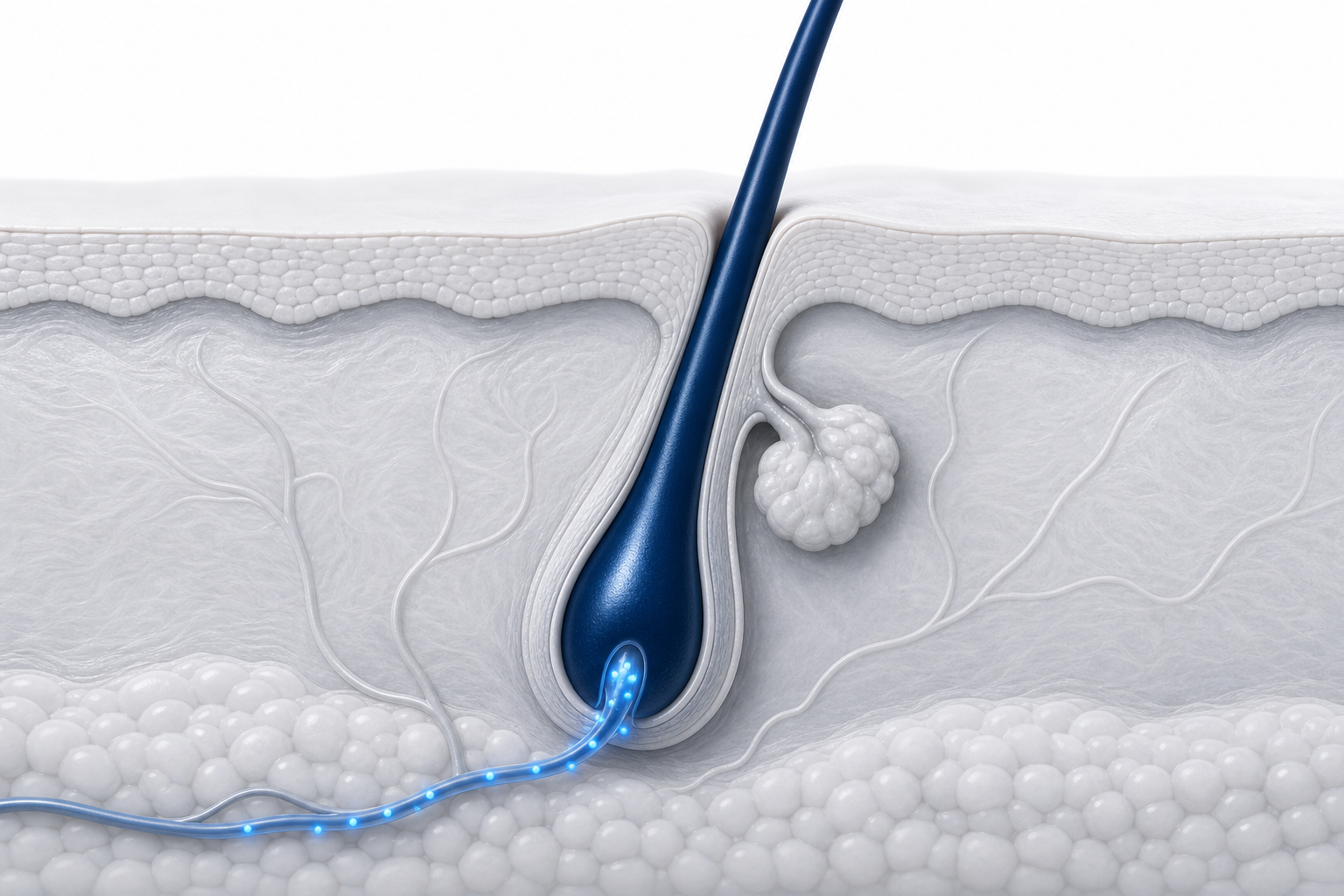
Rushton (2002, Int J Dermatol) found markedly lower ferritin in women with chronic telogen effluvium than in controls. What counts is the stored value, ferritin, not just haemoglobin. In certain life stages the nutrient demand shifts in particular: after childbirth (postpartum hair loss) and during menopause, iron and hormone levels change, and here a targeted blood check is especially worthwhile. More on the diagnostics in the article on iron deficiency and hair loss.
Vitamin D is short in more than half of those affected
Vitamin D works through the vitamin D receptor (VDR), which sits in the hair follicle and helps steer the reactivation of new growth cycles. A 2024 meta-analysis (PMC11479915) found a vitamin D deficiency in 50.4% of women with hair loss and 53.5% of patients with telogen effluvium.
The DGE recommends 20 µg per day (800 IU) when no own production through the skin takes place. Since diet only supplies 2 to 4 µg and, according to the RKI, around 57 to 60% of the population do not reach the target value, vitamin D is one of the few nutrients where supplementation guided by a blood value is often justified.
Zinc, B12, folate and protein in risk groups
Zinc is a cofactor for over 300 enzymes and needed for keratin formation. A study of 23,975 patients, however, showed only a minimal difference in serum zinc (96 versus 99 µg/dl), which is why a blanket zinc measurement in hair loss is not recommended. Zinc is mainly relevant in vegans and people with malabsorption.
Vitamin B12 and folate drive cell division in the follicle. Vegans almost certainly develop a B12 deficiency without a supplement. Protein is the foundation: hair is around 95% keratin, and severe deficiency states after crash diets or operations trigger a well-documented telogen effluvium that is reversible once levels return to normal.
Vitamin A, C, E, selenium and omega-3: benefits and limits
Vitamin C mainly improves iron absorption by reducing Fe3+ to the absorbable form Fe2+. For vitamin E, a small RCT by Beoy et al. (2010) with 38 men on tocotrienols showed 34% more hair after 8 months, though it needs replication. For omega-3, Ablon (2015) found more anagen hairs in 120 women, but as a multi-ingredient product.
With vitamin A and selenium, caution is the key word. Both cause hair loss in deficiency as well as in overdose. Anyone who supplements these blindly risks the very symptom they are trying to fight. Details on this in the section on supplement risks further down.
The biotin myth: why the much-marketed hair vitamin usually does nothing
Biotin is seen as the hair vitamin par excellence, yet for the vast majority of people, biotin supplementation against hair loss does nothing. The reason: a true biotin deficiency is extremely rare on a mixed diet. The average intake (women 40 µg, men 46 µg) already fully covers the daily requirement of 40 µg.
The DGE puts it plainly: since there is no widespread deficiency in the population, no general recommendation for biotin supplements can be made. Yelich et al. (2024, JCAD) reviewed the evidence. The highest-quality, double-blind placebo-controlled study found no difference between biotin and placebo in hair growth.
FDA warning: biotin skews important lab results
The US authority, the FDA, explicitly warned against biotin supplements in 2019 because they skew lab results. Many immunoassays use the biotin-streptavidin bond. Ingested biotin competes with it and can make results falsely high or falsely low. Hair-skin-nail products often contain 5 to 20 mg of biotin, 125 to 500 times the daily requirement.
Important: which tests biotin skews
Affected tests include the troponin test (a heart attack marker that can appear falsely low; the FDA documented one death from a missed diagnosis), the thyroid values TSH, T3 and T4, as well as hCG, vitamin D and hormone tests. The FDA recommends pausing biotin at least 72 hours before a blood draw and informing both your doctor and the lab.
For hair loss, this creates a double problem: high-dose biotin offers no benefit without a deficiency and can at the same time disturb the very diagnostics meant to uncover the true cause. Anyone having their blood values checked should stop biotin products beforehand.
Can supplements actually make hair loss worse?
Yes, supplements can make hair loss worse when taken without a deficiency and in doses that are too high. Vitamin A and selenium cause hair loss in overdose, and long-term zinc intake without copper balance can lead to hair loss indirectly via a copper deficiency. The “more helps more” idea is simply wrong here.
Vitamin A is fat-soluble and accumulates in the liver. The WHO explicitly lists alopecia as a symptom of hypervitaminosis A. Excess retinol speeds up the follicle cycle and drives hairs prematurely into the telogen phase. It becomes critical with the combination of retinol supplements, frequent liver consumption and fortified foods above the upper limit of 3,000 µg per day (EFSA). Beta-carotene from plants, by contrast, is safe because the body controls the conversion according to need.
With selenium, the toxic window is narrow: the requirement is 60 to 70 µg, the upper limit 300 µg per day (EFSA). Selenium poisoning (selenosis) often shows diffuse hair loss as the first sign. The most common source is Brazil nuts, which depending on origin contain 10 to 70 µg each. Civas et al. (2024, J Cosmet Dermatol) documented a case of hair loss and nail dystrophy caused by a selenium supplement.
Zinc without copper: the underrated trigger
Long-term zinc supplementation without copper balance depletes the copper stores. In the gut lining, zinc induces metallothionein, which binds copper and blocks its absorption. The result is a copper deficiency with anaemia, and this anaemia can in turn trigger hair loss. Several case reports (PMC12286130, PMC10510946) confirm this mechanism.
The practical consequence: anyone taking more than 15 to 20 mg of zinc per day long-term should add around 1 to 2 mg of copper. As a general rule, the fat-soluble vitamins A, D, E and K accumulate in the body and form a cumulative risk in combined products. The rule is: measure first, then take.
When and how should you take hair vitamins?
When taking vitamins against hair loss, timing decides the effect, because individual nutrients block or boost each other. Iron does not belong with calcium, coffee or zinc, vitamin D needs fat, and vitamin C is what makes iron properly available in the first place. The collision and synergy checker below shows the most important interactions at a glance.
| Nutrient | Blocked by | Boosted by | Practical intake |
|---|---|---|---|
| Iron | ✗ Calcium/milk, coffee & black tea (up to 50 to 80% inhibition), high zinc doses, acid blockers | ✓ Vitamin C (100 to 200 mg raise absorption 2 to 3 fold) | On an empty stomach or with orange juice; at least 1 hr away from coffee/milk |
| Zinc | ✗ high iron doses (competition at the DMT1 transporter) | – | With long-term use >15 to 20 mg: add copper (1 to 2 mg) |
| Vitamin C | – | ✓ acts as an iron booster itself | Take together with plant-based iron |
| Vitamin D (fat-soluble) | ✗ taking it on an empty stomach lowers absorption | ✓ dietary fat; K2 (MK-7) discussed at higher doses | With a fat-containing meal (breakfast/lunch) |
| Vitamin A, E, K (fat-soluble) | ✗ they accumulate, overdose risk (especially A) | ✓ dietary fat improves absorption | With a meal; A and D not long-term high-dose without a doctor |
| Biotin | – | – | Stop at least 72 hrs before a blood draw (FDA) |
| Omega-3 | – | – | On blood thinners (>3 g/day) ask your doctor |
✓ boosts absorption | ✗ blocks absorption. Figures for oral intake with a confirmed deficiency.
The practical classic: take an iron tablet with a glass of orange juice instead of a milky coffee. The coffee at breakfast halves iron absorption, the vitamin C boost doubles it. With fat-soluble vitamins the opposite applies: they need fat in the meal but accumulate, and they tolerate no long-term high dose without medical supervision.
Spotting a vitamin deficiency: which blood values in hair loss?
To spot a vitamin deficiency as a cause of hair loss, ferritin, 25-OH vitamin D, a full blood count and the TSH value are the most useful, complemented by zinc, B12 (holotranscobalamin) and CRP. Every GP can cover these values. You can take the printable checklist below along to your appointment. There is also more background in our article on blood tests for hair loss.
Blood values checklist for your appointment
To print out or photograph. The target ranges are a rough guide, not a substitute for a diagnosis. Note: stop biotin products 72 hrs before the blood draw.
| ☐ Value | What it shows | Rough guide |
|---|---|---|
| ☐ Ferritin | Iron stores (better than serum iron) | Lab normal from 12 to 30 µg/l; a higher range is discussed for the hair (see note) |
| ☐ 25-OH vitamin D | Vitamin D status | Sufficient from 50 nmol/l (20 ng/ml); deficiency below 30 nmol/l |
| ☐ Full blood count | Anaemia, general blood picture | Lab-dependent reference |
| ☐ TSH | Thyroid (often overlooked) | around 0.4 to 4.0 mU/l (lab-dependent) |
| ☐ CRP | Inflammation (skews ferritin upwards) | always together with ferritin |
| ☐ Zinc (optional) | only shows severe deficiencies | around 70 to 120 µg/dl (serum unreliable, whole-blood analysis more informative) |
| ☐ B12 / Holo-TC | active B12, more sensitive than total B12 | Holo-TC around 37.5 to 188 pmol/l (lab-dependent) |
| ☐ Folate (optional) | cell division, blood formation | lab-dependent reference |
Note on ferritin (YMYL): guidelines often define an iron deficiency only below 30 µg/l. Part of the hair-focused medical field names target values of around 40 to 70 µg/l for hair growth, and some authors such as Rushton (2002) even above 70 µg/l. These higher thresholds are not conclusively established scientifically and are not set down as a consensus in the guidelines. Interpreting your values belongs in medical hands.
Two values are especially tricky. Ferritin is an acute-phase protein and rises falsely high during inflammation, which is why CRP should always be measured alongside it. And serum zinc only reflects severe deficiencies, because around 99% of the body’s zinc lies inside the cells. A normal zinc value therefore does not reliably rule out a mild deficiency.
Supplement reality check: what do hair-vitamin products really do?
Hair-vitamin products only do something when they correct a deficiency that genuinely exists. Without a shortfall, no benefit is to be expected. A 2025 systematic review (PMC13063204) found mixed results for oral hair supplements with often low study quality. The market for such products runs into the billions; the evidence does not keep pace with it.
Typical combined products contain biotin (often 5 to 10 mg, far above requirement), zinc, selenium, B vitamins and collagen peptides. That makes assessment difficult: if any component works at all, it stays unclear which one. And with selenium or vitamin A in too high a dose, the product can even do harm.
One particular trend is hair gummies (often marketed as “bears”). They are usually heavily overpriced, contain a lot of sugar and almost always rely on the biotin principle in their formula, which brings no proven benefit without a confirmed deficiency. A pretty gummy bear changes nothing about this basic rule: what is not missing in the blood cannot be topped up.
Supplements make sense with a deficiency confirmed in the blood and for clear risk groups: vegans (B12, iron, zinc), pregnant women, older people with malabsorption and people after a heavily reduced diet or surgery. For everyone else the rule is: the money is better spent on a balanced diet than on a capsule taken on suspicion.
Food over pills: the hair plate
A balanced diet covers nearly all hair-relevant nutrients and is superior to supplements in healthy people. A Mediterranean diet of fish, pulses, olive oil and vegetables supplies iron, zinc, omega-3, B vitamins and protein in a balanced form. These are exactly the food groups shown by the hair plate in the infographic below.
The hair plate: eat nutrient-rich
Six hair-relevant nutrients and the best foods for each
Iron
- •Lentils
- •Spinach
- •Red meat
Vitamin D
- •Salmon
- •Herring
- •Egg
Zinc
- •Pumpkin seeds
- •Oysters
- •Beef
Biotin
- •Liver
- •Eggs
- •Nuts
Protein
- •Fish
- •Eggs
- •Pulses
Omega-3
- •Salmon
- •Herring
- •Flaxseed
A balanced mixed diet usually covers these nutrients fully in healthy people.
A few combinations are particularly worthwhile. Plant-based iron from lentils or spinach is absorbed much better with a vitamin C source such as peppers. Eggs should be eaten cooked rather than raw, because raw egg white contains avidin, which binds biotin. And fish twice a week covers the omega-3 requirement without a capsule.
The most common diet-related triggers for hair loss are crash diets, an abrupt switch to a vegan diet without planning and a very low-protein diet. In all three cases the diffuse hair loss appears with the typical lag of 2 to 4 months and reverses after a return to a balanced diet.
Regrowth timeline: how long does it take after correcting the deficiency?
After correcting a nutrient deficiency, because of the hair cycle it takes 3 to 6 months until visible improvements show, with the full picture setting in after 6 to 12 months. Worth knowing: in the first weeks the hair often keeps shedding, even though the blood values are already normalising. This phase is normal and no sign that the therapy is failing.
The hair cycle in three phases
Anagen
Growth
2 to 7 years
Catagen
Transition
2 to 3 weeks
Telogen
Rest and shedding
around 3 months
A nutrient deficiency pushes follicles into the telogen phase early, and the hair sheds diffusely.
| Period | What happens in the follicle | What you notice |
|---|---|---|
| Month 1 to 2 | Ferritin or vitamin D level normalises, follicles still resting | Hair loss often continues, no visible progress |
| Month 3 to 4 | Follicles re-enter the anagen (growth) phase | Shedding slows, first fine baby hairs at the hairline |
| Month 5 to 6 | New hairs grow longer and stronger | Visibly more density, shedding usually back at 50 to 100 hairs/day |
| Month 6 to 12 | Full recovery possible if no other cause is present | Volume approaches the starting state |
Applies to deficiency-related telogen effluvium. If the shedding stays unchanged after 6 months of substitution, other causes should be investigated.
Diffuse or genetic? When vitamins do not help
Vitamins help with diffuse, deficiency-related hair loss across the whole scalp, but not with genetic (androgenetic) hair loss. Androgenetic alopecia is by far the most common form and affects around 50% of men over 50 and about 38% of women. The cause is a hereditarily raised DHT sensitivity of the follicles, not a nutrient deficiency. More on this under androgenetic alopecia.
The pattern reveals the form. Nutrient and thyroid causes produce diffuse hair loss that affects the whole scalp evenly. A receding hairline, a thinning crown or a widening parting, by contrast, point to the genetic type. And only this type responds to hair growth products such as minoxidil or to a hair transplant. The two forms often occur at the same time.
The authoritative AWMF S3 guideline on androgenetic alopecia (Kanti et al., 2018) lists minoxidil and finasteride as proven therapies, but does not list nutrient supplements as a primary treatment option, though it does name correcting an existing deficiency as a supporting measure. In women it is also worth looking at hormones and hair as well as the thyroid.
This is exactly where the value of a medical work-up as a filter lies: it first clarifies which type is present. The free hair analysis at Elithair is a visual pattern analysis that classifies the distribution pattern and separates genetic from diffuse hair loss. It does not replace a medical blood test for vitamin and nutrient deficiencies, but helps you judge whether a blood test or a different therapy is the sensible next step. Other causes of hair loss and hair loss in women specifically are described separately. See also our note on hair loss in women.
Common questions about vitamins against hair loss
Which vitamin is most commonly short in hair loss?
The most common shortfalls are iron (as ferritin), vitamin D and zinc. According to the RKI, around 57 to 60% of the population do not reach the vitamin D target value, and women of childbearing age are often under-supplied with iron. A benefit only arises, though, when a deficiency is confirmed in the blood.
Does biotin help against hair loss?
No, only with a true biotin deficiency, which is extremely rare on a normal diet. A double-blind study (Yelich et al. 2024) found no difference from placebo. On top of that, high-dose biotin skews lab results such as troponin and the thyroid values according to the FDA, and should be stopped 72 hours before a blood test.
How long does it take for hair to regrow after correcting the deficiency?
First improvements usually show after 3 to 4 months, a clear recovery after around 6 months and the full picture after 6 to 12 months. In the first weeks the hair often keeps shedding, because the hair cycle needs time. This is normal and no sign of the therapy failing.
Can too much vitamin A or zinc cause hair loss?
Yes. An overdose of vitamin A (above 3,000 µg/day of retinol, EFSA) drives follicles prematurely into the resting phase, and the WHO lists alopecia as a symptom of hypervitaminosis A. Long-term zinc intake without copper balance can trigger anaemia via a copper deficiency and therefore hair loss indirectly. Both are reversible after stopping.
Vitamin D and hair loss: is there a connection?
Yes, an association is well documented. Studies show a vitamin D deficiency in around half of those affected. The vitamin D receptor sits in the hair follicle. Causal proof is still pending, but with a confirmed deficiency, correcting it makes sense.
Are foods enough or do I need tablets?
In healthy people, a balanced Mediterranean diet is usually enough. Tablets only make sense with a deficiency confirmed in the blood or for risk groups such as vegans (B12, iron, zinc), pregnant women or older people. One exception is vitamin D, which the diet barely covers and which is often short in the population.
What time of day should I take hair vitamins?
Iron is best on an empty stomach or with vitamin C (orange juice) and at least one hour away from coffee, tea and milk, which inhibit absorption by up to 50 to 80%. Fat-soluble vitamins such as vitamin D belong with a fat-containing meal. Pause biotin for 72 hours before a blood test.
Scientific sources
- •Almohanna et al.: “The Role of Vitamins and Minerals in Hair Loss: A Review”, Dermatol Ther, 2019. Source
- •Wang et al.: “Micronutrients and Androgenetic Alopecia: A Systematic Review”, Mol Nutr Food Res, 2024. Source
- •Yelich et al.: “Biotin for Hair Loss: Teasing Out the Evidence”, JCAD, 2024. Source
- •Meta-analysis: “Vitamin D deficiency in non-scarring and scarring alopecias”, 2024 (PMC11479915). Source
- •Civas et al.: “Selenium in the supplement as the probable cause of hair loss and nail dystrophy”, J Cosmet Dermatol, 2024. Source
- •FDA: “Biotin Interference in Troponin Lab Tests”, Safety Communication, 2019. Source
- •StatPearls / NCBI Bookshelf: “Vitamin A Toxicity” (NBK532916). Source
- •German Nutrition Society (DGE): Reference values for vitamins and minerals, as of 2024. Source
Medical disclaimer: this article is for information and does not replace medical advice or a diagnosis.
Dr. Imad Moustafa
Hair transplant specialist