


Plenty of people notice their temples receding and wonder whether their hairline has always looked like that and is simply part of their face, or whether hair loss is starting. This guide clears up that uncertainty, for men, for women and for younger readers.
In short: can you be born with a receding hairline?
In medical terms, a congenital receding hairline does not exist as a condition in its own right. What you are born with is only the shape and height of your hairline. Two things that are both genetic but fundamentally different often get confused: a stable, inherited hairline shape (harmless) and hereditary, progressive hair loss (androgenetic alopecia), which is also inherited but starts later and keeps advancing.
- Stable, unchanged since your teens, symmetrical = usually a harmless mature hairline or an inherited hairline feature such as a widow’s peak, not hair loss.
- Progressing, with hairs at the temples getting finer = early androgenetic alopecia (in men the typical M shape, in women rarer and more of a warning sign).
- In women, two further causes come into play: hair loss at the temples from the pull of tight hairstyles (traction) and the scarring condition frontal fibrosing alopecia. Both need to be assessed by a doctor.
“Medically, a congenital receding hairline does not exist as a condition. What is inherited is only the shape of the hairline. Once the line starts moving back progressively, you are looking at hereditary hair loss.”
To keep the terms straight, the overview below sorts out what people actually search for, what it is called medically and whether it has any clinical significance at all.
| What people search for | Correct medical term | Clinically significant? |
|---|---|---|
| “Born with a receding hairline” (stable, always been there) | Inherited hairline shape / mature hairline | no |
| Widow’s peak | Congenital, inherited hairline feature | no |
| “Genetic receding temples” that keep getting worse | Androgenetic alopecia (hereditary pattern hair loss) | yes, progressive |
| Hair loss at the temples from a ponytail or extensions | Traction alopecia | yes, reversible if caught early |
Summary
- Can you be born with a receding hairline? What “congenital” really means here
- Inherited hairline or hair loss? Mature hairline versus early recession
- Receding temples as a teenager: normal between 14 and 20?
- Why do the temples recede first?
- Receding temples in women: inherited, hormonal or a warning sign?
- Hair loss at the temples in women caused by traction
- When it is not hereditary recession: traction, FFA and diffuse hair loss
- Are receding temples a sign that you will go bald?
- What to do about receding temples, inherited or hereditary
- Frequently asked questions about being born with a receding hairline
- Sources
Can you be born with a receding hairline? What “congenital” really means here
Strictly speaking, receding temples are rarely congenital. What you inherit is the shape and height of your hairline, determined by polygenic inheritance, in other words by many genes each with a small individual effect. The wedge-shaped recession itself usually develops later, through hereditary hair loss.
So there are two things worth keeping clearly apart. First, the inherited hairline shape: some people naturally have a higher, more angular hairline or a widow’s peak. That shape is stable and barely changes. Second, androgenetic alopecia, hereditary pattern hair loss.
Androgenetic alopecia is genetic too, but it is a progressive process that pushes the line back at the temples cycle by cycle. According to the European S3 guideline on the treatment of androgenetic alopecia (Kanti et al., European Dermatology Forum, 2018), up to 80 per cent of men and up to 42 per cent of women are affected over the course of their lives, with the first signs often appearing in the teenage years.
An honest word on inheritance: the schoolbook myth that baldness comes only from your mother’s father has been disproved. Twin studies show a heritability of around 80 per cent, and the pattern is polygenic. The androgen receptor gene locus does account for a large share of the risk, but both sides of the family contribute (British Journal of Dermatology, 2013, “Evidence for a polygenic contribution to androgenetic alopecia”). An early onset in the family is a prognostic marker.
And then there is the question parents type into Google almost word for word: babies and toddlers do not yet have genuine receding temples. The wedge-shaped contour on an infant’s forehead is a hairline that has not finished forming yet, together with the normal shedding of newborn hair. It says nothing about hair loss later in life.
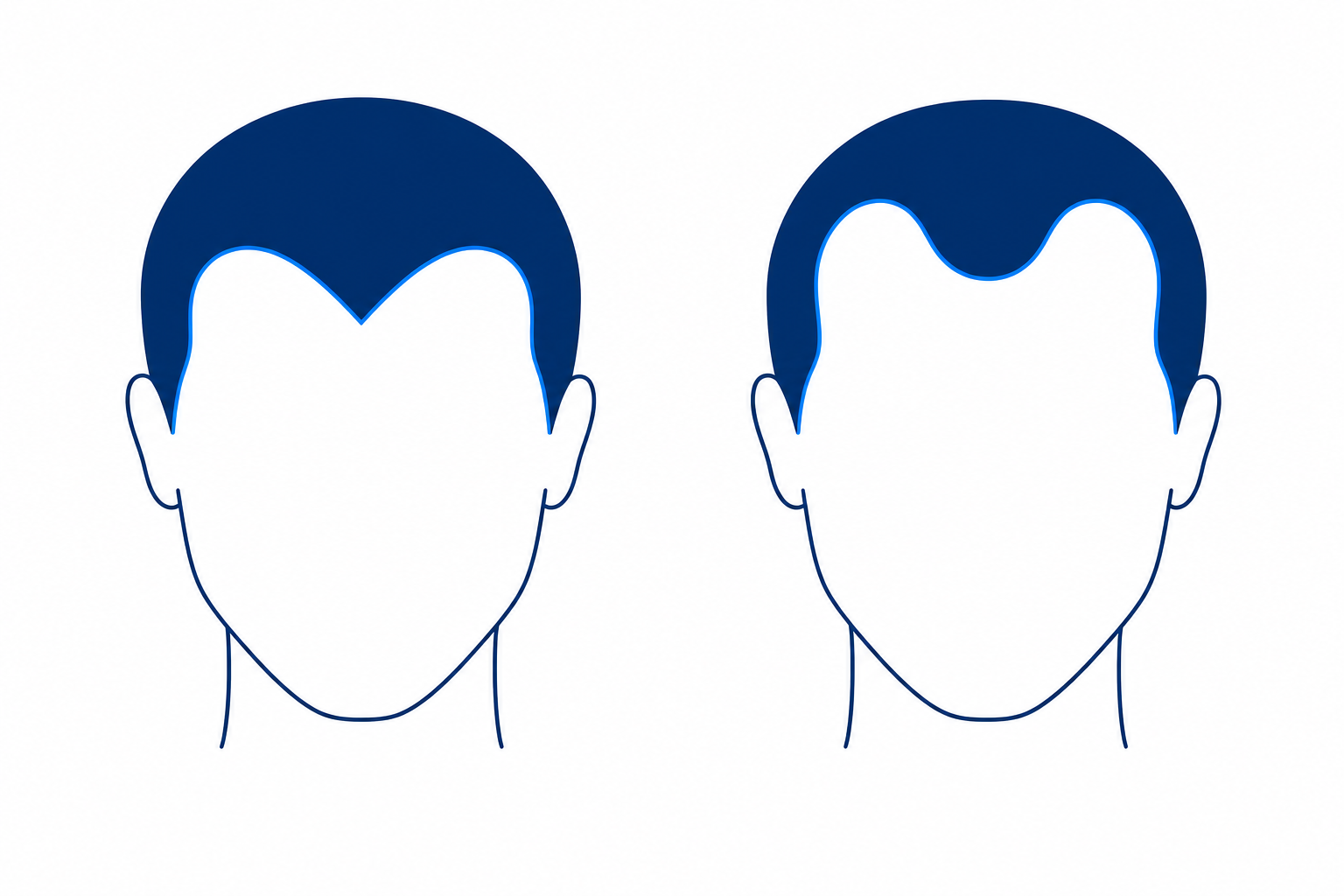
A widow’s peak is an inherited hairline feature you are born with, and it has no clinical significance. It is the central, V-shaped point in the middle of the forehead. It looks clearly different from the M-shaped recession at the temples caused by hair loss.
Inherited hairline or hair loss? Mature hairline versus early recession
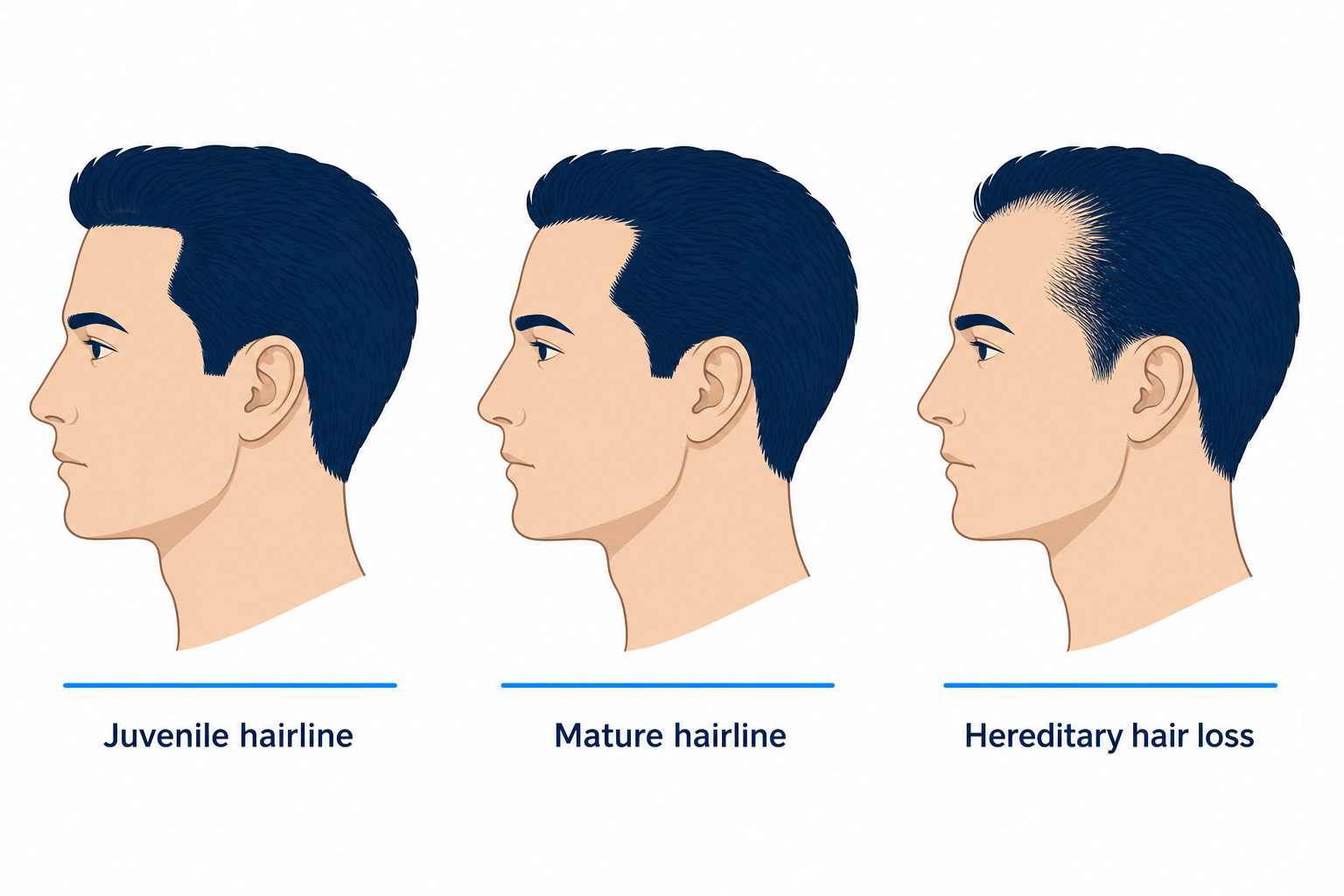
Whether receding temples are simply the hairline you were born with or the start of hair loss comes down mainly to time. An inherited or mature hairline stays stable and symmetrical for years. Early hereditary recession keeps moving, gets deeper and shows increasingly fine, miniaturised hairs at the temples.
The mature hairline is a normal step in growing up. The straight, childlike line usually moves back evenly between the ages of 17 and 30, roughly 1 to 1.5 centimetres as a rule of thumb, and then stops. Strong terminal hair still reaches all the way to the new edge.
With early androgenetic alopecia, by contrast, there is no natural stopping point. The hallmark is miniaturisation of the hair follicles: strong terminal hair turns into fine, short, pale vellus hairs. The pattern can also be uneven at first, with one side deeper than the other.
The checklist below is a guide, not a diagnosis. It helps you work out which way your temples are more likely to be heading.
| Feature | Inherited / mature hairline (harmless) | Hereditary hair loss (progressive) |
|---|---|---|
| Change over time (old photos) | Stable for years, no movement | Becomes measurably deeper |
| Symmetry | Both sides largely the same, slight natural differences possible | One side recedes noticeably more than the other |
| Hair quality at the temples | Strong terminal hair right up to the edge | Fine, short “baby hairs” (miniaturisation) |
| Onset | Late puberty, then it stops | Starts and keeps progressing |
| Family history | High forehead without balding | Fathers and brothers with progressive recession |
| Accompanying signs | none | thinning at the parting or crown as well |
A guide, not a diagnosis. Only a medical hair assessment gives you certainty.
A second clue, often underrated, is the pace. It is not the height of the line that matters but its movement. The comparison below makes that clearer, especially for young people who mistake a one-off maturing step for the start of going bald.
| Mature / inherited hairline | Hereditary hair loss | |
|---|---|---|
| Time frame | Takes anything from a few months to 1 or 2 years to settle, then stops | Progresses continuously over years |
| End point | A stable line with no further recession | No natural stopping point without treatment |
| Hair quality | Stays strong | Gets progressively thinner (miniaturisation) |
Since comparing photos over time is the most reliable thing you can do on your own, it is worth doing it properly. Badly taken pictures with changing light or angles can suggest a change that is not really there. Here is how to document it so the shots stay comparable:
How to compare your hairline properly
- Dampen your hair and comb it back off your forehead, so the real line becomes visible.
- Use the same even lighting every time, with no flash from below or at an angle.
- Same distance, camera at eye level, head straight, not tipped back.
- Take one shot front-on and one from each three-quarter angle.
- Use the distance from your eyebrow to your hairline as a fixed reference, measured in the middle and at both temples.
- Repeat every 3 to 6 months, note the date, keep the conditions identical.
If the line moves measurably against your reference point, that points to a progressive course. If it stays put, it is stable.
Receding temples as a teenager: normal between 14 and 20?
Receding temples in your teens, usually from around 16 to 18, are in the vast majority of cases nothing more than the hairline maturing, and they affect a large proportion of young men. Hair loss only becomes relevant for treatment once the recession clearly progresses and the hair visibly thins.
The change from the straight childlike line to the more angular adult shape is a hormonal step in puberty, not hair loss. It is entirely understandable that receding temples feel like a heavy burden at this age. That makes a level-headed assessment all the more important, because there is usually no reason to panic. If you compare old photos and see no further movement, you have almost certainly just reached your adult hairline.

Even so, hereditary hair loss can start early. Studies on the adolescent form report very different rates depending on the definition and the population studied, from under 2 per cent to more than 15 per cent (reviews in the medical literature, including McDonough & Schwartz, Cutis 2011). Any single percentage figure would therefore be misleading.
What matters is what that means in practice: genuine, clearly progressing recession with thinning before the age of 20 points to early-onset androgenetic alopecia and is a reason to see a dermatologist now rather than wait. The sooner you know what you are dealing with, the more hair you can keep. What actually helps at that point is covered in our guide to treating a receding hairline.
Why do the temples recede first?
The temples recede first because their hair follicles are genetically particularly sensitive to the hormone DHT (dihydrotestosterone). DHT makes sensitive follicles shrink, while the follicles at the back of the head stay largely DHT-resistant. That is why men develop the typical M shape.
The chain of events in brief: the enzyme 5-alpha reductase converts testosterone into DHT. DHT binds to the androgen receptor in follicle cells about five times more strongly than testosterone does. Sensitive follicles respond by shortening their growth phase and miniaturising. These male stages are classified on the Hamilton-Norwood scale (Hamilton 1951, revised by Norwood 1975).
That is where both mix-ups come from: the sensitivity is inherited, but the hair loss only appears once enough DHT has acted over enough time. This is exactly why it is described as genetic, yet not visible at birth. How an individual follicle moves through its growth phases is explained in our article on the hair growth cycle, and the genetic background in our article on androgenetic alopecia.
One important caveat: this DHT mechanism at the temples describes the male pattern. In female pattern hair loss, DHT is often not the only driver, and the front hairline usually stays intact. More on women in a moment. Diffuse hair loss across the whole scalp caused by a deficiency or an illness, by contrast, does not create wedge-shaped corners at the temples at all.
Receding temples in women: inherited, hormonal or a warning sign?
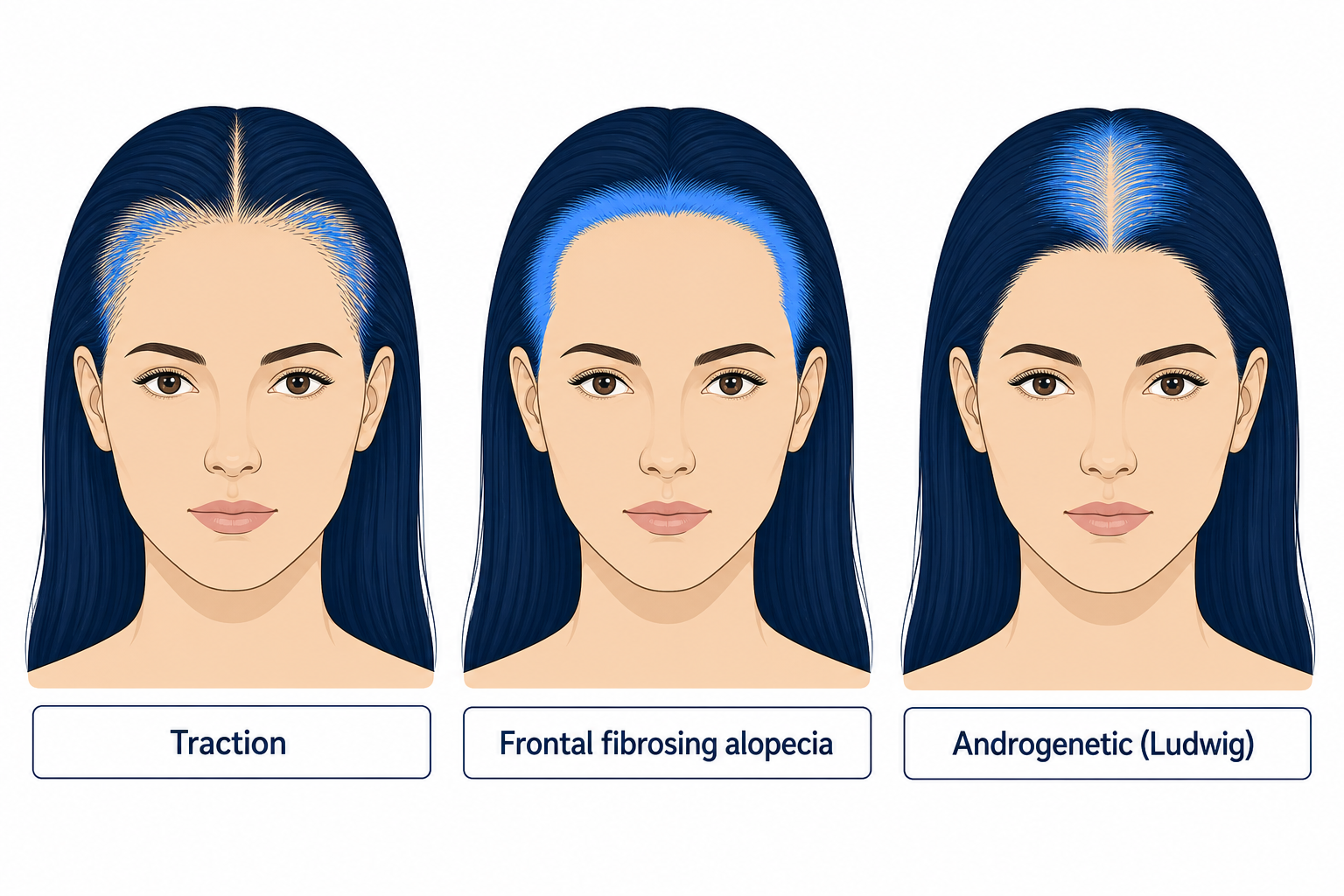
The classic male M shape is rare in women. Female pattern hair loss usually shows up as diffuse thinning around the parting with the front hairline preserved, known as the Ludwig pattern (Ludwig, British Journal of Dermatology, 1977). Clearly receding temples in a woman are therefore more of a warning sign than a harmless maturing step.
In a woman it is harmless when the hairline naturally sits higher or forms a widow’s peak and has been stable since her teens, with no thinning. That should not be confused with a mid-parting that widens into a triangular shape, the Olsen pattern, where the hairline itself stays intact but the parting looks broader.
Women should have new, progressive recession at the temples checked out, along with visible thinning or accompanying signs such as irregular periods, acne or increased body hair. Signs like these can point to raised androgens, for example in PCOS. Important: hair loss alone does not prove PCOS, since most affected women have normal androgen levels (Androgen Excess and PCOS Society, J Clin Endocrinol Metab, 2019).
For a woman with receding temples, then, working out the cause comes before any self-treatment. A good starting point is our overview of hair loss in women and, for the hormonal and diffuse side of things, a blood test for hair loss.
Hair loss at the temples in women caused by traction
A common and often overlooked cause of hair loss at the temples in women is traction alopecia. Constant pull from tightly bound hairstyles such as ponytails, buns, cornrows, braids, extensions or weaves weakens the hairs at exactly the temple and front hairline. Men with a man bun can be affected too, but women make up the majority.
Typical signs are thinning or bald strips along the lines of tension, plus fine remaining hairs at the very edge, the so-called fringe sign. In one clinical cohort it was present in around 90 per cent of the patients examined (eScholarship, “The Fringe Sign”). The loss is painless and gradual at first.
Timing is the decisive factor: the early stage is non-scarring and reversible once the tension is reduced, while the late, chronic stage scars and is irreversible (StatPearls, “Traction Alopecia”). In practice that means reducing the pull, wearing looser styles and taking breaks from extensions. The earlier you act, the better the outlook. Traction follows the pattern of the pull, not the androgenetic pattern.
When it is not hereditary recession: traction, FFA and diffuse hair loss
Not every receding temple line is hereditary or a harmless inherited shape. Four conditions look similar but need to be classified differently: the mature or inherited hairline, traction alopecia, frontal fibrosing alopecia and diffuse hair loss across the whole scalp.
The mature or inherited hairline is stable and symmetrical, with no clinical significance. Traction alopecia follows the pattern of the pull and is reversible early on. Diffuse or telogen hair loss affects the whole scalp, creates no wedge-shaped corners and often traces back to iron deficiency, the thyroid or stress, which you can read about in our articles on iron deficiency and the thyroid.
Frontal fibrosing alopecia (FFA) is a scarring form: the front and side hairline recedes in a band, often with loss of the eyebrows and pale, shiny skin along the edge. Eyebrow loss occurs in 64 to 94 per cent of cases (reviews, including PMC9357920). FFA has to be treated by a doctor and, while it is active, it is not an indication for a transplant.
One widespread misconception worth correcting: FFA does not only occur after the menopause. Kossard did describe it in 1994 in six post-menopausal women, but since then cases in pre-menopausal women aged roughly 20 to 40 have been increasing as well. Younger women should not rule the diagnosis out and should see a dermatologist if they suspect it.
The vitamin myth deserves debunking too: an inherited hairline shape and hereditary recession are not caused by a lack of vitamins or nutrients. A deficiency produces diffuse hair loss across the whole scalp, not wedge-shaped corners at the temples, and supplements do not fill those corners back in. There is more on this in our article on vitamins for hair loss.
A safety note: do not use minoxidil on your own on inflamed or scarring scalp (active FFA) or on areas under strain from pulling (traction). It can make irritation worse and it does not resolve these conditions. Diagnosis first, then treatment.
Because women in particular have several possible causes, the overview below helps sort them out, though it is no substitute for a medical examination.
| Cause | Typical pattern | Accompanying signs | Reversible? | What to do |
|---|---|---|---|---|
| Inherited / mature hairline | Stable, symmetrical | none | not hair loss | nothing needed |
| Traction alopecia | Tension zones (temples, front hairline) | Fringe hairs, sometimes tender | yes early on, no once scarred | Reduce the pull, change hairstyle |
| Frontal fibrosing alopecia | Band-like recession of the front and temple hairline | Eyebrow loss (64–94%), shiny skin | scarring, no | See a dermatologist, no self-treatment |
| Androgenetic (Ludwig) | Diffuse at the parting, front line usually preserved | possible signs of PCOS | partly, with treatment | Get a medical assessment, confirm the cause |
| Diffuse / telogen | Whole scalp, no corners | follows a deficiency, stress or illness | usually yes | Blood test, treat the cause |
As a woman with receding temples, always get a medical assessment.
Some signs are not for you to interpret yourself and need a dermatologist. The list below sums up the red flags.
Red flags: when to see a doctor
- Very rapid hair loss within a few weeks
- Round, patchy bald spots (alopecia areata)
- Itching, redness, flaking or shiny, scarred skin along the edge
- Clearly receding temples in a woman
- Loss of the eyebrows
- Thinning along the lines of tight, pulling hairstyles
- Hair loss together with fatigue, irregular periods or other symptoms
In these cases see a dermatologist and avoid self-treatment. Our overview of the causes of hair loss helps you narrow things down, and our article on alopecia areata helps you tell the two apart.
Are receding temples a sign that you will go bald?
A stable, inherited hairline is not a precursor to baldness. Hereditary, progressing recession at the temples is an early indicator of further hair loss, but it does not inevitably end in a completely bald head. How far it goes depends on your genetic predisposition.
How it develops varies from person to person. Some cases settle early, others keep progressing. Most men with a mature, stable hairline never develop pronounced baldness. An early onset and a strong family history count as prognostic markers for a course that is more likely to progress.
So the message is not panic but clarity: the sooner you know which type you have and how it is developing, the better you can influence it. The sensible first step is working out what you are dealing with, rather than reaching for a product straight away.
What to do about receding temples, inherited or hereditary
The first step with receding temples is not a product but a diagnosis: is this a harmless inherited hairline, traction, FFA or hereditary hair loss? Only the hereditary (androgenetic) type responds to hair growth medication or a hair transplant at all.
That leads to a simple set of decisions. A harmless hairline or a widow’s peak needs nothing. With traction, reducing the pull is what helps. If FFA is suspected, it is one for a dermatologist. And for hereditary hair loss, you will find the detailed options, from minoxidil and finasteride through to transplants and costs, in our guide to treating a receding hairline.
How we see it at Elithair
With receding temples, the first question is never which treatment but which type. A stable, inherited hairline is not something you treat. Traction and the scarring condition frontal fibrosing alopecia are cases in their own right and not candidates for a hair transplant. Only hereditary hair loss responds to medication or a transplant. That is why the starting point is the assessment, not the operation.
If you see any of the red flags listed above, your first stop is always a doctor, not an online analysis. If that medical check has already happened, or if the question is purely whether the pattern is stable or progressing, a free hair analysis from Elithair helps with the visual assessment. It looks only at the visible pattern and hair quality. It replaces neither a blood test nor a dermatological examination, but it does give you a first sense of direction.
Frequently asked questions about being born with a receding hairline
Can you be born with a receding hairline?
Receding temples themselves are not a congenital condition in medical terms. What you are born with is only the shape and height of the hairline. A wedge-shaped, progressing recession, by contrast, usually develops later through hereditary (androgenetic) hair loss.
Do babies or toddlers already have receding temples?
No, babies and toddlers do not yet have genuine receding temples. The wedge-shaped contour on an infant’s forehead is a hairline that has not finished forming yet, together with the normal shedding of newborn hair. It says nothing about hair loss later on.
How do I tell whether my receding hairline is inherited or hair loss?
The decisive factor is how it changes over time. An inherited or mature line is stable for years and largely symmetrical. A progressing recession becomes measurably deeper and shows fine, miniaturised hairs. A photo comparison over 3 to 6 months helps.
Can a receding hairline be asymmetrical?
Slight natural asymmetry is normal and harmless. Hardly any face is exactly symmetrical, and a whorl or cowlick can make one side look a little different too. Only a clearly uneven recession that progresses over months, with one side moving back distinctly more, points towards early hereditary hair loss and is a reason to keep an eye on it.
Receding temples or a widow’s peak, what is the difference?
A widow’s peak is a central, V-shaped point in the middle of the forehead, an inherited and harmless feature. Receding temples are the M-shaped indentations at the sides and can indicate hair loss.
Who do you inherit a receding hairline from, your mother or your father?
A receding hairline is inherited from both sides of the family. The inheritance is polygenic, spread across many genes. The myth that the predisposition comes only from your mother’s father has been scientifically disproved.
Which vitamin am I lacking if my temples are receding?
None. An inherited hairline shape and hereditary recession are not caused by a vitamin deficiency. A deficiency causes diffuse hair loss across the whole scalp, not wedge-shaped corners at the temples, and supplements do not fill those corners back in.
Receding temples at 16 or 17, is that normal for a teenager?
In the vast majority of cases they are normal. The slight recession at the temples in late puberty is the hairline maturing as it should. Only clearly progressing recession with visible thinning should be assessed by a doctor early on.
Can a teenager already have hereditary hair loss?
Yes, a teenager can already have hereditary hair loss, but the great majority of adolescent changes at the temples are the harmless maturing step. Studies report very different rates for early-onset predisposition, from under 2 to over 15 per cent.
Do women get receding temples too, and why do they look different?
Women rarely get the classic M shape. Female pattern hair loss usually shows up as thinning around the parting with the front line preserved (the Ludwig pattern). Clearly receding temples are more of a warning sign in women.
Why are my temples receding as a woman?
Several causes are possible: pull from tight hairstyles (traction alopecia), the scarring condition frontal fibrosing alopecia, a hereditary pattern or diffuse hair loss. Which one applies should be clarified by a dermatologist.
Hair loss at the temples from a ponytail or extensions, is that traction alopecia?
It can be traction alopecia. Constant pull weakens the hairs along the temple and front hairline. Early on the loss is reversible once the tension is reduced, but not in the late, scarred stage.
Is a hairline you were born with a sign that you will go bald?
A stable, inherited hairline is not a precursor to baldness. Only progressing, hereditary recession is an early indicator of further hair loss, and even then it does not inevitably end in a completely bald head.
Does an inherited receding hairline ever grow back?
An inherited hairline shape does not change and does not fill back in, but it has no clinical significance either. With hereditary hair loss, early treatment under medical supervision can influence the course.
When should I see a doctor about receding temples?
If the loss is very rapid, if you have round patchy bald spots (alopecia areata), redness or flaking, loss of your eyebrows, if you are a woman with clearly receding temples, or if hair loss comes with other symptoms. Then see a dermatologist and avoid self-treatment.
Sources
- Kanti V, Messenger A, Dobos G, et al. Evidence-based (S3) guideline for the treatment of androgenetic alopecia in women and in men. J Eur Acad Dermatol Venereol. 2018;32(1):11-22.
- Evidence for a polygenic contribution to androgenetic alopecia. British Journal of Dermatology. 2013;169(4):927.
- McDonough PH, Schwartz RA. Adolescent androgenic alopecia. Cutis. 2011;88(4):165-168.
- Female Pattern Hair Loss, An Update (Ludwig and Olsen classifications). PMC7413422.
- Female Pattern Hair Loss and Androgen Excess (PCOS committee). J Clin Endocrinol Metab. 2019;104(7):2875.
- Traction Alopecia. StatPearls, NCBI Bookshelf NBK470434.
- The Fringe Sign, a useful clinical finding in traction alopecia. eScholarship.
- Frontal fibrosing alopecia, a review of disease pathogenesis. PMC9357920.
This article is intended as general information and guidance and does not replace a medical diagnosis or treatment. If your hair loss is progressing or unclear, please speak to a doctor, ideally a dermatologist. Last updated 2026.

Dr. Imad Moustafa
Hair transplant specialist