

In short: this is how fast hair grows
On the scalp, hair grows by roughly 1 cm a month on average, which works out to about 0.3 to 0.4 mm a day and 12 to 15 cm a year (NCBI StatPearls; AOK-Magazin). This baseline pace is largely set by your genes and cannot really be sped up. You can only release the brakes, not raise the speed.
- Average growth: around 1 cm a month (individual range of 0.6 to 1.5 cm).
- Per day / per year: around 0.3 to 0.4 mm / 12 to 15 cm.
- Fastest area: the hair on your head, because its growth phase lasts the longest at 2 to 7 years.
- Speeding it up: barely possible; you can only release the brakes, such as nutrient deficiencies, hair breakage and an unhealthy scalp.
- After a trim: no faster growth, because hair grows from the root, not from the tip.
Almost everyone has asked themselves this at some point: after a haircut gone wrong, while growing out an old style, or when hair simply “won’t grow properly” any more. This guide (2026 edition) uses evidence-backed figures to answer how fast hair really grows, why the pace is similar for everyone, and what you can actually influence.
Summary
- How fast does hair grow per month, per day and per year?
- How fast does the hair on your head grow compared with the rest of your body?
- Why does hair grow faster for some people?
- Does hair grow faster if you cut it?
- Can you speed up hair growth?
- How long does it take to reach your target length?
- Why does hair stop growing beyond a certain length?
- Slow growth, or already hair loss?
- How fast does hair grow back after shedding and after a hair transplant?
- Checklist: normally slow, or worth getting checked?
- Frequently asked questions: how fast does hair grow?
- Sources
How fast does hair grow per month, per day and per year?
Hair grows by around 1 cm a month on average, which equates to roughly 0.3 to 0.4 mm a day and 12 to 15 cm a year. The peer-reviewed reference text NCBI StatPearls (“Anatomy, Hair”) gives a figure of 0.35 mm daily; the German-language AOK-Magazin rounds this to 1 cm a month and 12 cm a year.
These values are averages. Realistically, the individual range sits at around 0.6 to 1.5 cm a month, and in rare cases up to about 2 cm. How fast hair grows per month depends on genetics, age, ethnicity and health (more on this below). One centimetre a month is the reliable rule of thumb.
| Timeframe | Average | Realistic range |
|---|---|---|
| Per day | ~0.35 mm | 0.25 to 0.5 mm |
| Per week | ~2.5 mm | 1.75 to 3.5 mm |
| Per month | ~1 cm | 0.6 to 1.5 cm (rarely up to ~2 cm) |
| Per year | ~12 to 15 cm | 8 to 18 cm |
Source: aggregated from NCBI StatPearls, AOK-Magazin and Loussouarn et al. 2001 (ethnic ranges).
How fast does the hair on your head grow compared with the rest of your body?
The hair on your head grows fastest and becomes the longest of all body hair, because its growth phase (anagen) lasts the longest at 2 to 7 years. According to NCBI StatPearls, 85 to 90% of scalp hairs are in this active phase at any one time. Beard hair, eyelashes and body hair have a shorter anagen phase and therefore stay shorter.
One misconception is key here: the daily pace of scalp and beard hair is similar (around 0.3 mm a day for each). The big difference in achievable length comes almost entirely from the length of the growth phase, not from fundamentally faster growth on the head. Eyelashes grow for only a few weeks and therefore stay short.
| Region | approx. mm/day | approx. cm/month | Anagen duration | What it means in practice |
|---|---|---|---|---|
| Scalp hair | ~0.3 to 0.4 | ~1 | 2 to 7 years | Can grow very long |
| Beard hair | ~0.27 | ~1.25 | 2 to 6 years | Similar pace, often patchier from person to person |
| Eyebrows | ~0.16 | ~0.3 to 0.5 | 4 to 6 months | Grows only briefly, stays short |
| Eyelashes | ~0.12 to 0.16 | ~0.3 to 0.4 | 4 to 11 weeks | Shortest phase, shortest length |
Scalp hair baseline data: NCBI StatPearls. Beard, eyebrow and eyelash values are convergent estimates drawn from several dermatological reviews.
The fact that beard hair looks slower or patchier in many men is usually down to genetics, not a question of grooming. To learn why gaps appear and what you can influence, read our guide on stimulating beard growth.
Why does hair grow faster for some people?
Hair grows faster for some people because the baseline pace is set genetically, while a few factors shift it by fractions of a millimetre: age, sex and hormones, ethnicity, the season, and your nutritional and general health. By far the biggest factor is genetics, which determines both pace and maximum length via the length of the anagen phase.
Ethnicity and hair type
Hair type influences how fast hair grows. The most robust study in the field (Loussouarn, British Journal of Dermatology 2001) measured African hair at 256 µm/day (≈0.77 cm/month) and Caucasian hair at 396 µm/day (≈1.19 cm/month). Asian hair tends to grow the fastest. These differences are real tendencies, not an exact prediction for any one person.
Age, hormones and the season
Growth slows with age because the anagen phase tends to shorten (review article PMC9917549). This is likely to become clearly noticeable only later in life, roughly from your 40s and 50s onward and in women after the menopause. During pregnancy, oestrogen and progesterone extend the growth phase and hair looks fuller; after birth, a temporary shedding often follows (Cleveland Clinic). The menopause can also make hair thinner.
A seasonal effect is documented, but it is small: a study on the seasonality of hair shedding (PMID 19407435) found the highest shedding rate in summer. In other words, hair does not grow noticeably faster in summer. The difference amounts to a few tenths of a millimetre a day and is invisible in everyday life.
Curls and shrinkage
Curly hair grows just as fast at the follicle as straight hair, but it appears to gain length far more slowly. The reason is shrinkage: curls contract and hide anywhere from 30 to 75% of the actual length depending on the curl pattern. This is not a warning sign; if anything, it is a mark of healthy, elastic hair.
Diet plays a part too: a proven deficiency in iron, protein, zinc or vitamin D can push hair into the resting phase and slow growth. You will find details on nutrients in our guides on vitamins against hair loss and iron deficiency and hair loss.
Does hair grow faster if you cut it?
No. Hair does not grow faster after a cut, because it grows from the root in the follicle, not from the cut tip. Scissors and razors never reach the growth-active zone in the scalp at all. The Mayo Clinic confirms it too: shaving changes neither the growth rate nor the colour or thickness of the hair root.
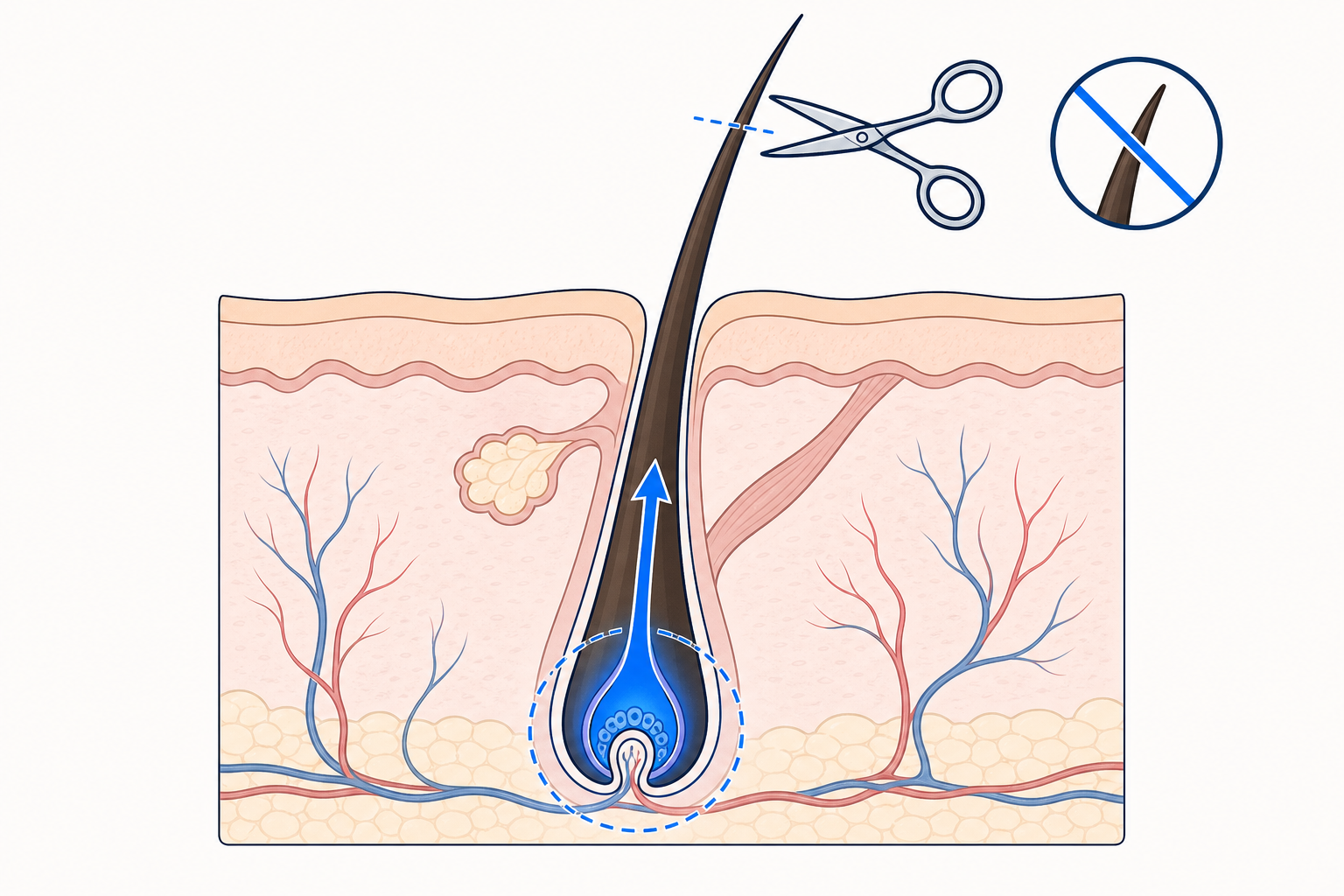
Why it still creates a false impression: freshly cut or shaved tips are blunt and all the same length, which makes them look denser and stronger. Shaving creates a blunt cut in the thicker part of the hair shaft, so the stubble feels coarser and looks darker because it has not yet been bleached by the sun (AOK-Magazin).
Regular tip trims do have a real benefit, though: they remove split ends and curb breakage. This does not make hair grow faster, but it loses less length at the ends and looks better cared-for and, over time, longer. So if you want long hair, the gains come from losing less to breakage, not from growing faster.
Can you speed up hair growth?
Hair growth can barely be sped up: the genetic baseline pace of around 1 cm a month cannot be meaningfully increased. The only realistic option is to release existing brakes, meaning correcting proven nutrient deficiencies, reducing breakage and keeping the scalp healthy. Anyone whose levels are already adequate has little more to gain.
Nutrients such as iron, protein, zinc or vitamin D only demonstrably help where there is a genuine, diagnosed deficiency. Biotin is rarely lacking in someone eating a healthy diet; taking it without a deficiency has no proven benefit for growth speed. “Test first, then supplement” is the safe rule here, not least because self-supplementing carries risks.
There is cautious evidence for scalp massage: a self-report survey by English and Barazesh (2019, n=340) reported that 68.9% of participants noticed less hair loss with daily massage. This was not a controlled trial, and many participants were using medication at the same time. The survey does not prove a faster baseline pace in healthy hair.
Minoxidil is a pharmacy or prescription medicine for diagnosed (androgenetic) hair loss, not a cosmetic growth booster for healthy people. It extends the growth phase in genetic hair loss (Messenger and Rundegren 2004). Scalp irritation and an initial increase in shedding are known effects; the benefit ends once you stop using it. Only use it after consulting a doctor or pharmacist.
| Measure | Does it speed up growth? | Proven effect | In context |
|---|---|---|---|
| Trimming the ends | No | Prevents split ends and breakage | More visible length, no faster growth |
| Shaving | No | No effect on rate or thickness | The stubble look is deceptive |
| Scalp massage | Unclear | Survey (n=340): 68.9% less shedding (self-reported) | Cautiously positive for shedding, no proof for speed |
| Biotin / hair gummies | Only with a deficiency | No added benefit without a deficiency | Not a blanket growth remedy |
| Correcting iron / ferritin | Only with a deficiency | Shedding can improve where a deficiency exists | Only after medical diagnosis, do not self-dose |
| A balanced diet | Indirectly | The basis for healthy growth | Avoid deficiencies; “more” does not help |
| Castor oil | Not proven | No robust clinical data | A conditioning effect is possible, no growth proof |
| Rice water | Not proven | No clinical data | A trend with no evidence |
| Caffeine shampoo | Inconsistent | A few small studies, no broad confirmation | No growth guarantee |
| Minoxidil | Yes, in genetic loss | Approved for androgenetic alopecia | A medicine, pharmacy/prescription only |
| Cutting back on heat / dye | No (speed), yes (breakage) | Less breakage = more length | An indirect effect on length |
Sources: NCBI StatPearls, Mayo Clinic, English & Barazesh 2019, Messenger & Rundegren 2004. Not a recommendation for self-medication; use medicines and nutrients only after medical assessment.
A common misconception lies behind the phrase “my hair won’t grow any more”. Often this is not a growth problem but a breakage problem: the hair keeps growing at the root but breaks off at the tips just as fast. This is typical with heavy bleaching, heat styling, extensions or very tight tying.
In practical terms, you protect length by mechanically avoiding breakage: detangle wet hair only with a wide-tooth comb instead of brushing hard, sleep on a silk or satin pillowcase to reduce friction, and steer clear of very tight plaits, buns and metal hair ties. Cut back on heat styling and aggressive bleaching where you can.
How long does it take to reach your target length?
At around 1 cm of hair growth a month, reaching your target length takes a corresponding amount of time: for 12 cm of growth, plan for about a year. The table below works through common hairstyle goals. All figures are model calculations at an average pace, not an individual guarantee, since the range is 0.6 to 1.5 cm.
| From | To | approx. cm of growth | approx. duration (at 1 cm/month) |
|---|---|---|---|
| Short cut (~2 cm) | Bob (~15 cm) | ~13 cm | ~13 months |
| Bob (~15 cm) | Shoulder length (~30 cm) | ~15 cm | ~15 months |
| Shoulder length (~30 cm) | Bra-strap length (~40 to 45 cm) | ~10 to 15 cm | ~10 to 15 months |
| Growing out a pixie (~3 cm) | Bob (~15 cm) | ~12 cm | ~12 months |
| Growing out an undercut (~0 cm) | Blending with the top (~10 cm) | ~10 cm | ~10 months |
Guide values at an average growth of around 1 cm/month, not an exact prediction.
Why does hair stop growing beyond a certain length?
Hair does not stop growing, but every individual hair has a genetically limited growth phase (anagen) of 2 to 7 years. Once it is over, the hair falls out and is replaced by a new one. This anagen duration determines the maximum achievable length, as NCBI StatPearls describes for the hair cycle.
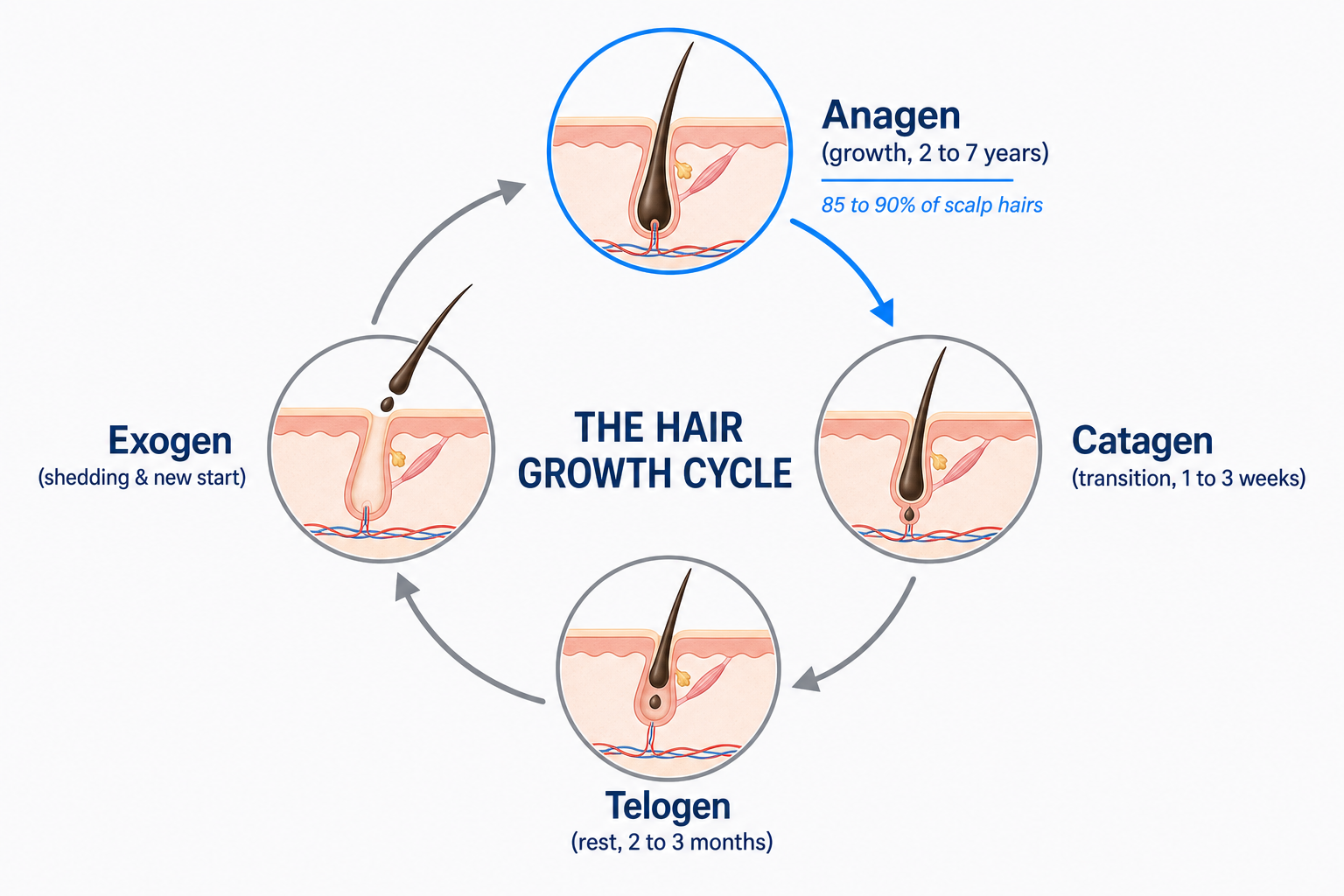
A worked example makes it tangible: at 1 cm a month and an anagen phase of 6 years, a hair reaches around 72 cm. With just a 2-year growth phase, it is about 24 cm. Anyone who has inherited a short anagen phase will never exceed a certain length, regardless of grooming. There is more on this in our guide to the hair cycle.
Slow growth, or already hair loss?
People who feel their hair “won’t grow any more” often have no problem with pace, but are losing density. Two patterns are worth telling apart: diffuse thinning across the whole head, and androgenetic hair loss with a receding hairline or a sparse crown. In the genetic type the follicles shrink and the hairs become finer and shorter, which feels like slower growth.
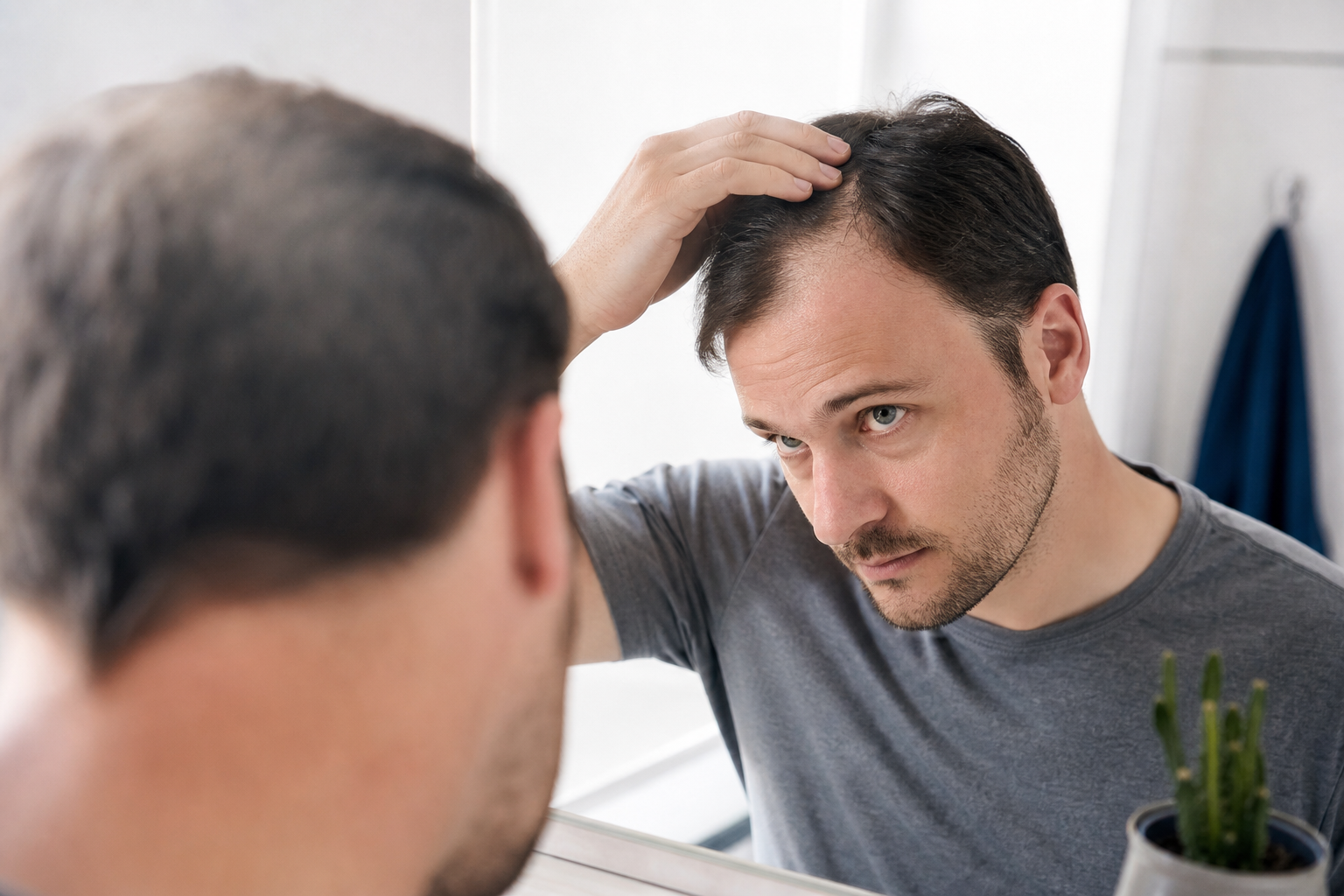
Diffuse thinning usually has treatable causes: iron deficiency, a thyroid disorder, stress, the period after a pregnancy, or the perimenopause. Once the cause is addressed, hair generally grows back. With androgenetic hair loss, by contrast, the growth phase shortens permanently; here the problem is not speed but the loss of follicles.
You should have it checked if you experience sudden diffuse hair loss over several weeks, visibly thinning zones, a receding hairline, or shedding alongside symptoms such as fatigue, cycle irregularities or signs of a thyroid problem. For background, see our guides on the causes of hair loss, hair loss in women and hair loss due to the thyroid.
Diffuse or genetic? Why the distinction matters
With diffuse, potentially reversible hair loss, the priority is to identify the cause through lab tests and a doctor; this is not a case for a hair transplant. Only where follicles have been permanently lost to genetic hair loss does speeding things up make no difference. A free, no-obligation hair analysis serves here as an initial visual assessment of which type is involved. It does not replace a medical blood test, but it helps to clarify whether any treatment makes sense at all.
Not sure which type applies to you?
The free, no-obligation hair analysis gives an initial visual assessment. It does not replace a medical blood test.
Start your free hair analysisHow fast does hair grow back after shedding and after a hair transplant?
After normal shedding, a new hair grows back in the same spot at the usual pace of around 1 cm a month, provided the follicle stays healthy. Transplanted hairs do not grow faster either: after the normal shedding of the transplanted hairs (weeks 2 to 6), the preserved roots start afresh and follow the same baseline pace.
| Phase after the hair transplant | Timeframe | What happens |
|---|---|---|
| Possible shock loss | Weeks 2 to 6 | The transplanted hairs may fall out, the root is preserved |
| Resting phase | Months 2 to 3 | The follicles rest before they start afresh |
| First regrowth | from month 3 to 4 | Fine new hairs become visible (~1 cm/month) |
| Visible density | Months 6 to 9 | About 50 to 60% of the result |
| Final result | Months 12 to 18 | Full, final density |
Timeframes that converge across the industry, varying from person to person. Transplanted hair grows at the same baseline pace as natural hair.
An important point to keep in mind: a hair transplant is not a shortcut for speed. It restores hair where there are no active follicles left; the growth itself stays at around 1 cm a month. That is why the final result is in place only after 12 to 18 months, not sooner.
After chemotherapy, hair grows back in most people, often with the first fine hairs a few weeks after the treatment ends and a clear recovery over several months. The course varies greatly from person to person, and texture or colour can change temporarily. You should always have this process overseen by a doctor.
Checklist: normally slow, or worth getting checked?
The following guide helps you judge whether your hair is growing at a normally slow pace or whether there is a reason to get it checked. It does not replace a medical diagnosis, but it gives an initial steer. When in doubt, or if you have accompanying symptoms, seeing a doctor is always the safe route.
Normal (patience is all it takes)
- Hair has grown evenly for years, just “feels slow”
- No visible loss of density, no new bald patches
- A lot of breakage or split ends at the tips
- Curls with noticeable shrinkage
- After birth or a hormonal shift, with shedding that eases within months
Worth getting checked
- An increasingly sparse crown or receding hairline
- Sudden, diffuse hair loss over several weeks
- Accompanying symptoms such as fatigue, cycle irregularities, signs of a thyroid problem
- Shedding after illness, surgery or significant weight loss
- Shedding in the perimenopause that does not ease on its own
A view from practice
In the consulting room, many people confuse slow growth with the onset of hair loss. The two are easy to separate: for almost everyone, the baseline pace is around 1 cm a month. What matters is not how fast the hair grows, but whether it is becoming finer and shorter. That is precisely the sign worth following up.
Frequently asked questions: how fast does hair grow?
How fast does hair grow per month?
Hair grows by around 1 cm a month on average, with an individual range of about 0.6 to 1.5 cm. That equates to roughly 0.3 to 0.4 mm a day and 12 to 15 cm a year (NCBI StatPearls, AOK-Magazin).
Does hair grow faster if you cut it?
No. Hair does not grow faster after a cut, because it grows from the root in the scalp, not from the tip. Cutting only prevents split ends, so less breaks off and the hair looks longer over time.
Can you speed up hair growth?
The genetic baseline pace can barely be sped up. You can only release brakes: correct proven nutrient deficiencies, reduce breakage and keep the scalp healthy. There is no miracle cure for faster growth in healthy hair.
How fast does the hair on your head grow compared with a beard?
Scalp and beard hair grow at a similar daily pace (around 0.3 mm). Scalp hair still grows longer because its growth phase lasts longer at 2 to 7 years. Beard hair is often patchier from person to person, usually for genetic reasons.
Why does my hair grow so slowly?
Usually the baseline pace is set by your genes and simply cannot be increased. Hair type, age and, in rare cases, a nutrient deficiency also play a part. If the hair is also becoming visibly finer and thinner, you should get it checked.
Does hair grow faster in summer?
There is a small seasonal effect, but it is not noticeable in everyday life. A study on seasonality (PMID 19407435) actually found the highest shedding rate in summer. There is no question of noticeably faster growth in summer.
How long does it take to go from a short cut to shoulder length?
From a short cut (~2 cm) to shoulder length (~30 cm) is around 28 cm of growth, so at about 1 cm a month that is roughly two and a half years. This is a guide value, not an exact prediction, as the pace varies from person to person.
How fast do transplanted hairs grow?
Transplanted hairs do not grow faster than natural hair, also around 1 cm a month. After a possible initial shock loss, the first hairs appear from month 3 to 4, and the final result is in place after 12 to 18 months.
Sources
- NCBI StatPearls: “Anatomy, Hair” (growth rate, hair cycle, anagen proportion). ncbi.nlm.nih.gov
- AOK-Magazin: “So schnell wachsen Haare”. aok.de
- Loussouarn G. “African hair growth parameters”, Br J Dermatol. 2001;145(2):294-7 (PMID 11531795). onlinelibrary.wiley.com
- English RS Jr., Barazesh JM. “Self-Assessments of Standardized Scalp Massages”, Dermatol Ther. 2019;9(1):167-178 (Survey). springer.com
- Messenger AG, Rundegren J. “Minoxidil: mechanisms of action on hair growth”, Br J Dermatol. 2004 (PMID 14996087). pubmed.ncbi.nlm.nih.gov
- Mayo Clinic: “Shaving hair: Does shaved hair grow back thicker?”. mayoclinic.org
- Cleveland Clinic: “Postpartum Hair Loss”. my.clevelandclinic.org
- Randall VA, Ebling FJ. “Seasonality of hair shedding in healthy women”, Br J Dermatol. (PMID 19407435). pubmed.ncbi.nlm.nih.gov
This article is intended as general information and does not replace medical advice, diagnosis or treatment. If you experience persistent or sudden hair loss, please consult a doctor. As of 2026.

Dr. Imad Moustafa
Hair transplant specialist