

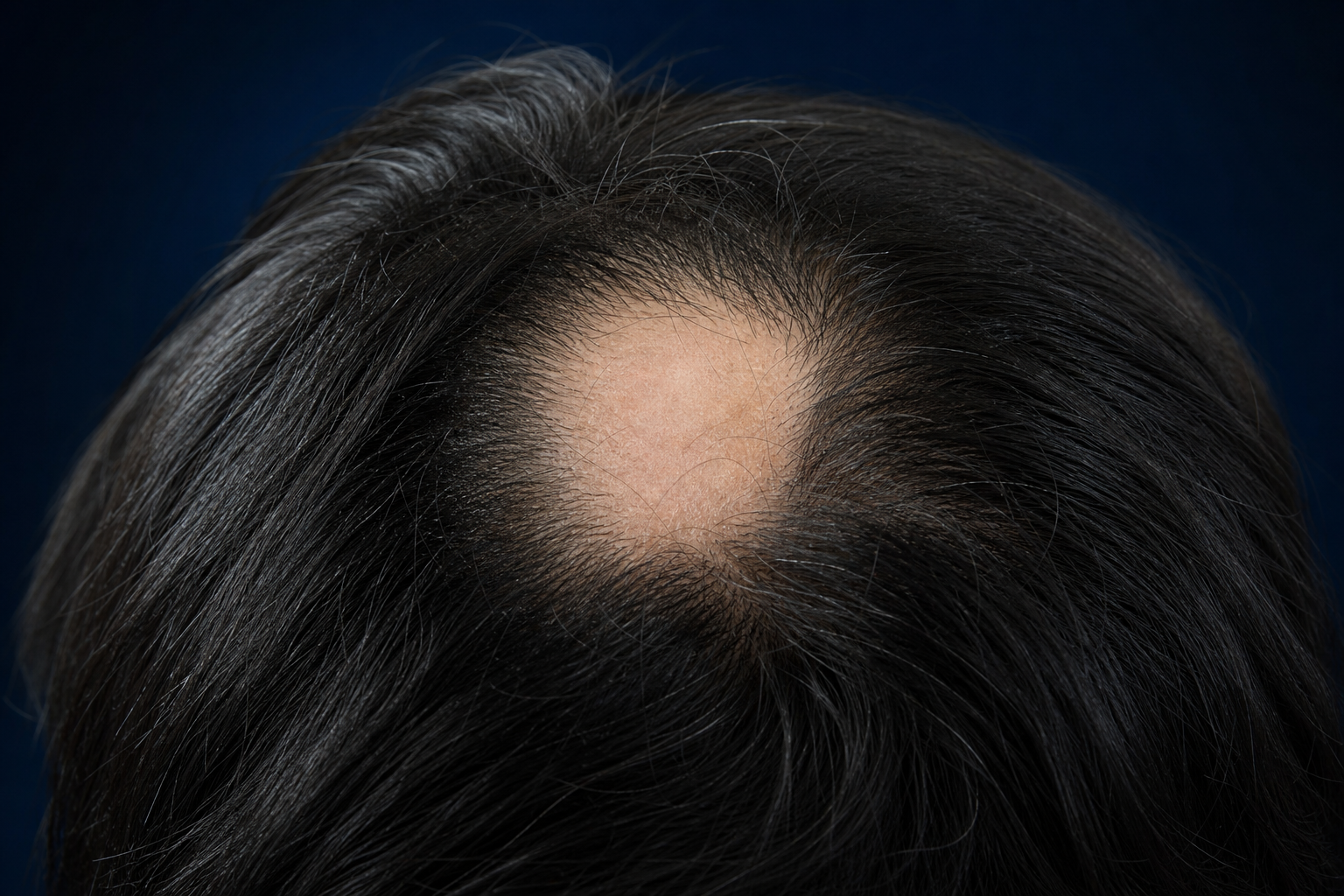
Alopecia areata (AA) affects 1-2 percent of the British population, accounting for 2% of new dermatological NHS outpatients each year.
Scientists have been studying the relationship between AA and autoimmune diseases, coeliac disease, and what causes alopecia areata for many years.
New studies show that patients who received auto immunotherapy and changed their diets experienced successful hair regrowth. We’ll go over these findings in greater depth below.
Quick answer: what is alopecia areata?
Alopecia areata (patchy hair loss) is an autoimmune condition in which the body’s own immune cells attack the hair follicle, creating sharply defined, coin-sized bald patches. The follicle is only switched off, not destroyed, which is why the hair can grow back. The condition is not contagious and not life-threatening, but its course is unpredictable. Assessment belongs with a dermatologist.
- The condition: an autoimmune reaction against the hair follicle, with a worldwide lifetime prevalence of around 2%.
- Characteristic sign: exclamation mark hairs at the edge of active patches (detectable in 91.9% of active cases).
- First-line treatment: topical or intralesional corticosteroids, and JAK inhibitors for severe forms.
- Prognosis: a single small patch often regrows within 6 to 12 months, while extensive forms recover far less often.
Summary
- What is alopecia areata?
- Symptoms: how to recognise alopecia areata
- Causes of alopecia areata
- Forms and severity of alopecia areata
- Does alopecia areata grow back?
- Treatment of alopecia areata
- Alopecia areata vs hereditary hair loss: when a hair transplant is an option
- When to see a doctor about alopecia areata
- Myth vs fact about alopecia areata
- Frequently asked questions about alopecia areata
- Sources
What is alopecia areata?
Alopecia areata (patchy hair loss) is an autoimmune condition in which the immune system attacks the hair follicles and leaves round, sharply defined bald patches. Unlike scarring alopecias, the follicle is only switched off, not destroyed. According to the foundational paper “Hair follicle immune privilege and its collapse” (2020), the structure is preserved, so there is fundamentally the potential for regrowth.[1]
The lifetime prevalence worldwide is around 2%, and 2.1% in a US population study.[2] This makes alopecia areata the most common autoimmune condition of all and the second most common form of hair loss after hereditary hair loss. In Germany, according to the announcement of the new S3 guideline (DDG, February 2026), around 170,000 people are affected, with roughly 70,000 new cases per year.[3]
The condition can begin at any age, with the peak incidence between the ages of 10 and 30. Around 66% of those affected experience their first episode before the age of 30.[4] Contrary to a widespread assumption, women are more often affected: a Global Burden of Disease analysis (1990 to 2021) puts their lifetime risk at around 1.9 times higher than that of men.[5]
Alopecia areata is not contagious, not an infection and not a fungus, and it poses no direct danger to life. The main burden is psychosocial: anxiety, low mood and reduced quality of life are well documented. “Not dangerous” therefore does not mean “harmless”; the emotional strain is real and must be taken seriously.
Symptoms: how to recognise alopecia areata
Alopecia areata shows up as sharply defined, round or oval bald patches on smooth, unremarkable skin, without scaling, redness or scarring. A coin-sized gap is often noticed by chance while combing or by the hairdresser. The edges are clear and the surrounding hair looks healthy. This distinguishes the condition from inflammatory or scarring forms.
The most important warning sign is exclamation mark hairs: short hairs at the edge of active patches that taper towards the scalp and are broader at the tip. They are considered a highly characteristic sign of active disease and, according to a systematic review (2023), are detectable in 91.9% of active cases.[6] They are not strictly conclusive, as they occasionally occur in other conditions too.
Many people notice itching, tingling or burning at the site before any visible hair loss. According to research summaries, this so-called trichodynia is reported by about 25 to 30% of patients. The symptom is often anxiety-provoking, but on its own it is no proof of alopecia areata. It can be an early sign of a new flare-up.
Some of those affected show nail changes, the frequency of which varies widely in the literature (7 to 66%, averaging around 30%). Typical are pitted nails (small dents, 53.3% in one cohort) and trachyonychia (rough sandpaper nails). Nail involvement is regarded as a rather unfavourable prognostic marker. The scalp, beard, eyelashes, eyebrows and body hair can all be affected.
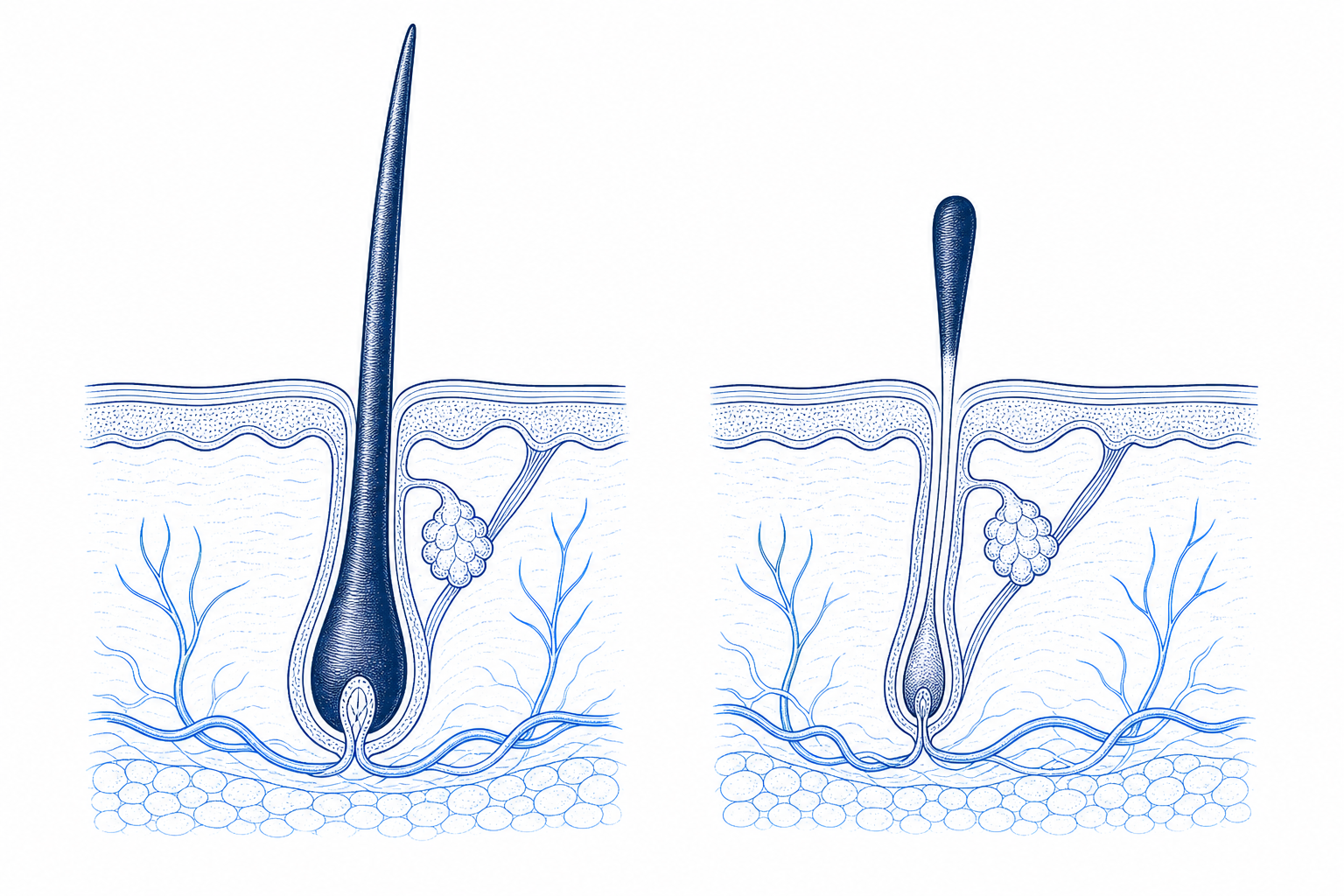
Symptom checklist: typical signs at a glance
- One or more round, sharply defined bald patches, often coin-sized
- Smooth, unirritated scalp with no scaling, redness or scarring
- Short exclamation mark hairs at the edge of the patch
- Itching, tingling or burning (trichodynia) before or during hair loss
- Dents (pitted nails) or rough ridges (trachyonychia) on the nails
- Possible involvement of beard, eyelashes or eyebrows
This list is no substitute for a medical diagnosis. It is a guide for the conversation with your dermatologist.
Causes of alopecia areata
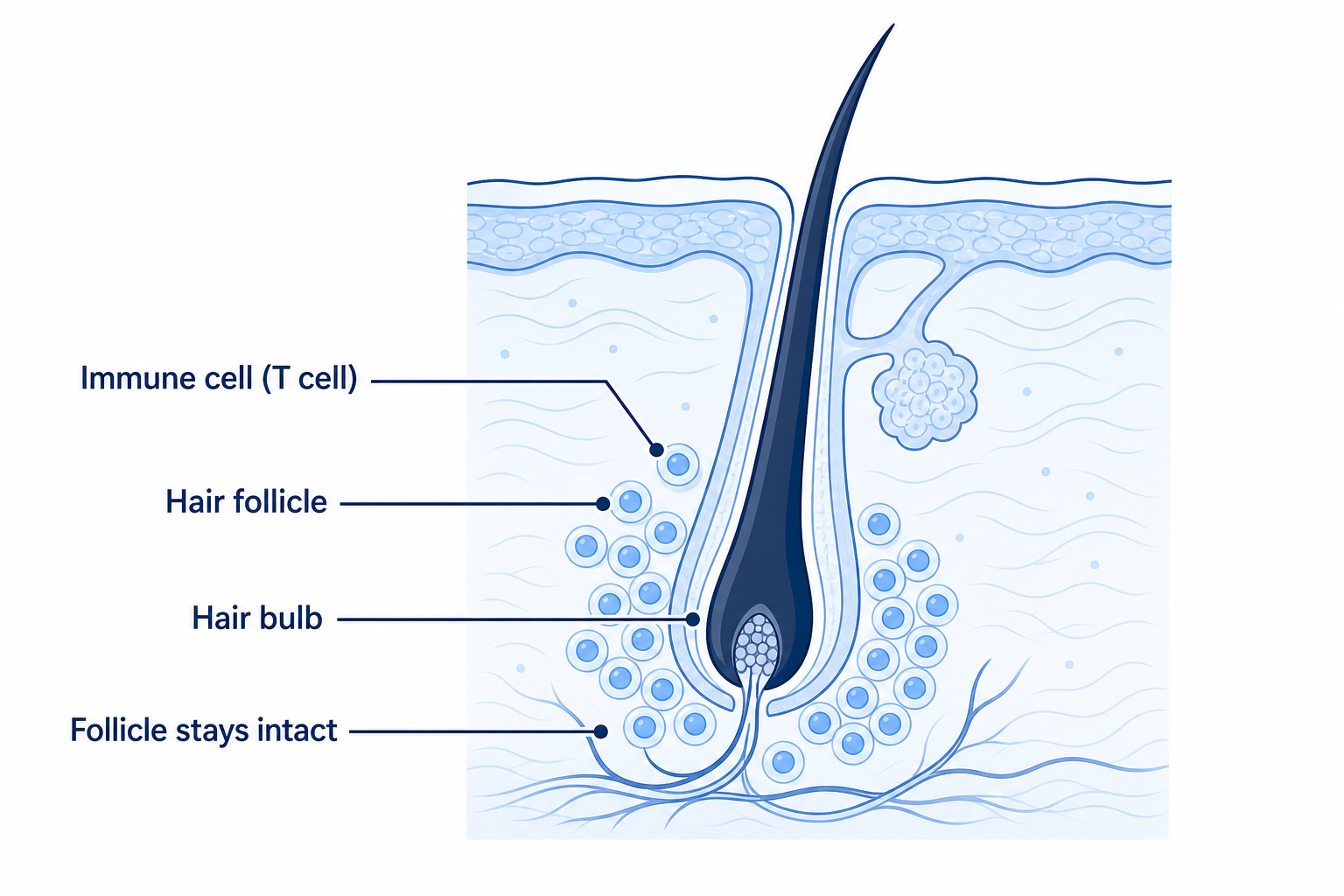
The cause of alopecia areata is an autoimmune reaction on the basis of a genetic predisposition, not a nutrient deficiency and not poor hair care. During the growth phase, the follicle normally has an “immune privilege”, a kind of protected zone. In alopecia areata this protection collapses, so the immune system treats its own hair as foreign.[1]
Specifically, CD8+ NKG2D+ T cells migrate into the hair bulb and release the messenger interferon-gamma (IFN-γ), which intensifies the attack.[7] The central signalling pathway behind this is the JAK-STAT pathway. This is precisely why modern JAK inhibitors work: they interrupt this cascade. The follicle itself remains intact throughout this process.
Alopecia areata occurs more frequently alongside other autoimmune conditions. The most common accompanying condition is autoimmune thyroid disease (6.8% in one study), followed by vitiligo (around 2.8%) and atopic dermatitis (up to 14.1%).[8] Overall, in one clinical study 11.5% of those affected had a further autoimmune condition, compared with 7.9% in the control group.[9] We explain this link to the thyroid in our article on hair loss caused by the thyroid.
The predisposition is the prerequisite; a trigger then sets off the flare-up. Recognised triggers include infections, hormonal changes and emotional strain. Flare-ups have also been described after a COVID-19 infection or vaccination, more often in people with a family history. However, large analyses show no generally increased risk, so a nuanced view is important here.
Does alopecia areata come from stress?
Stress is not the cause of alopecia areata, but where a predisposition already exists it can help trigger a flare-up. The underlying condition remains autoimmune.[10] Perhaps the clearest evidence against it being “all in the mind”: alopecia areata also occurs in newborns and infants, in whom psychological stress can be ruled out as an explanation.
In an older psychodermatological study, at least 23% of patients reported a stressful life event before the onset of the condition.[11] This figure comes from a small sample and is not suitable as a fixed causal rate. But it does show that stress can be one piece of the puzzle for some of those affected, while never being the sole explanation.
The framing “you brought this on yourself through stress” is factually wrong and is often experienced by those affected as an accusation of blame. In reality, the reverse is true: the visible hair loss itself causes considerable stress, feeding a vicious circle. Stress management is therefore a sensible supporting measure, but it does not reliably calm the autoimmune process and is no substitute for treatment.
Forms and severity of alopecia areata
Alopecia areata ranges from a single patch to complete hair loss, and the form determines prognosis and treatment. The most common and usually mildest variant is patchy alopecia areata with one or more limited patches. From there, dermatologists describe a spectrum extending to the severe, extensive forms.
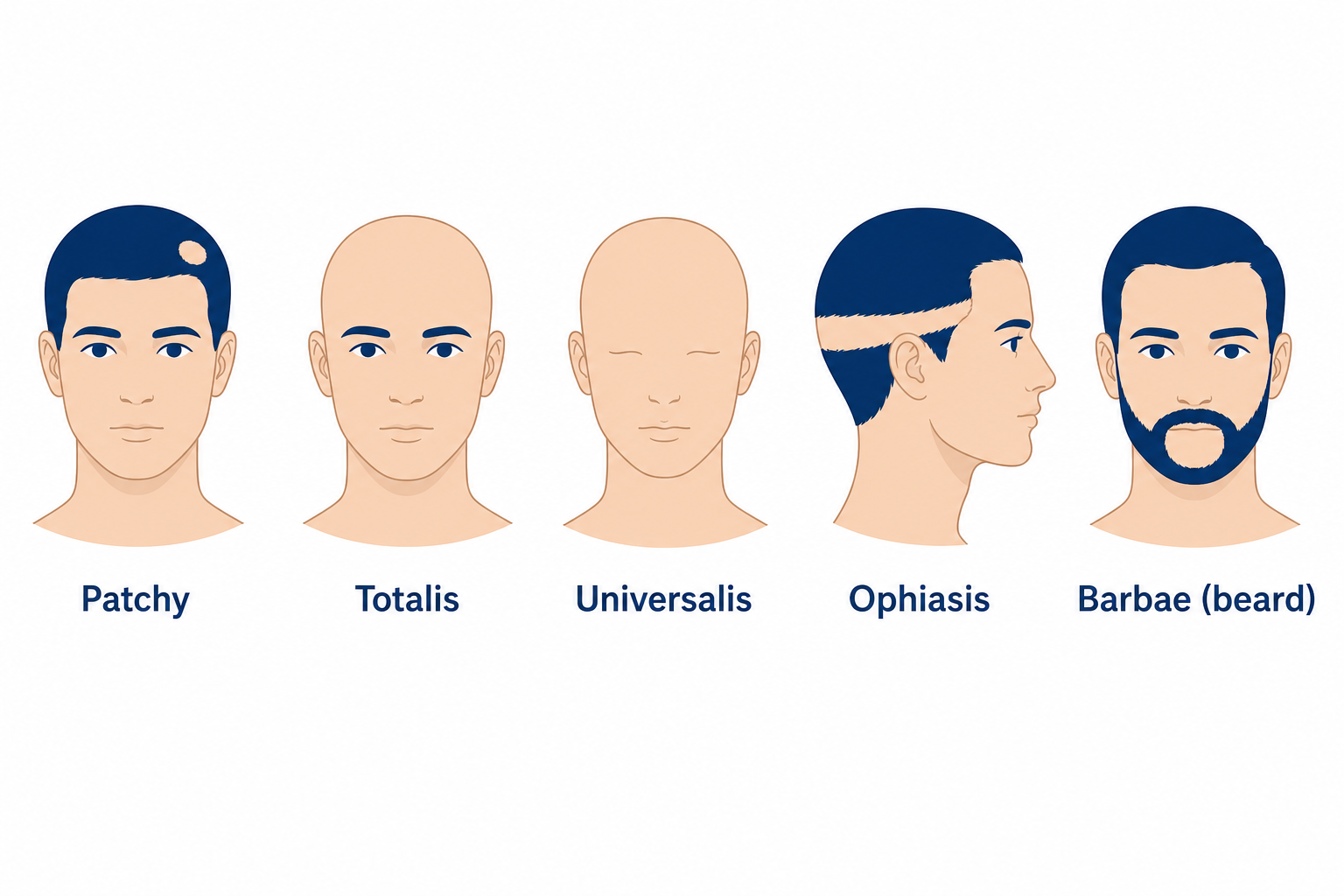
- Alopecia areata (patchy): one or more round patches, usually the mildest and most common form.
- Alopecia totalis: complete loss of scalp hair.
- Alopecia universalis: complete loss of scalp and body hair.
- Ophiasis: band-shaped loss at the back of the head and hairline, prognostically unfavourable.
- Alopecia areata incognita (diffuse): a rare, diffuse form seen mainly in younger women that resembles telogen effluvium.
- Alopecia areata barbae: a special form confined to the beard, accounting for around 28% of cases according to one survey, with an average age of onset of 30 to 40 years.
Briefly explained: the SALT score
The “Severity of Alopecia Tool” (SALT) provides a standardised measure of the proportion of bald scalp area. The scalp is divided into four regions with fixed area shares: crown 40%, back of the head 24%, each side 18%. The total score ranges from 0 (no loss) to 100 (complete loss of scalp hair). From a SALT score of 50, meaning around 50% scalp involvement, alopecia areata is classed as severe. This is also the approval threshold for JAK inhibitors in Europe.
Does alopecia areata grow back?
In short: yes, alopecia areata can grow back, because the follicle is not destroyed, but the chances depend heavily on the severity. With mild, patchy involvement, according to a review, spontaneous remission occurs in 30 to 50% of cases within the first 6 to 12 months, and up to 66% recover within 5 years.[12]
The extent is decisive: with under 25% scalp involvement the remission rate is around 68%, while with over 50% involvement it is only about 8%. For alopecia totalis, universalis and the ophiasis form, spontaneous remission is under 10%. Anyone with one of these forms should not rely on “it will just grow back”.
Important for context: press reports on the new German S3 guideline (2026) summarise that a “spontaneous cure” occurs in fewer than 10% of cases.[3] This seems to contradict the international 30 to 68% for mild cases. The reason lies in differing definitions: lasting, relapse-free recovery is rarer than visible regrowth of individual patches.
The new hair often appears thin and unpigmented at first, as light vellus hair, and only then follow repigmentation and thickening over several months. The precise timing, why the first hairs only become visible after months, is linked to the hair cycle. The following timeline shows a typical but not guaranteed course.
| Time period | What happens in the follicle | What you may see |
|---|---|---|
| Month 1–3 | The flare-up settles, the attack on the patch subsides, the follicle rests. | Hair loss at the edge of the patch stops and the bald area no longer spreads. |
| Month 3–6 | The follicle re-enters the growth phase (anagen). | Fine, often unpigmented vellus hair appears in the bald patch. |
| Month 6–12 | Repigmentation and thickening of the new hairs. | With mild involvement the patch visibly fills in, and the hair gains colour and strength. |
The course is individual and comes in flare-ups. With extensive forms (totalis, universalis, ophiasis), regrowth is considerably less likely.
Favourable prognosis
- A single, small patch
- Short duration of the condition
- First onset in adulthood
- No nail involvement
Unfavourable prognosis
- Onset in childhood
- Large extent (totalis, universalis)
- Ophiasis pattern at the back of the head
- Nail involvement, accompanying atopy or autoimmune condition
And to be honest: relapses are possible at any time, even after years without symptoms. A patch that has once grown back is no guarantee for the future. This is why dermatological follow-up is important, especially when new patches appear or the picture changes.
Treatment of alopecia areata
In short: the treatment of alopecia areata depends on the severity and ranges from deliberate watchful waiting through cortisone preparations and topical immunotherapy to modern JAK inhibitors. The aim is to slow the autoimmune reaction, not to “cure” at the push of a button. No over-the-counter product and no hair transplant removes the underlying condition. The choice of therapy belongs in dermatological hands.
For a small, fresh single patch, controlled watchful waiting during the first roughly 6 months is a legitimate option under the new German S3 guideline, because the chance of spontaneous remission is high here. For more extensive or rapid loss, active treatments come into play. The overview below assigns the options to the respective severity.
| Treatment | For which severity | How it works | Important to know |
|---|---|---|---|
| Watchful waiting | Mild, limited single patch, first approx. 6 months | No intervention, observation of the natural course | Legitimate under the S3 guideline; high spontaneous remission only with small, fresh involvement |
| Topical/intralesional cortisone | Mild to moderate, locally limited patches | Local immunosuppression within the patch | Standard option for limited involvement; side effects usually local (skin thinning) |
| Systemic cortisone (short-term) | Acute, rapidly spreading forms | Systemic immunosuppression | Often a good initial response, but frequently relapse after stopping; long-term risks (osteoporosis, metabolism). Never adjust the dose yourself |
| Topical immunotherapy (DCP) | Moderate to severe, extensive AA | Targeted contact dermatitis redirects the immune response | Some regrowth in approx. 69%, complete regrowth approx. 23%, relapse rate approx. 37%[13] |
| JAK inhibitors (baricitinib, ritlecitinib) | Severe AA only, SALT score from 50 | Inhibition of the JAK-STAT signalling pathway | Prescription-only; boxed-warning class covering cardiovascular events, cancer and thromboses. Benefit-risk assessment by a doctor only |
| Topical minoxidil | All severities, only as an add-on (adjuvant) | Promotes blood flow and growth | Insufficiently proven as a monotherapy; in combination around 57% response according to a meta-analysis[14] |
| Cosmetic options (wig, hairpiece) | All severities, especially extensive loss | No therapeutic effect, but quality of life | In Germany wigs count as a medical aid and are usually covered by health insurance |
One point is decisive for expectations: JAK inhibitors such as baricitinib (Olumiant, CHMP recommendation May 2022) and ritlecitinib (Litfulo, EU approval September 2023, from age 12) are approved exclusively for severe alopecia areata, meaning from a SALT score of 50.[15] They are not intended for the typical coin-sized single patch.
These agents can bring about significant regrowth in severe cases, but they carry a boxed-warning class covering cardiovascular events, cancer and thromboses, derived from data on other JAK inhibitors.[16] Systemic cortisone is no harmless long-term solution either: relapse frequently follows once it is stopped. Decisions like these are always weighed by the doctor against the severity.
Alopecia areata vs hereditary hair loss: when a hair transplant is an option
Alopecia areata (autoimmune, round patches, often reversible) differs fundamentally from hereditary hair loss (androgenetic, a receding hairline and thinning crown). Only the hereditary type can be treated with a hair transplant at all. Anyone who discovers a bald patch should therefore first find out which type is present. Both can also occur at the same time.
| Feature | Alopecia areata (patchy hair loss) | Hereditary hair loss (androgenetic) | Diffuse hair loss (e.g. thyroid, iron) |
|---|---|---|---|
| Appearance | Sharply defined, round bald patches | Receding hairline, thinning crown and top of the head | Even thinning without clear edges |
| Cause | Autoimmune reaction against the follicle | Genetic sensitivity to DHT | Usually reversible: iron deficiency, thyroid, medication |
| Typical course | Comes in flare-ups, often with spontaneous remission | Chronically progressive, no spontaneous remission | Usually reversible once the cause is addressed |
| Follicle permanently damaged? | No, no scarring | Yes, progressive miniaturisation | No, once the cause is addressed |
| Responds to a hair transplant? | No, the autoimmune process also attacks transplanted follicles | Yes, the only one of the three forms with an established transplant option | No, the cause does not lie in the follicle itself |
For alopecia areata, a hair transplant is fundamentally not a reliable solution, not even in a seemingly quiet phase. The autoimmune process can flare up again at any time and would attack transplanted follicles just the same. In addition, the surgical stimulus can reactivate a previously dormant patch through the Köbner phenomenon. Only a confirmed androgenetic pattern is transplantable at all.
A view from Elithair’s practice
In our consultations we repeatedly see people who mistake a round bald patch for the start of baldness and ask straight away about a hair transplant. But the first and most important step is to determine the type. Alopecia areata is an autoimmune, often reversible condition and belongs with a dermatologist. A hair transplant is not a sensible option here. Only with a hereditary pattern and a stable course is it even something to consider.
So the first step is always the question: which type is actually present? This is exactly what the free Elithair hair analysis is designed for, as a pre-filter. It looks at your visible pattern of loss and gives a first indication of whether it looks more like a hereditary pattern, which is fundamentally transplantable, or like alopecia areata or diffuse hair loss, which belongs with a dermatologist. In both cases the result points you in the right direction. It is no substitute for a medical blood test or a dermatological diagnosis, but it can clarify the direction.
When to see a doctor about alopecia areata
You should see a dermatologist for any new bald patch, for rapid or widespread loss, for involvement of the beard, eyelashes or nails, and for significant emotional strain. The dermatologist is the right point of contact for alopecia areata. They confirm the diagnosis and check for accompanying autoimmune conditions, for example via thyroid levels.
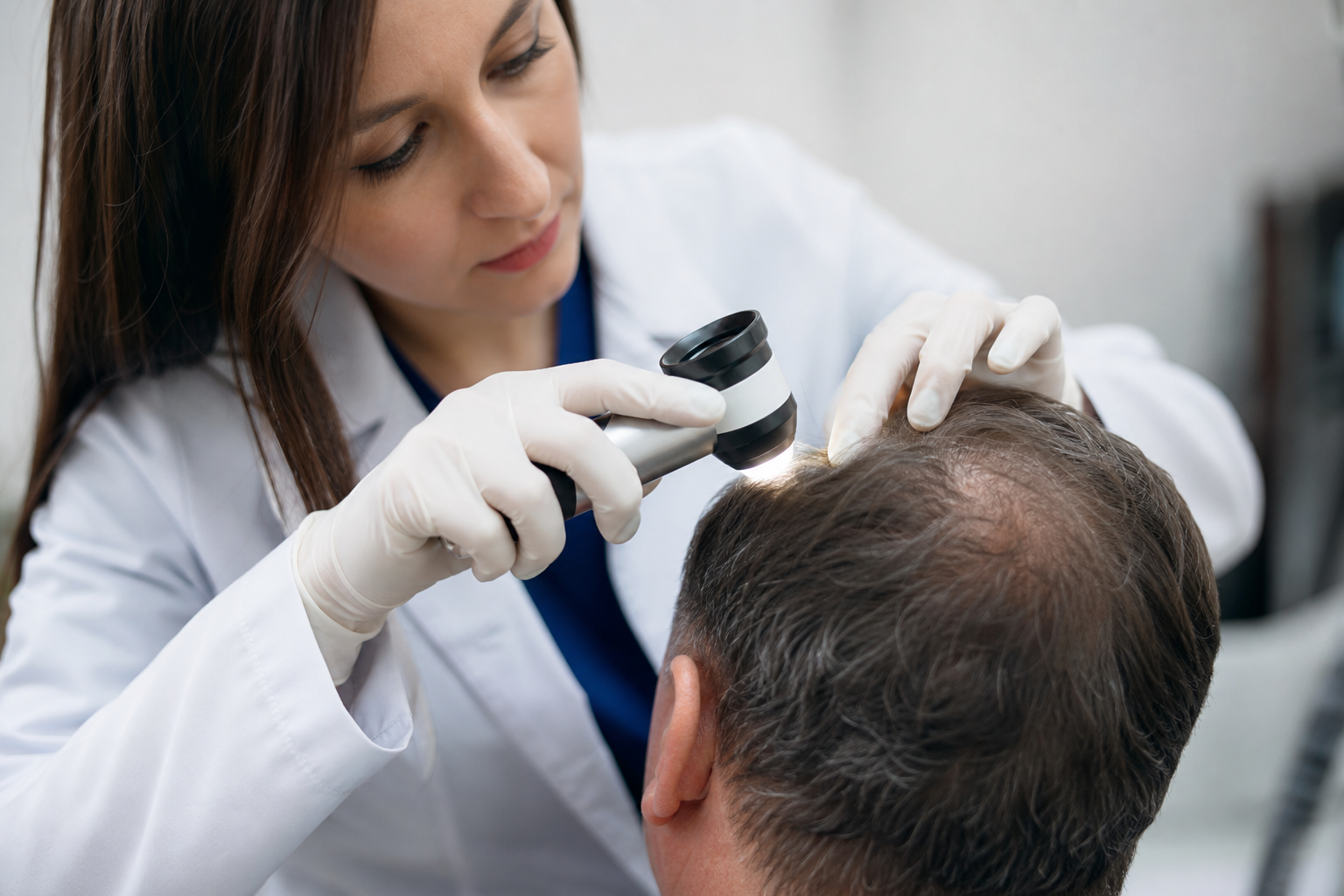
The doctor makes the diagnosis using several methods. In addition to visual inspection, trichoscopy (dermatoscopy) is often used, the most important non-invasive examination. Typical signs are yellow dots (the most common sign), black dots, exclamation mark hairs and short vellus hairs. Their decline under treatment is regarded as a good sign of response. A blood test can additionally rule out other causes.
Warning signs: see a dermatologist now
- A new, round bald patch you cannot explain
- Rapid spread or several patches at once
- Involvement of the beard, eyelashes or eyebrows
- Changes to the nails (dents, rough ridges)
- Significant emotional strain caused by the hair loss
Only the doctor performs the pull test. Please do not tug at your own hair; it causes unnecessary worry.
Myth vs fact about alopecia areata
Plenty of persistent misconceptions circulate around alopecia areata, from home remedies to fear of contagion. The comparison below places the most common claims in context based on the evidence. It is no substitute for a conversation with your doctor, but it helps to sort out common misinformation and ease unnecessary worries.
| Myth | Fact |
|---|---|
| Onion juice or garlic makes the hair grow back | Based on a single small study from 2002 with a high dropout rate, never replicated. It can irritate the skin and changes nothing about the autoimmune process |
| Alopecia areata is contagious | No. It is not an infection and not a fungus, but an autoimmune condition. Transmission is not possible |
| It’s purely psychological, just stress | Stress can be a trigger, but it is not the cause. The basis is a genetically determined autoimmune reaction |
| The wrong shampoo is to blame | Hair care does not influence the autoimmune process. Washing, blow-drying and styling are fine |
| I’m no longer allowed to colour my hair now | Colouring and styling are generally possible. If the scalp is irritated, it is worth checking with your dermatologist |
| A special diet cures the condition | There is no proven effect for vitamin A, D, biotin or selenium. A balanced diet is sensible but is no substitute for treatment |
What helps the mind
Because the course is medically uncertain, coping with the strain is an important building block in its own right. It is okay for visible hair loss to weigh on you, and you do not have to cope with it alone.
- For a small, fresh patch, hair fibres (keratin-based scatter hair) and tinted root sprays conceal the bald spot within seconds, for instance before an appointment. They are purely cosmetic, do not influence the autoimmune process and are no substitute for assessment.
- With more extensive loss, camouflage, a hairpiece or a wig ease the pressure of everyday life; in Germany wigs are usually covered by health insurance as a medical aid.
- Sharing experiences with others affected brings relief. Alopecia Areata Deutschland e.V. (AAD) has offered advice since 1991 and also helps with insurance applications.[17]
- If the psychological strain persists, professional support is sensible and no sign of weakness.
Frequently asked questions about alopecia areata
Is alopecia areata dangerous or contagious?
Alopecia areata is neither contagious nor a form of cancer, and it poses no direct danger to life. It is not an infection and not a fungus. What must be taken seriously, though, is the psychological strain and, in severe forms (ophiasis, totalis, universalis), the chronic course. “Not dangerous” therefore does not mean “harmless”.
Is alopecia areata curable?
The follicle is not destroyed in alopecia areata, so regrowth is possible. Medicine nevertheless speaks cautiously of a “cure”, because relapses can occur at any time. With a mild single patch, up to 66% recover within 5 years, while with extensive forms spontaneous remission is under 10%.
Which doctor treats alopecia areata?
The dermatologist is responsible. They confirm the diagnosis by visual inspection and trichoscopy, assess the severity and check for accompanying conditions such as a thyroid disorder. For alopecia areata the dermatologist is the right first point of contact, not the GP alone and not a hair-transplant provider.
Is a vitamin or nutrient missing in alopecia areata?
Alopecia areata is not caused by a nutrient deficiency but by an autoimmune reaction. There is no proven effect for vitamin A, D, biotin and selenium. The doctor nevertheless often checks values such as iron and thyroid in order to rule out accompanying causes. More on this in our article on iron deficiency and hair loss.
Alopecia areata in children, what is different?
In children, alopecia areata often begins early and more frequently shows nail changes (trachyonychia 26% compared with 8.6% in adults). The psychosocial strain from bullying is particularly high. Treatment relies on options with fewer side effects; the JAK inhibitor ritlecitinib is only approved from age 12. Treatment belongs in the hands of a paediatric dermatologist.
Can alopecia areata come back?
Yes, relapses are possible at any time with alopecia areata, even after years without symptoms. A patch that has once grown back is no guarantee of lasting calm. This is why dermatological follow-up remains sensible, especially when new patches appear or the picture changes.
Can I wash and colour my hair with alopecia areata?
Yes. Washing, blow-drying, styling and, as a rule, colouring too do not influence the autoimmune process and are fine. No shampoo causes alopecia areata. Only if the scalp is irritated or under treatment should you briefly check chemical treatments with your dermatologist.
Can a hair transplant fix alopecia areata?
No. For alopecia areata a hair transplant is fundamentally not a reliable solution, because the autoimmune process also attacks transplanted follicles and the surgical stimulus can reactivate a patch through the Köbner phenomenon. Only hereditary (androgenetic) hair loss is transplantable. Both types can be present at the same time.
Sources
- Hair follicle immune privilege and its collapse in alopecia areata, PubMed (2020): pubmed.ncbi.nlm.nih.gov
- Lifetime incidence risk of Alopecia Areata, Rochester Epidemiology Project 1990–2009, PMC: pmc.ncbi.nlm.nih.gov
- S3 guideline “Diagnostik und Therapie der Alopecia areata” (AWMF Reg. No. 013-104, 2026): register.awmf.org; DDG press release: derma.de
- DermNet, Alopecia areata in children: dermnetnz.org
- Global sex disparities in lifetime risk of alopecia areata (GBD 1990–2021), Biology of Sex Differences 2025: link.springer.com
- Trichoscopy pattern in alopecia areata, Systematic Review and Meta-Analysis (2023): onlinelibrary.wiley.com
- TH1 effector CD4 T cells rely on IFN-γ production to induce alopecia areata, Science Advances (2024): science.org
- The Frequency of Autoimmune Thyroid Disease in Alopecia Areata and Vitiligo Patients, PMC: ncbi.nlm.nih.gov
- Alopecia Areata and Autoimmunity: A Clinical Study, PMC: pmc.ncbi.nlm.nih.gov
- Lifestyle Factors Involved in the Pathogenesis of Alopecia Areata, PMC: ncbi.nlm.nih.gov
- Stress and alopecia areata: a psychodermatologic study, PubMed: pubmed.ncbi.nlm.nih.gov
- Alopecia Areata: Burden of Disease, Approach to Treatment (remission rates), PMC: pmc.ncbi.nlm.nih.gov
- Zhu et al., DCP immunotherapy, Systematic Review and Meta-Analysis, Dermatologic Therapy 2023: onlinelibrary.wiley.com
- The Role of Minoxidil in Treatment of Alopecia Areata, Systematic Review and Meta-Analysis, PMC: pmc.ncbi.nlm.nih.gov
- EMA, Litfulo (Ritlecitinib) EPAR: ema.europa.eu
- FDA, Boxed Warning for JAK inhibitors (2021), Healio: healio.com
- Alopecia Areata Deutschland e.V. (patient support group): kreisrunderhaarausfall.de
This article is for general information and is no substitute for a medical diagnosis or treatment. Alopecia areata requires dermatological assessment. Last updated: 2026.
Dr. Imad Moustafa
Hair transplant specialist