

In short: pubic hair loss
A slow, even thinning of the pubic hair from roughly the age of 40 to 50 is physiologically normal. It is androgen-dependent and responds to the age-related decline in oestrogen (women, menopause) or testosterone (men; from around age 35, free testosterone falls by about 1.3 per cent per year according to a 2024 PMC review). A sudden, one-sided loss, or one accompanied by skin changes, can on the other hand be a warning sign and should be checked by a doctor.
The most common causes at a glance:
- Normal: hormonal decline in the menopause and andropause, a slower hair cycle
- Needs investigation: thyroid disorder, pituitary/adrenal insufficiency, lichen sclerosus
- Reversible/triggering: iron deficiency, stress, chemotherapy, certain medicines
Pubic hair loss unsettles many people because it is rarely discussed openly. This article explains what about the loss of pubic hair is age-related and harmless, and when it should be checked by a doctor. Every statement draws on current dermatological and endocrinological sources. Last updated: 2026.
Summary
- Why does pubic hair change with age?
- When to see a doctor about pubic hair loss (warning signs)
- Common changes in pubic hair
- Pubic hair with age: differences between women and men
- Causes of loss of pubic hair
- Preserving pubic hair and preventing changes
- Does less pubic hair have drawbacks? The protective function
- Social and psychological aspects
- Medical and cosmetic options
- Does lost pubic hair grow back?
- Frequently asked questions about pubic hair loss
- Conclusion: understand the natural change and act in a targeted way
- Sources
Why does pubic hair change with age?
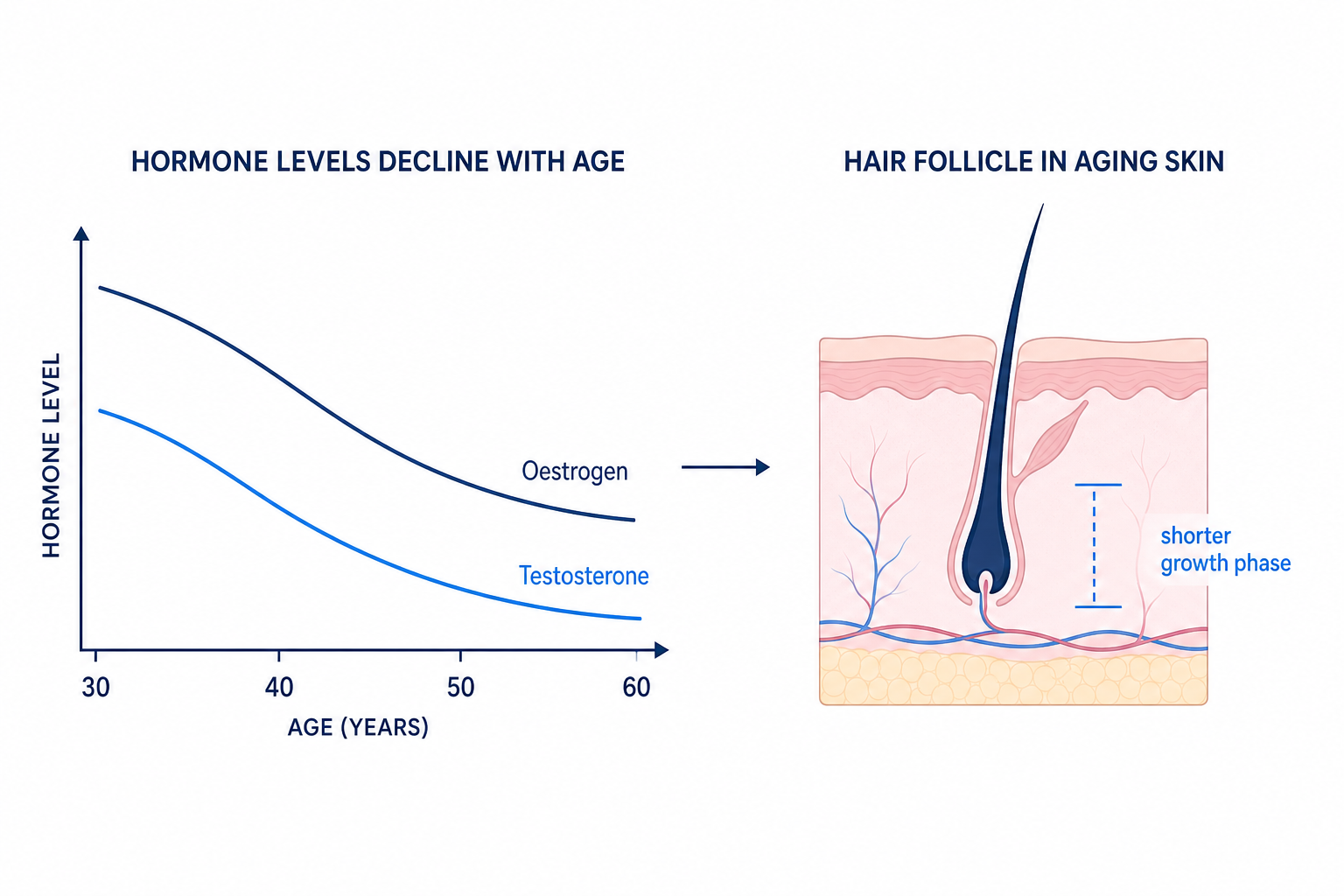
Pubic hair changes with age because it is androgen-dependent and the body produces fewer sex hormones over the years. Before puberty, the pubic region carries only fine vellus hair. It is androgens such as testosterone, DHT and DHEA that convert it into thicker terminal hair (Inui et al., Experimental Dermatology 2013). As these hormones fall again, the process partly reverses.
Hormonal changes: the key mechanism
Hormonal changes are the single most important reason for the decline in pubic hair with age. In men, according to a 2024 PMC review, total testosterone falls by around 0.4 per cent per year from about age 35, and free testosterone by about 1.3 per cent. Because the decline is gradual, the thinning of the hormone-controlled body hair tends to be milder and later in men.
In women, ovarian oestrogen production in the menopause drops to about 10 per cent of the pre-menopausal level (PubMed 2012). In a 2011 study by the International Menopause Society involving 758 post-menopausal women, 41 per cent reported hair loss, with the diffuse overall loss correlating significantly with body hair loss and older age. There is more on this in our article on hair loss in women.
Natural ageing of the hair cycle
The hair cycle itself also slows down and makes the pubic hair look thinner. Pubic hair naturally has a short cycle: the growth phase (anagen) lasts only 2 to 6 months, compared with 2 to 7 years on the scalp (The Trichological Society). With age, the anagen phase becomes shorter and the resting phase (telogen) longer. As a result, fewer follicles are active at the same time and density decreases. Our article on the hair growth cycle explains the background.
Genetic and individual factors
How early and how strongly the pubic hair changes depends heavily on genetic predisposition. Some people keep dense hair well into old age, while others notice thinning early on. As with greying or with androgenetic alopecia on the scalp, individual disposition determines the timing and extent. Specific study data on pubic hair alone are still lacking here.
When to see a doctor about pubic hair loss (warning signs)
Pubic hair loss is a warning sign when it appears suddenly, on one side, or together with skin changes. A slow, even decline over years, by contrast, fits with age and is usually nothing to worry about. The overview below helps with an initial assessment, but it is no substitute for a medical examination.
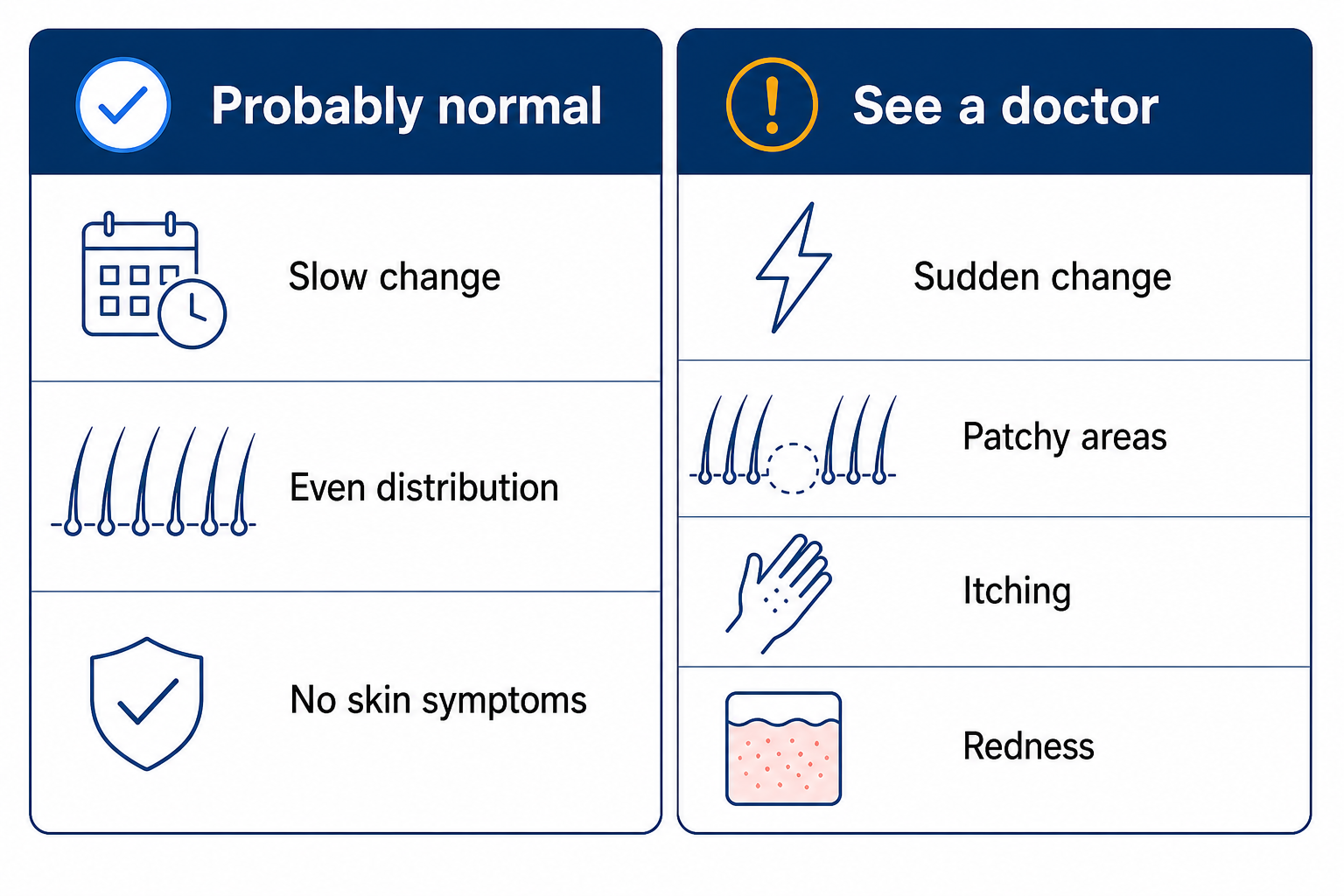
| Probably normal (age-related) | Have it checked by a doctor |
|---|---|
| Slowly thinner over years, evenly | Suddenly, within weeks |
| On both sides and evenly distributed | One-sided or patchy bald spots |
| No skin change, no itching | Itching, redness, burning, white hardened skin (lichen sclerosus) |
| No other symptoms | Fatigue, weight change, sensitivity to cold (thyroid) |
| Fits with the menopause or andropause | Cycle irregularities together with hair loss (PCOS, pituitary) |
| Age over ~45 (women) or ~50 (men) | In young people with no recognisable cause |
Which doctor to see about loss of pubic hair?
The first point of contact for a noticeable loss of pubic hair is usually the GP, who arranges basic blood work. A full blood count along with ferritin and TSH levels is useful for orientation; a blood test for hair loss helps narrow down possible causes. Where there are skin changes, the route leads to a dermatologist; for women with cycle irregularities, to a gynaecologist; for men with additional symptoms, to a urologist; and where a hormonal disorder is suspected, to an endocrinologist.
Common changes in pubic hair
The typical changes in pubic hair with age are thinning, greying and, in rare cases, an almost complete loss. The first two are harmless and hormonally driven; complete loss needs an explanation.
| Change | What happens | Interpretation |
|---|---|---|
| Thinning | Hair becomes finer and less dense, gaps appear | Most common change, physiological |
| Greying | Melanocytes in the hair root stop producing melanin | Harmless, timing genetically determined |
| Complete loss | The hair almost completely disappears | Rare with pure ageing, more likely a sign of a condition |
The greying of pubic hair follows the same mechanism as on the scalp: the melanocytes in the hair follicles become exhausted and stop forming pigment (Maturitas 2025). No fixed starting point can be given, and there is no evidence that pubic hair greys systematically earlier or later than scalp hair. An almost complete loss is untypical of pure ageing and should be assessed by a doctor.
Pubic hair with age: differences between women and men
Pubic hair changes differently in women and men with age, because the hormonal decline follows a different course. In women, oestrogen drops relatively abruptly in the menopause; in men, testosterone falls slowly over decades. Accordingly, the changes usually set in earlier and more clearly in women.
| Feature | Women | Men |
|---|---|---|
| Main cause | Oestrogen drop in the menopause (~51 years) | Gradual testosterone decline from ~35 years |
| Course | Relatively abrupt, then stabilises | Very gradual over decades |
| Typical onset | Peri- to post-menopause (~45–55 years) | Usually later, milder (~50–65 years) |
| Pattern | Thinning, can decrease markedly | Finer, less dense, rarely complete |
| Accompanying phenomenon | Facial hair may increase (relative androgen predominance) | — |
In women, a paradoxical pattern emerges: while pubic and underarm hair decreases, facial hair on the chin and upper lip can increase. The reason is the relative androgen predominance, because adrenal androgen production is preserved more strongly in the menopause than ovarian oestrogen formation (International Menopause Society 2011). Up to 52 per cent of post-menopausal women report a noticeable thinning of their hair, according to Maturitas (2025).
Causes of loss of pubic hair
Loss of pubic hair can be harmlessly hormonal or a symptom of a condition that needs treatment. The most common cause is the age-related hormonal decline in the menopause and andropause. Alongside this, there is a range of causes that need investigation, which often reveal themselves through additional symptoms.
Thyroid disorders
Thyroid disorders are an important, treatable cause of diffuse hair loss, which can also affect the pubic hair. With an underactive thyroid (hypothyroidism), hair loss occurs in around 33 per cent of those affected according to a review in Cureus (2023), and with an overactive thyroid in about 50 per cent. Thyroid hormones prolong the anagen phase directly at the follicle (PubMed 2008). When they are missing, the hair slips into the resting phase earlier. There is more on this in our article on thyroid hair loss.
Polycystic ovary syndrome (PCOS)
With polycystic ovary syndrome (PCOS), loss of pubic hair is untypical; the opposite is more likely to occur. PCOS is primarily associated with hirsutism, that is, increased body hair: around 70 to 80 per cent of those affected experience it (ASRM/ACOG). On the scalp, the excess of androgens can cause male-pattern hair loss (PubMed 2022), whereas pubic hair usually remains or is increased. PCOS therefore does not, as a rule, cause loss of pubic hair.
Pituitary and adrenal disorders
A complete loss of pubic and underarm hair in women can point to pituitary or adrenal insufficiency. Because women form a large part of their androgens via the adrenal gland, pituitary insufficiency (for example in Sheehan’s syndrome) leads to a lack of DHEA production and thus to the loss of this hair (StatPearls/NCBI). Addison’s disease is also among these causes. It is often accompanied by fatigue, weight change or cycle irregularities. Men are less often affected, because the testes take over androgen production.
Nutrient deficiency (iron, zinc)
A proven nutrient deficiency can contribute to diffuse hair loss, which can also affect body hair. For iron deficiency, diffuse hair loss (telogen effluvium) is well documented (PubMed 2010); a ferritin level below 30 µg/l is regarded as a deficiency, though higher thresholds are sometimes discussed in trichology. Whether pubic hair specifically is affected has not been studied separately. Importantly: only supplement iron or zinc when a deficiency has been proven. There is background in our article on iron deficiency and hair loss.
Medicines
Certain medicines can disrupt the hair cycle and so thin the pubic hair too. Chemotherapy triggers anagen effluvium, which affects all growing hairs, including pubic, underarm and body hair; it usually recovers after 3 to 6 months (PMC 2017). According to the Drug Commission of the German Medical Association (2015), more than 400 substances are known to have hair loss as a side effect, among them beta blockers, antidepressants, anticoagulants such as heparin and high-dose vitamin A.
Skin conditions: lichen sclerosus
Lichen sclerosus is a chronic inflammatory, scarring skin condition of the anogenital area that causes permanent hair loss. According to the first German S3 guideline (AWMF 013-105, April 2026), it presents with white, parchment-like, hardened skin, itching and scarring. It is not curable, requires long-term treatment with potent corticosteroids and increases the risk of squamous cell carcinoma in the affected area. With such skin changes, prompt dermatological or gynaecological assessment is important.
Alopecia areata, too, can affect the pubic hair in extensive cases (alopecia universalis, only 5 to 10 per cent of cases) (AWMF S3 guideline 013-104, 2026). Psoriasis, eczema as well as fungal or bacterial infections can locally damage the hair follicles in the intimate area, especially when they are accompanied by inflammation and itching.
Circulatory disorders and diabetes
Circulatory disorders can reduce the supply to the hair follicles and encourage a loss of body hair. The classic example is loss of leg hair in peripheral arterial disease (PAD). However, a study in the Archives of Dermatology (2009) found that loss of leg hair is not a reliable predictor of PAD; it therefore counts only as a possible accompanying sign, not as proof. In diabetes mellitus, an impaired microcirculation can likewise affect hair growth.
Lifestyle and stress
Lifestyle factors, too, can lead to temporary hair loss. Chronic stress raises the telogen rate via cortisol and can trigger telogen effluvium (StatPearls/NCBI). Smoking constricts the blood vessels and reduces the blood supply to the follicles. Crash diets and a one-sided, deficient diet can likewise disrupt the hair cycle. These triggers are usually reversible once the cause is addressed. There is an overview in our article on the causes of hair loss.
Pregnancy and hormonal changes after birth
The hormonal shift after birth can trigger a temporary telogen effluvium, which can affect not only the scalp hair but also body and pubic hair. After delivery, oestrogen levels fall rapidly and many follicles switch into the resting phase at the same time (StatPearls/NCBI). This post-partum hair loss is usually reversible and generally resolves on its own within a few months.
Mechanical irritation from waxing and epilating
Repeated mechanical hair removal such as waxing or epilating can irritate the hair follicles in the intimate area and weaken them over the long term. Aggressive methods that pull out the hair together with the root place mechanical strain on the follicle. If inflammation or scarring is repeatedly triggered, growth can be permanently impaired. Gentler methods and low-irritation care protect the follicles. With hardened or scarred skin, a dermatological assessment makes sense.
Preserving pubic hair and preventing changes
You cannot stop the age-related decline in pubic hair, but you can support hair and skin health. An honest expectation is important: care and nutrition preserve hair quality, but they do not reverse the hormonally driven decline. Nutrients only work if a deficiency is actually present.

- Care and hygiene: mild, pH-neutral cleansing (the skin in the intimate area sits at pH 4 to 5); avoid aggressive hair-removal methods that mechanically damage the follicles.
- Nutrition: iron- and zinc-rich foods (pulses, pumpkin seeds, nuts), protein and omega-3. Measure first, then supplement in a targeted way.
- Stress reduction: chronic stress raises the telogen rate via cortisol; exercise and relaxation have a stabilising effect.
- Stopping smoking: improves microcirculation and thus the supply to the hair follicles.
- Nourishing oils: coconut, argan or rosemary oil soothe the skin. Regrowth in hormonally driven loss has not been proven by this.
Does less pubic hair have drawbacks? The protective function
In everyday life, less pubic hair usually has only cosmetic, and rarely functional, consequences. Even so, pubic hair does serve practical purposes. According to the American College of Obstetricians and Gynecologists (ACOG), it reduces friction between skin and clothing and can protect the sensitive genital skin from micro-injuries. With a marked decline, the skin sometimes reacts more sensitively to friction.
The pubic area is also rich in apocrine sweat glands, which is why it is debated whether the hair serves as a diffuser for scent compounds (pheromones). In humans, this function is far less well documented than in the animal kingdom and remains a hypothesis. A health impairment from missing pubic hair alone has not been clinically proven. With sensitive skin, gentler care and less irritating underwear help.
Social and psychological aspects
Changes in pubic hair are a normal part of ageing and reduce neither attractiveness nor sexuality, though they can cause insecurity. The key lies in self-acceptance and in the awareness that, in terms of health, the topic is usually nothing to worry about. A positive attitude towards your own body strengthens self-confidence, precisely because the topic is rarely discussed openly in society.
The perception of pubic hair varies greatly by culture and era. While it was at times regarded as a sign of maturity, modern beauty ideals often favour smooth skin. Such norms shape one’s own attitude. In relationships, open communication helps to ease insecurities and build mutual understanding.
Medical and cosmetic options
Treatment options for loss of pubic hair depend on the cause and are often limited. Menopausal hormone therapy can stabilise the hormonal situation, but its effect on pubic hair has not been proven: the International Menopause Society (2011) found no significant difference in body hair score between women with and without hormone therapy. Any hormone therapy requires a medical indication and a benefit-risk assessment.
Cosmetically, a more even appearance can be achieved in two ways. Laser treatment permanently removes any remaining hairs, which can be desired as a balancing measure with uneven thinning. Micro-hair pigmentation creates the optical impression of more density, but is rarely used in the intimate area. Care products and growth serums can support hair structure, but regrowth in hormonally driven loss is not backed by studies.
Hair transplant in the intimate area: only a special case
A hair transplant in the intimate area is only a rare special case, not the answer to normal age-related thinning. It makes sense exclusively where there is permanently absent, locally confined hair, for example after scarring from lichen sclerosus, a burn or surgery. Donor follicles are then extracted by FUE and placed at a precise angle using the DHI method (Choi pen). With diffuse, hormonally driven loss, the follicles are only miniaturised, not destroyed, so a transplant is not an option.
Whether there is in fact a permanent gap, or whether the loss is diffuse and hormonally driven, can be clarified beforehand. A free hair analysis assesses the visual pattern of the hair and so filters which situation applies. It is a pattern analysis and does not replace a medical blood test, which checks physical causes such as the thyroid or iron deficiency.
Discreet and without obligation: a text-based questionnaire, no photo required. Any uploaded images are reviewed confidentially under GDPR by medical staff only.
Does lost pubic hair grow back?
Whether pubic hair grows back depends entirely on the cause. With reversible triggers such as chemotherapy, a corrected iron deficiency, a treated thyroid or settled stress, it usually grows back. Pubic hair tends to recover faster than scalp hair, because its growth cycle is shorter (StatPearls/NCBI). With age-related miniaturisation or scarring, by contrast, regrowth does not occur.
| Timeframe | What happens | Requirement |
|---|---|---|
| Week 1–4 | Cause addressed (deficiency corrected, treatment started) | Reversible cause identified |
| Month 1–2 | Follicles still in the resting phase, visible loss may continue | — |
| Month 3–4 | Follicles re-enter the growth phase, loss stops | — |
| Month 4–6 | First new, fine hairs visible | — |
| Month 6–12 | Cosmetically noticeable density with reversible effluvium | — |
| Irreversible | No regrowth with miniaturisation or scarring | — |
Frequently asked questions about pubic hair loss
Is it normal for pubic hair to thin with age?
Yes, this is physiologically normal. As oestrogen or testosterone levels fall with age (from around 40 to 50 years), the pubic hair gradually becomes thinner. It is androgen-dependent and responds sensitively to the hormonal decline.
From what age does pubic hair change?
In women, often from the perimenopause (around 45 to 52 years); in men, usually later and milder (around 50 to 65 years). Genetics also plays a part in whether someone notices changes earlier or later.
Does lost pubic hair grow back?
That depends on the cause. After chemotherapy, or with a treated iron deficiency or thyroid problem, usually yes, within about 4 to 12 months. With age-related hormonal thinning or scarring (for example from lichen sclerosus), it tends not to grow back fully.
When is pubic hair loss a warning sign?
When the loss appears suddenly within weeks, patchy or one-sided, is accompanied by itching, redness or white hardened skin, or occurs together with fatigue, cycle irregularities and weight change, as well as in young people with no recognisable trigger. A medical assessment is then advisable.
Which conditions cause loss of pubic hair?
Above all an underactive thyroid, pituitary insufficiency, Addison’s disease, lichen sclerosus (scarring) and, in rare cases, alopecia universalis as well as pronounced iron or zinc deficiency states. Diabetes and circulatory disorders can reduce body hair in general.
Does pubic hair turn grey with age?
Yes. It is the same mechanism as with scalp hair: the melanocytes in the hair follicles stop producing melanin over time. When this begins is genetically determined.
Can pubic hair be transplanted?
In principle yes, but only as a rare special case with permanently absent, locally confined loss, for example after scarring. Against age-related diffuse thinning, a hair transplant does not make sense, because the follicles are only miniaturised and not destroyed.
Which doctor should you see for sudden loss of pubic hair?
First the GP, for basic blood work (ferritin, TSH, hormone status). Women with cycle irregularities should see a gynaecologist, those with skin changes a dermatologist, and where a hormonal or thyroid condition is suspected, an endocrinologist.
Conclusion: understand the natural change and act in a targeted way
Pubic hair loss is, in most cases, a normal, hormonally driven part of getting older. Thinner hair, greying and slower growth are nothing to worry about. The decisive point is the two-path message: what happens slowly and evenly belongs to age; what appears suddenly, on one side, or with skin changes and accompanying symptoms should be checked by a doctor.
With good care, a nutrient-rich diet and a mindful approach to stress, you support your hair health without having to reverse the hormonal decline. If you are unsure, a visit to the right specialist is worthwhile. Last updated 2026.
Sources
- S3 guideline Lichen sclerosus, AWMF Reg. No. 013-105, April 2026 — PMC
- Menopause and hair loss in women: Exploring the hormonal transition, Maturitas 2025 — PubMed
- Age-related testosterone decline: mechanisms and intervention strategies, PMC 2024 — PMC
- Impact of Thyroid Dysfunction on Hair Disorders, Cureus 2023 — PMC
- Physiological changes in scalp, facial and body hair after the menopause, International Menopause Society 2011 — IMS
- Iron deficiency in female pattern hair loss and chronic telogen effluvium, PubMed 2010 — PubMed
- Telogen Effluvium, StatPearls / NCBI Bookshelf — NCBI
- Hair loss in practice, Drug Commission of the German Medical Association (AkdÄ) 2015 — AkdÄ
This article is for general information and is not a substitute for a medical diagnosis or treatment. With persistent or sudden symptoms, please consult a doctor.
Dr. Imad Moustafa
Hair transplant specialist