

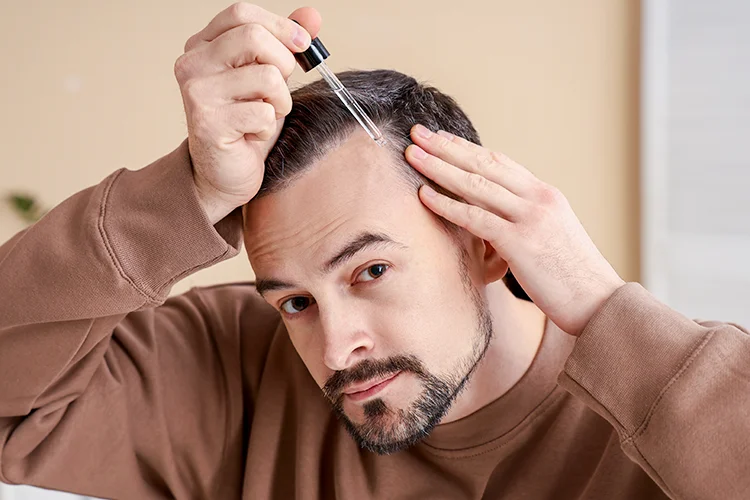
Diffuse hair loss, thinning hair, and slowed growth are among the most common reasons why men and women seek hair restoration. In addition to classic methods like PRP or minoxidil, so-called nano-topicals are increasingly coming into focus. These are high-tech products that work with laser treatment, growth factors, and nanotechnology.
Lately, two names keep coming up – KeraLase™ and Z-Factors. Both are said to increase the activity of hair follicles and thus promote growth without surgery. But how exactly does it work? And are the effects really comparable to a hair transplant? In this article, that’s what we’ll be seeking to find out.
Summary
How Nano-topicals Work
Nano-topicals combine medical laser technology with nanostructured drug systems to deliver active ingredients precisely into deeper layers of the scalp. The aim is to increase the tissue’s absorption capacity and better reach still-active hair follicles.
The principle is based on several coordinated steps:
- A medical laser treatment (e.g. with the Lutronic LaseMD Ultra®) creates controlled microchannels in the scalp.
- Topical agents such as peptides, proteins, or cytokines are then applied.
- Nanostructured carrier systems support the even distribution of these active ingredients in the tissue and facilitate their penetration into the hair follicles.
The combined effect is intended to support regenerative processes in the scalp, improve blood circulation and extend the growth phase of existing hair, provided that the hair follicles are not already permanently inactive.
KeraLase™: Laser Precision?
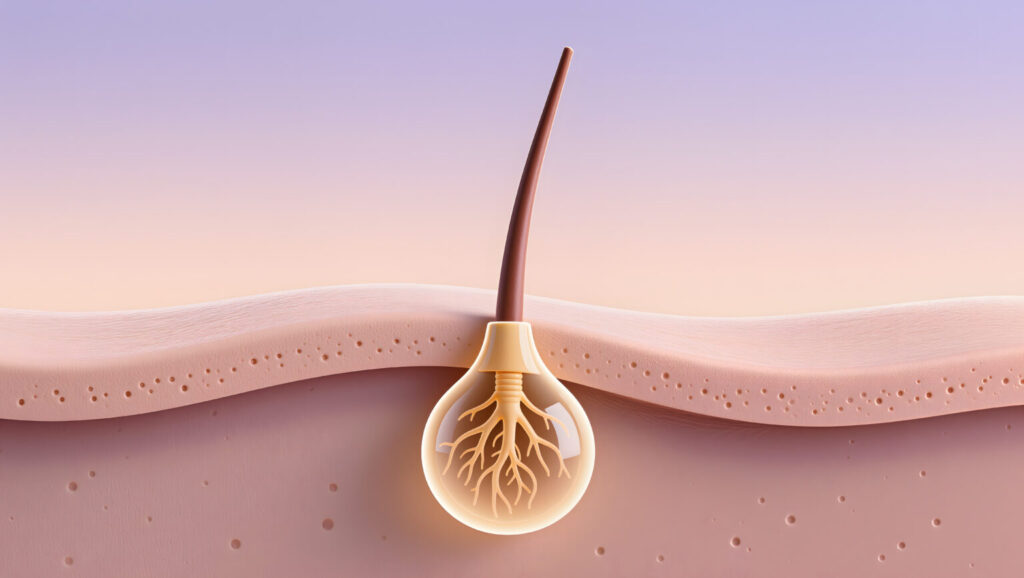
The KeraLase™ procedure was originally developed for skin regeneration and later adapted for the scalp. It combines the LaseMD® laser technology with a special serum of recombinant growth factors (KeraFactor™).
The treatment should:
- improve the scalp’s absorption capacity,
- Stimulate weakened hair follicles,
- slow down hair loss.
Anecdotal evidence suggests positive effects in cases of diffuse hair loss, especially when the follicles are not yet completely inactive. However, long-term data and large-scale clinical trials are still pending.
Z-Factors: Nano-peptides and Regenerative Agents
Z-Factors also work with a similar idea – a peptide serum is applied after a gentle scalp treatment to improve cell communication. The growth factors it contains are intended to act like biological “signals” and support cell communication in the area surrounding the hair follicle.
Observed effects:
- Stronger hair growth in cases of diffuse thinning,
- improved scalp circulation,
- Lower hair loss rate after multiple treatments.
However, the effect is supportive, not regenerative, meaning that destroyed or scarred hair follicles cannot be replaced.
Application & Limitations: Who are Nano-topicals Suitable For?
Nano-topicals can be beneficial for early or diffuse hair loss, provided the hair follicles are still active. Typical applications include diffuse hair loss, weakened hair roots, or as part of complementary care regimens to support existing growth processes.
They are not suitable for large bald patches, permanently inactive or scarred hair follicles, or for those desiring a clearly defined, permanently new hairline. In these cases, a hair transplant with living hair follicles is the only long-term solution.
How Safe are Nano-topicals?
Based on current knowledge, nano-topicals such as KeraLase™ or Z-Factors are considered well-tolerated. The lasers used are non-invasive, and the serums used are biocompatible.
However, dermatologists point out that reliable long-term data is still lacking and that results can vary considerably from person to person. A medical assessment before use is therefore crucial.
Nano-topicals are considered a supportive approach, not a medically equivalent replacement for surgical procedures.
Elithair: Science, Innovation, and Sustainable Results
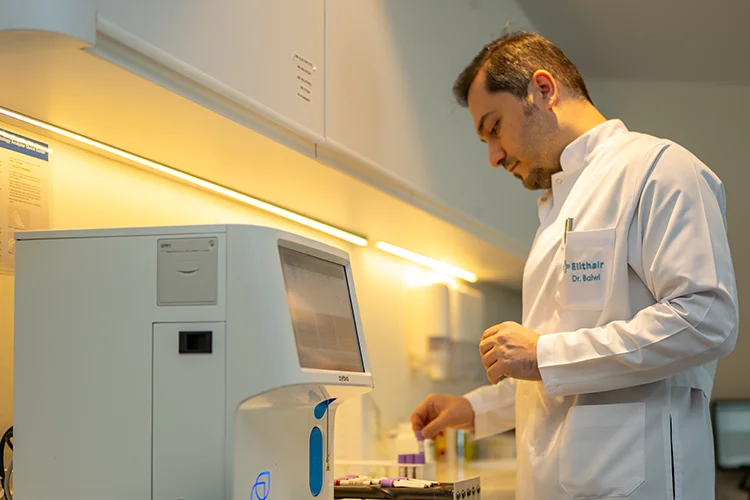
At Elithair, new procedures and trends are not adopted uncritically. Every innovation undergoes a medical evaluation before being implemented in practice. Under the direction of Dr. Abdulaziz Balwi, whose team has already performed over 150,000 successful procedures, the focus remains firmly on methods with demonstrable, long-term effectiveness.
Every treatment is based on a medical assessment. This assessment takes into account, among other things:
- Condition and activity of the hair follicles
- Condition and health of the scalp
- Cause and course of hair loss
- realistic expectations regarding density and hairline
Complementary methods such as PRP therapy or vitamin-based regeneration treatments can be used as treatment options or alongside other procedures. The aim of these methods is to
- to support the hair follicles,
- to promote blood circulation in the scalp
- and to positively support the growth of transplanted hair.
However, there is a clear medical limit: these procedures do not replace hair follicles and are not suitable as a standalone solution for advanced hair loss.
Permanent new hair structure is only achieved through hair transplantation with living hair follicles. Elithair combines surgical precision, modern technology, and medical expertise – for results that not only grow visibly but also last long-term.
Conclusion
Nano-topicals like KeraLase™ and Z-Factors demonstrate the rapid pace of advancements in hair medicine. They can stimulate growth, regenerate the scalp, and provide excellent support alongside transplantation.
However, they do not replace hair follicles – and therefore not a hair transplant either. For lasting, natural results, the combination of modern technology, experience, and surgical precision – as with Elithair – remains the most effective solution.
FAQs
How many nano-topical treatment sessions are typically required to see results?
Most nano-topical treatments such as KeraLase™ or Z-Factors are delivered as a series rather than a single session. Typically, 3–6 sessions spaced several weeks apart are recommended. Visible improvements, such as reduced shedding or thicker hair texture, may appear after a few months, depending on individual response and hair loss severity.
How long do the effects of nano-topicals last?
The effects are not permanent. Nano-topicals support existing hair follicles, meaning ongoing or maintenance treatments are usually required to sustain results. If treatments are discontinued, hair growth often returns to its previous baseline over time.
Can nano-topicals be combined with minoxidil or other medical treatments?
Yes, nano-topicals are often used alongside treatments such as minoxidil, PRP therapy, or nutritional supplementation. A medical professional should assess compatibility and timing to ensure treatments complement rather than interfere with each other.
Are nano-topicals suitable for both men and women?
Yes. Nano-topicals are commonly used for both men and women, particularly in cases of diffuse thinning or early-stage hair loss. Women with hormonally driven or stress-related hair loss may benefit especially, provided the follicles remain active.
Do nano-topicals work for genetic hair loss (androgenetic alopecia)?
They may help slow progression and improve hair quality in early stages of genetic hair loss. However, they do not stop the underlying hormonal cause and cannot restore hair in areas where follicles are already inactive.
Is there any downtime after a nano-topical treatment?
Downtime is minimal. Patients may experience mild redness or scalp sensitivity for a short period after treatment, but normal activities can usually be resumed the same day.
How do nano-topicals differ from PRP therapy?
PRP uses the patient’s own blood-derived growth factors, while nano-topicals rely on laboratory-produced peptides or recombinant growth factors delivered via laser-created microchannels. Both aim to stimulate follicles, but their mechanisms and biological sources differ.
Are results from nano-topicals clinically proven?
While early studies and observational data suggest benefits, large-scale, long-term clinical trials are still limited. Current evidence supports their role as a supportive or complementary treatment rather than a standalone medical solution.
Can nano-topicals prevent the need for a future hair transplant?
In some early-stage cases, they may delay the progression of hair loss. However, they cannot prevent hair loss entirely or replace the need for a transplant once follicles are permanently inactive.
Are nano-topicals suitable after a hair transplant?
Yes. They are often used post-transplant to support scalp health, improve circulation, and optimise the growth of transplanted follicles, although timing should be determined by the treating physician.
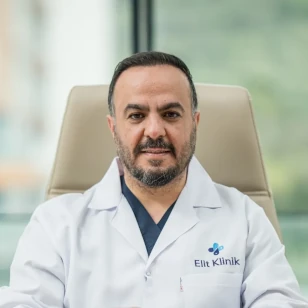
Dr. Imad Moustafa
Hair transplant specialist