

The numbers on the scales are heading down, and then one morning there is noticeably more hair in the plughole than there used to be. That can be unsettling, especially when you are genuinely pleased with how the weight loss is going. Take a breath: in the vast majority of cases your hair follicles are perfectly healthy. This is exactly the moment that worries many Wegovy users once the weight loss really gets going. The question behind it is a fair one, because Wegovy is the only semaglutide product where hair loss is officially listed in the FDA prescribing information, even though Ozempic contains the very same active ingredient.
Here we explain how high the risk on Wegovy really is, why the 2.4 mg obesity dose tends to affect people more often than the diabetes dose, and above all what lies behind it and what you can do about it. A quick spoiler: in the vast majority of cases this is not damage to the hair follicle but a temporary reaction to rapid weight loss. It is called telogen effluvium, and as a rule it grows back fully.
In short: Wegovy and hair loss
Yes, Wegovy can trigger hair loss, but nearly always only temporarily. The trigger is rapid weight loss, not damage to the hair root by the active ingredient. It is a telogen effluvium that, with a stable weight and good nutrition, usually grows back fully.
- In the STEP licensing trials, 3% of adults on Wegovy 2.4 mg reported hair loss, compared with 1% on placebo. The FDA label lists this explicitly.
- With substantial weight loss of more than 20% of body weight, the rate rises to 5.3%. Women are affected far more often than men (4% vs 0.9%).
- The cause is almost always telogen effluvium driven by rapid weight loss, not direct damage from the active ingredient semaglutide.
- The loss is, as a rule, temporary. With a stable weight and good nutrition, the hair typically returns within 6 to 12 months.
This article is for information only and does not replace medical advice. Do not stop Wegovy on your own because of hair loss; always discuss any changes with your treating doctor.
Summary
- Does Wegovy cause hair loss? The straight answer
- What the clinical evidence on Wegovy shows
- What does hair loss on Wegovy look like?
- Why does it happen? The mechanism behind it
- The timeline: when does it start, when does it stop?
- Who is most at risk?
- What exactly is Wegovy?
- Wegovy and hereditary hair loss: the unmasking problem
- Prevention: how to protect your hair during weight loss
- Treatment and regrowth: what really helps
- The Elithair approach: when does a hair transplant make sense?
- Wegovy compared with other GLP-1 medicines
- When to see a doctor: the warning signs
- Frequently asked questions about Wegovy and hair loss
- Conclusion: putting Wegovy and hair loss in perspective
- Sources
Does Wegovy cause hair loss? The straight answer
Yes, Wegovy can cause hair loss, and unlike many of the rumours doing the rounds, this is actually officially documented. In the pooled data from the pivotal STEP licensing trials (STEP 2, 3 and 4), 3% of adults on semaglutide 2.4 mg lost a measurable amount of hair, compared with 1% on placebo. That is roughly three times the placebo rate. This is why the US medicines regulator, the FDA, lists hair loss explicitly in Section 6.1 of the Wegovy prescribing information as a side effect. The key points at a glance:
- Frequency: around 3% of adults are affected according to the licensing trials, and more with substantial weight loss.
- Cause: not the molecule itself but the rapid weight loss (telogen effluvium).
- Onset: typically 2 to 4 months after starting treatment or a dose increase.
- Outlook: the loss is, as a rule, temporary and grows back within 6 to 12 months.
What matters most, though, is what the regulator adds straight away: these hair loss reactions were linked to the weight loss, not to any direct damaging effect of the molecule on the hair root. This very distinction is what decides whether your hair comes back. And in the great majority of cases, it does.
What the clinical evidence on Wegovy shows
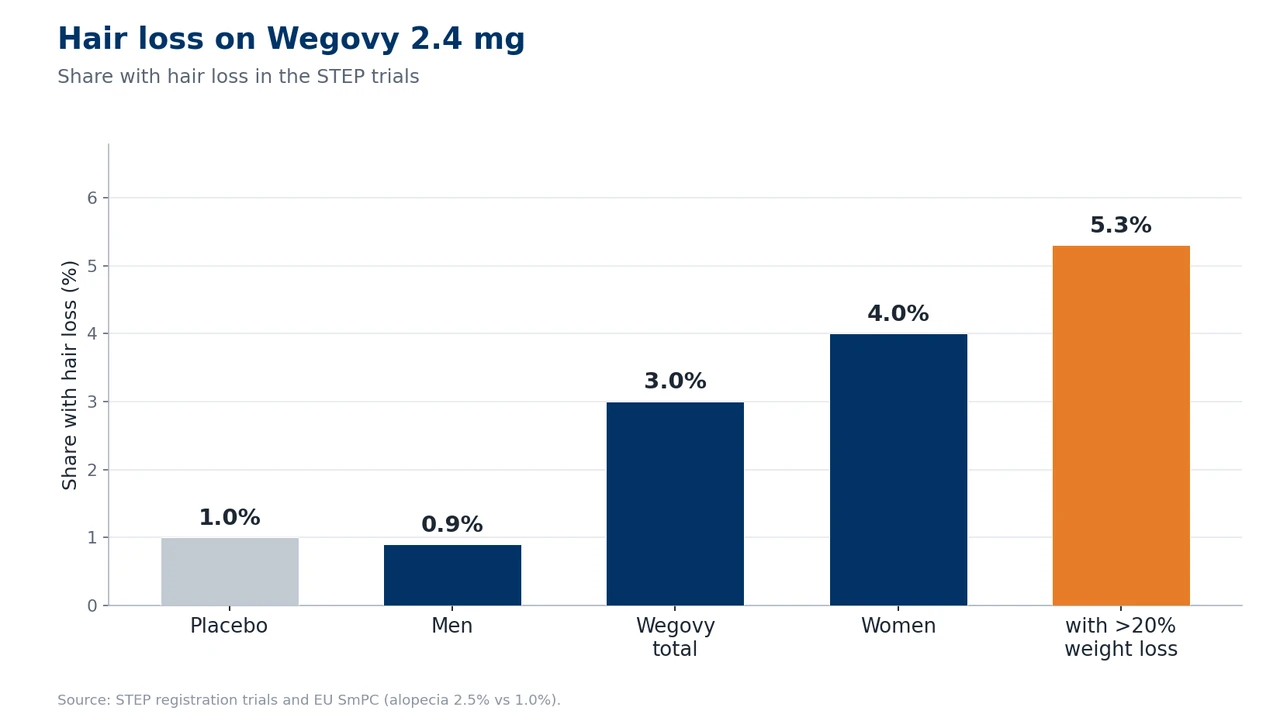
Wegovy (semaglutide 2.4 mg, given weekly by subcutaneous injection) has been FDA-approved for chronic weight management since June 2021. Section 6.1 of the prescribing information lists hair loss at 3% on the active drug compared with 1% on placebo. In adolescents aged 12 and over the difference is even more pronounced: 4% on Wegovy compared with 0% on placebo. The European product information (SmPC) classes alopecia as “common”, meaning at least one in a hundred people treated, at 2.5% versus 1.0% on placebo.
What do the STEP licensing trials show?
Behind these percentages sit large, well-conducted trials. In STEP 1 (just under 2,000 participants, 68 weeks) the mean weight loss was minus 14.9%, with an alopecia rate of around 3% versus 0.9% on placebo. The two-year STEP 5 trial confirmed the picture, with minus 15.2% weight and roughly 3.2% hair loss. The more weight people lost, the more clearly the signal emerged. This very relationship runs like a thread through the whole body of data.
What do the real-world data outside the trials say?
Beyond the licensing trials, the same pattern shows up. An analysis of the FDA adverse-event database (Godfrey et al. 2025) found a clear, statistically significant reporting signal for hair loss with semaglutide. The largest real-world cohort to date, with almost 548,000 matched adults (Vidal/Akiska et al. 2026), showed a 1.76-fold higher risk of telogen effluvium after twelve months on GLP-1 medicines. And a systematic review in Science Progress (Gupta et al. 2026) put the risk of alopecia at around 3.4 times that of placebo, with semaglutide at the top and a clear dose dependency. It is precisely this dose dependency that is the common thread.
Why Wegovy has a label entry and Ozempic does not
Here is where it surprises many people: Ozempic contains the same active ingredient, semaglutide, yet it does not list hair loss in Section 6.1 of its FDA label. The reason lies not in the molecule but in the dose and the indication. Ozempic is used for type 2 diabetes at doses of up to 2.0 mg, and the mean weight loss in the licensing trials was only 3 to 6 kilograms. This mild metabolic stimulus is not enough to produce a measurable hair loss signal.
Wegovy, by contrast, is used for obesity at the higher 2.4 mg dose and achieves mean weight losses of 14 to 16%. That is a qualitatively different stressor for the body. If you would like to understand the active ingredient itself in more detail, you will find the mechanics laid out in our hub article on semaglutide and hair loss. For a direct comparison with the lower-dose diabetes version, see our article on Ozempic and hair loss.
What does hair loss on Wegovy look like?
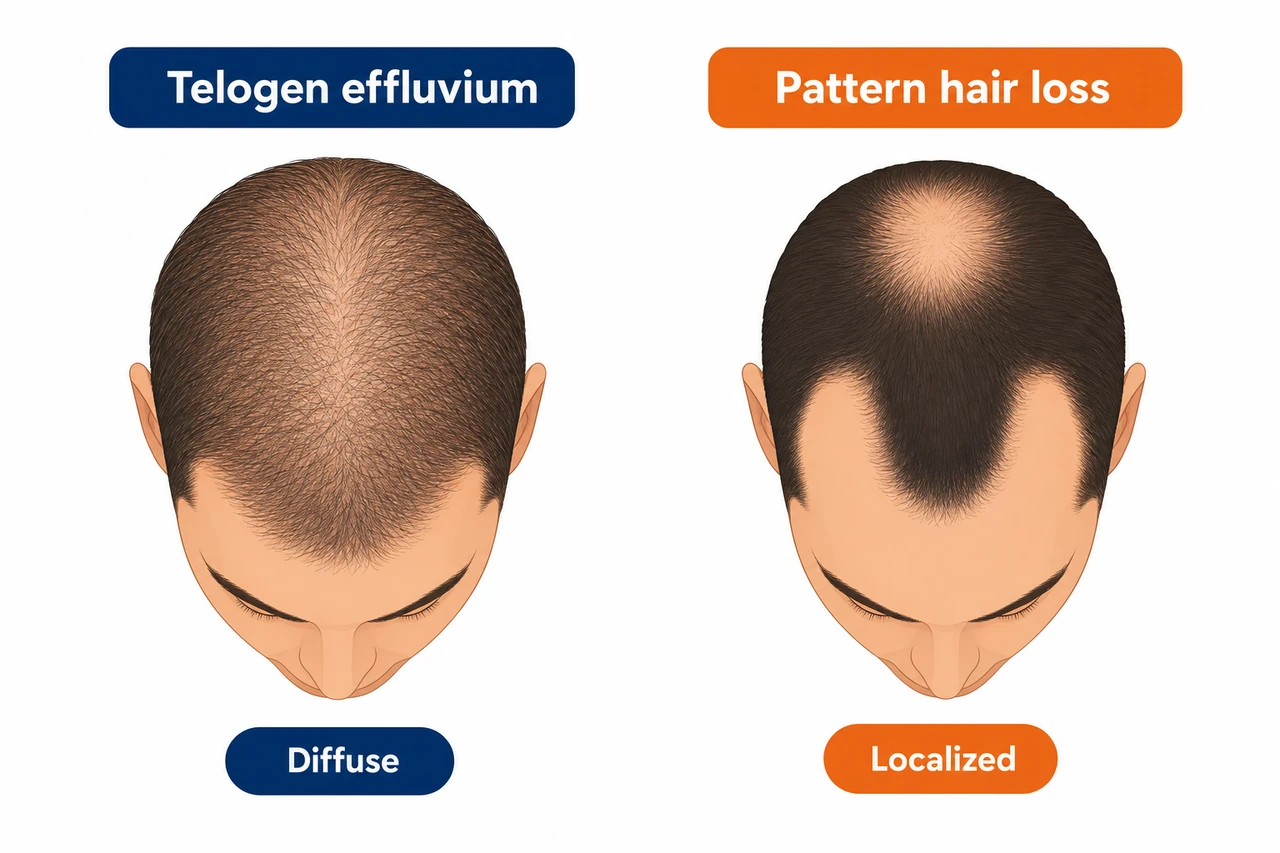
The typical picture on Wegovy is a diffuse, even thinning across the whole scalp. There are no bald patches and no sharp receding line. It is the classic form of diffuse hair loss spread across the entire scalp. Here is how to recognise it:
- Noticeably more hair in the brush, the plughole and on the pillow, often well beyond the normal 50 to 100 hairs a day.
- An even thinning across the whole head, with no clearly defined bald spots.
- In women it is often noticed first because the ponytail gets thinner or the scalp starts to show through at the parting.
This diffuse form is the hallmark of telogen effluvium. It is fundamentally different from the patterned, hereditary androgenetic alopecia, in which a receding hairline or a crown thinning develops. The figure below shows the difference at a glance.
Are the hair follicles damaged in the process?
In a pure telogen effluvium the hair follicles stay intact; they are simply resting for a while. No fully bald patch forms, and overall volume thins without any single area emptying out completely. That is exactly the good news: resting follicles can become active again, whereas destroyed ones cannot.
Why does it happen? The mechanism behind it
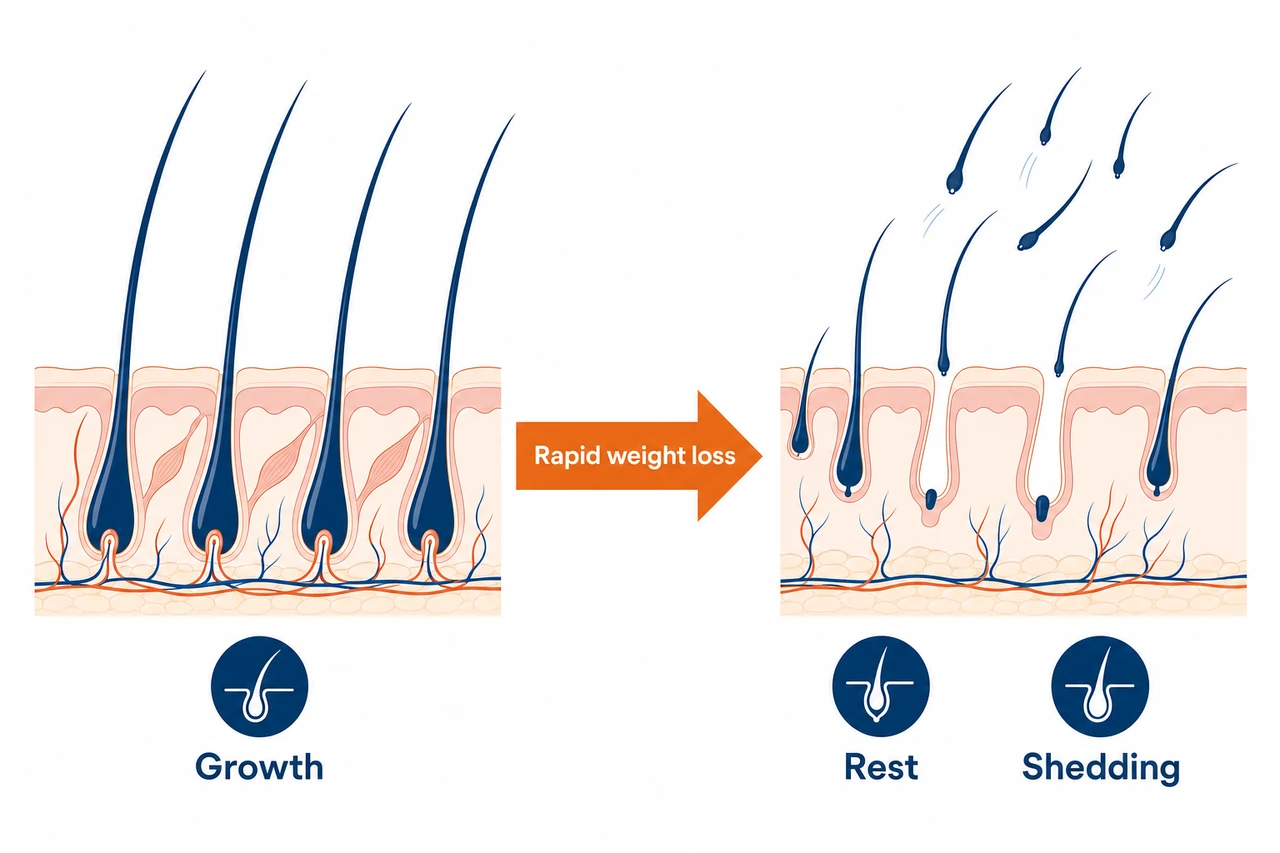
The main mechanism is called telogen effluvium. It kicks in when a strong physical stimulus pushes many hair follicles out of the growth phase and into the resting phase all at once. With Wegovy that stimulus is rapid weight loss. The body reads a marked calorie deficit as stress and prioritises supplying the vital organs. Hair sits a long way down that order of priority. Under heavy stress, up to 70% of growing hairs can switch into the resting state at the same time.
What part do nutrient deficiencies play?
On top of this comes a second factor: nutrient deficiencies. Wegovy suppresses appetite considerably, which during weight loss can lead to an inadequate supply of nutrients. Three deficiencies matter most for the hair:
- Protein deficiency, because hair is made up of around 90% keratin.
- Iron deficiency, because iron is a key building block for cell division in the hair root.
- Zinc deficiency, which disrupts keratin formation.
With a substantial calorie deficit and a suppressed appetite, it is easy to slip into exactly these gaps.
Does semaglutide damage the hair root directly?
A comparable pattern is well known from bariatric surgery, where 56 to 72% of those operated on lose hair a few months after the procedure. Through weight loss, Wegovy creates a similar, if usually milder, stimulus. The important point here is this: it is not a poisoning of the hair follicles by semaglutide. All the current review articles stress that a direct follicle-toxic effect of the active ingredient is not proven. The fact that Ozempic, with its lower dose and less weight loss, shows no label signal confirms exactly that. You can read more about how hormones and hair interact in our article on hormones and hair.
The timeline: when does it start, when does it stop?
Telogen effluvium follows a fixed sequence in time, and that explains an important observation. Around two to three months pass between the trigger and the visible shedding, because a hair only actually falls out after this resting phase. It is the same mechanism we explain in detail in our article on the hair growth cycle.
Why does the shedding coincide with the dose increase?
With Wegovy, the onset of shedding therefore often coincides with the dose increases to 1.7 mg or 2.4 mg, which are due from week 13 and week 17 respectively. But this is not because the molecule suddenly becomes toxic to the hair root at that dose. The decisive factor is the calorie deficit built up over the preceding weeks, which hits the follicles with exactly that typical two-to-three-month lag. The typical course looks like this:
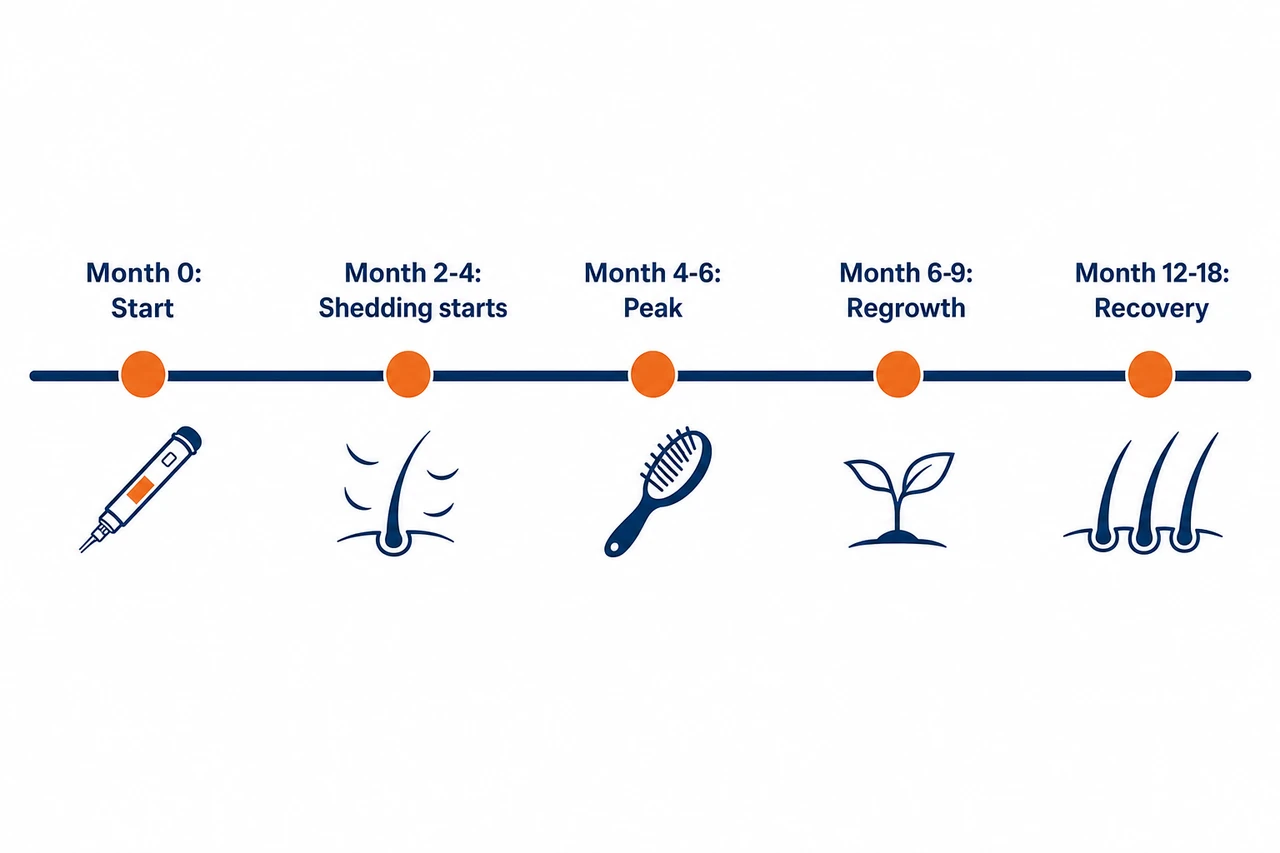
- Months 0 to 3 (latency): no visible shedding. The follicles quietly switch into the resting phase, alongside the start of treatment or the dose increase.
- Months 3 to 4 (first shedding): noticeably more hair in the brush and the shower. The lag behind the trigger often causes confusion.
- Months 4 to 6 (peak): the most intense phase, with many resting hairs shed at the same time.
- Months 5 to 7 (turning point): once the weight loss slows and the nutrient supply is right, the shedding eases off.
- Months 6 to 12 (regrowth): new hair visibly grows back, at about one centimetre a month.
- Months 12 to 18: with a favourable course, hair volume is largely restored in cosmetic terms.
How long does the hair loss last overall?
By definition, an acute telogen effluvium lasts less than six months. If the shedding goes on longer, it is described as a chronic course, or a previously hidden hereditary component comes to light. It is also notable that the European product information states that most of those affected recovered while continuing treatment. So stopping Wegovy is not necessarily needed for regrowth.
Who is most at risk?
Not every Wegovy user carries the same risk. The single strongest predictor is the extent of the weight loss. Anyone who loses more than 20% of their body weight has an alopecia rate of 5.3%, compared with 2.5% for a loss of less than 20%. Since Wegovy achieved a mean of minus 14.9% in STEP 1 and even minus 16.0% in STEP 3, there are many strong responders who fall squarely into this exposed range.
In the pooled STEP data the alopecia rate in women was 4% compared with 0.9% in men. A study from the University of British Columbia found a more than twofold higher risk in women on semaglutide (adjusted hazard ratio 2.08). The background is more frequent iron deficiency, hormonal fluctuations and lower protein stores.
Skipping intermediate doses speeds up the weight loss and with it the metabolic stress. The official 16-week titration schedule should be followed.
Around 91% of those affected in one review analysis already had a history of hair loss. Anyone who is prone to hereditary hair loss in any case, or who starts out with an iron, zinc or vitamin D deficiency, is more exposed.
Does the indication play a part?
The indication plays a part too. Wegovy’s obesity indication means a more drastic weight loss than Ozempic’s diabetes indication, and with it a higher risk of telogen effluvium.
What exactly is Wegovy?
Wegovy is the brand name for semaglutide at the 2.4 mg dose, made by Novo Nordisk. The active ingredient belongs to the class of GLP-1 receptor agonists. It binds to GLP-1 receptors in the hypothalamus and brainstem, reduces appetite, slows gastric emptying and enhances the feeling of fullness. Wegovy has been approved since June 2021 (FDA) and January 2022 (EMA) for chronic weight management in adults with a BMI of 30 or above, or 27 and above with a weight-related comorbidity.
How is Wegovy dosed?
The dose is built up slowly over 16 weeks: 0.25 mg in weeks 1 to 4, then 0.5 mg, 1.0 mg, 1.7 mg, and from week 17 the maintenance dose of 2.4 mg once a week. The same active ingredient is also found, under other names, in Ozempic (up to 2.0 mg, type 2 diabetes) and in Rybelsus (oral, type 2 diabetes). The different dose and indication is precisely why the hair loss profile varies between these products.
Wegovy and hereditary hair loss: the unmasking problem
There is one situation in which a temporary loss can turn into a lasting issue. Androgenetic alopecia, that is, hereditary hair loss, affects around half of both sexes by the age of 50, but often goes unnoticed for years. A telogen effluvium can unmask such a latent predisposition. When the diffuse thinning subsides after the Wegovy phase, a previously hidden hereditary thinning sometimes remains visible.
How do I tell whether hereditary hair loss has been unmasked?
The large real-world cohort (Vidal/Akiska et al. 2026) found that, after twelve months on GLP-1 medicines, there was a raised risk not only of telogen effluvium but also of androgenetic alopecia (a factor of 1.64). Hormonal shifts during substantial weight loss could play a role in people with a genetic predisposition. In practical terms this means: anyone who sees no recovery after around twelve months should have a dermatologist check whether the telogen effluvium has fully healed or whether a hereditary component has become visible. The Norwood-Hamilton scale helps to grade the severity.
Prevention: how to protect your hair during weight loss
The good part: you are not helpless against hair loss on Wegovy. Several levers act on exactly the triggers we know about.
The five most effective measures:
- ✅ Enough protein. Aim for 1.2 to 1.6 g of protein per kilogram of body weight a day, spread across several meals. Protein shakes are handy when your appetite is small on Wegovy.
- ✅ Keep an eye on iron status. Have your ferritin checked before starting treatment and then every 3 to 6 months. Aim for a value above 40 ng/ml, ideally above 70 ng/ml for optimal hair growth.
- ✅ Other micronutrients only where there is a deficiency. Top up zinc, vitamin D and B12 specifically when a deficiency has been confirmed, not on a hunch.
- ✅ Titrate slowly. Stick to the 16-week schedule and keep the weight loss to around 0.5 to 1.0 kg a week. Less speed means less metabolic stress.
- ✅ Gentle hair care. A soft brush, as little heat styling as possible, and no tight hairstyles that pull on the hair as well.
Does biotin help against the hair loss?
A word on biotin, which comes up in every other community discussion: in people without a confirmed biotin deficiency there is no solid evidence that it works. Worse still, high-dose biotin can skew lab results such as troponin or thyroid hormones, something the FDA warns about explicitly. Save your money and put it towards protein and a ferritin check.
Treatment and regrowth: what really helps
The first priority is always to address the underlying cause. Correct any nutrient deficiencies and stabilise the weight. As long as the rapid weight loss continues, the shedding can carry on. Once the weight settles, the loss usually eases off and the hair comes back on its own. Stopping Wegovy is usually not needed for this: the European product information states that the majority of those affected recover while continuing treatment. Any change of therapy belongs in a doctor’s hands in every case, not done off your own bat.
Does minoxidil help with regrowth?
If you want to support regrowth actively, topical minoxidil is an option. It is licensed for hereditary hair loss and is used off-label for telogen effluvium. An open-label study showed a measurable increase in hair density with minoxidil 5% in telogen effluvium. Two points matter here: minoxidil can trigger a temporary initial shedding at the start, and hair may shed again after you stop it. In a pure telogen effluvium it is therefore often not needed at all, because the hair comes back anyway. Its real value lies more where a hereditary component has been unmasked. Its use should be supervised by a doctor. Oral minoxidil and PRP (platelet-rich plasma) are further options, and they too belong in a doctor’s hands.
Does hair grow back fully after Wegovy?
With an uncomplicated telogen effluvium the outlook is good: most of those affected recover fully within 6 to 12 months of stabilising their weight. There is no permanent hair loss with a pure telogen effluvium that has no hereditary component.
The Elithair approach: when does a hair transplant make sense?
Let us be clear from the outset: for a pure, Wegovy-related telogen effluvium a hair transplant is neither necessary nor sensible. The hair follicles are intact; they are simply resting. A transplant would miss the actual cause. The right path first is to optimise nutrition, keep an eye on lab values, treat conservatively if needed, and wait for the spontaneous regrowth.
When does a hair transplant become relevant after all?
A hair transplant only becomes relevant in two scenarios. First, when Wegovy has unmasked a previously hidden androgenetic alopecia that remains after the telogen effluvium has settled and does not respond adequately to conservative treatment. Second, when after around twelve months there has been no meaningful recovery despite a stable weight and normalised nutrient levels. One thing is important here: before any transplant the weight loss must be complete and the weight stable for at least 6 to 12 months, because active metabolic stress can push transplanted follicles into the resting phase as well.
In our clinics we are increasingly seeing patients losing hair while on GLP-1 therapy. In the vast majority of cases this is a telogen effluvium driven by rapid weight loss, not lasting damage. Our advice is clear: first establish the cause, stabilise the weight, and wait for the recovery. A hair transplant only comes into question if, after months, a lasting, hereditary loss remains.
Dr. Balwi, Medical Director at Elithair
Elithair has carried out over 150,000 hair transplants, works to TÜV-certified ISO 9001 standards and provides a written 20-year guarantee. If a transplant really does make sense, the standard method used is the DHI method, complemented by NEO FUE. The transplanted hair comes from the DHT-resistant donor area and therefore does not fall out again. You can find out more about the clinic and the process on the Elithair homepage.
Wegovy compared with other GLP-1 medicines
Comparing the common weight-loss and diabetes products makes the central rule clear: the greater the weight loss, the higher the risk of hair loss. It is not the molecule that decides but the dose and the pace of weight loss.
| Product | Active ingredient | Indication | Hair loss rate | In the FDA label? | Mean weight loss |
|---|---|---|---|---|---|
| Wegovy 2.4 mg | Semaglutide | Obesity | 3% (FDA), up to 5.3% with >20% loss | Yes | −14.9% (68 wks) |
| Ozempic 0.5–2.0 mg | Semaglutide | Type 2 diabetes | not listed in 6.1 | No | 3–6 kg |
| Zepbound 5–15 mg | Tirzepatide | Obesity | approx. 5% (women 7.1%) | Yes | −22.5% (15 mg) |
| Mounjaro 5–15 mg | Tirzepatide | Type 2 diabetes | post-marketing (Section 6.2) | 6.2 only | 11.4 kg (15 mg) |
Two things stand out. Wegovy has a higher rate than the equally dosed Ozempic, because the obesity indication means a more drastic weight loss. And the obesity counterpart from the tirzepatide family, Zepbound, sits at around 5%, even above Wegovy, in keeping with its still greater weight loss of up to minus 22.5%. The mechanics behind it are the same for both active ingredients, as our hub article on tirzepatide and hair loss shows. Switching products on account of hair loss alone is therefore rarely the answer, especially as some of the alternatives carry a higher risk.
When to see a doctor: the warning signs
The typical telogen effluvium is harmless and temporary. But there are situations where you should not wait and see, but get it checked by a doctor.
- Round, bald patches (1 to 4 cm): suspected alopecia areata, which often heals completely when treated early. One documented case occurred after starting semaglutide.
- Redness, itching, pain or scarring of the scalp: suspected scarring alopecia, which can be permanent if left untreated.
- Very heavy shedding plus general symptoms such as exhaustion or sensitivity to cold: have your thyroid checked (TSH test).
- Shedding that lasts more than six months despite good nutrition and a stable weight.
- A patterned rather than diffuse pattern (receding hairline, thinning parting): suspected unmasked hereditary alopecia.
- No visible regrowth after twelve months: a trichological assessment is sensible.
Frequently asked questions about Wegovy and hair loss
Conclusion: putting Wegovy and hair loss in perspective
Wegovy can cause hair loss; that is officially documented and affects around 3% of adults, more with substantial weight loss and more in women. But it is almost always a telogen effluvium driven by rapid weight loss, not damage to the hair follicle by the molecule itself. That is exactly why the loss is, as a rule, temporary and grows back within 6 to 12 months with a stable weight and good nutrition. Anyone who pays attention early to protein and iron status and titrates slowly is actively protecting their hair. And anyone who sees no recovery after twelve months should have it checked whether a hereditary component has become visible. A free hair analysis is the simplest first step for that.
Sources
- Novo Nordisk / FDA. Wegovy (semaglutide) Prescribing Information, Section 6.1. US Food and Drug Administration, 2024. FDA Label
- Novo Nordisk. Wegovy Summary of Product Characteristics (SmPC), Section 4.8. UK EMC, 2024. medicines.org.uk
- Wilding JPH, Batterham RL, Calanna S, et al. Once-Weekly Semaglutide in Adults with Overweight or Obesity (STEP 1). N Engl J Med. 2021. NEJM
- Garvey WT, Batterham RL, Bhatta M, et al. Two-year effects of semaglutide (STEP 5). Nat Med. 2022. PMC
- Godfrey H, Leibovit-Reiben Z, Jedlowski P, Thiede R. Alopecia associated with semaglutide and tirzepatide: a pharmacovigilance study (FAERS). JEADV. 2025. PubMed
- Vidal SI, Akiska YM, Nasseri M, et al. Increased Risk of Hair Loss With GLP-1 Receptor Agonists: A Real-World Multicentre Cohort Study. JAAD International. 2026. PMC
- Gupta AK, Teasell EM, Economopoulos V, Mirmirani P. GLP-1 therapies and hair loss: A systematic review. Science Progress. 2026. SAGE
- Alsuwailem OA, et al. Hair Loss Associated With GLP-1 Receptor Agonist Use: A Systematic Review. Cureus. 2025. PMC
- Rojas Lopez RF, et al. Alopecia as an Emerging Adverse Effect Associated With GLP-1 RAs (Scoping Review). Cureus. 2025. PMC
- Sodhi M, Etminan M. Risk of Hair Loss with Semaglutide for Weight Loss. medRxiv Preprint, 2025. medRxiv
- Novo Nordisk / FDA. Ozempic (semaglutide) Prescribing Information. FDA, 2025. FDA Label
- Eli Lilly / FDA. Zepbound (tirzepatide) Prescribing Information, Section 6.1. FDA, 2024. FDA Label
- Blume-Peytavi U, et al. Telogen Effluvium. StatPearls / NCBI Bookshelf (NIH), 2024. NCBI
- Ohyama M, et al. Topical Minoxidil 5% for Telogen Effluvium: An Open-Label Pilot Study. J Dermatol. 2025. PMC
- American Academy of Dermatology (AAD). How can GLP-1 drugs affect my skin, hair, and nails? 2026. aad.org
This article is provided for general information purposes only and does not replace individual medical advice. If your hair loss persists, you should seek a professional diagnosis. Please make changes to your Wegovy therapy only in consultation with your treating doctor.

Dr. Imad Moustafa
Hair transplant specialist