

Quick answer: PP405 for androgenetic alopecia
PP405 is an experimental, topical (applied to the scalp) and non-hormonal compound for androgenetic alopecia, developed by the UCLA spin-out Pelage Pharmaceuticals. It is intended to reactivate dormant hair follicle stem cells via lactate metabolism. As of June 2026, PP405 is not yet approved and not available to buy.
- Status: Phase 2a completed (results June 2025), Phase 3 announced for 2026 but not yet started.
- Key figure: In Phase 2a, 31% of men with advanced loss (Norwood III vertex or higher) achieved more than 20% increase in hair density after 8 weeks, compared with 0% in the placebo group.
- Market: realistically 2027–2030 at the earliest in the US, probably later in the UK; no EMA or MHRA application is known.
- Buying: not possible. Products sold as “PP405 powder” or “research chemical” are not the clinical compound.
Plenty of promises, forum rumours and sales offers are circulating around PP405. This guide puts the compound into sober perspective: what it is, how it is supposed to work, what the studies really show and why you cannot currently buy it from any reputable source. Data as of June 2026.
Summary
- What is PP405?
- How does PP405 work? (PP405 mechanism)
- Who is developing PP405? Pelage Pharmaceuticals and the “McLaurin Therapeutics” myth
- The evidence: what the PP405 studies show (PP405 study)
- PP405 experiences: what study participants report
- When will PP405 come to market?
- Can you buy PP405 in the UK? (buy PP405)
- PP405 vs. minoxidil, finasteride and hair transplant
- Does PP405 work in women?
- The time factor: at which stage can PP405 work?
- Conclusion: promising research, lasting solutions available today
- Common questions about PP405 for androgenetic alopecia
- Sources
What is PP405?
PP405 is a small-molecule compound that is applied topically to the scalp and is intended to reactivate dormant hair follicle stem cells. PP405 is being developed by Pelage Pharmaceuticals, a biotech company spun out of the University of California, Los Angeles (UCLA) in 2018. As of June 2026 the compound is in clinical testing (Phase 2a completed).
Unlike the approved standards, PP405 works neither hormonally (like finasteride) nor by promoting blood flow (like minoxidil). The approach is a completely different one: PP405 intervenes in the energy metabolism of the stem cells and is intended to bring weakened but still present follicles out of the resting phase and back into the growth phase. The exact chemical structure is patented and not publicly known.
The name carries a small story with it: “Pelage” comes from the French word for fur or coat as a hair metaphor, and “PP405” combines the company initials with Interstate 405 in Los Angeles (source: Wikipedia, PP405). PP405 has been developed specifically for androgenetic alopecia. For scarred scalp or alopecia areata (autoimmune) there is no mechanism of action.
What is androgenetic alopecia all about?
Androgenetic alopecia (AGA) is the most common cause of hair loss worldwide. According to StatPearls (NCBI), around 50% of men aged 50 and over are affected, around 80% from age 70, and up to 42% of women by age 70. The hormone DHT (dihydrotestosterone) binds to androgen receptors at the hair root, shortens the growth phase and causes the follicles to shrink step by step (miniaturisation). Important: in early to intermediate stages the follicles do not disappear, they only become smaller. This is exactly where PP405 comes in.
How does PP405 work? (PP405 mechanism)
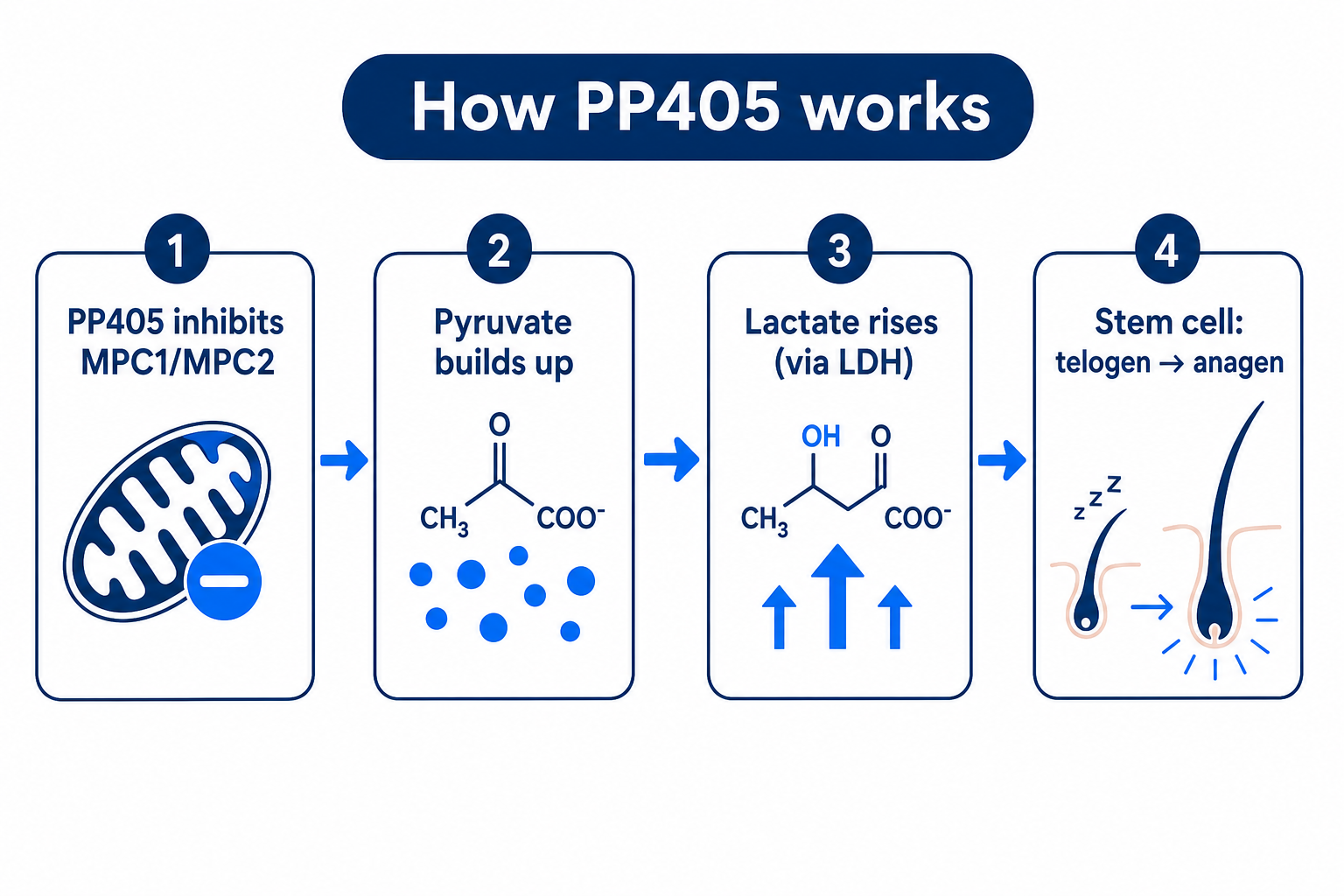
The PP405 mechanism is based on a metabolism-driven process: PP405 is a dual inhibitor of the mitochondrial pyruvate carrier MPC1 and MPC2. When this carrier is inhibited, pyruvate can no longer enter the mitochondria, builds up in the cell and is increasingly converted into lactate via lactate dehydrogenase (LDH). This rise in lactate is the actual switch.
In the hair follicle stem cells, lactate acts like a biological switch: low lactate levels keep the stem cells in the resting phase (telogen), high levels push them into the growth phase (anagen). A UCLA research team led by Flores et al. demonstrated this principle back in 2017 in the journal Nature Cell Biology (PMID 28812580). It is the scientific basis of PP405.
Specifically, the 2017 study showed: if the enzyme LDHA is switched off in hair follicle stem cells, the follicles stay in telogen and no new hair cycle starts. If, on the other hand, lactate production is increased through an MPC1 deletion, the hair cycle speeds up. PP405 mimics this effect pharmacologically, without touching the hormone system.
An important point on tolerability: PP405 is formulated so that it penetrates deep into the scalp but does not pass into the blood. In the Phase 1 and Phase 2a data no PP405 was detectable in blood plasma (source: Pelage Pharmaceuticals, AAD 2024). This points to good local tolerability and against systemic side effects of the kind known, for example, from oral finasteride.
A note on accuracy: Some older sources attribute additional effects to PP405, such as stimulation of growth factors (VEGF, IGF-1), an anti-inflammatory action or improved blood flow. For these pathways there is no proven evidence for PP405 from the clinical studies. The documented mechanism is exclusively the MPC1/MPC2 lactate pathway.
Perspective from Elithair practice
Stem-cell-based research approaches like PP405 are exciting from a medical point of view, because they tackle an old problem from a new angle. What remains decisive, though, is the stage: only what is still there can be reactivated. If follicles have already been broken down by androgenetic alopecia, no compound can bring them back. In that case, the route to lasting density still leads via your own, DHT-resistant hair.
Who is developing PP405? Pelage Pharmaceuticals and the “McLaurin Therapeutics” myth
PP405 is being developed by Pelage Pharmaceuticals, a biotech company spun out of UCLA in 2018 with an exclusive patent and technology licence from the university. The scientific core consists of three UCLA researchers: stem cell biologist Dr William Lowry, metabolism researcher Dr Heather Christofk and medicinal chemist Prof. Michael Jung, who synthesised PP405. The company is led by CEO Daniel Gil.
Pelage is solidly financed: in October 2025 the company closed a Series B round of 120 million US dollars, led by ARCH Venture Partners and GV (Google Ventures). In the same month, TIME Magazine listed PP405 as one of its “Best Inventions of 2025”. These external signals make PP405 a serious research programme, not a garage project.
In search queries and forums, the name “McLaurin Therapeutics” keeps cropping up in connection with PP405. There is no verifiable link for this: neither press releases nor patent databases nor ClinicalTrials.gov name such a company as the developer. All valid sources cite Pelage Pharmaceuticals exclusively. “McLaurin Therapeutics” is most likely a mix-up arising from forum rumours. Be cautious of offers that rely on company names that cannot be verified.
The evidence: what the PP405 studies show (PP405 study)
So far, the PP405 studies have run exclusively in the US: Phase 1 (completed January 2024) demonstrated safety and the mechanism of action, and Phase 2a (results June 2025) delivered the first signs of efficacy. Before that comes the UCLA basic research from 2017 onwards. A Phase 3 PP405 study has been announced for 2026, but as of June 2026 it had not yet started.
Phase 1: safety and proof of mechanism
In Phase 1, participants applied a 0.05% PP405 gel for seven days. According to Pelage (presented in the late-breaking session of the AAD annual meeting 2024), the proliferation marker Ki67 in the hair follicles rose significantly after seven days, measured by scalp biopsy. In addition, new “hair germs” formed, a typical sign of the transition from telogen to anagen. No PP405 was detectable in the blood, and no side effects occurred.
Phase 2a: first signs of efficacy
The Phase 2a study (registered as NCT06393452, randomised, double-blind, vehicle-controlled) included 78 participants aged 18 to 55, men with Norwood type III vertex to V and women in the Savin classification I-2 to I-4. They applied PP405 0.05% or a placebo vehicle daily for four weeks, with follow-up to week 12.
The central result (source: Pelage Pharmaceuticals, June 2025): in men with a higher degree of loss (Norwood III vertex or higher), 31% of the PP405 group showed more than 20% increase in hair density after 8 weeks, compared with 0% in the placebo group. New terminal hair grew from previously empty follicles, not just fine vellus hair. Here too: no PP405 in the blood, no systemic side effects.
The pace is remarkable: this response appeared after 8 weeks, of which only 4 weeks were active application. Approved treatments such as minoxidil and finasteride typically need 4 to 6 months before the first visible results, according to StatPearls (NCBI). To assess the results, Pelage also introduced the “Follicular Unit Count” metric (number of active follicular units).
How carefully these figures should be read
- Small sample size (78 participants) and very short application period (4 weeks active).
- Phase 2a was primarily designed for safety; the efficacy data are secondary results.
- The 31% figure applies only to men with advanced loss, not to all participants and not generally to women.
- There is no direct comparison arm with minoxidil or finasteride and no long-term proof of durability.
A Phase 2b extension (open-label extension) ran at the end of 2025 for the former placebo participants; Pelage intended to present full data from it in 2026. At the AAD annual meeting 2026, Dr Arash Mostaghimi (Brigham and Women’s Hospital) placed PP405 within an outlook on new hair loss therapies, without naming any new effect figures beyond Phase 2a.
PP405 study timeline at a glance
| Phase | Timeframe | What was tested | Result | Significance |
|---|---|---|---|---|
| Preclinical / UCLA | from 2017 | lactate mechanism (mouse model, ex vivo) | MPC1 deletion speeds up hair cycle | scientific basis |
| Phase 1 | completed Jan. 2024 | 7 days 0.05% topical | safe; Ki67 rise; hair germs; no systemic absorption | proof of mechanism |
| Phase 2a | results June 2025 | 78 participants, RCT, 4 weeks application | 31% of men (Norwood III+) >20% density after 8 wks vs. 0% placebo | first signs of efficacy |
| Phase 2b (OLE) | end of 2025 | open-label extension, 3 months | full data pending (2026) | extended safety |
| Phase 3 | planned from 2026 | large RCT, men + women | open | decides on approval |
| Approval / market | 2027–2030 at the earliest | FDA submission ~2027/2028 | open | not yet available to buy |
PP405 experiences: what study participants report
There are no real-world PP405 experiences from everyday use so far, because the compound is not approved and not freely available. The only thing available is the data from the clinical studies (Phase 1 and Phase 2a). Everything else that appears online as a personal account of “bought PP405” cannot be verified.
From the studies, a realistic picture can at least be derived: local tolerability was good, no burning or scalp irritation was documented in Phase 1 and 2a, and no systemic effects were recorded either. The effect was individual: 31% of the men with advanced loss responded with more than 20% increase in density, while the rest were below that or showed no measurable response. Responders and non-responders are normal in hair therapies.
Caution is warranted with forum “experiences”: reports of supposedly bought PP405 (for example on Reddit r/Tressless) most likely refer to JXL069 or similar research chemicals that are passed off as PP405. Pelage has made clear that JXL069 is not PP405. Such reports therefore say nothing about the real compound.
When will PP405 come to market?
As of June 2026, PP405 is not approved; a market launch is realistic between 2027 and 2030 at the earliest in the US. The Phase 3 study was announced for 2026 but had not yet started. Only after a successful completion can Pelage apply for approval from the US regulator, the FDA. All timings are estimates, not commitments.
For the UK and the EU the picture is even more cautious: no application to the European Medicines Agency (EMA) or the UK’s MHRA is known. After a US approval, a regulatory procedure of typically two to three years would be added. Realistically, PP405 is therefore unlikely to be available in the UK before 2030, and probably on prescription. A failure in Phase 3 would overturn the entire timeline.
Can you buy PP405 in the UK? (buy PP405)
No, you cannot buy PP405. PP405 is not approved and is exclusively part of clinical studies under the control of Pelage Pharmaceuticals. Anyone searching the internet for “buy PP405” will come across powders, liquids and “research chemicals” sold as PP405. These are not Pelage’s clinical compound, and buying them is risky for several reasons.
Why grey-market “PP405” is not a real option
- Unknown structure: the chemical structure of PP405 is patented and not published. Any substance sold as “PP405” is therefore either a different compound or a fake.
- JXL069 mix-up: many forum buyers imported the related MPC inhibitor molecule JXL069 from China in 2025, assuming it was PP405. Pelage has made clear: PP405 is neither JXL069 nor JXL082. JXL069 is a pure research tool.
- Missing carrier formulation: PP405 needs a specially developed, proprietary carrier gel that delivers the compound into the stem cells of the scalp without passing into the blood. Even the correct substance would very likely not penetrate effectively without this vehicle.
- No guarantee: research chemicals have no verified dosage, no purity control and an unknown toxicity. Self-application can damage the scalp.
The responsible route is through medical advice. Anyone who wants to do something about their hair loss now can turn to the approved options minoxidil and finasteride (with a medical weighing of the risks, see below) or, where follicles are already lost, consider a hair transplant. Waiting for PP405 is one option; self-experimentation with grey-market substances is not.
PP405 vs. minoxidil, finasteride and hair transplant
Compared with minoxidil, finasteride and the hair transplant, PP405 is the only approach not yet approved: a future candidate up against three available options. Each method has a different mechanism of action and a different role. The matrix below summarises the differences; all values come from the sources cited at the end.
| Criterion | PP405 (experimental) | Minoxidil | Finasteride (men) | Hair transplant (Elithair) |
|---|---|---|---|---|
| Status | Phase 2a, not approved | approved | approved; new warning Sept. 2025 | established |
| Mechanism | stem cell reactivation (lactate/MPC) | blood flow, anagen extended | DHT reduction (hormonal) | own DHT-resistant follicles |
| Permanent? | unclear (no long-term data) | no, only during use | no, only during intake | yes, permanent |
| Application | topical daily (study) | topical daily / oral | tablet once daily / topical | one-off procedure |
| In women | Phase 3 pending | yes (approved) | no (contraindicated) | yes |
| Speed | ~8 weeks (Phase 2a) | 4–6 months | 3–6 months | growth 3–12 months |
| Lost follicles? | no | no | no | yes (only option) |
| Available today? | no | yes | yes (prescription) | yes |
An important safety point on finasteride: in September 2025 the German regulator BfArM (risk information dated 16/09/2025) confirmed suicidal thoughts as a side effect; 1 mg packs will in future include a patient information card. Loss of libido and erectile dysfunction are also known. Anyone considering finasteride should weigh this up with a doctor. PP405, by contrast, acts locally with no detectable entry into the blood, but as yet has no long-term data.
The key message of the table: PP405 is a future hope with interesting first data. Minoxidil and finasteride are available maintenance therapies that only work during use. And the hair transplant is the only method that permanently restores density where follicles are already lost. You can read more about the hereditary form in the article on androgenetic alopecia.
Does PP405 work in women?
The Phase 2a study included men and women (in women, Savin classification I-2 to I-4), yet there is as yet no robust efficacy data for women. The published results with more than 20% increase in density refer expressly to men with a higher degree of loss. Pelage has not published separate women’s data from Phase 2a.
This is particularly relevant for women, because for female androgenetic alopecia only a single approved treatment exists so far (minoxidil). PP405 could become a second option here, which is a stated research goal of Pelage. This will only become robust with the data from Phase 3, which is intended to study men and women in larger numbers. More on this in the article hormones and hair.
The time factor: at which stage can PP405 work?
PP405 can only reactivate follicles that are still present but weakened; follicles already permanently lost or scarred cannot be brought back. As long as the stem cells in the so-called bulge region survive, reactivation is biologically conceivable (basis: Flores et al., Nature Cell Biology 2017). Once they have disappeared, no compound can replace them.
In practical terms this means: in early to intermediate stages (Norwood I–IV) the follicles are usually only miniaturised and, in theory, responsive. On bald areas (Norwood V–VII) the follicles have often disappeared or the scalp is scarred. Wikipedia (PP405) also points out that PP405 is likely no longer effective in advanced, scarred stages. Recognising it early therefore preserves options.
The complementary logic is important: medication (perhaps PP405 in future) and hair transplant do not exclude one another, they complement each other. In androgenetic alopecia, DHT-sensitive follicles shrink until they disappear. A hair transplant permanently fills areas that are already bald with your own, DHT-resistant follicles, while compounds protect and reactivate the surrounding remaining hair.
Alternative for an advanced stage: the Elithair procedure
If follicles are already permanently lost, no compound can bring them back. At Elithair, lasting restoration is then carried out via DHI with the CHOI pen and the patented NEO FUE for extraction. Which stage is present and whether reactivable follicles are still there is shown by a hair analysis. It is an optical pattern analysis of the scalp and does not replace a medical blood test, but it does help to assess your own starting point realistically.
Conclusion: promising research, lasting solutions available today
PP405 for androgenetic alopecia is a scientifically grounded, serious research approach based on UCLA basic research (Nature Cell Biology 2017) and the first clinical signs from Phase 2a (June 2025). Promising, but still years away from approval: small sample size, short application, no long-term proof, Phase 3 pending.
Anyone who wants to act now has two sensible routes: in early stages the approved treatments (minoxidil, finasteride with medical counselling), and where follicles are already lost the hair transplant. Both can be combined with new compounds later. Buying supposed PP405 products from the grey market is clearly to be advised against. A free hair analysis will clarify which stage you are at.
Common questions about PP405 for androgenetic alopecia
Is PP405 already available?
No. PP405 is an experimental compound in clinical testing (Phase 2a completed, Phase 3 planned). It cannot be bought. Offers on the internet are not the real PP405 compound.
How much better is PP405 than minoxidil?
A direct head-to-head comparison does not exist. In Phase 2a, 31% of the treated men with advanced loss showed more than 20% increase in hair density after 8 weeks, of which only 4 weeks were application. Minoxidil typically needs 4 to 6 months. Long-term data for PP405 is still lacking.
Does PP405 have side effects?
In Phase 1 and Phase 2a (78 participants, 4 weeks) no systemic side effects were observed, and no PP405 was detectable in the blood. For long-term side effects, data is still lacking, as Phase 3 is pending.
When will PP405 come to the UK?
At the earliest after a US approval (around 2027 to 2030) and a subsequent EMA or MHRA procedure of two to three years. Realistically, PP405 is unlikely to be available in the UK before 2030, and probably on prescription.
Does PP405 replace the hair transplant?
No. PP405 can only reactivate hair follicles that are still present but dormant. Where follicles are already completely lost, the hair transplant remains the only method for permanently restoring density.
Does PP405 help with a receding hairline?
A receding hairline is one of the early stages, in which follicles are usually only miniaturised, a stage in which PP405 could potentially take effect. There is no robust data for this, though: the Phase 2a study included men from Norwood III vertex, not for pure hairline recession (Norwood II).
Would PP405 need to be used permanently, or does the effect last after stopping?
This is still open, because long-term data is lacking (Phase 3 is pending). Since in androgenetic alopecia the hormone DHT continues to attack the follicles, PP405 is likely to be a long-term therapy: the reactivation switch triggered via lactate metabolism would presumably have to stay flipped permanently. This is a reasoned assumption, not study-based evidence. Minoxidil and finasteride also only work during use.
What will PP405 cost?
There are no official prices, because PP405 is not approved and not on the market. As a new, patented biotech compound, it would likely sit in the premium segment above generic minoxidil at a market launch. Concrete figures would be pure speculation as long as neither approval nor a manufacturer’s price is fixed.
Sources
- Flores A. et al. “Lactate dehydrogenase activity drives hair follicle stem cell activation.” Nature Cell Biology, 2017 (PMID 28812580). pubmed.ncbi.nlm.nih.gov
- Pelage Pharmaceuticals: Phase 2a results PP405, June 2025. pelagepharma.com
- Pelage Pharmaceuticals: late-breaking data AAD 2024 (Phase 1, Ki67). pelagepharma.com
- ClinicalTrials.gov / Purdue CDEK: Phase 2a study NCT06393452. cdek.pharmacy.purdue.edu
- StatPearls (NCBI): Androgenetic Alopecia (prevalence, pathophysiology). ncbi.nlm.nih.gov
- BfArM: risk information finasteride/dutasteride, September 2025. bfarm.de
- ISHRS: Effectiveness of 5% Minoxidil in Treating Male-Pattern Hair Loss. ishrs.org
- Wikipedia: PP405 (distinction from JXL069, stage note; secondary source). en.wikipedia.org
Note: this article is for general information and does not replace medical advice. PP405 is an experimental, unapproved compound. Statements on timelines and efficacy are based on the study status of June 2026 and may change. Please make treatment decisions together with a doctor.
Dr. Imad Moustafa
Hair transplant specialist