

Short and clear: keratin and your hair
- Keratin is the fiber-forming structural protein that makes up about 90 percent of your hair (keratin.com).
- “Keratin for hair” means two things: nourishing keratin treatments (smooth the surface, cosmetic) and chemical keratin straightening (relaxes curls, lasts 2 to 5 months).
- Good for your hair? Nourishing masks, yes. With straightening, the sticking point is formaldehyde: only choose products free of formaldehyde and methylene glycol.
- Keratin beautifies the hair fiber, but it does not affect hair growth or hair loss at the root.
Keratin is everywhere: in shampoo ads, in your stylist’s chair, on the ingredient list of your mask. But what is really behind it, what does a treatment actually do, and when does it get risky? This guide (updated 2026) explains the protein, gives an honest comparison of masks, salon treatments and straightening, and shows what you need to watch for when it comes to formaldehyde.
Summary
- What is keratin? The protein in your hair, explained simply
- Keratin treatment, keratin mask or keratin straightening: the difference
- Is keratin good for your hair? An honest look at the benefits and effects
- Risks and downsides of keratin straightening: the formaldehyde problem
- Keratin during pregnancy and common safety questions
- Caring for keratin-treated hair: before and after the treatment
- When keratin does not help: a damaged surface or real hair loss?
- FAQ: keratin and hair
- Sources
What is keratin? The protein in your hair, explained simply
Keratin is a fiber-forming structural protein and the main building block of hair, nails and the outermost layer of skin. Depending on the source and hair type, human hair is roughly 65 to 95 percent keratin, with a figure of around 90 percent often cited (keratin.com). The rest is water, lipids and traces of minerals and melanin.
Keratin is built from amino acids. The key one is the sulfur-containing amino acid cysteine: it forms what are called disulfide bonds between the protein chains. The denser this network of bonds, the stronger and more resilient the hair (MedLexi.de, medi-karriere.de). In mammals the form present is alpha-keratin, whose helical structures give hair its elasticity.
Important up front: hair breakage is not the same as hair loss
Keratin only acts on the hair fiber, meaning the surface. Hair breakage (the fiber snapping from external damage) can be improved with keratin. Hair loss, on the other hand, starts at the root and does not respond to care products. If you suspect your hair is thinning, you will find guidance further down in the section “When keratin does not help.”
Where in the hair does the keratin sit?
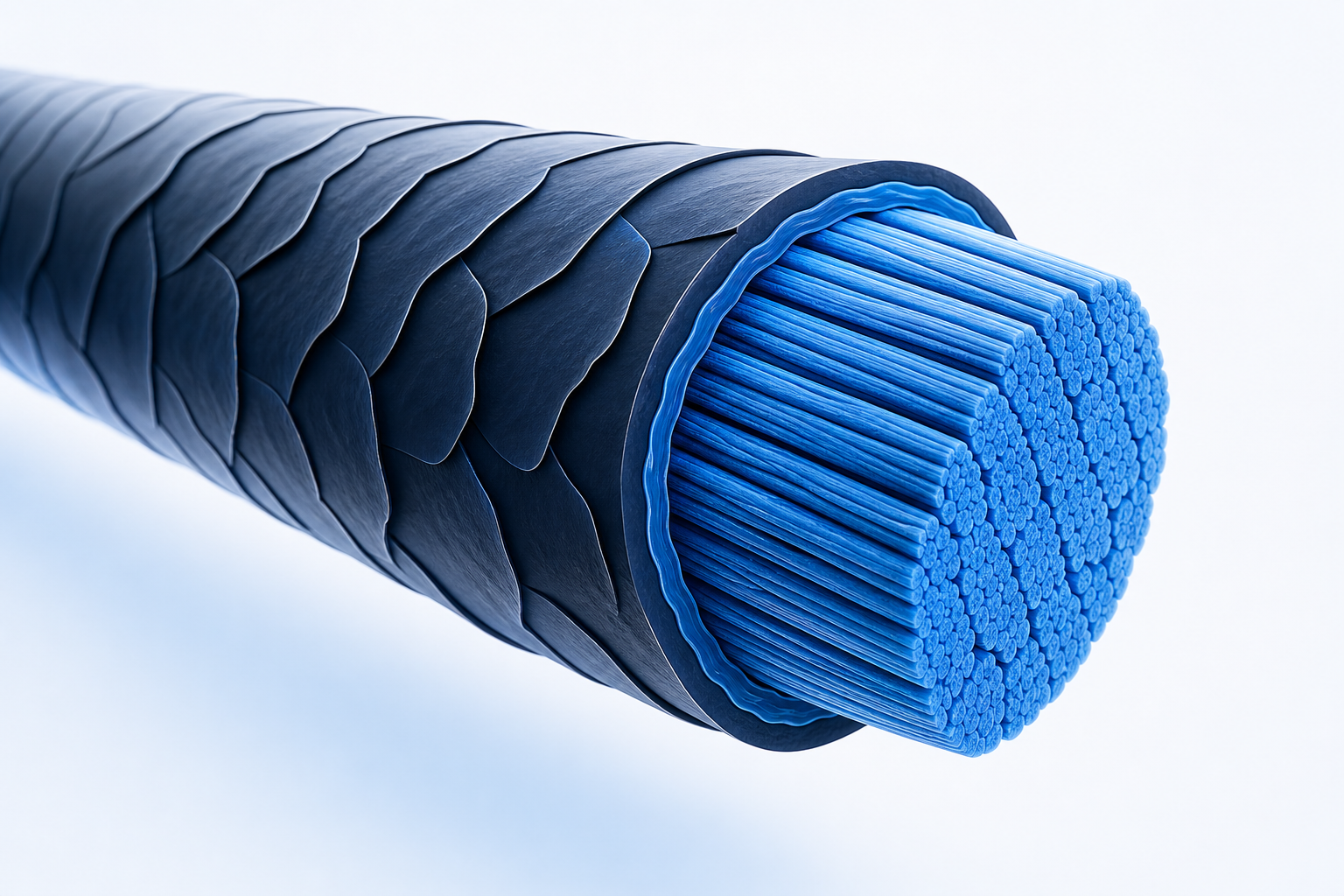
Keratin sits in two areas of the hair. The cortex makes up 80 to 90 percent of the hair’s volume and provides its mechanical strength. The cuticle is the outer shell of flat, overlapping keratin scales that protects the cortex (ScienceDirect). It is this scaly cuticle layer that most keratin care products work on.
Natural and added keratin: where it comes from
Your body produces its own keratin. The keratin in cosmetics is usually hydrolyzed keratin (INCI: Hydrolyzed Keratin): through hydrolysis the long protein chains are broken into smaller fragments so they can bind to the hair. It is traditionally obtained from sheep’s wool, feathers or animal horns (INCI Beauty, keratin-info.de). In other words, it is of animal origin.
If you prefer vegan options, there are “keratin-like” alternatives: phytokeratin based on hydrolyzed wheat or soy protein (INCI: Hydrolyzed Wheat Protein). It is structurally similar to keratin and conditions comparably, but it is not identical (myrto-naturalcosmetics.de, Jean&Len). Do not confuse keratin with collagen: collagen sits in the skin around the follicle, not in the hair fiber itself (bubsnaturals.com).
Keratin treatment, keratin mask or keratin straightening: the difference
A “keratin treatment” refers to three different things, and that is exactly what gets mixed up. When people search for “keratin treatment,” they usually mean one of these three variants:
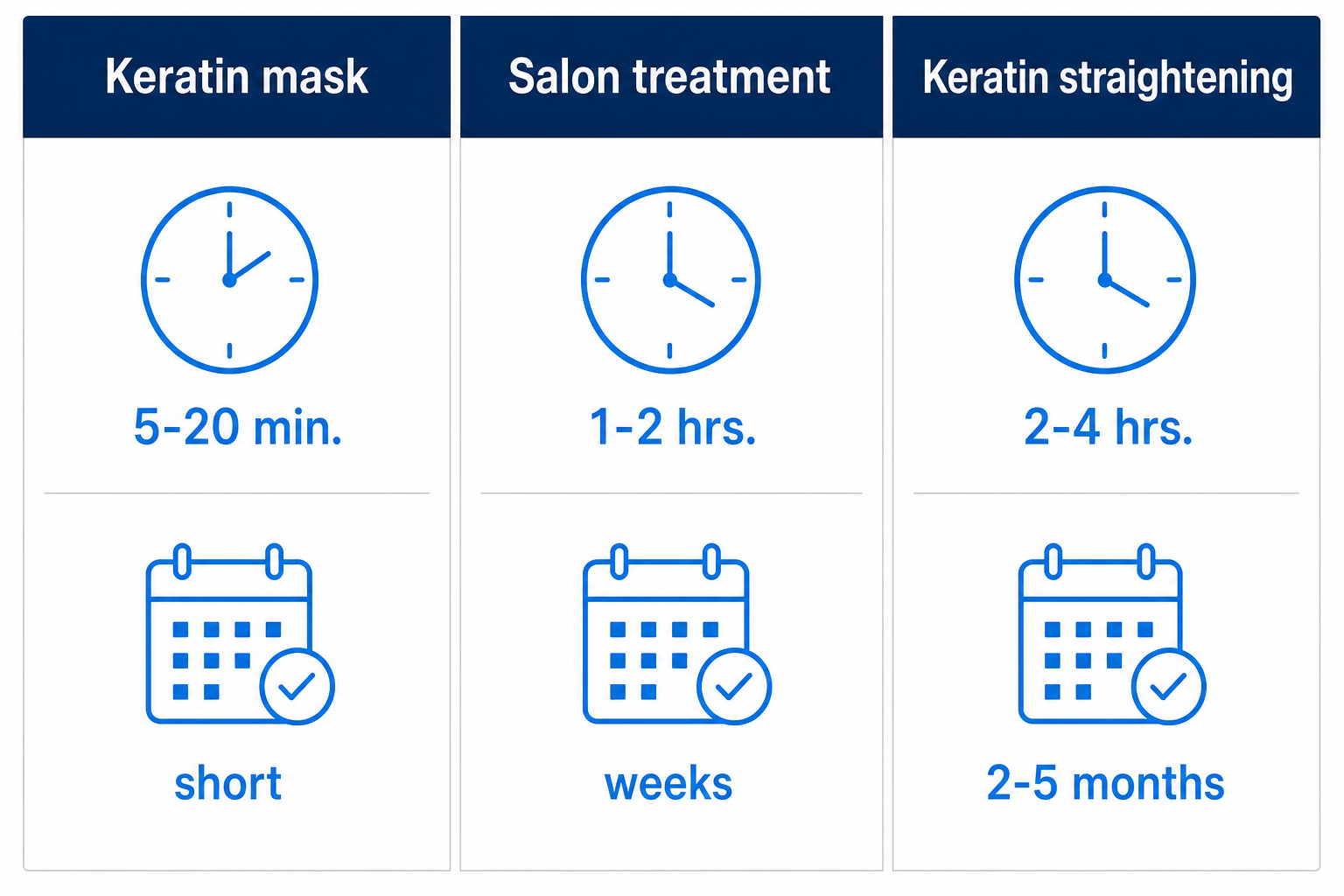
- 1. Keratin mask (at-home care): a mask or treatment from the drugstore that smooths the surface cosmetically, lasts until the next wash, no chemical step.
- 2. Salon treatment / express blow-out: temporary in-salon care with shine and light smoothing, lasts about 4 to 8 weeks.
- 3. Keratin straightening (chemical): the long-lasting relaxing done by a professional in the salon, lasts 2 to 5 months, and this is where formaldehyde becomes relevant.
So some people are only after a conditioning mask, while others want strong straightening. The nourishing keratin mask repairs the look and adds shine, the salon treatment or express blow-out smooths lightly, and the chemical keratin straightening relaxes the hair long term (numihair.com, clinikally.com). Only the third variant is a true chemical process.
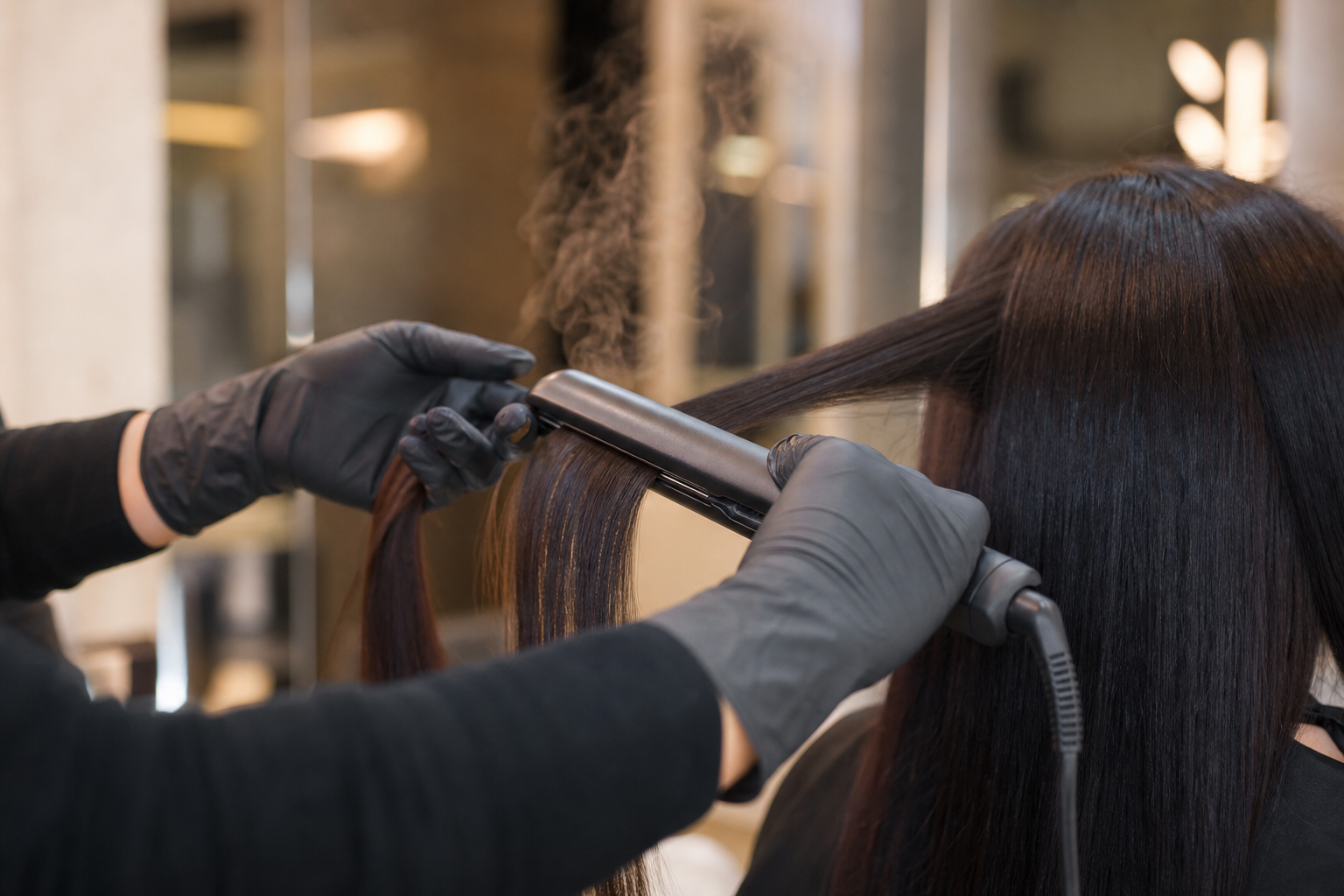
The chemical straightening works like this in the salon: wash the hair, apply the keratin solution and let it sit for about 20 minutes, blow-dry with a round brush, then seal section by section with a flat iron at around 390 to 450 degrees Fahrenheit (200 to 230 degrees Celsius) (keratin.pro). Total time 2 to 4 hours. Many know this variant as a “Brazilian Blowout” or “Brazilian keratin treatment.”
| Criterion | Keratin mask (care) | Salon treatment / blow-out | Keratin straightening (chemical) |
|---|---|---|---|
| Main goal | Repair, shine, conditioning | Shine, light smoothing, frizz gone | Long-lasting relaxing |
| Where | at home or salon | salon | professional salon (mandatory) |
| Duration | 5 to 20 min. | 1 to 2 hrs. | 2 to 4 hrs. |
| How long it lasts | until the next wash | about 4 to 8 weeks | 2 to 5 months |
| Smoothing effect | low | medium | strong |
| Cost | about $5 to $30 (product) | about $50 to $120 | about $150 to $450, up to $600 |
| Formaldehyde risk | no | usually no | possible, ask for formaldehyde-free |
| 48-hour wait needed | no | no | yes |
Approximate values. Sources: headmasters-beauty.de, keratin-info.de, perfecthair.ch, numihair.com, clinikally.com.
Important note on how long it lasts: a classic keratin treatment lasts 3 to 6 months with good care, while a “Brazilian Blowout” lasts more like 8 to 12 weeks, that is 2 to 3 months (clinikally.com, salon833.com). Unlike a perm there is no harsh line of regrowth; the result grows out gently.
Is keratin good for your hair? An honest look at the benefits and effects
Is keratin good for your hair? For the surface, yes: hydrolyzed keratin fills microscopic gaps in the cuticle layer, reduces frizz, adds shine and makes hair easier to comb. It is a cosmetic effect, not new growth and not a repair of the hair root. Think of keratin as a temporary filler for cracks, not a cure.
The mechanism is well studied. According to the study by Malinauskyte et al. (2020, Int. J. Cosmet. Sci.), small keratin fragments (221 and 2,577 daltons) penetrate deep into the cortex, while large fragments (75,440 daltons) form a protective film on the cuticle. Fan et al. (2025, Molecules) also showed that treated hair retained its tensile strength after UV exposure, while untreated hair lost 14.32 percent.
The hair that benefits most is coarse, curly, frizzy and chemically stressed or bleached hair: less frizz, more shine, and in some cases more than 50 percent shorter blow-dry time (Healthline). Keratin is less suited to fine, already-straight hair, which can end up weighed down and flat (Healthline). If you want to keep your curls, avoid chemical straightening, as it dissolves the curl pattern.
The honest limit: the effect is temporary and superficial. Hair is a dead keratin fiber, not living tissue. Keratin improves how it looks, but it does not biologically repair the fiber. After a few washes (mask) or 2 to 5 months (straightening) the effect has faded and the treatment is repeated.
Risks and downsides of keratin straightening: the formaldehyde problem
The biggest risk of keratin straightening is formaldehyde. Many straightening products contain methylene glycol or other formaldehyde releasers that release formaldehyde when heated. The IARC classifies formaldehyde as carcinogenic to humans (Group 1, Monograph 100F, 2012); the European ECHA classifies it as presumed to be carcinogenic (Carc. 1B, since 2016). Both classifications justify clear caution.
In the EU, free formaldehyde in cosmetics has been banned since May 2019 (Annex II of Regulation (EC) No 1223/2009). Formaldehyde releasers remain permitted within limits but are regulated. Since July 31, 2024, products that release more than 10 ppm of formaldehyde must carry the warning “releases formaldehyde” (Regulation (EU) 2022/1181). That is why it is not enough to just look for the word formaldehyde on the label.
Germany’s Federal Institute for Risk Assessment (BfR) warned as far back as 2010 (press release 16/2010): tested hair straighteners contained 1.6 to 2.0 percent free formaldehyde, far above the 0.2 percent limit. The BfR explicitly advised both consumers and stylists against using them. In a salon, OSHA measured 10 ppm during blow-drying, five times the short-term exposure limit (OSHA).
In the U.S., the FDA proposed a ban on formaldehyde-containing hair straighteners in October 2023 and is sticking with it; the exact timeline, however, is still pending and the deadline has been pushed back several times (most recently late 2025, CNN January 2026). So as of 2026 the ban has been announced but is not yet in force.
Heat damage, hair breakage and protein overload
Beyond formaldehyde, keratin straightening carries other risks. A flat iron at 390 to 450 degrees Fahrenheit (200 to 230 degrees Celsius) can damage the cuticle layer, especially on fine or already-damaged hair. This leads to hair breakage (the fiber snaps), not true hair loss from the root. Treatments that are too frequent or too concentrated can trigger a protein overload: the hair becomes stiff and brittle despite all the care.
Does keratin make you lose hair? High-quality treatments done with suitable products do not damage the hair permanently. Genuine, lasting hair loss from keratin is not documented (numihair.com, belgraviacentre.com). In rare individual cases the chemical and thermal stress can trigger a temporary telogen effluvium, which is reversible.
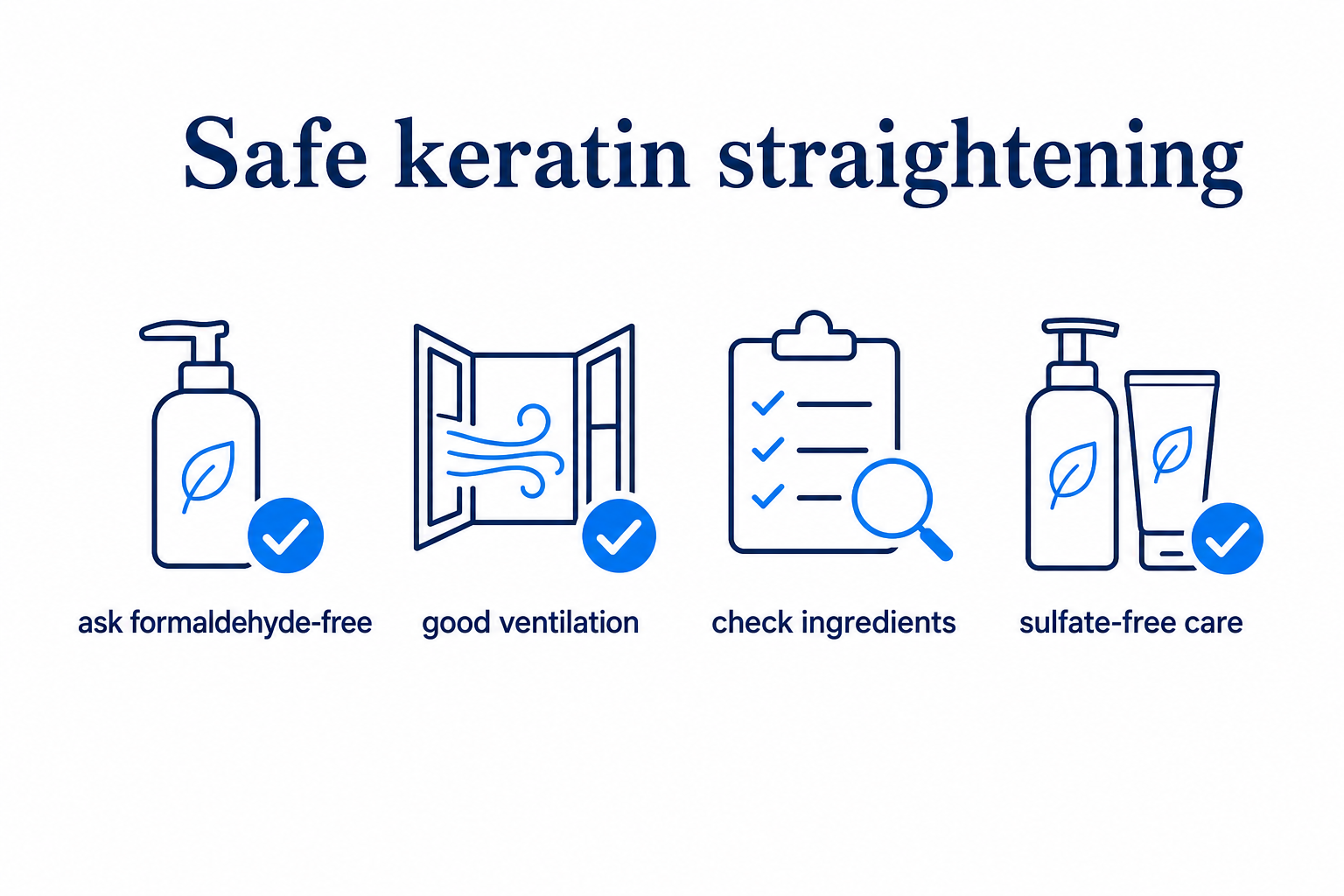
Checklist: safe keratin straightening
- Before your appointment: check the ingredients and explicitly ask for products free of formaldehyde and methylene glycol.
- In the salon: make sure there is good ventilation. If the staff put on respirator masks without being asked, that is a warning sign for formaldehyde releasers.
- Hair-type check: coarse, curly, frizzy hair benefits most; fine, straight hair only with caution.
- Allergy: do a patch test if you have a sensitive scalp; if you have a known formaldehyde allergy, avoid salon straightening entirely.
- Pregnancy or breastfeeding: postpone formaldehyde-containing straightening or use only a formaldehyde-free conditioning mask, and ask your doctor first.
- For 48 to 72 hours afterward: do not wash, do not tie up, no hair ties and no clips.
- Switch up your care: use a sulfate-free and salt-free shampoo.
- Realistic expectation: it lasts 2 to 5 months and grows out softly rather than with a hard line of regrowth.
Sources: BfR, OSHA, EU Cosmetics Regulation, perfecthair.ch, headmasters-beauty.de.
Keratin during pregnancy and common safety questions
During pregnancy and breastfeeding, experts advise avoiding keratin straightening that contains formaldehyde or formaldehyde releasers. The basis is not proven harm in humans, but the precautionary principle: in high doses, formaldehyde is reproductively toxic (animal data, PubMed PMID 11572272). There are no clinical studies specifically on keratin during pregnancy.
Nourishing, formaldehyde-free keratin masks are considered less of a concern, but should still be discussed with your treating doctor. Keep in mind: even products labeled “formaldehyde-free” can contain releasers. So do not base the decision on the packaging alone. Formaldehyde is also a known contact allergen and can irritate the scalp, eyes and airways.
Caring for keratin-treated hair: before and after the treatment
Keratin-treated hair needs sulfate-free and salt-free care. For the first 48 to 72 hours after straightening you should not wash the hair, not tie it up and not use a hair tie or clip, otherwise marks stay visible in the fresh keratin seal (perfecthair.ch, keratin-info.de). Only after that does the full hold set in.
Why sulfate-free and salt-free? Sulfates are aggressive surfactants that quickly wash out the keratin seal and shorten the treatment; salt works in a similar way (frisurenmachen.de, headmasters-beauty.de). Wash 2 to 3 times a week instead of daily, as this extends how long it lasts. Chlorinated and salt water from a pool or the ocean shorten it noticeably, so protect your hair or avoid them.
| Avoid in shampoo | Why |
|---|---|
| Sodium Lauryl Sulfate (SLS) | Aggressive surfactant, dissolves the keratin seal |
| Sodium Laureth Sulfate (SLES) | Similar effect to SLS, somewhat milder |
| Sodium Chloride | Salt dissolves the keratin layer, shortens how long it lasts |
| Chlorinated and salt water | Acts like Sodium Chloride, with added UV exposure |
Sources: frisurenmachen.de, headmasters-beauty.de.
Do keratin shampoos and masks from the drugstore do anything? Realistically, yes, as ongoing care. Their keratin content is much lower and they skip the flat-iron sealing step, so there is no lasting smoothing effect, but you do get shine and protection against breakage (dm.de, deinfriseur.de). A salon straightening usually needs a refresh every 4 to 6 months and costs around $150 to $200.
Can you do keratin at home yourself? Conditioning masks, yes, no problem. DIY straightening kits exist too, with an effect lasting 2 to 4 months but weaker than in the salon (Refinery29). The even, safe heat is harder to control at home, and you can barely verify that a product is formaldehyde-free. For coarse or thick hair, the professional salon is the safer choice.
When keratin does not help: a damaged surface or real hair loss?
Keratin improves how the hair fiber looks, but it cannot stop thinning hair or hair loss. The reason: hair loss starts at the hair root, not at the surface. Keratin helps with frizz, dryness, split ends and breakage caused by external damage. It does not help with declining hair density, a widening part or a receding hairline.
A simplified way to tell the difference: if a hair breaks off without a thickening at the end, it is breakage, and keratin can help. If a hair comes out of the root with a small bulb (the bulbus) on it, the issue is the amount of hair, not the fiber. Self-diagnosis does not replace a professional assessment; it is only a first orientation.
If, despite good care and regular keratin masks, you notice there is less hair overall or your part is visibly getting wider, you should have the cause assessed rather than treating only the surface. A free hair analysis can help determine whether care is enough or whether there is real hair loss. You can also find background on this in our overview of the causes of hair loss.
FAQ: keratin and hair
Is keratin good for your hair?
For the hair surface, yes: keratin fills gaps in the cuticle layer, reduces frizz and adds shine. The effect is cosmetic and temporary, not biological healing. Coarse and stressed hair benefits clearly, while fine hair should use it sparingly, as it can end up weighed down.
How long does keratin straightening last?
A classic keratin treatment lasts about 3 to 6 months, while a “Brazilian Blowout” lasts around 2 to 3 months (8 to 12 weeks). Sulfate-free shampoo, washing less often and avoiding chlorinated and salt water noticeably extend how long it lasts.
How much does a keratin treatment cost?
A salon keratin straightening costs about $150 to $450, and up to $600 at high-end salons, depending on hair length, density and region. Refreshes every 4 to 6 months run around $150 to $200. Conditioning masks from the drugstore cost about $5 to $30.
Does keratin straightening contain formaldehyde, and is that dangerous?
Some products contain methylene glycol or other formaldehyde releasers that release formaldehyde when heated. Free formaldehyde has been banned in EU cosmetics since 2019; the IARC classifies formaldehyde as a Group 1 carcinogen. So explicitly ask for products free of formaldehyde and methylene glycol.
Does keratin damage your hair or make you lose hair?
High-quality treatments with proper aftercare do not damage the hair permanently. Heat around 390 to 450 degrees Fahrenheit (200 to 230 degrees Celsius) can cause hair breakage, but not true hair loss from the root. In rare cases the stress can trigger a temporary, reversible telogen effluvium.
Which shampoo should you use after a keratin treatment?
A sulfate-free and salt-free shampoo. On the ingredient list, avoid Sodium Lauryl Sulfate, Sodium Laureth Sulfate and Sodium Chloride. Chlorinated and salt water at the pool or ocean also shorten the effect and should be avoided or protected against with a leave-in.
What is the difference between a keratin mask and keratin straightening?
A keratin mask is a care product for home or salon, works temporarily, barely smooths and costs about $5 to $30. Keratin straightening is a chemical-thermal seal done by a professional in the salon, lasts 2 to 5 months, costs $150 to $600 and carries a possible formaldehyde risk.
Can you do keratin at home yourself?
Simple conditioning masks from the drugstore work well at home. Keratin straightening is possible with DIY kits, but the result is weaker than in the salon, the heat is harder to control and it is hard to verify that the product is formaldehyde-free. For coarse or thick hair, the salon is safer.
Sources
- IARC, Monographs Volume 100F (2012): formaldehyde as a Group 1 carcinogen. ehp.niehs.nih.gov
- ECHA / Formacare: formaldehyde CLP classification Carc. 1B. formacare.eu
- Regulation (EU) 2022/1181 (mandatory “releases formaldehyde” labeling). eur-lex.europa.eu
- BfR, press release 16/2010: hair straighteners containing formaldehyde. bfr.bund.de
- OSHA: formaldehyde in hair products, worker health. osha.gov
- Malinauskyte et al. (2020), Int. J. Cosmet. Sci.: penetration of hydrolyzed keratin. pmc.ncbi.nlm.nih.gov
- Fan et al. (2025), Molecules: hydrolyzed keratin against hair photoaging. pubmed.ncbi.nlm.nih.gov
- Keratin.com: chemical components of hair. keratin.com
Note: this guide is for general information on cosmetic hair care and does not replace individual medical or dermatological advice. If you have skin reactions, allergies or unexplained hair loss, please consult a professional.
Dr. Imad Moustafa
Hair transplant specialist