

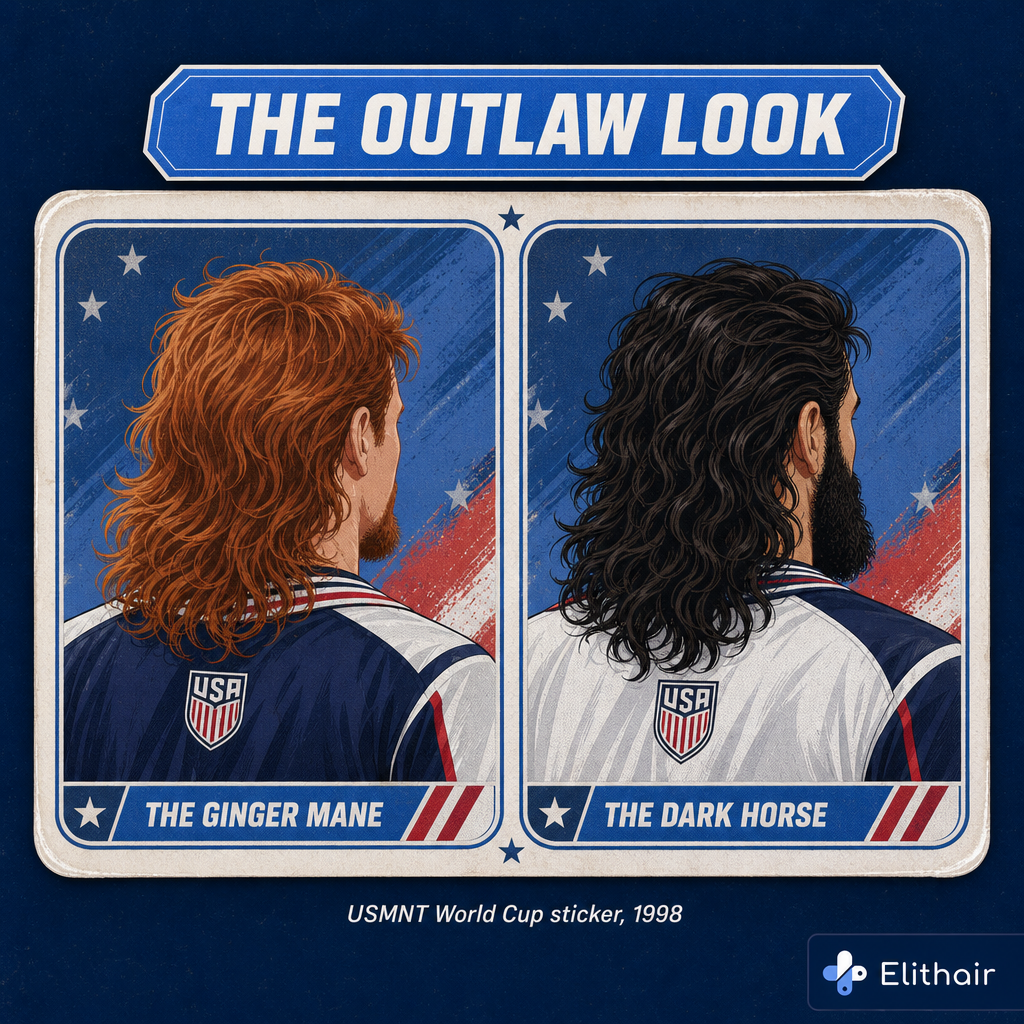
There is one World Cup collectible from 1998 that tells you everything about American soccer in a single frame. Alexi Lalas on the left: a long, shaggy ginger mane and a full beard, looking like he wandered off a grunge stage and onto a national team. Marcelo Balboa next to him: a wavy mane, a full beard, and a mustache stacked on top for good measure. Two grown men on an official sticker, looking less like elite athletes and more like the rhythm section of a band that opened for Pearl Jam.
It is the single most outrageous portrait the United States ever put on a World Cup sticker. And here is the wild part: it is the only full-beard moment the USMNT produced in the entire 20th century. After Lalas and Balboa, the United States did not field a single full beard at a World Cup for the next 24 years.
We went through every American player portrait on the official World Cup collectible stickers, the series that has run since 1970, and tagged each face for hair and beard. That gives us 156 recorded USMNT faces across nine tournaments: 1990, 1994, 1998, 2002, 2006, 2010, 2014, 2022 and 2026. (Yes, 2018 is missing. We did not qualify. We do not want to talk about it.) This is not a goals story. The USA has only 22 recorded World Cup goals in this dataset, which is a polite way of saying the trophy cabinet is empty. It is a story about faces. So let’s start with the famous ones.
Summary
- The Hair Hall of Fame
- Want a Character? Look at the Back Four.
- The Home-Soil Peak: One in Three, Twice in a Row
- The 24-Year Clean-Chin Drought
- The Beard Comeback (This Time It’s Grooming)
- The Goal Ledger: Hair Doesn’t Score (And We Can Prove It Doesn’t Matter)
- The Team With No Bald Spot
- A Mirror Held Up to America
The Hair Hall of Fame
Every country has its hair legends. Most of America’s are crammed into one decade.
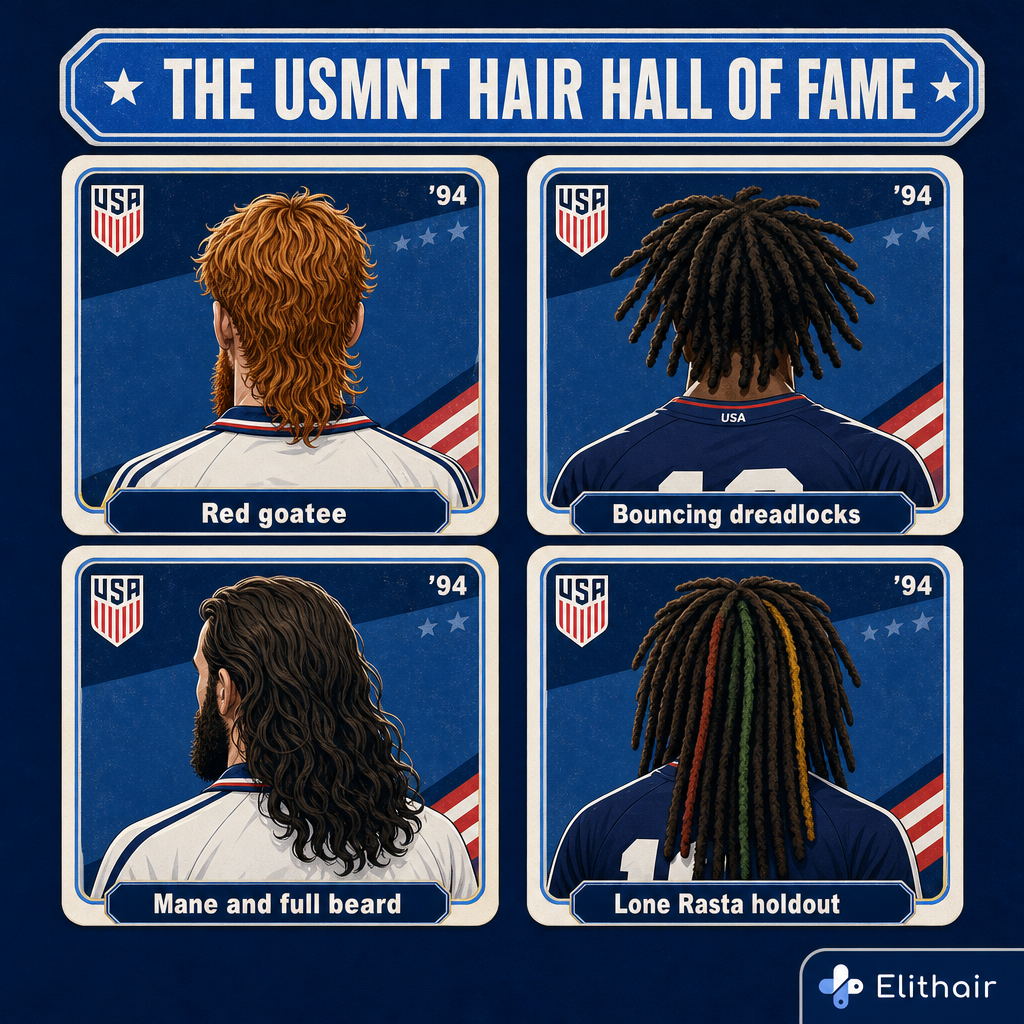
Alexi Lalas (1994, 1998). The patron saint of US soccer hair. Ginger, shaggy, and topped with that unmistakable red goatee in 1994, then upgraded to a full-on mane plus full beard by 1998. He looked like he should be selling you a guitar pedal, not marking a striker. No American has ever looked more like a rock star on a soccer sticker, before or since.
Cobi Jones (1994, 1998, 2002). The dreadlocks that refused to die. Jones wore his bouncing dreads through three straight World Cups while the entire team around him slowly buzzed everything off. He is the only American to carry a signature non-short look across three tournaments, and the last visible thread connecting the wild 90s to the buzzcut 2000s.
Marcelo Balboa (1998). The other half of the legendary double sticker. Long wavy mane, full beard, mustache. If Lalas was the rock star, Balboa was the biker who rode him to the gig.
Kyle Beckerman (2014). The lone holdout. By 2014 the squad was almost entirely short-haired, with exactly one glorious exception: Beckerman’s long Rasta dreadlocks swinging around the midfield like a postcard mailed from 1996. The last of the Mohicans.
Notice the pattern in the years. Almost every name on this list is from 1994 or 1998. American soccer packed its entire personality into two tournaments, then spent the next quarter century looking like everybody else.
Want a Character? Look at the Back Four.
Here is a cut nobody talks about, and it is the most American thing in the whole dataset: the eccentric looks do not live up front. They live in defense.
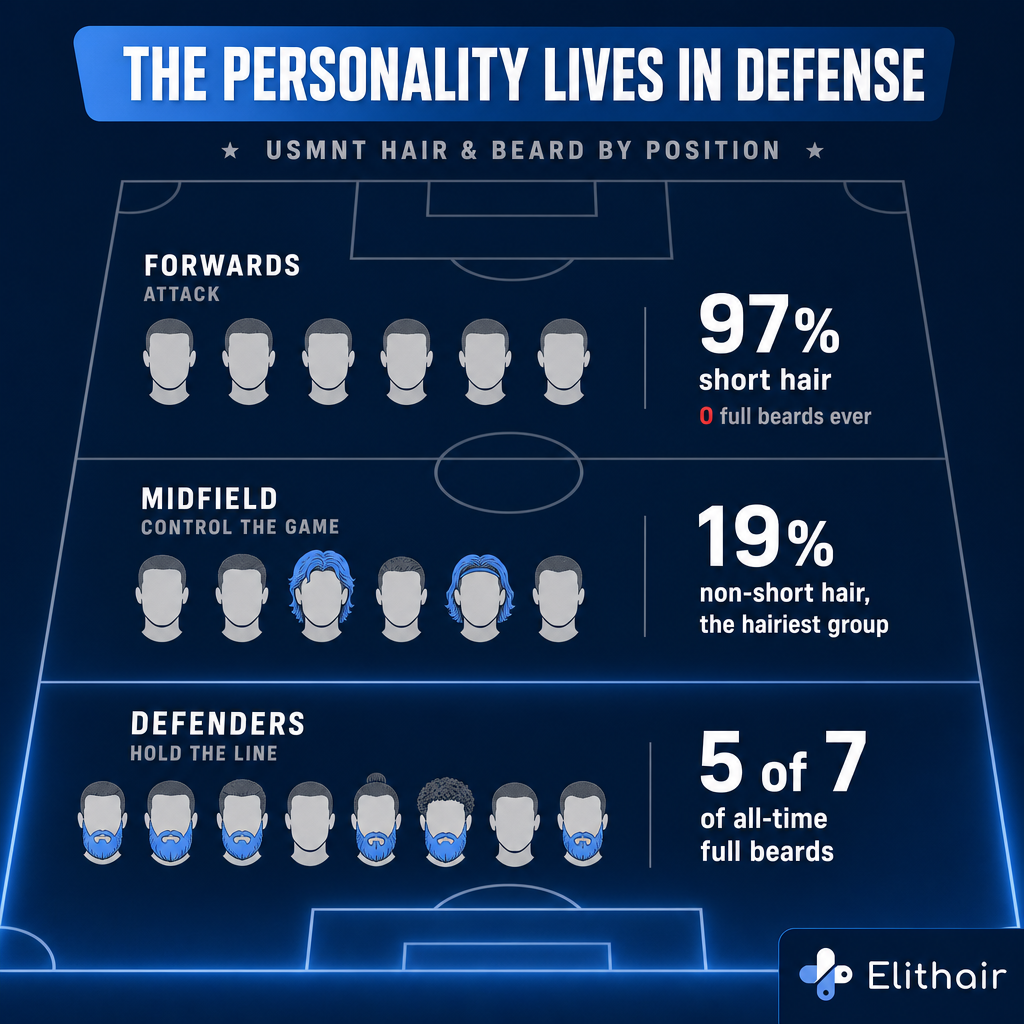
Split all 156 portraits by position and the picture is striking. The forwards are robots. Of 36 recorded American strikers across nine World Cups, 35 wore short hair. That is 97 percent. Exactly one forward in USMNT history showed up to a World Cup with anything other than short hair. Strikers came to work, scored (occasionally), and went home. No drama on top.
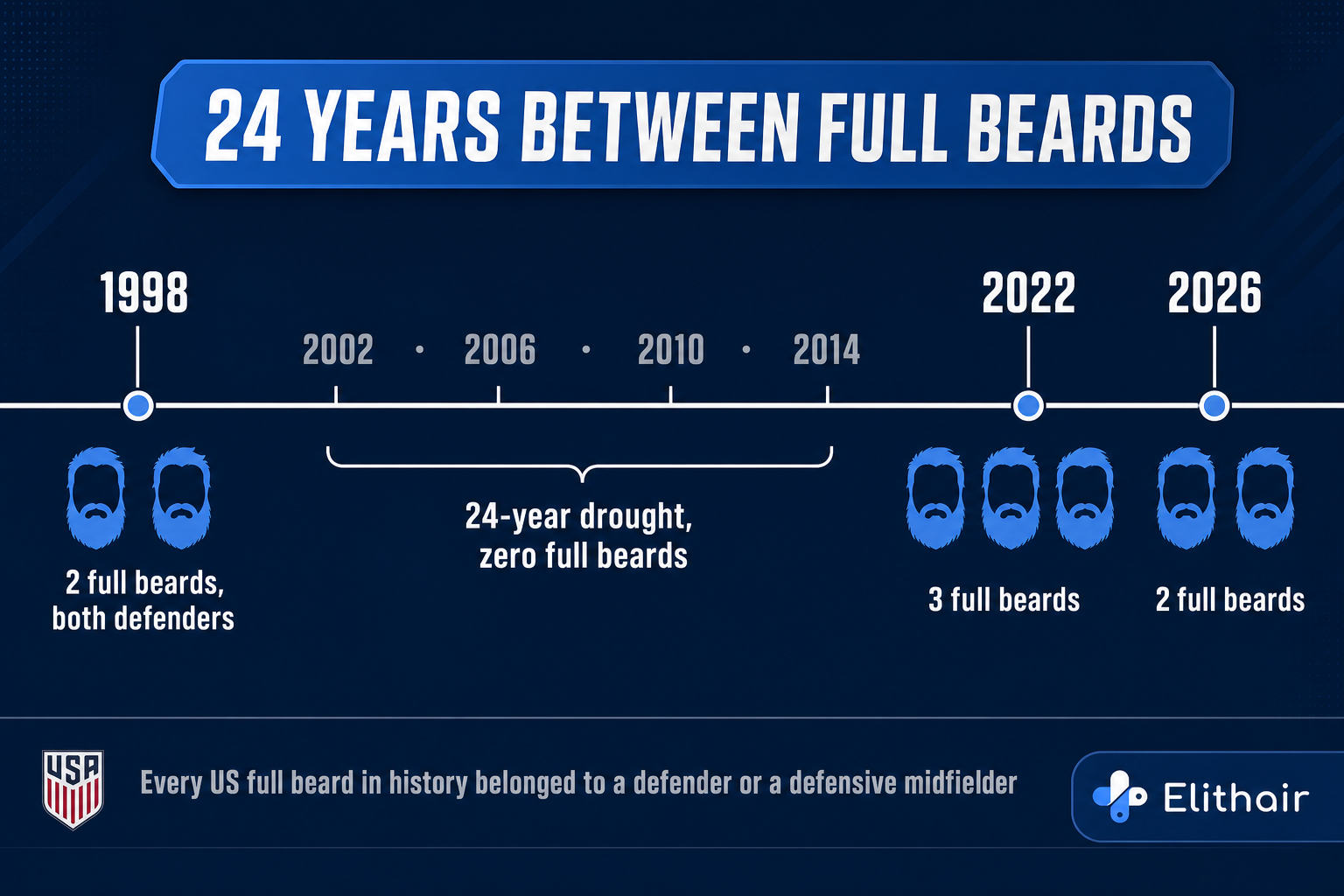
The back line is where the personality hides. Of the seven full beards the United States has ever worn at a World Cup, five belonged to defenders: Lalas and Balboa in 1998, then Aaron Long and Cameron Carter-Vickers in 2022, then Tim Ream in 2026. The other two were defensive midfielders (Kellyn Acosta and Weston McKennie). Add it up and not a single American forward has ever worn a full beard at a World Cup. Every wild look the USMNT ever produced came from a defender or a holding midfielder. The artists play in the back; the strikers play it safe.
The midfielders sit in between, and they are the hairiest group by the hair on top: 8 of 42 wore non-short hair (19 percent), more than any other position. Cobi Jones, Beckerman, McKennie. If you want a character, the data says start at the back and work forward, and give up by the time you reach the strikers.
The Home-Soil Peak: One in Three, Twice in a Row
The two hairiest teams the United States ever fielded both showed up in the 90s, and both made a statement.
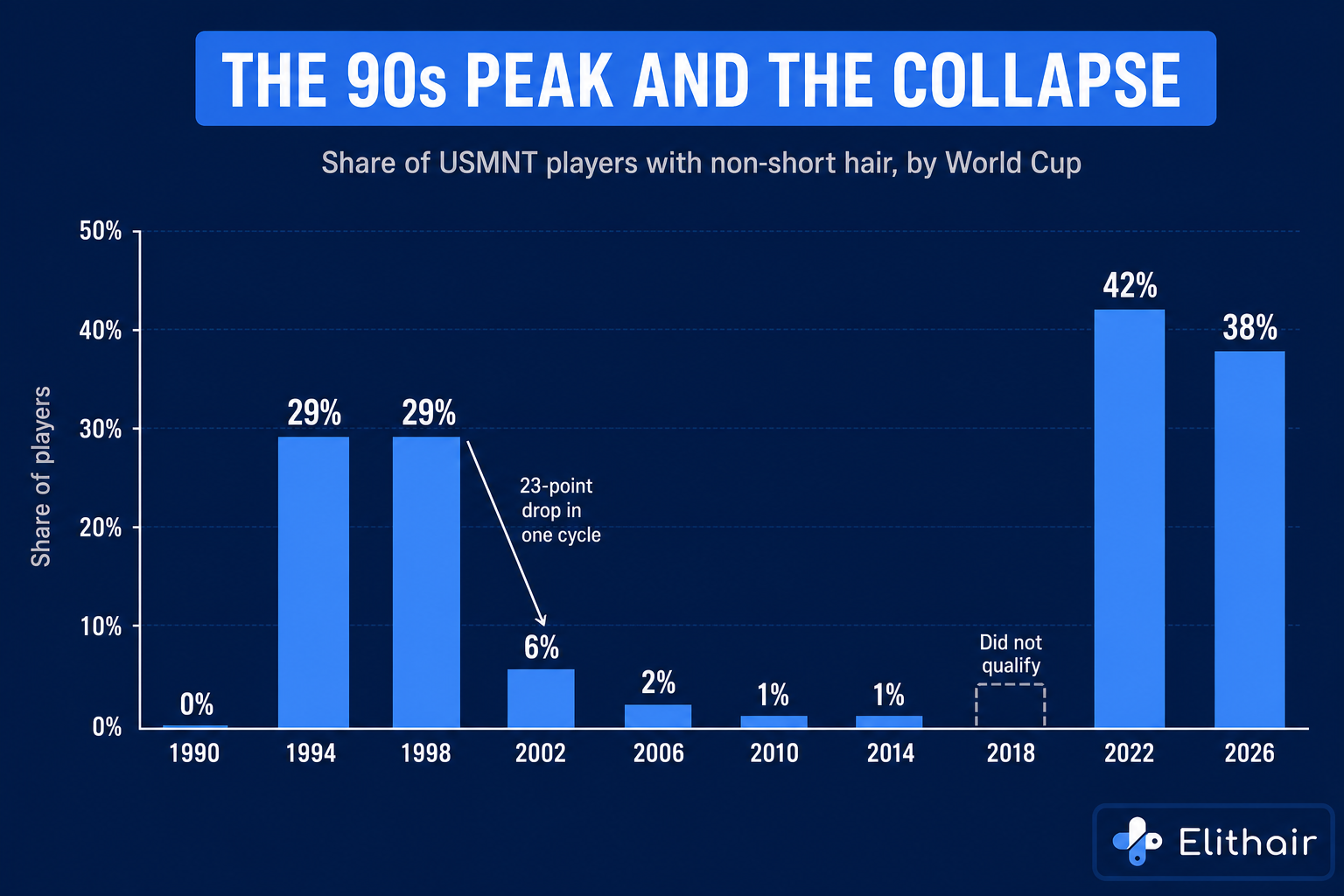
At the 1994 World Cup, hosted at home, 5 of 17 recorded players wore non-short hair. That is 29 percent, the highest figure in USMNT history. Four years later in 1998, the exact same number: 5 of 17, 29 percent again. Back to back, on the biggest stages the program had ever reached, nearly a third of the team showed up with a mane, dreads or a goatee.
That feels even louder when you remember the contrast. The Americans missed the entire global mane era. After 1950 the USMNT went 40 years without qualifying, sitting out the 1970s when long hair peaked worldwide and the 1980s mustache decade entirely. When they finally arrived at Italia 1990, all 17 recorded players wore short hair: a clean 100 percent, zero manes, the most conservative debut imaginable. The world had spent twenty years growing it out, and the USA walked in looking like a corporate softball team. Then, within four years, they overcorrected straight into red goatees and dreadlocks. America did not ease into having a personality. It went from zero to Lalas in one cycle.
The 24-Year Clean-Chin Drought
Then it all came crashing down, and fast.
In 1998, 29 percent of the squad wore non-short hair. By the 2002 World Cup, that number was 6 percent. One player. One of 16. A 23-point collapse in a single cycle, the sharpest style break in the entire American dataset. The rebellious manes evaporated and the European-style buzzcut took over. American kids were now signing for European clubs, training in European academies, and visiting, apparently, European barbers.
The beard told the same story, even more bluntly. Lalas and Balboa in 1998 were the only full beards the United States produced in the whole 20th century. After them: nothing. Zero full beards in 2002, 2006, 2010 and 2014. The USMNT went 24 years between full beards, from the 1998 double sticker all the way to 2022. An entire generation of Americans played World Cup soccer with a clean chin because that is what the modern, serious, globalized player was supposed to look like.
The cleanest team of all came in 2014: 18 of 19 recorded players clean-shaven, 95 percent, basically a barbershop ad. Beckerman’s dreads were the only thing keeping that squad from looking completely interchangeable with any other nation on earth.
The Beard Comeback (This Time It’s Grooming)
After 24 dry years, the beard came back all at once.
At the 2022 World Cup, 8 of 19 recorded Americans were bearded, light or full, which is 42 percent and the beardiest US team on record. Three of them wore full beards: Aaron Long, Cameron Carter-Vickers and Kellyn Acosta. The first American full beards since the Clinton administration, and three of them in one squad. The 2026 home World Cup keeps it rolling: 6 of 16 bearded (38 percent), with two full beards belonging to Tim Ream, the 38-year-old veteran wearing the oldest beard at the tournament, and Weston McKennie, whose medium hair plus full beard is the closest thing the modern team has to a callback to the old outlaws.
But the meaning flipped completely. In 1998, the beard was rebellion: a mane and a full beard worn like a middle finger to convention. In 2026, the beard is grooming. It is the tidy, sculpted Champions League beard of a tactics student who knows exactly how he wants to look. The formula of the modern American team is simple and a little funny: uniformly short hair across the board, individual beard on top.
The Goal Ledger: Hair Doesn’t Score (And We Can Prove It Doesn’t Matter)
This is the part where a worse article would lie to you. So let’s be honest, because the numbers are tiny and a little funny.
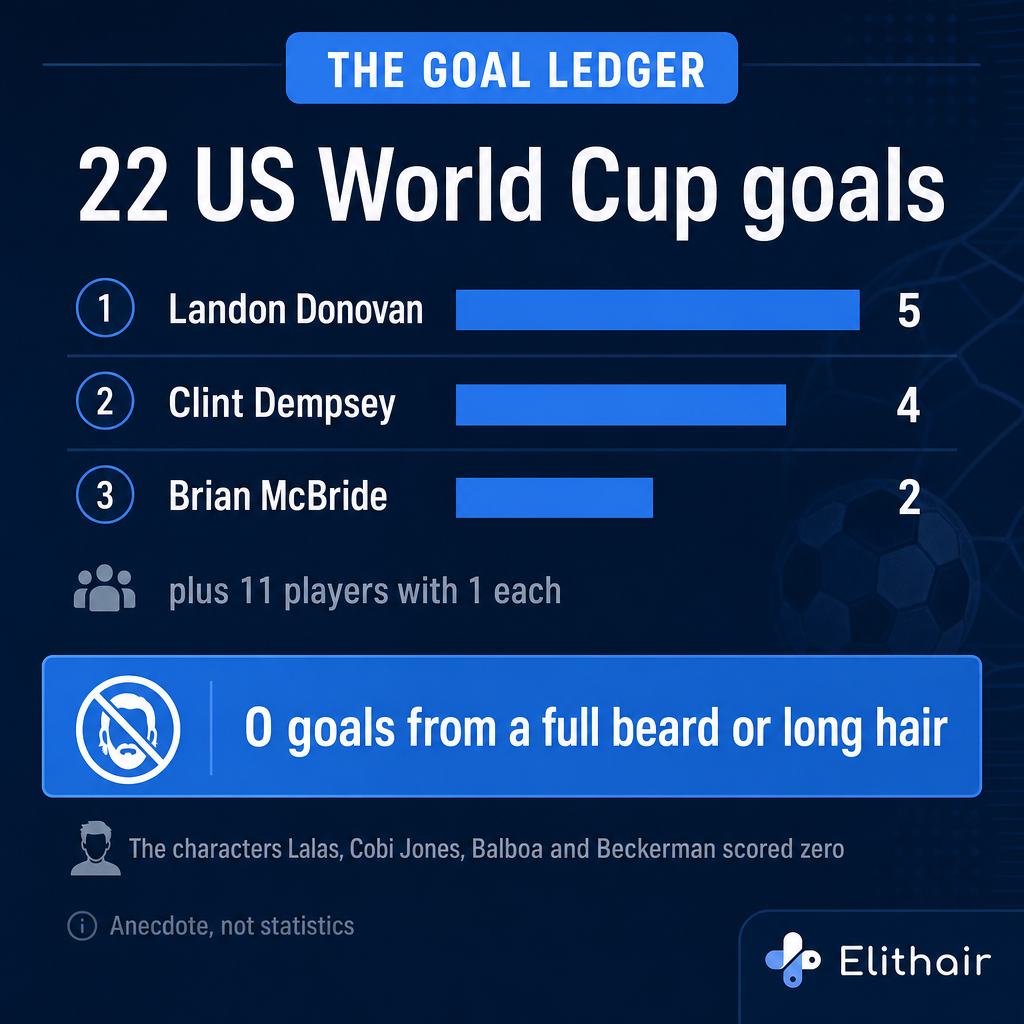
The USMNT has 22 recorded World Cup goals in this dataset, split across 14 different scorers. Landon Donovan leads with 5, Clint Dempsey with 4, Brian McBride with 2, and then a long tail of eleven players with a single goal each. Hardly a sample size. Read what follows as a fun fact, not a finding.
With that disclaimer locked in: not one of those 22 American World Cup goals was ever scored by a full beard or by long hair. Twenty of the 22 came from clean-shaven players, the other two from light stubble (Bruce Murray in 1990 and Christian Pulisic). Twenty-one of the 22 came from short hair. The lone exception is Clint Dempsey in 2006, who happened to wear his hair medium that summer. Meanwhile the great popcorn-haired characters, Lalas, Cobi Jones, Balboa and Beckerman, combined for a grand total of zero recorded World Cup goals.
There is a boring reason for this, of course. About 87 percent of all recorded Americans were short-haired to begin with, so naturally almost all the goals came from short hair. There simply were not enough manes on the field to do any scoring. The characters were defenders and wingers, not finishers. (Dempsey, for the record, is the most stylish data point in here: he scored in three straight World Cups and wore a different look each time. Medium and clean in 2006, short with stubble in 2010, short and clean in 2014. A man evolving in real time.)
But the anecdote rhymes nicely with the bigger story. The most dangerous Americans in front of goal were never the flamboyant ones. They were the quietly short-haired pragmatists. The buzzcut crowd did the scoring while the rocker crowd did the vibing. Hair does not put the ball in the net, but if you squint, the correlation is right there, winking back at you.
The Team With No Bald Spot
Here is one last quirk that jumps out when you line up all 156 American faces: nobody is balding.
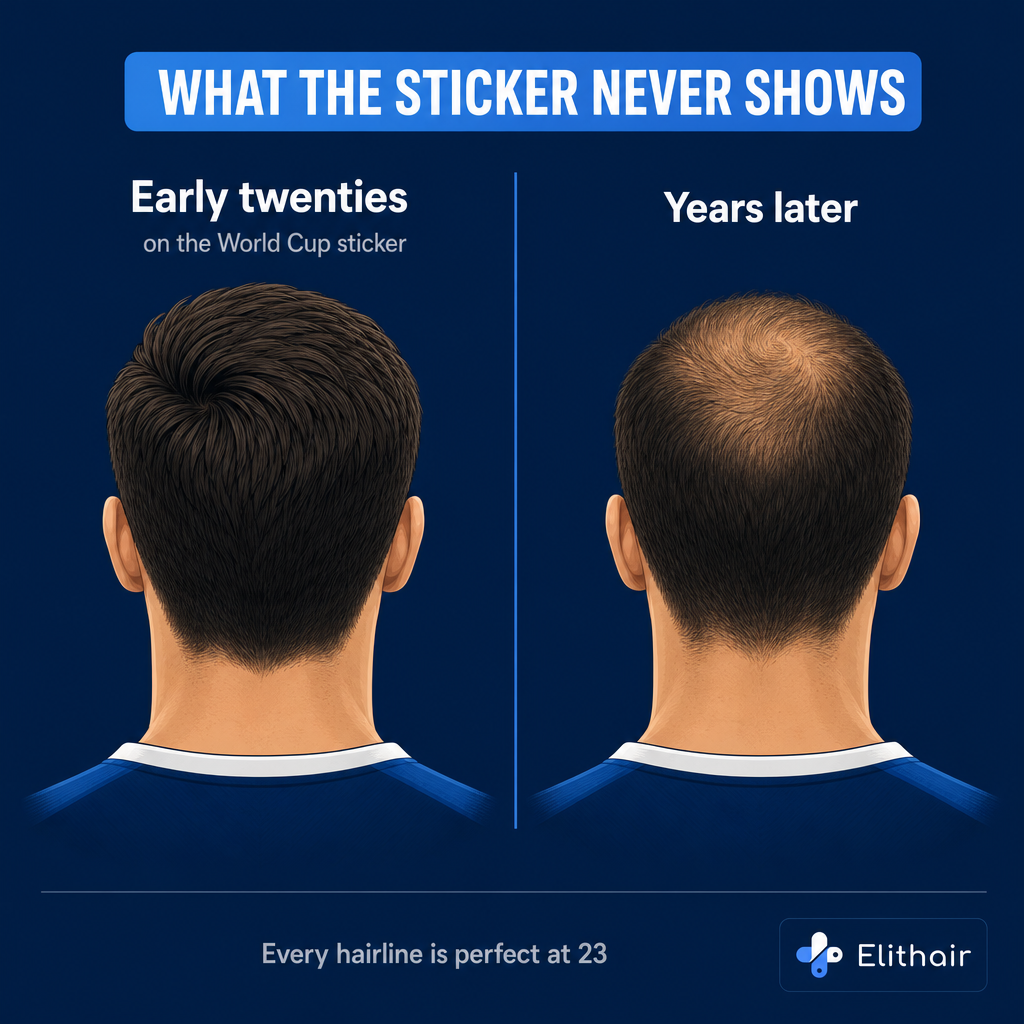
Across nine tournaments and 156 portraits, the USMNT shows almost no visible hair loss at all. Zero bald heads. Exactly one player with thinning hair, goalkeeper Kasey Keller in 2006. In the entire dataset, the United States is essentially the only team without a single receding hairline on its stickers.
That is not genetic luck. It is timing. These portraits capture players in their early-to-mid twenties, at the very front of their careers, when nearly everyone still has a full head of hair. On the sticker, every hairline is perfect at 23. What comes years later shows up on no World Cup portrait, and that is exactly where modern hair medicine steps in.
A Mirror Held Up to America
So what does the USMNT look like walking into its own home World Cup in 2026?
Overwhelmingly short-haired, 14 of 16 recorded players, about 88 percent. Mostly young. A few neat beards, the global standard issue of the era. Tim Ream carries the elder-statesman full beard at 38, McKennie carries the one quiet nod to the wild old days, and the rest look like exactly what they are: a generation of Americans who grew up on the Premier League, signed for European clubs as teenagers, and absorbed the global aesthetic completely.
That is the whole arc in one squad photo. The team that once missed the mane era, then overcorrected into red goatees and rocker beards, has become the team that looks like everyone else, on purpose, because looking like everyone else now means belonging at the top of the world game. We will probably never get another Lalas, another double sticker of two bearded rockers grinning out of an album. But there is something fitting about it. The 90s outlaws made the world take American soccer seriously enough to copy. The 2026 squad is what taking it seriously looks like.
And if you want the truest fun fact of all: the team that finally belongs is the one that stopped trying to stand out. A program that started with 17 short crops in 1990 and a red goatee in 1994 will run out at its home World Cup looking calm, modern and a little bit boring. Which might just be the most American glow-up of them all.
—
*Method, briefly: every figure above comes from classifying American player portraits on the official World Cup collectible stickers (the series running since 1970), 156 faces across the nine tournaments the USA reached from 1990 to 2026. Per-tournament samples are small (16 to 19 players), so we always give the raw counts, not just percentages, and we treat every hair-versus-goals pattern as entertainment, not evidence.*

Dr. Imad Moustafa
Hair transplant specialist