


Quick answer
Clascoterone (cortexolone 17α-propionate) is a topical anti-androgen that blocks the androgen receptor directly at the hair follicle. As an acne cream under the name Winlevi (1%), it is approved (FDA 2020, EMA October 2025). For male pattern hair loss, it is being studied as Breezula (5% solution). As of June 2026, Breezula is neither available nor prescribable in the United States or the EU.
- Drug class: topical anti-androgen (androgen receptor antagonist)
- Synonyms: cortexolone 17alpha-propionate, CB-03-01, CAS 19608-29-8
- Target group: men with mild to moderate androgenetic alopecia (AGA)
- Difference from finasteride: Unlike finasteride, clascoterone acts only locally at the follicle and does not lower DHT levels in the rest of the body.
- Status (June 2026): Phase III complete, FDA approval filing planned for early 2027, not yet on the U.S. market
Expert context · Elithair editorial team
This guide was prepared by the Elithair editorial team based on regulatory documents (FDA, EMA), published medical literature and the manufacturer’s study communications, and was medically reviewed. Because clascoterone for hair loss (Breezula) is an experimental, not-yet-approved compound, all statements on efficacy and safety are framed cautiously and within their respective study context. As of June 2026. This article is not a substitute for medical advice.
Across forums, Reddit and YouTube, one name keeps coming up when the talk turns to new hope against genetic hair loss: clascoterone. This guide takes a sober look at the compound, what the studies actually show, where the limits are and whether you can already get it.
Summary
- What is clascoterone?
- Winlevi, Breezula and clascoterone: the difference
- How does clascoterone work against hair loss?
- What do the clascoterone studies show?
- What side effects does clascoterone have?
- Clascoterone vs. finasteride vs. minoxidil
- Can you buy clascoterone or Breezula in the United States?
- Who is clascoterone an option for, and who is it not?
- Waiting for Breezula: what can affected men do until 2028?
- Development and approval timeline
- Bottom line: clascoterone, state of the research in 2026
- Frequently asked questions about clascoterone
- Sources
What is clascoterone?
Clascoterone is a topical anti-androgen, chemically known as cortexolone 17alpha-propionate (INN: cortexolone 17alpha-propionate, development name CB-03-01, CAS 19608-29-8). It is applied directly to the scalp and targets the hormonal trigger of androgenetic alopecia, the most common form of hair loss in men.
Structurally it is a synthetic pregnane steroid, derived from progesterone and 11-deoxycortisol. So it is a steroid, but not a corticosteroid: it acts as an anti-androgen, not as a cortisone preparation. The compound was developed by Cassiopea S.p.A. (Italy), now part of Cosmo Pharmaceuticals.
The decisive point: clascoterone competitively blocks the androgen receptor in the dermal papilla cells of the follicle. There it competes with dihydrotestosterone (DHT) for the binding site. This slows the DHT-driven miniaturization of the follicles without changing hormone production in the rest of the body.
In brief: DHT is the more potent form of the male sex hormone testosterone and is considered the main cause of hereditary hair loss. It binds to the androgen receptor of sensitive follicles and shrinks them over the years. More on this in our guide to androgenetic alopecia.
Winlevi, Breezula and clascoterone: the difference
Winlevi, Breezula and clascoterone refer to the same compound in different forms: clascoterone is the pure active ingredient (INN), Winlevi the approved acne cream and Breezula the experimental hair-loss solution. They differ in concentration, vehicle and indication, and that is exactly what matters therapeutically.
Winlevi contains 1% clascoterone in a cream for facial acne. Breezula is a 5% solution, formulated to penetrate the scalp. According to the EMA product page, Winlevi was approved in the EU on October 17, 2025, whereas Breezula has no approval for hair loss (as of June 2026).
| Name | Type / concentration | Indication | Approval status (June 2026) |
|---|---|---|---|
| Clascoterone | active ingredient (INN) = cortexolone 17alpha-propionate | topical anti-androgen | active ingredient, varies by brand/indication |
| Winlevi | cream, 1% | acne vulgaris (ages 12+) | approved: FDA August 2020, EMA October 2025 (under additional monitoring) |
| Breezula | topical solution (scalp), 5% | androgenetic alopecia (AGA) | not approved, Phase III complete, FDA filing planned early 2027 |
Same active ingredient, different brands and indications. Sources: EMA Winlevi EPAR; DermNet NZ; Cosmo Pharmaceuticals.
How does clascoterone work against hair loss?
The way clascoterone works is based on antagonism at the androgen receptor: the compound binds competitively to the receptor in the dermal papilla cells and prevents DHT and testosterone from activating the genes that drive follicle shrinkage in androgenetic alopecia. So it is a local hormone blocker at the follicle itself.
In vitro, clascoterone inhibits androgen-driven transcription about as effectively as finasteride and, in DHT-stimulated scalp papilla cells, reduced IL-6 synthesis more than the anti-androgen enzalutamide (Rosette et al. 2019, Journal of Drugs in Dermatology). It therefore acts directly on the biological trigger of miniaturization.
The effect stays largely local. In skin and plasma, clascoterone is rapidly broken down by esterases into the inactive metabolite cortexolone. According to Mazzetti et al. (2019), the mean Cmax after 14 days of continuous use was 4.4 to 4.6 ng/mL; this active breakdown pathway markedly limits any systemic anti-androgen effect.
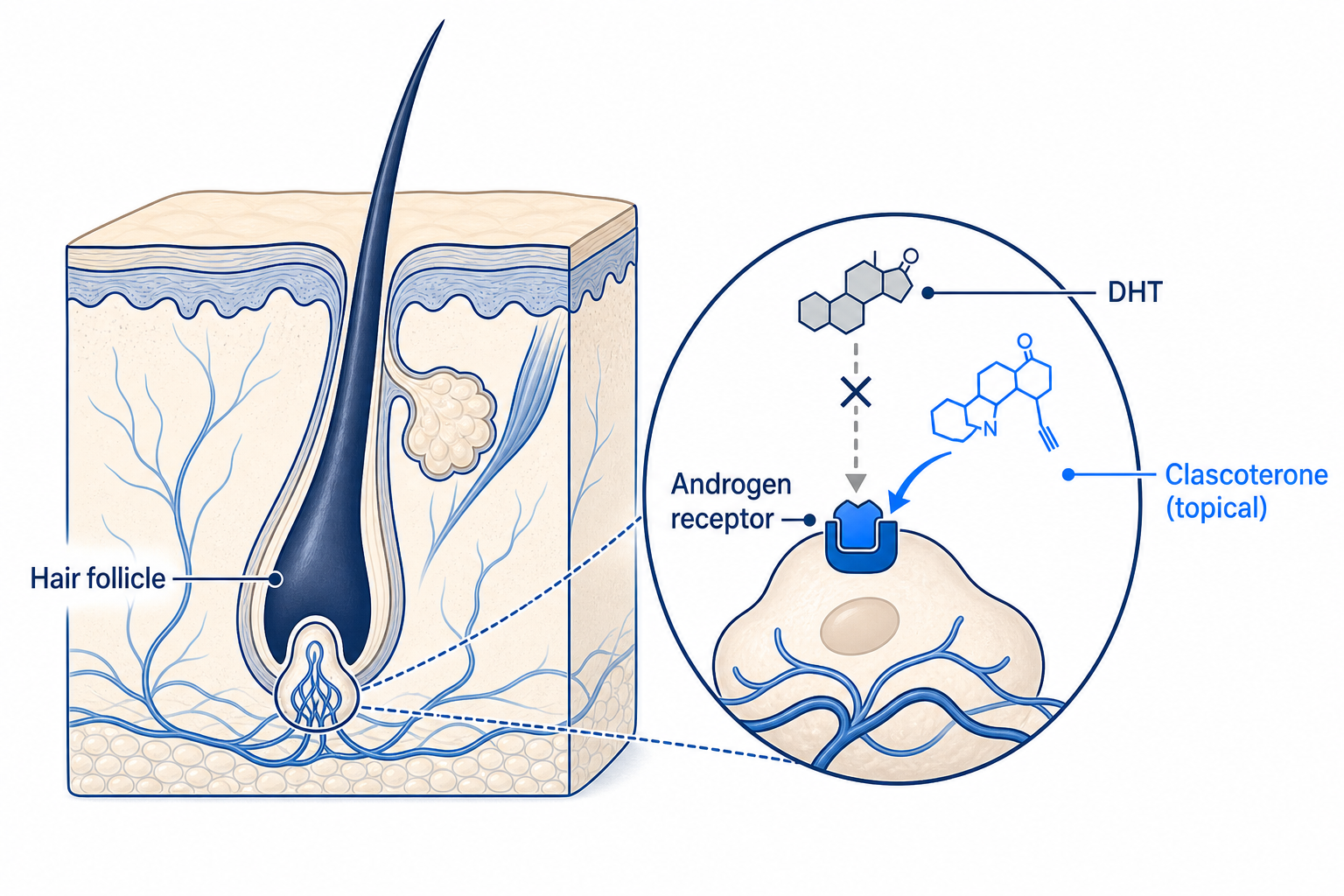
The mechanism explains the difference from the established treatments: finasteride inhibits the enzyme 5alpha-reductase systemically and thereby lowers DHT levels throughout the body. Clascoterone blocks only the receptor at the follicle; DHT levels in the blood remain unchanged. Minoxidil, in turn, does not act on the hormone system at all, but extends the growth phase and improves blood flow.
What do the clascoterone studies show?
The clascoterone studies show statistically significant effects against androgenetic alopecia, but they come mostly from company press releases, not from peer-reviewed full publications (as of June 2026). The key endpoint is the TAHC (Target Area Hair Count): the number of non-vellus hairs per square centimeter in the treated area.
Phase II in men: absolute hair counts
The Phase II clascoterone study (over 400 men, ages 18 to 55, mild to moderate AGA, study sites in Germany, 12 months) compared several concentrations against the vehicle. According to the Cassiopea press release (April 2019), all active arms were significantly superior; the numerically strongest was 7.5% twice daily at +14.3 hairs/cm².
| Concentration / use | TAHC vs. vehicle | Hair width (TAHW) | p-value |
|---|---|---|---|
| 2.5% twice daily | +10.2 hairs/cm² | +521.1 µm | 0.0087 |
| 5.0% twice daily | +13.8 hairs/cm² | +615.0 µm | 0.0006 |
| 7.5% twice daily | +14.3 hairs/cm² | +762.5 µm | 0.0003 |
| 7.5% once daily | +12.7 hairs/cm² | +658.8 µm | 0.0016 |
Phase II data, men, 12 months. Source: Cassiopea press release April 2019 (no peer-reviewed full publication).
Phase III in men (SCALP 1 and SCALP 2)
In the Phase III clascoterone study (Breezula 5% solution), 1,465 men were randomized across two trials (SCALP 1 and SCALP 2, 51 sites in the USA and Europe). According to Cosmo topline data (December 2025), SCALP 1 achieved a relative TAHC improvement of +539% versus placebo, and SCALP 2 +168% (both p < 0.05).
Important context for the numbers: The 539% and 168% are relative improvements versus placebo, not absolute hair density. If the placebo group barely changes, even small absolute differences produce large percentages. Absolute Phase III hair counts had not been published in peer review as of June 2026. The absolute Phase II figure was around +14 hairs/cm².
The 12-month data (April 2026) show, according to Cosmo, that men on continuous treatment achieved a 239% greater TAHC increase than those who switched to the vehicle after 6 months. CEO Giovanni Di Napoli himself stressed that these figures cannot be compared directly with the 6-month numbers. The safety profile remained at vehicle level.
Does clascoterone also work in women?
Whether clascoterone works in women is an open question: early signals are insufficiently supported. In a Phase II study with 293 women, the overall population showed no significant advantage over the vehicle. Only in the subgroup of women under 30 using 5% clascoterone was the TAHC difference significant (p = 0.0391, Cassiopea September 2021).
However, this subgroup was not designed for statistical power; the sample size is not enough for a general recommendation. A dedicated Phase III program for women has not been announced so far (as of June 2026). For women, the compound is therefore considered experimental and unproven. More on the topic in our guide to hair loss in women.
What side effects does clascoterone have?
The side effects of clascoterone are mostly local: redness, flaking and itching at the application site, on a par with the vehicle in the acne approval studies. Systemically, the compound has so far appeared largely unremarkable. Long-term data for continuous scalp use in AGA are still lacking, however (as of June 2026).
| Local reaction | Clascoterone 1% | Vehicle |
|---|---|---|
| Redness (erythema) | 12.2% | 15.4% |
| Flaking / dryness | 10.5% | 10.4% |
| Itching (pruritus) | 7.7% | 8.2% |
| Burning / stinging | 4.2% | 4.3% |
| Edema | 3.6% | 3.5% |
Local reactions from the Winlevi acne study (1% cream, 12 weeks). Source: FDA label / DailyMed.
One open question is the HPA axis (hypothalamic-pituitary-adrenal system). In the Winlevi data, transient HPA suppression occurred in 5% of adults and 9% of adolescents after 14 days (Mazzetti et al. 2019); all cases normalized within 4 weeks of stopping. For the months-to-years scalp use of the 5% solution, sufficient long-term data are lacking.
The Winlevi label also noted a shift toward elevated potassium levels in 5% of those treated (versus 4% under vehicle); the clinical relevance is unclear. According to the label, the compound is contraindicated in pregnancy and breastfeeding, in children under 12 and in people aged 65 and over. So clascoterone cannot be described as free of side effects.
Clascoterone vs. finasteride vs. minoxidil
Clascoterone, finasteride and minoxidil act at different points: clascoterone blocks the androgen receptor locally, finasteride lowers DHT levels systemically and minoxidil promotes growth without touching hormones. A direct head-to-head efficacy comparison of the three treatments from a single study is still lacking.
| Criterion | Clascoterone 5% (Breezula) | Finasteride 1 mg | Topical minoxidil |
|---|---|---|---|
| Mode of action | androgen receptor antagonist (local) | 5alpha-reductase inhibitor (systemic, lowers DHT) | blood flow / anagen extension (not hormonal) |
| Application | topical (scalp solution) | oral (tablet) | topical (solution/foam) |
| Systemic hormonal effect | minimal to none | yes, lowers blood DHT by about 65 to 70% | none |
| Approval for AGA (US/EU) | no (experimental) | yes (prescription only) | yes (over the counter) |
| Known side effects | local skin reactions, HPA suppression possible with extensive use | sexual dysfunction, mood changes, post-finasteride syndrome (disputed) | hypertrichosis, scalp irritation |
| Long-term data | limited (12 months, peer review pending) | extensive (over 25 years) | extensive |
| Suitable stages | mild to moderate (Norwood III to V) | mild to moderate | mild to moderate |
A factual comparison, not a treatment recommendation. Sources: gesund.bund.de; Mazzetti et al. 2019; DermNet NZ. Talk to a medical professional before starting any therapy.
On post-finasteride syndrome (sexual dysfunction, mood and cognitive complaints persisting even after stopping): it is not scientifically recognized as a distinct syndrome, but it is reported by a meaningful number of affected men. The theoretical advantage of clascoterone is that it does not lower blood DHT in the first place.
Combining clascoterone with minoxidil is theoretically discussed as sensible because of the different mechanisms of action, but clinical combination studies are still lacking. If you already use minoxidil, you will find the basics in our guide to minoxidil for hair loss.
Can you buy clascoterone or Breezula in the United States?
Breezula, the 5% clascoterone solution for hair loss, cannot be bought or prescribed in the United States (as of June 2026). The FDA filing is planned by Cosmo for early 2027; the earliest possible U.S. approval would fall in mid to late 2027, with EU approval lagging behind that.
The acne cream Winlevi (1%) has been available in the EU since October 2025, but exclusively for acne, not for hair loss. Off-label use on the scalp is simply unsuitable: at 1% the concentration is too low (AGA needs roughly 5 to 7.5%) and the cream vehicle is formulated for facial acne, so it clumps the hair and does not penetrate the scalp follicles adequately.
Warning: be wary of dubious online sources and homemade preparations
On platforms like Alibaba, raw clascoterone powder (CB-03-01) is offered for sale. Such products are neither pharmacologically tested nor manufactured to GMP standards; purity, concentration and sterility are not guaranteed. Making your own tinctures is illegal in the EU and a health risk. Stay away from it.
There are no official figures on cost. U.S. market analysts estimate $90 to $150 per month, without reimbursement. Androgenetic alopecia is generally not classified as a reimbursable medical condition, and insurers usually do not cover such treatment costs (gesund.bund.de).
Who is clascoterone an option for, and who is it not?
Based on the study evidence, clascoterone is an option for men with mild to moderate androgenetic alopecia, that is, Norwood stages III (vertex) to V. It can stabilize follicles that are still present, but it does not bring back follicles that have already died. Like all AGA treatments, it requires ongoing therapy; the effect is lost once you stop.
In practice, that means Breezula, if approved, would be a solution applied twice daily to the dry scalp in the affected area, similar to how minoxidil is used. It is not a cure but an ongoing therapy over years. In the 12-month data, men who switched to the vehicle after 6 months lost the gains they had previously achieved (Cosmo, April 2026).
The compound is not suitable for advanced AGA (Norwood VI to VII), where no living follicles remain, nor for pregnant or breastfeeding women and children. One distinction is decisive: diffuse hair loss does not respond to anti-androgens.
First clarify the cause: AGA or diffuse hair loss?
Anti-androgens like clascoterone target solely the hormonal-genetic cause of androgenetic alopecia. Diffuse hair loss (telogen effluvium) has other triggers, such as iron deficiency (ferritin often below 30 to 70 µg/L), thyroid disorders, stress or malnutrition. Here an anti-androgen does nothing; the cause has to be clarified first.
Before any drug therapy, therefore, comes a medical diagnosis with trichoscopy and, if needed, blood work. Whether it is AGA or another form can be assessed through a visual pattern analysis of the scalp and the hair-loss pattern. Such a hair analysis, however, does not replace a medical blood test, for example to check iron or thyroid values, and you can read more about that in our guide to blood testing for hair loss.

Only once the cause is established does it make sense to decide on a therapy. And this is exactly where many face the practical question: clascoterone is not yet available, so what do you do until Breezula maybe arrives?
Waiting for Breezula: what can affected men do until 2028?
Until Breezula realistically becomes available in 2028 or later, affected men do not have to wait idly. On the contrary: with hereditary hair loss, acting early matters, because follicles that have died cannot be brought back by any medication. There are established, approved options to stabilize what you still have right now.
For immediate stabilization, three routes are well supported today: minoxidil (over the counter, topical, extends the growth phase), finasteride (prescription only, lowers DHT levels) and, as a complement, PRP treatment using your own blood. Which option is medically appropriate depends on the stage, tolerability and personal preferences, and belongs in a physician’s hands.
If individual areas are already bald because follicles there are permanently lost, no topical treatment can regenerate them. In that case, a hair transplant (FUE or DHI) is the medically established route, because it moves your own DHT-resistant follicles from the back of the head into the thinning zones. A compound like clascoterone could, in the future, help stabilize the remaining native hair as a complement.
The sensible first step, therefore, is to have your own hair-loss type and stage assessed. A free hair analysis from Elithair is a visual pattern analysis of your photos; it shows, without obligation, whether a hereditary pattern is present and which routes are realistic. It does not replace a medical blood test, but it is a good starting point for further planning.
Development and approval timeline
The development of clascoterone spans from acne approval to the completed hair-loss trials. If Breezula were to be approved, it would, according to Cosmo, be the first topical AGA drug with a new mode of action since minoxidil (1988) and finasteride (1997), that is, after more than 30 years.
| Date | Milestone |
|---|---|
| August 2020 | FDA approval of Winlevi (1%) for acne |
| October 2025 | EMA approval of Winlevi in the EU (under additional monitoring) |
| December 2025 | Phase III topline results for Breezula (SCALP 1 and SCALP 2) |
| April 2026 | 12-month Phase III safety data |
| Early 2027 (planned) | FDA approval filing (NDA) for Breezula |
| 2028 or later (expected) | possible EU approval following the FDA |
Timeline subject to change. Sources: FDA; EMA Winlevi EPAR; Cosmo Pharmaceuticals; GenEngNews.
Bottom line: clascoterone, state of the research in 2026
As Breezula, clascoterone is so far the only topical androgen receptor antagonist to have shown statistically significant results against androgenetic alopecia in a large Phase III trial. That is genuine progress, because for more than 30 years no topical AGA drug with a new mode of action has come along.
At the same time, a sober view is warranted: the Phase III primary data have not yet been published in peer review, and long-term safety over years and the final absolute hair counts are still outstanding. Approval in the United States and EU will take patience, realistically 2028 or later. Off-label use, homemade preparations and buying from uncontrolled online sources are clearly to be avoided.
If you are dealing with visible hair loss today, you should first have the cause clarified by a doctor. With genetic hair loss and permanently lost follicles, a hair transplant remains the established, plannable option, while compounds like clascoterone could, in the future, help stabilize the existing hair as a complement.
Frequently asked questions about clascoterone
What is the difference between Winlevi and Breezula?
Same active ingredient (clascoterone), different formulation and strength. Winlevi is a 1% cream for acne and is approved in the EU and USA. Breezula is a 5% solution for hereditary hair loss, still in research and not approved (as of June 2026).
Is clascoterone a DHT blocker?
Not in the classic sense. Clascoterone does not block DHT production, that is what finasteride does, but rather the androgen receptor that DHT binds to. Blood DHT levels stay unchanged. So it is a receptor blocker at the follicle, not a production inhibitor.
Can I use Winlevi off-label for my hair?
No. Winlevi contains only 1% clascoterone instead of the roughly 5% needed for AGA. The cream is formulated for facial acne, not for scalp penetration; it clumps the hair and does not reach the follicles adequately. Off-label, it is neither effective nor recommended.
Is clascoterone better than finasteride?
A direct head-to-head comparison from studies is lacking. Clascoterone acts locally at the receptor without any systemic DHT effect; finasteride acts systemically and has been extensively documented for over 25 years. Both stabilize AGA without bringing back lost follicles.
When will Breezula reach the market in the United States?
2027 at the earliest if the FDA approval (filing planned for early 2027) goes through, with EU availability following once the EMA completes its assessment. No binding approval has been promised (as of June 2026).
Can clascoterone be combined with minoxidil?
Theoretically sensible, since the mechanisms of action differ and there is no known antagonism. However, clinical combination studies are still lacking. It should only be used after medical advice.
Does clascoterone help with diffuse hair loss too?
No. Diffuse hair loss usually has other causes such as iron deficiency, thyroid disorders or stress. Anti-androgens target solely the hormonal-genetic cause of AGA. With diffuse hair loss, the cause should be clarified by a doctor first.
Does clascoterone work in women?
Only early, insufficient signals. In a Phase II study with 293 women, only the subgroup of those under 30 using 5% clascoterone showed a significant effect (p = 0.0391). For women overall, the evidence is not sufficient, and no Phase III program for women is underway.
Sources
- Rosette C. et al. (2019): Cortexolone 17α-Propionate (Clascoterone) is an Androgen Receptor Antagonist in Dermal Papilla Cells In Vitro. Journal of Drugs in Dermatology. PubMed 30811143
- Mazzetti A. et al. (2019): Pharmacokinetic Profile, Safety, and Tolerability of Clascoterone (CB-03-01) Topical Cream, 1%. Journal of Drugs in Dermatology. PubMed 31251549
- FDA / DailyMed: Winlevi (Clascoterone) Prescribing Information, Initial U.S. Approval 2020. DailyMed Winlevi
- EMA: Winlevi (Clascoterone) EPAR, approved October 17, 2025. European Medicines Agency
- Cosmo Pharmaceuticals: Phase III topline results SCALP 1 and SCALP 2, December 2025. cosmohealthconfidence.com
- Cosmo Pharmaceuticals: 12-month Phase III safety data, April 2026. cosmohealthconfidence.com
- Cassiopea S.p.A.: Phase II 12-month results, men, April 2019. Finanznachrichten.de
- DermNet NZ: Clascoterone (side effects, contraindications, regulation). DermNet NZ
- gesund.bund.de (German Federal Ministry of Health): Male pattern hair loss. gesund.bund.de
Medically reviewed, as of June 2026. This guide is for information and does not replace medical advice, diagnosis or treatment. Clascoterone (Breezula) is not approved for hair loss. Do not make any treatment decision without consulting a doctor.

Dr. Imad Moustafa
Hair transplant specialist