


When people talk about hair falling out after a hair transplant, they usually mean two very different things. With shedding, the graft sheds the visible hair shaft while the root stays in the scalp and pushes out a new hair a few months later. True shock loss after a hair transplant, by contrast, affects the surrounding native hair and is rare: in an analysis of 621 FUE patients it occurred in 3.7 per cent of cases (Okochi et al., Aesthetic Plastic Surgery 2024). This article sorts out hair loss after a hair transplant week by week and month by month.
Key takeaways
- ✓As a rule, neither shedding nor shock loss needs treatment: in most patients growth resumes on its own after about three to six months (StatPearls)
- ✓True shock loss affecting the native hair is rare (3.7 per cent in 621 patients, Okochi et al. 2024), and women are affected far more often than men
- ✓Gaps at six months are not the final state: the result usually matures until month 12, and in densely packed zones and on the top of the head sometimes until month 15 to 18
- ✓If hair falls out again one or two years later, the cause is usually the ongoing genetic predisposition in the untransplanted area, not the graft
The table of contents shows where to find what. After that we go into detail phase by phase, from the second week to the second year.
Summary
- Hair loss after the procedure: what is behind it?
- The difference: shedding of the grafts or true shock loss?
- Causes
- Is it normal for the hair to fall out?
- How long does hair loss after a hair transplant last?
- Still gaps after 6 months: the growth curve up to the final result
- Shock loss in the donor area
- Solutions and tips to support hair growth
- When should you be concerned?
- Hair loss again two years after a hair transplant: what is behind it
- Successful hair transplants: patience pays off
- Frequently asked questions about shock loss and hair loss after a hair transplant
- Conclusion: a natural process
- Sources and medical disclaimer
Hair loss after the procedure: what is behind it?
Hair loss after a hair transplant is the norm in the first weeks and is not a sign of a failed result. Many patients notice increased hair loss. This so-called “shock loss” is a well-known and in most cases temporary reaction of the scalp. It can affect both the recipient and the donor area and is directly linked to the healing and adaptation process of the hair follicles.
There are exactly three possibilities to weigh up when you are trying to make sense of your own progress: the shedding of the transplanted hair shafts, a temporary loss of the surrounding native hair and, far more rarely, a graft lost mechanically in the first few days. Which of them applies comes down to the timing and to what the fallen hair looks like.
Normal hair loss
The hair loss after a hair transplant is often a physiological process:
- The transplanted hair follicles temporarily enter a resting phase
- The hair loss usually starts within the first 2 to 8 weeks
- The hair roots stay intact; only the visible hairs fall out
- New hair growth usually begins after a few months
This course of events is considered harmless and is part of the natural regeneration process.
Problematic hair loss
In rarer cases, the hair loss can point to factors that should be watched more closely:
- It mainly affects the untransplanted native hair around the treated areas
- Hair loss in the donor area can indicate overharvesting or impaired healing
- Longer-lasting, patchy hair loss
- Accompanying inflammation or infection of the scalp
In cases like these a check-up with a doctor makes sense, so that the healing process can be assessed properly.
How often does hair loss occur after a hair transplant?
How often hair loss occurs after a hair transplant depends on which of the two phenomena is meant. Shedding of the transplanted hairs affects most patients and is described in the literature as essentially a normal part of healing, though without a reliable percentage (Goldin et al., Hair Transplantation, StatPearls NBK547740).
True shock loss after a hair transplant, that is, the temporary loss of the surrounding native hair, is by contrast rare: in the largest analysis to date, covering 621 FUE patients, it came to 3.7 per cent (Okochi et al., Aesthetic Plastic Surgery 2024). The next section separates the two processes cleanly and answers the question almost every patient asks after the first hair wash: is this shedding or a lost graft?
The difference: shedding of the grafts or true shock loss?
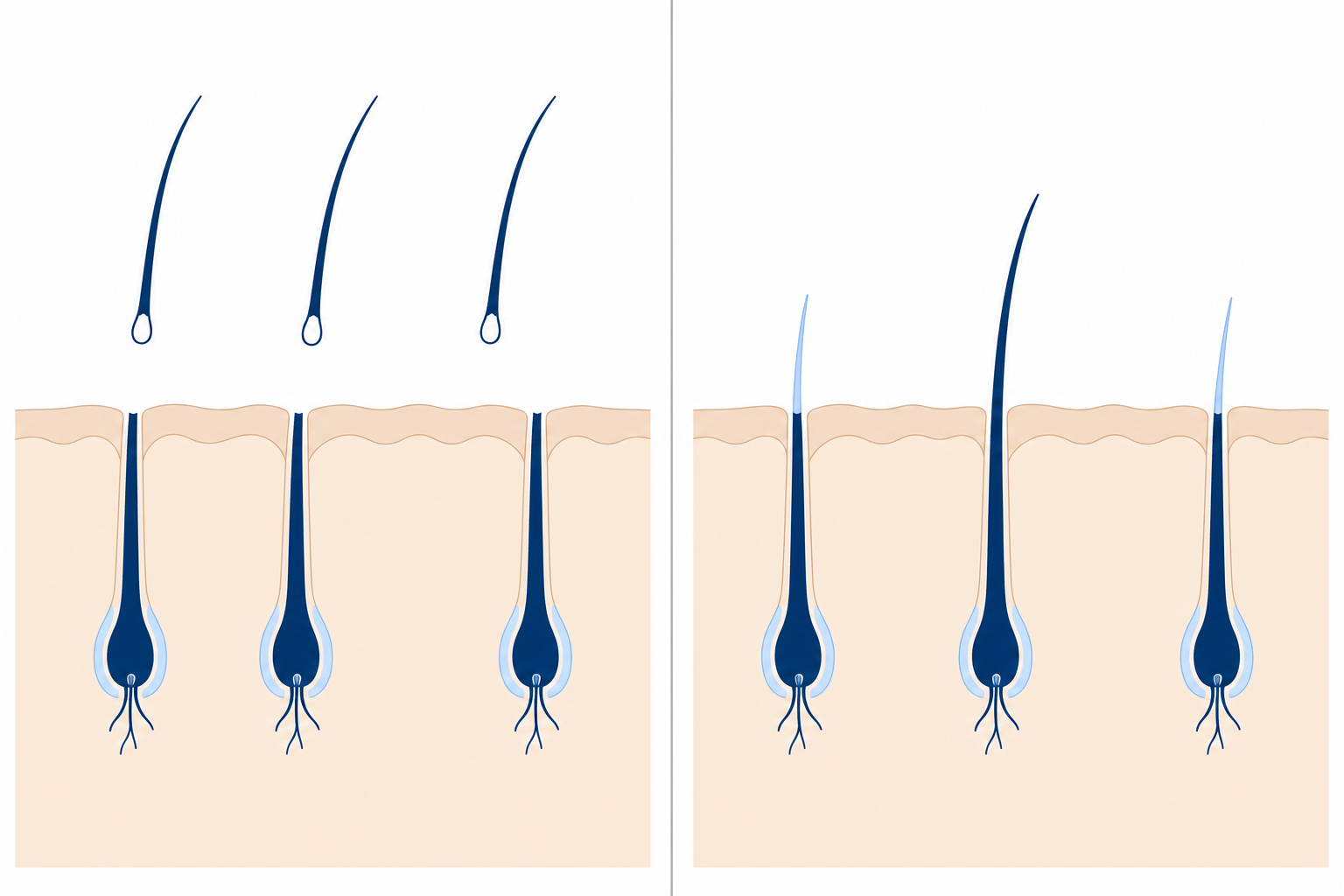
Shedding and shock loss are two different processes after a hair transplant: with shedding, the shaft of the transplanted hairs falls out and the root stays in the scalp; with shock loss, surrounding native hair temporarily enters the resting phase. Anyone who can tell the two apart will find it much easier to stay calm about their own progress.
Shedding of the transplanted hairs: the normal case
Shedding after a hair transplant affects most patients. During the procedure the transplanted follicle is separated from its blood supply and afterwards switches into the resting phase (telogen). The visible hair shaft is shed, the root stays in its new place.
The medical database StatPearls describes the sequence like this: the shedding of the implanted hairs begins a few days after the procedure, and it can take several months for regrowth to appear (Goldin et al., StatPearls NBK547740). The peak is typically in weeks 2 to 8. How the resting and growth phases relate to each other is explained in the article on the hair growth cycle.
A common question: all at once or gradually? Shedding is almost always spread out over weeks. The typical pattern is a slowly rising curve with the odd hair on the pillow and in the towel, a peak in weeks 4 to 8 and a tapering off by around week 10. A loss concentrated on a single day is the exception, but it does happen and is not in itself a warning sign.
True shock loss of the native hair: the exception
True shock loss is a temporary effluvium of the hair around the treated area, in other words of the native hair. A 2026 review lists surgical trauma, perifollicular inflammation, a local shortfall in blood supply and the vasoconstrictors in the local anaesthetic as triggers (Romera de Blas et al., Frontiers in Medicine 2026).
Hairs that have already thinned because of a genetic predisposition are especially sensitive. Experience shows that shock loss resolves over the course of months, because the follicles are not lost but only change phase. That is exactly what makes it hard to tell apart from progressive hair loss at the beginning.
The following overview compares the three processes that are perceived as “hair loss” after a hair transplant: shedding of the grafts, true shock loss of the native hair and the permanent loss of a graft. It covers the hair affected, the time window, the documented frequency and whether action is needed.
| Feature | Shedding of the grafts | True shock loss | Permanent graft loss |
|---|---|---|---|
| What falls out | the shaft of the transplanted hairs | surrounding native hair | nothing falls out, the graft does not take |
| Hair root | stays in the scalp | stays, the follicle is in the resting phase | the follicle has not taken |
| Typical time window | weeks 2 to 8 | weeks 2 to 12 | only becomes apparent after month 6 to 12 |
| Frequency | affects most patients, no reliable figure in the literature | 3.7% in 621 FUE patients, women around 21% (Okochi et al. 2024) | isolated cases, no reliable figures |
| Course | new growth from month 3 to 6 | experience shows it resolves over the course of months | no regrowth |
| Action needed | none, wait it out | follow-up appointment if unsure | medical assessment after month 12 |
Is this shedding or have I lost a graft?
Whether a hair that has fallen out belongs to normal shedding or is a lost graft can be judged from the hair itself and from the timing. A hair in the resting phase comes out with a short, club-shaped, unpigmented end of hardened keratin, without a root sheath and without any bleeding on the scalp (DermNet, Telogen effluvium).
Timing is decisive. A study on graft anchoring found that tugging on the hair on days 1 and 2 pulled the graft out, but that this no longer happened from day 6 onwards, and that in the group examined all grafts were firmly in place from day 10 (Bernstein and Rassman, Dermatologic Surgery 2006, PMID 16442039). The NHS gives the first 14 days as the uncertain phase.
After about 10 to 14 days, mechanical graft loss is therefore practically impossible. Whatever falls out after that is very likely shedding. Until then the rule is: do not scratch, do not rub, do not pick at scabs.
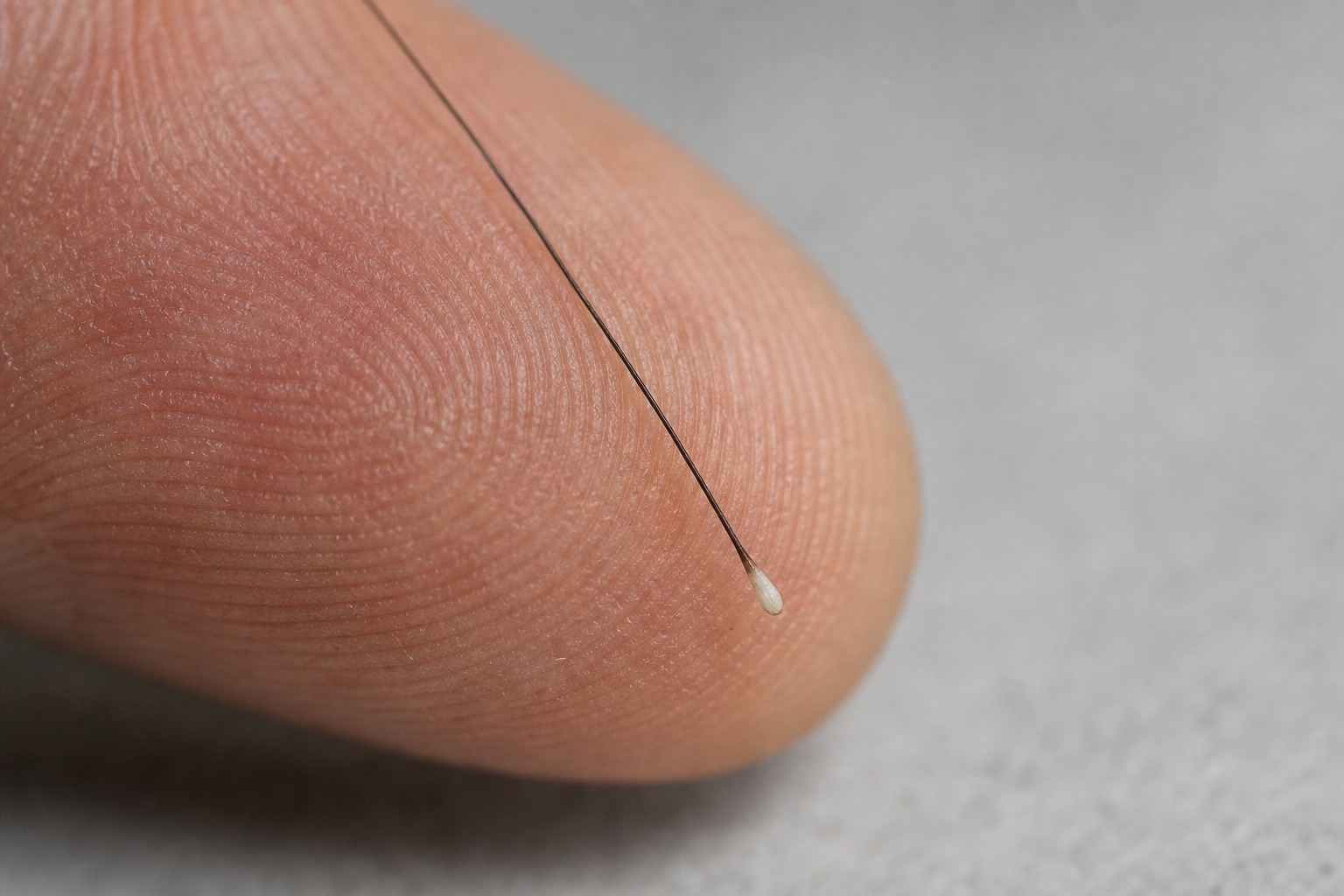
The following visual check sums up how to tell the two apart in everyday life: by the fallen hair itself, by the scalp underneath, by the timing and by what triggered it.
| Feature | Points to shedding (the normal case) | Points to a lost graft (rare) |
|---|---|---|
| What you are holding in your hand | a plain hair shaft, often with a small whitish thickening of keratin at the end | a hair with tissue attached |
| Scalp at that spot | unremarkable, no bleeding | pinpoint bleeding right after the incident |
| Timing | from week 2 onwards, peaking in weeks 4 to 8 | practically only in the first few days, from around day 10 to 14 the grafts are firmly in place |
| Trigger | happens on its own, including during careful washing | a mechanical incident: scratching, rubbing, a knock |
| What it means | the root stays in the scalp, the hair grows back | this one graft will not grow back |
| What to do | nothing, carry on as usual | leave the spot alone, and if it happens repeatedly, tell the clinic |
These characteristics are based on established clinical knowledge about the morphology of telogen hairs and about how grafts heal into place, not on a study that has examined this exact distinction. If it happens repeatedly or you have doubts, sending a photo to your treating clinic is the fastest route.
How common is shock loss? The evidence in 2026
Only one larger study has looked at how common true shock loss after a hair transplant really is. Okochi and colleagues analysed 621 patients after follicular unit excision and found a temporary effluvium in the recipient area in 3.7 per cent, around 1.6 per cent in men and around 21 per cent in women (Aesthetic Plastic Surgery 2024, PMID 37816944).
That is the best figure available, but it cannot be taken as a universal rate: it comes from a retrospective single-centre analysis, methodologically level IV evidence. A 2026 review cites a range of 0.15 to 15 per cent for effluvium in the recipient area, which goes back to the same study (Romera de Blas et al., Frontiers in Medicine 2026).
Temporary effluvium in the recipient area, 621 FUE patients
All patients · 3.7% (23 of 621)
Men · around 1.6% (9 of 554)
Women · around 21% (14 of 67)
Source: Okochi H. et al., Aesthetic Plastic Surgery 2024;48(7):1258–1263, PMID 37816944. Limitation: single centre, retrospective, level IV evidence. Sex was the only significant risk factor (odds ratio 30.18).
Why much higher shock loss figures circulate online
The high percentages for the frequency of shock loss that circulate in forums and on clinic websites cannot be backed up in the medical literature. They come from a mix-up: the normal shedding of the transplanted hairs is lumped together with true shock loss of the native hair into a single number.
That puts a process that occurs in most patients and has no consequences in the same category as a rare reaction that the literature puts at 3.7 per cent (Okochi et al. 2024). For your own progress, one question matters most: is only the transplanted hair affected, or the surrounding native hair as well?
Risk factors: why women are affected by shock loss more often
The only statistically significant risk factor for shock loss in the analysis by Okochi et al. (2024) was sex. Women showed a temporary effluvium far more often than men, around 21 per cent versus around 1.6 per cent, with an odds ratio of 30.18 (95 per cent confidence interval 9.43 to 96.55).
Several explanations are plausible, none of them proven: in women, grafts are more often placed in between existing hair, the target area contains more hairs that have already thinned, and those hairs are more sensitive to the trauma of the procedure. That is an attempt at an explanation, not a documented cause.
None of this argues against a hair transplant for women. What makes sense is to raise the topic during the consultation, document the baseline density and follow the progress more closely. How female and male hair loss differ is covered in the article on androgenetic alopecia.
What follow-up appointments show
In follow-up appointments, by far the most common finding in the first months is shedding of the transplanted hairs, not true shock loss of the native hair. Clinically, one question is therefore decisive: is the surrounding native hair affected as well? That case alone is hard to tell apart from progressive, genetically driven hair loss early on, and that case alone really calls for an assessment against baseline photos.
Causes
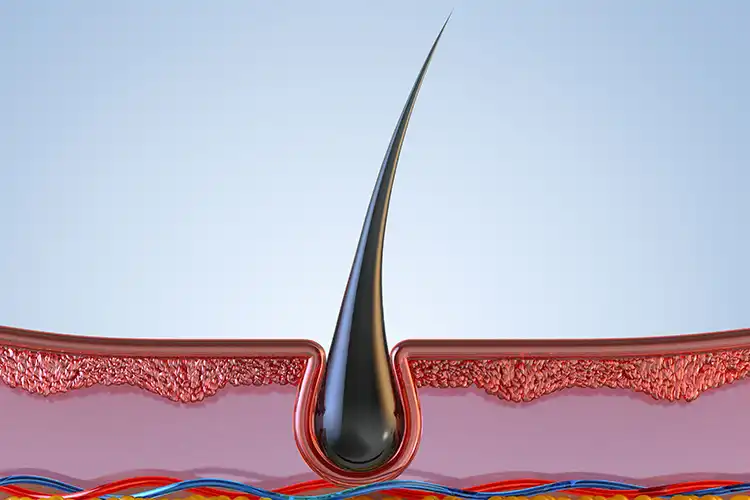
There are several reasons why hair loss can occur after a hair transplant. In most cases it is a normal and temporary process, closely linked to the natural hair growth cycle and to the healing of the scalp.
Shock loss
Behind hair loss after a hair transplant lies one and the same mechanism, which can affect two different groups of hair. During the procedure the follicle is separated from its blood supply or irritated by the surgical trauma and then switches into the resting phase (telogen phase). After weeks to months it moves back into the growth phase (anagen phase), in which new hair forms.
In the transplanted hairs this change of phase is the normal case and is called shedding: the shaft falls out, the root stays. True shock loss, by contrast, is when the surrounding native hair reacts as well. That case is rare and, in the analysis by Okochi et al. (2024), came to 3.7 per cent of 621 patients.
Stress for the scalp: mechanical strain during the procedure
During the procedure the scalp is put under mechanical strain in both the donor and the recipient area. This strain can also affect surrounding, untransplanted hair follicles. In response, a temporary loss can occur, which usually resolves completely as healing continues.
Other factors: aftercare mistakes and external influences
External factors can also contribute to hair loss after the procedure:
- Insufficient or incorrect aftercare, for example through aggressive products or mechanical irritation
- Lifestyle factors such as stress, smoking or an unbalanced diet
- Impaired blood flow to the scalp during the healing phase
These influences explain why one recovery can be bumpier than another. They do not explain how high the risk is in an individual case. What is documented and what is not is covered in the next section.
Which factors influence the risk (and which do not)
The risk of shock loss after a hair transplant can only be influenced to a limited extent, because the trauma to the scalp is part of the procedure itself. So far, exactly one factor is documented: sex, with women at an odds ratio of 30.18 (Okochi et al. 2024).
A second point concerns the starting situation. StatPearls recommends stabilising with medication for 6 to 12 months before the procedure if more than 15 per cent of the hair in the recipient area is miniaturised, because a high degree of miniaturisation increases the risk of shock loss that may, in some cases, be permanent (StatPearls NBK547740).
Implantation density is also suspected of playing a role. A case series of 28 patients describes an immediate, band-like effluvium in connection with a high density of 50 to 70 follicular units per square centimetre (Mir-Bonafé et al., Actas Dermo-Sifiliográficas 2023). A case series does not establish a frequency; it points to a possible connection.
Many patients ask whether the hair loss at the back of the head comes from the anaesthetic injections. That has not been studied. It is plausible, because the review by Romera de Blas et al. (2026) lists vasoconstricting agents and a local shortfall in blood supply among the factors behind the effluvium. That does not make tumescent solution a documented cause.
There are no reliable comparative data on the influence of the extraction technique, the number of grafts or the size of the session on the frequency of shock loss. Anyone advertising a technique as protection against shock loss is going beyond the evidence. What that leaves is a medical consultation in which miniaturisation and density are assessed, a realistically planned density and patience along the way.
Is it normal for the hair to fall out?
Yes, hair loss after a hair transplant in the first weeks is completely normal and part of the natural healing process. This so-called shock loss, when it occurs, usually sets in within the first 2 to 8 weeks after the procedure. The transplanted hairs fall out, while the hair roots stay intact in the scalp and prepare for the next growth phase.
When does new hair growth begin?
New hair growth usually starts after about 3 to 6 months according to the StatPearls medical database, which gives the same time frame for the period after shock loss (NBK547740). At first the new hairs are finer and irregular, and they only gain strength and density over the following months. The next section shows the whole course up to the final result, month by month.
What is not normal, on the other hand, is hair loss that spreads beyond the treated area, increases after month 6 or comes with signs of inflammation. With changes like these it makes sense to contact the treating clinic early.
How long does hair loss after a hair transplant last?

Hair loss in the first weeks
After a hair transplant, so-called shock loss can occur, usually within the first two to eight weeks. The transplanted hairs temporarily fall out because the hair follicles switch into a resting phase (telogen phase). This is a normal process and as a rule no cause for concern: the hair roots remain and start growing again after a while.
The timeline: from week 1 to month 18
The timeline after a hair transplant is individual, but it usually follows a similar pattern: shedding in weeks 2 to 8, new growth from month 3 to 6, assessment of the result from month 12.
- From about 3 months: The first fine, often still thin hairs start to grow back
- After around 6 months: The hair visibly gains density and strength, an interim stage and not the final result
- After 9 to 12 months: Hair growth is largely complete, and the transplanted hairs reach their natural structure
- After 12 to 18 months: On the top of the head and in densely packed zones, hair diameter and pigmentation keep increasing
The NHS patient information gives the same order of magnitude: new hair usually appears after about four months, the full result after 10 to 18 months. StatPearls recommends that clinics follow up with photo documentation over 6 to 12 months, until the grafts have matured (StatPearls NBK547740).
The following table sets out this progression month by month: what you see at each point, what is happening in the follicle and whether the finding is part of the normal course. The donor area has its own row at the end.
| Time point | What you see | What is happening in the follicle | Normal? |
|---|---|---|---|
| Week 1 | scabs, redness, short implanted hairs | wound healing, the grafts anchor themselves | yes |
| Weeks 2 to 4 | the first transplanted hairs fall out, scabs come off | the transplanted follicles enter the resting phase (telogen) | yes |
| Weeks 4 to 8 | peak of the shedding, the area looks emptier than right after the procedure | resting phase, the roots stay in the scalp | yes |
| Month 3 | usually still hardly any visible change, first fine hairs possible | transition into the growth phase (anagen), not synchronised | yes |
| Months 4 to 5 | fine, light, short hairs appear unevenly | new hair shafts grow, diameter still small | yes |
| Month 6 | visible increase, often still gaps and thin zones | some of the follicles have not started yet | yes, explicitly an interim stage |
| Month 9 | clearly more density, the hairs become thicker and darker | diameter and pigmentation keep maturing | yes |
| Month 12 | the result can usually be assessed | most follicles have entered growth | assessment point |
| Months 15 to 18 | a final increase, above all on the top of the head and in dense zones | remaining maturation | yes |
| Donor area | the shaved zone fills in during weeks 2 to 6, an effluvium resolves over 3 to 6 months | wound healing of the extraction points, change of phase in the neighbouring hairs | yes |
Why patience is decisive
Many patients feel unsettled when hair loss after a hair transplant lasts longer or growth looks uneven at first. In most cases this is not a sign of a problem but an expression of the natural hair cycle: the follicles do not all start at the same time but get going gradually over several months.
That is why the result cannot be judged conclusively before month 12, and why every interim verdict before that point is a snapshot. Consistent aftercare supports the process, but it cannot be sped up.
Still gaps after 6 months: the growth curve up to the final result
Gaps six months after a hair transplant are not the final state. After about six months you are looking at an interim stage: density and hair diameter keep increasing up to month 12, and on the top of the head and in densely packed zones sometimes up to month 15 to 18. For the full result the NHS gives 10 to 18 months.
There is no reliable figure for what percentage of the result is visible after six months. Neither StatPearls nor the NHS nor the 2026 review names such a rate. Claims like “half of it after six months” come from clinic marketing, not from studies.
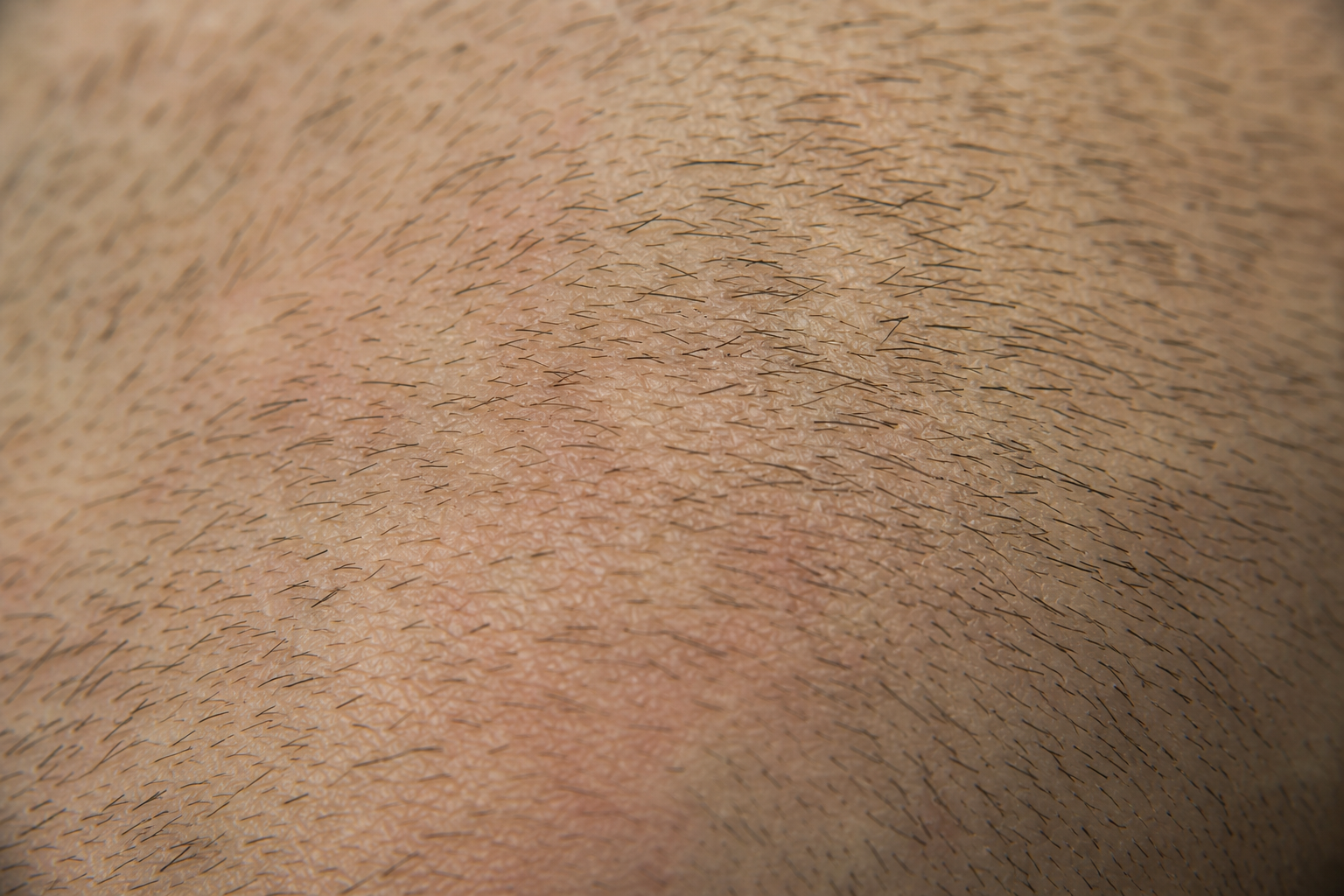
Why month 6 is visually deceptive
The impression after six months is deceptive for three reasons. First, the follicles do not all start together but come in over a period of months. Second, the new hairs are thin, light and short at first and therefore cover less well. Third, diameter and pigmentation only increase later on.
In practical terms: two areas with an identical number of grown hairs can look completely different in density, simply because the hairs differ in thickness. Coverage comes from hair diameter, not from the number alone.
Patchy growth is a pattern, not a mistake
Uneven, patchy growth in months 4 to 8 is the normal case, because the follicles start asynchronously. The zones that come in first are often the hairline and the temples. The top of the head and the crown typically follow later, which reinforces the impression of a gap at the back.
As long as something is happening everywhere, an uneven picture is not a sign of a problem. It only becomes notable when one area stays completely empty for months while the neighbouring zones are visibly growing.
The dip in months 2 to 4, known among specialists as the “ugly duckling phase”
If there was still a lot of native hair in the target area, the visual impression in months 2 to 4 can temporarily be worse than before the procedure. Hair surgeons call this dip the “ugly duckling phase”. The transplanted hair has been shed, the native hair has reacted to the trauma, and the new hair is not there yet. Unpleasant, but not a step backwards.
You can plan around this phase at work: the procedure itself is mainly visible in the first two to three weeks, and the dip is a matter of density, so it shows up less with short hair. What is allowed in which week is set out day by day in the guide to what to do after a hair transplant.
Spots where the new hairs break through
Individual inflamed pustules in months 2 to 6 usually appear when a new hair breaks through the skin. A multicentre study of 1,317 patients found an overall rate of 12.11 per cent for folliculitis after a hair transplant (Plastic and Reconstructive Surgery 2024, PMID 37904273). Common, as a rule harmless, and the new hair is normally not lost because of it.
Risk factors in that study were an operation in the summer, more than 4,000 grafts and an implantation density above 45 grafts per square centimetre. Those are risk factors for folliculitis, not for shock loss. The two are often confused.
This has to be distinguished from extensive, purulent, weeping or painful inflammation. That needs medical attention and should not be squeezed or scratched open. The traffic-light table further down sorts the borderline cases.
When six months is a reason for a follow-up after all
A follow-up appointment after six months makes sense if there is no new growth at all, if one area stays completely empty while the surroundings are growing, or if there are signs of inflammation. Gaps alone are not a finding at six months, but a complete absence of growth is.
Shock loss in the donor area
Shock loss can also occur in the donor area. There, hairs around the extraction sites temporarily enter the resting phase, which is why the back of the head can look patchy or thinned out in the first months. How common that is cannot be quantified: the review by Romera de Blas et al. (2026) states explicitly that the true frequency is unknown and that effluvium in the donor area appears to be considerably rarer than in the recipient area.
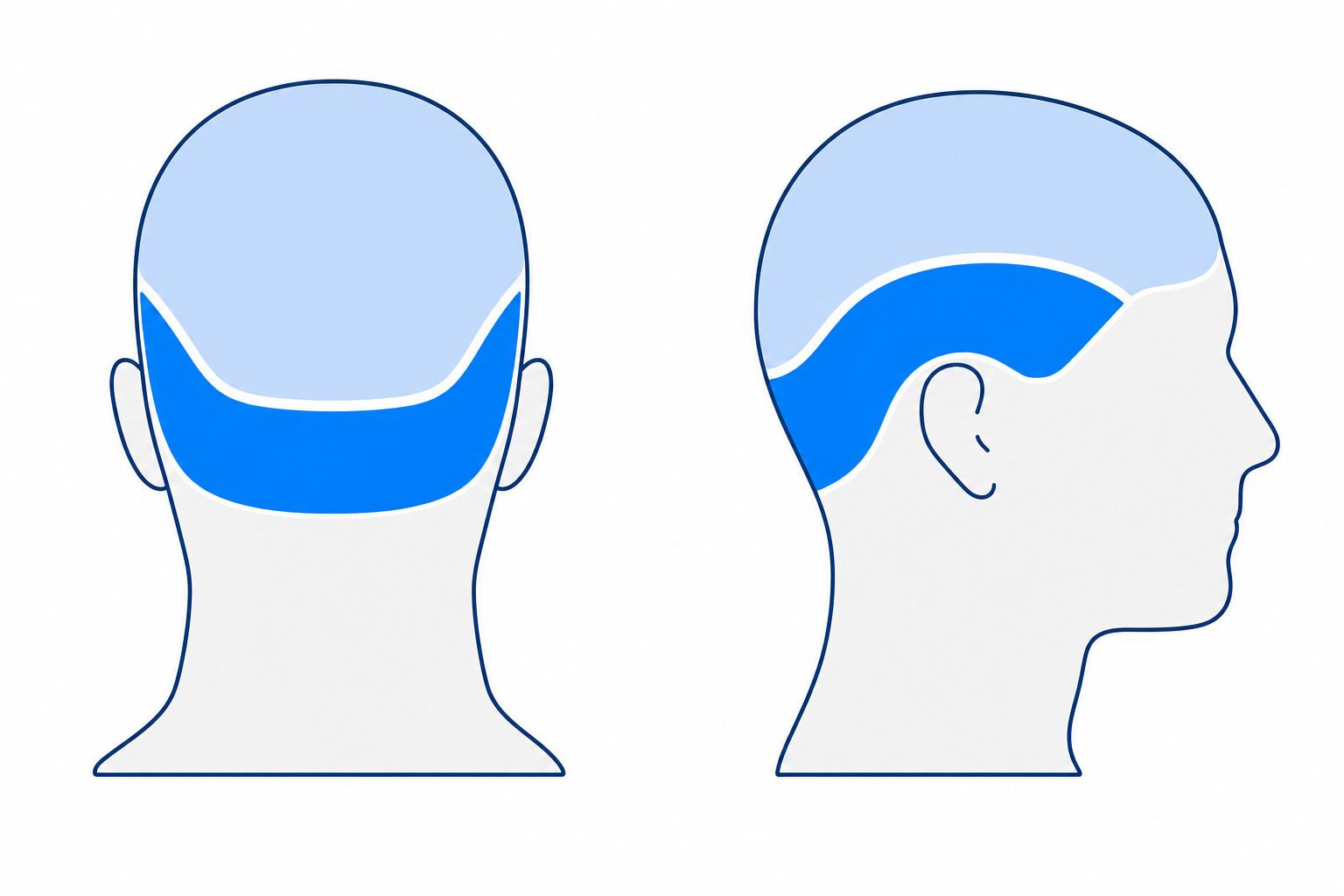
The evidence exists only as case series and individual cases: 12 patients in Gómez-Zubiaur et al. (Dermatologic Surgery 2021), four cases in Kerure et al. (Journal of Cutaneous and Aesthetic Surgery 2020), plus a few individual case reports. No percentage risk can be derived from series like these, but they do show that the phenomenon exists and has been described.
In terms of timing, according to the same review, an effluvium in the donor area typically shows up 2 to 4 weeks after the procedure and resolves spontaneously within 3 to 6 months. The shaved zone itself grows back in weeks 2 to 6, independently of this.
Why the back of the head looks thinned out even though no hair has been lost
The back of the head looks thinner after the procedure even without shock loss. The zone is shaved short, the extraction points are visible as tiny scabs, and the contrast with the longer hair around it reinforces the impression. As soon as the zone grows back, this effect disappears.
Temporary shock loss or permanent overharvesting?
The key distinction in the donor area is between temporary effluvium and permanent thinning. Shock loss tends to look patchy and resolves as the hair grows back. Overharvesting shows up as a uniformly reduced density across a large area and stays that way. This distinction is based on clinical experience; there is no comparative study on it.
A medical assessment makes sense if the zone is still visibly thinner than before the procedure after six months or shows sharply defined bald patches. Healing, care and scars in the extraction zone are covered in a separate article on the donor area after a hair transplant.
Solutions and tips to support hair growth
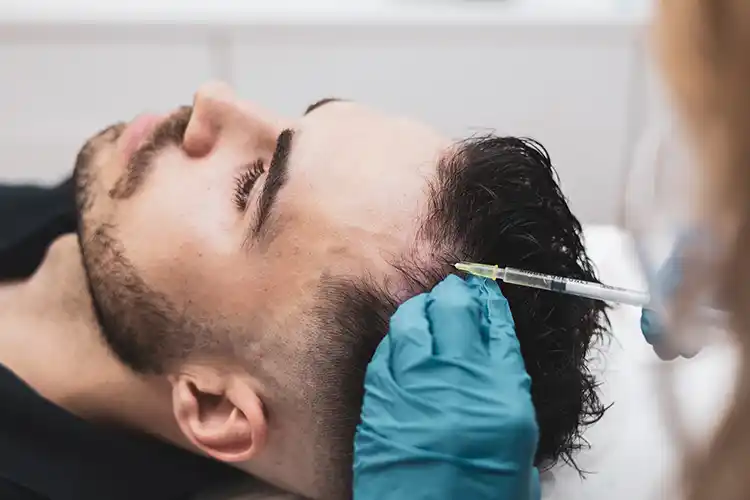
After a hair transplant, targeted aftercare can have a positive effect on healing and support the regrowth of the hair. Especially with hair loss after a hair transplant patience, consistent care and a stable general condition play an important role.
Care after the transplant
In the first weeks it is important to treat the scalp especially gently:
- At first, cleanse only with plain water or a medically recommended, mild shampoo
- Pat the scalp dry carefully, do not rub or scratch
- Avoid tight headwear, strong sunlight and mechanical irritation
These measures prevent the healing process from being disturbed and protect the transplanted follicles. What is allowed in which week, from washing to sport, is set out day by day in the aftercare guide.
Nutrition for strong hair
A balanced diet can support hair growth as well:
- A sufficient intake of biotin, zinc, iron and omega-3 fatty acids
- Protein-rich foods such as eggs, fish, pulses or nuts to support the hair structure
- Drinking enough fluids to promote blood flow and the nutrient supply to the hair roots
Stress management
- Chronic stress can worsen hair loss, and regular exercise, meditation or yoga help to lower stress levels
- Healthy sleep supports the regeneration of the hair follicles
Supportive therapies
Accompanying measures can make sense in individual cases, but they do not replace a transplant:
- PRP treatments are a regenerative measure, and the treating clinic decides on their use case by case. As a remedy for shock loss or as a way to speed up regrowth they are not documented
- Active ingredients such as minoxidil or finasteride belong in medically supervised treatment and not in self-medication. They act on the native hair, not on the shedding of the grafts
In summary: consistent aftercare, a healthy lifestyle and realistic expectations are the sensible way to support hair growth after a transplant. The final result develops step by step and above all needs time.
When should you be concerned?

In most cases, hair loss after a hair transplant is a normal part of the healing process. Even so, there are certain signs that can point to complications and should be checked by a doctor.
Signs of complications
Certain symptoms go beyond the usual healing process:
- Severe or increasing redness and swelling: Slight redness is normal after the procedure and usually subsides within a few days. If it increases or comes with pain, however, this can indicate inflammation or infection.
- Purulent inflammation or unusual scab formation: Small scabs are normal in the first days. Weeping, heavily reddened or painful spots, however, should be checked by a doctor.
- Unusually heavy or long-lasting hair loss: While possible shock loss usually occurs within 2 to 8 weeks and is temporary, persistent or progressive hair loss can indicate a poor graft survival rate or other problems.
When a follow-up appointment is necessary
A medical follow-up is advisable if symptoms last longer than about two weeks or get worse. Persistent pain, tenderness or pronounced signs of inflammation should not be ignored either.
Beyond that: If there is no new hair growth at all after about six months, the healing process should be checked professionally. That means really no growth, not a result that does not yet look dense enough.
A follow-up appointment assesses three things: the density compared with the baseline documentation, signs of inflammation on the scalp and the condition of the surrounding native hair, that is, the degree of miniaturisation. That is exactly why the baseline photo is so valuable: without something to compare against, every assessment comes down to a gut feeling.
Two tools help with self-assessment, and they build directly on each other. The traffic-light self-check sorts every typical observation according to whether it belongs to the normal course or belongs in a consultation. The progress log below it makes sure your photos stay comparable over the months.
| Observation | When it is normal | See a doctor if |
|---|---|---|
| Hair loss in the transplanted area | weeks 2 to 8, peaking in weeks 4 to 8 | no new growth at all is visible from month 6 |
| Hair loss in the surrounding native hair | weeks 2 to 12, resolving over months | the loss increases after month 6 or spreads beyond the area |
| Hair loss in the donor area | from weeks 2 to 4, resolving within 3 to 6 months | the zone stays evenly thinner after month 6 or shows bald patches |
| Redness and swelling | the first days after the procedure, then decreasing | it increases after more than two weeks or hurts |
| Scabs | the first 7 to 14 days, they come off on their own | they weep, smell or are still firmly attached after two weeks |
| Itching | weeks 1 to 4, often while healing | it comes with blisters, pustules or severe redness |
| Individual spots as the hair breaks through | months 2 to 6, isolated and hardly painful | they become extensive, purulent or painful |
| Purulent or weeping inflammation | never a normal finding | always, as soon as possible |
| Pain and tenderness | the first days, then decreasing | it persists after two weeks or increases again |
| No new growth | not meaningful until month 3 to 4 | nothing is growing anywhere from month 6, at the latest from month 12 |
| Numbness | weeks to a few months, usually receding | it is unchanged after month 6 or painful |
Progress log: how to document your growth meaningfully
The most common source of error in self-assessment is not the hair, it is the light.
- ✓Always the same four angles: front, hairline from above, top of the head and crown, back of the head
- ✓Always the same light, no direct ceiling light from above, no flash
- ✓Hair dry, same length, no styling products, no hair fibres
- ✓Schedule: day 1, then months 1, 3, 6, 9 and 12
- ✓Keep the baseline photo from before the procedure, because without that anchor people almost always underestimate their progress
- ✓One photo per time point is enough, and counting fallen hairs every day tells you nothing
A follow-up appointment is not an admission that something has gone wrong; it is the intended route when you are unsure. When in doubt: having someone take a look is always better than puzzling over it for months.
Hair loss again two years after a hair transplant: what is behind it
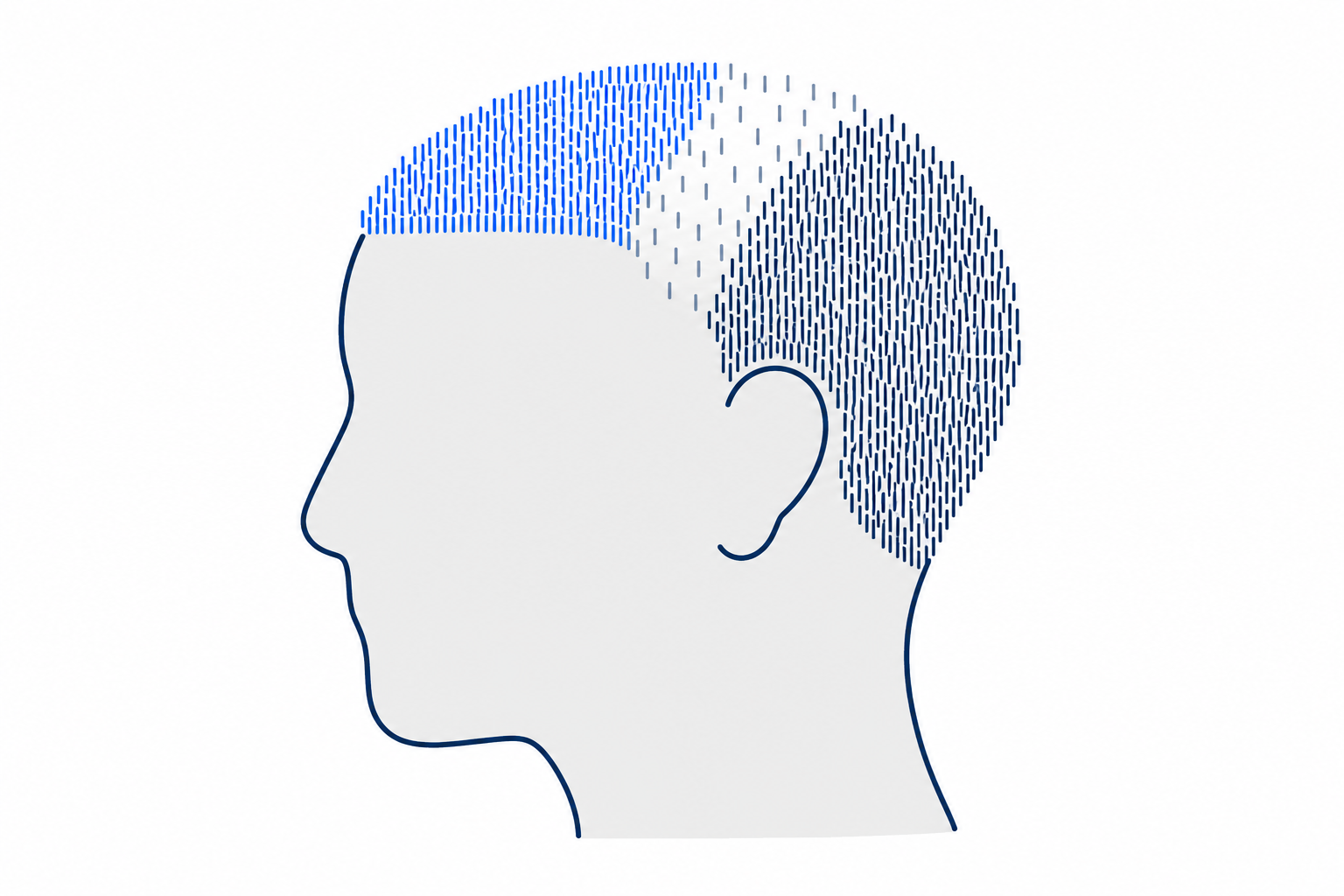
If hair falls out again one or two years after a hair transplant, it is usually not shock loss and not graft loss, but progressive androgenetic alopecia in the untransplanted area. A transplant treats the area, not the predisposition.
Why the transplanted hairs usually stay
The grafts come from the horseshoe-shaped rim at the back of the head and at the temples. These follicles are considerably less sensitive to the hormone DHT because they have fewer androgen receptors and less 5-alpha-reductase, and they keep this property in their new location. Norman Orentreich described the principle back in 1959, and the ISHRS still refers to it today as donor dominance.
That is why transplanted hairs usually stay for good. What that biological permanence means over the long run is shown in the articles on the longevity of a hair transplant and on the picture 10 years later.
Why the native hair keeps falling out
The remaining follicles stay sensitive to DHT. They keep miniaturising, no matter how well the graft has grown. That is why new hair loss two years after a hair transplant is not a contradiction of the result but the normal continuation of androgenetic alopecia.
You can recognise it yourself from the pattern: the thinning is next to or behind the transplanted area, and a visible step often forms between the dense transplant and the thinning native hair. If, on the other hand, hair falls out evenly across the whole head, diffuse hair loss is more likely, and then it is worth looking at the causes of hair loss.
The role of accompanying drug therapy
Drug therapy is not aimed at the shedding but at the further loss of native hair. In a randomised, placebo-controlled study of 79 men, 94 per cent of the finasteride group showed a visible increase in hair in the frontal and upper scalp area after 48 weeks, compared with 67 per cent on placebo (Leavitt et al., Dermatologic Surgery 2005, PMID 16188178).
That study concerned the surrounding native hair, not the grafts, and it was conducted in men only. The European S3 guideline on androgenetic alopecia (Kanti et al. 2018) lists topical minoxidil and oral finasteride as standard options for men. If treatment is stopped, the effect is lost again.
Different rules apply to women. Finasteride is contraindicated in women of childbearing potential, it must not be used in pregnancy, and even contact with broken tablets should be avoided. Topical minoxidil is prescribed to women in a different concentration than to men. Details can be found in the articles on finasteride and minoxidil, and in every case use should be medically supervised.
Is a second session needed?
How many patients need a second session over time is not documented; the figures for that do not exist. The question comes down to two points: what is causing the new hair loss, and whether the donor reserve at the back of the head is sufficient for added density. An overview of the options is given in the comparison of hair growth products and hair transplants.
Shedding and shock loss are explicitly not a case for another procedure; they need time. Progressive hair loss in the untreated area is a different question. Before adding density makes sense, the cause, the condition of the scalp and the density need to be assessed, and that is exactly what a hair analysis is for. At Elithair it is free of charge and reviewed by a doctor, and in many cases it leads to the conclusion that no surgery is needed for now.
Successful hair transplants: patience pays off
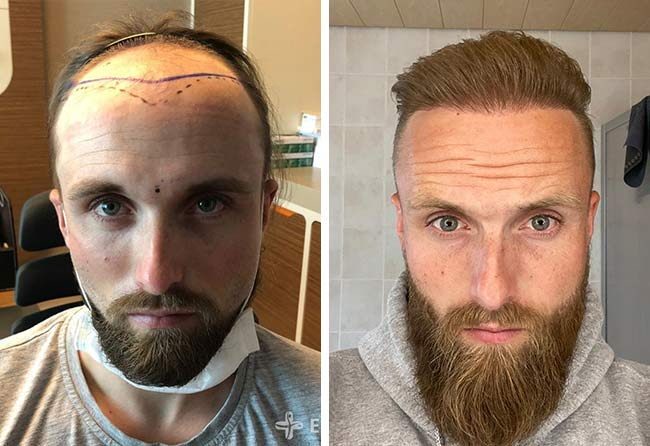
How the course described here plays out in practice is shown by a documented case from our follow-up care. It is not proof of efficacy and not a prognosis for other patients, but an example of where on the timeline uncertainty typically arises.
For Frederik G. a noticeable share of the implanted hairs fell out in the weeks after the treatment, which is exactly the shedding from weeks 2 to 8. New growth only set in after several months, within the 3 to 6 months that StatPearls describes as the usual time frame.
The case illustrates what the timeline dictates: months without progress lie between the shedding and visible new growth. Anyone who knows about that gap judges the interim stage differently from someone who mistakes it for the result.
Before and after results: the road to full hair
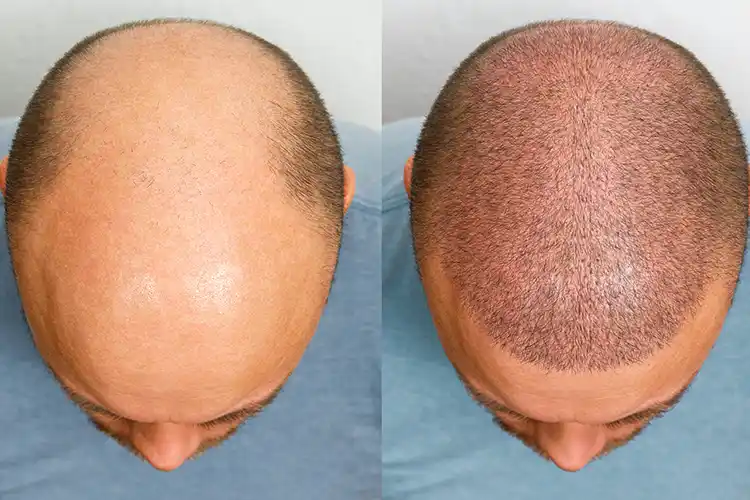
Before and after results are only useful for judging your own situation if the time point is stated. A picture from month 6 and a picture from month 14 show different stages of the same process, not different qualities of result. So with comparison pictures, always look at the month, at the light and at the hair length.
Results turn out differently from person to person, because baseline density, area and hair structure differ. What can be influenced is how you handle the waiting time: document instead of counting every day, stick to the aftercare, and involve the clinic if anything looks unusual.
Frequently asked questions about shock loss and hair loss after a hair transplant
Is shock loss after a hair transplant permanent?
As a rule, no. With shedding the root stays in the scalp, and experience shows that shock loss of the native hair resolves over the course of months. Permanently absent growth is the exception and should be assessed by a doctor after twelve months at the latest.
Do all transplanted hairs fall out?
In most patients the visible shaft of the transplanted hairs falls out in weeks 2 to 8. The medical literature does not give a reliable percentage for this. The root stays in its new place, and regrowth usually begins after three to six months.
Is shock loss a sign that something went wrong during the operation?
As a rule, no. Shedding is part of the healing process, and there are no reliable comparative data on a connection between technique or session size and the frequency of shock loss. The only documented risk factor so far is sex (Okochi et al. 2024).
There are still gaps after 6 months. Is that normal?
Yes. Six months is an interim stage, not the final result. The follicles do not start at the same time, and the new hairs are thin and light at first. The result usually matures until month 12, and on the top of the head sometimes until month 15 to 18.
Does the donor area grow back after shock loss?
According to the available case series, an effluvium in the donor area resolves spontaneously within 3 to 6 months. If the zone stays evenly thinner after six months, permanent thinning from overharvesting is a possibility and should be assessed.
Why are women affected by shock loss more often?
In the analysis by Okochi et al. (2024), sex was the only significant risk factor: around 21 per cent in women compared with around 1.6 per cent in men, odds ratio 30.18. Why that is the case has not been clarified; denser existing hair and more thinned hairs in the target area are among the explanations discussed.
Can I prevent shock loss?
Only to a limited extent, because the trauma to the scalp is part of the procedure. What makes sense is a medical consultation with an assessment of miniaturisation, a realistically planned density and documentation of the baseline. With pronounced miniaturisation, StatPearls recommends stabilising with medication beforehand.
Does minoxidil help against hair loss after a transplant?
Minoxidil acts on the native hair, not on the shedding of the grafts. A benefit against shock loss is not documented. Using it after a transplant is a medical decision, not least because women are prescribed a different concentration than men.
Why does hair fall out again two years after a hair transplant?
Usually progressive androgenetic alopecia in the untransplanted area is behind it. The transplanted follicles are considerably less sensitive to DHT and usually stay for good, while the surrounding native hair stays sensitive and can keep miniaturising.
What happens if no hair has grown after 12 months?
Then a medical assessment is indicated. It looks at the density compared with the baseline documentation, at signs of inflammation and at the condition of the native hair. Twelve months is the established assessment point, before that a result cannot be judged conclusively.
Did I pull out a graft while washing, or is this normal shedding?
A plain hair shaft with a small whitish thickening at the end and no bleeding points to shedding. Mechanical graft loss is practically only possible in the first few days: from around day 10 to 14 the grafts are firmly in place (Bernstein and Rassman 2006, NHS).
I have spots where the new hairs are growing. Is that bad?
Usually not. Individual pustules form when new hairs break through the skin. A multicentre study of 1,317 patients found folliculitis after a hair transplant in 12.11 per cent (PMID 37904273). Extensive, purulent or painful inflammation should be assessed by a doctor.
Conclusion: a natural process
Hair loss after a hair transplant is in most cases a normal part of the healing process. Two processes have to be kept apart: the shedding of the transplanted hairs, where the root stays, and the rare true shock loss of the surrounding native hair, which experience shows resolves over the course of months.
Three numbers carry the whole picture: new growth as a rule after 3 to 6 months (StatPearls), the full result after 10 to 18 months (NHS), true shock loss of the native hair in 3.7 per cent of 621 patients, considerably more often in women (Okochi et al. 2024, level IV evidence). Everything that falls within this frame is a process, not a finding.
Outside that frame the picture changes: no new growth from month 6, increasing loss spreading beyond the area, purulent inflammation or persistent pain should be assessed by a doctor, at the treating clinic or at a dermatology clinic. Follow-up care is a fixed part of the support at Elithair so getting in touch is part of the plan, not an exception.

Sources and medical disclaimer
Sources used (as of August 2026)
- Okochi H., Onda M., Momosawa A., Okochi M.: An Analysis of Risk Factors of Recipient Site Temporary Effluvium After Follicular Unit Excision. Aesthetic Plastic Surgery 2024;48(7):1258–1263. PMID 37816944. PubMed
- Goldin J., Zito P.M., Raggio B.S.: Hair Transplantation. StatPearls, NCBI Bookshelf NBK547740, continuously updated. NCBI
- Romera de Blas C., Vega Díez D., Ricart Vayá J.M., Gómez Zubiaur A.: Complications in follicular unit excision hair transplantation. Frontiers in Medicine 2026. PMC12909172
- Bernstein R.M., Rassman W.R.: Graft Anchoring in Hair Transplantation. Dermatologic Surgery 2006;32(2):198–204. PMID 16442039. PubMed
- Characterization and Risk Factors of Folliculitis after Hair Transplantation: A Multicenter Retrospective Study. Plastic and Reconstructive Surgery 2024;154(6):1115e–1122e. PMID 37904273. PubMed
- Leavitt M., David P.M., Rao N.A., Barusco M., Kaufman K.D., Ziering C.: Effects of Finasteride (1 mg) on Hair Transplant. Dermatologic Surgery 2005;31(10):1268–1276. PMID 16188178. PubMed
- Kanti V., Messenger A., Dobos G. et al.: Evidence-based (S3) guideline for the treatment of androgenetic alopecia in women and in men. Journal of the European Academy of Dermatology and Venereology 2018;32(1):11–22. JEADV
- Gómez-Zubiaur A. et al.: Localized telogen effluvium of the donor area after hair transplant surgery in 12 patients. Dermatologic Surgery 2021;47:1023–1024. Also Kerure A.S. et al., Journal of Cutaneous and Aesthetic Surgery 2020;13:31–34.
- NHS: Hair transplant. nhs.uk
- FDA: PROPECIA (finasteride) Tablets, prescribing information. accessdata.fda.gov
This article is for information purposes and does not replace medical advice, diagnosis or treatment. If you have symptoms or are unsure about your healing process, contact the treating clinic or a dermatologist. As of August 2026.

Dr. Imad Moustafa
Hair transplant specialist