

When Lionel Messi hoisted the World Cup trophy into the Lusail night sky in December 2022, half the world was debating his left foot. Nobody said a word about his hair. An oversight, as it turns out: players with medium-length hair, Messi length in other words, scored 1.26 times as often per head at that tournament as the average. And that was not even the record. Eight years earlier, at the 2014 World Cup, the same hairstyle around Colombia’s top scorer James Rodríguez had scored as much as 1.55 times more. The unassuming mane is the tournament’s secret efficiency queen.
And that is not the only trail the comb leaves across the goalscoring charts. The clean-shaven scored almost twice as many goals per head in 2022 as the stubble brigade, 1.8 times as many, to be exact. Of all things, the three-day stubble, fashionably untouchable for years now, is statistically the worst goalscoring facial hair in the professional game.
These are not sentences you write lightly. They come from the Elithair World Cup Hair Report 2026, for which Elithair has built a database unlike any before it: 6,993 hairstyles and beards from all 15 World Cups from 1970 to 2026, each one classified from official player portraits and linked to the official tournament statistics, from the goalscoring charts through sendings-off to the publicly known hair transplants of professional football. It is the largest football-history hairstyle analysis ever undertaken, reaching back without gaps to the very first World Cup sticker. And because the World Cup in North America is under way right now, this report grows with every matchday.
The data measures a tournament like no one has seen before: Saudi Arabia crowns itself the new beard world champion with an 87 per cent full-beard rate, holders Argentina have reached for the razor as one, among 746 classified players across the 48 nations there is not a single flowing mane to be found, and the tournament’s first bald-headed goal has catapulted the goal efficiency of bald players to 16 times the average. Which leaves the question of questions: which haircut scores the most World Cup goals?
- 56 years, 15 tournaments, 6,993 players, 1,656 goals: the largest hairstyle analysis in World Cup history, reaching back without gaps to 1970.
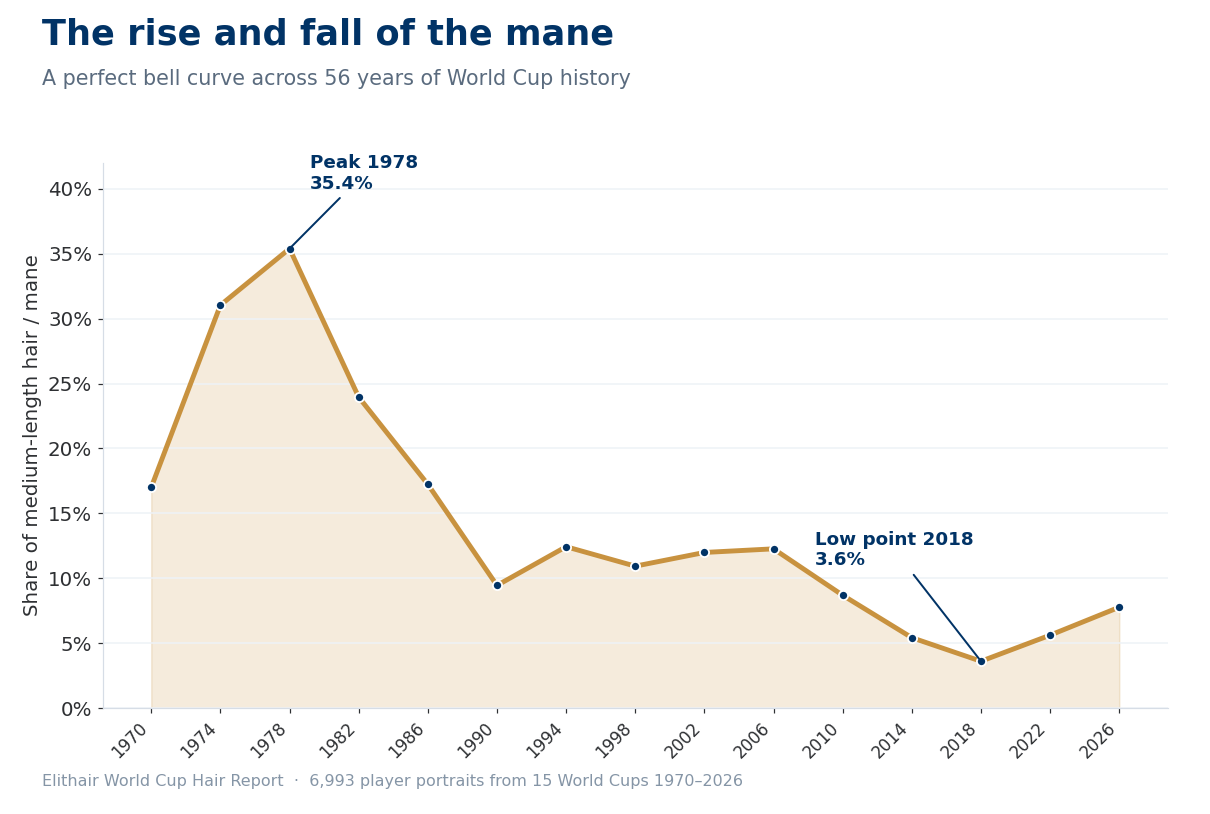
- The rise and fall of the mane: medium-length hair climbed from 17% (1970) to a peak of 35.4% (1978) and fell back to a low of 3.6% (2018). A perfect bell curve across two generations of players.
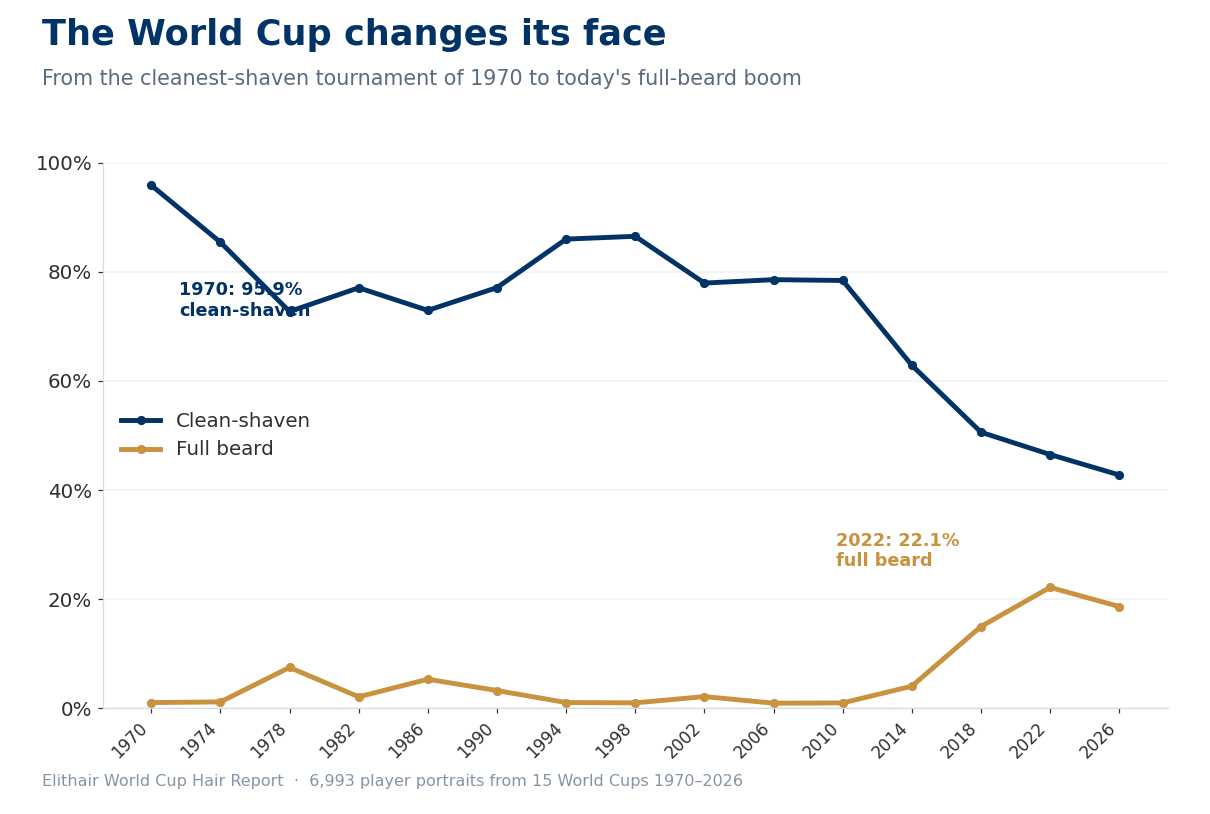
- The tournament has changed its face: in 1970, 96% of players were clean-shaven, in 2026 only 43%. The full beard exploded from around 1% to 22%.
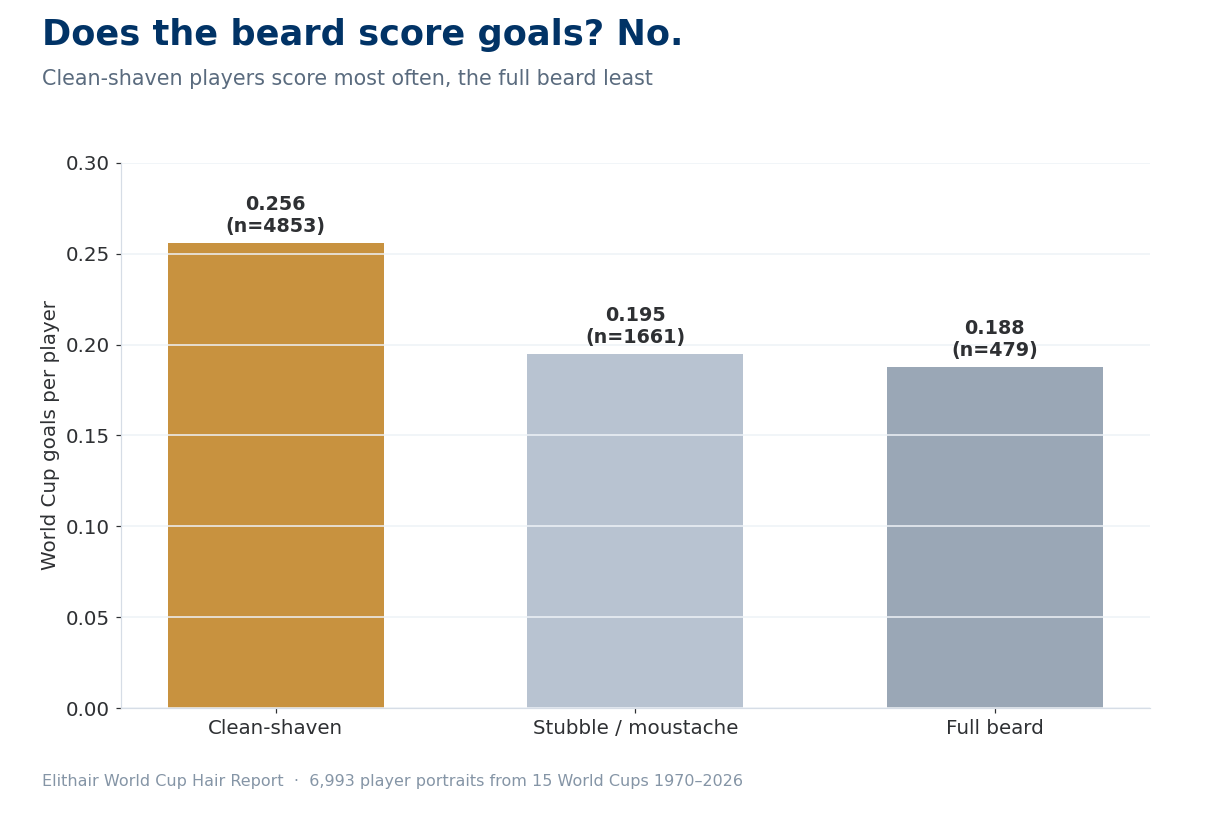
- The beard myth crumbles: across all tournaments the clean-shaven score most often (0.26 goals per head), the full beard least (0.19). The supposedly more masculine look is statistically the weaker goalscorer.
- Every world champion wears their era: in 1978 half of Argentina took the field with the mane, in 1998 France was 100% short-haired, in 2022 a third of Argentina wore the full beard.
Summary
- The Hair Report in numbers
- The great evolution: 56 years of World Cup hair and beards
- A word on how this report was put together
- The biology of success: what connection is there between a full head of hair and football?
- Nerves in the stands: which set of fans is most likely to lose its hair at the World Cup?
- Extreme conditions for the scalp: how does the climate at the 2026 World Cup affect the players’ hair health?
- Footballers with a hair transplant: who is open about it
- Which haircut scores the most goals? The goalscorer analysis
- Bald head equals defensive rock? Hairstyles and positions
- The corner-flag myth: which haircuts have whipped in the most corners?
- Yellow and red cards: which haircut fouls most often?
- Headed goals: does a bald head help with the header?
- The most iconic World Cup hairstyles in history
- Coaches and receding hairlines: stress on the touchline
- The tactics check: more hair-raising facts from the World Cup archive
- Why footballers in particular act early
- 2026 World Cup: the haircuts to keep an eye on
- The final verdict: who will be the 2026 hair world champion?
- Frequently asked questions about hair and football
The Hair Report in numbers
The great evolution: 56 years of World Cup hair and beards
Line up all 15 World Cups since 1970 side by side and you watch professional football grow old. No other stage documents the shifting ideals of male beauty as completely as the team photo before kick-off. What began in 1970 as a field of clean-shaven short cuts is, half a century later, a pitch full of full beards and undercuts. Four big fashions read clearly out of the data.
The most spectacular curve is drawn by the mane. In 1970 not even one player in five wore his hair medium-length (17%). Then came the decade of loose hair: Günter Netzer, Johan Cruyff and Mario Kempes turned the flowing mane into the trademark of an entire footballing generation. In 1978 it reached its historic peak of 35.4%, more than one in three players at the tournament. After that it went downhill for four decades, to the low point of 3.6% at the 2018 World Cup. Only the present brings a timid comeback of the centre parting (7.8% in 2026). Plot the values of all 15 tournaments and you get an almost textbook bell curve across 56 years.
The upheaval on the face is even more radical. The 1970 World Cup was the cleanest-shaven tournament in history: 95.9% of all players were clean-shaven, the beard all but non-existent. Today it is almost the other way round. In 2026 only a minority of 43% wear a bare chin, while the full beard has grown from around one per cent (2006) to its peak of 22.1% (2022). In between lies the almost forgotten moustache era of the 80s, when the top-lip moustache became compulsory and the stubble rate jumped above 20%.
How these fashions shifted tournament by tournament you can look up for yourself in the database below. It covers all 6,993 classified player portraits of the 15 World Cups, sortable by every hairstyle and every beard type.
The world champion’s hairstyle
There is a pattern that runs through the entire history of the tournament and that you only see once all the data sits together: every world champion wears the fashion of their time. If you want to know which hairstyle is in vogue right now, you only have to look at the reigning champion.
In 1978 the title went to an Argentina whose first eleven was half mane (50%), led by the long-haired top scorer Mario Kempes. Twenty years later, in 1998, a 100% short-haired France won, not a single centre parting in the squad. And in 2022 Messi’s world-champion eleven mirrored today’s beard boom: nearly a third wore the full beard, after that same Argentina had been the mane team par excellence four decades earlier. The reigning world champion is, in hairstyle terms, always a portrait of their era.
A word on how this report was put together
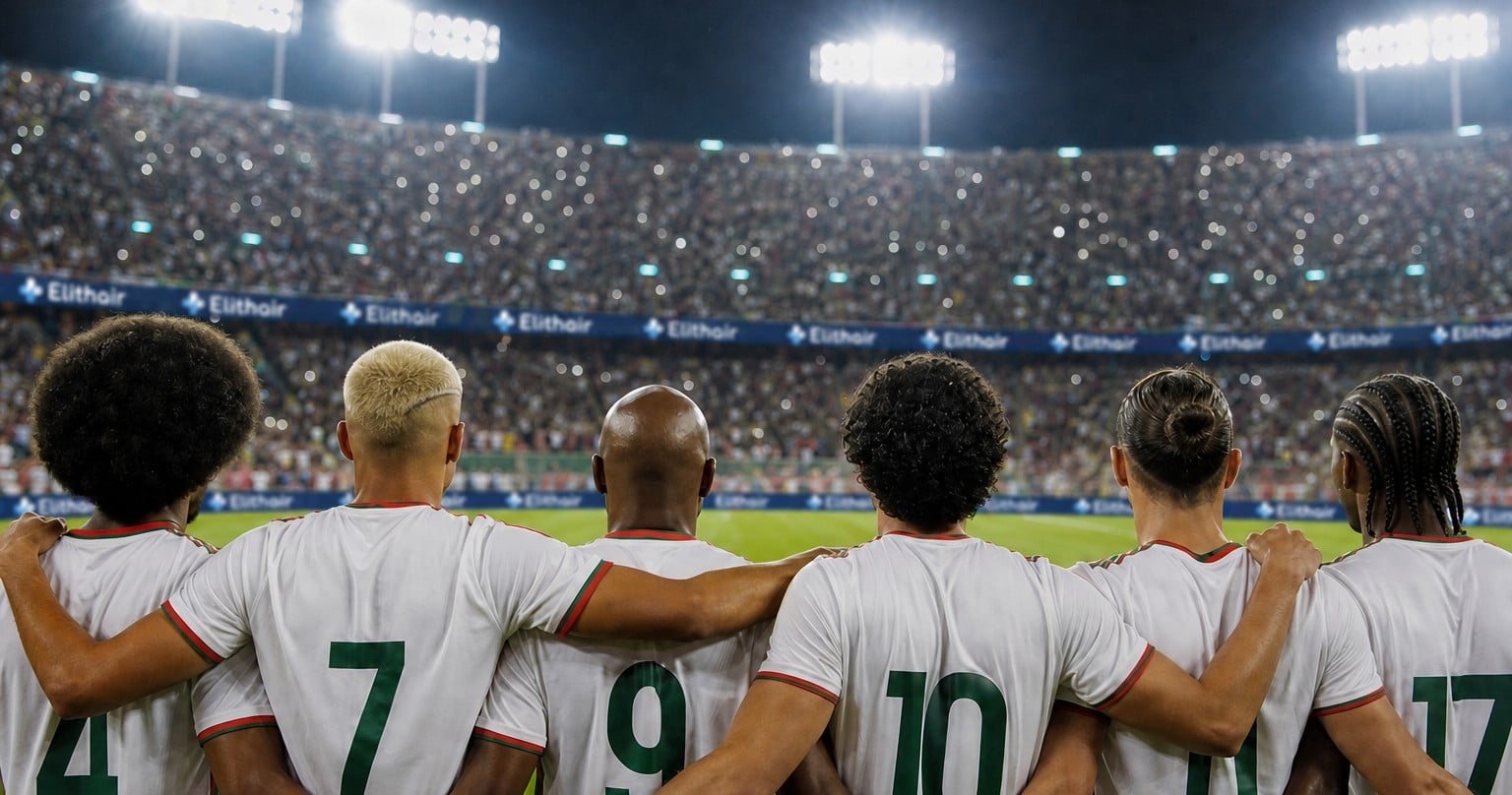
For this report we drew on the official goalscorer lists, card records and match reports of every World Cup since 1970. Every player named, every goal and every sending-off can be checked individually.
The editorial graft lies in the categorising: Elithair sorted the players’ hairstyles at the time of each tournament into types, from the classic short cut and the curly mane to the shaved head. Anything said about hair transplants is based purely on players confirming it themselves or on widespread media coverage, which is flagged as such.
This year’s headline addition is the heart of the report: Elithair has individually classified 6,993 player portraits from all 15 World Cups from 1970 to 2026, based on official, standardised sticker images with a consistent cut-off date before each tournament. Every portrait was assigned to one of five hairstyle types (short, medium-length, long, thinning hair, bald) and one of three beard types (clean-shaven, stubble or moustache, full beard), then double-checked by hand. In total that links 1,656 World Cup goals to the hairstyle of the player who scored them.
The report stays honest about its limits: for the oldest tournaments not every goalscorer features in the sticker album, so goal attribution there sits between 73 and 93 per cent, while the squad hairstyle record is complete. Statements about individual efficiency values should therefore be read as a tendency, not down to the decimal point. If you want the exact picture, the full aggregate dataset is available above in the interactive database and as a download.
The biology of success: what connection is there between a full head of hair and football?
Is a full head of hair a sign of sporting fitness? From a medical and biological point of view, there genuinely is a fascinating correlation here. Full, strong hair mirrors a healthy body that is firing on all cylinders. Hair follicles are among the most metabolically active tissues in the human body. When a player is suffering from severe nutrient deficiency, chronic stress or a hormonal imbalance, the first thing the body does is cut off the energy supply to the hair.
Nerves in the stands: which set of fans is most likely to lose its hair at the World Cup?
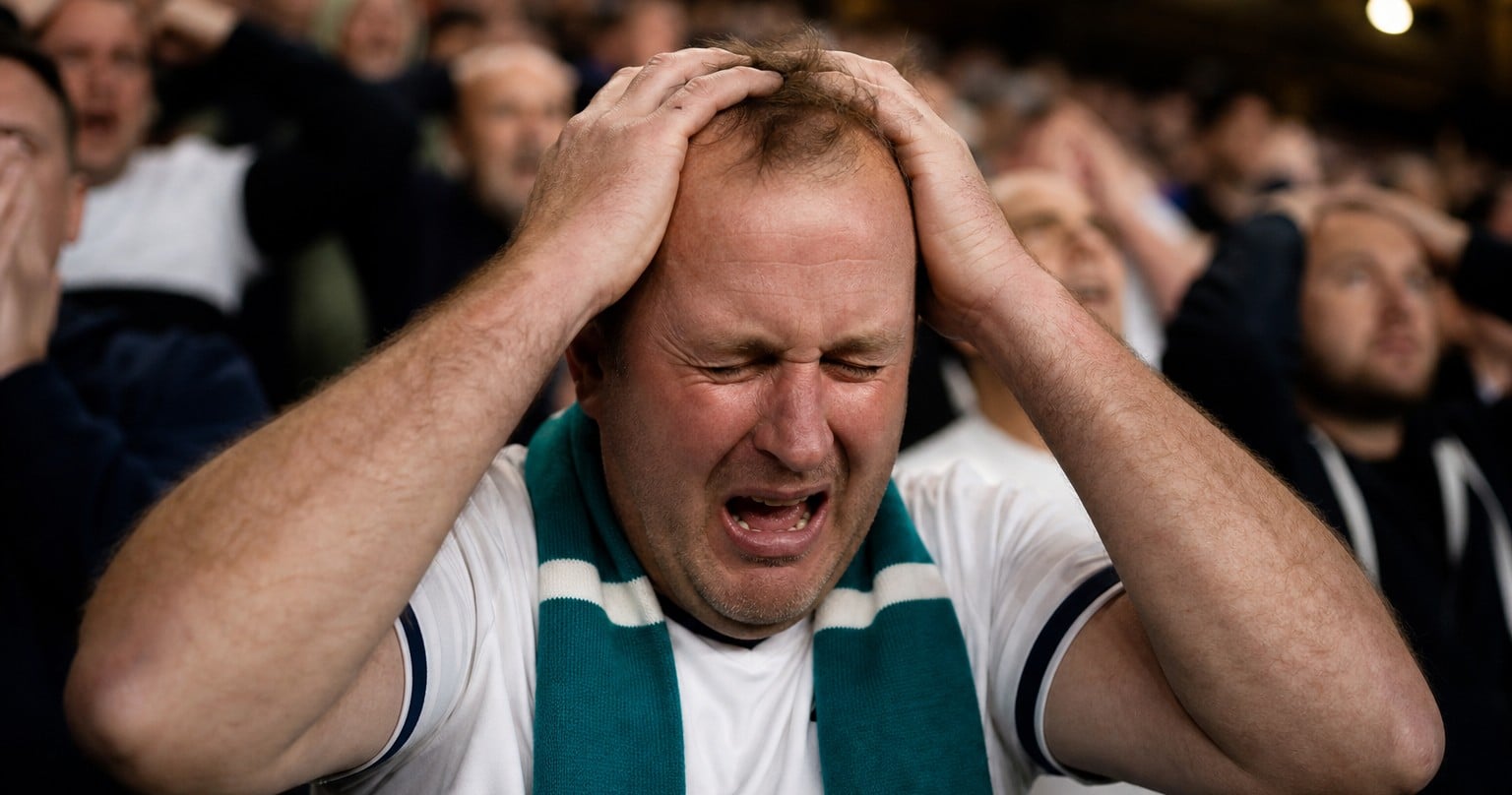
A World Cup is not for the faint-hearted. When a last-16 tie goes to a penalty shoot-out, the cortisol levels of millions of fans rocket to astronomical heights. And that is exactly where the danger to the hair lies: chronic or extremely acute emotional stress can trigger a phenomenon that doctors call telogen effluvium (diffuse hair loss).
Which sets of supporters are most at risk of leaving the 2026 World Cup with less hair than they arrived with?
Assessment by the Elithair editorial team based on Elithair studies into stress and hair health, along with the way past tournaments have unfolded.
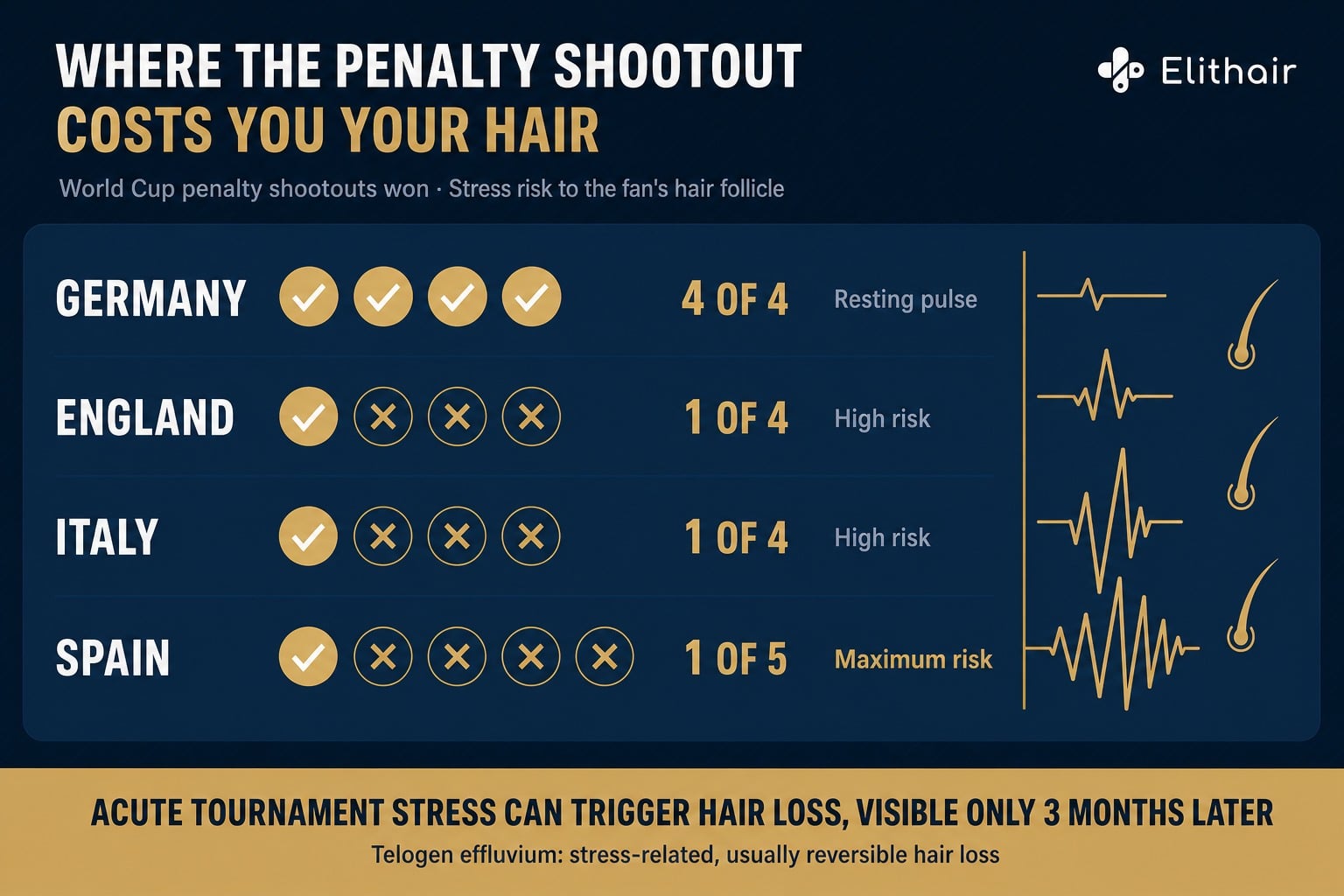
Just how real the English penalty trauma in particular is becomes clear from a sober look at the World Cup penalty shootouts won:
Extreme conditions for the scalp: how does the climate at the 2026 World Cup affect the players’ hair health?
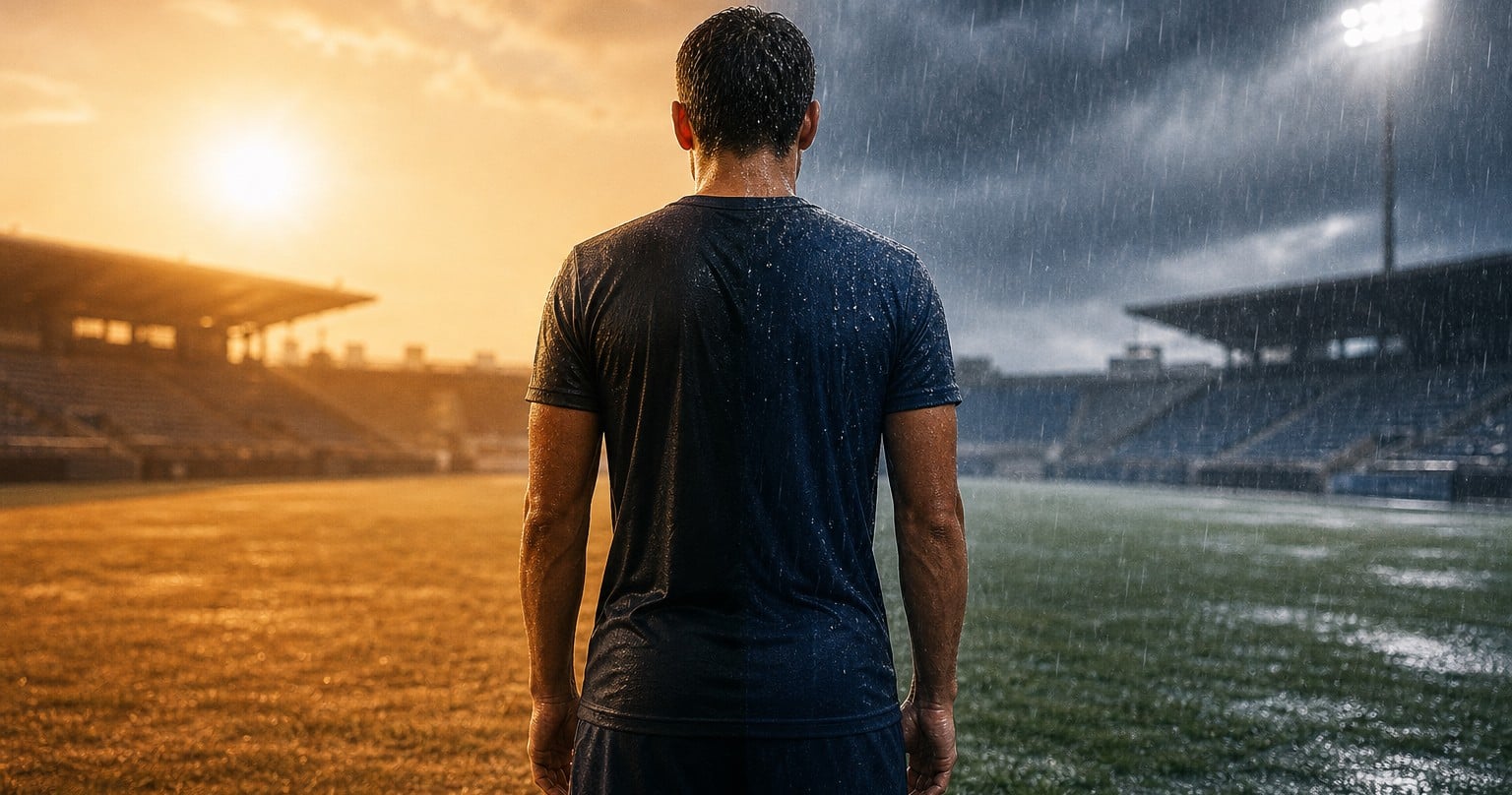
The 2026 World Cup is a logistical and climatic monster of a job. Within a matter of days, players have to switch between three completely different climate zones: from the extreme, humid heat of Monterrey in Mexico, to the dusty altitude air of Mexico City, all the way to the air-conditioned high-tech arenas or the changeable weather of Canada and the USA. This constant climate shock is a brutal assault on the athletes’ scalps and hair follicles.
Footballers with a hair transplant: who is open about it
Few professions are on camera as relentlessly as top footballers. Every receding hairline is broadcast in close-up, every thinning crown documented from a drone’s-eye view. So it is hardly a shock that hair and football overlap off the pitch too, and that some of the most famous names in the game went public about their hair transplants long ago.
Wayne Rooney got the ball rolling. England’s record goalscorer confirmed the procedure himself on Twitter in June 2011, aged 25 and at the peak of his career. His openness is still seen as a turning point: what had once been a taboo became, thanks to Rooney, a normal medical decision you were allowed to talk about. Italy’s star coach Antonio Conte, who played at World Cups and later managed Chelsea, Inter Milan and the Italian national side among others, has also openly confirmed his hair transplant.
The same goes for Croatian coach Slaven Bilić, former Arsenal defender Rob Holding and England winger Andros Townsend, who even documented his procedure in detail. In the case of Spanish World Cup winner David Silva, plenty of outlets reported on a treatment.
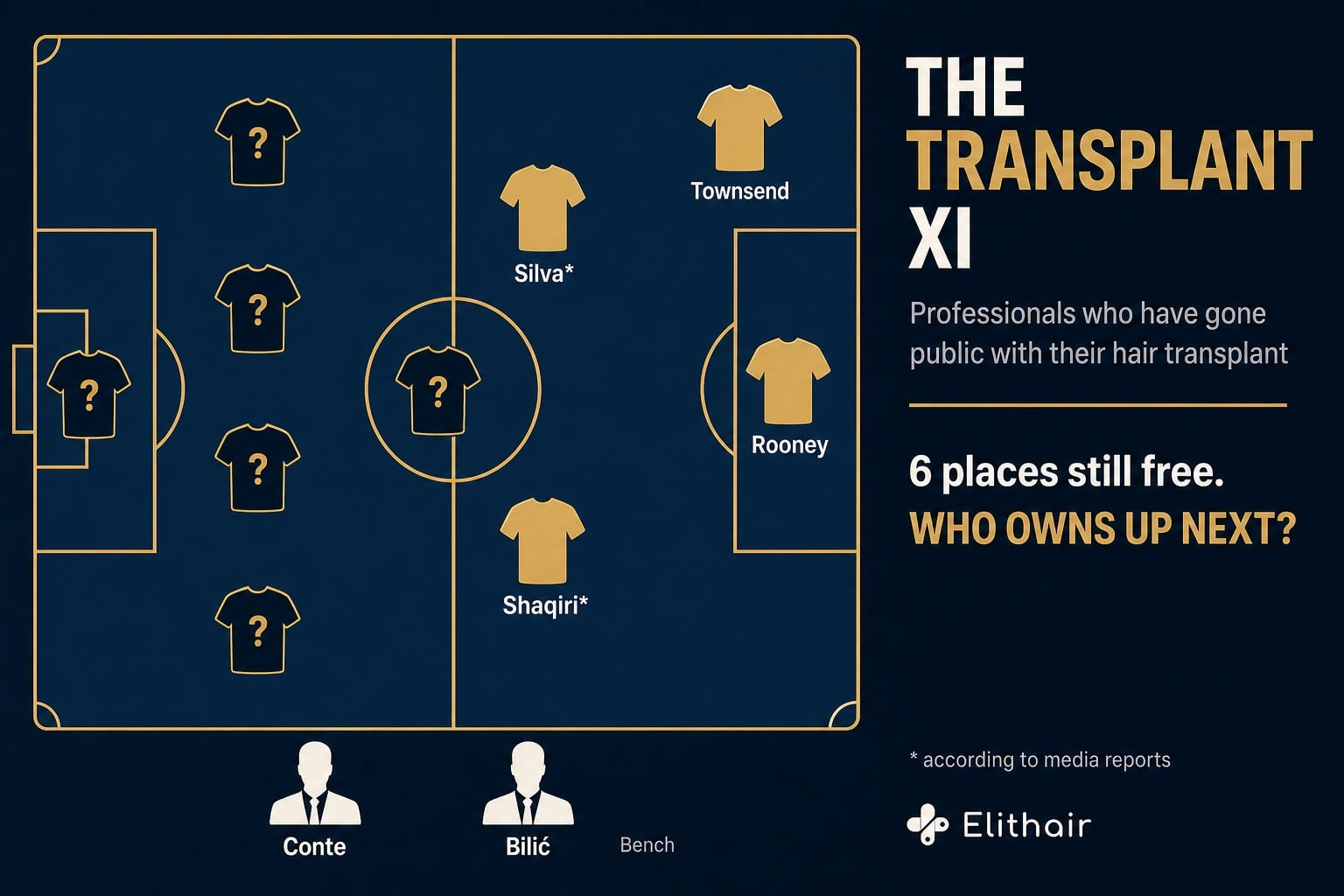
One thing stands out: the sheer number of English players on this list. In England the subject has been handled far more openly since Rooney’s tweet than in other football nations, although attitudes in German-speaking countries have noticeably normalised too. The fact that it is precisely professional athletes, whose bodies are their livelihood, who act early and openly follows a perfectly understandable logic: anyone who performs in front of millions every week notices the changes not only himself, but reads about them in the comments section soon enough.
Which haircut scores the most goals? The goalscorer analysis
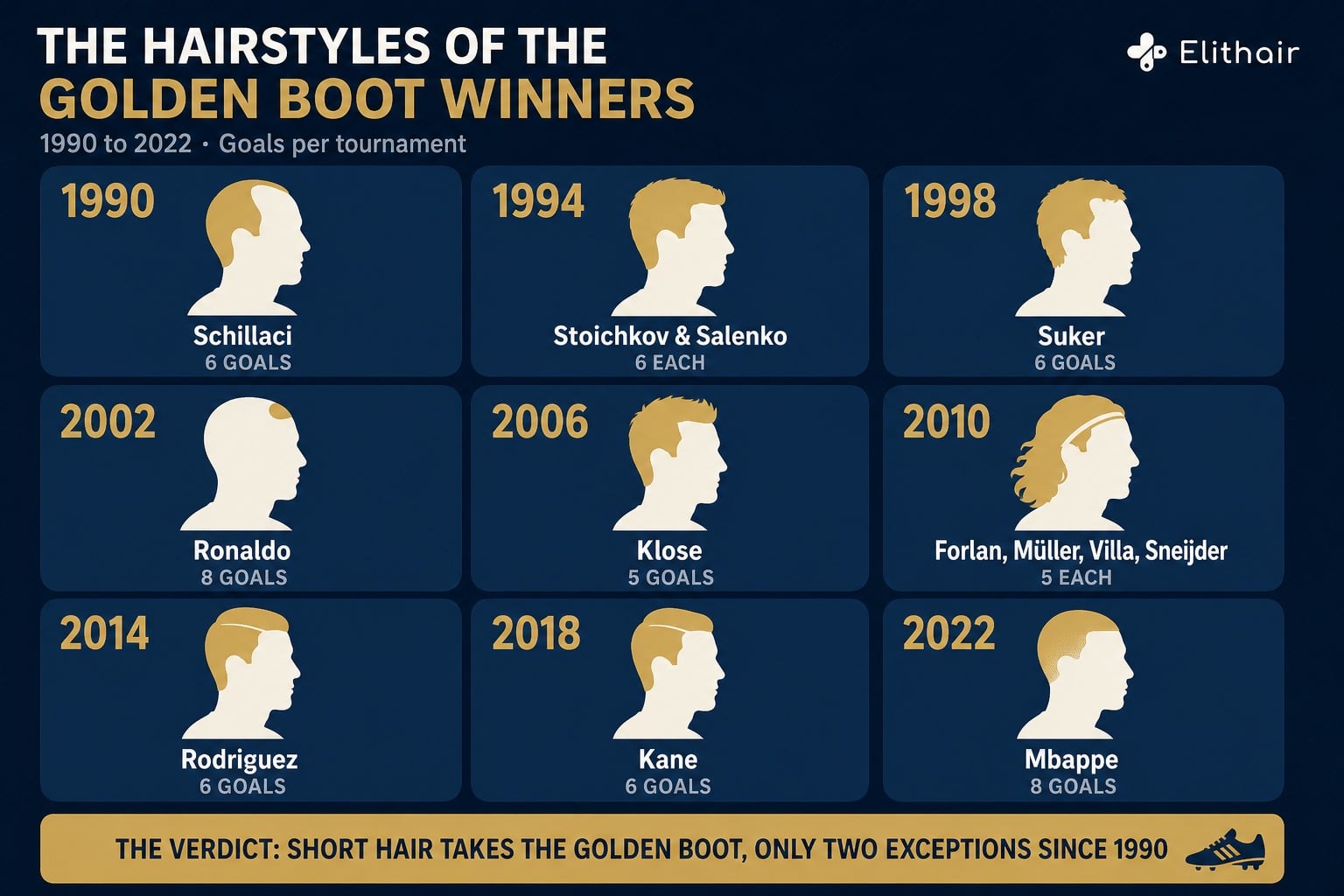
The central question of this report can be answered using the official World Cup goalscorer lists. Sort the leading scorers of recent tournaments by hairstyle and a strikingly clear pattern emerges.
For recent history the verdict is plain: since 1990 the unflashy short cut all but completely dominates the Golden Boot rankings. Only two exceptions break the run. Diego Forlán shared the title in 2010 with his blond mane flowing behind him, alongside three close-cropped colleagues, and Ronaldo won the 2002 award with what is probably the most talked-about haircut in World Cup history: the half-moon crescent above his forehead, which by his own account he shaved in to drag the press’s attention away from an injury and onto his head. The plan worked. Eight goals and the title followed.
Go further back, though, and the picture flips. In the mane era of the 70s and early 80s the top scorers wore their hair long themselves: Mario Kempes dragged Argentina to the title in 1978 with the flowing mane, and Paolo Rossi (1982) and Gary Lineker (1986) also scored most with medium-length hair. Only from 1990 did the pragmatic short cut take over, the one that rules the rankings to this day. The best goalscorer’s hairstyle, in other words, follows the great evolution from the first chapter exactly.
The all-time record backs up the case for successful pragmatism too: Miroslav Klose, the World Cup’s record scorer with 16 goals, wore the same no-nonsense short cut across four tournaments. If you want to score goals, the data suggests, you are clearly better off pouring your energy into the finish than into the styling.
And it is no one-off: across all 15 tournaments and 1,656 goals, clean-shaven players score most often (0.26 goals per head), ahead of stubble-wearers (0.20) and full beards (0.19). Of all things, the supposedly more masculine full beard is statistically the weakest goalscoring facial hair in World Cup history. A nice jab at the cliché, even if the beard boom of the more recent, more defensive tournaments lends a hand.
⚡ Live figure from the World Cup in progress (as of 12 June): the first bald-headed goal of 2026 has already gone in. That puts the goal efficiency of bald players at 16 times the average right now. Tiny sample size, big headline.
Mass beats magic: which hairstyle scores most efficiently?
That the short cut dominates the goalscoring charts has an unspectacular reason: there is simply the most of it. 86% of all World Cup players wear short hair, so logically the most goals fall into that group too. It only gets interesting when you look not at the total but at the goals per head. Then the picture flips completely.
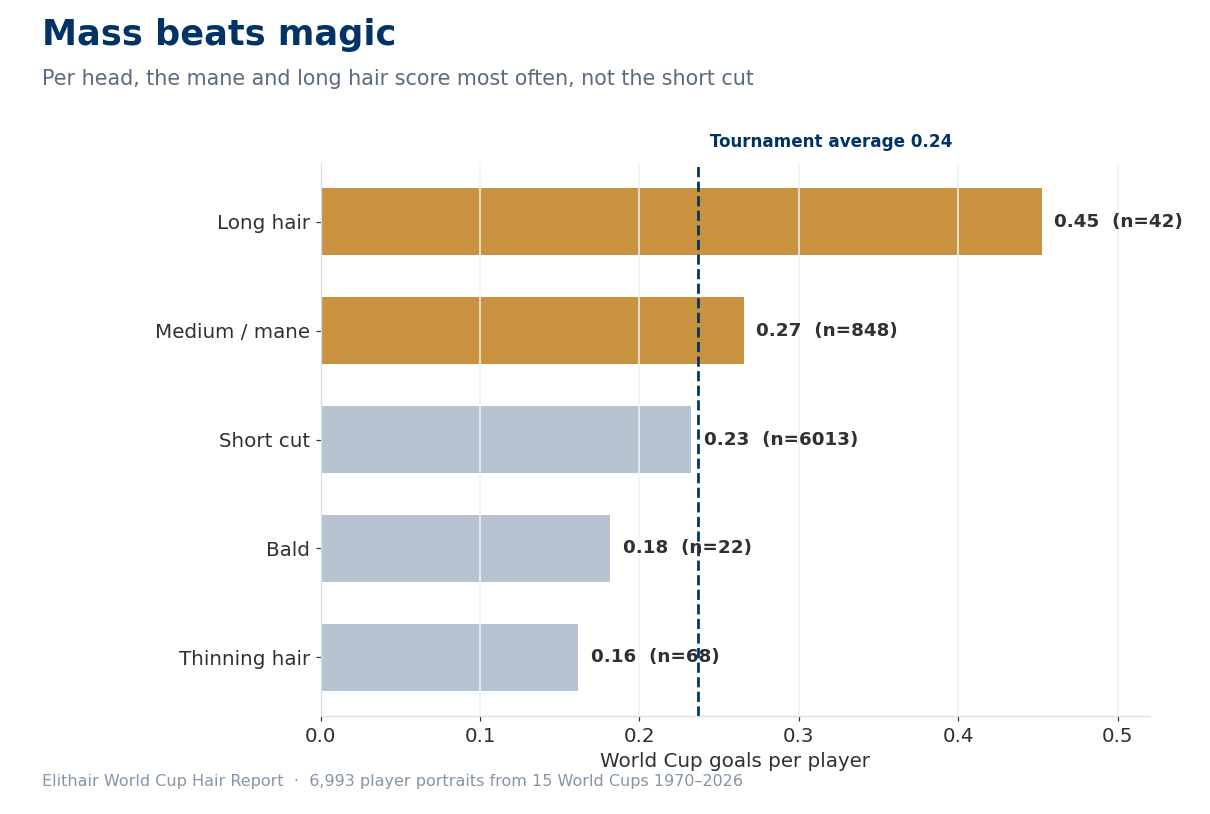
Across all 15 tournaments a player with a short cut scores 0.23 goals on average, just below the tournament average. Medium-length hair comes in at 0.27, long hair at as much as 0.45 goals per head, almost double. The mane is by no means the inefficient fashion cut it is so often written off as, but the tournament’s secret efficiency queen. From Mario Kempes through Carlos Valderrama and Diego Forlán to James Rodríguez and Erling Haaland: whoever scores most per head wears long hair more often than the average. The short cut wins through mass, not magic.
With the beard the finding is even clearer and clears up a favourite cliché. The supposedly more masculine full beard is the weakest goalscoring facial hair in World Cup history.
Bald head equals defensive rock? Hairstyles and positions
A second pattern shows up when you sort the hairstyle types by position. The most eye-catching haircuts in World Cup history belonged almost without exception to attacking players: Carlos Valderrama orchestrated Colombia’s midfield under a blond crown of curls, Roberto Baggio cast a spell in 1994 with the divine ponytail, and Paul Pogba changed hair colour faster than some teams changed their tactics in 2018.
At the other end of the scale you have goalkeepers and centre-backs. Fabien Barthez kept France to the title in 1998 with a clean-shaven head, while the man in front of him, Marcel Desailly, hoovered up everything that came into the box, bald as you like. Of course there is no scientific link between haircut and position to be drawn from this. On the contrary, the overall data thoroughly debunks the myth of the bald defensive rock: across all 6,993 players the short-hair share sits at 86 to 87 per cent in every position, from the keeper to the centre-forward. Only goalkeepers are a touch more often bald, simply because they are on average the oldest players on the pitch. So a simpler explanation is more plausible: attacking players are more firmly in the media spotlight, and endorsement deals and personal brands reward being instantly recognisable. In modern football the haircut is also a business model, and that one simply pays better up front.
One detail in the data is telling for a hair clinic in particular: the genuine bald look only appears anywhere in the statistics from the 2000s onwards, before that its share is zero. That does not mean earlier generations knew no hair loss. It means players have only worn the bald head with confidence for a good two decades, rather than laboriously hiding it. What Fabien Barthez and Zinédine Zidane led the way on is now the norm: anyone losing their hair makes a look of it instead of combing over. The visibility has changed, not the biology.
The corner-flag myth: which haircuts have whipped in the most corners?
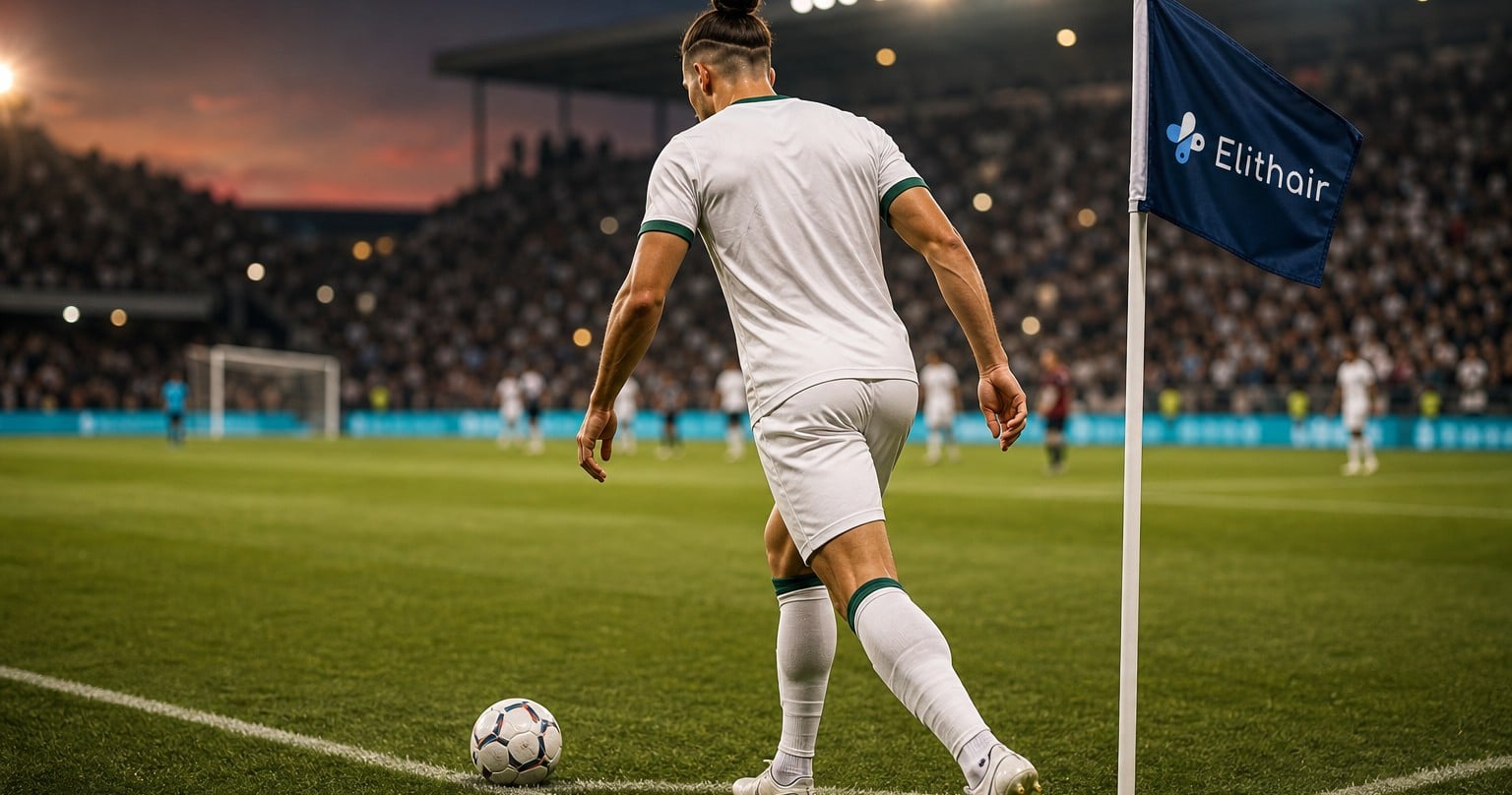
The set-piece specialist places the ball just so, takes his run-up and curls the leather into the box with mathematical precision. Taking corners and free-kicks is about centimetres, about absolute calm and a totally clear line of sight. Run the numbers on the best providers and you find that the kings of the corner overwhelmingly wear haircuts that keep the face completely clear.
Yellow and red cards: which haircut fouls most often?
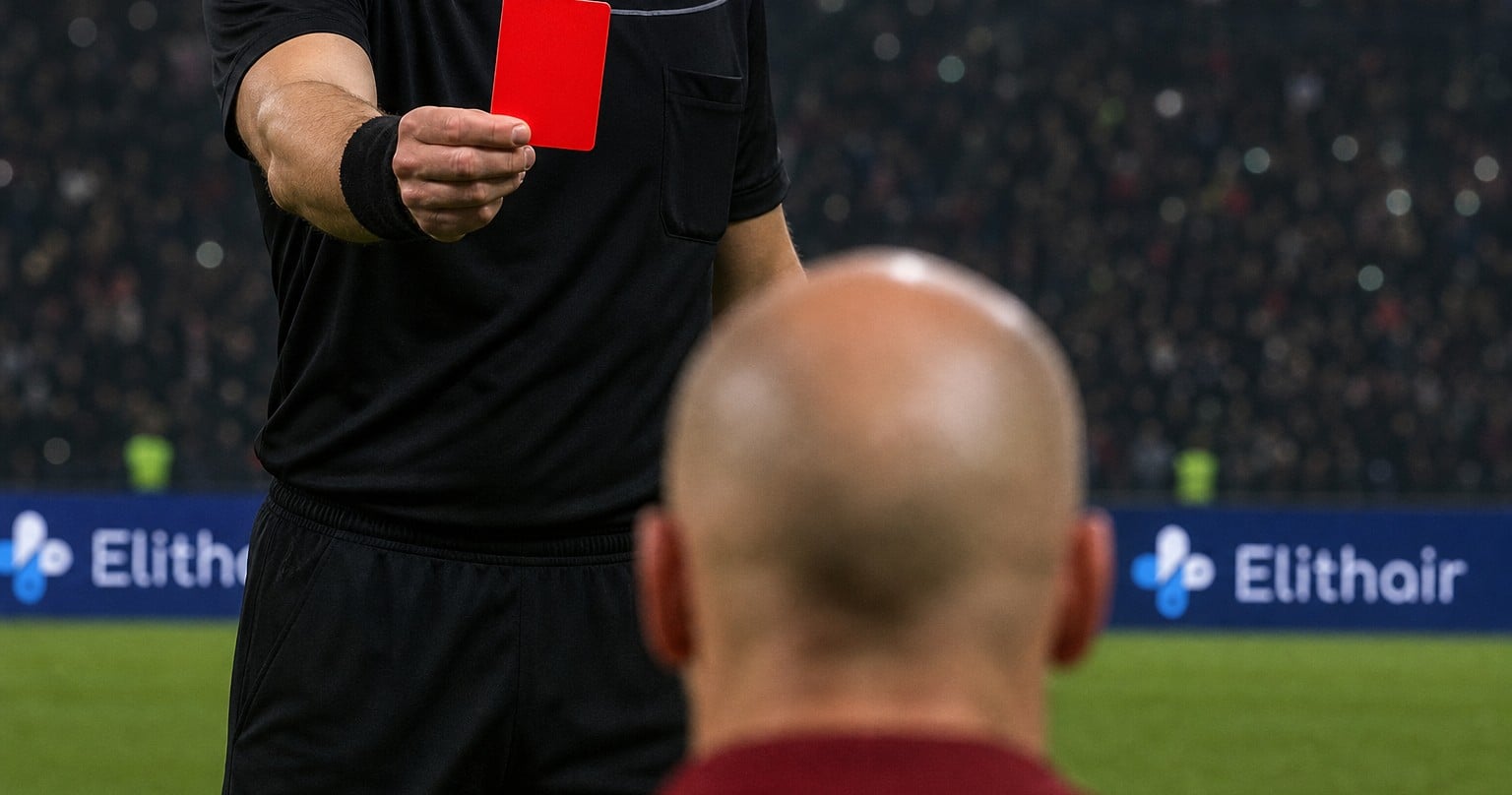
When it comes to sendings-off, one hairstyle leads the table unchallenged, and that is mostly down to a single man. Zinédine Zidane, one of the most elegant players of all time, was sent off twice at World Cups: in the 1998 group stage against Saudi Arabia and in the 2006 final against Italy, when his headbutt on Marco Materazzi became the most famous red card in football history. At the time, Zidane wore the most distinctive bald head in world football. The only other man to pull off the dubious feat of two World Cup sendings-off was Cameroon’s Rigobert Song (1994 and 1998), a player known for his ever-changing, often dyed and braided hairstyles.
The so-called Battle of Nuremberg in 2006 between Portugal and the Netherlands still holds the record for the most ill-tempered World Cup match, with 16 yellows and 4 reds, while the 2022 quarter-final between the Netherlands and Argentina set the booking record for a single game with 18 cautions. So a haircut neither protects you from a sending-off nor goads you into one. The only thing worth pinning down is a curiosity: the only two players ever sent off twice at a World Cup could hardly have been more different in the hair department.
Headed goals: does a bald head help with the header?
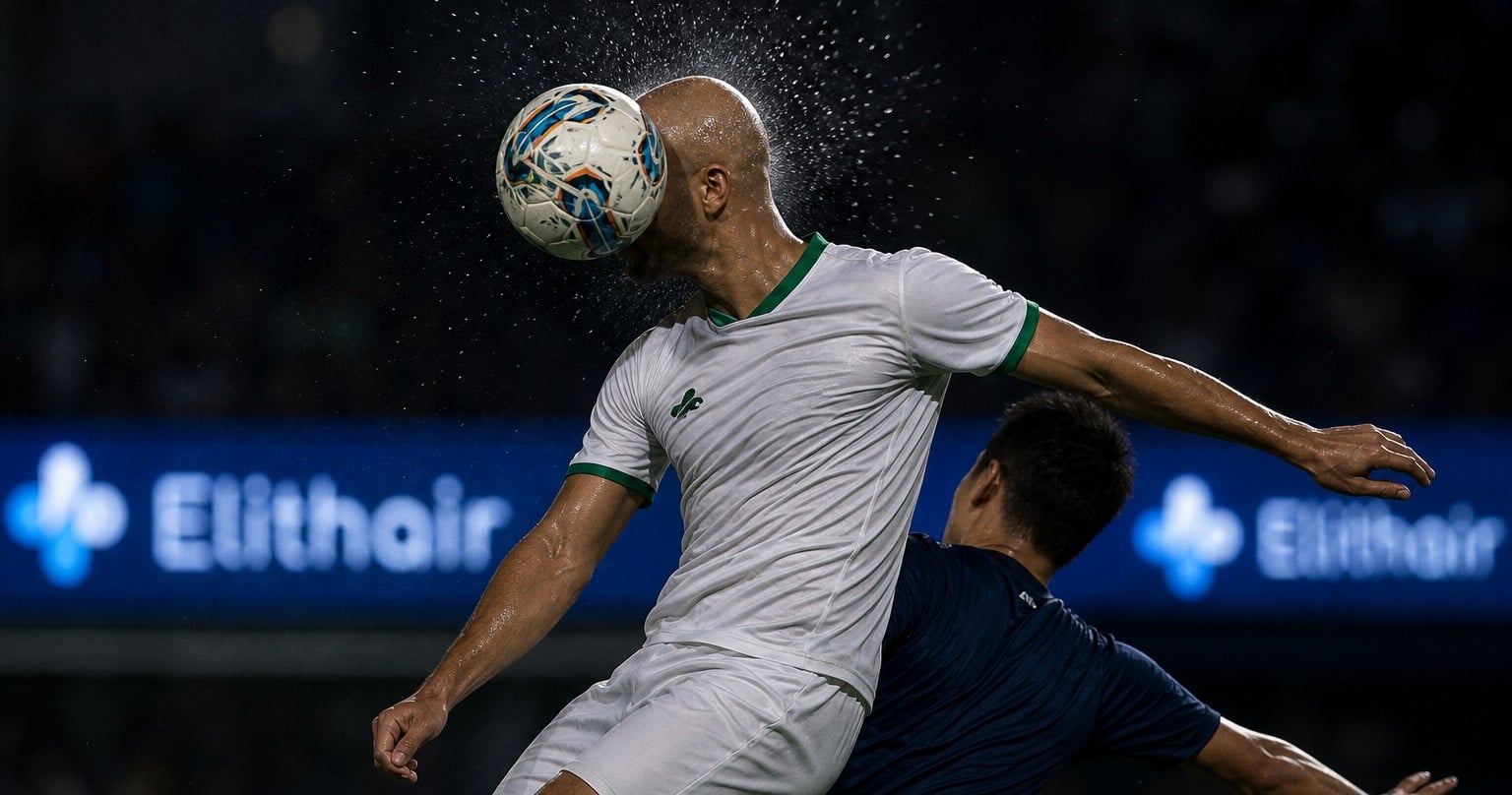
Hardly any part of the game links hair and football as directly as the aerial battle. The question writes itself: do players with less hair head the ball better? The anecdotes are tempting. Yordan Letchkov, whose bald patch ranks among the most recognisable in football history, knocked Germany out of the 1994 tournament with a diving header. Zinédine Zidane headed France to their first world title in 1998 with two almost identical headed goals in the final.
But the numbers strip the myth bare. The most successful header of the ball in World Cup history wore a full head of hair: Miroslav Klose scored five headed goals at the 2002 World Cup alone, every one of his tournament goals that year. Mats Hummels also headed Germany into the 2014 semi-final with a full mane. From a sports-medicine angle that is no great surprise: what really matters for a good header is timing, spring and neck muscles. There is no scientific proof of any measurable aerodynamic edge for a bald head, even if Letchkov fans are likely to see it differently to this day.
Do headers actually cause hair loss? The fact check
This is where the report sees off a stubborn myth. The idea that thousands of headers over the course of a career damage the hair roots clings on with remarkable persistence, but it has no medical basis. In more than 90% of cases, male hair loss comes down to androgenetic alopecia. For genetic reasons, the hair follicles are sensitive to the hormone dihydrotestosterone (DHT) and shrink over the years. It has nothing to do with the mechanical strain of headers, sweat under a headband or tight training caps.
The reason footballers in particular so often stand out with thinning hair is simpler than that: they are in the spotlight at exactly the age when hereditary hair loss typically begins. A receding hairline and a thinning crown can start to show from the early twenties, and by the age of 50 roughly half of all men are affected. So football does not cause the hair loss, it just makes it more visible than any other job does.
The most iconic World Cup hairstyles in history
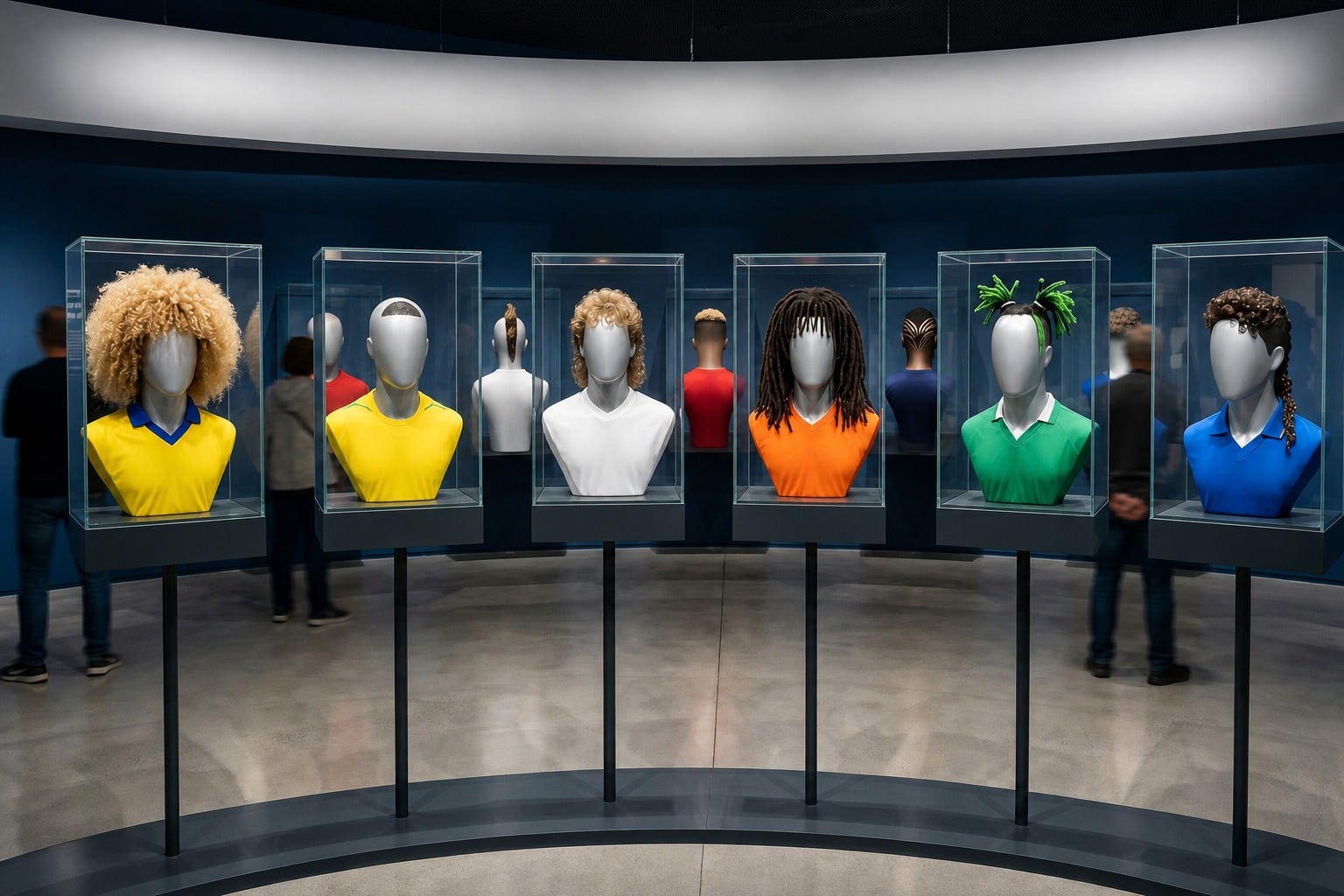
No hair report would be complete without a hall of fame. These hairstyles defined World Cups, regardless of goals and titles, and show just how tightly hair and football are bound together as pop culture.
- Carlos Valderrama (Colombia, 1990 to 1998): the blond crown of curls, still perhaps the most famous hairstyle in football history. Three World Cups, zero compromises.
- Rudi Völler (Germany, 1990): the curly mullet became Germany’s national haircut in their title-winning year and still carries its owner’s nickname to this day. In Germany the mullet era was known simply as Tante Käthe (“Auntie Käthe”).
- Ruud Gullit (Netherlands, 1990): dreadlocks in professional football long before individual hairstyles were taken for granted. He set the style for an entire generation.
- Roberto Baggio (Italy, 1994): the divine ponytail. The fact that it was his missed penalty that settled the final made the ponytail immortal once and for all.
- Taribo West (Nigeria, 1998): green-dyed braids tied up in the national colours. Still the benchmark for tournament commitment.
- Ronaldo (Brazil, 2002): the half-moon haircut. By his own account a deliberate distraction tactic, backed up on the pitch by eight goals and the title.
- David Beckham (England, 1998 to 2006): from the centre parting through the mohican to the ponytail. Nobody has ever used the haircut as a media strategy more consistently.
- Paul Pogba (France, 2018): new colours and patterns week in, week out, and a world title at the end of it. The haircut as part of the personal brand, perfected.
Coaches and receding hairlines: stress on the touchline
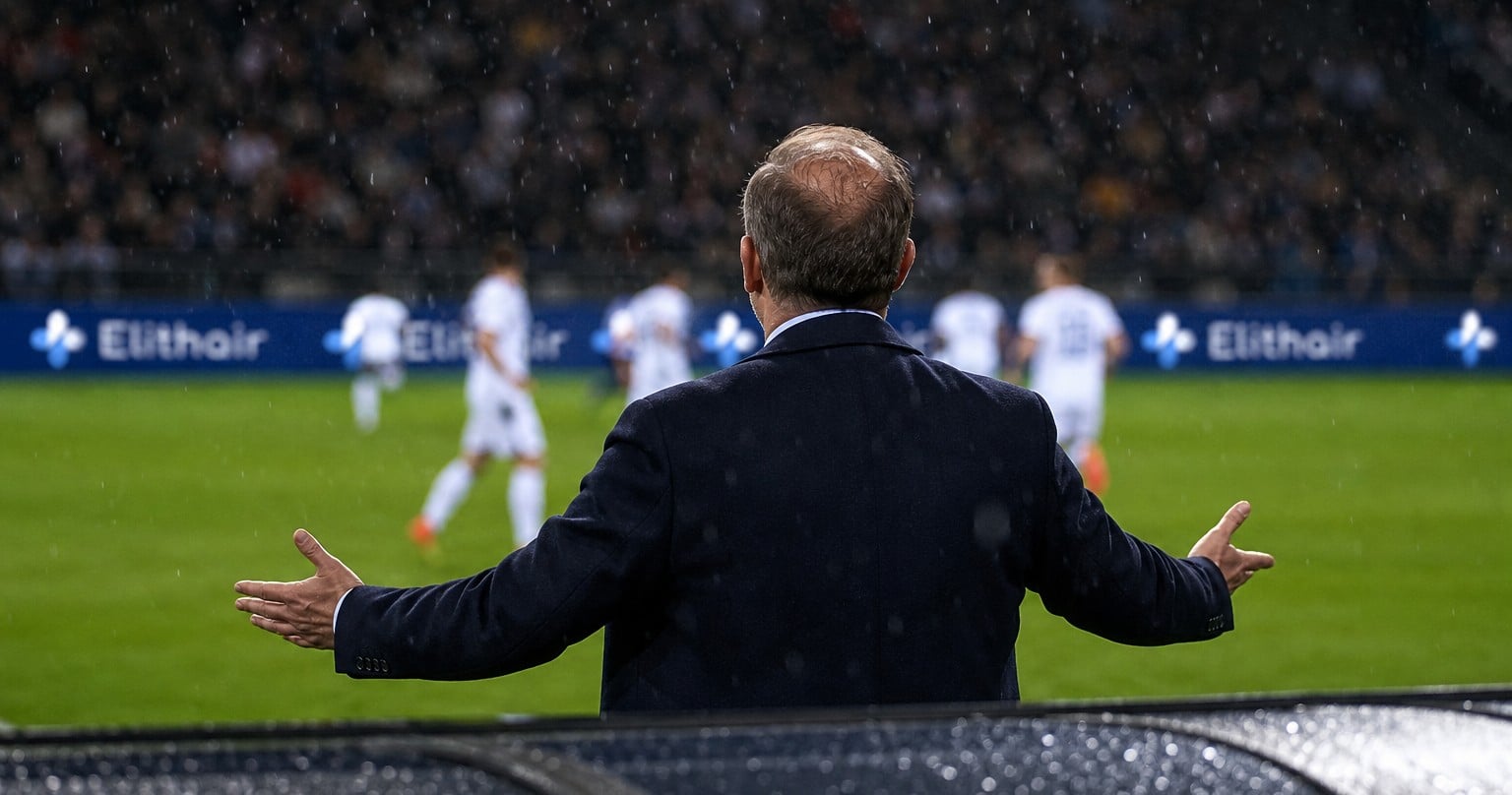
A glance at the dugouts of the 2026 World Cup shows a familiar picture: Didier Deschamps leads France into the tournament with a receding hairline, Carlo Ancelotti takes on what is probably the most prestigious job in world football with Brazil, and plenty of his colleagues have seen their foreheads gain ground over the years too. Is it the stress?
The honest answer: only up to a point. Chronic stress can indeed trigger hair loss, the so-called telogen effluvium, where an above-average number of hairs switch into the resting phase at the same time. But this stress-related shedding is usually diffuse and reversible. The classic receding hairline and the thinning crown of the coaching generation, on the other hand, are down to androgenetic alopecia and would have happened anyway, relegation scraps and penalty shoot-outs or not.
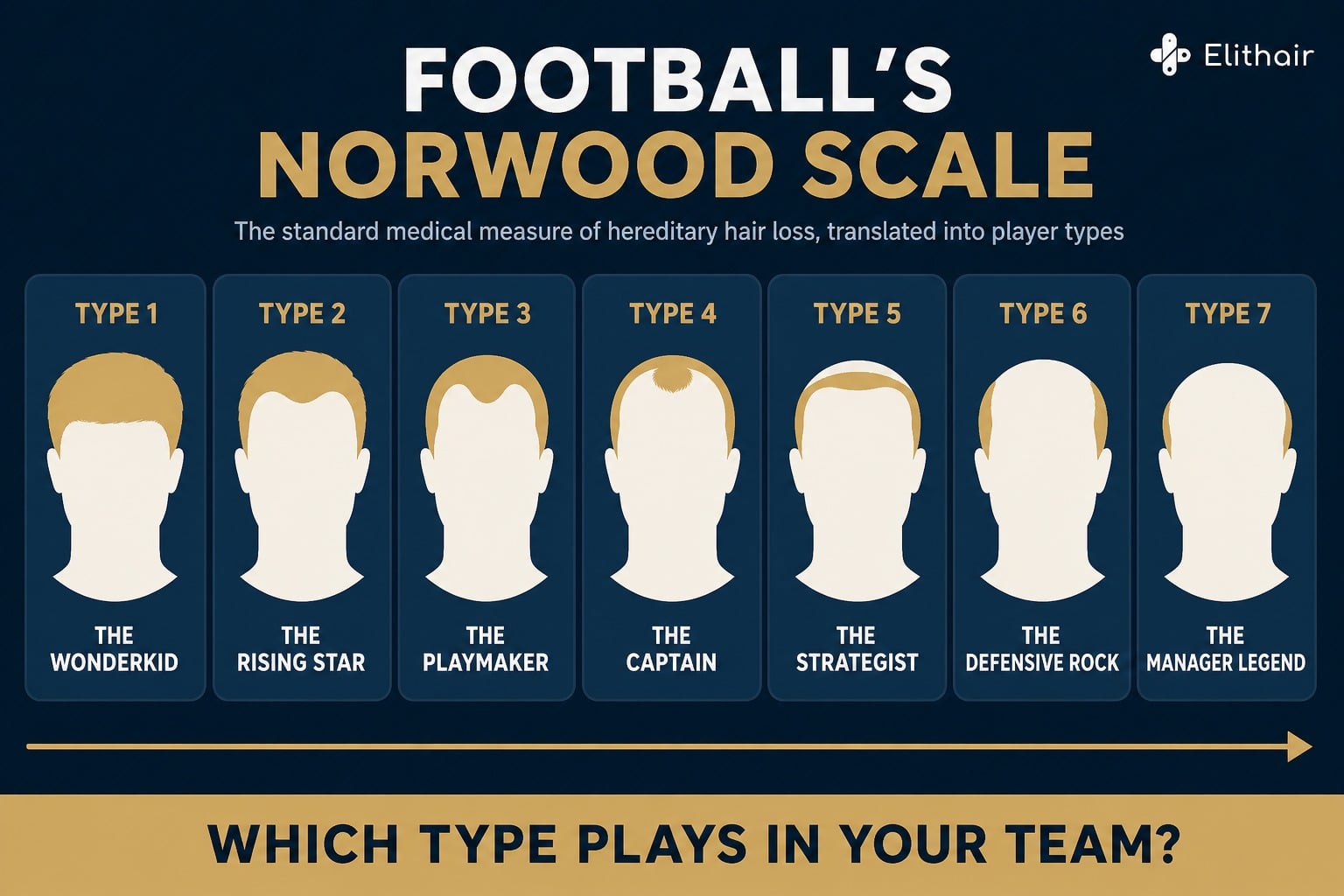
The coaching job, at most, speeds up how soon it becomes visible: gesticulate in close-up for 90 minutes and you cannot hide a thing. Antonio Conte, as everyone knows, drew his own conclusions from that visibility and never hid his hair transplant.
The tactics check: more hair-raising facts from the World Cup archive
To round off Elithair’s 2026 World Cup Hair Report, let’s take a look at the most curious and important milestones in footballing hair management:
- The “barber invasion” factor: big nations like France, England and Brazil fly their personal star barbers into the World Cup base by private jet. The reason is the so-called “fresh-cut effect”. When the hairline sits millimetre-perfect, the player’s confidence in the tunnel before kick-off noticeably goes up, or so the pros themselves say.
- The cushioning advantage of curls: with a wink and a pinch of physics: players with a thick head of curls (Marouane Fellaini in his day) have a slight edge in the defensive aerial duel. The dense, springy curls act like a natural shock absorber and soak up the impact of the hard leather ball.
Why footballers in particular act early
There is a second reason, beyond the relentless media attention, why pro footballers are so unusually open about hair transplants: timing. Left untreated, hereditary hair loss only progresses, and the sooner the starting point is documented and assessed, the better you can plan.
From elite sport, pros are used to tackling physical matters early, with data and with specialists, rather than letting them slide. On top of that there is the career calendar: many players deliberately schedule the procedure for the summer break, because a hair transplant comes with an initial period of taking it easy. Light training is possible again after about two weeks, while contact sport and headers have to wait for medical clearance a few weeks after that.
A summer World Cup, incidentally, shifts that planning measurably: tournament years are traditionally weak summers in professional football for any kind of scheduled procedure, from dental work to a hair transplant.
2026 World Cup: the haircuts to keep an eye on
On the pitch, too, the North American tournament promises plenty in the hair department. Erling Haaland leads Norway to their first World Cup since 1998, complete with the most distinctive long blond hairstyle in world football, which he wears loose or tied back depending on the match.
Kylian Mbappé arrives as the reigning Golden Boot winner with his trusty short cut, exactly in keeping with the winning formula documented above.
With Germany, it is worth watching the young generation around Jamal Musiala and Florian Wirtz, whose haircuts so far are as understated as their football is elegant.
And if an underdog ends up defining the tournament, one thing is certain: come Monday, his haircut will be the order of the day in every barbershop from Flensburg to Vienna. The Valderrama effect has worked reliably since 1990, and it shows better than any statistic just how much hair and football belong together.
Averaged over all 15 tournaments, the full beard is firmly in the hands of the Middle East and North Africa: Iran (36%), Saudi Arabia (28%), Tunisia (21%) and Morocco (19%) top the all-time beard table. The most mane over the decades, by contrast, was worn by a completely different country: Scotland, with 26% medium-length hair all-time, ahead of (West) Germany at 22%.
The final verdict: who will be the 2026 hair world champion?

Add up the data, the biological factors and the psychological dynamics of the modern game, and it quickly becomes clear: top-level football today is decided in no small part in the head. And what gets worn on top of that head plays a leading role. A vital, dense head of hair is long past being a mere vanity badge. It is a measurable factor in a professional athlete’s wellbeing and self-belief.
Whether it’s a storm-tested buzzcut, a perfectly fixed man bun or a hairline won back through a professional hair transplant: the players at the 2026 World Cup will do whatever it takes to make a statement, on the pitch and off it.
And so to the question in the headline. After almost 7,000 classified player hairstyles from 15 tournaments, we allow ourselves a tongue-in-cheek awards ceremony:
So the 2026 hair world champion will, in all likelihood, be a man with an unremarkable short cut. The data leaves room for little else. Unless, that is, the mane strikes back.
Frequently asked questions about hair and football

Dr. Imad Moustafa
Hair transplant specialist