

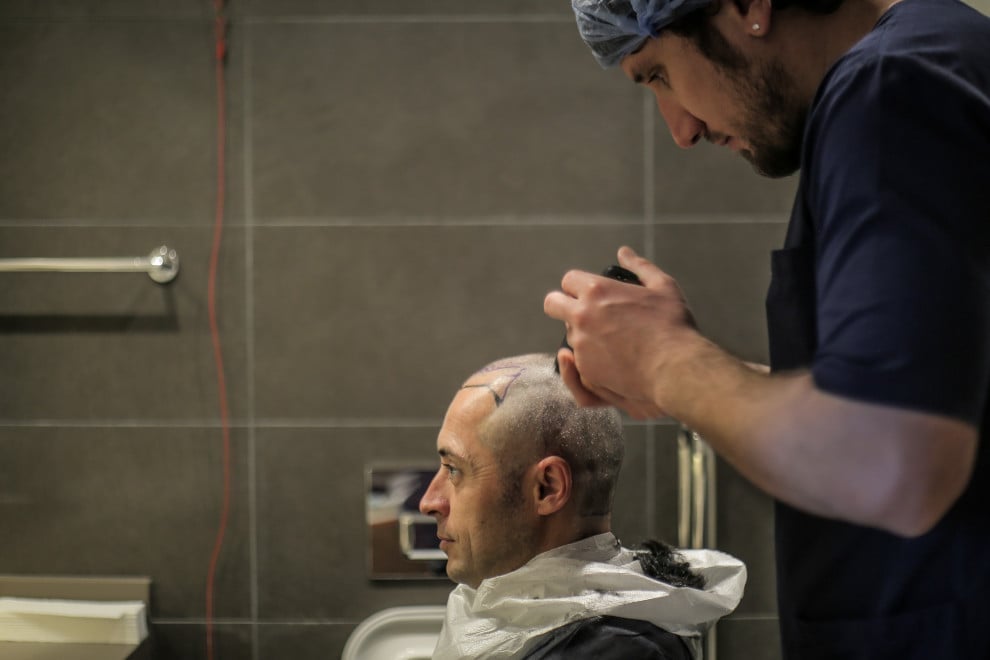
A hair transplant without shaving is what almost every patient wants when the thought of the classic buzz cut puts them off. The good news: it can be done. How far it can go depends a great deal on whether you are a woman or a man, how many grafts you need and which method suits your particular hair loss. This article explains honestly what is possible, where the limits lie and why the right technique decides the result.
Summary
- Is a hair transplant completely without shaving actually possible?
- Why is the head normally shaved for a hair transplant?
- The crucial difference: women and men
- The methods compared head to head
- How many grafts are possible without shaving?
- Healing and getting back to normal life
- Why Elithair has mastered the unshaved hair transplant
- What does a hair transplant without shaving cost?
- Conclusion: who is a hair transplant without shaving worth it for?
- Frequently asked questions about hair transplants without shaving
- Sources
Is a hair transplant completely without shaving actually possible?
Yes, a hair transplant without shaving is possible. Whether it is right for you comes down to four factors: the method chosen, your sex, your pattern of hair loss and the number of grafts you need. For women, the Zero Shave FUE offers a method that needs no shaving at all. For men, a discreet partial shave is usually the better route.
In practice the phrase “without shaving” does not always mean the same thing. Sometimes only the recipient area stays unshaved, sometimes only the donor area, and in rare cases both. This is exactly where marketing parts ways with medicine. Anyone who promises you that every hair transplant runs completely shave-free with 4,000 grafts is overselling it. At Elithair we tell you instead exactly which route suits your case, and why.
A quick orientation first. Women benefit from their long covering hair and a donor area at the back of the head that is often still dense. Here, an unshaved treatment is the norm. Men, above all, want the procedure to stay invisible. That can be solved beautifully with a hidden partial shave, without any cost to the medical result. You can have both routes at Elithair, advised by a team that has carried out more than 150,000 treatments.
Why is the head normally shaved for a hair transplant?
Shaving is not some tiresome habit of surgeons. It is a genuine quality tool. During a FUE hair transplant, the surgeon extracts individual grafts with a hollow needle just 0.7 to 0.9 millimetres in diameter. To see the exact exit angle of each hair follicle, short hair helps enormously. On a shaved surface only a few millimetres long, the trained eye spots at once which way the root is running.
This has a direct bearing on the transection rate, meaning the proportion of follicles damaged during extraction. A damaged follicle grows poorly or not at all. The professional body ISHRS sets a benchmark of under ten per cent as a good target. In the published case series on unshaved FUE by Park and colleagues, the transection rate came in at 8.2 per cent and 9.2 per cent respectively, well within the normal, acceptable range and below the ISHRS benchmark. Unshaved is therefore achievable, but it demands more experience and care from the surgeon.
There are further reasons too. A shaved surface is easier to keep clean, which improves hygiene. The surgeon works faster, because there is no need to hold every long hair aside one by one. And it is precisely that speed that counts. The shorter the time grafts spend outside the body, the better. A study by Ahmad and Mohmand also showed that the transection rate rises with the surgeon’s workload: fatigue and time pressure cost quality. A well-drilled team that works briskly and with full concentration therefore matters more than any advertising promise.
In short: shaving serves the result. Leaving it out is not an end in itself. It is a decision you should only make where it does not put the outcome at risk.
The crucial difference: women and men
Whether a hair transplant without shaving makes sense is decided above all by the anatomy of the hair loss. And that looks fundamentally different in women and in men.
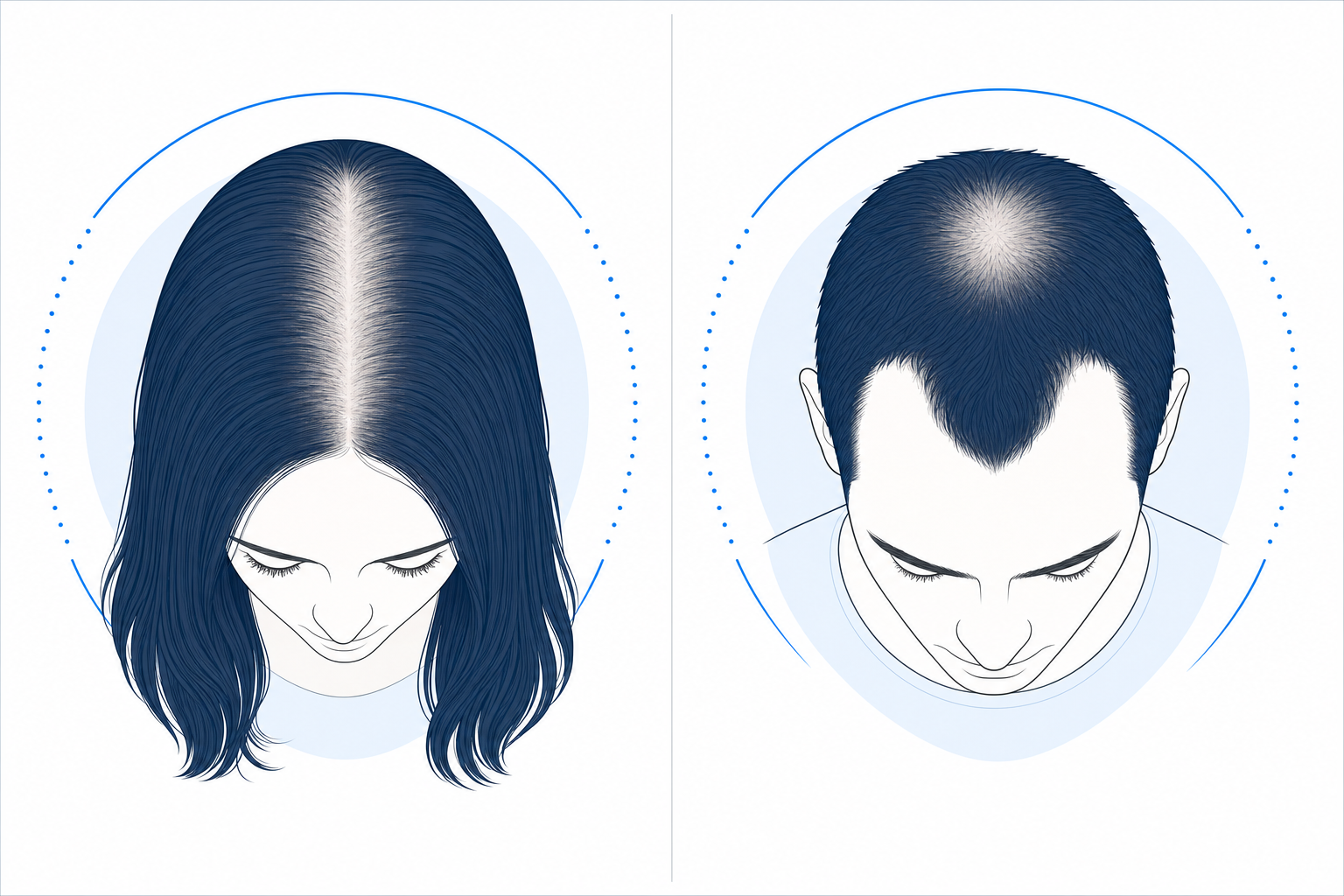
Women usually lose their hair diffusely. It thins along the central parting, while the front hairline is generally preserved. These patterns are described using the Ludwig or Sinclair scale. As Herskovitz and Tosti note in their review of female hair loss, the donor area at the back of the head often stays dense in women. That is exactly the key. Add to that the long covering hair, which conceals an unshaved recipient area in a completely natural way. So the conditions are ideal for a treatment with no shaving at all.
Men, by contrast, lose hair in the typical Norwood pattern: first the receding temples, then the crown, the so-called tonsure. These zones are exposed and are not covered by long hair. Anyone wanting to add density across a wide area here often needs several thousand grafts. A completely unshaved treatment then quickly reaches its limits. For men, the answer is rarely “no shaving at all” and far more often “a clever, hidden partial shave”.
Zero Shave FUE: the no-shave solution for women
The Zero Shave FUE is the only method in the world in which neither the donor nor the recipient area is shaved. It was developed by Dr Abdulaziz Balwi in our own research and development laboratory, exclusively at Elithair and specifically for women. It is tailored precisely to the female hair pattern: the long covering hair conceals the recipient area naturally, and the dense donor area at the back of the head allows extraction without any visible shaving.
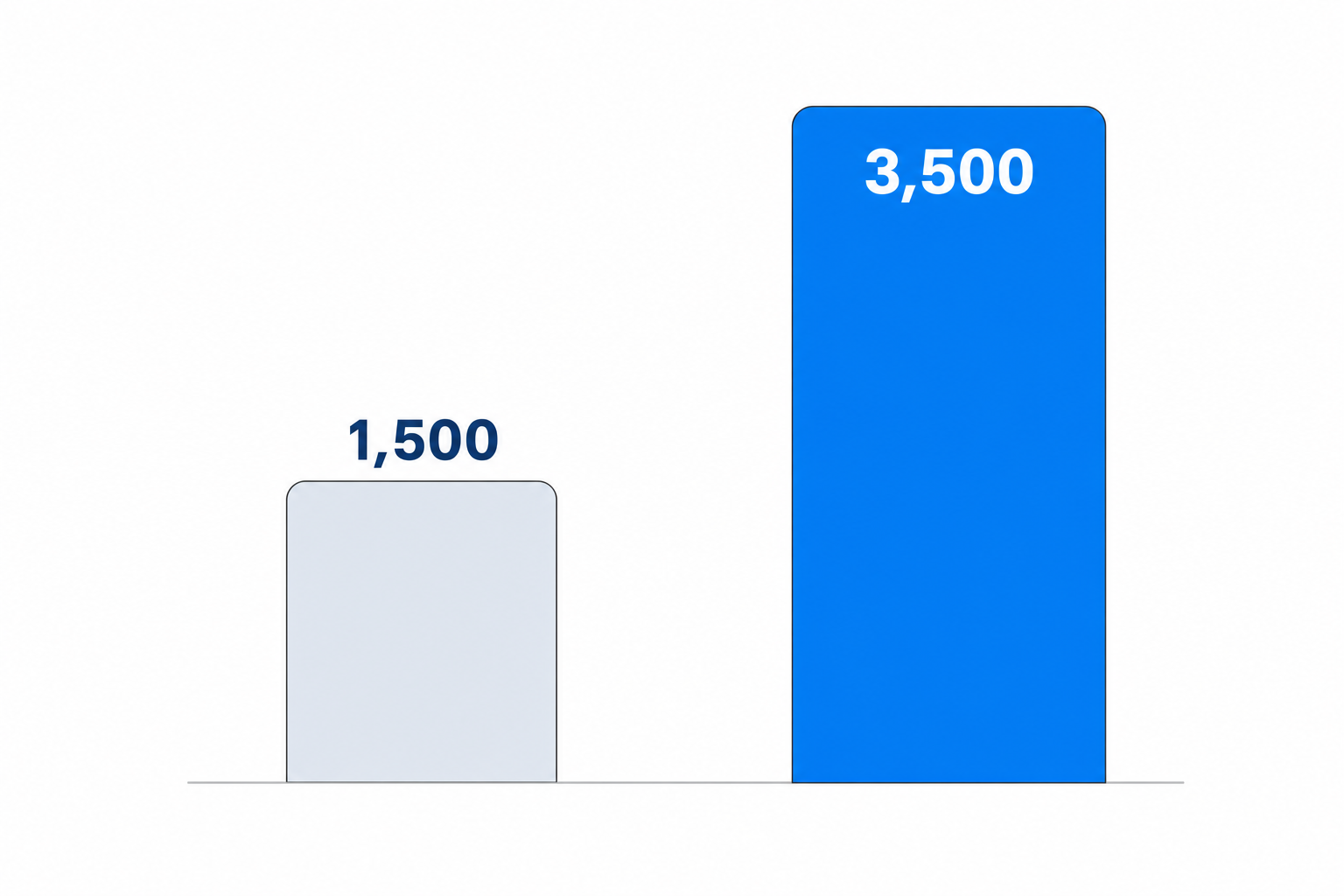
The biggest difference from other unshaved procedures lies in the volume. While classic Long Hair FUE usually tops out at around 1,500 grafts, the Zero Shave FUE makes up to 3,500 grafts possible in a single procedure. That is enough for genuine density across the central parting, not just a small cosmetic touch-up. The treatment is carried out under Sleep-Deep, a gentle sedation with which you feel zero per cent pain. The procedure takes six to eight hours, and your stay in Istanbul is only two to three days.
The prerequisite is a sufficiently dense donor area at the back of the head. The method is particularly well suited to hormonally driven hair loss and the typical thinning around the central parting. The first new hairs appear after three to four months, and the final result is in place after twelve to eighteen months. You can find out more about treatment specifically for women on our page about hair transplants for women.
Discreet partial shave: the best route for men
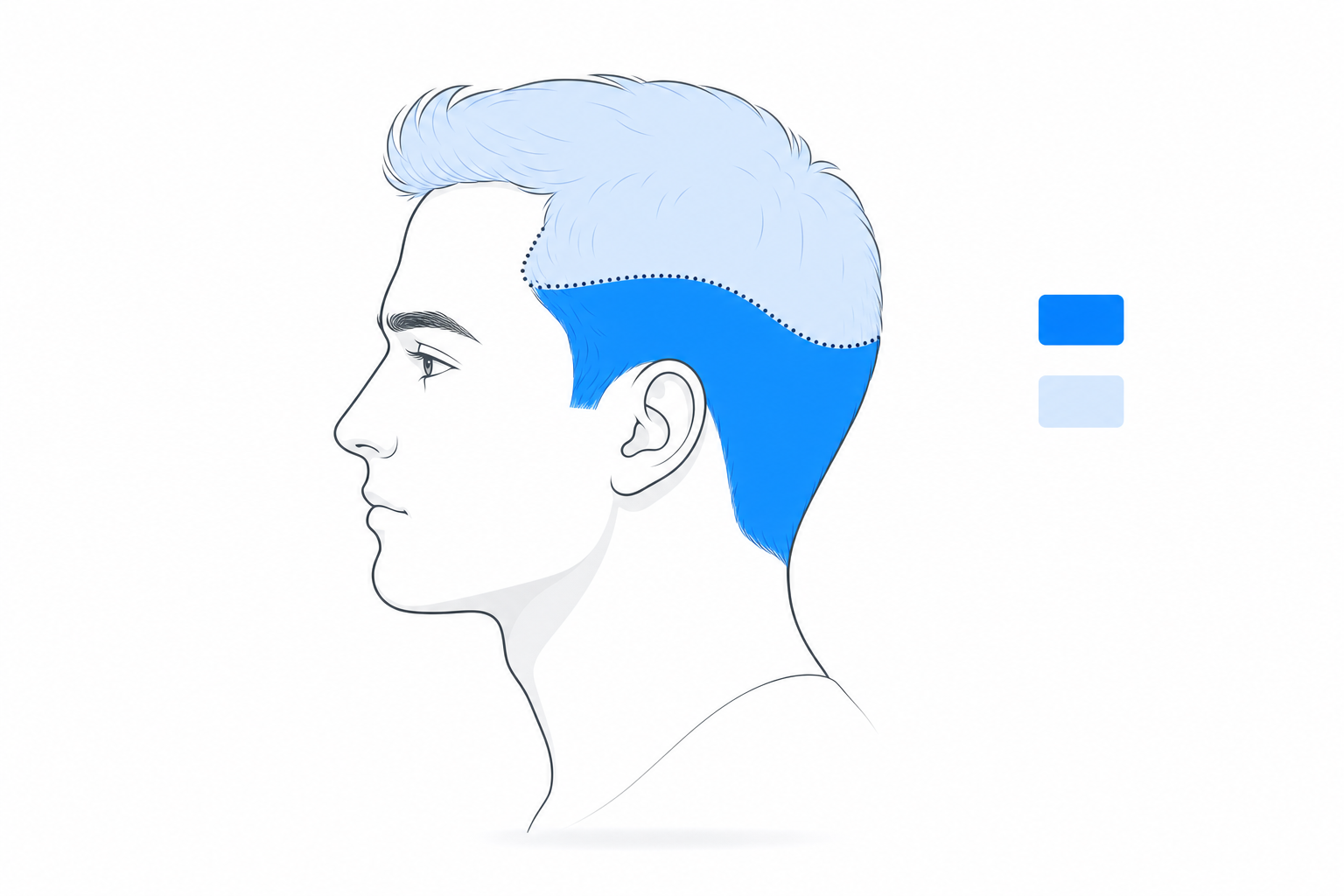
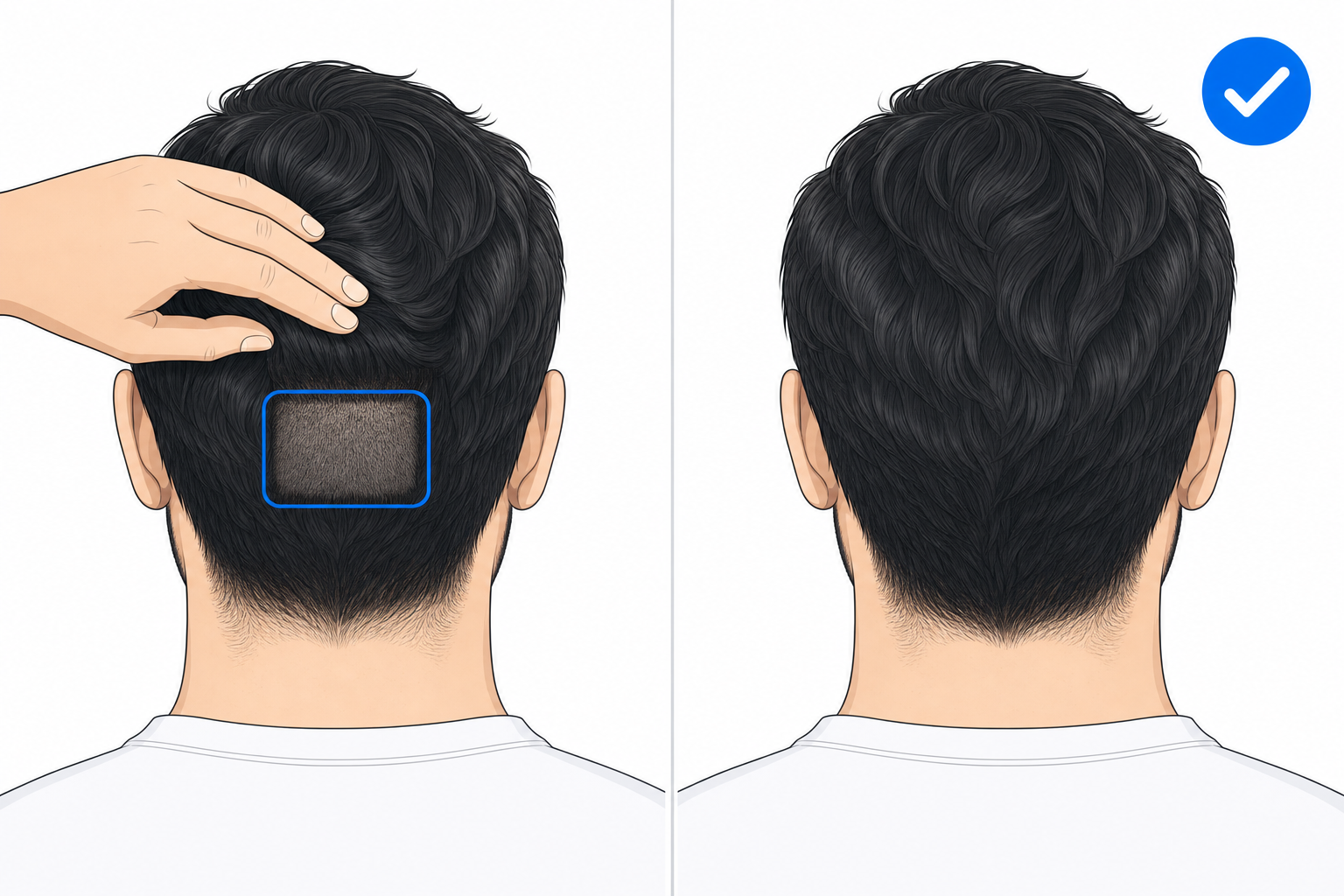
Most men are not, in truth, afraid of the shaving itself. They are afraid of what colleagues and acquaintances will see. They want no one to notice that they have had treatment. This is exactly where the discreet partial shave comes in. The surgeon trims only a small area or a narrow strip within the donor area at the back of the head. The longer covering hair above falls down and conceals the short patch completely. From the outside, nothing is visible.
For smaller corrections, a largely unshaved route is even sensibly feasible: mildly receding temples, a soft thickening at the hairline, in the order of a few hundred grafts. But as soon as large areas need to be densified and several thousand grafts are required, a full shave holds the medical advantage. It gives the surgeon a better field of view, keeps the transection rate low, shortens the operating time and with it the ischaemia time of the grafts. That feeds directly into the survival rate.
So do not see shaving as a drawback, but as a mark of quality. For a man with extensive hair loss, a full shave is often the route to the densest, most natural end result. What grows back within a few weeks more than makes up for the short phase with a shaved head. Which route is right for you is something we work out in the free hair analysis, honestly and with no sales pressure.
The methods compared head to head
There is no single hair transplant without shaving. Behind the phrase sit several techniques that differ markedly, in graft volume, in effort and in which area actually stays unshaved. Once you know the differences, no advertising promise will catch you out again.
FUE with a discreet partial shave
FUE is the standard procedure of modern hair transplantation. In the version with a discreet partial shave, most of the head is left untouched and only a small donor zone is trimmed and hidden by the surrounding hair. This method is the classic choice for men with a manageable graft requirement and offers a very good balance of discretion and surgical precision. The scientific basis for unshaved FUE was laid by Jae Hyun Park, who has documented his experience with non-shaven extraction in specialist journals.
DHI without shaving in the recipient area
In a DHI hair transplant, the surgeon places the grafts with an implanter pen that opens the channel and plants the hair in a single step. Technically this means the recipient area need not be shaved, because the grafts are implanted between the existing long hairs. The donor area at the back of the head, however, still has to be trimmed or shaved, because extraction needs a clear field of view. DHI is therefore an elegant way to spare the visible recipient area, but it is not a complete avoidance of all shaving. Anyone wanting to combine the two should also look at the NEO FUE, which works with robot-assisted precision.
Long Hair FUE
With Long Hair FUE, the hair in the donor area is not trimmed at all but extracted at full length. The big advantage: you can see straight away from the implanted hair how the result will fall later on. That is a real plus, especially when designing the hairline. The drawback lies in the volume. Long hairs are harder to handle, and extraction is slower and more demanding. That is why Long Hair FUE in practice usually tops out at around 1,500 grafts. For a small correction that is enough, for adding density across a wide area it is not.
Zero Shave FUE
Here the circle closes on the premier league of unshaved procedures. The Zero Shave FUE combines the discretion of an unshaved treatment with a graft volume that other procedures cannot reach: up to 3,500 grafts, without shaving either the donor or the recipient area. It is tailored to women and solves the very problem that Long Hair FUE founders on. For that reason it is the first choice for patients with thinning along the central parting.
How many grafts are possible without shaving?
The honest answer: it depends on the method. With Zero Shave FUE, up to 3,500 grafts are possible in a single session. Classic Long Hair FUE sits well below that, at around 1,500 grafts. Why can the number not simply be pushed up at will, just because you skip the shaving?
The reason is time. Every extracted graft is a tiny piece of living tissue that has no blood supply outside the body. This phase is called the ischaemia time. According to Limmer, who described the foundations of modern micrografting technique, grafts lose around one per cent of their survival chance for every hour spent outside the body. The longer the procedure lasts, the longer some grafts wait, and the more critical it becomes for the survival rate.
Working unshaved is slower. The surgeon has to hold long hair aside, carefully expose each follicle and aim more precisely. That costs minutes, which mount up across thousands of grafts into hours. This is why every reputable clinic sets an honest upper limit. Anyone promising 4,000 or 5,000 grafts completely without shaving is either risking an overlong procedure with a poorer survival rate or simply not telling the whole truth. The 3,500 grafts of the Zero Shave FUE are technically maxed out, and that is exactly what makes them so valuable: they are a genuine promise, and one that is kept.
What pushes this limit higher is not a device, but team size and routine. Several specialists trained in microsurgery, working in parallel, keep the ischaemia time short, even with an unshaved approach. That is precisely what Elithair makes possible.
Healing and getting back to normal life
The real reason so many people want to be treated without shaving is simple: they want to slip back into everyday life seamlessly, without having to explain what they have had done. How realistic is that?
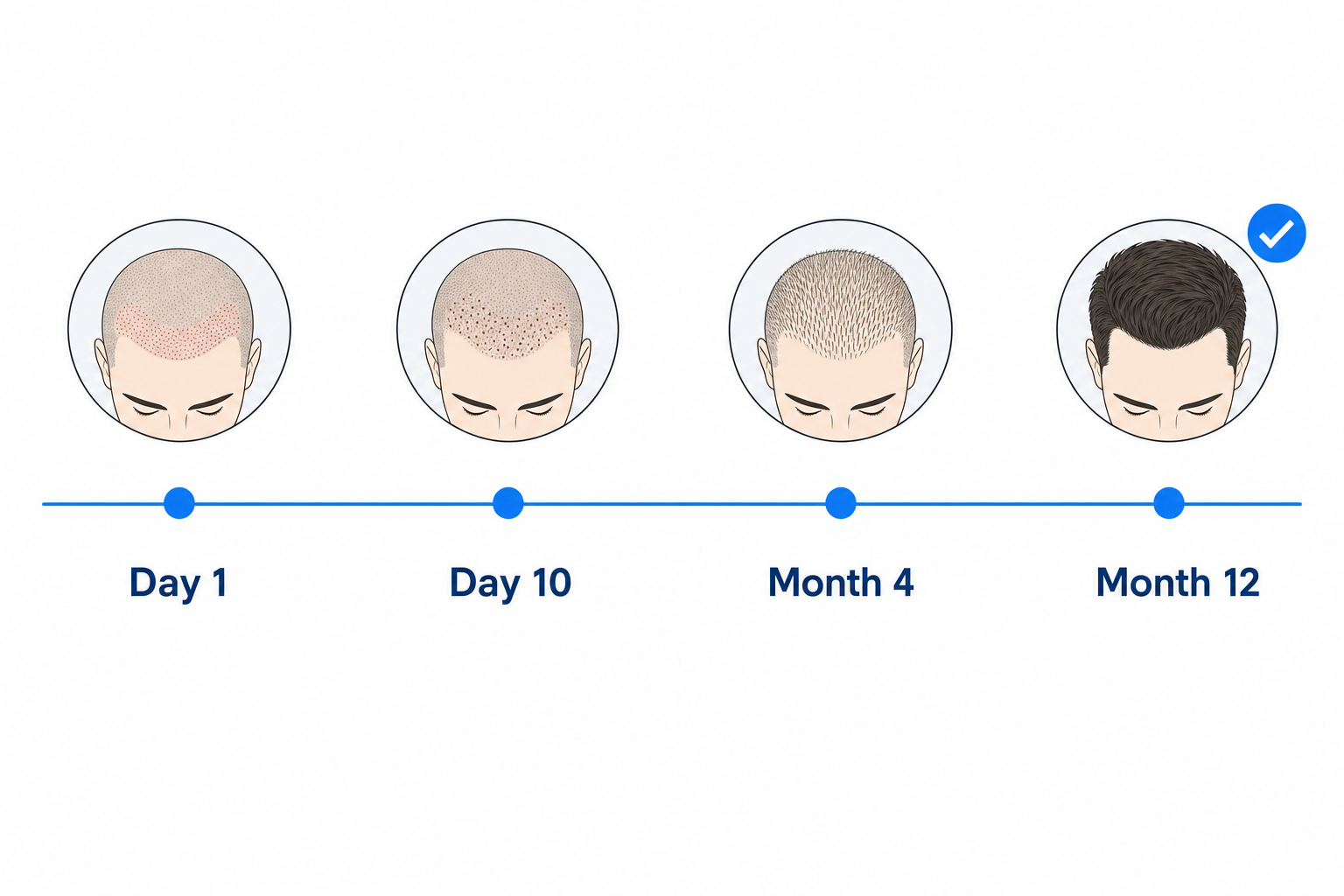
In the first few days after the procedure, small crusts form around the implanted grafts. With an unshaved treatment, these crusts sit between your existing long hairs, which makes them less visible from the outset. They normally fall off on their own within seven to ten days, provided you follow the aftercare guidance. You learn the careful washing routine directly with us: gently dabbing on a special lotion, no rubbing, no hard jet of water, no scratching. Once the crusts have healed, there is usually nothing left to see in long hair.
One topic that honest clinics speak about openly is shock loss. Here, existing hairs around the treated zone can also fall out temporarily. That sounds alarming at first, but it is a well-known and usually reversible phenomenon. The hairs are briefly in a resting phase and, in the vast majority of cases, grow back within a few months. A similar temporary effect can also occur in the donor area, described by Kerure and colleagues as acute effluvium. An experienced team minimises the risk through gentle technique, a correctly chosen channel size and a procedure that does not last needlessly long.
In day-to-day life, a simple trick helps. For as long as a short donor zone would be visible at the back of the head, you simply lay the longer covering hair over it. Lifted up, you can see the trimmed patch; let down, it disappears completely. It is exactly this effect that makes the partial shave so discreet in men and the Zero Shave FUE so invisible in women. Most patients are presentable again after just a few days, and at the office nothing stands out.
Why Elithair has mastered the unshaved hair transplant
Many clinics advise against the unshaved hair transplant or charge a hefty surcharge for it. The reason is usually the same: it is more demanding, slower and calls for more skill. That is exactly where our strength lies.
The central challenge of the unshaved treatment is the longer operating time, and with it the ischaemia time of the grafts. We solve it through team size. At Elithair, a large team of specialists trained in microsurgery works on every treatment, coordinated by experienced doctors. Several pairs of hands in parallel keep short the time a graft spends outside the body. That keeps the survival rate high, even when the slower, unshaved approach is chosen. What becomes a bottleneck for small practices is routine for us.
Then there is the equipment. Fine specialist needles and precise implanter pens allow the exact work between long hairs that the unshaved technique demands. The Zero Shave FUE itself comes from our own research and development laboratory, developed by Dr Abdulaziz Balwi. It is not a bought-in licence, but in-house expertise.
The numbers speak for themselves: more than 150,000 treatments carried out, a TÜV-certified quality standard and a team that works to the standards of the ISHRS, the international professional body for hair transplantation. This experience is exactly what the unshaved treatment needs. It forgives fewer mistakes than the classic method and rewards routine all the more.
What does a hair transplant without shaving cost?
At Elithair, a hair transplant without shaving starts from £2,799 (all-inclusive). The key point: you pay no surcharge compared with the classic method. With us, the Zero Shave FUE costs exactly the same as a regular treatment with shaving.
That is far from a given. Clinics in the UK often charge a surcharge of 30 to 50 per cent for comparable unshaved methods, because the extra effort is passed on to the patient. We do it differently. The greater effort is absorbed through our structure and team size, not through your wallet.
The all-inclusive package covers the treatment, the pre-examination, hotel accommodation, transfers and the aftercare. You are only in Istanbul for two to three days. You can find a detailed breakdown of the packages and what they include on our prices page.
Conclusion: who is a hair transplant without shaving worth it for?
A hair transplant without shaving is worth it when the method suits your case. Here is the clear breakdown.
For women, the Zero Shave FUE is in most cases the ideal solution. The long covering hair conceals the recipient area, the dense back of the head supplies the grafts, and with up to 3,500 grafts genuine density is possible, completely without visible shaving. For diffuse hair loss and thinning along the central parting, there is hardly a more elegant answer.
For men with smaller corrections, such as receding temples or a slight thickening at the hairline in the region of a few hundred grafts, the discreet partial shave is the best choice. It stays invisible and delivers a clean result. For extensive hair loss with a high graft requirement, a full shave is medically superior. It produces the densest, most natural end result, and the shaved head is only a brief episode.
Which route is right for you can only be said responsibly after an examination. That is why everything begins with the free hair analysis. We look at your pattern of hair loss and your donor area, and recommend the method that suits your goal, honestly and with no sales pressure.
Frequently asked questions about hair transplants without shaving
Sources
- Park JH, You SH, Kim NR. Nonshaven Follicular Unit Extraction: Personal Experience. Ann Plast Surg. 2019. PubMed
- Park JH, You SH, Kim NR, Ho YH. Long hair follicular unit excision: personal experience. Int J Dermatol. 2021. PubMed
- Ahmad M, Mohmand MH. Effect of surgeon’s workload on rate of transection during FUE. J Cosmet Dermatol. 2020. PubMed
- Limmer BL. Elliptical donor stereoscopically assisted micrografting in hair transplantation. J Dermatol Surg Oncol. 1994. PubMed
- Lee SJ et al. Evaluation of survival rate after follicular unit transplantation using the KNU implanter. Dermatol Surg. 2001. PubMed
- Romera de Blas C et al. Complications in follicular unit excision hair transplantation. Front Med. 2026. Frontiers in Medicine
- Kerure AS et al. Donor Area Acute Effluvium following FUE. J Cutan Aesthet Surg. 2020. PubMed
- Herskovitz I, Tosti A. Female Pattern Hair Loss. Int J Endocrinol Metab. 2013. PubMed
- ISHRS FUE Advancement Committee. FUE Clinical Practice Guidelines. 2019. ISHRS
- ISHRS. Position Statement on Qualifications for Scalp Surgery. ISHRS
This article is for information only and is not a substitute for medical advice. If your hair loss persists, you should seek a professional diagnosis.
Dr. Imad Moustafa
Hair transplant specialist