

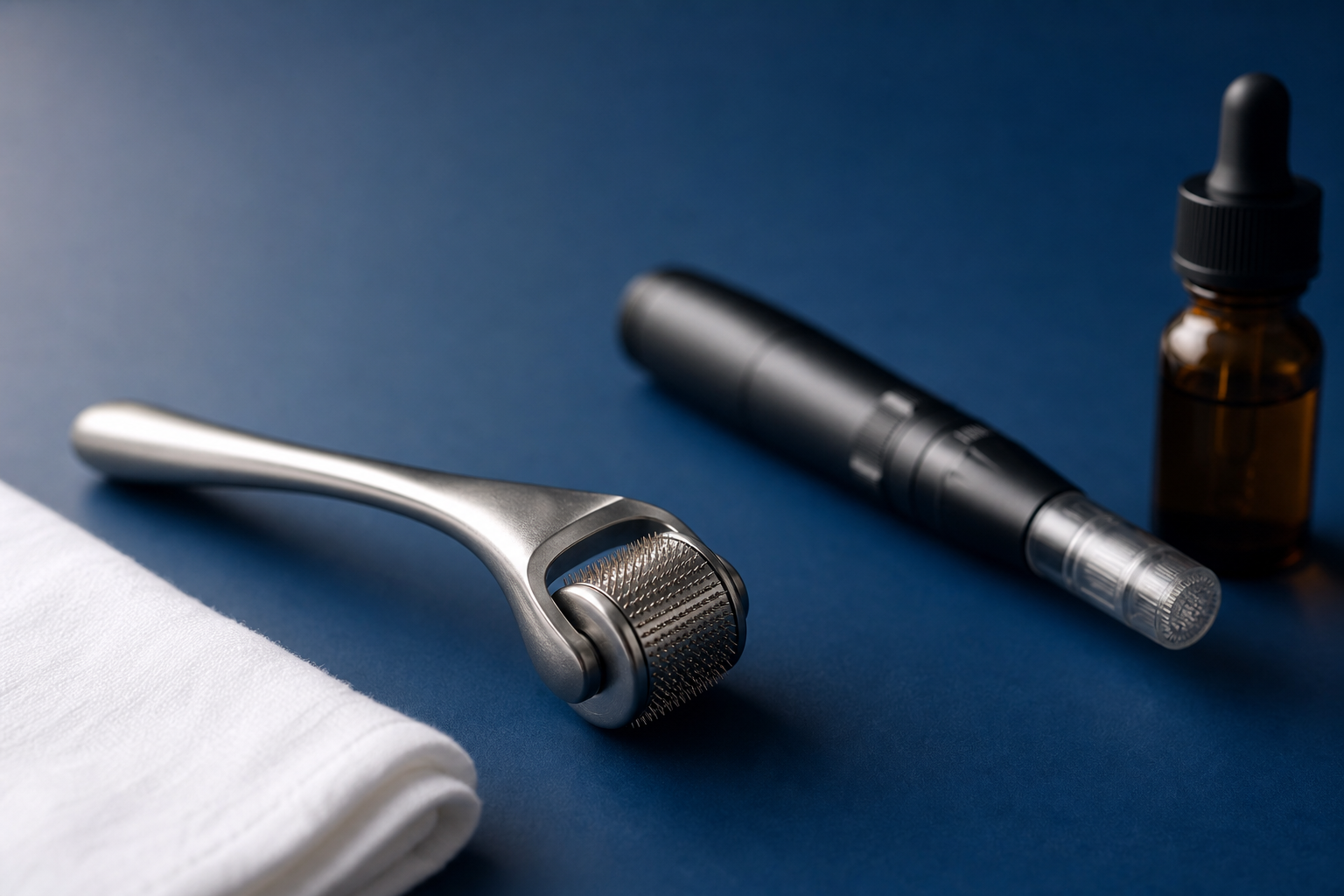
Anyone who wants to use a dermaroller for hair loss needs three answers above all: which needle length, how often, and what is allowed on the scalp afterwards. The procedure behind the device is called microneedling, and the dermaroller is only one of several device types. On its own, microneedling rests on weak evidence. Together with minoxidil, the data point to an added benefit: in a randomised pilot study of 100 men, hair density rose by 91.4 hairs per cm² after 12 weeks, compared with 22.2 on minoxidil alone (Dhurat et al., Int J Trichology 2013). Here you will read which needle length is defensible at home, what the routine looks like, and when to leave the roller in its case.
The key points
- ✓At home, 0.25 to 0.5 mm is the benchmark, and the frequency follows the needle length, because redness and swelling last 2 to 3 days
- ✓Infection and scarring are the two serious risks, and they almost always come from avoidable mistakes, such as a device that was never disinfected or needles that are too long
- ✓The roller is the home device and pierces at an angle and unevenly, while a pen and in-clinic microneedling work vertically, deeper and under controlled conditions
- ✓On bald, shiny areas rolling achieves nothing, because the only follicle you can stimulate is one that is still there
The table of contents below shows you where to find what you need. After that we work through the evidence, needle length, technique and risks in turn.
Summary
- What is microneedling for hair, and what is a dermaroller?
- How does microneedling work on the scalp?
- Does microneedling really work for hair loss? An honest look at the evidence
- Combining microneedling and minoxidil: getting the timing right
- Which needle length for the scalp? From 0.25 to 1.5 mm
- Using a dermaroller correctly: step by step
- Risks and side effects of microneedling on the scalp
- Microneedling after a hair transplant: only with medical clearance
- Dermaroller, dermapen, in-clinic microneedling or mesotherapy?
- Which type of hair loss does microneedling help, and when is it the wrong approach?
- Conclusion: microneedling for hair at a glance (2026)
- Frequently asked questions about microneedling and dermarollers for hair loss
- Sources
What is microneedling for hair, and what is a dermaroller?
Microneedling for hair is a procedure in which fine needles create controlled micro-injuries in the scalp. The dermaroller is not a procedure in its own right, it is one of the tools. That distinction matters, because online the device name and the method are constantly mixed up.
According to the StatPearls review published by the US National Library of Medicine, three classes of device follow the same principle: the rolling needle drum (dermaroller), motorised devices with needles that punch in vertically (dermapen) and professional devices for greater depths. They differ in precision and trauma, not in the underlying principle.
A classic dermaroller carries 192 needles in 24 rows of 8, and needle lengths on the market range from 0.5 to 3 mm (expert commentary by Jha & Vinay, JAAD 2019). The same authors criticise the fact that any form of needling is sold as microneedling, even though the device, the depth and the technique make a large difference.
The method originally comes from scar and skin-ageing treatment and was later transferred to the scalp. It differs fundamentally from a scalp massage: there is no needle stimulus there, and therefore no wound healing response. How much the time factor matters becomes clear from the hair growth cycle with its growth and resting phases.
How does microneedling work on the scalp?
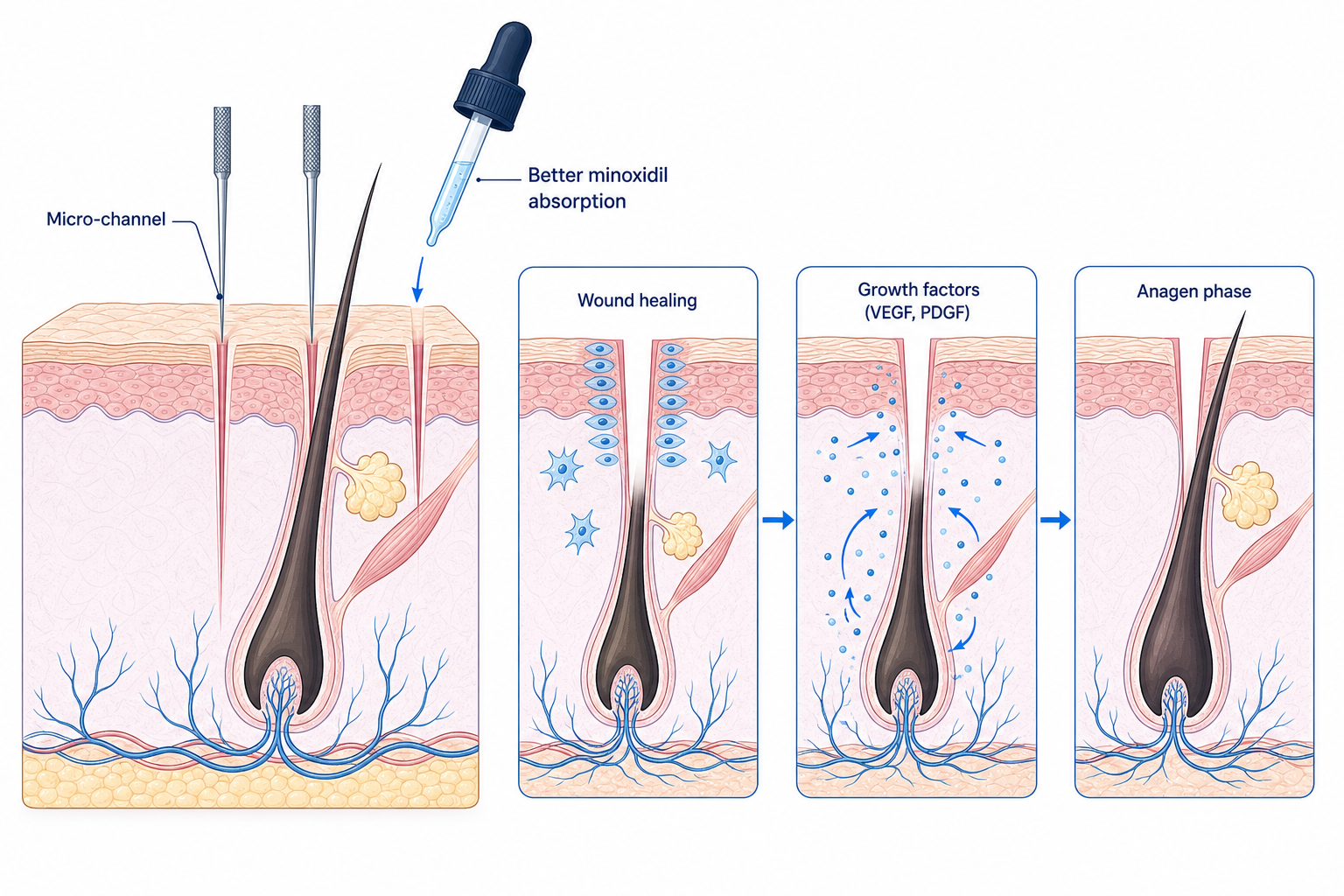
Microneedling on the scalp works along three routes: the controlled micro-injury with the wound healing that follows, the release of growth factors with better blood flow, and improved uptake of topical agents. The three routes are backed by very different levels of evidence, and that difference decides what expectations are realistic.
1. Micro-injury and wound healing. The needles create fine channels in the skin. The body treats them like small wounds and starts its repair process, releasing its own signalling molecules in the process. The StatPearls review describes this basic mechanism as the actual working principle, whatever the device type.
2. Growth factors and blood flow. The molecules usually named here are those that stimulate small new blood vessels, VEGF among them. The data come from animal work: in mice, repeated needling increased the activity of these factors and promoted hair growth (Kim et al., Ann Dermatol 2016). In humans, this route is not proven.
One detail from the same paper is worth noting: the lengths tested were 0.15, 0.25, 0.5 and 1 mm, and the best results came from the shorter needles around 0.25 to 0.5 mm, not from the longest ones. So even at the level of the mechanism, nothing supports the widespread assumption that deeper is automatically better.
3. Better uptake of topical agents. Through the micro-channels, a topical product penetrates deeper than it would through intact skin. This is the most readily understandable effect, and the reason why practically every human study has tested microneedling together with minoxidil. The Spanish AEDV consensus document (2023/2024) also classes it as a penetration enhancer rather than a standalone treatment.
The honest summary is this: the mechanism is plausible and partly proven, above all for better uptake. The equation “more growth factors equals more hair” has not been demonstrated in humans. Being clear about that means going into the treatment with realistic expectations.
Does microneedling really work for hair loss? An honest look at the evidence
Whether microneedling works for hair loss can be answered like this on the evidence we have today: there are positive studies, but they are small, mostly methodologically weak and almost exclusively carried out in combination with minoxidil. A guideline recommendation for microneedling on its own does not exist.
The most important study on microneedling for hair loss is a randomised pilot study in 100 men with mild to moderate androgenetic alopecia. One half rolled once a week and also applied 5% minoxidil twice daily; the other half used minoxidil alone. After 12 weeks, the microneedling group had gained a mean of 91.4 hairs per cm², the minoxidil group 22.2 (Dhurat et al., Int J Trichology 2013).
Increase in hair density after 12 weeks (Dhurat et al. 2013, 50 men per group)
Microneedling + 5% minoxidil
+91.4 hairs/cm²
5% minoxidil alone
+22.2 hairs/cm²
Primary endpoint hair density, 12 weeks, p=0.039. Pilot study with 50 participants per group, of whom 44 completed in the minoxidil group. Source: Dhurat et al., Int J Trichology 2013.
The participants’ own assessment was even more striking: 41 of 50 in the microneedling group rated their own improvement at more than 50 per cent, against 2 of 44 in the minoxidil group. Neither group showed notable side effects. The authors themselves name the small number of participants and the pilot design as the weaknesses of their work.
A broader base comes from a meta-analysis that pools 13 randomised studies with a total of 696 patients (Pei et al., J Cosmet Dermatol 2024). Microneedling in combination clearly improved hair density and hair diameter there compared with single therapy, with comparable tolerability. The sum, however, is only as good as its parts: small sample sizes, short durations, very different protocols.
The most important point for context: the European S3 guideline of the European Dermatology Forum quotes exactly these Dhurat figures and states that further studies are needed to confirm any superiority of the combination of minoxidil and microneedling. There is no treatment recommendation for it. Minoxidil itself is clearly recommended in the same guideline.
The same gap shows in state-run patient information on male pattern hair loss, which names only minoxidil, finasteride and hair transplantation. Microneedling does not appear there. Anyone looking for a procedure with guideline status will not find it here, and that is a matter of record rather than an opinion.
As a standalone treatment, microneedling rests on weak evidence. In the studies that count, it was always used together with a topical agent. There is also a case series of just four men who had used finasteride and minoxidil without success for two to five years and showed new growth after microneedling was added (Dhurat and Mathapati 2015). Four cases are a signal, not proof.
One further blind spot: the available studies were carried out almost exclusively in men. For women with hereditary hair loss, the data on microneedling are correspondingly thinner, even though the mechanism is the same.
When can you expect the first results?
With microneedling, the first changes you can actually assess are to be expected after several months at the earliest, because the hair cycle sets the pace, not the treatment. A hair that is in its resting phase today needs months before it visibly grows back. This timeline helps against the most common disappointment, namely giving up too early or celebrating too early.
| Timeframe | What realistically happens | What does not happen yet |
|---|---|---|
| Week 1–4 | The scalp reacts to the stimulus. Redness and mild oedema for 2 to 3 days after each session count as an expected reaction according to StatPearls. The routine becomes familiar. | No visible change to the hair. Anything that looks denser now is styling, not growth. |
| Month 2–3 | At the earliest, the first fine short hairs in the treated area. Daily hair loss may stabilise. | No assessable increase in density. A before-and-after comparison does not make sense yet. |
| Month 4–6 | The first period in which a change in density can be judged from photographs. Dhurat et al. (2013) reported earlier first signs in the combination group than under minoxidil alone. | No final result. Bald, shiny areas do not change. |
| Month 6–12 | Time for an honest assessment, ideally with photos taken in the same light, at the same distance and with the same hairstyle. | If you see nothing by this point, experience suggests that rolling for longer rarely adds anything. |
| From month 12 | If it helps, microneedling is an ongoing measure alongside the topical treatment. | No completed course of treatment. Once you stop, the added effect stops with it. |
Combining microneedling and minoxidil: getting the timing right
The combination of microneedling and minoxidil is the only well-studied use case, and it is also where the biggest safety issue sits. Minoxidil must not go on the scalp immediately after rolling. The reason is the very effect that makes the combination interesting: the sharply increased uptake through the freshly opened micro-channels.
Important warning: no minoxidil straight after rolling
Minoxidil is a vasodilator, so it widens blood vessels. Through open micro-channels, considerably more of the drug can reach the bloodstream than through intact skin. Where too much minoxidil reaches the bloodstream, StatPearls and a case report on minoxidil overdose describe palpitations, a drop in blood pressure, dizziness and oedema.
If palpitations, dizziness, breathlessness or swollen legs occur: stop the treatment immediately and get medical advice. Do not wait to see whether it settles on its own.
How long you should wait has not been fixed by any study. A gap of about 24 hours is common in user and clinic sources, meaning you roll one day and go back to minoxidil the next. That is a consensus from practice, not a scientifically established limit.
So if you use minoxidil daily, build the rolling sensibly into your routine instead of stacking both into the same evening. Dosage, shedding and side effects are covered in detail in the article Minoxidil for hair loss.
Other products do not belong in fresh micro-channels either. Nodular foreign-body reactions of the skin are documented after microneedling with vitamin C serums, among them the case of a 49-year-old woman in whom the reaction only began two weeks after the treatment (JAAD Case Reports 2023, SAGE Open Med Case Rep 2022). Retinol, alcohol-based tonics, fragrances and dry shampoo fall into the same category.
Rosemary oil is often touted on social media as the gentle alternative. In a comparative study with 100 participants, hair count rose markedly with rosemary oil after 3 and 6 months, much as it did with minoxidil (Panahi et al., Skinmed 2015).
The comparison there, however, was only against the weaker 2% concentration, whereas 5% is what is usually recommended today. A single study does not turn it into a minoxidil alternative. And essential oils have no place on freshly needled skin anyway, given their potential to irritate.
Combinations with finasteride or a PRP treatment are medical decisions. They are perfectly conceivable in principle, but they belong in the hands of someone who knows the whole plan, not in a protocol you have assembled yourself from videos.
| What | How soon after rolling | Why |
|---|---|---|
| Minoxidil and other topicals | Not immediately afterwards. The widespread consensus in practice is a gap of about 24 hours (no study figure). | Through freshly opened micro-channels, considerably more of the drug reaches the bloodstream. Minoxidil is a vasodilator (StatPearls). |
| Caffeine or peptide serum | Not immediately afterwards, only once the redness has settled (precautionary advice). | The same penetration problem, and many off-the-shelf products contain alcohol and fragrances. |
| Rosemary oil and other essential oils | Not immediately afterwards (precautionary principle, no study specifically on this). | Essential oils have a known potential to irritate and sensitise irritated skin. |
| Vitamin C serum, retinol, alcohol-based tonic | Not at all directly afterwards. | Granulomatous reactions after microneedling with vitamin C serum are documented (JAAD Case Reports 2023, SAGE Open Med Case Rep 2022). |
| Medicated or ketoconazole shampoo | Not on the day of treatment (precautionary advice). | Active shampoos sting on freshly needled skin and are absorbed more strongly. |
| Washing your hair | Not directly afterwards. Ideally the next day, with lukewarm water and a mild shampoo (precautionary advice). | The micro-channels are an open point of entry. Clean the scalp before the session, not after it. |
| Exercise and heavy sweating | Avoid on the day of treatment (precautionary advice). | Sweat, friction and headwear encourage folliculitis. |
| Sauna, swimming pool, hot tub | Only after the irritation phase has settled, usually after 2 to 3 days (derived from StatPearls). | Heat intensifies the redness, and pools and benches are a source of germs. |
| Direct sun | Avoid in the first few days, cover your head. | Freshly irritated skin is prone to pigment changes. StatPearls names hyperpigmentation as a possible complication. |
| Colouring or bleaching your hair | Not during the irritation phase, better to leave several days (precautionary advice). | Oxidising agents and ammonia on open micro-channels irritate strongly and can sensitise. |
| Next microneedling session | Only once redness and tightness have completely gone, staggered according to needle length. | According to StatPearls, the acute repair takes 2 to 3 days. Constant irritation leads to chronic inflammation. |
Which needle length for the scalp? From 0.25 to 1.5 mm
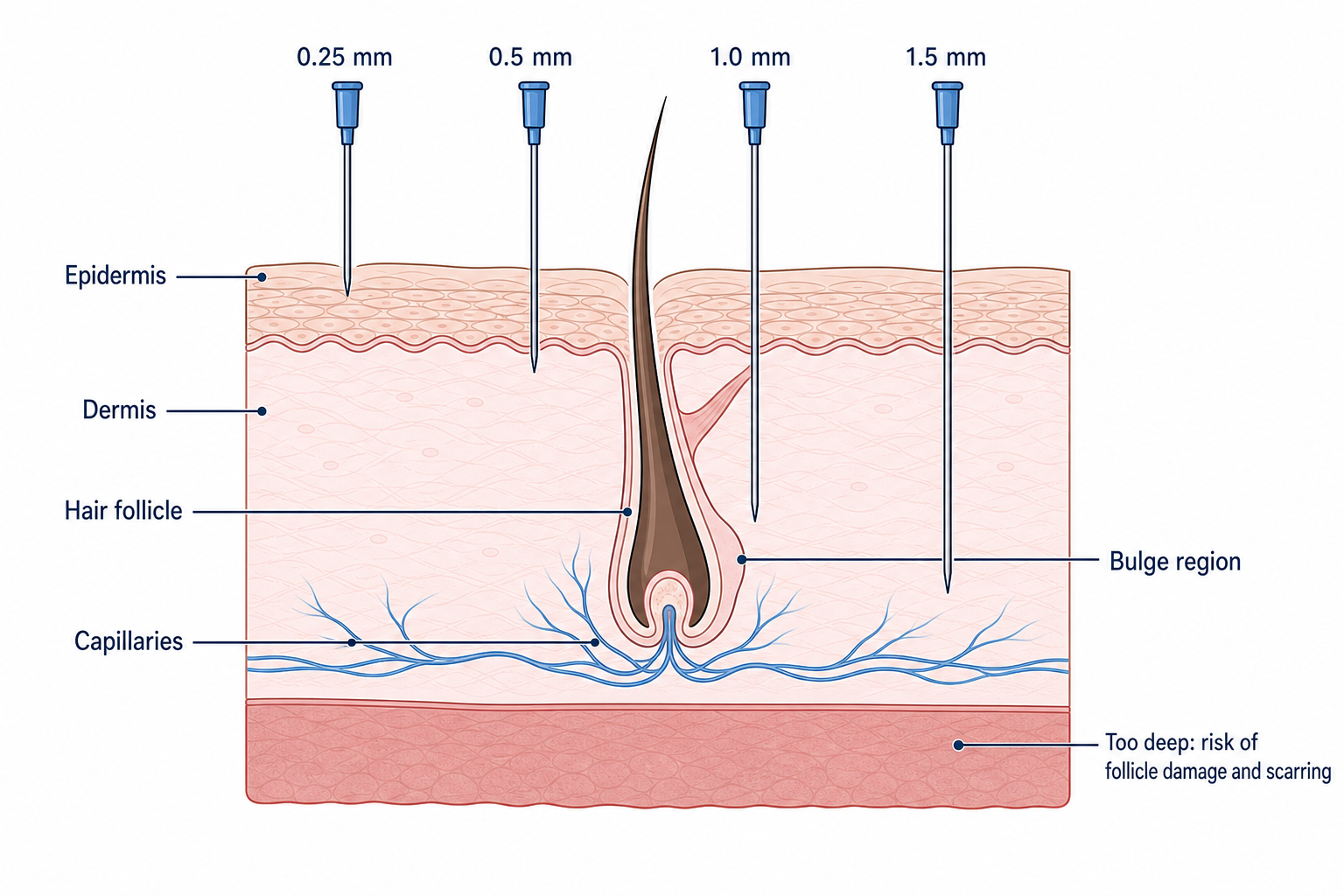
For using a dermaroller on your own scalp, the conservative lower range is the benchmark, so 0.25 to 0.5 mm, with around 1.0 mm as the upper limit for experienced users. The much-quoted 1.5 mm is the length used in studies and with professional devices, not a recommendation for the bathroom.
That distinction is the single most important point in this section. In studies on androgenetic alopecia, 1.5 mm is the preferred length, applied under controlled conditions (Jha & Vinay, JAAD 2019). The Cleveland Clinic points out that needles in home devices are often less than a tenth of the professional length, and warns explicitly against using professional needle lengths on yourself at home.
The reason lies in the structure of the skin. In the upper layers, the needle stimulus is enough to trigger uptake and repair. Further down sit the hair roots and fine blood vessels. The deeper the needle goes, the higher the risk of tissue injury, bleeding, scarring and pigment marks, according to StatPearls. Scar tissue can destroy follicles permanently, and that damage stays.
| Needle length | What it reaches | Suitable for | Usual frequency (consensus in practice) | Setting and note |
|---|---|---|---|---|
| 0.25 mm | the top layer of skin, mainly better uptake of topical agents | getting started, sensitive scalps, home use | can be used more often, roughly 2 to 3 times a week, depending on how well you tolerate it | At home. The usual home-care length according to manufacturer information. In the mouse model by Kim et al. (2016), 0.25 mm was among the most effective lengths. |
| 0.5 mm | reaches the upper dermis, a more pronounced healing stimulus | the standard range for the scalp in patient and clinic sources | less often than with 0.25 mm, always wait for the redness to go completely | At home with care. Redness and mild oedema for 2 to 3 days are normal according to StatPearls. |
| 1.0 mm | reaches down close to the hair roots | the upper limit for informed self-treatment | considerably less often, roughly once a week or less | Borderline range. The Cleveland Clinic warns against using professional needle lengths at home. |
| 1.5 mm | reaches the depth of the hair roots | study and professional use, explicitly not a home standard | weekly in the study protocol by Dhurat et al. (2013), but under supervision | Qualified hands only. Jha & Vinay (JAAD 2019) name 1.5 mm as the length preferred in AGA studies. |
| over 1.5 mm | deep dermis, the risk of root damage and scarring rises | professional use only | according to a professional protocol | Qualified hands only. StatPearls names 1.5 to 2.0 mm as the range for scar treatment. |
Frequency: why more often is not better
Frequency is tied directly to needle length. Short needles around 0.25 mm may be used more often, longer needles around 1.0 to 1.5 mm considerably less often. The reason is regeneration: StatPearls describes redness and swelling for 2 to 3 days after a session as a normal course. Only after that is the acute repair largely done.
The “roll daily” advice that circulates online is therefore a clear no with longer needles. Anyone who irritates the scalp constantly keeps it in a state of chronic inflammation, and chronic inflammation is the opposite of what hair growth needs. No study has tested exactly this behaviour. But the conclusion drawn from the healing times is unambiguous.
A face roller is not a scalp roller
A dermaroller made for the face is the wrong choice for the scalp. Face devices have different needle specifications, and thin needles bend more easily between hairs or snap off. Bent needles do not perforate the skin, they tear it. That is exactly how unnecessary injuries, and later scars, come about.
Who is allowed to carry out needling? Check the rules where you live
Needling devices count as medical devices, and manufacturers classify professional models into device risk classes. There is no single international needle-length limit. From certain needle lengths onwards, treating other people is reserved for qualified professionals in many places, and the details differ from country to country. Check the rules that apply where you live.
In practice, this question mainly concerns commercial providers who treat other people, not self-treatment at home with a device you bought yourself. Even so, if you want to be treated by someone else, ask who works there, with which needle length, and what qualification stands behind it.
Using a dermaroller correctly: step by step
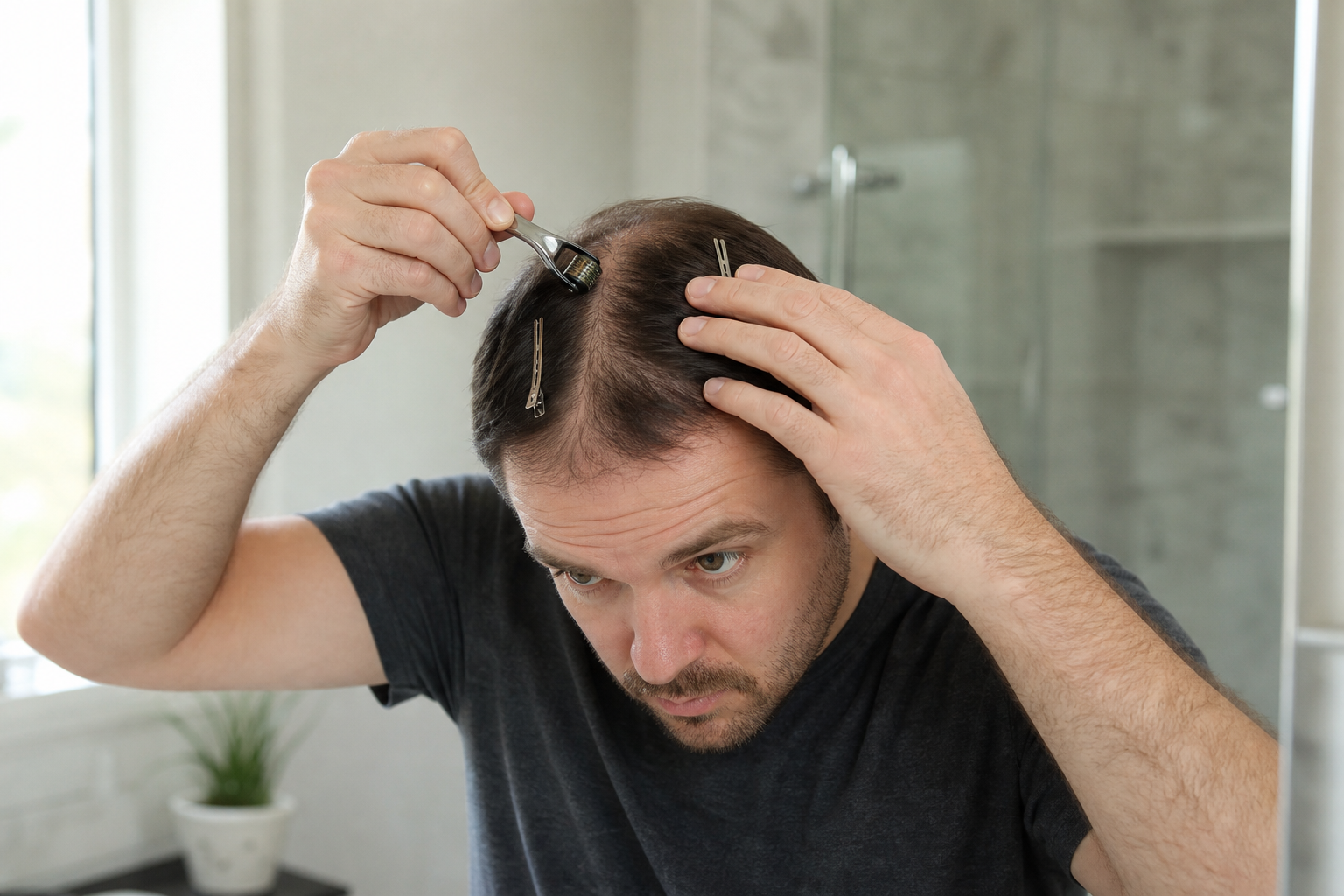
Using a dermaroller on the scalp correctly means: clean scalp, dry hair, few passes per zone with light pressure, and the aim is a fine, even redness with no bleeding. The routine takes a few minutes, and the care you take decides between benefit and harm.
- Clean the scalp and let it dry completely. On damp hair, strands catch in the drum more easily. Then part the hair into sections and hold them with clips so the scalp is exposed.
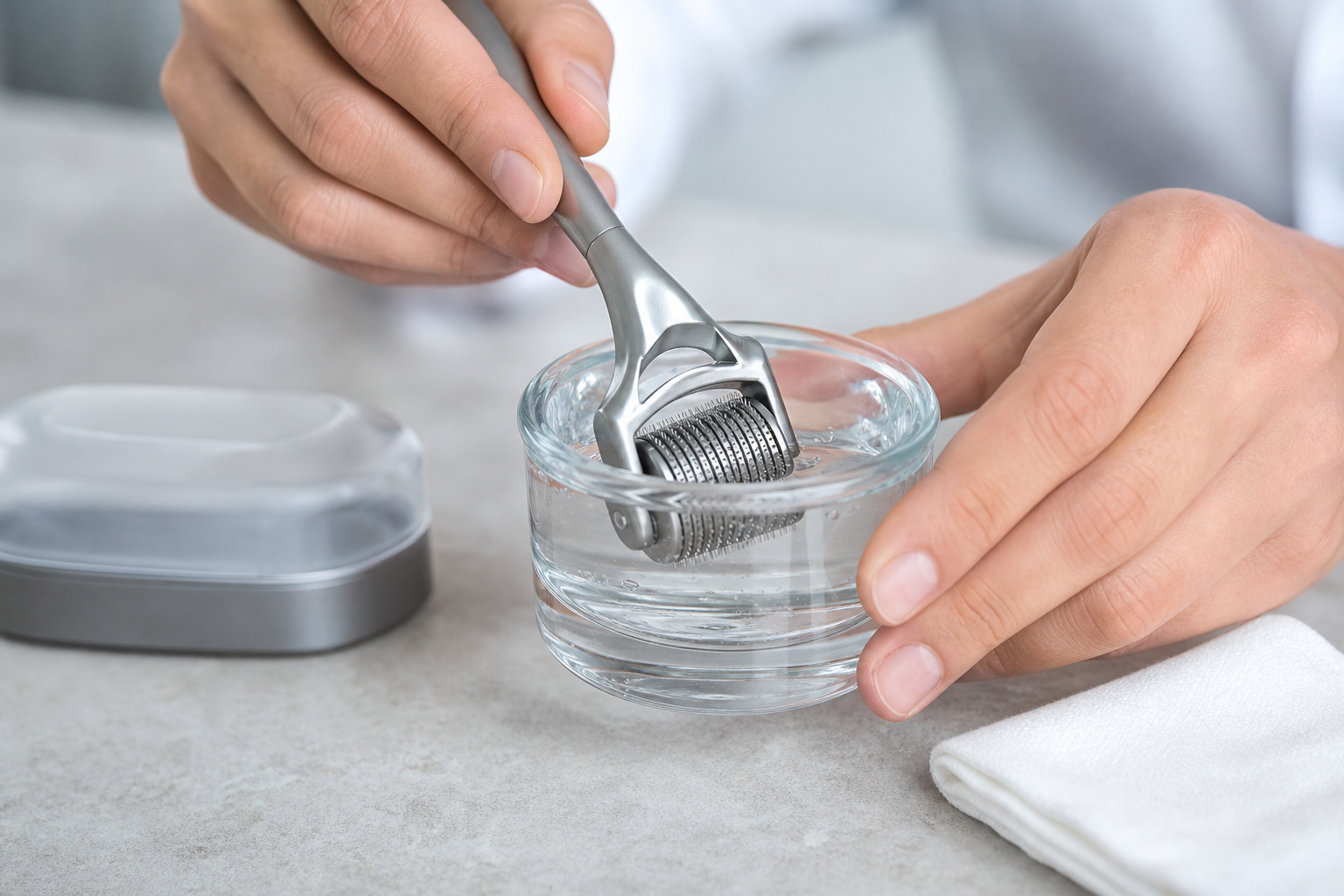
- Disinfect the roller before and after every session. 70% isopropyl alcohol is the agent of choice, details in the checklist below.
- Work in passes. A few repetitions per zone in two or three directions. Never turn the roller under pressure and never drag it sideways across the skin. Lift it and set it down again.
- Keep the pressure light and adjust it to the zone. Considerably less pressure over hard bony areas and at the temples than on the softer top of the head and the crown.
- The aim is a fine, even redness. Pinpoint bleeding is not a mark of quality, it is a sign of too much pressure or needles that are too long.
- Apply nothing afterwards that has not been explicitly cleared. Do not scratch, and do not run your fingers over the treated areas.
- Keep to the waiting times for minoxidil, hair washing, exercise, sauna and sun (see the timing table above).
What is normal after rolling, and what is a warning sign? Redness and mild swelling for 2 to 3 days are an expected reaction according to StatPearls. Anything that keeps increasing after that is no longer healing. The comparison below separates the two.
Normal reaction
- fine, even redness directly after the session
- redness and mild swelling over 2 to 3 days (StatPearls)
- slight tightness or a feeling of warmth that decreases day by day
- fine flaking in the days afterwards
- the odd tiny spot that disappears again straight away
Warning signs: stop the treatment and get medical advice
- pustules or yellowish crusts
- pain, warmth or swelling that increases instead of decreasing
- fever or feeling unwell
- blisters like those of a cold sore, a reactivation that StatPearls names as possible
- palpitations, dizziness or swollen legs after minoxidil
The most common mistakes make a short list: too much pressure, sessions too close together, a blunt or never-replaced roller, a device shared with others, minoxidil straight afterwards, rolling on an inflamed scalp, rolling on damp hair, and reaching for the face roller.
Hygiene and routine checklist to print out
Before
- Wash your hands, clean the scalp with a mild shampoo and let it dry completely
- Disinfect the roller by immersing the needle head in 70% isopropyl alcohol, leave it to work briefly, then let it air-dry
- Check the needle head against the light: bent or broken needles mean replacing it immediately
- No session with redness, flaking, pustules, open areas, sunburn or cold sores
During
- Part the hair into sections, work zone by zone, lift the roller instead of dragging it
- Adjust the pressure to the zone: careful at the temples and over bony areas, a little firmer on the top of the head and the crown
- The aim is a fine, even redness. Stop immediately if there is bleeding or a stabbing pain
- Never share the device with other people, not even within the family
After
- Disinfect the roller again, let it dry and store it in its closed case
- Apply nothing to the scalp that has not been explicitly cleared, and do not scratch
- No exercise on the day of the session, no sauna, no hat over a sweaty head
- With pustules, crusts, fever or increasing pain, stop the treatment and get medical advice
Roller care
Only 70% isopropyl alcohol cleans reliably. High-proof spirits, perfumed hand sanitiser, plain water and boiling plastic parts are not suitable. Replace the needle head as soon as the session starts to feel scratchy, needles are bent or the redness appears unevenly. Blunt needles tear the skin instead of perforating it.
Risks and side effects of microneedling on the scalp
Microneedling on the scalp is a procedure that injures the skin. The most common side effects are redness, burning and pinpoint bleeding. The two serious risks are infection and scarring, and both almost always arise from avoidable mistakes in how the device is used.
Infection and folliculitis. StatPearls names local infections such as impetigo as a possible complication of the procedure. The triggers are an unclean device, an unwashed scalp or a shared roller. Warning signs are pustules, pain, warmth, yellowish crusts and fever. What such an inflammation of the hair follicle looks like and how it is treated is covered in the article on folliculitis.
Scars and keloids. Needles that are too long, too much pressure, dragging the roller and rolling over bony prominences are the typical causes. StatPearls explicitly lists a marked tendency to keloids as a contraindication. Scarred areas can destroy follicles permanently. That is the most serious damage a simple home device can do.
Not on an inflamed scalp. Active redness, flaking, seborrhoeic dermatitis, psoriasis, eczema, open areas, sunburn and cold sores rule the treatment out. StatPearls lists chronic inflammatory skin conditions and active infections as contraindications. The order is clear: have the scalp inflammation treated first, then think about microneedling.
Not with active alopecia areata. In the Koebner phenomenon, mechanical skin stimuli in autoimmune-active tissue can provoke new patches. The concept is well established in dermatology (review by Zhang et al., Experimental Dermatology 2023), but for microneedling in alopecia areata it has not been conclusively proven in humans. There are case reports on microneedling in alopecia areata, though exclusively as a medically supervised treatment, not as home use during a flare.
Hair caught in the drum. Longer hairs can get caught in the needle drum and be pulled out mechanically. There is no study evidence for this, but the mechanics are obvious. With repeated pulling, traction strain is conceivable. The practical consequence: dry scalp, part the hair into sections, never drag sideways, and with long hair consider a pen instead.
More hair loss after starting. A slight increase in the first few weeks does happen and is no reason to panic. The shedding phase people know about comes from minoxidil, though, not from the rolling. If the loss increases markedly over several weeks, bald patches appear or the scalp hurts, that needs medical assessment. And once again: palpitations, dizziness or oedema after combined use with minoxidil are a reason to stop.
| Situation | Why no microneedling | What makes sense instead |
|---|---|---|
| Inflamed, red or flaking scalp | Needles spread germs and intensify the inflammation. StatPearls names chronic inflammatory skin conditions as a contraindication. | Have the scalp inflammation assessed and treated first, then reassess. |
| Seborrhoeic dermatitis, scalp psoriasis, eczema | A disrupted skin barrier plus mechanical trauma. In psoriasis, a skin stimulus can trigger new patches (Koebner phenomenon). | Dermatological treatment of the underlying condition, microneedling at the earliest in a stable quiet phase and after checking with a doctor. |
| Open areas, sunburn, active cold sores, warts | StatPearls lists active infections as a contraindication. A herpes reactivation is a described complication. | Let it heal. With a known tendency to cold sores, check with a doctor beforehand. |
| Alopecia areata in an active flare | A mechanical stimulus can theoretically provoke new patches in autoimmune-active tissue (Koebner phenomenon, Zhang et al. 2023). | Dermatological treatment. Microneedling in alopecia areata is described only as a medically supervised treatment. |
| Freshly transplanted area | Fresh grafts need time to heal in and build a blood supply. A needle stimulus can damage or displace them. | Wait and obtain explicit clearance from the treating clinic. |
| Blood thinners or anticoagulation | An increased tendency to bleed and trauma that is hard to predict. | Only after explicit medical advice. |
| Ongoing or recently finished isotretinoin treatment | In dermatology, the established precaution is to avoid skin-injuring procedures during this phase (wound healing and scarring risk). | Leave a gap and set the timing with your treating dermatologist. |
| Marked tendency to keloids | StatPearls explicitly names a marked tendency to keloids as a contraindication. | Avoid the procedure and discuss alternatives with a doctor. |
| Immunosuppression, chemotherapy, poorly controlled diabetes | Delayed wound healing and an increased risk of infection (StatPearls). | Only with medical clearance, and with diabetes only once it is stably controlled. |
| Pregnancy and breastfeeding | General caution. The usual combination with minoxidil is not intended for this period. | Discuss it with a doctor, and do not start any topical treatment on your own. |
| Unclear diagnosis of the hair loss | Without a diagnosis it is open whether you even have a form of hair loss in which microneedling has been studied. | Have the type and the causes of your hair loss clarified first. |
Microneedling after a hair transplant: only with medical clearance
A freshly transplanted area must not be rolled. Newly implanted grafts need time to heal in and build a stable blood supply. A mechanical needle stimulus in this phase can damage them, displace them or trigger an inflammation. That is an avoidable risk in a phase you cannot repeat.
On the timing there is no solid study evidence, only inconsistent figures from clinics online, ranging from a few weeks to many months. The conservative line therefore applies, and the clearance counts for more than the number: in every case only after explicit clearance from the treating clinic or doctor, and as a rule of thumb usually not before 6 months, often more in the range of 6 to 12 months.
The same logic applies to the donor area at the back of the head. Tissue was injured there too, and there too the clinic decides when mechanical irritation is allowed again. What is permitted in the weeks after the procedure and what is not is covered in detail under aftercare following a hair transplant.
What we see in aftercare at Elithair
In aftercare we regularly see patients who started too early and with needles that were too long, usually with the best intentions. The value of microneedling lies in restraint: clean hygiene, a moderate needle length, enough time between sessions and, if in doubt, a quick question before rolling. Anyone who is unsure in the first months after a procedure loses nothing by waiting and risks a great deal by being impatient.
Dermaroller, dermapen, in-clinic microneedling or mesotherapy?
The four terms stand for different things: the dermaroller is a rolling needle drum for home use, the dermapen a motorised device with needles that punch in vertically at an adjustable depth, in-clinic microneedling the professional application under sterile conditions, and mesotherapy is not microneedling at all but the delivery of an active solution by injection.
The technically decisive difference between drum and pen is documented: according to StatPearls, the needles of a roller enter at an angle as they roll, which leads to less uniform tissue trauma. Motorised devices punch vertically and allow a more even depth with more precise control. At the same figure in millimetres, the trauma from a drum can therefore be greater and more irregular. That is the strongest argument for a pen as soon as you go beyond short needles.
In terms of terminology, microneedling should be kept clearly separate from mesotherapy and PRP treatments. In mesotherapy an active solution is injected, in PRP a concentrate obtained from the patient’s own blood. Both are medical procedures with their own working principle, and their results cannot be claimed on the strength of microneedling data.
| Criterion | Dermaroller | Dermapen (pen) | In-clinic microneedling | Mesotherapy |
|---|---|---|---|---|
| Principle | a needle drum is rolled across the scalp | a motorised pen punches needles in vertically | professional application, sterile conditions, greater depths | injection of an active solution, not a pure needling procedure |
| Entry and tissue trauma | at an angle and rolling, less uniform trauma according to StatPearls | vertical, more even depth and more precise control (StatPearls) | controlled trauma according to a protocol | localised trauma from the needle |
| Needle depth | 0.5 to 3 mm on the market, sensible at home 0.25 to 0.5 mm | continuously adjustable, and therefore depth-controlled | professional devices from about 1.5 mm according to manufacturer information | follows from the injection technique |
| Who carries it out | self-treatment | self-treatment with short needles, above that qualified professionals | doctors or qualified professionals | doctors |
| Delivery of active agents | indirect, through better uptake of the topical applied later | indirect, as with the roller | often combined with active agents under supervision | direct, the agent is injected |
| Evidence in hair loss | the best studied, Dhurat et al. 2013 and the meta-analysis by Pei et al. 2024 (13 RCTs, 696 patients) mostly concern such protocols | less direct study literature specifically on motorised devices in androgenetic alopecia | no guideline recommendation of its own (European S3 guideline) | a procedure in its own right, cannot be backed up with microneedling data |
| Main risks | infection, scarring if used too deep, hair can catch in the drum | infection, scarring if the depth setting is too high | as with the procedure in general, but under sterile conditions | injection risks, needs a medical indication |
| Suitability with long hair | limited, the drum can catch hair | better, because the needles punch vertically instead of rolling | unproblematic, carried out by a professional | unproblematic |
| Cost | a one-off purchase, with the needle head replaced regularly | a higher purchase price, needle modules as consumables | self-pay per session, usually several sessions | self-pay per session |
Buying a dermaroller: how to spot a usable device
When buying a dermaroller, what counts is not the price but how well the needles are made. They have to be sharp, straight and evenly set. That is exactly what Jha and Vinay (JAAD 2019) criticise: far from every needling device delivers what was studied as microneedling in trials.
On the popular question of titanium versus surgical stainless steel, there is no comparative study on the scalp. Another point is relevant: in the literature on nodular skin reactions after microneedling, nickel from the needles is discussed alongside vitamin C as a possible trigger. With a known nickel allergy it is therefore worth checking the material specification and, if in doubt, asking a dermatologist.
You can spot cheap rollers by holding them up to the light: needles of unequal length, sitting at an angle or already bent out of the box. Needles like that do not perforate the skin cleanly, they tear it. That is a mechanical consideration rather than a study finding, but in practice it is the difference between fine redness and an unnecessary wound.
Buying checklist for dermarollers and pens
- Needle length clearly stated, in millimetres and not as “suitable for hair growth”. Without that figure you do not know how deep you are working.
- Length matched to the use: 0.25 to 0.5 mm for home use, professional lengths from about 1.5 mm belong in qualified hands (manufacturer information, Cleveland Clinic).
- Replaceable needle head, with spare heads available. A roller without spares is a consumable with a short life.
- Material and nickel content traceable, especially with a known nickel allergy.
- Conformity marking and manufacturer information on the intended purpose. Needling devices are medical devices, and manufacturers classify professional models into device risk classes. Which marking applies depends on where you buy.
- A case that closes properly, and a needle head you can actually check. Inspect the needle head against the light, and use the device for one person only.
- With long hair, rather a pen: needles that punch in vertically catch less hair than a rolling drum (StatPearls).
Which type of hair loss does microneedling help, and when is it the wrong approach?
Microneedling for hair loss has been studied almost exclusively in androgenetic alopecia, so in pattern hair loss with receding temples, a thinning top and crown. All the studies that count, from Dhurat et al. 2013 to the meta-analysis by Pei et al. 2024, relate to this form. For other forms there are no efficacy data.
Diffuse hair loss across the whole head is therefore the wrong reason to reach for a needling device. If iron deficiency, the thyroid, medication or an acute trigger is behind it, what is needed is a search for the cause and not a scalp treatment. The article on the causes of hair loss gives an overview of the possible triggers.
And a clear answer to the most common question: on bald, shiny areas, microneedling achieves nothing. The procedure can only stimulate follicles that are still there. Where no follicle is left, there is nothing to stimulate. So rolling is worthwhile in a thinned area with fine remaining hairs, not on a mirror-smooth surface.
Whether a thinning area still holds follicles that can be stimulated, or whether the surface is already empty, is hard to tell reliably in the mirror. In a consultation at Elithair we look at exactly this pattern: where hair has only become thinner, where no follicle is left, and which stage you are at. This hair analysis is a visual pattern assessment and does not replace a medical blood test.
For you, that is the decision before the decision, namely whether rolling makes any sense at all. If the course and the pattern point to an internal cause, a blood test for hair loss at your doctor’s is the right next step, not a needling device. Microneedling can stimulate existing, miniaturised follicles and improve the uptake of topical agents, and that is all.
What it cannot do: bring growth back to a zone where the follicle is already lost. For areas like that, a hair transplant is the established option, with FUE extraction and DHI implantation. That does not rule out an accompanying topical treatment, the two sit side by side.
Conclusion: microneedling for hair at a glance (2026)
Microneedling for hair is a supporting measure in androgenetic alopecia, not a standalone replacement for treatment. The best evidence is for the combination with minoxidil: 91.4 versus 22.2 additional hairs per cm² after 12 weeks in the pilot study of 100 men (Dhurat et al. 2013), with a meta-analysis of 13 studies pointing the same way (Pei et al. 2024). Even so, there is no guideline recommendation.
In practice that means: a needle length in the conservative range of 0.25 to 0.5 mm, a frequency matched to the length rather than daily use, consistent disinfection with 70% isopropyl alcohol, minoxidil only after a time gap, and an honest assessment after 6 to 12 months. Bald, shiny areas stay untouched, and with an inflamed scalp or an unclear diagnosis the first step is assessment, not rolling.
In favour
- inexpensive and available without a prescription
- can increase the uptake and therefore the effect of minoxidil
- a plausible mechanism via wound healing and penetration
- combines well with an existing topical treatment
- no significant side effects occurred in the studies
Against
- evidence from small, short studies, almost only in combination
- weak evidence as a standalone treatment, no guideline recommendation
- a risk of infection and scarring if used wrongly
- many contraindications, from an inflamed scalp to a tendency to keloids
- demands discipline over months and cannot create hair on bald areas
Frequently asked questions about microneedling and dermarollers for hair loss
What does in-clinic microneedling cost, and is it covered?
In-clinic microneedling is a self-pay treatment, and the price depends on the clinic and the number of sessions. Whether hair loss treatments are covered at all differs from country to country, so check the rules where you live. A home device costs little, and the needle heads are consumables.
Does microneedling on the scalp hurt, and does a numbing cream make sense?
Short needles around 0.25 to 0.5 mm usually feel tingling to uncomfortable, but not sharp. The pain rises noticeably with the length. If you are thinking about a numbing cream, you are working with a needle length that belongs in qualified hands. Here, the pain is a useful brake.
Is it true that regulators warn about microneedling devices?
In part. In October 2025, the US regulator the FDA pointed out risks of certain radiofrequency microneedling devices, meaning professional devices that also apply heat, for which burns, scarring and nerve damage have been reported among other things. Simple mechanical dermarollers for home use are not covered by this. So the warning does not carry over to them directly.
Does microneedling work the same way in women as in men?
That is an open question. The available studies were carried out almost exclusively in men, and for women with hereditary hair loss the data are considerably thinner. Because internal triggers such as iron deficiency or the thyroid play a part more often in women, medical assessment comes before the needling device even more clearly here.
Sources
- Dhurat R et al.: A Randomized Evaluator Blinded Study of Effect of Microneedling in Androgenetic Alopecia. Int J Trichology 2013. pmc.ncbi.nlm.nih.gov
- S3 European Dermatology Forum Guideline for the Treatment of Androgenetic Alopecia in Women and in Men (Update). S3 guideline (PDF)
- Pei D et al.: Efficacy and safety of combined microneedling therapy for androgenic alopecia. Systematic review and meta-analysis, J Cosmet Dermatol 2024. pubmed.ncbi.nlm.nih.gov
- StatPearls: Microneedling. NCBI Bookshelf NBK459344. ncbi.nlm.nih.gov
- StatPearls: Minoxidil. NCBI Bookshelf NBK482378. ncbi.nlm.nih.gov
- Jha AK, Vinay K: Androgenetic alopecia and microneedling: Every needling is not microneedling. J Am Acad Dermatol 2019. jaad.org
- Kim YS et al.: Repeated Microneedle Stimulation Induces Enhanced Hair Growth in a Murine Model. Ann Dermatol 2016 (mouse model). pubmed.ncbi.nlm.nih.gov
- Panahi Y et al.: Rosemary oil vs minoxidil 2% for the treatment of androgenetic alopecia. Skinmed 2015. pubmed.ncbi.nlm.nih.gov
- Sarcoidal granulomatous reaction to microneedling with vitamin C serum. JAAD Case Reports 2023. jaadcasereports.org
- Zhang X et al.: Characteristics and pathogenesis of Koebner phenomenon. Exp Dermatol 2023. onlinelibrary.wiley.com
- Cleveland Clinic: Does Microneedling Help With Hair Loss? Patient information. clevelandclinic.org
- gesund.bund.de (German Federal Ministry of Health): Male pattern hair loss. gesund.bund.de
- FDA: Microneedling Devices, safety communication on radiofrequency microneedling (October 2025). fda.gov
Medically reviewed, 2026. This article is for information and does not replace a medical diagnosis or treatment. Microneedling injures the skin in a controlled way. If you develop pustules, crusts, increasing pain, fever, palpitations or dizziness, stop the treatment and seek medical advice.
Dr. Imad Moustafa
Hair transplant specialist