


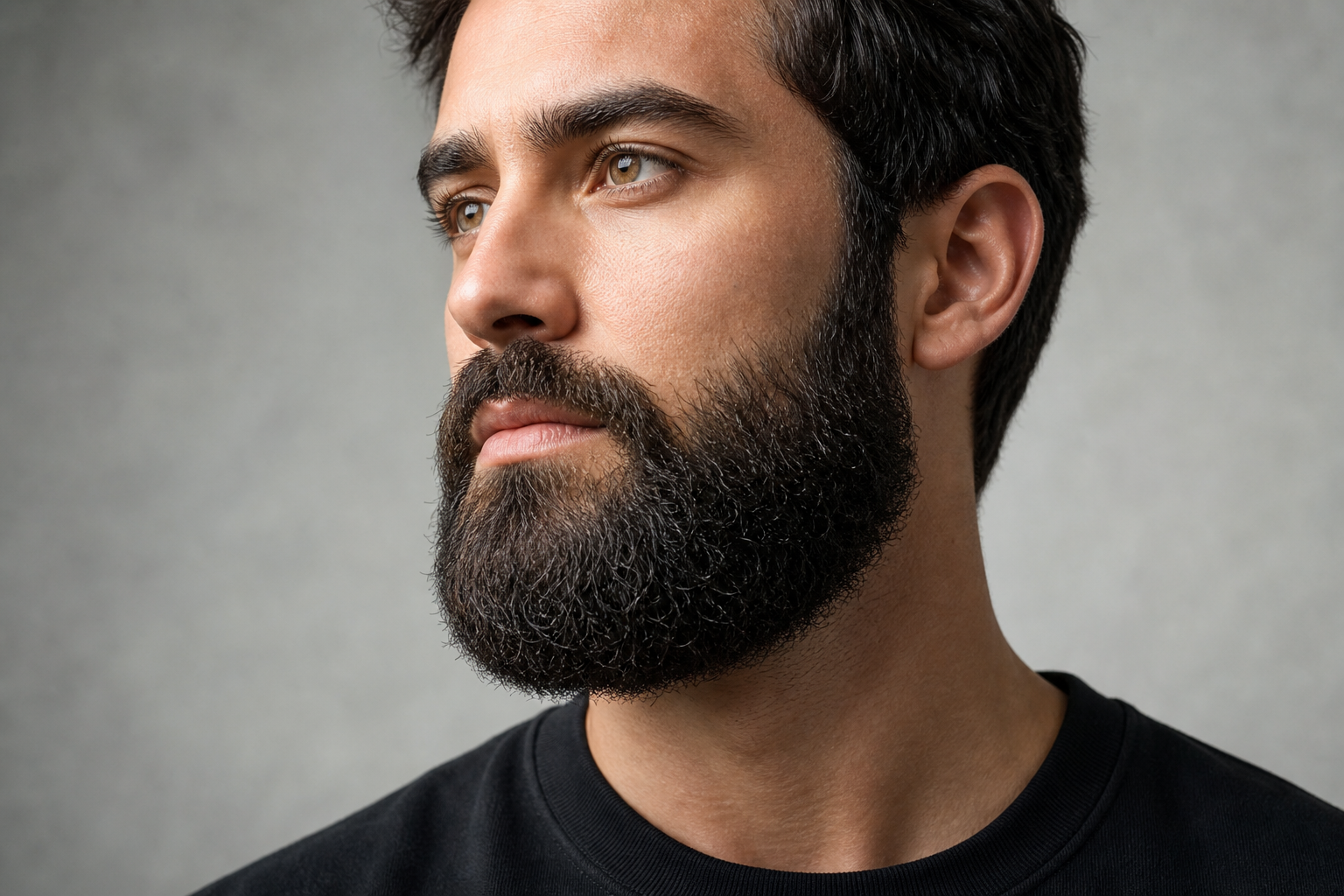
In short: stimulating beard growth means activating the follicles you already have
Stimulating beard growth only works where hair follicles are genetically present but weak or slow-growing. No product can create new follicles. These are the realistic paths, ranked from the strongest evidence down:
- Minoxidil (topical, off-label): the best evidence. Two randomized trials (Ingprasert 2016; Wattanawinitchai 2026) show measurable beard thickening, roughly +11.16 hairs/cm² after 12 weeks.
- Microneedling (derma roller): a supporting method, especially combined with minoxidil. Important: never use both on the same day.
- Lifestyle & patience: sleep, nutrition, exercise, and quitting smoking optimize existing follicles but cannot replace a missing genetic predisposition.
- Beard hair transplant (FUE + DHI): the only permanent solution for genuine gaps where no follicles are genetically present.
Important: Minoxidil on the face is off-label (outside its approved use) and should be coordinated with a physician. For sudden, sharply defined bald patches, please see a dermatologist.
A full, dense beard is part of many men’s identity. Yet the market is flooded with beard oils, sprays, and home remedies that promise a lot and deliver little. This article cleanly separates what really stimulates beard growth, what is pure marketing, and when only a procedure will help. Data as of 2026.
Summary
- Stimulating beard growth: which products actually work?
- Minoxidil for the beard: the best-supported beard growth product
- Microneedling and the derma roller for the beard
- Natural beard growth product: what do beard oil, vitamins, and home remedies achieve?
- Lifestyle: supporting beard growth naturally
- Why does the beard grow (or not)? Genetics, DHT, and hormones
- Myth check: what do shaving, garlic, and the like achieve?
- Thickening the beard: filling gaps, what works and what doesn’t
- Having the beard thickened: the beard hair transplant
- How long does it take? A realistic beard growth timeline
- Frequently asked questions about stimulating beard growth
- Sources
Stimulating beard growth: which products actually work?
If you want to stimulate beard growth, there is a clear hierarchy of evidence: minoxidil is the only beard growth product with clinical trials on the beard itself, and microneedling is considered supportive. Most heavily marketed products, such as beard oil, biotin capsules, or peppermint oil, have no proven growth effect on the human beard.
The table below ranks the common beard growth products honestly by mechanism, evidence, and realistic expectation. This kind of honest assessment is exactly what most people are looking for and rarely find in one place.
| Product | Mechanism | Scientific evidence | Realistic expectation | Risks / notes |
|---|---|---|---|---|
| Minoxidil (beard) | Extends the growth phase, boosts blood flow | 2 randomized trials on the beard (2016, 2026), off-label | Thickening possible with existing follicles in 3 to 6 months | Higher absorption on the face (heart palpitations), toxic to cats, off-label, effect reverses |
| Microneedling / derma roller | Microchannels, blood flow, growth factors | Good evidence combined with minoxidil (scalp studies) | Supportive, not on its own | Never directly with or after minoxidil (overdose risk), keep 24 hours apart |
| Caffeine serum | Claimed to extend the growth phase | Study only on scalp hair (Dhurat 2017), not the beard | Uncertain for the beard | Mostly harmless, no beard growth evidence |
| Beard oil / balm | Conditioning, shine, softness | No growth evidence | Conditions, does NOT stimulate growth | Safe as grooming, not a growth product |
| Peppermint oil | Blood flow (hypothesis) | Only one mouse study (2014), no human evidence | No reliable effect on the beard | Irritates the skin when undiluted |
| Castor oil | Home remedy | No growth evidence | Conditioning, no extra growth | A myth as a growth product |
| Biotin / vitamins | Building block of keratin formation | Effective only with a proven deficiency | No effect without a deficiency | High doses distort lab results |
| Testosterone boosters | Hormonal | No beard growth evidence in healthy men | No effect without a real hormone deficiency | Unregulated, see a physician if a deficiency is suspected |
| Beard hair transplant | Relocating your own follicles from the back of the head | Established procedure, permanent result | Permanent density even in genuine gaps | A medical procedure, requires analysis and a consultation beforehand |
There is one distinction that trips many people up: some want more beard growth but actually mean a denser appearance. Optical density and real growth are two different things. The quick check below sorts that out.
| Goal | Method | Realistic effect |
|---|---|---|
| Optical density (instant) | Trimming, shaping the outline, dyeing the beard, grooming | Light vellus hairs become visible, looks like more beard without real growth |
| Real growth (follicles present) | Minoxidil, microneedling, lifestyle | Thickening over months, if the follicles respond |
| Real growth (follicles missing) | Beard hair transplant | The only permanent option for genuine gaps |
Minoxidil for the beard: the best-supported beard growth product
Minoxidil is the best-supported beard growth product: two randomized trials show measurable thickening of the beard, roughly plus 11.16 hairs per cm² after 12 weeks. Use on the face is off-label and should be supervised by a physician. The first effects appear after 3 to 4 months at the earliest.
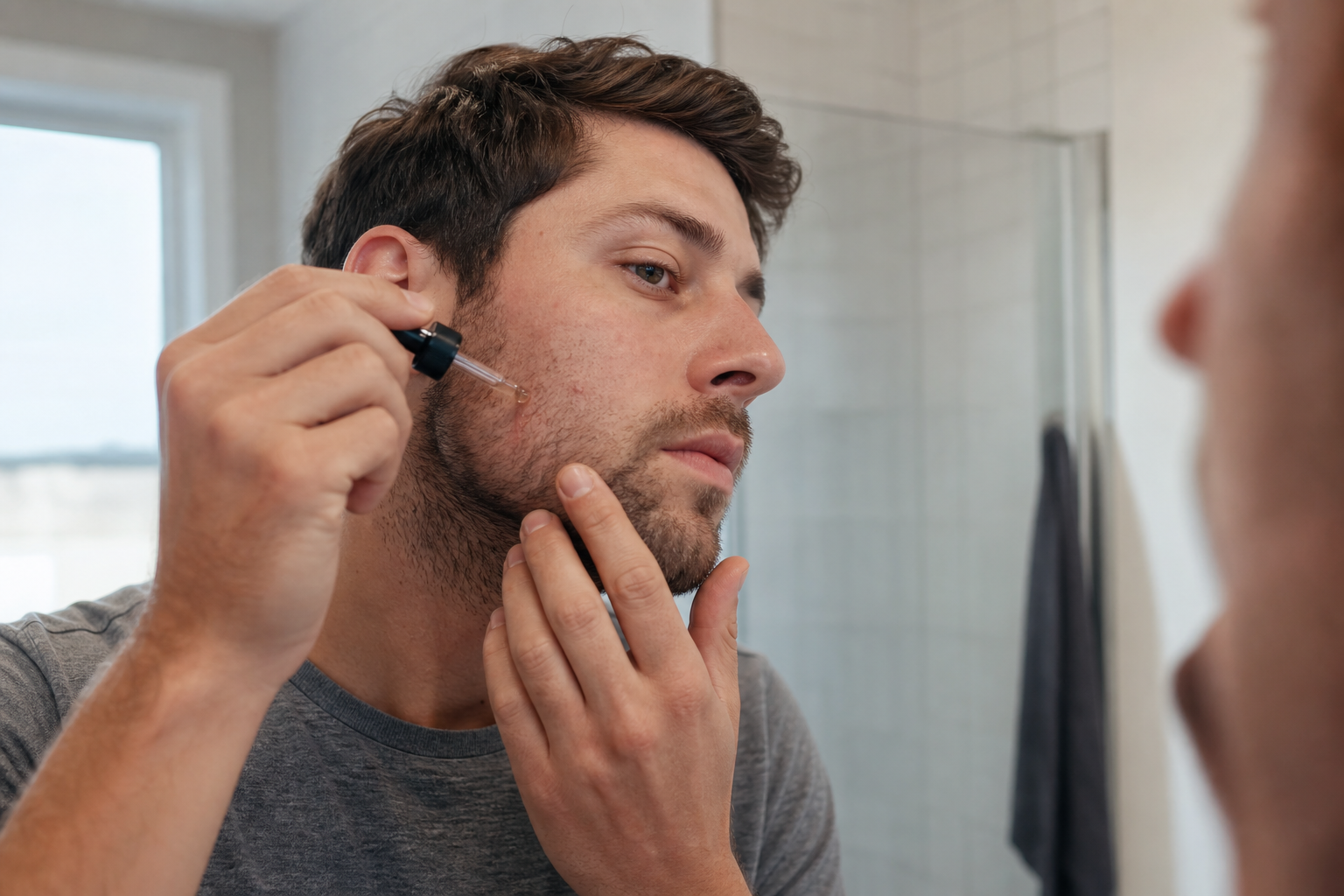
Minoxidil is the only beard growth product with clinical trials directly on the beard. It is a potassium channel opener that extends the growth phase of the beard follicles and boosts local blood flow. In two randomized, placebo-controlled trials, topical 3% minoxidil led to measurable thickening of the beard.
The study by Ingprasert et al. (2016, Journal of Dermatology) examined 48 men over 16 weeks. The photo score was significantly better with minoxidil than with placebo (p = 0.002), with mainly finer, non-terminal hairs appearing. The more recent study by Wattanawinitchai et al. (2026, Journal of Dermatological Treatment) found a gain of 11.16 hairs per cm² (p = 0.01) in 69 participants over 12 weeks, along with markedly higher satisfaction.
On usage: minoxidil is approved for the scalp in androgenetic alopecia, but its use on the beard is off-label, meaning outside the approved indication. It comes as a solution and as a foam, which often causes less skin irritation. The first effects can be expected after 3 to 4 months at the earliest, with a realistic result after 6 to 12 months. Please discuss specific amounts with a physician.
Important safety notes on minoxidil for the beard
- Higher absorption on the face: Facial skin is thinner and more vascularized than the scalp. Minoxidil is therefore absorbed more readily. Possible consequences include heart palpitations, a drop in blood pressure, or fluid retention. If you notice such symptoms, please see a physician immediately.
- Toxic to cats: Minoxidil is highly toxic to cats. In a review (ScienceDirect 2025), 14.7 percent of the documented poisoning cases were fatal, mostly through skin contact with users. Wash your hands thoroughly after applying it and keep cats away from your face until it has fully dried.
- No permanent result: After you stop using it, the effect often reverses. Skin irritation and dryness are also common.
Microneedling and the derma roller for the beard
Microneedling with a derma roller is considered a supporting method for the beard, especially combined with minoxidil. The fine microchannels boost blood flow and growth factors. The clinical data, however, come mainly from scalp hair, not the beard. Important: never use it on the same day as minoxidil.
Microneedling with a derma roller creates fine microchannels in the skin. These controlled micro-injuries stimulate wound healing: new collagen forms, growth factors are released, and microcirculation increases. The idea behind it is to activate dormant or weak beard follicles. Microneedling is considered a supporting method, especially combined with minoxidil.
The evidence here deserves an honest assessment. A meta-analysis (Archives of Dermatological Research, 2025) of 12 studies and 631 patients showed that microneedling plus minoxidil works significantly better than minoxidil alone. These data, however, come from the scalp, not the beard. Transferring them to the beard follicles is plausible, since the mechanism is likely the same, but it is not proven by dedicated beard studies.
A common follow-up question concerns the needle length of the derma roller, which is also a safety matter. As a rough guide:
- 0.25 to 0.5 mm: a superficial application meant mainly to support blood flow and the absorption of active ingredients.
- up to about 0.75 mm: additionally stimulates collagen formation but irritates the skin more noticeably.
- 1.0 mm and above: deep needles do not belong in self-treatment on the sensitive face. Without medical supervision, scarring and infections are a risk.
Caution: never apply minoxidil right after derma rolling
Microneedling massively increases the skin’s permeability. If minoxidil is applied right afterward, absorption rises from 4 to 13 percent in an ex-vivo study, roughly threefold. That means a higher risk of cardiovascular side effects. After derma rolling, wait at least 24 hours before you use minoxidil, and discuss the combined use with a physician.
Natural beard growth product: what do beard oil, vitamins, and home remedies achieve?
A natural beard growth product such as beard oil or castor oil conditions the beard but does not demonstrably stimulate new growth. That is the honest answer, one rarely heard in advertising. Beard oil smooths the stubble, reduces itching and flaking under the beard, and makes it supple. There is no evidence that it activates follicles or makes new hairs grow.
Castor oil is traditionally used as a home remedy. A review in the Journal of Drugs in Dermatology (2022), however, found no strong evidence of a growth effect. It conditions the hair shaft, nothing more. Caffeine serums are convincing only on scalp hair too: the study by Dhurat et al. (2017) showed an effect comparable to minoxidil in androgenetic alopecia, but not on the beard.
Does peppermint oil help beard growth?
Peppermint oil is often marketed as a natural minoxidil alternative, but a reliable beard growth effect is not proven. The entire hype rests on a single animal study (Oh et al. 2014) with only 3 to 5 mice per group over 4 weeks. No study on the human beard exists. Undiluted, peppermint oil can also irritate the skin. It is no substitute for a proven method.
What do biotin and vitamins achieve?
Biotin and vitamins help beard growth only if there is a genuine deficiency. The German Nutrition Society (DGE) cites an estimated value of 40 micrograms of biotin per day, and according to consumer advice the population is adequately supplied. Without a proven deficiency, taking them brings no additional effect. High doses of biotin can even distort lab results, for example for thyroid and cardiac markers. If a deficiency is suspected, a blood test clarifies the situation.
Lifestyle: supporting beard growth naturally
A healthy lifestyle can support beard growth naturally by optimizing the hormone balance and the supply to the follicles. It cannot, however, replace a missing genetic predisposition and does nothing for genuine bald patches. Anyone who already lives healthily should not expect miracles here. Four levers make sense.
- Sleep: Testosterone is released mainly at night. A study (JAMA 2011) showed that a week with only 5 hours of sleep lowered the testosterone level of young men by 10 to 15 percent. Seven to nine hours are considered ideal.
- Strength training: Moderate training can raise testosterone short-term by 15 to 20 percent and lowers the stress hormone cortisol. For the beard, this only works if the follicles are present.
- Nutrition: A zinc deficiency lowers testosterone and weakens follicles. Enough protein (about 0.8 to 1.0 grams per kilogram of body weight, DGE) provides the building blocks for the keratin in beard hair.
- Quitting smoking: Smoking worsens the skin’s microcirculation, so follicles are supplied less well. Chronic stress acts similarly through elevated cortisol.
Why does the beard grow (or not)? Genetics, DHT, and hormones
How densely the beard grows is determined mainly by genetics and the androgen hormone DHT (dihydrotestosterone). DHT is formed from testosterone via the enzyme 5-alpha-reductase and binds to the androgen receptors of the beard follicles with roughly fivefold higher affinity than testosterone. It extends their growth phase and makes the beard hair stronger.
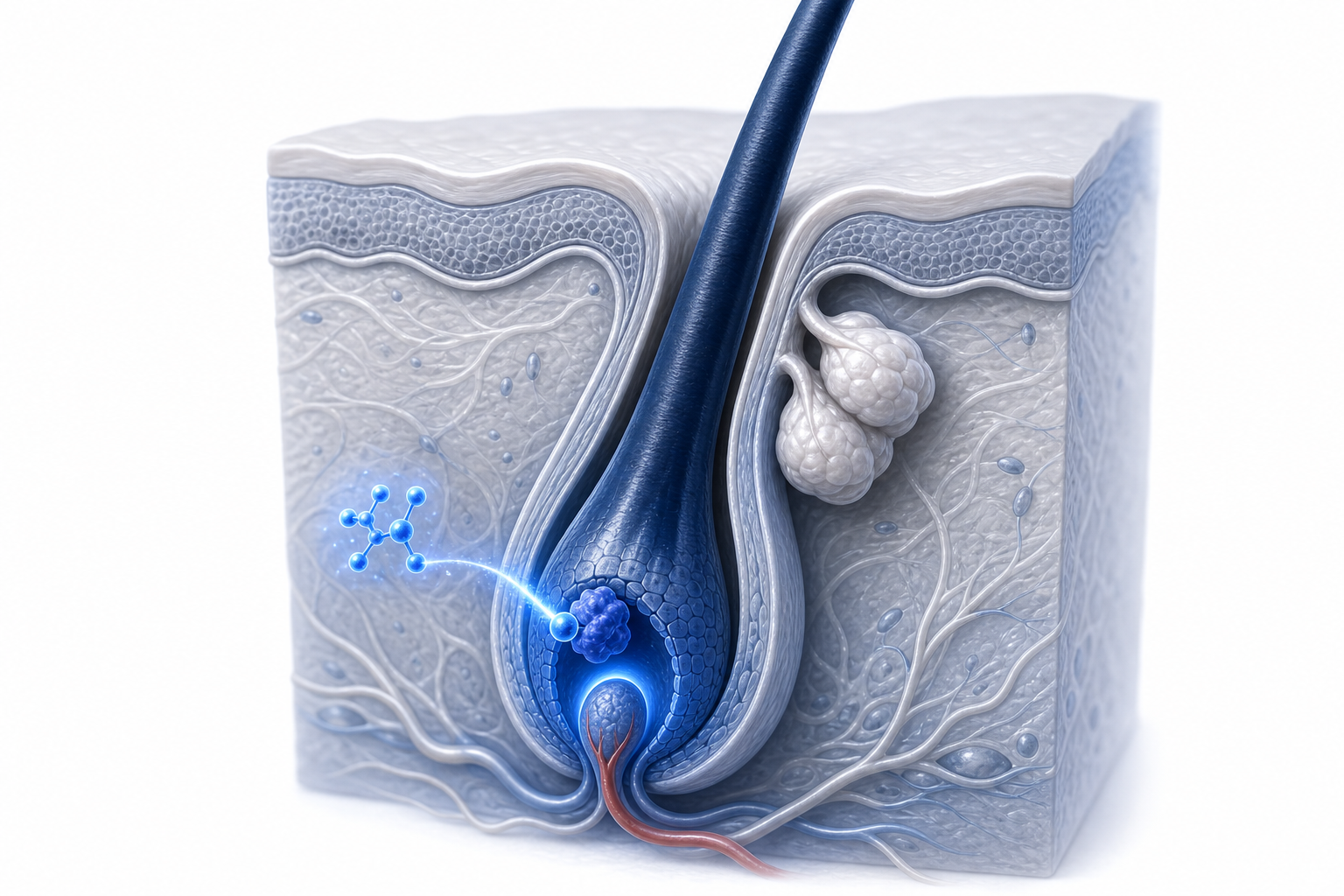
The androgen paradox is intriguing: the very same DHT that makes the beard grow weakens genetically sensitive scalp hair and drives androgenetic alopecia. Beard and scalp follicles therefore react in opposite ways to the same hormone. In the skin, mainly 5-alpha-reductase type 1 is at work, while on the scalp it is more often type 2.
What is decisive, though, is not the hormone level alone but the genetically fixed number of follicles and the sensitivity of the receptors. Some men carry a dense beard with low testosterone, others barely any with a high level. Ethnicity also influences follicle density and receptor activity. A healthy man with normal testosterone does not get a denser beard from so-called testosterone boosters.
At what age is beard growth fully developed?
Beard growth often matures late. The first fuzz on the upper lip appears at about 12 to 15 years of age, with stronger development at 16 to 20. Many men do not reach full maturity until between 23 and 30. Anyone under 25 with a patchy beard can often still experience considerable natural thickening, with no products at all.
Why does my beard grow asymmetrically or denser on one side?
Asymmetric beard growth, with one side denser than the other, is almost always normal and not a sign of disease. The causes are genetically different follicle densities on each side of the face, sleeping position with pressure on the side you sleep on, and slightly differing blood flow. Only when a gap appears suddenly and sharply defined should you have alopecia areata checked out (more on this below).
Beard hair goes through the same phases as scalp hair: growth (anagen), transition (catagen), and rest (telogen). The anagen phase of the beard lasts about 2 to 6 years. How this hair growth cycle works explains why every growth method takes months.
Myth check: what do shaving, garlic, and the like achieve?
Stubborn myths persist around beard growth, none of which bring real growth. The most common are shaving, onion or garlic juice, and castor oil. Here is the sober assessment, myth by myth.
Myth: shaving stimulates beard growth
Shaving does not stimulate beard growth. A study back in 1928 already disproved this, and nothing has changed since. The blade cuts the hair shaft at its thickest point, so the blunt cut edge looks visually darker and more angular. Speed, density, and follicle count stay the same. The stubble only feels coarser.
Myth: onion or garlic juice on beard gaps
Onion or garlic juice has no proven effect on healthy beard growth. The often-cited study (Sharquie 2002) tested onion juice on the scalp in alopecia areata, not on healthy beard follicles. That cannot be transferred. Instead, the diallyl disulfide it contains can cause skin irritation and contact eczema. This home remedy is widespread in Turkish and Arab communities, but it remains unproven.
Myth: castor oil makes the beard grow
Castor oil does not make the beard grow. No clinical study proves a growth effect, and the review in the Journal of Drugs in Dermatology (2022) also found no strong evidence. What remains is a conditioning effect: the hair shaft becomes suppler and shinier. No biological extra growth results from it.
Thickening the beard: filling gaps, what works and what doesn’t
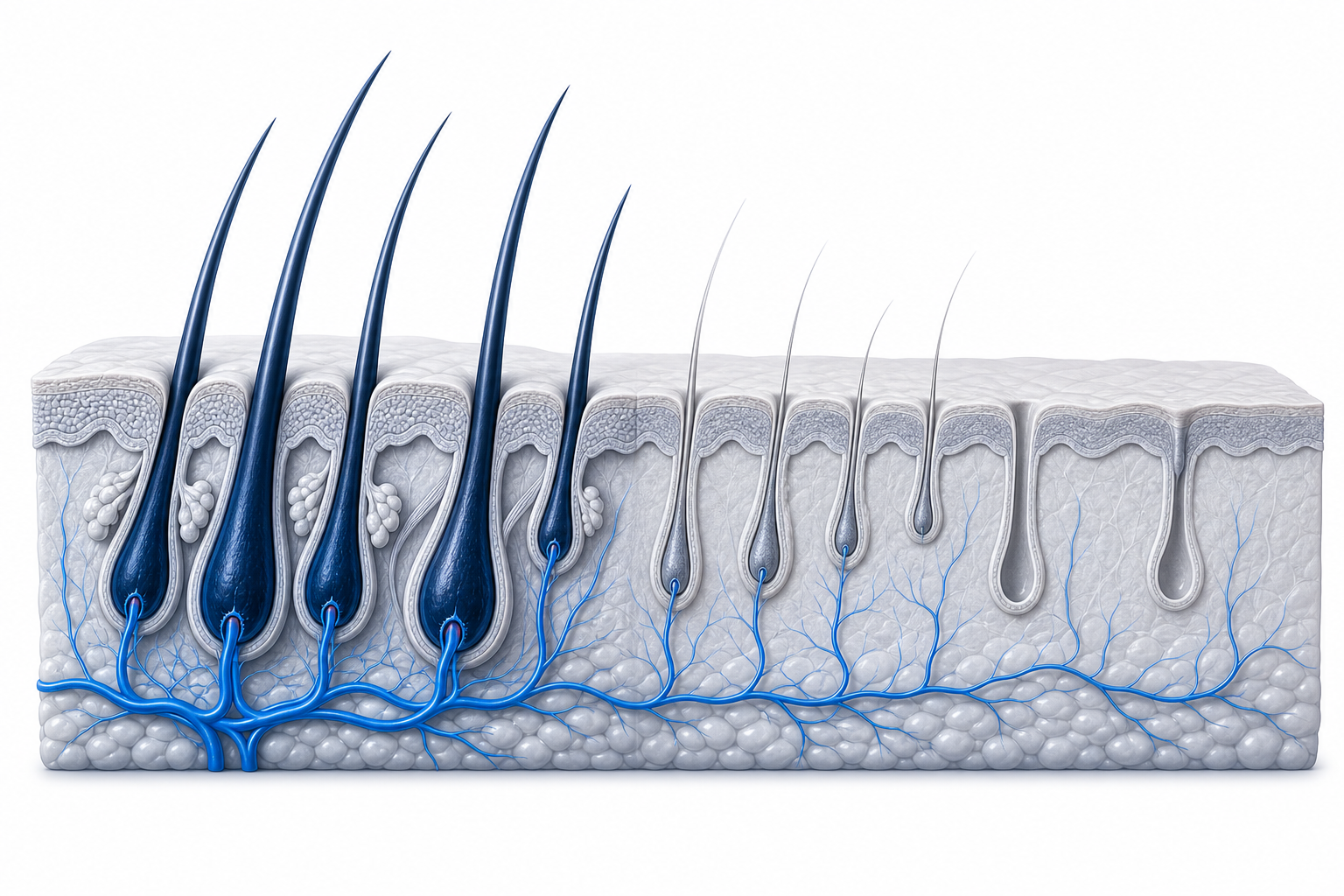
A beard can be thickened with products only where weak follicles are present. Genuine bald patches, whether genetic or from a scar, can only be made permanently dense by a beard hair transplant. So the first step is to honestly distinguish two cases before you spend money on a beard-thickening product.
Case A: The beard grows everywhere but thin. You see fine, light vellus hairs across the whole zone. Here follicles are present, just weak. Minoxidil, microneedling, lifestyle, and patience can thicken it over 3 to 12 months. Case B: There are completely smooth, bald patches without any fuzz. No follicles sit there that a product could activate. No topical beard growth product will help here.
| Your situation | Likely finding | Sensible path |
|---|---|---|
| Beard grows everywhere but thin and slow | Weak, existing follicles | Minoxidil (off-label) + lifestyle + patience (3 to 12 months) |
| Under 25, patchy, only recently | Beard still maturing | Wait until about 25, optimize lifestyle |
| Isolated gaps from the start, no fuzz | Genetically missing follicles | Products do nothing, consider a beard hair transplant |
| Sudden, round, sharply defined bald patch | Possible alopecia areata barbae | No products, no surgery, see a dermatologist right away |
| Scar in the beard area | Scarred follicle zone | After healing, consider a beard hair transplant |
| Over 30, beard fully mature, still gaps | Genetically determined gaps | Products usually ineffective, a transplant is an option |
Unsure whether follicles are still there?
The key is the distinction between Case A and Case B: if you still see fine vellus hairs in the patchy zone, a trial with minoxidil and patience is often worthwhile. If the patches are completely smooth, there are usually no follicles left there that a product could activate. This optical pattern analysis can be done from a photo and clarifies whether products have any chance for you at all, before you invest money.
When you should see a dermatologist: alopecia areata barbae
A sudden, round, sharply defined bald patch with smooth skin is not a grooming or genetics matter but possibly patchy hair loss of the beard zone (alopecia areata barbae). This is an autoimmune disease in which the immune system attacks the follicles. The current AWMF S3 guideline (register 013-104, published February 2026) calls for medical therapies for it, not over-the-counter products. A beard hair transplant is contraindicated during the active disease, because the immune system would attack the transplanted follicles too. Please have this evaluated by a dermatologist.
Having the beard thickened: the beard hair transplant
Anyone who wants to close genuine gaps permanently can have the beard thickened: in a beard hair transplant, your own genetically permanent hair follicles are relocated from the back of the head into the beard zone. These follicles are insensitive to DHT and keep growing for life once they have settled in. That is why the result is permanent.

The procedure combines two steps: in a beard hair transplant, the follicles are extracted individually from the donor area by FUE (Follicular Unit Extraction) and placed by DHI (Direct Hair Implantation) using the Choi implanter pen. The DHI technique allows precise control of angle and direction, which is decisive for a natural-looking beard.
Beard hair grows very flat, at about 10 to 15 degrees to the skin surface, much flatter than scalp hair (30 to 45 degrees). For the edges, single grafts with just one hair are used predominantly, so the transition looks natural. A typical case involves 1,000 to 3,000 grafts, depending on the area and the desired density. The procedure is done on an outpatient basis.
One should stay honest about scars: FUE extraction leaves pinpoint micro-scars in the donor area that are nearly invisible with normal hair. So it is not zero scars, but there are no visible lines. For very young men in their early 20s, the rule is: your own beard hair can still change, the transplanted hair stays. It is often sensible to wait for natural maturation.
A note from clinical practice
During consultations, men who have tried beard oils and home remedies for months often turn out to have had no follicles genetically present in the gaps at all. Grooming makes sense, but no product can grow a hair where there is no follicle. Where there really are gaps without follicles, relocating your own follicles from the back of the head is the only permanent path. Whether the beard zone offers enough of your own donor hair for a natural result is best clarified in a free analysis.
How long does it take? A realistic beard growth timeline
Whichever path you choose: beard growth takes patience. Beard growth products show their first effects after 3 to 4 months at the earliest, and the full result sets in after about 12 months, the same after a transplant. Beard hair grows only about 0.3 to 0.5 millimeters per day. The timeline below contrasts the course with a product and after a transplant.
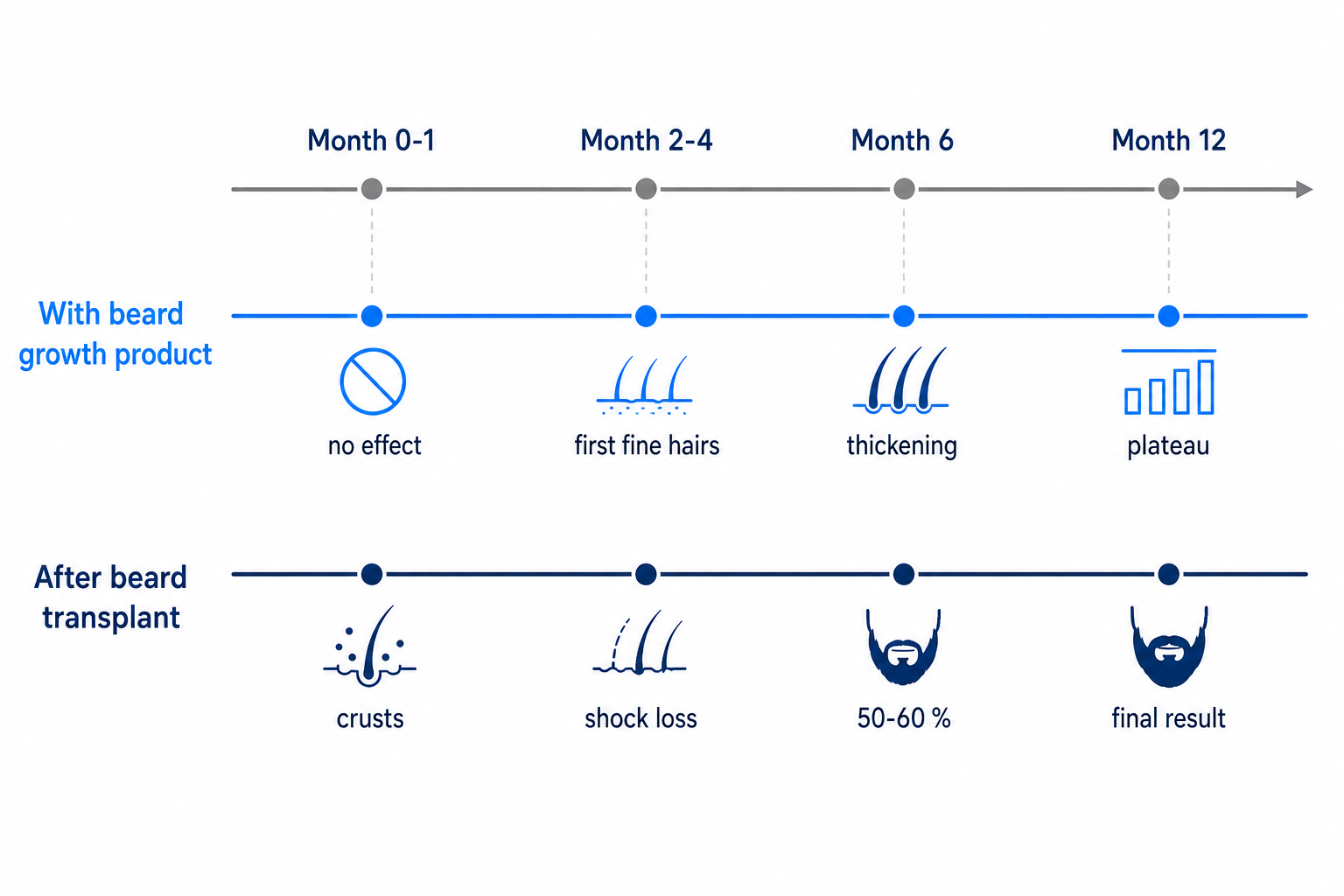
| Point in time | With a beard growth product (e.g. minoxidil, off-label) | After a beard hair transplant |
|---|---|---|
| Month 0 to 1 | Application begins, no visible effect yet, patience | Crusts on days 1 to 3, redness fades in 1 to 2 weeks |
| Month 2 to 4 | First finer hairs possible, if the follicles respond | Shock loss in weeks 2 to 6 (normal), first new hairs from month 3 to 4 |
| Month 6 | Visible thickening with responsive follicles | About 50 to 60 percent of the final result visible |
| Month 12 | Plateau reached, reversal possible after stopping | Full, permanent final result |
The difference is fundamental. Minoxidil extends the growth phase, so it only holds the hairs as long as you keep using it. With a transplant, the shock loss in weeks 2 to 6 is completely normal: the transplanted hairs fall out, but the follicles stay vital and start a new growth phase. That is why the final result is permanent.
Frequently asked questions about stimulating beard growth
How can you stimulate beard growth?
Stimulating beard growth only works where follicles are present. Minoxidil (off-label) has the best evidence, microneedling acts as a support, and sleep, nutrition, and exercise optimize existing follicles. Genuine bald gaps can only be made dense with a beard hair transplant.
What is the best beard growth product?
The best beard growth product with real evidence is minoxidil. Two randomized trials (Ingprasert 2016, Wattanawinitchai 2026) show measurable beard thickening. Use on the beard is off-label, so consulting a physician is advisable.
Is there a natural beard growth product that really works?
No. Beard oil, castor oil, and peppermint oil show no proven growth effect on the human beard. Peppermint oil rests on only a mouse study. What does help naturally is a healthy lifestyle with good sleep, balanced nutrition, and exercise, provided follicles are present.
Does a derma roller or microneedling help the beard?
Microneedling is considered supportive, especially together with minoxidil. Most of the data, though, come from scalp hair. Important: never apply minoxidil right before or after derma rolling; wait at least 24 hours, since skin absorption otherwise rises sharply.
Does peppermint oil help beard growth?
Not reliably. The hype is based on a single mouse study (Oh et al. 2014), and human evidence on the beard is lacking. Undiluted, peppermint oil can irritate the skin. It is no substitute for a proven method.
Why does my beard grow asymmetrically or denser on one side?
This is almost always normal and not a sign of disease. The causes are genetically different follicle densities on each side of the face, sleeping position, and slightly differing blood flow. Only a sudden, sharply defined bald patch should be checked by a physician.
Does shaving help beard growth?
No, that is a myth that was already disproved in 1928. Shaving changes neither speed nor density. The blunt cut edge only makes the stubble look more angular and darker.
Can a patchy beard be thickened?
Yes. Where weak follicles are present, you can thicken it with minoxidil and lifestyle. Where follicles are entirely missing, the beard can only be permanently thickened by a beard hair transplant (FUE + DHI), in which your own follicles are relocated from the back of the head.
What does it cost to have the beard thickened?
The cost depends heavily on the number of grafts needed (typically 1,000 to 3,000) and the clinic. A sensible first step is a free beard analysis, which clarifies whether enough of your own donor hair is available for a natural result.
Up to what age does the beard still grow?
Most men reach full maturity between 23 and 30. Anyone under 25 with a patchy beard should wait at first, since natural thickening often still sets in.
How long does it take for a beard growth product to work?
With minoxidil, the first changes can be expected after 3 to 4 months at the earliest, and the full effect after 6 to 12 months. Beard growth requires patience in general.
Sources
- Ingprasert S. et al. (2016): Minoxidil 3% lotion for beard enhancement, randomized trial. Journal of Dermatology 43(8). PubMed
- Wattanawinitchai K. et al. (2026): Topical 3% minoxidil for facial hair enhancement, randomized trial. Journal of Dermatological Treatment. PubMed
- Microneedling + minoxidil meta-analysis (2025), 12 studies, 631 patients. Archives of Dermatological Research. PMC
- Oh J.Y. et al. (2014): Peppermint Oil Promotes Hair Growth (animal study). Toxicological Research 30(4). PubMed
- Dhurat R. et al. (2017): Caffeine-Based Topical Liquid versus Minoxidil 5% (scalp). Skin Pharmacology and Physiology. PubMed
- Minoxidil toxicity in cats, scoping review (2025), 14.7% mortality. ScienceDirect. ScienceDirect
- AWMF S3 guideline on alopecia areata (2026), register 013-104. AWMF register
- Verbraucherzentrale: Biotin for skin, hair, and nails. Verbraucherzentrale
As of 2026. This article is for information and does not replace medical advice. Minoxidil is off-label on the beard, and its use should be supervised by a physician. For sudden, patchy hair loss in the beard, please consult a dermatologist.

Dr. Imad Moustafa
Hair transplant specialist