



Hair transplant surgeries are the only long term effective solution to hair loss, being performed on thousands of people a year. The increasing popularity of the procedure means that more and more people are interested in finding out if they are eligible. One of the central factors to suitability for a hair transplant is age, so here we will look at how it impacts your procedure and what is the best hair transplant age.
When it comes to hair transplants and age, most questions revolve around two extremes: am I too young at 20, and am I already too old at 60? The honest answer surprises a lot of people. Your age on paper matters far less than you would think. What counts more is how stable your hair loss is and what condition the donor area is in.
In short
There is no statutory minimum or maximum age for a hair transplant. What decides it is not your age on paper but whether genetic hair loss has become stable enough and whether the donor area at the back of the head can be planned reliably. That is settled by an individual medical assessment, not by a fixed number.
- When it makes sense: once the pattern of hair loss is clearly visible and has settled, which in practice usually means from the mid to late twenties. Surgeons themselves set a median minimum age of 23 (ISHRS 2025).
- Being too young is the real risk: at 18 to 22 there is no way to tell how far the loss will go. An international expert consensus recommends at least 6 months of medically supervised treatment for anyone under 30 before surgery.
- Barely any upper limit: a hair transplant is still possible at 60 or 70, as long as your general health is stable and there is enough donor hair available.
Summary
- When does a hair transplant make sense?
- Is there a minimum age for a hair transplant?
- Hair transplant at 20: why being young is the real risk
- How do I bridge the time until a hair transplant?
- The ideal age for a hair transplant: why there is no fixed number
- Hair transplants by age group: twenties, thirties, forties, 50+, 60+
- Is there an upper age limit for a hair transplant?
- How the right timing is determined: the hair analysis as a filter for age and suitability
- Does age affect the result of a hair transplant?
- After the transplant: what if the hair loss carries on?
- Frequently asked questions about hair transplants and age
- Sources
When does a hair transplant make sense?
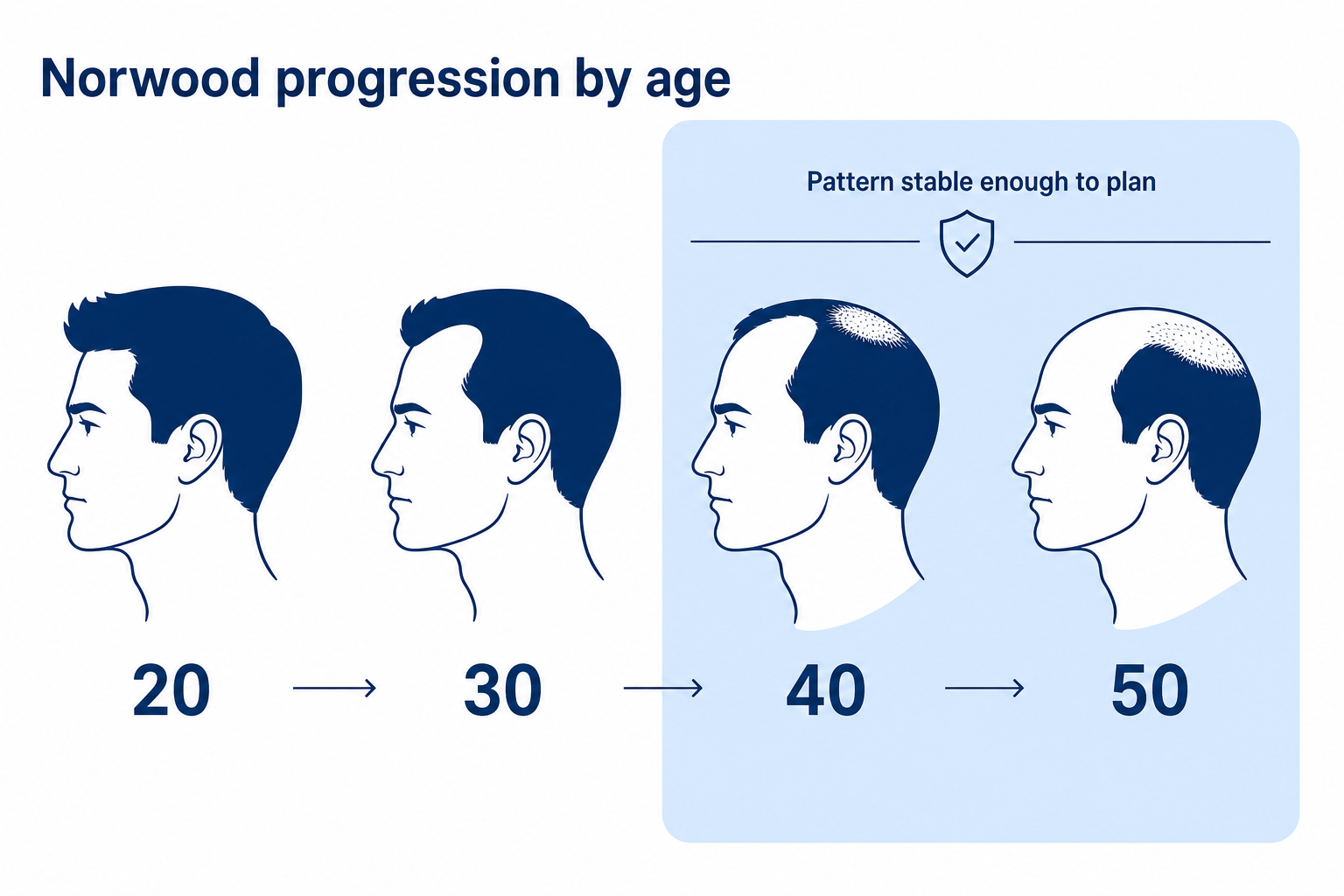
A hair transplant makes sense from the point at which the pattern of hair loss is clearly recognisable and the loss has either slowed down or been stabilised under medical supervision. In practice, that window usually opens in the mid to late twenties. So the question of when to have a hair transplant is really about how far the hair loss has matured, not about your year of birth alone.
The reason is straightforward: a hair transplant only moves existing hair around, it does not stop the ongoing loss in the surrounding native hair. So you first need to know where things are heading. Anyone who has surgery too early is planning around a moving target.
The most solid figure on this comes from an international expert consensus published in 2023 (Meyer-González, Silyuk et al., Delphi process with 38 specialists from 17 countries, Journal of Dermatological Treatment): in patients under 30 with genetic hair loss, at least 6 months of medically supervised observation or treatment should take place before a transplant, to confirm that the loss has stabilised.
Is there a minimum age for a hair transplant?
No law sets a minimum age specifically for hair transplant surgery. From the age of 18 you are legally an adult and can consent to the procedure yourself. There is, however, a medically sensible minimum age, and it sits well above the age of majority.
The important thing is to keep the two apart: being of age is the legal requirement, not the medical one. Medical-law commentary makes the same point: the capacity to give informed consent rests on an individual’s understanding and judgement rather than on a rigid age threshold. Fixed numbers only govern who can legally enter into the treatment contract.
Why 18 is medically too early: in late puberty and the early twenties, androgenetic alopecia (genetic hair loss triggered by the hormone DHT) is often only just getting going. The final pattern cannot yet be predicted. The European S3 guideline (Kanti et al. 2018) states that up to 80 per cent of men are affected over the course of their lives, with onset frequently as early as puberty.
Instead of a rigid cut-off, reputable clinics assess each case individually: how stable the progression is, the family history, the donor area and the patient’s expectations. The ISHRS Practice Census 2025 shows just how common minimum ages are: around three quarters of the surgeons surveyed set one of their own, with a median of 23 years (range 17 to 30).
Hair transplant at 20: why being young is the real risk
A hair transplant at 20 is medically premature in most cases, because at that age the hair loss is still actively progressing and nobody can predict how far it will go. That is exactly where the biggest risk of operating too early lies. It is not age itself that is dangerous, it is the lack of predictability.
The basis of that uncertainty is the Norwood-Hamilton scale, which since the work of Hamilton (1951) and Norwood (1975) has divided male hair loss into seven stages. At 20, the eventual stage (Norwood III to VII) is simply not yet settled. Three concrete dangers follow from this:
- Norwood progression cannot be predicted at 20. You are transplanting into an area that will keep changing over the coming years. Where hair will be missing in the end cannot be pinned down reliably.
- The island effect makes the result look unnatural. If the loss carries on after surgery, the transplanted hairline stays where it is while the hair around it thins out. The result is an isolated patch of hair with a bald rim.
- The donor area is used up too soon. Donor hair at the back of the head is limited and does not grow back. Anyone who puts it into the front line at 20 may not have enough left later on for loss that keeps progressing.
What is the island effect?
The island effect is a phenomenon described by surgeons, not an officially classified syndrome. If the native hair around a transplant that was done too early keeps falling out, only the transplanted area remains, looking like an isolated island of hair with a bald rim. Clinical observations report that it often only becomes visible after several years, once the surrounding area recedes.
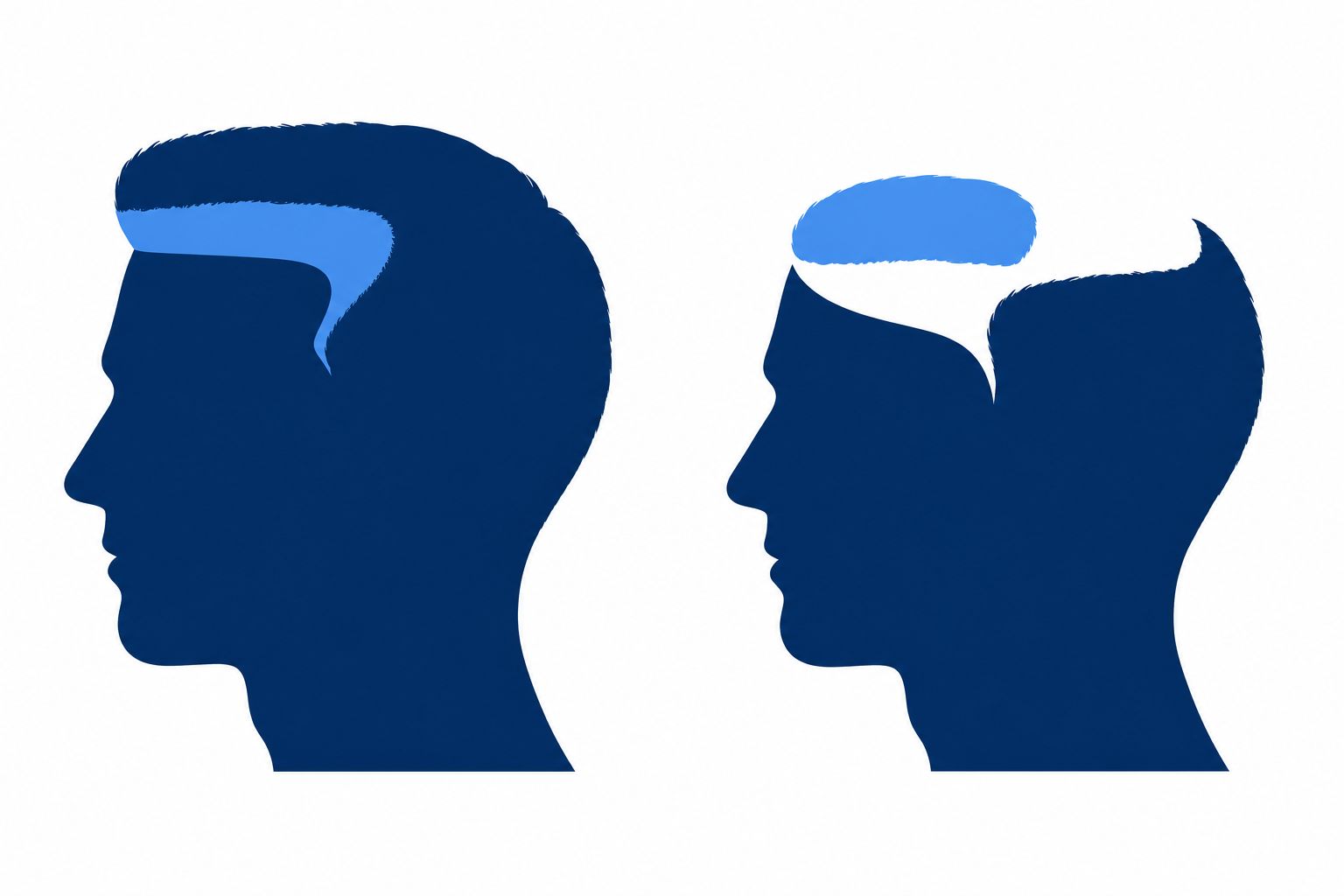
| Risk of a transplant done too early | Why it happens | Consequence |
|---|---|---|
| Island effect | surrounding hair keeps falling out after surgery | transplanted patch with a bald rim, looks unnatural |
| Hairline set too low | a youthful line no longer suits the face later on | looks out of place at 40, hard to correct |
| Donor area used up | limited donor hair that never grows back is spent too soon | no reserve hair left for later loss |
| Pattern misjudged | the final stage cannot be foreseen at 20 | follow-up transplants needed, higher total cost |
This is why reputable clinics often advise young patients to wait and get a proper medical assessment rather than going straight into surgery.
Can you fill in receding temples at 20 if the rest is still dense?
That is the classic route to the island effect. The area that is dense today may recede over the next few years, leaving the filled-in temples standing in isolation in front of a fresh recession. So the rule holds: let the pattern settle first, then fill in where it counts. How a receding hairline develops is explained in the article on androgenetic alopecia.
Do I have to take medication before a hair transplant?
For young men, the responsible route is not immediate surgery but a treatment ladder: first the medical diagnosis, then a medical review of drug therapies, then monitoring how things progress, and only transplanting once the pattern has settled. Active ingredients such as finasteride or minoxidil belong in a doctor’s hands, not in self-medication.
To put it honestly: the finasteride licensing study (Kaufman et al. 1998) ran in men aged between 18 and 41. The drug can stabilise the surrounding hair, but it comes with a side-effect profile. So-called post-finasteride syndrome is scientifically disputed, though several medicines regulators (including the MHRA and AEMPS) take it seriously. For women of childbearing age, finasteride is contraindicated because of the risk of birth defects. All of this needs to be clarified with a doctor, not decided on your own.
The message for anyone thinking about a hair transplant at 20: the best first step is not surgery but a clean diagnosis. In young patients, it often takes a blood test to establish whether the cause is genetic hair loss or something else, such as diffuse shedding.
How do I bridge the time until a hair transplant?
If you are still too young for a hair transplant, or need to let the pattern settle first, doing nothing is not your only option. Until the right moment arrives, there are non-surgical routes that take the pressure off. They do not replace a transplant, but they can visibly bridge the wait.
The medical core remains medically supervised treatment: active ingredients such as finasteride or minoxidil can slow the loss and stabilise the hair you still have, but they belong in a doctor’s hands. Alongside that, some clinics offer procedures such as PRP therapy using your own blood, or mesotherapy. Whether they help in an individual case is for a doctor to assess, as a reliable effect has not been proven for everyone.
Two purely cosmetic routes with no medical risk help straight away: hair-building fibres (keratin fibres that visually fill in thin areas) and a haircut that works with you. A shorter, even cut often makes early hair loss far less noticeable than long strands that are thinning out.
The ideal age for a hair transplant: why there is no fixed number
The ideal age for a hair transplant is not a particular year but the point at which the hair loss is stable and the pattern can be planned. Experience shows that for many people this window falls between the early thirties and the late forties, though it can come considerably earlier or later.
That window matches the figures from the ISHRS Practice Census 2025: more than half of male surgical patients (58.7 per cent) and of female patients (54.0 per cent) are between 30 and 49 years old. In 2024, 95 per cent of first-time patients began their hair restoration between the ages of 20 and 35. That is a global industry trend, not a fixed professional rule.
The myth that younger is always better does not stand up in practice. Young skin does heal well, but predictability matters more. A 45-year-old with a stable pattern is a better candidate than a 22-year-old whose loss is still moving. That is why the medical assessment always looks at the individual case, not the year of birth.
Readiness check: am I ready for a hair transplant?
These six points cover the criteria that actually matter, rather than your age:
- ✓ My hair loss has barely changed over the past year, or it has been stabilised medically.
- ✓ My pattern of hair loss is clearly recognisable, not just a first, unclear thinning.
- ✓ My donor area at the back of the head is still dense, with no widespread loss there.
- ✓ I have realistic expectations: added density and a natural line, not teenage fullness.
- ✓ I am willing to keep protecting the surrounding hair medically if needed.
- ✓ My general health allows an outpatient procedure under local anaesthetic.
The more points that apply, the more likely the timing is right. Only a medical assessment gives you certainty, especially on the first three points.
Hair transplants by age group: twenties, thirties, forties, 50+, 60+
A hair transplant can make sense in any age group, but the focus of the assessment shifts. In your twenties it is about stability and restraint, in your thirties and forties about careful execution, and from 50 onwards increasingly about the donor-area budget and general health. The table below sets it out.
| Age group | Typical situation | Suitability | What matters |
|---|---|---|---|
| 18–24 | hair loss often only just started, pattern unstable | usually premature | diagnose first, stabilise medically, wait |
| 25–29 | pattern becoming recognisable | suitable in individual cases | demonstrate stability, conservative hairline |
| 30–39 | pattern usually recognisable, good healing | often a good window | medical supervision, use the donor area efficiently |
| 40–49 | pattern usually stable | well suited | realistic density, set priority zones |
| 50–59 | pattern stable, donor density possibly lower | usually well suited | age-appropriate design, adjust expectations |
| 60+ | no reason for exclusion | possible with good health | general health, medication, donor reserve |
A guide, not a diagnosis. Whether a hair transplant makes sense at your age is decided by a medical hair analysis in your individual case, not by a number of years.
A quick word on each stage of life. In your twenties the pattern is often still unstable, so waiting and stabilising come first. In your thirties a good window frequently opens, because the pattern is recognisable and the donor area is strong. In your forties the pattern is usually stable and easy to plan around.
From 50+ onwards, most patients are well suited provided they are in good health. The target density is adjusted to suit the age, because the donor area may have thinned. 60+ is no reason for exclusion either. What counts here is general health, medication (blood thinners, for example, which need medical clearance) and enough donor hair.
A short decision path
- Under 25? Is your hairline still actively changing? Yes: no surgery for now, but a medical assessment and a review of drug therapies. Stable: a transplant can be considered in your individual case, and the hair analysis clarifies the details.
- 25 or older with a stable pattern and a good donor area? Then you are a candidate in principle, and the medical assessment sets the timing and the scope.
Is there an upper age limit for a hair transplant?
There is no fixed upper age limit for a hair transplant. The procedure is still possible at 60 or 70, as long as your state of health is stable and there is enough donor hair at the back of the head. The ISHRS patient information on transplants beyond the age of 50 states that excellent results are the rule in older patients when health and the donor area are right.

Later in life it is not the calendar year that counts but four factors: general health and fitness for the procedure, wound healing (slightly slower, but usually not a problem), medication (blood thinners, NSAIDs and certain supplements such as vitamin E or ginkgo need medical clearance) plus the density and quality of the donor area.
One important special case: from around 50, an age-related diffuse thinning can also set in (senescent alopecia), which can affect even the otherwise DHT-resistant donor area. Suitable donor hair may then be lacking. It is not age but an exhausted donor area or a serious underlying condition that can rule out a transplant. The examination clarifies that.
One point that puts older patients in particular at ease: at Elithair, a team of doctors checks the scalp, blood circulation and density in advance, and for the anaesthetic there is a dedicated anaesthetist whose only job is to monitor your local anaesthetic. That keeps the procedure controlled even if you have a pre-existing circulatory condition.
Women: why some of the rules are different here
This article mainly describes male genetic hair loss following the Norwood pattern. In women, hair loss usually runs diffusely (the Ludwig pattern, Erich Ludwig 1977), often with the front hairline preserved. That makes the donor area harder to assess reliably, and hormonal or scarring causes have to be ruled out first. The logic of age and suitability therefore does not carry over directly. There is more on this in the article on hair loss in women.
How the right timing is determined: the hair analysis as a filter for age and suitability
Whether a hair transplant makes sense at your age cannot be read off your year of birth. It only becomes clear through a medical assessment of the stage of hair loss, how stable it is and the state of the donor area. That is exactly what the free hair analysis is for. It is the filter for age and suitability that turns the abstract question “does my age fit?” into a concrete answer.
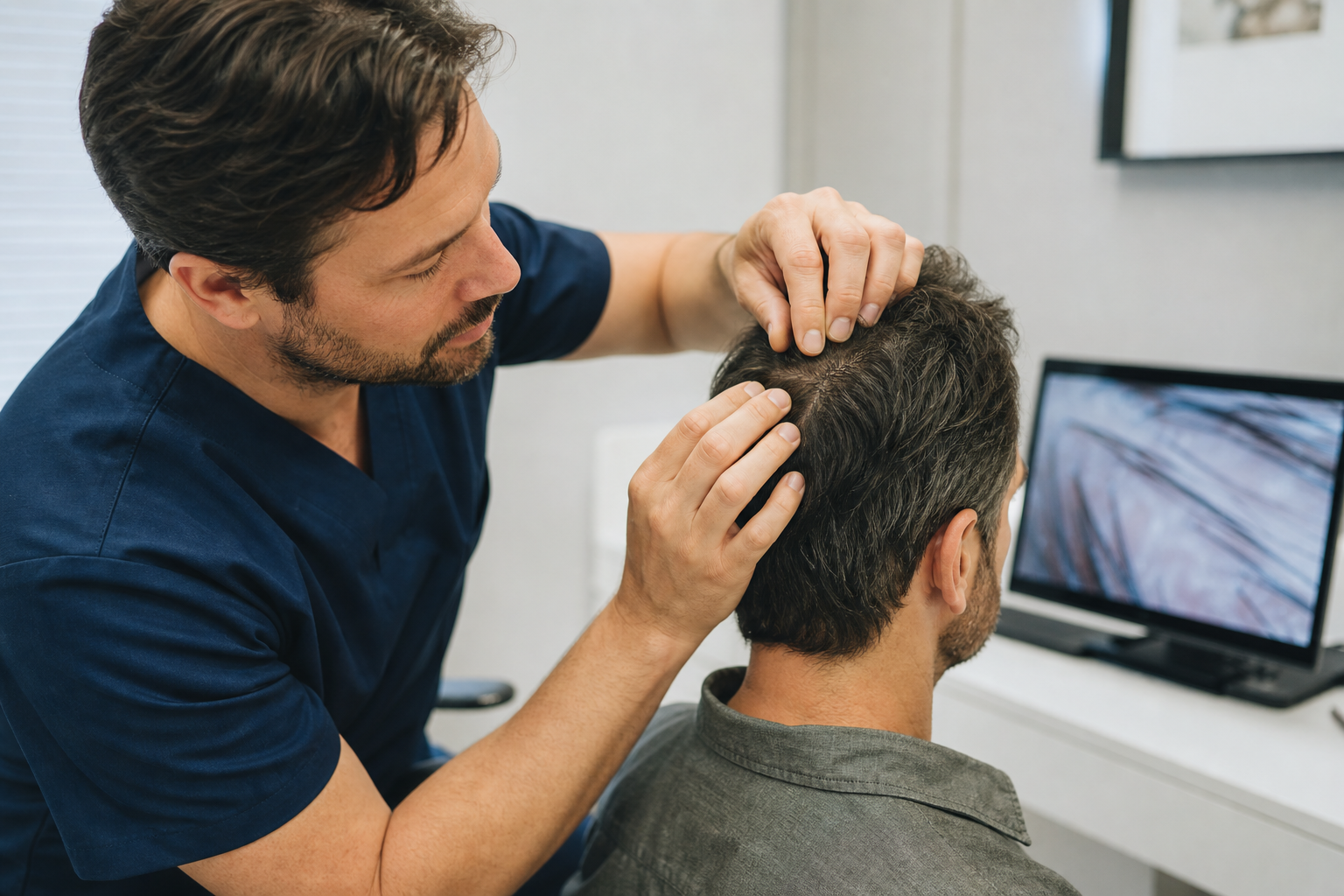
At Elithair, the Pre-Test System with its six analysis steps (blood count, blood circulation, scalp analysis, graft depth, hair structure and assessment of the donor area) clarifies exactly the questions that decide the timing: what stage the loss is at, whether it is still actively progressing, whether it should be stabilised medically first, and how much donor hair is available.
The blood test in the Pre-Test has a second purpose too: it checks whether genetic hair loss is present at all, or whether another cause is behind it (a deficiency or a hormonal disorder, for instance) for which a transplant would not be the right answer. Telling genetic loss apart from diffuse loss is the decisive first step, particularly in young patients.
A view from practice at Elithair
When it comes to age, we do not go by your date of birth but by how stable the hair loss is and what the donor area looks like. We often advise a 22-year-old with an unstable pattern to stabilise things first and wait. A healthy 65-year-old with a good donor area, on the other hand, gets a very good result. After the analysis we deliberately decline or postpone a considerable share of enquiries, especially from candidates who are too young. We only operate when the result will be good.
The most honest answer to the question of a hair transplant at 20 is often: not yet. The free hair analysis clarifies whether your age, the stability of your hair loss and your donor area make a hair transplant sensible now, later or not at all. No pressure to book, just a step towards clarity.
Does age affect the result of a hair transplant?
Age does not affect the growth rate of the transplanted hairs, it mainly affects the planning. Hair from the DHT-resistant donor area generally takes reliably at any age, provided the roots are extracted and implanted in good condition. There is no study evidence to the contrary.
What does change with age is limited, and worth spelling out plainly: younger skin tends to heal a little faster. In older patients the donor density is sometimes lower and the realistic target density is therefore lower too. And in younger patients the surrounding hair can keep falling out without medical supervision, which again concerns the planning, not whether the grafts take.
A word on the technique: at Elithair, extraction is carried out with FUE (using a micromotor, 0.6 to 0.8 mm) and implantation with DHI (using the Choi implanter pen). These are two steps of the same procedure, not competing alternatives. How natural the result looks is determined by the medical hairline design far more than by your age. A teenage hairline set too low on a 50-year-old would be the mistake, not the age.
After the transplant: what if the hair loss carries on?
The transplanted hairs stay, because they come from the DHT-resistant donor area. The native hair around them can keep falling out, though, especially in younger patients without medical supervision. That is why follow-up monitoring is part of good planning, and exactly why the right timing matters so much.
In practical terms that means planning a conservative hairline, budgeting a donor reserve for the future and having the surrounding hair medically assessed for stabilisation. The regrowth of the transplanted hairs follows a reliable timeline, which the table below sets out. That timeline applies largely regardless of age, and in older patients only the early wound healing may take marginally longer.
| Time | What happens |
|---|---|
| Day 1–3 | crusting, redness, mild swelling |
| Week 2 | the crusts come off |
| Week 2–6 | shock loss: the transplanted hair shafts fall out while the roots stay intact (normal) |
| Month 3–4 | the first fine new hairs appear |
| Month 6 | roughly 50 to 60 per cent of the growth is visible |
| Month 12 | full final result |
| Month 18 | maximum density |
This timeline also explains why a serious consultation talks about 6 to 9 months before you see a visible result, not weeks. How the underlying hair cycle works is covered in depth in a separate article.
Will I need a second hair transplant later if I start early?
Anyone who has a transplant very early tends to need a second or third procedure over the years, because the native hair loss carries on. There is no exact percentage for this, but the mechanism is not in dispute. A premature operation is therefore not only riskier medically, it can also work out more expensive over a lifetime, because touch-ups and additional grafts are needed.
The graft account: why donor hair is a budget
The donor area at the back of the head is a limited account that does not refill. Clinical sources give a rough guide of around 4,000 to 8,000 grafts that can be safely harvested over a lifetime, with 6,000 to 7,000 often cited as the practical upper limit. These are guide figures, not precisely evidenced numbers.
| Item | Effect on the graft account |
|---|---|
| Available donor hair (limited for life) | opening balance, never grows back |
| A low, youthful hairline at 20 | large withdrawal, often not recoverable |
| Loss that keeps progressing on the crown | needs a budget of its own later |
| Conservative, age-appropriate planning | a reserve stays available for the future |
Guide values, individual in each case. How much your account holds is measured by the medical hair analysis.
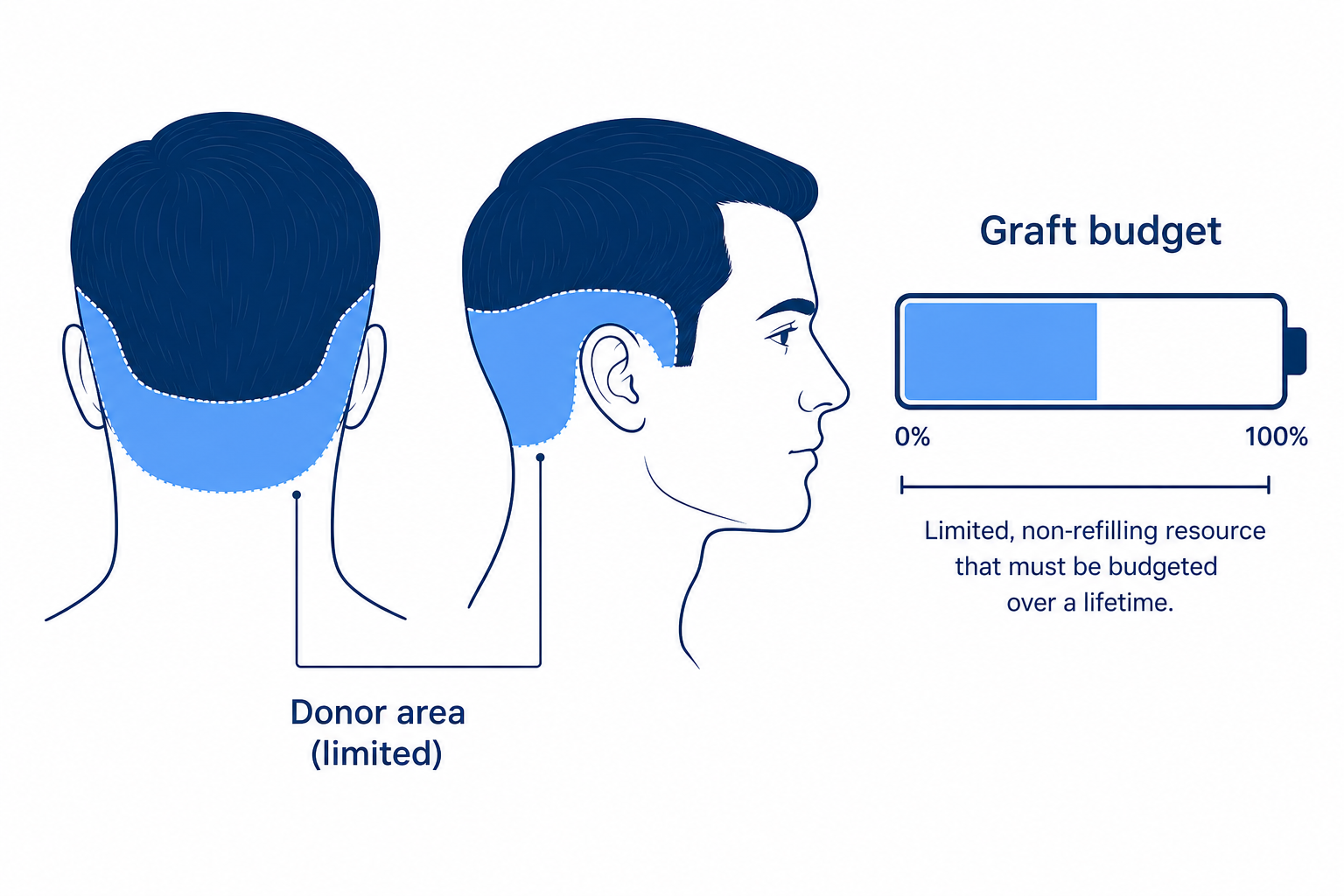
How many grafts a procedure needs depends on the Norwood stage. The guide below is the one Elithair uses internally. It shows why a procedure planned late and on a stable pattern protects the budget, while treatments started early and touched up several times use it up faster. Specific costs by scope can be found on our pricing page.
| Norwood stage | Grafts (guide value) | Area |
|---|---|---|
| NW 2 | 1,000–1,500 | mild temple recession |
| NW 3 | 1,500–3,000 | temples and hairline |
| NW 4 | 3,000–4,000 | mid-scalp |
| NW 5 | 3,500–4,500 | mid-scalp and crown |
| NW 6 | 5,000–6,000 | extensive area |
| NW 7 | 6,000+ | full restoration |
Elithair service note: 20-year guarantee
Elithair gives a 20-year guarantee on the transplanted grafts, provided the aftercare instructions are followed. A guarantee claim requires that enough grafts remain in the donor area and that the first operation was at least 12 months ago. The biological permanence of the transplanted hairs is a separate matter and is not a “lifetime guarantee”.
Frequently asked questions about hair transplants and age
At what age does a hair transplant make sense?
There is no fixed ideal age. A hair transplant starts to make sense once the hair loss is stable and the pattern is clearly recognisable, which in practice usually means from the mid to late twenties. For anyone under 30, an international expert consensus (2023) recommends at least 6 months of medically supervised observation beforehand.
Is there a minimum age for a hair transplant?
Legally, no: no law sets a minimum age specifically for hair transplants, and from 18 you can consent to the procedure as an adult. Medically, the threshold sits higher. According to the ISHRS Census 2025, surgeons set a median of 23 years, because the final pattern of hair loss is rarely settled before that.
Can you have a hair transplant at 18?
Legally yes, from the age of majority. Medically, 18 is almost always too early, because genetic hair loss is only just beginning and its final pattern is still open. The better first step at that age is a medical diagnosis plus waiting, not surgery.
Is a hair transplant at 20 too early?
Usually yes. At 20 the hair loss is often still actively progressing, so the final stage cannot be predicted. Anyone who has surgery anyway risks the island effect and uses up the limited donor area. The recommendation is to stabilise the progression medically first.
Why do clinics often turn young patients away?
Because the result can hardly be planned with any certainty while the loss is unstable. Responsible providers postpone surgery until the pattern has settled. After the analysis, Elithair deliberately postpones or declines a considerable share of enquiries from young patients rather than operating too early.
What is the island effect after a transplant done too early?
The island effect is a phenomenon described by surgeons, not a classified syndrome. If the native hair around the transplant keeps falling out after surgery, only the transplanted area remains and looks like an isolated island with a bald rim. It often only shows up after several years.
What is the ideal age for a hair transplant?
There is no fixed number. The ideal moment is when the pattern is stable and can be planned, which for many people falls between the early thirties and the late forties. Fittingly, ISHRS data shows that more than half of surgical patients are between 30 and 49 years old.
Can you still have a hair transplant at 60 or 70?
Yes. There is no fixed upper age limit. What matters is general health and a sufficient donor area, not your year of birth. According to the ISHRS, excellent results are the rule even in patients over 70. Blood thinners and other medication are reviewed with a doctor beforehand.
Does a hair transplant heal less well later in life?
Barely. Wound healing tends to be a little slower in older patients, but it is usually not a problem. More important than age are general health, the medication you take and the quality of the donor area.
Is the growth rate lower in older patients?
No. Hair from the DHT-resistant donor area generally takes regardless of age, provided the roots are extracted and implanted in good condition. Age mainly affects the planning and the realistic target density, not whether the grafts take.
Do I have to take medication before a hair transplant?
Not necessarily, but in younger patients especially, a medically reviewed treatment (finasteride or minoxidil, for instance) is often the first step towards stabilising the progression. That is decided by a doctor after a diagnosis, never through self-medication.
What helps against hair loss until a hair transplant makes sense?
To bridge the wait, medically supervised active ingredients (finasteride, minoxidil) work well, as do purely cosmetic options such as hair-building fibres and a suitable short haircut. Procedures such as PRP or mesotherapy should be assessed by a doctor. None of these options replaces a transplant, they bridge the waiting time.
How do I know whether my hair loss is stable enough?
One indicator: your hairline has barely changed over about a year, or it has been stabilised medically, and the pattern is clearly recognisable. Real certainty comes only from a medical hair analysis, though, not from your own assessment in the mirror.
Will I need a second hair transplant later if I start early?
Often yes. Anyone who has surgery early and with an unstable pattern tends to need a second or third procedure over the years, because the native hair loss carries on. That usually makes a premature operation more expensive over a lifetime.
Can you fill in receding temples at 20 if the rest is still dense?
Specialists usually advise against it. The area that is dense today may recede, leaving the filled-in temples standing in isolation in front of a fresh recession, the classic island effect. It is better to let the pattern settle first and then fill in where it counts.
Are finasteride and minoxidil an alternative to a hair transplant?
Only in part. They can slow the loss and stabilise the surrounding hair, but they do not transplant any hair. For young patients they are often the sensible first step before surgery. Their use and side effects need to be discussed with a doctor.
Do the same rules on age apply to women?
Not entirely. Female hair loss usually runs diffusely (the Ludwig pattern) rather than following the Norwood pattern, the donor area is often harder to assess reliably, and hormonal or scarring causes have to be ruled out first. Women therefore need an assessment of their own.
Sources
- Meyer-González T, Silyuk T, et al. (2023): An international expert consensus statement focusing on pre and post hair transplantation care. Journal of Dermatological Treatment. tandfonline.com
- ISHRS (2025): Practice Census Results. International Society of Hair Restoration Surgery. ishrs.org
- ISHRS: A Guide to Hair Transplantation After Age 50. ishrs.org
- Kanti V, Messenger A, Dobos G, et al. (2018): Evidence-based (S3) guideline for the treatment of androgenetic alopecia in women and in men. JEADV, PMID 29178529. pubmed.ncbi.nlm.nih.gov
- Kaufman KD, Olsen EA, Whiting D, et al. (1998): Finasteride in the treatment of men with androgenetic alopecia. J Am Acad Dermatol, PMID 9777765. pubmed.ncbi.nlm.nih.gov
- Deutsches Ärzteblatt: Legal guidance on treating minors (Recht: Worauf Ärzte bei der Behandlung Minderjähriger achten sollten). aerzteblatt.de
- StatPearls: Hair Transplantation. NIH/NCBI Bookshelf. ncbi.nlm.nih.gov
- FDA: PROPECIA (finasteride) prescribing information. accessdata.fda.gov
Last updated 2026. This article provides general information and is no substitute for medical advice, diagnosis or treatment. Whether and when a hair transplant makes sense in your case is determined by an individual medical examination.

Dr. Imad Moustafa
Hair transplant specialist