



Hair loss affects millions of people worldwide, with causes ranging from genetics, to health issues, to medical treatments like chemotherapy. While hair transplants have emerged as the ideal solution to chronic hair loss, the future could present a new form of treatment. In this article, we will be exploring the idea of hair banking; that is, the extraction and preservation of healthy hair follicles to be implanted at a later date.
Summary
- Could Hair Banking Work? A Glimpse into the Future
- Freezing Hair Follicles – A Realistic Option?
- Who Could Benefit from Hair Banking?
- Current Studies: How Advanced is Cryopreservation of Hair Follicles?
- Economic and Ethical Aspects of Hair Banking
- Comparison with Existing Treatment Options: Is Hair Banking Really the Better Choice?
- Conclusion: More Research Needed
Could Hair Banking Work? A Glimpse into the Future
The concept of hair banking is based on storing hair follicles (grafts) in a cryobank — similar to how human egg cells, blood, or stem cells are preserved. But how realistic is this approach, and what challenges need to be overcome?
In practice, a hair bank could function much like a blood or tissue bank:
- Extraction of Healthy Hair Follicles: Young, strong hair roots would be extracted in a clinic.
- Cryopreservation: The hair follicles would be frozen under strict laboratory conditions.
- Long-term Storage: The follicles would be preserved in a cryobank for years or even decades.
- Reuse When Needed: Once hair loss occurs or a transplant is desired, the follicles would be thawed and implanted.
But is this really feasible? While tissue preservation techniques have made significant progress in recent years, a functional hair bank is still outside of the realms of possibility for now. However, with further research, it could one day become a reality.
Freezing Hair Follicles – A Realistic Option?
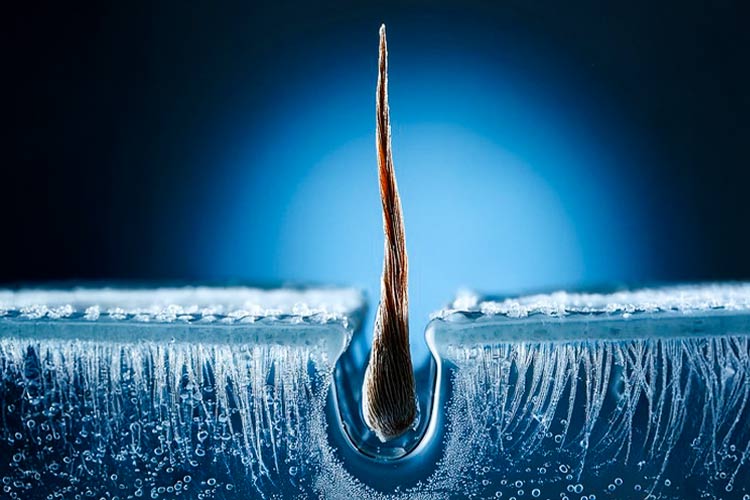
Grafts are complex biological structures made up of multiple cell types which go through a delicate growth phase. To use them for a future hair transplant, they would need to remain alive and functional. Herein lies the biggest challenge:
- Cell Survival After Freezing: While other cell types, such as eggs or blood stem cells, can be successfully cryopreserved, long-term storage of hair follicles is not yet established. Follicles are sensitive to ice crystals that could damage their structure.
- Required Conditions: Research indicates that cryopreservation at temperatures around -196°C, as used for stem cells, would be necessary to maintain cell activity in the long term. However, it’s still unclear if hair follicles can survive these extreme conditions intact.
- Reviving Follicles: Even if grafts could be frozen successfully, a method would need to be developed to restore them to a functional state after thawing. Current studies are exploring whether special cryoprotectants — substances that prevent cold damage — could improve cell survival.
- Preserving Growth Capability: A frozen follicle would not only need to survive but also enable sustainable hair growth after transplantation. As of now, no practical solutions exist for this issue.
Who Could Benefit from Hair Banking?
If hair banking becomes a reality, it could be particularly appealing to two groups:
- People with Genetic Predisposition to Hair Loss: Those who know they will suffer from androgenetic alopecia (hereditary hair loss) could extract and preserve healthy follicles early for a future transplant.
- Cancer Patients Before Chemotherapy: Chemotherapy often leads to temporary or permanent hair loss. Preserving healthy follicles in advance could offer a way to regain a full head of hair after treatment.
Current Studies: How Advanced is Cryopreservation of Hair Follicles?

Despite the promising concept of hair banking, research is still in its early stages. While cryopreservation of stem cells, eggs, and tissues is well-established, there are currently no comprehensive studies that demonstrate the long-term success of storing and reusing hair follicles.
Regenerative medicine is exploring methods to freeze and thaw grafts under specific conditions, but without a guarantee of growth capability. Research on the cryopreservation of plant cells by the Fraunhofer Institute for Molecular Biology and Applied Ecology (IME) could provide protocols for long-term storage of complex cell structures like hair follicles.
These advancements highlight that while a practical method for hair banking doesn’t exist yet, insights from related fields could pave the way for new approaches.
Economic and Ethical Aspects of Hair Banking
If hair banking becomes viable, questions of accessibility arise. Would it be available to everyone or only to a wealthy clientele? Setting up and operating cryobanks would require significant investment, likely resulting in high costs for patients.
Certain ethical questions remain unanswered too. For instance, who would maintain ownership of the frozen hair follicles in the long term? Would they permanently belong to the donor, or could they be used for research or even donated after a certain period?
There are also risks when it comes to possible broader commercialisation. It is possible that companies might exploit hair banking as a profitable business prematurely, before the technology has been adequately developed and studied, pressuring patients to store their hair without certainty of future success.
With the above issues in mind, clear regulations would be necessary to ensure transparency, fairness, and security for all parties involved.
Comparison with Existing Treatment Options: Is Hair Banking Really the Better Choice?
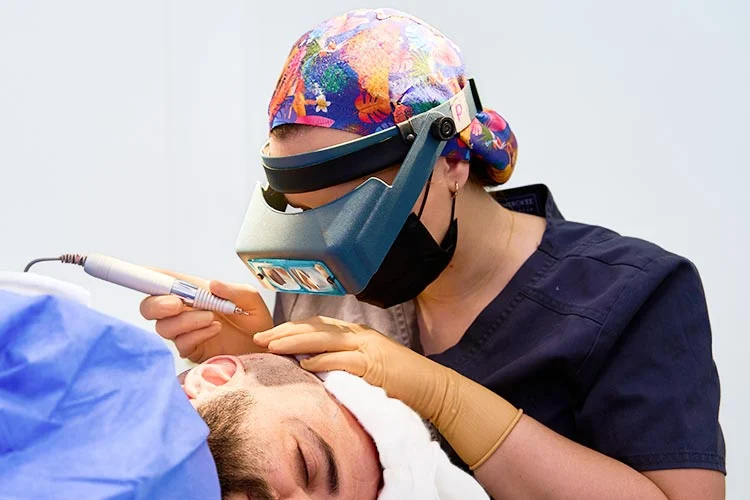
Hair transplants remain the most effective method to restore a full head of hair today. Modern techniques like FUE (Follicular Unit Extraction) and DHI (Direct Hair Implantation) ensure that hair follicles can be extracted and implanted with high success rates, delivering natural and lasting results.
In contrast, hair banking presents many uncertainties:
- Technical Challenges: The process is still in its infancy, with no guarantee of cell survival after thawing.
- Practicality: While hair transplants offer proven solutions today, hair banking is still a distant possibility.
For those already experiencing hair loss, a hair transplant remains the safest and most reliable option. To understand what the process involves, including the techniques, costs, and recovery journey, explore our comprehensive Hair Transplant Turkey Guide.
Conclusion: More Research Needed
Hair banking is a fascinating idea that could offer a new way to combat hair loss in the future. The thought of preserving your own hair follicles early on to use them later raises intriguing questions — both scientifically and ethically.
However, as of now, there are no proven methods to freeze and restore grafts successfully. Until research uncovers new possibilities, hair transplantation remains the best solution for achieving long-term hair restoration with natural results.
If you’re ready to regain a full head of hair, find out more about our hair transplant options today and take the first step towards renewed confidence!

Dr. Imad Moustafa
Hair transplant specialist